

Somehow, neuroscience is visible in art.
 |
Description
Book Introduction
Why we're drawn to simplicity
Why Color Moves Us
World-renowned Nobel Prize-winning neuroscientist
Eric Kandel on Neuroscience and Contemporary Art
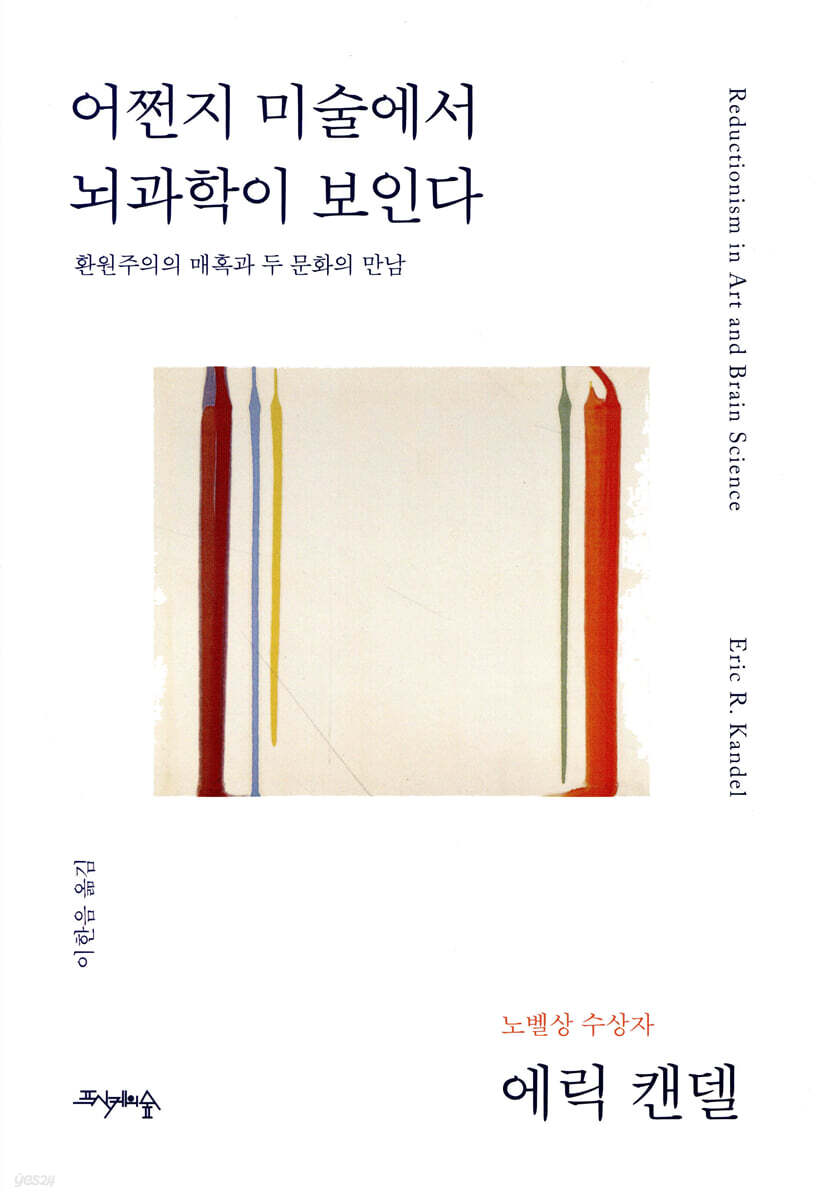
Eric Kandel, a renowned figure and genius in New York's intellectual world, has published his new book, "Somehow, Neuroscience Is Visible in Art."
In this book, Kandel deepens the connection between figurative art and brain science that he attempted in his previous work, and particularly attempts to integrate modern abstract expressionist art and brain science.
Beginning with William Turner, who stands at the pinnacle of the Abstract Expressionist lineage, the book moves through masterpieces of modern art, from Monet and Kandinsky to Pollock and Rothko, Warhol, and other minimalists, and meticulously delves into the intersection between these works and the exploration of brain science.
In the process, we gain a deeper understanding of the amazing properties and operating mechanisms of the human brain.
Why are we drawn to simple things?
Why do colors move us?
This book demonstrates without reservation that the questions of aesthetics are not so far removed from those of neuroscience, and that new insights await when these two great "cultures" illuminate each other.
Why Color Moves Us
World-renowned Nobel Prize-winning neuroscientist
Eric Kandel on Neuroscience and Contemporary Art
Eric Kandel, a renowned figure and genius in New York's intellectual world, has published his new book, "Somehow, Neuroscience Is Visible in Art."
In this book, Kandel deepens the connection between figurative art and brain science that he attempted in his previous work, and particularly attempts to integrate modern abstract expressionist art and brain science.
Beginning with William Turner, who stands at the pinnacle of the Abstract Expressionist lineage, the book moves through masterpieces of modern art, from Monet and Kandinsky to Pollock and Rothko, Warhol, and other minimalists, and meticulously delves into the intersection between these works and the exploration of brain science.
In the process, we gain a deeper understanding of the amazing properties and operating mechanisms of the human brain.
Why are we drawn to simple things?
Why do colors move us?
This book demonstrates without reservation that the questions of aesthetics are not so far removed from those of neuroscience, and that new insights await when these two great "cultures" illuminate each other.
- You can preview some of the book's contents.
Preview
index
introduction
Part 1: Two Cultures Encountered at the New York School
Chapter 1: The Emergence of the New York School of Abstract Art
Part 2: Neuroscience and Reductionism
Chapter 2: How We Respond to Art
Chapter 3: The Magic of Perception
Chapter 4: The Biology of Learning and Memory
Part 3: Art and Reductionism
Chapter 5: The Emergence of Abstract Art
Chapter 6: Mondrian's Radical Reduction
Chapter 7: Painters of the New York School
Chapter 8: How the Brain Processes Abstract Images
Chapter 9 Only Color
Chapter 10 Color and the Brain
Chapter 11: Focus on Light
Chapter 12: A New Wave of Conceptualization
Part 4: A Dialogue Between Abstract Art and Science
Chapter 13: Why Reductionism Succeeded in Art
Chapter 14: Return to Two Cultures
Acknowledgements
main
References
Search
Part 1: Two Cultures Encountered at the New York School
Chapter 1: The Emergence of the New York School of Abstract Art
Part 2: Neuroscience and Reductionism
Chapter 2: How We Respond to Art
Chapter 3: The Magic of Perception
Chapter 4: The Biology of Learning and Memory
Part 3: Art and Reductionism
Chapter 5: The Emergence of Abstract Art
Chapter 6: Mondrian's Radical Reduction
Chapter 7: Painters of the New York School
Chapter 8: How the Brain Processes Abstract Images
Chapter 9 Only Color
Chapter 10 Color and the Brain
Chapter 11: Focus on Light
Chapter 12: A New Wave of Conceptualization
Part 4: A Dialogue Between Abstract Art and Science
Chapter 13: Why Reductionism Succeeded in Art
Chapter 14: Return to Two Cultures
Acknowledgements
main
References
Search
Detailed image
.jpg)
Into the book
Although the artistic process is often described as a pure expression of human imagination, I want to show that abstract artists often achieve their goals using methodologies similar to those employed by scientists.
The New York School abstract expressionist painters of the 1940s and 1950s used such methods to explore the limits of experience and expand the very definition of visual art.
The Eiffel Tower model bought at the gift shop on page 35 can look identical in shape and size to the real Eiffel Tower seen across the Champ de Mars if held close to the eye.
Therefore, the actual source of any three-dimensional object we perceive is essentially uncertain.
Gombrich understood this problem well, citing Berkeley's view that "the world we see is a construction, slowly built by each of us through years of experimentation."
Top-down information on page 37 refers to higher-order mental functions such as cognitive influence and attention, imagery, expectation, and learned visual associations.
Because bottom-up processing can't handle all the confusing information we receive through our senses, the brain must engage top-down processing to resolve the remaining ambiguity.
Based on our experience, we must guess the meaning of the image before us.
The brain does this by constructing and testing hypotheses.
Top-down information places the image in the context of an individual's psychology, allowing the image to have different meanings for different people.
Figure 3.3 on page 51 shows how a cell in the monkey's facial region responds to various images.
Perhaps not surprisingly, these cells respond very well when monkeys are shown pictures of other monkeys (a).
However, they react even more strongly to faces drawn in cartoons (b).
This suggests that, like humans, monkeys react more strongly to cartoons than to real objects, since features are exaggerated in cartoons.
Page 59 Equally important in abstract art is the treatment of color.
Color is important because it helps us identify spatial details of shapes.
Color also has an extraordinary ability to evoke strong emotional responses in the viewer, whether alone or in combination with lines or shapes.
Page 64 Learning is an important means of behavioral adaptation and the only means of social progress.
In fact, there are only two main mechanisms that animals and humans can use to adapt to their environment.
Biological evolution and learning are the key.
Among them, learning is much more efficient.
Changes that occur through biological evolution are slow, often taking thousands of years in advanced organisms.
However, the changes that occur through learning are rapid and can occur repeatedly throughout an individual's lifetime.
On pages 74-75, the neural circuits of the small intestine were revealed to be surprisingly invariant.
Not only do the same cells form reflex circuits in every small organism, but they are connected in the same way.
Each sensory cell and each interneuron is connected only to a specific set of target cells.
These discoveries seemed to be the first to demonstrate what Kant called a simple case of a priori knowledge.
It has been shown that the basic structure of behavior is engraved in the brain under genetic and developmental control.
(Omitted) This realization raised a profound question.
How can learning occur in such precisely wired neural circuits? In other words, if there's no variability in the neural circuitry of behavior, how can behavior be modified? The solution to this seemingly obvious paradox is quite simple.
Learning changes the strength of connections between neurons.
Even if the genetic and developmental programs of a small group meticulously specify each and every connection between cells, making them invariant, they do not determine the "strength" of such connections.
So, as Locke might have predicted, learning acts on the connections in neural circuits to form memories.
Moreover, continuous changes in connection strength are the mechanism by which memories are stored.
In this basic and reduced form we see the reconciliation of nature and nurture, of Kant and Locke.
Page 81 Each of us likely grows up in different environments, is exposed to different combinations of stimuli, learns different things, and practices motor and perceptual skills in different ways.
Therefore, the structure of the brain will also change in each person's unique way.
We each have slightly different brains because our life experiences are different.
Even identical twins with identical genes will have different brains as they experience different things.
These unique variations in brain structure and genetic makeup are the biological foundation for individual expression.
Page 109 In 1959, neuroscientists discovered an important biological basis for Mondrian's reductionist language.
David Hubel and Torsten Wiesel, who initially worked at Johns Hopkins University and later moved to Harvard University, discovered that individual neurons in the brain's primary visual cortex respond to simple lines and edges oriented in a particular way (vertical, horizontal, cross-hatched, etc.).
These lines are the building blocks of shape and outline.
Ultimately, higher-level areas of the brain assemble these edges and angles into geometric shapes, which become the images represented in the brain.
Page 128 Sight and touch are particularly closely linked.
Bernard Berenson was probably the first art historian to emphasize this.
He argues that “the essence of painting is to stimulate the consciousness of tactile values” and therefore appeals to the tactile imagination through textures and edges as strongly as the actual three-dimensional objects depicted.
He further states that the reduced elements of form (volume, thickness, texture) are the main elements of aesthetic pleasure.
Of course, what Berenson is talking about here is things that create tactile sensations through optical illusions, such as shadows or perspective.
On the other hand, when looking at the work of de Kooning or Soutine, the visual sensation is transformed into sensations of touch, pressure, and grip through the three-dimensional surface of the painting itself.
In this way, the abstraction of visual elements, combined with tactile appeal, can enrich our aesthetic response.
On page 134, Pollock seems to have intuitively understood that the visual brain is a pattern recognition device.
The brain is an expert at extracting meaningful patterns from the input it receives.
This is also true when the input is extremely confusing.
This psychological phenomenon is called pareidolia.
It is a phenomenon in which ambiguous random stimuli are perceived as meaningful.
Page 146 Abstract art also relies on the same assumptions as the earlier Impressionist art.
Simple and sometimes crudely depicted features can sufficiently trigger a perceptual experience, which the viewer later enriches by completing the experience.
Evidence from brain studies suggests that this perceptual completion occurs through highly specific top-down signals projected to the visual cortex.
So what abstract artists claim, and what abstract art itself proves, is that the impression, the sensory stimulation of the retina, is merely a spark that triggers an associative recollection.
Rather than attempting to provide pictorial details, the abstract painter creates 'conditions' that allow the viewer to complete the painting based on his or her own unique experience.
A young woman is said to have said this after seeing a sunset landscape painted by Turner.
“Mr. Turner, I’ve never seen anything like it,” Turner replied.
“Did you ever hope to see it?”
On page 183, Purves summarizes all of this from the perspective we currently understand.
“People cling to the notion that color is an attribute of an object.
In fact, it's something the brain creates." As the dress example clearly shows, color perception is heavily influenced by top-down processing.
Painters exploit this fact, as well as the fact that colors often convey emotions, such as red representing 'love, courage, blood' and green representing 'spring, growth'.
But in all cases, it is ultimately the viewer who gives meaning to color, and the viewer does the same for line and texture.
Why does abstract art pose such a tremendous challenge to the viewer?
It teaches us to see art, and in some sense the world, in a new way.
Abstract art dares to challenge our visual system to interpret images that are fundamentally different from the types of images our brains have evolved to reconstruct.
As Albright points out, we desperately “search” for associations because our survival depends on cognition.
In the absence of strong conceptual cues, we create new associations.
The philosopher David Hume made a similar point.
“The creativity of the mind is nothing other than the mechanism by which we combine, transform, increase, or decrease the materials provided by our senses and experiences.”
The New York School abstract expressionist painters of the 1940s and 1950s used such methods to explore the limits of experience and expand the very definition of visual art.
The Eiffel Tower model bought at the gift shop on page 35 can look identical in shape and size to the real Eiffel Tower seen across the Champ de Mars if held close to the eye.
Therefore, the actual source of any three-dimensional object we perceive is essentially uncertain.
Gombrich understood this problem well, citing Berkeley's view that "the world we see is a construction, slowly built by each of us through years of experimentation."
Top-down information on page 37 refers to higher-order mental functions such as cognitive influence and attention, imagery, expectation, and learned visual associations.
Because bottom-up processing can't handle all the confusing information we receive through our senses, the brain must engage top-down processing to resolve the remaining ambiguity.
Based on our experience, we must guess the meaning of the image before us.
The brain does this by constructing and testing hypotheses.
Top-down information places the image in the context of an individual's psychology, allowing the image to have different meanings for different people.
Figure 3.3 on page 51 shows how a cell in the monkey's facial region responds to various images.
Perhaps not surprisingly, these cells respond very well when monkeys are shown pictures of other monkeys (a).
However, they react even more strongly to faces drawn in cartoons (b).
This suggests that, like humans, monkeys react more strongly to cartoons than to real objects, since features are exaggerated in cartoons.
Page 59 Equally important in abstract art is the treatment of color.
Color is important because it helps us identify spatial details of shapes.
Color also has an extraordinary ability to evoke strong emotional responses in the viewer, whether alone or in combination with lines or shapes.
Page 64 Learning is an important means of behavioral adaptation and the only means of social progress.
In fact, there are only two main mechanisms that animals and humans can use to adapt to their environment.
Biological evolution and learning are the key.
Among them, learning is much more efficient.
Changes that occur through biological evolution are slow, often taking thousands of years in advanced organisms.
However, the changes that occur through learning are rapid and can occur repeatedly throughout an individual's lifetime.
On pages 74-75, the neural circuits of the small intestine were revealed to be surprisingly invariant.
Not only do the same cells form reflex circuits in every small organism, but they are connected in the same way.
Each sensory cell and each interneuron is connected only to a specific set of target cells.
These discoveries seemed to be the first to demonstrate what Kant called a simple case of a priori knowledge.
It has been shown that the basic structure of behavior is engraved in the brain under genetic and developmental control.
(Omitted) This realization raised a profound question.
How can learning occur in such precisely wired neural circuits? In other words, if there's no variability in the neural circuitry of behavior, how can behavior be modified? The solution to this seemingly obvious paradox is quite simple.
Learning changes the strength of connections between neurons.
Even if the genetic and developmental programs of a small group meticulously specify each and every connection between cells, making them invariant, they do not determine the "strength" of such connections.
So, as Locke might have predicted, learning acts on the connections in neural circuits to form memories.
Moreover, continuous changes in connection strength are the mechanism by which memories are stored.
In this basic and reduced form we see the reconciliation of nature and nurture, of Kant and Locke.
Page 81 Each of us likely grows up in different environments, is exposed to different combinations of stimuli, learns different things, and practices motor and perceptual skills in different ways.
Therefore, the structure of the brain will also change in each person's unique way.
We each have slightly different brains because our life experiences are different.
Even identical twins with identical genes will have different brains as they experience different things.
These unique variations in brain structure and genetic makeup are the biological foundation for individual expression.
Page 109 In 1959, neuroscientists discovered an important biological basis for Mondrian's reductionist language.
David Hubel and Torsten Wiesel, who initially worked at Johns Hopkins University and later moved to Harvard University, discovered that individual neurons in the brain's primary visual cortex respond to simple lines and edges oriented in a particular way (vertical, horizontal, cross-hatched, etc.).
These lines are the building blocks of shape and outline.
Ultimately, higher-level areas of the brain assemble these edges and angles into geometric shapes, which become the images represented in the brain.
Page 128 Sight and touch are particularly closely linked.
Bernard Berenson was probably the first art historian to emphasize this.
He argues that “the essence of painting is to stimulate the consciousness of tactile values” and therefore appeals to the tactile imagination through textures and edges as strongly as the actual three-dimensional objects depicted.
He further states that the reduced elements of form (volume, thickness, texture) are the main elements of aesthetic pleasure.
Of course, what Berenson is talking about here is things that create tactile sensations through optical illusions, such as shadows or perspective.
On the other hand, when looking at the work of de Kooning or Soutine, the visual sensation is transformed into sensations of touch, pressure, and grip through the three-dimensional surface of the painting itself.
In this way, the abstraction of visual elements, combined with tactile appeal, can enrich our aesthetic response.
On page 134, Pollock seems to have intuitively understood that the visual brain is a pattern recognition device.
The brain is an expert at extracting meaningful patterns from the input it receives.
This is also true when the input is extremely confusing.
This psychological phenomenon is called pareidolia.
It is a phenomenon in which ambiguous random stimuli are perceived as meaningful.
Page 146 Abstract art also relies on the same assumptions as the earlier Impressionist art.
Simple and sometimes crudely depicted features can sufficiently trigger a perceptual experience, which the viewer later enriches by completing the experience.
Evidence from brain studies suggests that this perceptual completion occurs through highly specific top-down signals projected to the visual cortex.
So what abstract artists claim, and what abstract art itself proves, is that the impression, the sensory stimulation of the retina, is merely a spark that triggers an associative recollection.
Rather than attempting to provide pictorial details, the abstract painter creates 'conditions' that allow the viewer to complete the painting based on his or her own unique experience.
A young woman is said to have said this after seeing a sunset landscape painted by Turner.
“Mr. Turner, I’ve never seen anything like it,” Turner replied.
“Did you ever hope to see it?”
On page 183, Purves summarizes all of this from the perspective we currently understand.
“People cling to the notion that color is an attribute of an object.
In fact, it's something the brain creates." As the dress example clearly shows, color perception is heavily influenced by top-down processing.
Painters exploit this fact, as well as the fact that colors often convey emotions, such as red representing 'love, courage, blood' and green representing 'spring, growth'.
But in all cases, it is ultimately the viewer who gives meaning to color, and the viewer does the same for line and texture.
Why does abstract art pose such a tremendous challenge to the viewer?
It teaches us to see art, and in some sense the world, in a new way.
Abstract art dares to challenge our visual system to interpret images that are fundamentally different from the types of images our brains have evolved to reconstruct.
As Albright points out, we desperately “search” for associations because our survival depends on cognition.
In the absence of strong conceptual cues, we create new associations.
The philosopher David Hume made a similar point.
“The creativity of the mind is nothing other than the mechanism by which we combine, transform, increase, or decrease the materials provided by our senses and experiences.”
--- From the text
Publisher's Review
“Without compromising scientific rigor
“A wonderful book full of poetic insights!”_V.
S. Ramachandran (neuroscientist)
Eric Kandel won the 2000 Nobel Prize in Physiology or Medicine for his work elucidating the neurological mechanisms of memory, which had previously been considered inaccessible to experimental scientific analysis.
His research achievements are considered significant in that they opened the way to identifying and treating diseases such as dementia and memory loss.
He is currently a professor at Columbia University and a senior investigator at the Howard Hughes Medical Institute, Mortimer B.
He is co-director of the Zuckerman Institute for Mind, Brain, and Behavior.
His published works include "The Age of Insight," which explores the world of the unconscious across science, art, and humanities, and "Principles of Neuroscience," which is considered the best textbook in the field of neuroscience (co-authored).
The memoir, In Search of Memory, was also selected as one of the National Academy Awards' Best Books (2007).
“While moving between the complexities of science and art,
“It seamlessly weaves together the histories of both sides.” _Joseph LeDoux (neuroscientist)
What connection do alternative art and neuroscience have? Aren't they too far apart? This book argues that "reductionism" can serve as a bridge to connect the two cultures.
Reductionism is a tendency to explain various phenomena with a single fundamental principle or factor, and is “a strategy for solving particularly complex problems by exploring the simplest form of expression” (p. 61).
In Kandel's view, early 20th-century physics and mid-20th-century biology made great strides thanks to reductionism.
And Kandel himself made remarkable discoveries in brain science in the late 20th century through a reductionist approach.
In his book, “Somehow Brain Science Visible in Art,” he argues that modern abstract art is also actively adopting a reductionist strategy, and that this can be a powerful link connecting brain science and art.
This book is divided into four parts.
Part 1, "Two Cultures in the New York School," serves as an introductory discussion, briefly showing how New York Abstract Expressionism was formed through the interaction between artists and critics.
Part 2, “Brain Science and Reductionism,” consists of three chapters and primarily deals with neuroscientific discoveries related to art.
Kandel's major research achievements, the neurobiology of memory and learning, are introduced, including a detailed description of the two major pathways of human visual perception: bottom-up and top-down processing.
Part 3, 'Art and Reductionism,' examines modern art works in chronological order based on the explanations in Part 2.
It all starts with William Turner and Claude Monet.
In their works, the shapes of specific objects begin to blur in a groundbreaking way, heralding the beginning of full-fledged abstract expressionism.
Afterwards, great painters who have made art history such as Kandinsky, Mondrian, de Kooning, Pollock, Rothko, and Morris Louis appeared.
In addition to offering insight into art appreciation for these paintings, Kandel meticulously explores the connections between abstract art and neuroscience research over eight chapters.
Part 4, 'Dialogue between Abstract Art and Science', presents the conclusion to the discussion so far.
Neuroscience and art can be considered together through reductionism, and they offer mutually beneficial insights.
Although it's still a loose connection, as the conversation is only in its early stages, Kandel sees the vision it presents as immensely ambitious and challenging.
“Through the model of reductionism
“It presents a new way of looking at abstract art.” _Emily Brown (art historian)
Eric Kandel shows that the "reductionist" approach that has permeated his research career is effective not only in neuroscience but also in the creation and appreciation of modern abstract art.
Contrary to popular belief, attempts to reduce art to neuroscience do not diminish the value or impact of the work, but rather help us understand it more deeply.
For example, consider a case where a strange aesthetic harmony can be neatly explained by the simple physical distance between neurons.
Klimt's painting 'Judith' depicts the Jewish female heroine holding the head of Holofernes while in a state of post-coital languor.
De Kooning's painting 'Woman I' is also erotic and aggressive.
How can sex and violence, two seemingly polar opposites, be so closely linked? The hypothalamus contains two groups of neurons that interface with each other.
One group regulates aggressive behavior (fighting), and the other group regulates sexual intercourse.
Depending on the intensity of the stimulus, which group of neurons will be activated is determined, and accordingly, behavior is determined.
Weak sensory stimuli, such as foreplay, activate sex, whereas stronger stimuli, such as danger, activate aggressive behavior (p. 124).
This is an aesthetic harmony that occurs because two groups of neurons are close together.
Above all, what Kandel focuses on most importantly is the aesthetic emotion that the brain's 'top-down processing' creates.
According to neuroscience research, there are two pathways through which the brain processes visual perception.
These are upward and downward processing.
Bottom-up processing is a simple computational process that is accomplished through universal rules that are already ingrained in the brain.
“The brain can extract key elements such as contours, boundaries, intersections and contact points of lines from images of the physical world through computation.” (p. 36) On the other hand, top-down processing refers to higher-order mental functions.
Things like attention, expectation, association, memory, and learning.
Not all visual information can be processed by simple calculations of bottom-up processing.
There will always be some ambiguity, and this is where the brain's top-down processing comes into play.
That is, the brain always has to subjectively guess and verify visual information.
This is where abstract art delves into its core.
Contemporary artists leave what is called a "viewer's share" in their works, meaning that they intentionally leave behind and emphasize visual information that requires top-down processing.
It could be a 'line' like Mondrian, a 'color' like Morris Louis, or a 'contour' like Rothko.
Or it could be 'texture' and 'movement' like Pollock or de Kooning.
Although each artist's reductionist elements are different, they all share the commonality of emphasizing ambiguous visual information to induce top-down processing in the brain.
In this book, Kandel traces the connections between art and brain science.
And he witnesses the meeting of the two in 'Reductionism'.
Both neuroscience and modern art have achieved remarkable progress in their respective fields through a 'reductionist approach strategy.'
Moreover, there are many indications that brain science insights can intervene in the reduced elements of modern art.
Kandel presents evidence of this integration and connection, laying the first step toward constructing a new science of the mind.
“A wonderful book full of poetic insights!”_V.
S. Ramachandran (neuroscientist)
Eric Kandel won the 2000 Nobel Prize in Physiology or Medicine for his work elucidating the neurological mechanisms of memory, which had previously been considered inaccessible to experimental scientific analysis.
His research achievements are considered significant in that they opened the way to identifying and treating diseases such as dementia and memory loss.
He is currently a professor at Columbia University and a senior investigator at the Howard Hughes Medical Institute, Mortimer B.
He is co-director of the Zuckerman Institute for Mind, Brain, and Behavior.
His published works include "The Age of Insight," which explores the world of the unconscious across science, art, and humanities, and "Principles of Neuroscience," which is considered the best textbook in the field of neuroscience (co-authored).
The memoir, In Search of Memory, was also selected as one of the National Academy Awards' Best Books (2007).
“While moving between the complexities of science and art,
“It seamlessly weaves together the histories of both sides.” _Joseph LeDoux (neuroscientist)
What connection do alternative art and neuroscience have? Aren't they too far apart? This book argues that "reductionism" can serve as a bridge to connect the two cultures.
Reductionism is a tendency to explain various phenomena with a single fundamental principle or factor, and is “a strategy for solving particularly complex problems by exploring the simplest form of expression” (p. 61).
In Kandel's view, early 20th-century physics and mid-20th-century biology made great strides thanks to reductionism.
And Kandel himself made remarkable discoveries in brain science in the late 20th century through a reductionist approach.
In his book, “Somehow Brain Science Visible in Art,” he argues that modern abstract art is also actively adopting a reductionist strategy, and that this can be a powerful link connecting brain science and art.
This book is divided into four parts.
Part 1, "Two Cultures in the New York School," serves as an introductory discussion, briefly showing how New York Abstract Expressionism was formed through the interaction between artists and critics.
Part 2, “Brain Science and Reductionism,” consists of three chapters and primarily deals with neuroscientific discoveries related to art.
Kandel's major research achievements, the neurobiology of memory and learning, are introduced, including a detailed description of the two major pathways of human visual perception: bottom-up and top-down processing.
Part 3, 'Art and Reductionism,' examines modern art works in chronological order based on the explanations in Part 2.
It all starts with William Turner and Claude Monet.
In their works, the shapes of specific objects begin to blur in a groundbreaking way, heralding the beginning of full-fledged abstract expressionism.
Afterwards, great painters who have made art history such as Kandinsky, Mondrian, de Kooning, Pollock, Rothko, and Morris Louis appeared.
In addition to offering insight into art appreciation for these paintings, Kandel meticulously explores the connections between abstract art and neuroscience research over eight chapters.
Part 4, 'Dialogue between Abstract Art and Science', presents the conclusion to the discussion so far.
Neuroscience and art can be considered together through reductionism, and they offer mutually beneficial insights.
Although it's still a loose connection, as the conversation is only in its early stages, Kandel sees the vision it presents as immensely ambitious and challenging.
“Through the model of reductionism
“It presents a new way of looking at abstract art.” _Emily Brown (art historian)
Eric Kandel shows that the "reductionist" approach that has permeated his research career is effective not only in neuroscience but also in the creation and appreciation of modern abstract art.
Contrary to popular belief, attempts to reduce art to neuroscience do not diminish the value or impact of the work, but rather help us understand it more deeply.
For example, consider a case where a strange aesthetic harmony can be neatly explained by the simple physical distance between neurons.
Klimt's painting 'Judith' depicts the Jewish female heroine holding the head of Holofernes while in a state of post-coital languor.
De Kooning's painting 'Woman I' is also erotic and aggressive.
How can sex and violence, two seemingly polar opposites, be so closely linked? The hypothalamus contains two groups of neurons that interface with each other.
One group regulates aggressive behavior (fighting), and the other group regulates sexual intercourse.
Depending on the intensity of the stimulus, which group of neurons will be activated is determined, and accordingly, behavior is determined.
Weak sensory stimuli, such as foreplay, activate sex, whereas stronger stimuli, such as danger, activate aggressive behavior (p. 124).
This is an aesthetic harmony that occurs because two groups of neurons are close together.
Above all, what Kandel focuses on most importantly is the aesthetic emotion that the brain's 'top-down processing' creates.
According to neuroscience research, there are two pathways through which the brain processes visual perception.
These are upward and downward processing.
Bottom-up processing is a simple computational process that is accomplished through universal rules that are already ingrained in the brain.
“The brain can extract key elements such as contours, boundaries, intersections and contact points of lines from images of the physical world through computation.” (p. 36) On the other hand, top-down processing refers to higher-order mental functions.
Things like attention, expectation, association, memory, and learning.
Not all visual information can be processed by simple calculations of bottom-up processing.
There will always be some ambiguity, and this is where the brain's top-down processing comes into play.
That is, the brain always has to subjectively guess and verify visual information.
This is where abstract art delves into its core.
Contemporary artists leave what is called a "viewer's share" in their works, meaning that they intentionally leave behind and emphasize visual information that requires top-down processing.
It could be a 'line' like Mondrian, a 'color' like Morris Louis, or a 'contour' like Rothko.
Or it could be 'texture' and 'movement' like Pollock or de Kooning.
Although each artist's reductionist elements are different, they all share the commonality of emphasizing ambiguous visual information to induce top-down processing in the brain.
In this book, Kandel traces the connections between art and brain science.
And he witnesses the meeting of the two in 'Reductionism'.
Both neuroscience and modern art have achieved remarkable progress in their respective fields through a 'reductionist approach strategy.'
Moreover, there are many indications that brain science insights can intervene in the reduced elements of modern art.
Kandel presents evidence of this integration and connection, laying the first step toward constructing a new science of the mind.
GOODS SPECIFICS
- Date of issue: January 1, 2019
- Page count, weight, size: 252 pages | 571g | 160*232*20mm
- ISBN13: 9791189336035
- ISBN10: 1189336030
You may also like
카테고리
korean


korean

![GQ KOREA Mark (Monthly): December [2025]](http://librairie.coreenne.fr/cdn/shop/files/8ef265dbbfbf186523ed75ba7319009d.jpg?v=1765340328&width=3840)


