

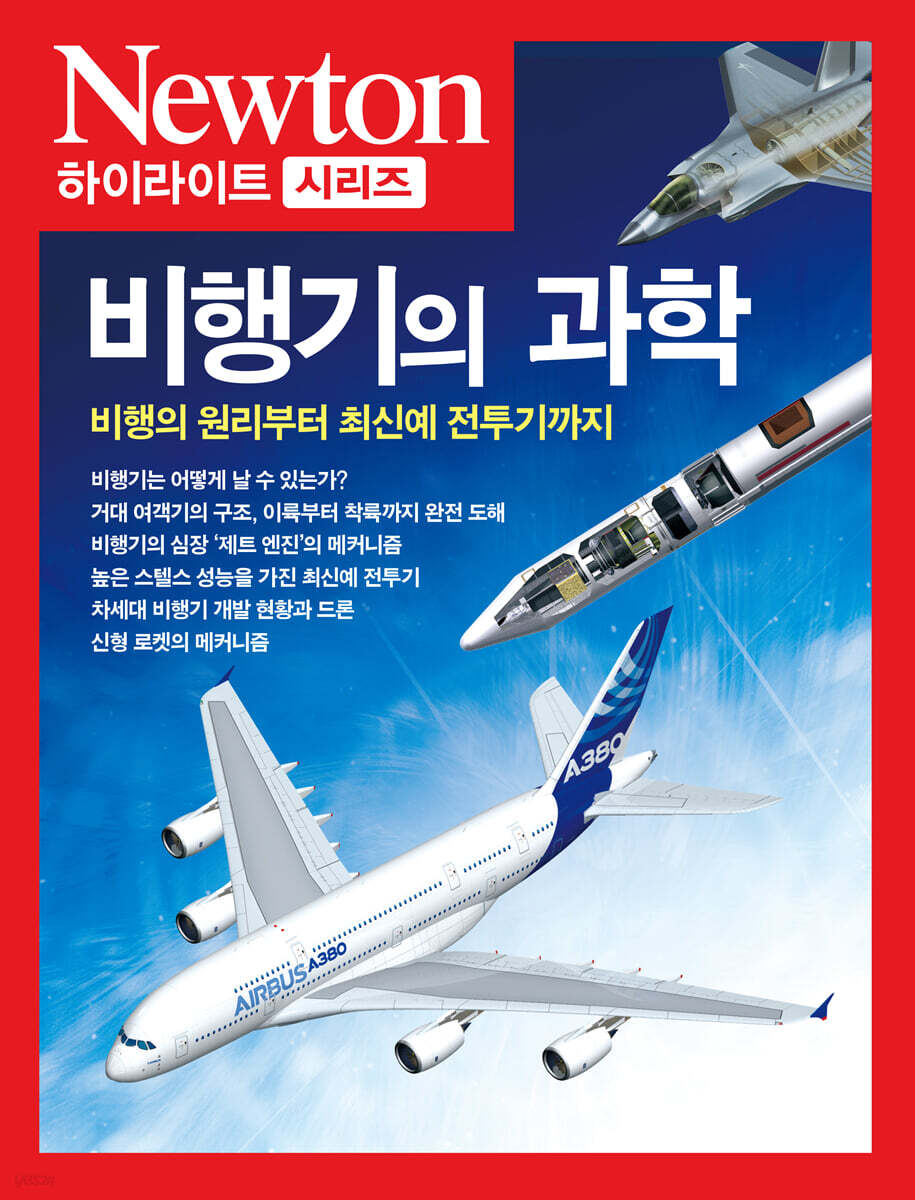
NEWTON HIGHLIGHT 120 The Science of Airplanes
 |
Description
Book Introduction
From the principles of flight to the latest fighter jets
More than a century has passed since the Wright brothers in the United States succeeded in the first manned powered flight in 1903.
Aviation technology has advanced dramatically over the years, and airplanes are now a common means of transportation used by many people.
It is no exaggeration to say that airplanes are the culmination of science and technology.
This is because, in order to build and operate an airplane, it is necessary to understand the scientific principles of how a metal mass weighing hundreds of tons flies through the sky, as well as to gather technology and experience from various fields such as mechanical, electronic, and material industries.
That's why there's a saying that 'the level of a country's airplane manufacturing is the level of its science and technology.'
This book is an introduction to airplanes, spaceships, and rockets, showing all the science of these aircraft with real photos and detailed illustrations.
First, the prologue introduces the detailed structure of the Wright brothers' airplane and the scene of the first flight with detailed pictures, as if you were looking right at them.
Chapter 1 thoroughly dissects the passenger aircraft we are familiar with.
It shows the process from takeoff to cruising and landing, and the structure and maintenance of the fuselage, wings, wheels, engine, cockpit, etc., as well as the lift, etc., required for an airplane to take off and land, with detailed pictures and explanations.
Chapters 2 and 3 introduce various aircraft that are currently in the news.
It's not just passenger planes that fly.
Military aircraft, including fighter jets and drones, each have special functions.
It also introduces next-generation aircraft such as solar powered solar planes and supersonic passenger planes, as well as the characteristics of jet passenger planes and development cases of business jets.
Chapter 4 explores rockets and spacecraft currently in use or under development.
Since the retirement of the space shuttle, public organizations such as NASA, as well as private companies, have developed various rockets and spacecraft to send people, supplies, and satellites into space. This article explains this situation using photos and illustrations.
We hope that this book, which covers everything from the basics to the latest developments in airplanes, spaceships, and rockets, will be of great help to readers.
More than a century has passed since the Wright brothers in the United States succeeded in the first manned powered flight in 1903.
Aviation technology has advanced dramatically over the years, and airplanes are now a common means of transportation used by many people.
It is no exaggeration to say that airplanes are the culmination of science and technology.
This is because, in order to build and operate an airplane, it is necessary to understand the scientific principles of how a metal mass weighing hundreds of tons flies through the sky, as well as to gather technology and experience from various fields such as mechanical, electronic, and material industries.
That's why there's a saying that 'the level of a country's airplane manufacturing is the level of its science and technology.'
This book is an introduction to airplanes, spaceships, and rockets, showing all the science of these aircraft with real photos and detailed illustrations.
First, the prologue introduces the detailed structure of the Wright brothers' airplane and the scene of the first flight with detailed pictures, as if you were looking right at them.
Chapter 1 thoroughly dissects the passenger aircraft we are familiar with.
It shows the process from takeoff to cruising and landing, and the structure and maintenance of the fuselage, wings, wheels, engine, cockpit, etc., as well as the lift, etc., required for an airplane to take off and land, with detailed pictures and explanations.
Chapters 2 and 3 introduce various aircraft that are currently in the news.
It's not just passenger planes that fly.
Military aircraft, including fighter jets and drones, each have special functions.
It also introduces next-generation aircraft such as solar powered solar planes and supersonic passenger planes, as well as the characteristics of jet passenger planes and development cases of business jets.
Chapter 4 explores rockets and spacecraft currently in use or under development.
Since the retirement of the space shuttle, public organizations such as NASA, as well as private companies, have developed various rockets and spacecraft to send people, supplies, and satellites into space. This article explains this situation using photos and illustrations.
We hope that this book, which covers everything from the basics to the latest developments in airplanes, spaceships, and rockets, will be of great help to readers.
- You can preview some of the book's contents.
Preview
index
prolog
The Wright Brothers and the Development of the Airplane
Chapter 1: Completely Diagrammed Aircraft
A380 Dissection / A380 Performance
From takeoff to landing
Fuel tank / Takeoff / Cruise / Jet engine / Cockpit / Carbon composite fiber / Landing / Landing gear / Maintenance / Lift / Questions about airplanes
Experience the principles of flight
Let's make a paper glider!
Chapter 2 Military Aircraft and Next-Generation Aircraft
The appearance of a sophisticated military aircraft
Supersonic flight / Fighter wing / F-35B engine
Next-generation airplanes
Solar Plane / The Forefront of Next-Generation Aircraft Development / MISORA, a Supersonic Biplane / Drone
Interview with Dr. Ilan Crew
Interview with Dr. Kenzo Nonami
Chapter 3 Development of New Aircraft
Dreamliner / Mitsubishi short-haul jetliner / HondaJet
Chapter 4: Spaceship and Rocket Technology
Space Shuttle / Space Development After the Space Shuttle / H-IIB Rocket / Epsilon Rocket / Epsilon, Into Space
Interview with Dr. Mamoru Mori
Interview with Dr. Yasuhiro Morita
Detailed image

Publisher's Review
A detailed introduction to the Wright brothers' aircraft, including its detailed structure, patented technology, experimental equipment, and the site of its first flight.
The photos and story of the Wright brothers' first powered flight in 1903 are widely known.
In addition, this book provides detailed explanations, using color illustrations and photographs, of previously unavailable materials, such as the detailed structure of the first powered airplane, the Flyer, the Wright brothers' patented flight technology, their self-made engine, and the wind tunnel used to test the effects of wind on the fuselage and wings.
Completely explains the basics of airplanes, including the structure of the airplane, principles of takeoff, landing, and cruising, engines and cockpits, characteristics of the airframe, maintenance, etc.
How can a metal mass weighing hundreds of tons fly? Using the Airbus A380, a massive passenger aircraft measuring 73 meters long, 80 meters wide, and weighing 560 tons, as an example, we introduce the principles and mechanisms of all aspects of flight, from takeoff to landing.
Additionally, you can see detailed structures of the fuselage, wings, wheels, engines, cockpit, and even maintenance processes through world-class, precise illustrations.
'Supersonic flight, characteristics of fighter jets…, hypersonic passenger aircraft, solar plane, etc. The latest developments in next-generation aircraft
Airplanes continue to make leaps and bounds.
Among them, military fighter jets are the ones that incorporate various modern scientific technologies.
You can see the core of the technology designed to perform at its best, such as the engines and wings of the latest fighter jets.
In addition, we will introduce in detail next-generation aircraft such as the 'hypersonic passenger plane' that can cross the Pacific Ocean in two hours, the 'solar plane' that uses solar energy, and drones that are expected to be used in various fields.
Development of new civil aircraft and production of jet airliners
Development of jet passenger aircraft is actively taking place in the United States and Europe, particularly in France.
Meanwhile, in Japan, development of jet aircraft has been active recently.
The Boeing 787, which has a high level of Japanese participation in development, has entered service, and development of jet passenger aircraft and business jets being developed in Japan is also progressing.
Let's look at the development of new jet airliners, focusing on the case of Japan.
The development site for the space shuttle and other spacecraft used in subsequent space exploration, as well as new rockets.
As mankind began to fly, it naturally became their goal to reach space.
Thus, development progressed on rockets to send satellites and people into space, and spacecraft to transport supplies and people to the International Space Station.
The space shuttle has great significance as a spacecraft that transports humans to and from space.
The International Space Station, which also serves as a base for spacecraft in space, also plays a variety of roles, including space experiments.
The structure and development site of various rockets, such as 'Epsilon' and 'H3', will also be revealed in depth.
The photos and story of the Wright brothers' first powered flight in 1903 are widely known.
In addition, this book provides detailed explanations, using color illustrations and photographs, of previously unavailable materials, such as the detailed structure of the first powered airplane, the Flyer, the Wright brothers' patented flight technology, their self-made engine, and the wind tunnel used to test the effects of wind on the fuselage and wings.
Completely explains the basics of airplanes, including the structure of the airplane, principles of takeoff, landing, and cruising, engines and cockpits, characteristics of the airframe, maintenance, etc.
How can a metal mass weighing hundreds of tons fly? Using the Airbus A380, a massive passenger aircraft measuring 73 meters long, 80 meters wide, and weighing 560 tons, as an example, we introduce the principles and mechanisms of all aspects of flight, from takeoff to landing.
Additionally, you can see detailed structures of the fuselage, wings, wheels, engines, cockpit, and even maintenance processes through world-class, precise illustrations.
'Supersonic flight, characteristics of fighter jets…, hypersonic passenger aircraft, solar plane, etc. The latest developments in next-generation aircraft
Airplanes continue to make leaps and bounds.
Among them, military fighter jets are the ones that incorporate various modern scientific technologies.
You can see the core of the technology designed to perform at its best, such as the engines and wings of the latest fighter jets.
In addition, we will introduce in detail next-generation aircraft such as the 'hypersonic passenger plane' that can cross the Pacific Ocean in two hours, the 'solar plane' that uses solar energy, and drones that are expected to be used in various fields.
Development of new civil aircraft and production of jet airliners
Development of jet passenger aircraft is actively taking place in the United States and Europe, particularly in France.
Meanwhile, in Japan, development of jet aircraft has been active recently.
The Boeing 787, which has a high level of Japanese participation in development, has entered service, and development of jet passenger aircraft and business jets being developed in Japan is also progressing.
Let's look at the development of new jet airliners, focusing on the case of Japan.
The development site for the space shuttle and other spacecraft used in subsequent space exploration, as well as new rockets.
As mankind began to fly, it naturally became their goal to reach space.
Thus, development progressed on rockets to send satellites and people into space, and spacecraft to transport supplies and people to the International Space Station.
The space shuttle has great significance as a spacecraft that transports humans to and from space.
The International Space Station, which also serves as a base for spacecraft in space, also plays a variety of roles, including space experiments.
The structure and development site of various rockets, such as 'Epsilon' and 'H3', will also be revealed in depth.
GOODS SPECIFICS
- Date of publication: June 15, 2018
- Page count, weight, size: 160 pages | 524g | 210*275*20mm
- ISBN13: 9791161960326
- ISBN10: 1161960325
You may also like
카테고리
korean


korean

![GQ KOREA Mark (Monthly): December [2025]](http://librairie.coreenne.fr/cdn/shop/files/8ef265dbbfbf186523ed75ba7319009d.jpg?v=1765340328&width=3840)


