

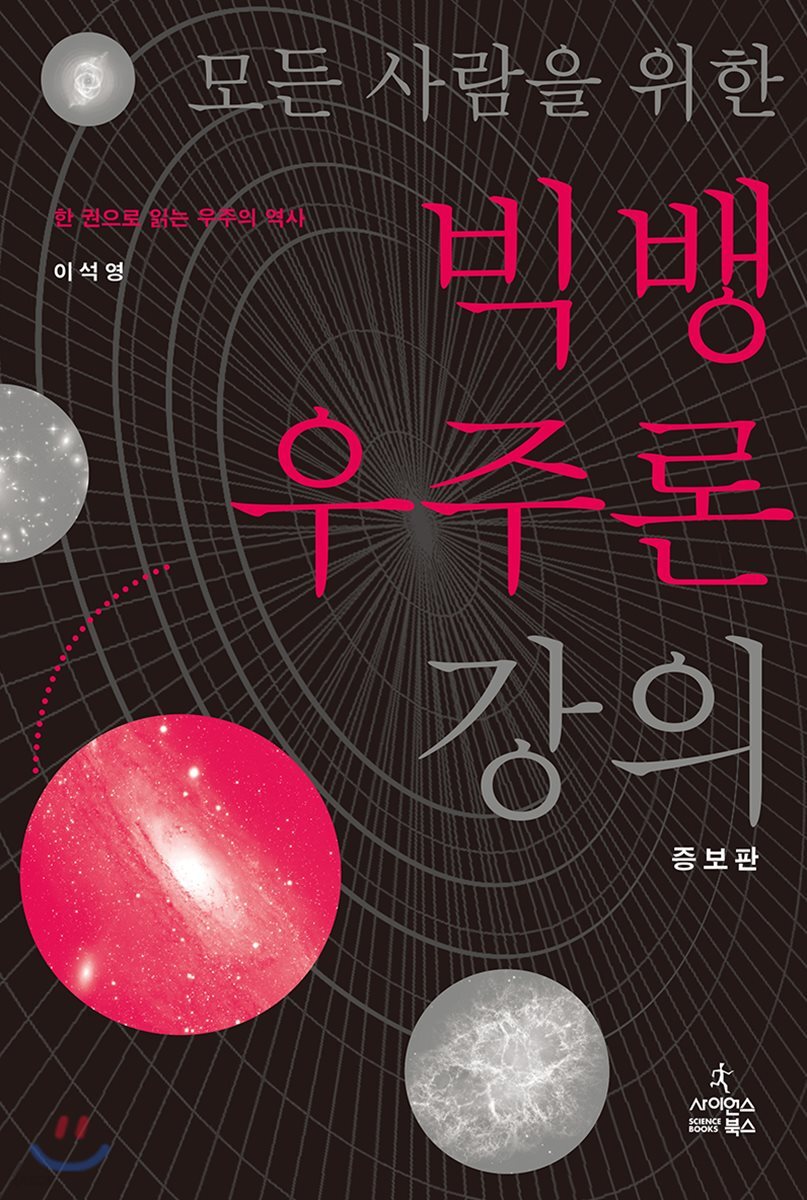
Big Bang Cosmology Lectures for Everyone
 |
Description
Book Introduction
The long-awaited expanded edition of 'South Korea's representative cosmology textbook' is now available!
· APCTP's "50 Science Classics of Our Time"
· A must-read for integrated science education
Humanity is now living in an era of knowledge revolution that surpasses the era of Galileo, Newton, and Einstein.
Because the origin and fate of the universe are being revealed.
The origin and destiny of the universe—isn't this the ultimate goal of human knowledge? ― From the text
Today, in the 21st century, we are in the midst of another astronomical revolution.
The Planck Space Telescope is precisely observing the anisotropy of the cosmic microwave background to unlock the remaining secrets of the universe.
It is impossible to predict the changes that the James Webb Space Telescope, which will replace Hubble, will bring.
Today, we have a surprisingly solid understanding of the 13.7 billion-year history of the universe and its future destiny.
That is, through the Big Bang cosmology.
The proportion of astronomy in the high school science curriculum, which was reorganized for the purpose of integrated public education, has been expanded.
In particular, the contents of 'the origin and evolution of the universe', that is, the Big Bang cosmology, are featured at the beginning of the textbook.
In 2009, a year that heralded the era of "integrated curricula," Professor Lee Seok-young (Department of Astronomy and Space Science, Yonsei University)'s "Big Bang Cosmology Lectures for Everyone" sparked public interest upon its publication. Invited to give a lecture on KBS's "Humanities Lecture Rock" and receiving praise from prominent astronomy figures like Professor Lee Myeong-hyeon, the book quickly became a bestseller.
This means that our society has realized the importance of the Big Bang cosmology and recognized it as a basic knowledge that modern people must know.
Starting in 2018, the integrated science exam will require students to have a deep understanding of the Big Bang cosmology.
Because the Big Bang cosmology is the beginning of a unified science, a Big History spanning 13.7 billion years.
Now a must-read for middle and high school students, this book has truly become a book 'for everyone.'
· APCTP's "50 Science Classics of Our Time"
· A must-read for integrated science education
Humanity is now living in an era of knowledge revolution that surpasses the era of Galileo, Newton, and Einstein.
Because the origin and fate of the universe are being revealed.
The origin and destiny of the universe—isn't this the ultimate goal of human knowledge? ― From the text
Today, in the 21st century, we are in the midst of another astronomical revolution.
The Planck Space Telescope is precisely observing the anisotropy of the cosmic microwave background to unlock the remaining secrets of the universe.
It is impossible to predict the changes that the James Webb Space Telescope, which will replace Hubble, will bring.
Today, we have a surprisingly solid understanding of the 13.7 billion-year history of the universe and its future destiny.
That is, through the Big Bang cosmology.
The proportion of astronomy in the high school science curriculum, which was reorganized for the purpose of integrated public education, has been expanded.
In particular, the contents of 'the origin and evolution of the universe', that is, the Big Bang cosmology, are featured at the beginning of the textbook.
In 2009, a year that heralded the era of "integrated curricula," Professor Lee Seok-young (Department of Astronomy and Space Science, Yonsei University)'s "Big Bang Cosmology Lectures for Everyone" sparked public interest upon its publication. Invited to give a lecture on KBS's "Humanities Lecture Rock" and receiving praise from prominent astronomy figures like Professor Lee Myeong-hyeon, the book quickly became a bestseller.
This means that our society has realized the importance of the Big Bang cosmology and recognized it as a basic knowledge that modern people must know.
Starting in 2018, the integrated science exam will require students to have a deep understanding of the Big Bang cosmology.
Because the Big Bang cosmology is the beginning of a unified science, a Big History spanning 13.7 billion years.
Now a must-read for middle and high school students, this book has truly become a book 'for everyone.'
- You can preview some of the book's contents.
Preview
index
We are publishing an expanded edition with sincere gratitude for ‘everyone’.
Starting the book, what is the height of the sky? 10
Lesson 1: How Big Is Your Universe? 15
2nd lecture: Beauty with weight 23
Space Telescope Institute 41
Why Doesn't the Universe Collapse into a Point? 43
Yale University 59
The light of the 4th power penetrates 13.7 billion years and reaches 61
Princeton University and the Institute for Advanced Study 74
5. The Universe is 380,000 years old. 77.
Oxford University 92
Episode 6: The Beginning of 3 Minutes 95
University of Cambridge 107
Chapter 7: What is the fate of the universe? 109
Carnegie Observatory 123
The Big Bang Cosmology Wasn't Perfect 127
Paris Astrophysics Institute 144
9 Things You See Are Not Everything! 147
California Institute of Technology 170
10-Strong Super Iron, Rapid Expansion 173
Massachusetts Institute of Technology 185
Lesson 11: An Unidentified Energy Rules the Universe! 187
Harvard University 205
Lecture 12: Anisotropy of the Cosmic Background Radiation 207
Harvard University 221
Lesson 13: We Know Only 4 Percent 225
California State University, Santa Cruz Campus 232
Lecture 14: Dark Matter: The Cradle of Galaxies 235
Max Planck Institute 247
Lesson 15: Galaxies Are More Beautiful Than Stars 249
Leiden University and the University of Groningen 271
16 Round of 16: From the Birth to the Disappearance of a Star 273
University of Padua 290
Lecture 17: The 21st Century: The Age of Astronomy 293
NASA 303
18. All of This Is a Product of the Big Bang 307
Appendix 314: The Expansion of a Flat Universe
Search 317
Photographs and illustrations copyright 320
Starting the book, what is the height of the sky? 10
Lesson 1: How Big Is Your Universe? 15
2nd lecture: Beauty with weight 23
Space Telescope Institute 41
Why Doesn't the Universe Collapse into a Point? 43
Yale University 59
The light of the 4th power penetrates 13.7 billion years and reaches 61
Princeton University and the Institute for Advanced Study 74
5. The Universe is 380,000 years old. 77.
Oxford University 92
Episode 6: The Beginning of 3 Minutes 95
University of Cambridge 107
Chapter 7: What is the fate of the universe? 109
Carnegie Observatory 123
The Big Bang Cosmology Wasn't Perfect 127
Paris Astrophysics Institute 144
9 Things You See Are Not Everything! 147
California Institute of Technology 170
10-Strong Super Iron, Rapid Expansion 173
Massachusetts Institute of Technology 185
Lesson 11: An Unidentified Energy Rules the Universe! 187
Harvard University 205
Lecture 12: Anisotropy of the Cosmic Background Radiation 207
Harvard University 221
Lesson 13: We Know Only 4 Percent 225
California State University, Santa Cruz Campus 232
Lecture 14: Dark Matter: The Cradle of Galaxies 235
Max Planck Institute 247
Lesson 15: Galaxies Are More Beautiful Than Stars 249
Leiden University and the University of Groningen 271
16 Round of 16: From the Birth to the Disappearance of a Star 273
University of Padua 290
Lecture 17: The 21st Century: The Age of Astronomy 293
NASA 303
18. All of This Is a Product of the Big Bang 307
Appendix 314: The Expansion of a Flat Universe
Search 317
Photographs and illustrations copyright 320
Publisher's Review
In the age of astronomy, Big Bang cosmology has become essential knowledge.
A must-read for youth and the general public in the era of convergent curricula.
The newly published 『(Expanded Edition) Big Bang Cosmology Lectures for Everyone』 by Science Books Co., Ltd. contains the core of Big Bang cosmology, which has established itself as the only theory explaining the principles of the universe, as well as recent issues.
You can check out the latest research results on the Big Bang cosmology through this expanded edition, as told by Professor Lee Seok-young, the author of "I Can't Be the Only One Who Feels the Thrill of Experiencing a New Astronomical Revolution."
This lecture can be said to cover everything from the basics of Big Bang cosmology to the cutting edge of the field.
In particular, the newly added 12th lecture, “Anisotropy of Cosmic Background Radiation,” forms the core of the front line.
Measurements from WMAP and the Planck Space Telescope over the past decade have shown that the temperature distribution of the cosmic microwave background is not entirely uniform, with deviations of 10-5 to 10-6.
This slight temperature variation is called the anisotropy of the cosmic background radiation.
It is now being revealed that anisotropy, previously dismissed as a measurement error, actually served as a seed that determined the large-scale structure of the universe.
This book presents the results of anisotropy research and the formation of the cosmic large-scale structure, which are surprisingly consistent with theoretical predictions.
Meanwhile, the author added an appendix, "Inflation of the Flat Universe," which includes a special mathematical proof process to correct the popular misconception that a flat universe will eventually stop expanding.
Even high school science textbooks are making these mistakes, but this book, based on its accurate content, is establishing itself as the "Representative Cosmology Textbook of the Republic of Korea."
Professor Lee Seok-young graduated from the Department of Astronomy and Space Science at Yonsei University and received his doctorate from Yale University with a dissertation on the theory of elliptical galaxies.
He was highly recognized in academic circles for his papers on elliptical galaxies and even gave a keynote address to the American Astronomical Society.
After graduation, he immediately worked as a researcher at NASA's Goddard Space Flight Center, where he participated in the Hubble Space Telescope project.
He also served as a senior researcher at the California Institute of Technology.
I dare say that he is the best talent that the domestic astronomy community has produced.
This book contains everything about the Big Bang cosmology that he taught to students while working as a professor at Oxford University and Yonsei University.
Through Professor Lee Seok-young's lectures, which explain potentially difficult topics as easily as possible, we can catch up with the context of the new astronomical revolution.
In short, 『(Expanded Edition) Big Bang Cosmology Lectures for Everyone』 is a book that contains the 13.7 billion year history of the universe in a single volume.
“How big is your universe?”
A Story of 13.7 Billion Years of the Universe, Told by Korea's Leading Astronomer
I dare say, “There is something more beautiful than flowers in space.”
There is a beauty in the universe that goes beyond mere beauty, a beauty that has weight.
― In the text
『(Expanded Edition) Big Bang Cosmology Lectures for Everyone』 consists of a total of 18 lectures, including newly added lectures.
In Chapter 1, "How Big Is Your Universe?", the author welcomes us into the vast and profound world of Big Bang cosmology, along with a general background knowledge of the composition of the universe.
In lectures 2-4, where the lectures begin in earnest, we will cover the process of creation of the Big Bang cosmology.
First, in the second lecture, “Weighty Beauty,” you can experience the scale of the subject of future research (the universe) through the images of galaxies and galaxy clusters observed through the Hubble Space Telescope.
A galaxy 100,000 light-years in diameter, a galaxy cluster with a mass 1,000 trillion times that of the Sun, and the changes in the appearance of galaxies over billions of years are on a scale that we cannot even imagine with our everyday way of thinking.
If the reader has established this "astronomical perspective," he or she can move on to the next lecture with the pride of exploring a world that no one has ever fathomed.
Lecture 3, “Why Doesn’t the Universe Collapse into a Point?” begins with the story of Einstein, who simultaneously provided a clue to the Big Bang theory and denied it.
The Big Bang cosmology gained vitality thanks to Friedman's mathematical proof (using Einstein's equations) and Hubble's observations.
After this paradoxical birth, the Big Bang cosmology developed in earnest and became established as a core theory of astronomy.
In the fourth lecture, “Light Through 13.7 Billion Years,” we discuss the discovery of cosmic background radiation, which has reached us from the “end” of the universe after “through 13.7 billion years.”
The discovery of cosmic background radiation, and the fact that its energy spectrum matches precisely the thermodynamic theory, provides direct evidence for the Big Bang cosmology.
If the universe has been expanding from the past to the present, what will happen in the future? Will it expand endlessly? Or will it eventually contract again? According to Big Bang cosmology, the fate of the universe was already decided at its birth.
It's like knowing the initial velocity of a rocket as it launches it into the air, and knowing its final velocity, you can know its final velocity.
― In the text
Chapters 5-7 cover the history of the universe as revealed by the Big Bang theory.
Chapter 5, “Until the Universe Became 380,000 Years Old,” explains the changes in the universe that occurred over the 380,000 years immediately following the Big Bang.
It provides a comprehensive understanding of the 380,000-year history of the universe, including the era of the Grand Unified Theory, the era of inflation, the era of hadrons, and the era of nucleosynthesis.
I would like to point out in advance that the 'astronomical perspective' discussed above requires an understanding of not only very long periods of time but also very short periods of time (10-43 seconds).
If you can even slightly estimate this short time, you may move on to Chapter 6, “The First Three Minutes.”
The first three minutes were a period of dynamic change comparable to the 13.7 billion years of history that followed.
The universe at this time, dominated by hadrons and hydrogen atoms, is well explained by the Big Bang nucleosynthesis theory.
The current universe was formed by the nuclear synthesis of hydrogen atoms, which then created substances such as helium.
In Chapter 7, “What is the Fate of the Universe?”, the future of the universe created in this way is predicted.
There are several possibilities, including whether the universe will continue to expand at an accelerated rate, eventually reaching an extremely low density, or whether it will gradually stop expanding and reach a specific size.
There is even a 'Big Crunch' hypothesis that it will contract back to a single point.
No one can perfectly predict the future, but we can make some scientific predictions based on initial conditions.
So astronomers tried to understand the state of the universe in the early days of the Big Bang, but in the process, they discovered fatal problems.
Will it just remain a fantasy?
Three Major Problems of Big Bang Cosmology and Their Solutions
Hubble's discovery of the expansion of the universe in the late 1920s, the discovery of cosmic background radiation in the 1960s, and the Big Bang nucleosynthesis theory, which was completed through theoretical research starting in the 1950s and observational research in the 1980s, established the Big Bang cosmology as the best cosmology currently in existence.
But there were also problems with the Big Bang cosmology.
That is also a very serious problem.
― In the text
Chapters 8 and 9 deal with the problems of the Big Bang cosmology.
Episode 8, “The Big Bang Cosmology Was Not Perfect,” introduces the representative problems that brought about a crisis in the Big Bang cosmology.
In this lecture, you will learn about the 'cosmic horizon problem', which states that the same information is observed from two points beyond the limits of information exchange; the 'flatness problem', which states that the density of the early universe must have been determined very mysteriously and without any error in order for the current universe to be created; and the 'primordial particle problem', which states that primordial particles that may have existed in the early universe cannot be found at present.
A problem also arises in Lesson 9, "Seeing is Not Everything!"
The actual density of the universe is much higher than the density that can be seen with the naked eye.
What's even more troubling is that the universe is actually expanding at a much faster rate than the calculated rate of expansion.
To explain these, the concepts of dark matter and dark energy have been introduced today, respectively.
Just as you can't imagine a stylish shirt from its wrinkled appearance, it seems unlikely that you could imagine a universe as beautiful as ours by looking only at the early universe before inflation.
But when I used the latest iron called a rapid expansion iron and quickly ironed it, the original wrinkles, no matter how small or large, were completely smoothed out! ― From the text
In chapters 10 through 13, a solution is introduced that not only revives the Big Bang cosmology, which was on the verge of being branded a flawed theory, but also makes it more solid.
Lecture 10, "Super-Strong Iron, Rapid Inflation," deals with the theory of rapid inflation proposed by Alan Guth.
Just as water rapidly increases in volume when it boils, the early universe, which was very hot, also underwent rapid volume expansion.
Along with the evidence that could lead to inflationary theory beyond the hypothesis, we can see how it brilliantly solves the problems of the Big Bang cosmology mentioned above.
Lecture 11, “Unidentified Energy Rules the Universe!” focuses on dark energy.
Dark energy is an unknown energy that acts as a repulsive force against gravity and accelerates the expansion of the universe.
It is particularly interesting that the cosmological constant, once thought to be Einstein's mistake, may be the very identity of dark energy.
The Secret of the Universe's Birth Revealed Through Noise
The first domestic explanation of the anisotropy of the universe hidden in the cosmic background radiation!
One of the greatest recent achievements in cosmology is the discovery of anisotropy in the cosmic background radiation.
― In the text
Studies conducted from completely different angles began to fit together here and there, and a plausible picture of the universe began to emerge.
Are we finally learning the history of the universe? - From the text
The previously mentioned lecture 12, “Anisotropy of the Cosmic Background Radiation,” deals with research results that provide new evidence for the theory of rapid inflation.
Although the 'basic principle of cosmology' that space is uniform and isotropic has been broken, this has allowed us to understand in much more detail the process of the universe's birth through rapid expansion.
As observational technology advances, it is expected that newer secrets will be revealed, which is why the author calls today a revolutionary era.
Lecture 13, "We Know Only 4 Percent," is a sub-summary of a long series that covers everything from the problems of the Big Bang cosmology to its solutions.
From the early Big Bang hypothesis to the latest research on anisotropy, what we've ultimately realized is that we only understand 4 percent of the universe.
Dark matter and dark energy, which make up the remaining 96 percent, are still unknown.
But the mere fact that we know what we don't know is enough to make the Big Bang cosmology significant.
Just as there are those who generously give back to society, making society feel somewhat livable, I wonder if this universe isn't beautiful because there are giant stars who generously give back the elements they created.
― In the text
Lecture 14, “Dark Matter: The Cradle of Galaxies,” discusses the birth of stars and galaxies, which originate from 96 percent of the unknown.
The gravitational distribution of dark matter caused particles to gather in 'pools' of space, undergoing nuclear fusion to form the first stars and galaxies.
Lesson 15, “Galaxies are bigger than stars,” and Lesson 16, “From the birth of a star to its disappearance,” cover the stories of stars and galaxies that are born that way.
Since galaxy research is Professor Lee Seok-young's specialty, I recommend experiencing his lectures, which contain detailed explanations, sentence by sentence.
In particular, this expanded edition allows us to see how the anisotropy of the cosmic background radiation discussed in Lecture 12 created the current galaxy distribution.
At this very moment, humanity's greatest question is revealed.
The first classic of the new era of Big Bang cosmology!
The development of observational instruments, which has been accelerating since the early 20th century, is now reaching its peak as we enter the 21st century.
― In the text
When Galileo first observed Jupiter through a telescope, he probably never dreamed that he would completely change humanity's view of the universe that had persisted for thousands, even tens of thousands of years.
The most precious discoveries will come to us unexpectedly, in ways we cannot imagine, and with unimaginable value.
― In the text
One of the reasons we call this moment a revolutionary moment in astronomy is the groundbreaking advancements in observation technology.
We are benefiting from the Hubble Space Telescope, which has observed external galaxies; the COBE space probe, which has measured the spectrum of the cosmic microwave background; WMAP, which has ushered in the era of quantification in astronomy; the Planck Space Telescope, which has contributed to the study of anisotropy by measuring the temperature distribution of the cosmic microwave background more precisely; and the James Webb Space Telescope, which is scheduled to launch in 2018.
This is well explained in Lecture 17, “The 21st Century is the Age of Astronomy.”
Thanks to theoretical advances such as inflationary theory and anisotropy research, as well as the advent of next-generation space telescopes, our understanding of the universe is becoming clearer and broader.
Even though we've reached Episode 18, "All of This is a Product of the Big Bang," you may still have countless questions.
It must be admitted that this book contains a high level of content, as it contains the entire 13.7 billion years of dynamic cosmic history.
However, if we know where we stand now, 90 years after the first Big Bang hypothesis was announced, 25 years after the Big Bang was established as a theory thanks to the COBE space probe measuring the spectrum of cosmic background radiation, and 20 years after the discovery of the accelerating expansion of the universe and the full introduction of the concept of dark energy, we can consider ourselves excellent students of the 'Big Bang Cosmology Lecture'.
This year marks several anniversaries related to Big Bang cosmology and is also in the midst of dramatic changes brought about by next-generation observational technologies.
In 2017, a year that marks a new era in Big Bang cosmology, the publication of 『(Expanded Edition) Big Bang Cosmology Lectures for Everyone』 is of great significance.
The 21st century is the age of astronomy.
There are countless space exploration projects underway.
Now, who among the readers will participate in this history? ― From the text
A must-read for youth and the general public in the era of convergent curricula.
The newly published 『(Expanded Edition) Big Bang Cosmology Lectures for Everyone』 by Science Books Co., Ltd. contains the core of Big Bang cosmology, which has established itself as the only theory explaining the principles of the universe, as well as recent issues.
You can check out the latest research results on the Big Bang cosmology through this expanded edition, as told by Professor Lee Seok-young, the author of "I Can't Be the Only One Who Feels the Thrill of Experiencing a New Astronomical Revolution."
This lecture can be said to cover everything from the basics of Big Bang cosmology to the cutting edge of the field.
In particular, the newly added 12th lecture, “Anisotropy of Cosmic Background Radiation,” forms the core of the front line.
Measurements from WMAP and the Planck Space Telescope over the past decade have shown that the temperature distribution of the cosmic microwave background is not entirely uniform, with deviations of 10-5 to 10-6.
This slight temperature variation is called the anisotropy of the cosmic background radiation.
It is now being revealed that anisotropy, previously dismissed as a measurement error, actually served as a seed that determined the large-scale structure of the universe.
This book presents the results of anisotropy research and the formation of the cosmic large-scale structure, which are surprisingly consistent with theoretical predictions.
Meanwhile, the author added an appendix, "Inflation of the Flat Universe," which includes a special mathematical proof process to correct the popular misconception that a flat universe will eventually stop expanding.
Even high school science textbooks are making these mistakes, but this book, based on its accurate content, is establishing itself as the "Representative Cosmology Textbook of the Republic of Korea."
Professor Lee Seok-young graduated from the Department of Astronomy and Space Science at Yonsei University and received his doctorate from Yale University with a dissertation on the theory of elliptical galaxies.
He was highly recognized in academic circles for his papers on elliptical galaxies and even gave a keynote address to the American Astronomical Society.
After graduation, he immediately worked as a researcher at NASA's Goddard Space Flight Center, where he participated in the Hubble Space Telescope project.
He also served as a senior researcher at the California Institute of Technology.
I dare say that he is the best talent that the domestic astronomy community has produced.
This book contains everything about the Big Bang cosmology that he taught to students while working as a professor at Oxford University and Yonsei University.
Through Professor Lee Seok-young's lectures, which explain potentially difficult topics as easily as possible, we can catch up with the context of the new astronomical revolution.
In short, 『(Expanded Edition) Big Bang Cosmology Lectures for Everyone』 is a book that contains the 13.7 billion year history of the universe in a single volume.
“How big is your universe?”
A Story of 13.7 Billion Years of the Universe, Told by Korea's Leading Astronomer
I dare say, “There is something more beautiful than flowers in space.”
There is a beauty in the universe that goes beyond mere beauty, a beauty that has weight.
― In the text
『(Expanded Edition) Big Bang Cosmology Lectures for Everyone』 consists of a total of 18 lectures, including newly added lectures.
In Chapter 1, "How Big Is Your Universe?", the author welcomes us into the vast and profound world of Big Bang cosmology, along with a general background knowledge of the composition of the universe.
In lectures 2-4, where the lectures begin in earnest, we will cover the process of creation of the Big Bang cosmology.
First, in the second lecture, “Weighty Beauty,” you can experience the scale of the subject of future research (the universe) through the images of galaxies and galaxy clusters observed through the Hubble Space Telescope.
A galaxy 100,000 light-years in diameter, a galaxy cluster with a mass 1,000 trillion times that of the Sun, and the changes in the appearance of galaxies over billions of years are on a scale that we cannot even imagine with our everyday way of thinking.
If the reader has established this "astronomical perspective," he or she can move on to the next lecture with the pride of exploring a world that no one has ever fathomed.
Lecture 3, “Why Doesn’t the Universe Collapse into a Point?” begins with the story of Einstein, who simultaneously provided a clue to the Big Bang theory and denied it.
The Big Bang cosmology gained vitality thanks to Friedman's mathematical proof (using Einstein's equations) and Hubble's observations.
After this paradoxical birth, the Big Bang cosmology developed in earnest and became established as a core theory of astronomy.
In the fourth lecture, “Light Through 13.7 Billion Years,” we discuss the discovery of cosmic background radiation, which has reached us from the “end” of the universe after “through 13.7 billion years.”
The discovery of cosmic background radiation, and the fact that its energy spectrum matches precisely the thermodynamic theory, provides direct evidence for the Big Bang cosmology.
If the universe has been expanding from the past to the present, what will happen in the future? Will it expand endlessly? Or will it eventually contract again? According to Big Bang cosmology, the fate of the universe was already decided at its birth.
It's like knowing the initial velocity of a rocket as it launches it into the air, and knowing its final velocity, you can know its final velocity.
― In the text
Chapters 5-7 cover the history of the universe as revealed by the Big Bang theory.
Chapter 5, “Until the Universe Became 380,000 Years Old,” explains the changes in the universe that occurred over the 380,000 years immediately following the Big Bang.
It provides a comprehensive understanding of the 380,000-year history of the universe, including the era of the Grand Unified Theory, the era of inflation, the era of hadrons, and the era of nucleosynthesis.
I would like to point out in advance that the 'astronomical perspective' discussed above requires an understanding of not only very long periods of time but also very short periods of time (10-43 seconds).
If you can even slightly estimate this short time, you may move on to Chapter 6, “The First Three Minutes.”
The first three minutes were a period of dynamic change comparable to the 13.7 billion years of history that followed.
The universe at this time, dominated by hadrons and hydrogen atoms, is well explained by the Big Bang nucleosynthesis theory.
The current universe was formed by the nuclear synthesis of hydrogen atoms, which then created substances such as helium.
In Chapter 7, “What is the Fate of the Universe?”, the future of the universe created in this way is predicted.
There are several possibilities, including whether the universe will continue to expand at an accelerated rate, eventually reaching an extremely low density, or whether it will gradually stop expanding and reach a specific size.
There is even a 'Big Crunch' hypothesis that it will contract back to a single point.
No one can perfectly predict the future, but we can make some scientific predictions based on initial conditions.
So astronomers tried to understand the state of the universe in the early days of the Big Bang, but in the process, they discovered fatal problems.
Will it just remain a fantasy?
Three Major Problems of Big Bang Cosmology and Their Solutions
Hubble's discovery of the expansion of the universe in the late 1920s, the discovery of cosmic background radiation in the 1960s, and the Big Bang nucleosynthesis theory, which was completed through theoretical research starting in the 1950s and observational research in the 1980s, established the Big Bang cosmology as the best cosmology currently in existence.
But there were also problems with the Big Bang cosmology.
That is also a very serious problem.
― In the text
Chapters 8 and 9 deal with the problems of the Big Bang cosmology.
Episode 8, “The Big Bang Cosmology Was Not Perfect,” introduces the representative problems that brought about a crisis in the Big Bang cosmology.
In this lecture, you will learn about the 'cosmic horizon problem', which states that the same information is observed from two points beyond the limits of information exchange; the 'flatness problem', which states that the density of the early universe must have been determined very mysteriously and without any error in order for the current universe to be created; and the 'primordial particle problem', which states that primordial particles that may have existed in the early universe cannot be found at present.
A problem also arises in Lesson 9, "Seeing is Not Everything!"
The actual density of the universe is much higher than the density that can be seen with the naked eye.
What's even more troubling is that the universe is actually expanding at a much faster rate than the calculated rate of expansion.
To explain these, the concepts of dark matter and dark energy have been introduced today, respectively.
Just as you can't imagine a stylish shirt from its wrinkled appearance, it seems unlikely that you could imagine a universe as beautiful as ours by looking only at the early universe before inflation.
But when I used the latest iron called a rapid expansion iron and quickly ironed it, the original wrinkles, no matter how small or large, were completely smoothed out! ― From the text
In chapters 10 through 13, a solution is introduced that not only revives the Big Bang cosmology, which was on the verge of being branded a flawed theory, but also makes it more solid.
Lecture 10, "Super-Strong Iron, Rapid Inflation," deals with the theory of rapid inflation proposed by Alan Guth.
Just as water rapidly increases in volume when it boils, the early universe, which was very hot, also underwent rapid volume expansion.
Along with the evidence that could lead to inflationary theory beyond the hypothesis, we can see how it brilliantly solves the problems of the Big Bang cosmology mentioned above.
Lecture 11, “Unidentified Energy Rules the Universe!” focuses on dark energy.
Dark energy is an unknown energy that acts as a repulsive force against gravity and accelerates the expansion of the universe.
It is particularly interesting that the cosmological constant, once thought to be Einstein's mistake, may be the very identity of dark energy.
The Secret of the Universe's Birth Revealed Through Noise
The first domestic explanation of the anisotropy of the universe hidden in the cosmic background radiation!
One of the greatest recent achievements in cosmology is the discovery of anisotropy in the cosmic background radiation.
― In the text
Studies conducted from completely different angles began to fit together here and there, and a plausible picture of the universe began to emerge.
Are we finally learning the history of the universe? - From the text
The previously mentioned lecture 12, “Anisotropy of the Cosmic Background Radiation,” deals with research results that provide new evidence for the theory of rapid inflation.
Although the 'basic principle of cosmology' that space is uniform and isotropic has been broken, this has allowed us to understand in much more detail the process of the universe's birth through rapid expansion.
As observational technology advances, it is expected that newer secrets will be revealed, which is why the author calls today a revolutionary era.
Lecture 13, "We Know Only 4 Percent," is a sub-summary of a long series that covers everything from the problems of the Big Bang cosmology to its solutions.
From the early Big Bang hypothesis to the latest research on anisotropy, what we've ultimately realized is that we only understand 4 percent of the universe.
Dark matter and dark energy, which make up the remaining 96 percent, are still unknown.
But the mere fact that we know what we don't know is enough to make the Big Bang cosmology significant.
Just as there are those who generously give back to society, making society feel somewhat livable, I wonder if this universe isn't beautiful because there are giant stars who generously give back the elements they created.
― In the text
Lecture 14, “Dark Matter: The Cradle of Galaxies,” discusses the birth of stars and galaxies, which originate from 96 percent of the unknown.
The gravitational distribution of dark matter caused particles to gather in 'pools' of space, undergoing nuclear fusion to form the first stars and galaxies.
Lesson 15, “Galaxies are bigger than stars,” and Lesson 16, “From the birth of a star to its disappearance,” cover the stories of stars and galaxies that are born that way.
Since galaxy research is Professor Lee Seok-young's specialty, I recommend experiencing his lectures, which contain detailed explanations, sentence by sentence.
In particular, this expanded edition allows us to see how the anisotropy of the cosmic background radiation discussed in Lecture 12 created the current galaxy distribution.
At this very moment, humanity's greatest question is revealed.
The first classic of the new era of Big Bang cosmology!
The development of observational instruments, which has been accelerating since the early 20th century, is now reaching its peak as we enter the 21st century.
― In the text
When Galileo first observed Jupiter through a telescope, he probably never dreamed that he would completely change humanity's view of the universe that had persisted for thousands, even tens of thousands of years.
The most precious discoveries will come to us unexpectedly, in ways we cannot imagine, and with unimaginable value.
― In the text
One of the reasons we call this moment a revolutionary moment in astronomy is the groundbreaking advancements in observation technology.
We are benefiting from the Hubble Space Telescope, which has observed external galaxies; the COBE space probe, which has measured the spectrum of the cosmic microwave background; WMAP, which has ushered in the era of quantification in astronomy; the Planck Space Telescope, which has contributed to the study of anisotropy by measuring the temperature distribution of the cosmic microwave background more precisely; and the James Webb Space Telescope, which is scheduled to launch in 2018.
This is well explained in Lecture 17, “The 21st Century is the Age of Astronomy.”
Thanks to theoretical advances such as inflationary theory and anisotropy research, as well as the advent of next-generation space telescopes, our understanding of the universe is becoming clearer and broader.
Even though we've reached Episode 18, "All of This is a Product of the Big Bang," you may still have countless questions.
It must be admitted that this book contains a high level of content, as it contains the entire 13.7 billion years of dynamic cosmic history.
However, if we know where we stand now, 90 years after the first Big Bang hypothesis was announced, 25 years after the Big Bang was established as a theory thanks to the COBE space probe measuring the spectrum of cosmic background radiation, and 20 years after the discovery of the accelerating expansion of the universe and the full introduction of the concept of dark energy, we can consider ourselves excellent students of the 'Big Bang Cosmology Lecture'.
This year marks several anniversaries related to Big Bang cosmology and is also in the midst of dramatic changes brought about by next-generation observational technologies.
In 2017, a year that marks a new era in Big Bang cosmology, the publication of 『(Expanded Edition) Big Bang Cosmology Lectures for Everyone』 is of great significance.
The 21st century is the age of astronomy.
There are countless space exploration projects underway.
Now, who among the readers will participate in this history? ― From the text
GOODS SPECIFICS
- Date of publication: March 24, 2017
- Page count, weight, size: 324 pages | 564g | 148*220*19mm
- ISBN13: 9788983718266
- ISBN10: 8983718269
You may also like
카테고리
korean


korean

![GQ KOREA Mark (Monthly): December [2025]](http://librairie.coreenne.fr/cdn/shop/files/8ef265dbbfbf186523ed75ba7319009d.jpg?v=1765340328&width=3840)


