

NEWTON HIGHLIGHT Newton Highlights Relativity
 |
Description
Book Introduction
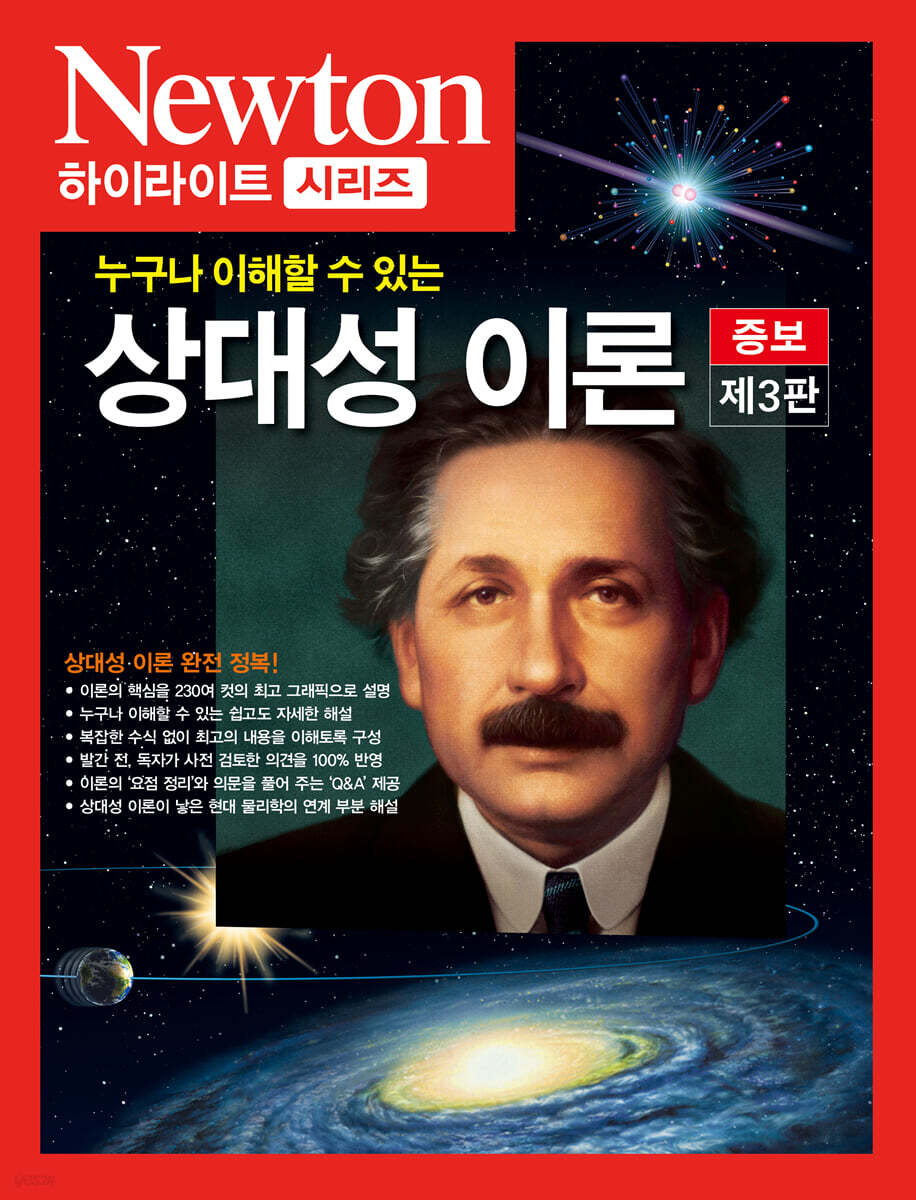
Over 230 high-quality illustrations showcasing the core of the theory.
The theory of relativity includes concepts such as 'simultaneity, stretching of space, constancy of the speed of light, mass and energy, gravity, the equivalence principle, the fourth dimension, the warping of space, the warping of light, and black holes.'
These concepts are difficult to understand through text alone.
Even if it is the same picture, it is true that professional drawings are difficult for general readers to understand.
"The Theory of Relativity: A Guide for Everyone" presents the principles of these concepts at a glance with over 230 color illustrations.
This is a key piece of information that clearly shows the core of the theory of relativity.
Easy and detailed explanations that anyone can understand
Another thing this book boasts is its meticulous composition.
Even readers who are new to the theory of relativity can easily understand the intricately structured content, starting from the background of the theory and progressing to its core. As you follow along, you will soon find yourself grasping the plot.
Here, easy-to-understand and detailed explanations based on pictures on each page play a big role.
It becomes easier to understand because it is explained using common examples that occur around us.
The theory of relativity includes concepts such as 'simultaneity, stretching of space, constancy of the speed of light, mass and energy, gravity, the equivalence principle, the fourth dimension, the warping of space, the warping of light, and black holes.'
These concepts are difficult to understand through text alone.
Even if it is the same picture, it is true that professional drawings are difficult for general readers to understand.
"The Theory of Relativity: A Guide for Everyone" presents the principles of these concepts at a glance with over 230 color illustrations.
This is a key piece of information that clearly shows the core of the theory of relativity.
Easy and detailed explanations that anyone can understand
Another thing this book boasts is its meticulous composition.
Even readers who are new to the theory of relativity can easily understand the intricately structured content, starting from the background of the theory and progressing to its core. As you follow along, you will soon find yourself grasping the plot.
Here, easy-to-understand and detailed explanations based on pictures on each page play a big role.
It becomes easier to understand because it is explained using common examples that occur around us.
index
Chapter 1 Digest Relativity
Summary of Special Relativity / Summary of General Relativity
Chapter 2: Until the theory of relativity emerged
A 6-year-old's fantasy / The mystery of the ether / Experiments to find the ether / Absolute coordinates and absolute time / Geocentrism and heliocentrism / The principle of relativity / All inertial frames are equal / The principle of the constancy of the speed of light / Summary: Until the theory of relativity was developed
Chapter 3 What is Special Relativity?
Simultaneity Discord / Time Flow Slows / Time Slowing is 'Pijang Wavelength' / Addition of Speed / Space Shrinks / Space Shrinking is also 'Pijang Wavelength' / Particles Experiencing the Theory of Relativity / Mass Increases / What is Mass? / Mass = Energy / Summary: What is Special Theory of Relativity?
Chapter 4 What is General Relativity?
Challenges to Gravity / The Equivalence Principle / The Core of General Relativity / Light is Curved / Space is Curved / Curved Space and Light / Gravity Curves Space / What is Curved Space? / Time Slowed by Gravity / Summary: What is General Relativity? / What is Relativity, After all? / Reader Monitor's 'I Want to Know More!' Q&A Collection
Chapter 5: Modern Physics: The Theory of Relativity
Special relativity and modern physics / Special relativity and E=mc@2 / Special relativity and particle physics / Special relativity and synchrotron radiation / Special relativity and antiparticles / Catalytic reactions / The identity of magnetism / General relativity and modern physics / Relativity and GPS / General relativity and black holes / General relativity and gravitational waves / General relativity and cosmology / Einstein's equations / Einstein and modern physics
Q&A List
Q&A 1.
What was Einstein's life like?
Q&A 2.
What was Einstein pursuing?
Q&A 3.
What exactly is light?
Q&A 4.
Why is the speed of light the same for everyone?
Q&A 5.
What experiments confirmed the principle of constancy of the speed of light?
Q&A 6.
What does simultaneity mismatch mean?
Q&A 7.
Why does time slow down?
Q&A 8.
What is the Twin Paradox? ①
Q&A 9.
Do objects actually shrink at speeds close to the speed of light?
Q&A 10.
What happens when mass increases at speeds close to the speed of light?
Q&A 11.
What are some examples of mass = energy other than nuclear reactions?
Q&A 12.
Which reaction converts mass into energy most efficiently?
Q&A 13.
What are some examples of light bending due to gravity?
Q&A 14.
What is the curvature of space?
Q&A 15.
What is the difference between the slowing down of time due to gravity and the special theory of relativity?
Q&A 16.
What is the Twin Paradox? ②
Summary of Special Relativity / Summary of General Relativity
Chapter 2: Until the theory of relativity emerged
A 6-year-old's fantasy / The mystery of the ether / Experiments to find the ether / Absolute coordinates and absolute time / Geocentrism and heliocentrism / The principle of relativity / All inertial frames are equal / The principle of the constancy of the speed of light / Summary: Until the theory of relativity was developed
Chapter 3 What is Special Relativity?
Simultaneity Discord / Time Flow Slows / Time Slowing is 'Pijang Wavelength' / Addition of Speed / Space Shrinks / Space Shrinking is also 'Pijang Wavelength' / Particles Experiencing the Theory of Relativity / Mass Increases / What is Mass? / Mass = Energy / Summary: What is Special Theory of Relativity?
Chapter 4 What is General Relativity?
Challenges to Gravity / The Equivalence Principle / The Core of General Relativity / Light is Curved / Space is Curved / Curved Space and Light / Gravity Curves Space / What is Curved Space? / Time Slowed by Gravity / Summary: What is General Relativity? / What is Relativity, After all? / Reader Monitor's 'I Want to Know More!' Q&A Collection
Chapter 5: Modern Physics: The Theory of Relativity
Special relativity and modern physics / Special relativity and E=mc@2 / Special relativity and particle physics / Special relativity and synchrotron radiation / Special relativity and antiparticles / Catalytic reactions / The identity of magnetism / General relativity and modern physics / Relativity and GPS / General relativity and black holes / General relativity and gravitational waves / General relativity and cosmology / Einstein's equations / Einstein and modern physics
Q&A List
Q&A 1.
What was Einstein's life like?
Q&A 2.
What was Einstein pursuing?
Q&A 3.
What exactly is light?
Q&A 4.
Why is the speed of light the same for everyone?
Q&A 5.
What experiments confirmed the principle of constancy of the speed of light?
Q&A 6.
What does simultaneity mismatch mean?
Q&A 7.
Why does time slow down?
Q&A 8.
What is the Twin Paradox? ①
Q&A 9.
Do objects actually shrink at speeds close to the speed of light?
Q&A 10.
What happens when mass increases at speeds close to the speed of light?
Q&A 11.
What are some examples of mass = energy other than nuclear reactions?
Q&A 12.
Which reaction converts mass into energy most efficiently?
Q&A 13.
What are some examples of light bending due to gravity?
Q&A 14.
What is the curvature of space?
Q&A 15.
What is the difference between the slowing down of time due to gravity and the special theory of relativity?
Q&A 16.
What is the Twin Paradox? ②
Detailed image

Publisher's Review
Theory of relativity?
Anyone can understand!
On the first floor of a building, time passes more slowly than on the 20th floor.
Also, the passage of time is accelerated in GPS satellites used for vehicle navigation, etc.
This has been confirmed through rigorous verification (see pages 188-191 of the text).
The great scientist Isaac Newton believed that the flow of time and the length of space are the same for everyone, everywhere, at all times.
And this view was accepted as fact for over 200 years until Einstein's theory of relativity was developed.
However, Einstein presented the surprising theory that the flow of time and the length of space are not absolute and change depending on the observer's position.
It is the theory of relativity.
It is difficult to explain the theory of relativity in one word, but its core is that 'the faster an object moves, the slower the flow of time becomes and the shorter its length becomes.
Also, the stronger the gravity, the slower the flow of time and the more light bends.
That is, space itself is curved.'
These findings are undoubtedly correct as a result of numerous experiments and observations.
Also, phenomena predicted by the theory of relativity, such as the existence of gravitational waves, have been proven.
Unfortunately, however, many people seem to think that the theory of relativity, which can be considered the essence of modern science, is difficult.
Perhaps this is because we've been exposed to overly theoretical and complex explanations, with illustrations and mathematical content that only experts can understand. But this book is different.
This book is designed to make the theory of relativity 'understandable to everyone'.
That is, the special features of this book include over 230 color illustrations that visually demonstrate the core principles of the theory of relativity, and a clear text that explains them easily without difficult formulas.
Also, before publishing the book, we had reader monitors check the contents of the book and corrected all difficult-to-understand parts, thereby creating an introductory book on the theory of relativity that anyone can understand.
In addition, it summarizes the contents of the theory of relativity and includes 16 Q&As that answer readers' common questions and concerns.
In addition, the third edition of the revised edition introduces in detail the newly discovered aspects of modern physics with the introduction of the theory of relativity, allowing readers to understand the entire theory of relativity from beginning to end.
I am confident that this will be a meaningful reading opportunity for both readers who are new to the theory of relativity and those who have struggled to understand it.
Over 230 high-quality illustrations showcasing the core of the theory.
The theory of relativity includes concepts such as 'simultaneity, stretching of space, constancy of the speed of light, mass and energy, gravity, the equivalence principle, the fourth dimension, the warping of space, the warping of light, and black holes.'
These concepts are difficult to understand through text alone.
Even if it is the same picture, it is true that professional drawings are difficult for general readers to understand.
"The Theory of Relativity: A Guide for Everyone" presents the principles of these concepts at a glance with over 230 color illustrations.
This is a key piece of information that clearly shows the core of the theory of relativity.
Easy and detailed explanations that anyone can understand
Another thing this book boasts is its meticulous composition.
Even readers who are new to the theory of relativity can easily understand the intricately structured content, starting from the background of the theory and progressing to its core. As you follow along, you will soon find yourself grasping the plot.
Here, easy-to-understand and detailed explanations based on pictures on each page play a big role.
It becomes easier to understand because it is explained using common examples that occur around us.
Structured to help you understand the best content without complex formulas
Physics is expressed in mathematics.
Because it requires rigorous proof, not general assertions.
However, understanding the theory of relativity mathematically is the job of experts.
There are only nine lines of physical equations in this book.
This is also done through a separate column titled 'For readers who want to know more'.
For the general reader, what is important for understanding the theory of relativity is not the formulas, but the basic concepts.
This book is designed to help you understand the best theories without using difficult formulas.
Before publication, the book is revised and produced based on 100% of readers' comments.
The Reader Monitor Team also played a major role in the creation of this book.
In other words, the edited content was reviewed by a monitoring team of readers and any parts that were difficult to understand were pointed out.
Because this book was created by 100% reflecting the opinions of readers gathered in this way and revising all relevant parts, it was able to become a theory of relativity that was truly 'understandable to anyone' and suited to the readers' level.
Provides a summary of the theory and a Q&A to answer any questions.
To help you understand the core of the theory of relativity without having to read the entire book, we've included a 'summary of key points' at the beginning of the book.
Meanwhile, we have selected 16 frequently asked questions or difficult-to-understand content from readers and organized them in a Q&A format.
It will be of great help in understanding the theory of relativity more clearly.
Additionally, the 'Keyword Map' shows how the concepts of the theory of relativity relate to each other, allowing readers to systematically understand the content without getting 'lost' while reading the book.
A partial explanation of the connection between the theory of relativity and current physics.
The theory of relativity also had a major influence on new physics that emerged after the 20th century.
The core of various contents in various fields starting from the theory of relativity, such as elementary particles, synchrotron radiation, antiparticles, magnetism, GPS, black holes, gravitational waves, and cosmology, are also clearly organized.
Anyone can understand!
On the first floor of a building, time passes more slowly than on the 20th floor.
Also, the passage of time is accelerated in GPS satellites used for vehicle navigation, etc.
This has been confirmed through rigorous verification (see pages 188-191 of the text).
The great scientist Isaac Newton believed that the flow of time and the length of space are the same for everyone, everywhere, at all times.
And this view was accepted as fact for over 200 years until Einstein's theory of relativity was developed.
However, Einstein presented the surprising theory that the flow of time and the length of space are not absolute and change depending on the observer's position.
It is the theory of relativity.
It is difficult to explain the theory of relativity in one word, but its core is that 'the faster an object moves, the slower the flow of time becomes and the shorter its length becomes.
Also, the stronger the gravity, the slower the flow of time and the more light bends.
That is, space itself is curved.'
These findings are undoubtedly correct as a result of numerous experiments and observations.
Also, phenomena predicted by the theory of relativity, such as the existence of gravitational waves, have been proven.
Unfortunately, however, many people seem to think that the theory of relativity, which can be considered the essence of modern science, is difficult.
Perhaps this is because we've been exposed to overly theoretical and complex explanations, with illustrations and mathematical content that only experts can understand. But this book is different.
This book is designed to make the theory of relativity 'understandable to everyone'.
That is, the special features of this book include over 230 color illustrations that visually demonstrate the core principles of the theory of relativity, and a clear text that explains them easily without difficult formulas.
Also, before publishing the book, we had reader monitors check the contents of the book and corrected all difficult-to-understand parts, thereby creating an introductory book on the theory of relativity that anyone can understand.
In addition, it summarizes the contents of the theory of relativity and includes 16 Q&As that answer readers' common questions and concerns.
In addition, the third edition of the revised edition introduces in detail the newly discovered aspects of modern physics with the introduction of the theory of relativity, allowing readers to understand the entire theory of relativity from beginning to end.
I am confident that this will be a meaningful reading opportunity for both readers who are new to the theory of relativity and those who have struggled to understand it.
Over 230 high-quality illustrations showcasing the core of the theory.
The theory of relativity includes concepts such as 'simultaneity, stretching of space, constancy of the speed of light, mass and energy, gravity, the equivalence principle, the fourth dimension, the warping of space, the warping of light, and black holes.'
These concepts are difficult to understand through text alone.
Even if it is the same picture, it is true that professional drawings are difficult for general readers to understand.
"The Theory of Relativity: A Guide for Everyone" presents the principles of these concepts at a glance with over 230 color illustrations.
This is a key piece of information that clearly shows the core of the theory of relativity.
Easy and detailed explanations that anyone can understand
Another thing this book boasts is its meticulous composition.
Even readers who are new to the theory of relativity can easily understand the intricately structured content, starting from the background of the theory and progressing to its core. As you follow along, you will soon find yourself grasping the plot.
Here, easy-to-understand and detailed explanations based on pictures on each page play a big role.
It becomes easier to understand because it is explained using common examples that occur around us.
Structured to help you understand the best content without complex formulas
Physics is expressed in mathematics.
Because it requires rigorous proof, not general assertions.
However, understanding the theory of relativity mathematically is the job of experts.
There are only nine lines of physical equations in this book.
This is also done through a separate column titled 'For readers who want to know more'.
For the general reader, what is important for understanding the theory of relativity is not the formulas, but the basic concepts.
This book is designed to help you understand the best theories without using difficult formulas.
Before publication, the book is revised and produced based on 100% of readers' comments.
The Reader Monitor Team also played a major role in the creation of this book.
In other words, the edited content was reviewed by a monitoring team of readers and any parts that were difficult to understand were pointed out.
Because this book was created by 100% reflecting the opinions of readers gathered in this way and revising all relevant parts, it was able to become a theory of relativity that was truly 'understandable to anyone' and suited to the readers' level.
Provides a summary of the theory and a Q&A to answer any questions.
To help you understand the core of the theory of relativity without having to read the entire book, we've included a 'summary of key points' at the beginning of the book.
Meanwhile, we have selected 16 frequently asked questions or difficult-to-understand content from readers and organized them in a Q&A format.
It will be of great help in understanding the theory of relativity more clearly.
Additionally, the 'Keyword Map' shows how the concepts of the theory of relativity relate to each other, allowing readers to systematically understand the content without getting 'lost' while reading the book.
A partial explanation of the connection between the theory of relativity and current physics.
The theory of relativity also had a major influence on new physics that emerged after the 20th century.
The core of various contents in various fields starting from the theory of relativity, such as elementary particles, synchrotron radiation, antiparticles, magnetism, GPS, black holes, gravitational waves, and cosmology, are also clearly organized.
GOODS SPECIFICS
- Publication date: November 15, 2016
- Page count, weight, size: 208 pages | 210*275*20mm
- ISBN13: 9791195755684
- ISBN10: 1195755686
You may also like
카테고리
korean


korean

![ELLE 엘르 스페셜 에디션 A형 : 12월 [2025]](http://librairie.coreenne.fr/cdn/shop/files/b8e27a3de6c9538896439686c6b0e8fb.jpg?v=1766436872&width=3840)


