

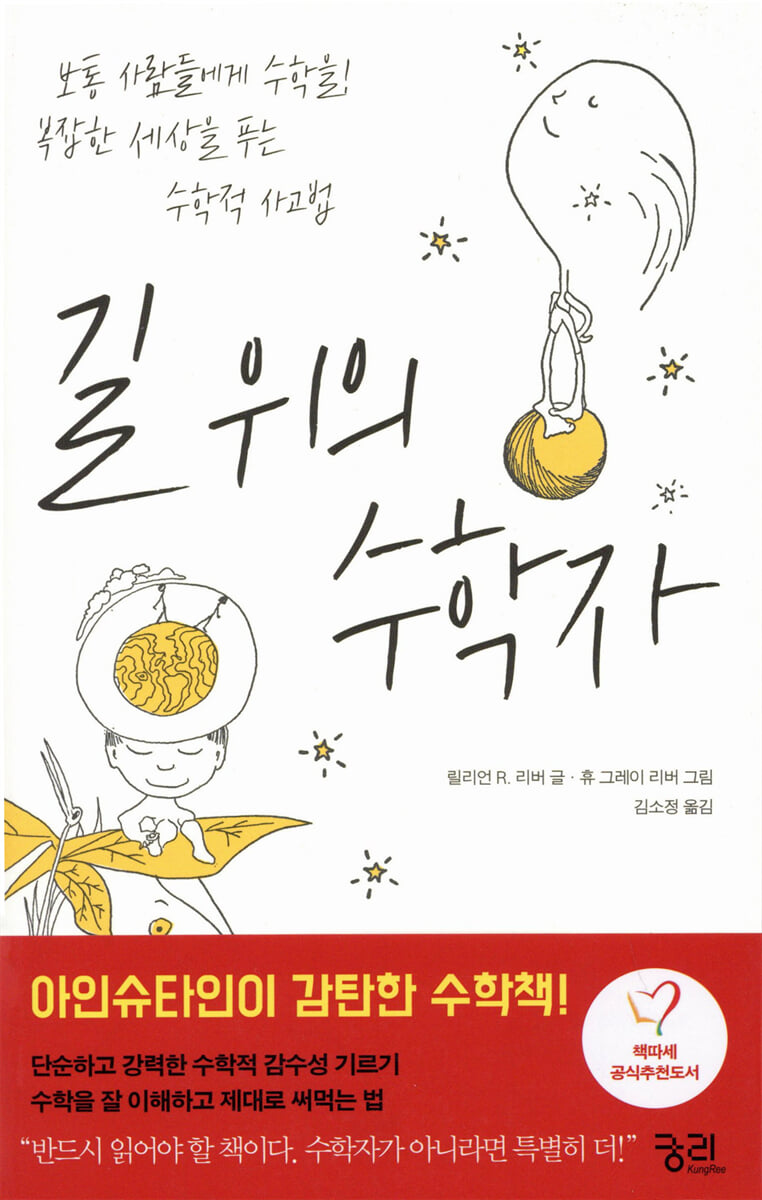
Mathematician on the Road
 |
Description
Book Introduction
We often call people who want to get closer to math but despair at the difficulty, get hurt and abandoned at some point, and eventually give up and let go of math a 'math dropout.'
However, the author of this book, Mathematicians on the Road, Lillian R.
River doesn't use the word "water blisters."
The author calls them 'ordinary people', or 'ordinary people'.
And so, a special math book for all the ordinary people in the world began!
A math book that Albert Einstein and Eric Temple Bell admired!
Meet a special math journey for all the 'ordinary people' in the world!
The power of mathematical thinking that clearly explains the complex world!
★ A must-read math book published 75 years ago and read across generations ★
2 plus 2 may not be 4.
The sum of the three angles of a triangle may not be 180 degrees.
There can be two parallel lines passing through a point.
Did you know?
This book, "The Mathematician on the Road," which teaches "how to think more freely in the world of mathematics" from a creative and interesting perspective, was first published about 75 years ago in 1942, and is a classic must-read in the field of mathematics that is still consistently read by readers of all generations, regardless of age or gender.
This book demonstrates the wonders of clear and powerful mathematical thinking and explains in an easy and fun way how modern mathematical topics such as algebra, equations, trigonometry, and calculus can be applied to our daily lives, further awakening the beauty of mathematics and confidence in studying it.
However, the author of this book, Mathematicians on the Road, Lillian R.
River doesn't use the word "water blisters."
The author calls them 'ordinary people', or 'ordinary people'.
And so, a special math book for all the ordinary people in the world began!
A math book that Albert Einstein and Eric Temple Bell admired!
Meet a special math journey for all the 'ordinary people' in the world!
The power of mathematical thinking that clearly explains the complex world!
★ A must-read math book published 75 years ago and read across generations ★
2 plus 2 may not be 4.
The sum of the three angles of a triangle may not be 180 degrees.
There can be two parallel lines passing through a point.
Did you know?
This book, "The Mathematician on the Road," which teaches "how to think more freely in the world of mathematics" from a creative and interesting perspective, was first published about 75 years ago in 1942, and is a classic must-read in the field of mathematics that is still consistently read by readers of all generations, regardless of age or gender.
This book demonstrates the wonders of clear and powerful mathematical thinking and explains in an easy and fun way how modern mathematical topics such as algebra, equations, trigonometry, and calculus can be applied to our daily lives, further awakening the beauty of mathematics and confidence in studying it.
- You can preview some of the book's contents.
Preview
index
Introduction
Who is our hero, Mr. Botong?
Part 1.
Old mathematics
01.
50 million people can't be wrong
02.
Let's not hit the ceiling!
03.
The answer is, is it very thin paper?
04.
generalization
05.
The totem tower we built
06.
Totem Tower (continued)
07.
abstraction
08.
Define the terms
09.
wedding ceremony
10.
descendants
11.
Part 1 Summary
Part 2.
New mathematics
12.
New education
13.
common sense
14.
Freedom and indulgence
15.
Pride and Prejudice
16.
2 plus 2 may not be 4!
17.
Abstract-Modern style
18.
4th dimension
19.
preparedness
20.
Modern people
Keep in mind!
Translator's Note
Who is our hero, Mr. Botong?
Part 1.
Old mathematics
01.
50 million people can't be wrong
02.
Let's not hit the ceiling!
03.
The answer is, is it very thin paper?
04.
generalization
05.
The totem tower we built
06.
Totem Tower (continued)
07.
abstraction
08.
Define the terms
09.
wedding ceremony
10.
descendants
11.
Part 1 Summary
Part 2.
New mathematics
12.
New education
13.
common sense
14.
Freedom and indulgence
15.
Pride and Prejudice
16.
2 plus 2 may not be 4!
17.
Abstract-Modern style
18.
4th dimension
19.
preparedness
20.
Modern people
Keep in mind!
Translator's Note
Detailed image
Publisher's Review
“I am confident that this book by Lillian Lieber will receive the recognition it deserves!”
- Albert Einstein
“It is a very skillful and really lighthearted way of displaying the essence of mathematical sensibility in a wonderful way.
“These are stories that everyone should know.” - Barry Merzur, Professor of Mathematics, Harvard University
“This is a must-read book.
Especially if you are not a mathematician.”
- Eric Temple Bell, author of Men of Mathematics
We often call people who want to get closer to math but despair at the difficulty, get hurt and abandoned at some point, and eventually give up and let go of math a 'math dropout.'
However, the author of this book, Mathematicians on the Road, Lillian R.
River doesn't use the word "water blisters."
The author calls them 'ordinary people', or 'ordinary people'.
And so, a special math book for all the ordinary people in the world began!
A math book that Albert Einstein and Eric Temple Bell admired!
Meet a special math journey for all the 'ordinary people' in the world!
The power of mathematical thinking that clearly explains the complex world!
★ A must-read math book published 75 years ago and read across generations ★
2 plus 2 may not be 4.
The sum of the three angles of a triangle may not be 180 degrees.
There can be two parallel lines passing through a point.
Did you know?
This book, "The Mathematician on the Road," which teaches "how to think more freely in the world of mathematics" from a creative and interesting perspective, was first published about 75 years ago in 1942, and is a classic must-read in the field of mathematics that is still consistently read by readers of all generations, regardless of age or gender.
This book demonstrates the wonders of clear and powerful mathematical thinking and explains in an easy and fun way how modern mathematical topics such as algebra, equations, trigonometry, and calculus can be applied to our daily lives, further awakening the beauty of mathematics and confidence in studying it.
“At the beginning of the book, the authors present three easy-to-solve problems.
It's a matter of choosing a job, a matter of stacking paper napkins, a matter of wrapping a belt around the Earth's equator.
If you choose an answer to any of the three questions without thinking deeply, you are likely to get it wrong.
There are many problems in this world that you think about at first glance and then get wrong.
It's not just a question of putting numbers into perspective.
Mathematics asks us not to be impatient, not to have preconceived notions, not to take things lightly.
Mathematics is a tool that gives us the opportunity to think deeply and develops our ability to think deeply.
I believe that the process of thinking through various thoughts rather than finding the answer through calculations is a meaningful means of improving thinking skills.
There is perhaps no better friend than mathematics to cultivate the ability to think twice before speaking or acting.
This book, “Mathematician on the Road,” is a book that can be read with interest in mathematics by anyone who likes mathematics, by anyone who is interested in mathematics but finds it too difficult to approach, and even by anyone who is not interested in mathematics but happens to pick up this book. - From an interview with the translator
A math story that you learn by savoring each line as if reading a piece of free poetry.
How to understand and use mathematics effectively, and develop a simple yet powerful mathematical sensibility!
“Don’t be impatient, don’t be prejudiced, don’t take things lightly!”
This book, which basically teaches how to think using mathematics, is light, not heavy, and is fun to read.
It's not too light, but it's serious.
Although there are calculation problems, the problems are presented in a way that anyone can think about without having to memorize difficult equations.
Although it deals with a somewhat heavy topic of the nature of mathematics and its impact on modern people (their thought systems, cognitive abilities, and lifestyles), it is a light and brisk read, which is a testament to the two authors, writer Lillian R.
Thanks to the efforts of River and artist Gray River.
Author Lillian R.
Lillian Rosanoff Lieber (1886–1986) was head of the physics department at Wells College in 1917, taught at Connecticut College from 1918 to 1920, and chaired the mathematics department at Long Island University from 1934 to 1954.
Having been in the classroom for a long time, she felt that there were limitations to the conventional mathematics education methods taught in schools. She actively wrote to create a new and popular educational book that was not bound by conventions in order to draw out students' curiosity and creativity, and this book, 『The Education of T.
C. Mits) was published.
[The original title of this book is “The Education of T.
C. Mits” can be directly translated as ‘a famous person on the street—an ordinary, common person—teaching’, while ‘T.
C. Mits' is a term that can be translated as 'ordinary person' or 'ordinary person', and is a new word (for the time) created by Lillian Lieber.
The text of the book is written in a distinctly different style from existing mathematics books.
It is like reading a piece of free verse and telling a story about mathematics.
As the author begins the text, he clearly states that the reason he writes the text in this free verse format is to help readers understand.
The author's intention to make the subject of mathematics, which can be difficult even without it, easier to read and understand by breaking it up into poems rather than writing long prose pieces was quite successful.
As readers progress through the book, they will naturally have time to reflect between lines and gradually open the path to deeper mathematical thinking.
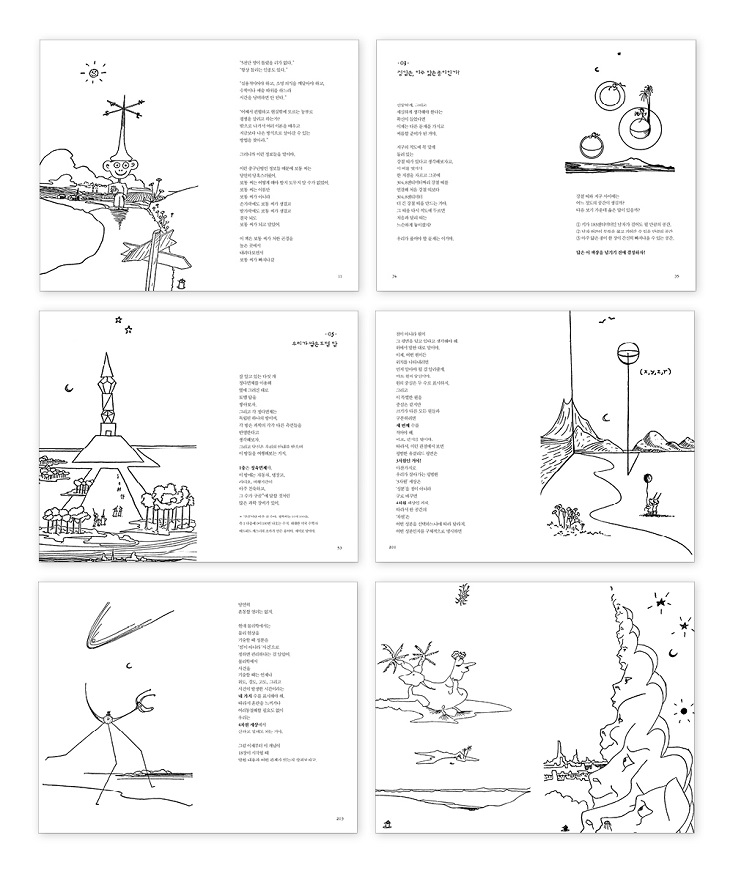
Another highlight of this book is the 50 or so illustrations in the text.
Hugh Gray Lieber (1896-1961), a professor and head of the Department of Fine Arts at Long Island University, is the illustrator of this book. He cheerfully and wittily depicts the figure of Mr. Ordinary, who appears wearing a hyperbolic hat and tries to find his center and position in the vast background of the complex labyrinth of reality and the pinnacle of mathematics, adding fun and interest.
For readers who are tired of the numbers and formulas in existing math books, looking at the pictures in this book can be a good way to become familiar with math.
“Common people, let’s learn math!”
A great guide to start thinking deeply!
Into a feast of thoughts that crosses life, mathematics, philosophy, and science!
The surprisingly simple problems the authors present to us in the text—such as what happens when you untie the belt that holds the Earth's equator, stretch it a little longer, and then wrap it again (Chapter 3)—work a mysterious magic that forces us to think quantitatively and deeply before we even realize what is actually happening.
The authors invite us to the concepts of arithmetic, algebra, and generalization (Chapter 4), the tower of mathematics (Chapters 5-6), logic and definition (Chapter 7), the problem of terminology (Chapter 8), and the wedding of algebra and geometry (Chapter 9), allowing us to think about various problems we encounter in daily life and how to solve them.
They also persuade us by presenting a subtly wrong hypothesis with figures of their own drawing, using the fascinating but false evidence of Euclidean geometry, with faces that cannot be seen (Chapter 13).
Then, we explain why the hypothesis is wrong and tell us what we must keep in mind.
We also provide a brief introduction to calculus (Chapter 10), which alone will give readers a sufficient understanding of what makes calculus special.
The authors also give a brief introduction to finite geometry (Chapter 15), explaining it in a fluid manner using the same method used to establish axioms in geometry, so there is no need to use abstract concepts.
We just have to look.
The authors employ similar magic when explaining finite arithmetic (Chapter 16).
Furthermore, it explains the 4th dimension (Chapter 18) and provides a nodding explanation of relativity.
In this way, in the text, which consists of 2 parts and 20 chapters, the authors explain difficult mathematical concepts in a simple and fun way that anyone can understand, using their unique humor and illustrations.
Furthermore, he shares with readers numerous ideas that transcend mathematics, life, philosophy, and science, and reflects on the lessons hidden within them that must be kept in mind.
Those who love math, those who are interested in math but find it too difficult to approach, and even those who have no interest in math but happen to pick up this book will find sparkling ideas that will help them in their daily lives if they take a short time to read it.
Recommendation
“I am confident that this book by Lillian Lieber will receive the recognition it deserves!” - Albert Einstein
“A delightful book!” - The New York Times
“The authors of this book have a special talent.
The talent for writing math books that anyone can read, the talent for selecting precisely the concepts that must be explained in order to capture the essence that makes math real, the talent for writing books that, once you start reading, you can't put it down, the talent for making small, economical softcover books that fit in a small bag.
This book beautifully unfolds the essence of mathematical sensibility in a very skillful and truly lighthearted way.
“These are stories that everyone should know.” - Barry Merzur, Professor of Mathematics, Harvard University
“This is a must-read book.
“Especially if you’re not a mathematician.” - Eric Temple Bell, author of Men of Mathematics
“The text and illustrations in this book are original, entertaining, and informative!” - Saturday Literary Review
- Albert Einstein
“It is a very skillful and really lighthearted way of displaying the essence of mathematical sensibility in a wonderful way.
“These are stories that everyone should know.” - Barry Merzur, Professor of Mathematics, Harvard University
“This is a must-read book.
Especially if you are not a mathematician.”
- Eric Temple Bell, author of Men of Mathematics
We often call people who want to get closer to math but despair at the difficulty, get hurt and abandoned at some point, and eventually give up and let go of math a 'math dropout.'
However, the author of this book, Mathematicians on the Road, Lillian R.
River doesn't use the word "water blisters."
The author calls them 'ordinary people', or 'ordinary people'.
And so, a special math book for all the ordinary people in the world began!
A math book that Albert Einstein and Eric Temple Bell admired!
Meet a special math journey for all the 'ordinary people' in the world!
The power of mathematical thinking that clearly explains the complex world!
★ A must-read math book published 75 years ago and read across generations ★
2 plus 2 may not be 4.
The sum of the three angles of a triangle may not be 180 degrees.
There can be two parallel lines passing through a point.
Did you know?
This book, "The Mathematician on the Road," which teaches "how to think more freely in the world of mathematics" from a creative and interesting perspective, was first published about 75 years ago in 1942, and is a classic must-read in the field of mathematics that is still consistently read by readers of all generations, regardless of age or gender.
This book demonstrates the wonders of clear and powerful mathematical thinking and explains in an easy and fun way how modern mathematical topics such as algebra, equations, trigonometry, and calculus can be applied to our daily lives, further awakening the beauty of mathematics and confidence in studying it.
“At the beginning of the book, the authors present three easy-to-solve problems.
It's a matter of choosing a job, a matter of stacking paper napkins, a matter of wrapping a belt around the Earth's equator.
If you choose an answer to any of the three questions without thinking deeply, you are likely to get it wrong.
There are many problems in this world that you think about at first glance and then get wrong.
It's not just a question of putting numbers into perspective.
Mathematics asks us not to be impatient, not to have preconceived notions, not to take things lightly.
Mathematics is a tool that gives us the opportunity to think deeply and develops our ability to think deeply.
I believe that the process of thinking through various thoughts rather than finding the answer through calculations is a meaningful means of improving thinking skills.
There is perhaps no better friend than mathematics to cultivate the ability to think twice before speaking or acting.
This book, “Mathematician on the Road,” is a book that can be read with interest in mathematics by anyone who likes mathematics, by anyone who is interested in mathematics but finds it too difficult to approach, and even by anyone who is not interested in mathematics but happens to pick up this book. - From an interview with the translator
A math story that you learn by savoring each line as if reading a piece of free poetry.
How to understand and use mathematics effectively, and develop a simple yet powerful mathematical sensibility!
“Don’t be impatient, don’t be prejudiced, don’t take things lightly!”
This book, which basically teaches how to think using mathematics, is light, not heavy, and is fun to read.
It's not too light, but it's serious.
Although there are calculation problems, the problems are presented in a way that anyone can think about without having to memorize difficult equations.
Although it deals with a somewhat heavy topic of the nature of mathematics and its impact on modern people (their thought systems, cognitive abilities, and lifestyles), it is a light and brisk read, which is a testament to the two authors, writer Lillian R.
Thanks to the efforts of River and artist Gray River.
Author Lillian R.
Lillian Rosanoff Lieber (1886–1986) was head of the physics department at Wells College in 1917, taught at Connecticut College from 1918 to 1920, and chaired the mathematics department at Long Island University from 1934 to 1954.
Having been in the classroom for a long time, she felt that there were limitations to the conventional mathematics education methods taught in schools. She actively wrote to create a new and popular educational book that was not bound by conventions in order to draw out students' curiosity and creativity, and this book, 『The Education of T.
C. Mits) was published.
[The original title of this book is “The Education of T.
C. Mits” can be directly translated as ‘a famous person on the street—an ordinary, common person—teaching’, while ‘T.
C. Mits' is a term that can be translated as 'ordinary person' or 'ordinary person', and is a new word (for the time) created by Lillian Lieber.
The text of the book is written in a distinctly different style from existing mathematics books.
It is like reading a piece of free verse and telling a story about mathematics.
As the author begins the text, he clearly states that the reason he writes the text in this free verse format is to help readers understand.
The author's intention to make the subject of mathematics, which can be difficult even without it, easier to read and understand by breaking it up into poems rather than writing long prose pieces was quite successful.
As readers progress through the book, they will naturally have time to reflect between lines and gradually open the path to deeper mathematical thinking.
Another highlight of this book is the 50 or so illustrations in the text.
Hugh Gray Lieber (1896-1961), a professor and head of the Department of Fine Arts at Long Island University, is the illustrator of this book. He cheerfully and wittily depicts the figure of Mr. Ordinary, who appears wearing a hyperbolic hat and tries to find his center and position in the vast background of the complex labyrinth of reality and the pinnacle of mathematics, adding fun and interest.
For readers who are tired of the numbers and formulas in existing math books, looking at the pictures in this book can be a good way to become familiar with math.
“Common people, let’s learn math!”
A great guide to start thinking deeply!
Into a feast of thoughts that crosses life, mathematics, philosophy, and science!
The surprisingly simple problems the authors present to us in the text—such as what happens when you untie the belt that holds the Earth's equator, stretch it a little longer, and then wrap it again (Chapter 3)—work a mysterious magic that forces us to think quantitatively and deeply before we even realize what is actually happening.
The authors invite us to the concepts of arithmetic, algebra, and generalization (Chapter 4), the tower of mathematics (Chapters 5-6), logic and definition (Chapter 7), the problem of terminology (Chapter 8), and the wedding of algebra and geometry (Chapter 9), allowing us to think about various problems we encounter in daily life and how to solve them.
They also persuade us by presenting a subtly wrong hypothesis with figures of their own drawing, using the fascinating but false evidence of Euclidean geometry, with faces that cannot be seen (Chapter 13).
Then, we explain why the hypothesis is wrong and tell us what we must keep in mind.
We also provide a brief introduction to calculus (Chapter 10), which alone will give readers a sufficient understanding of what makes calculus special.
The authors also give a brief introduction to finite geometry (Chapter 15), explaining it in a fluid manner using the same method used to establish axioms in geometry, so there is no need to use abstract concepts.
We just have to look.
The authors employ similar magic when explaining finite arithmetic (Chapter 16).
Furthermore, it explains the 4th dimension (Chapter 18) and provides a nodding explanation of relativity.
In this way, in the text, which consists of 2 parts and 20 chapters, the authors explain difficult mathematical concepts in a simple and fun way that anyone can understand, using their unique humor and illustrations.
Furthermore, he shares with readers numerous ideas that transcend mathematics, life, philosophy, and science, and reflects on the lessons hidden within them that must be kept in mind.
Those who love math, those who are interested in math but find it too difficult to approach, and even those who have no interest in math but happen to pick up this book will find sparkling ideas that will help them in their daily lives if they take a short time to read it.
Recommendation
“I am confident that this book by Lillian Lieber will receive the recognition it deserves!” - Albert Einstein
“A delightful book!” - The New York Times
“The authors of this book have a special talent.
The talent for writing math books that anyone can read, the talent for selecting precisely the concepts that must be explained in order to capture the essence that makes math real, the talent for writing books that, once you start reading, you can't put it down, the talent for making small, economical softcover books that fit in a small bag.
This book beautifully unfolds the essence of mathematical sensibility in a very skillful and truly lighthearted way.
“These are stories that everyone should know.” - Barry Merzur, Professor of Mathematics, Harvard University
“This is a must-read book.
“Especially if you’re not a mathematician.” - Eric Temple Bell, author of Men of Mathematics
“The text and illustrations in this book are original, entertaining, and informative!” - Saturday Literary Review
GOODS SPECIFICS
- Date of publication: August 17, 2016
- Page count, weight, size: 244 pages | 366g | 130*205*20mm
- ISBN13: 9788958203919
- ISBN10: 8958203919
You may also like
카테고리
korean


korean

![GQ KOREA Mark (Monthly): December [2025]](http://librairie.coreenne.fr/cdn/shop/files/8ef265dbbfbf186523ed75ba7319009d.jpg?v=1765340328&width=3840)


