

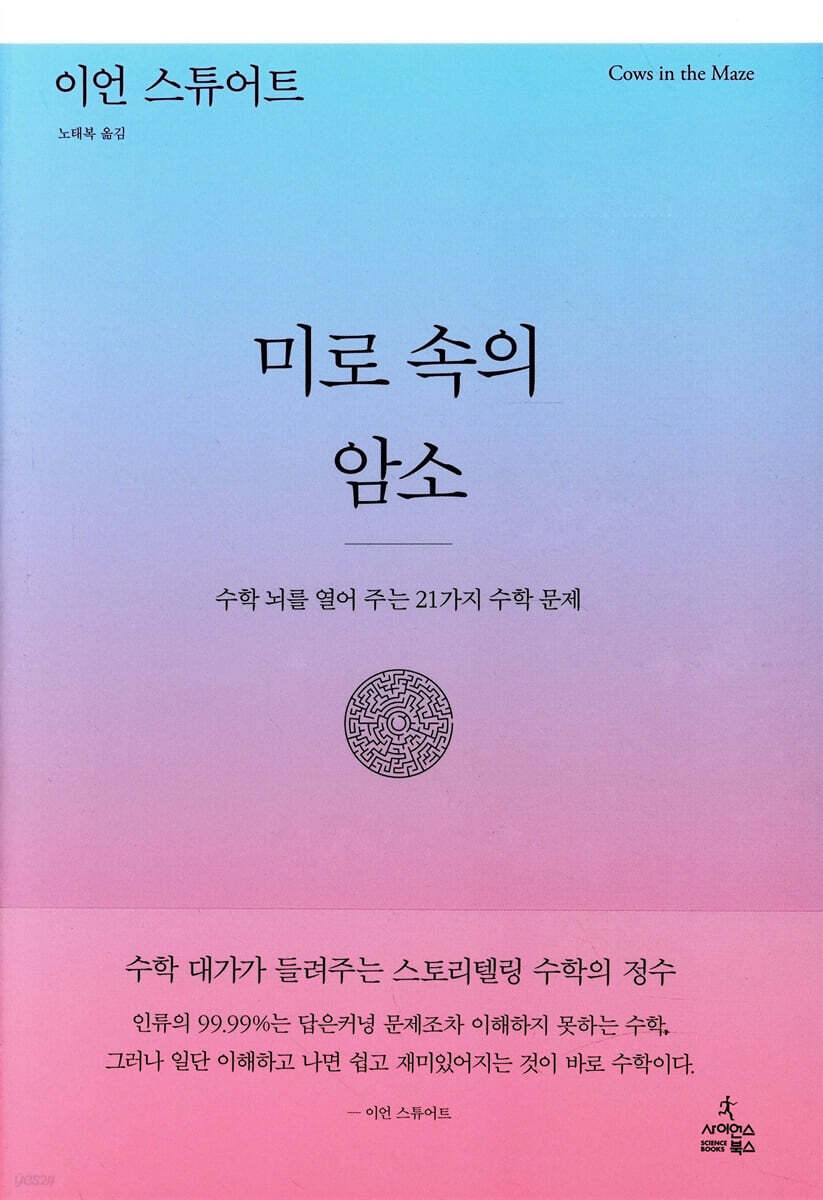
Cow in the Maze
 |
Description
Book Introduction
The Essence of Mathematics: Storytelling from a Mathematics Master
Scientific American's popular math columns in one volume!
The math in this book is fun.
- Ian Stewart
Parents preparing for pregnancy and childbirth are immersing themselves in studying math for 'math prenatal education.'
This part is similar to the way students solve math problems to raise their math ability test scores.
Wouldn't it be great if there was a way to find joy in math without stress? As someone who appreciates the beauty of mathematics more than anyone else and loves it, British mathematician Ian Stewart offers a novel proposal to make math accessible to non-mathematicians.
In the vast and rich world of mathematics, the mathematics in textbooks is only a very small part.
In "The Cow in the Maze," the author advises not to get hung up on difficult content but to move forward somehow.
Sometimes, things become more understandable after they've passed, and you can always go back and try again.
Ian Stewart, who decided to become a mathematician after reading Martin Gardner's mathematics column in Scientific American as a child, majored in mathematics at Cambridge University in England, received his doctorate from the University of Warwick, and is currently an honorary professor at the University of Warwick.
Cows in the Maze: And Other Mathematical Explorations, published by Science Books, is a compilation of 21 carefully selected articles from the mathematics columns written by Ian Stewart, "Britain's most outstanding mathematics writer," for the American and French editions of Scientific American, along with feedback and additional information sent in by readers.
This book serves as a light yet solid bridge between 『The Mathematics of Life: A Revolution in 21st-Century Mathematics and Biology』 and 『17 Equations that Changed the World』(currently in print).
Some of the most difficult problems in mathematics are inspired by everyday life. - From the text
Scientific American's popular math columns in one volume!
The math in this book is fun.
- Ian Stewart
Parents preparing for pregnancy and childbirth are immersing themselves in studying math for 'math prenatal education.'
This part is similar to the way students solve math problems to raise their math ability test scores.
Wouldn't it be great if there was a way to find joy in math without stress? As someone who appreciates the beauty of mathematics more than anyone else and loves it, British mathematician Ian Stewart offers a novel proposal to make math accessible to non-mathematicians.
In the vast and rich world of mathematics, the mathematics in textbooks is only a very small part.
In "The Cow in the Maze," the author advises not to get hung up on difficult content but to move forward somehow.
Sometimes, things become more understandable after they've passed, and you can always go back and try again.
Ian Stewart, who decided to become a mathematician after reading Martin Gardner's mathematics column in Scientific American as a child, majored in mathematics at Cambridge University in England, received his doctorate from the University of Warwick, and is currently an honorary professor at the University of Warwick.
Cows in the Maze: And Other Mathematical Explorations, published by Science Books, is a compilation of 21 carefully selected articles from the mathematics columns written by Ian Stewart, "Britain's most outstanding mathematics writer," for the American and French editions of Scientific American, along with feedback and additional information sent in by readers.
This book serves as a light yet solid bridge between 『The Mathematics of Life: A Revolution in 21st-Century Mathematics and Biology』 and 『17 Equations that Changed the World』(currently in print).
Some of the most difficult problems in mathematics are inspired by everyday life. - From the text
- You can preview some of the book's contents.
Preview
index
Entering 5
1 The Exciting Secret of Dice 13
2 Polygonal Privacy 31
3 Connect to win 41
4 Jumping Champion 53
5 Walking with Four-Legged Animals 67
6 Tiling with Knots 87
7 Towards the Future 1.
Trapped in Time! 99
8 Towards the future 2.
Holes: Black Holes, White Holes, Wormholes 115
9 Towards the future 3.
Back to the past 131
10 Twisted Cone 153
11 What shape are teardrops? 163
12 Interrogator's Errors 181
13 Cows in the Maze 199
14 The Journey of the Knight 215
15 Cat's Cradle Calculation Challenge 227
16 Glass Klein Bottles 239
17 A Relationship as Solid as Cement 251
Challenge yourself with 18 knots and discover new mathematical possibilities! 263
19 The Most Perfect Magic Square 275
20 That can't be! 289
21 Dance with the Dodecahedron 299
Further Reading 308
Copyright 315
Search 316
1 The Exciting Secret of Dice 13
2 Polygonal Privacy 31
3 Connect to win 41
4 Jumping Champion 53
5 Walking with Four-Legged Animals 67
6 Tiling with Knots 87
7 Towards the Future 1.
Trapped in Time! 99
8 Towards the future 2.
Holes: Black Holes, White Holes, Wormholes 115
9 Towards the future 3.
Back to the past 131
10 Twisted Cone 153
11 What shape are teardrops? 163
12 Interrogator's Errors 181
13 Cows in the Maze 199
14 The Journey of the Knight 215
15 Cat's Cradle Calculation Challenge 227
16 Glass Klein Bottles 239
17 A Relationship as Solid as Cement 251
Challenge yourself with 18 knots and discover new mathematical possibilities! 263
19 The Most Perfect Magic Square 275
20 That can't be! 289
21 Dance with the Dodecahedron 299
Further Reading 308
Copyright 315
Search 316
Publisher's Review
21 Math Problems to Enjoy with Great Mathematician Ian Stewart
This book covers number theory, geometry, topology, probability theory, combinatorics, fluid dynamics, mathematical physics, and various fields of applied mathematics.
Although these are grand names, in 『Cow in the Maze』 they come across as familiar, like a scene from a walking path in search of cows.
'The Cow in the Maze' is the title of Chapter 13 of the 21 Mathematical Explorations in this 21-chapter book.
The author suggests that each story can be read comfortably and enjoyably in any order.
"Chapter 1: The Exciting Secret of Dice" begins with the long history of dice games and explains what patterns can be discovered by probabilistically analyzing the sum of the numbers produced by rolling two dice.
In "Chapter 2 Polygonal Privacy," combinatorial geometry is introduced naturally by assuming that fences made of opaque materials used in dental clinics and art studios are formed into triangles, squares, pentagons, or circles, respectively.
"Connecting to Win 3 Cards" is a chapter that provides a quick look at how mathematical the board game Hex is.
It also shows the progression of the hex board with easy-to-understand markings using the board game Go stones, and helps you find the perfect move for the game.
Meanwhile, what is the most common interval between consecutive prime numbers? Chapter 4, "Jumping Champion," which covers this number, dubbed "Jumping Champion" by Princeton University's Conway, covers prime number theorem, prime factorials, and twin primes.
"Chapter 5 Walking with Four-Legged Beasts" introduces topology through a conversation between Jane and Tarzan about the walking styles of jungle animals.
This also contains the gait and symmetry problems that appear in Ian Stewart's book, The Mathematics of Life.
"Chapter 6: Tiling with Knots" introduces topology and knot problems by covering the topic of "plane packing," a popular topic in both hobby and mainstream mathematics.
Chapters 7-9, “Towards the Future,” are by H.
Inspired by H.G. Wells's The Time Machine, this is a story about exploring space and time through the mouth of a time traveler.
"Chapter 7: Trapped in Time!" begins with the special theory of relativity and the twin paradox.
In Chapter 8, Holes: Black Holes, White Holes, and Wormholes, the field of positional analysis is introduced through Newton's theory of gravity and Einstein's theory of general relativity.
Chapter 9, Back to the Past, concludes our journey through mathematically and physically possible worlds and cosmic strings.
"Chapter 10 Twisted Cones" begins with the geometry of conics, familiar since ancient Greece, and explores spherical cone arrangements and 3D forms.
In Chapter 11, "What Shape Are Teardrops?", a conversation between friends while drinking leads to changes in the shape of falling water drops.
"Chapter 12: Interrogator's Errors" examines the issues surrounding DNA profiling and jury errors, and examines the errors in probability theory through case studies.
You have to solve the maze to find the cow.
It's not a common maze, it's a logic maze.
All you need is two pencils.
The path through the maze changes depending on which pencil you choose.
And the cow is at the very end.
- In the text
The joy of logic that opens your mathematical brain!
"Chapter 13: Cows in the Maze" is a chapter that shows the logical reasoning behind why mazes, a staple of hobby mathematics, are serious mathematics.
Through the exciting process of discerning the truth from the falsehood of propositions and choosing a path through the maze, you can finally meet the cow.
"Chapter 14: The Knight's Journey" is also a puzzle with a long history.
The layout of the chessboard on which the knight's journey takes place is introduced with a picture.
"Chapter 15: The Cat's Cradle Calculus Challenge" begins with Kurt Vonnegut's novel's protagonist, Newt, being called a topologist.
Geometry, topology, and combinatorics are hidden in a very traditional cat's cradle.
"Chapter 16 Glass Klein Bottle" is an extension of the Möbius strip and leads to a unique topological exploration.
Chapter 17, "A Relationship as Solid as Cement," presents examples of how mathematical research is applied in various fields such as art and science, such as painting, sculpture, architecture, and dance.
"Chapter 18: A New World of Mathematics Opens Up When You Challenge Knots!" covers mainstream mathematics' efforts to discover geometric theories from knots, and "Chapter 19: The Most Perfect Magic Square" introduces reversible square arrays that become increasingly complex.
"Chapter 20: That Can't Be! " explains the process of proving that annoying problems in mathematics are either flawed or simply unfound errors.
And "Chapter 21: Dancing with the Dodecahedron" rediscovers the connection between mathematics and art by introducing a dance utilizing the aforementioned regular polyhedron problem.
The author reiterates that the dance of threading can be transformed into serious mathematical thinking.
When a lightbulb goes on in your head and you suddenly understand how math works, nothing can take that amazing feeling away. - From the text
This book covers number theory, geometry, topology, probability theory, combinatorics, fluid dynamics, mathematical physics, and various fields of applied mathematics.
Although these are grand names, in 『Cow in the Maze』 they come across as familiar, like a scene from a walking path in search of cows.
'The Cow in the Maze' is the title of Chapter 13 of the 21 Mathematical Explorations in this 21-chapter book.
The author suggests that each story can be read comfortably and enjoyably in any order.
"Chapter 1: The Exciting Secret of Dice" begins with the long history of dice games and explains what patterns can be discovered by probabilistically analyzing the sum of the numbers produced by rolling two dice.
In "Chapter 2 Polygonal Privacy," combinatorial geometry is introduced naturally by assuming that fences made of opaque materials used in dental clinics and art studios are formed into triangles, squares, pentagons, or circles, respectively.
"Connecting to Win 3 Cards" is a chapter that provides a quick look at how mathematical the board game Hex is.
It also shows the progression of the hex board with easy-to-understand markings using the board game Go stones, and helps you find the perfect move for the game.
Meanwhile, what is the most common interval between consecutive prime numbers? Chapter 4, "Jumping Champion," which covers this number, dubbed "Jumping Champion" by Princeton University's Conway, covers prime number theorem, prime factorials, and twin primes.
"Chapter 5 Walking with Four-Legged Beasts" introduces topology through a conversation between Jane and Tarzan about the walking styles of jungle animals.
This also contains the gait and symmetry problems that appear in Ian Stewart's book, The Mathematics of Life.
"Chapter 6: Tiling with Knots" introduces topology and knot problems by covering the topic of "plane packing," a popular topic in both hobby and mainstream mathematics.
Chapters 7-9, “Towards the Future,” are by H.
Inspired by H.G. Wells's The Time Machine, this is a story about exploring space and time through the mouth of a time traveler.
"Chapter 7: Trapped in Time!" begins with the special theory of relativity and the twin paradox.
In Chapter 8, Holes: Black Holes, White Holes, and Wormholes, the field of positional analysis is introduced through Newton's theory of gravity and Einstein's theory of general relativity.
Chapter 9, Back to the Past, concludes our journey through mathematically and physically possible worlds and cosmic strings.
"Chapter 10 Twisted Cones" begins with the geometry of conics, familiar since ancient Greece, and explores spherical cone arrangements and 3D forms.
In Chapter 11, "What Shape Are Teardrops?", a conversation between friends while drinking leads to changes in the shape of falling water drops.
"Chapter 12: Interrogator's Errors" examines the issues surrounding DNA profiling and jury errors, and examines the errors in probability theory through case studies.
You have to solve the maze to find the cow.
It's not a common maze, it's a logic maze.
All you need is two pencils.
The path through the maze changes depending on which pencil you choose.
And the cow is at the very end.
- In the text
The joy of logic that opens your mathematical brain!
"Chapter 13: Cows in the Maze" is a chapter that shows the logical reasoning behind why mazes, a staple of hobby mathematics, are serious mathematics.
Through the exciting process of discerning the truth from the falsehood of propositions and choosing a path through the maze, you can finally meet the cow.
"Chapter 14: The Knight's Journey" is also a puzzle with a long history.
The layout of the chessboard on which the knight's journey takes place is introduced with a picture.
"Chapter 15: The Cat's Cradle Calculus Challenge" begins with Kurt Vonnegut's novel's protagonist, Newt, being called a topologist.
Geometry, topology, and combinatorics are hidden in a very traditional cat's cradle.
"Chapter 16 Glass Klein Bottle" is an extension of the Möbius strip and leads to a unique topological exploration.
Chapter 17, "A Relationship as Solid as Cement," presents examples of how mathematical research is applied in various fields such as art and science, such as painting, sculpture, architecture, and dance.
"Chapter 18: A New World of Mathematics Opens Up When You Challenge Knots!" covers mainstream mathematics' efforts to discover geometric theories from knots, and "Chapter 19: The Most Perfect Magic Square" introduces reversible square arrays that become increasingly complex.
"Chapter 20: That Can't Be! " explains the process of proving that annoying problems in mathematics are either flawed or simply unfound errors.
And "Chapter 21: Dancing with the Dodecahedron" rediscovers the connection between mathematics and art by introducing a dance utilizing the aforementioned regular polyhedron problem.
The author reiterates that the dance of threading can be transformed into serious mathematical thinking.
When a lightbulb goes on in your head and you suddenly understand how math works, nothing can take that amazing feeling away. - From the text
GOODS SPECIFICS
- Date of issue: August 15, 2015
- Format: Hardcover book binding method guide
- Page count, weight, size: 320 pages | 655g | 152*224*27mm
- ISBN13: 9788983717429
- ISBN10: 8983717424
You may also like
카테고리
korean


korean

![GQ KOREA Mark (Monthly): December [2025]](http://librairie.coreenne.fr/cdn/shop/files/8ef265dbbfbf186523ed75ba7319009d.jpg?v=1765340328&width=3840)


