

Why Beauty is Truth
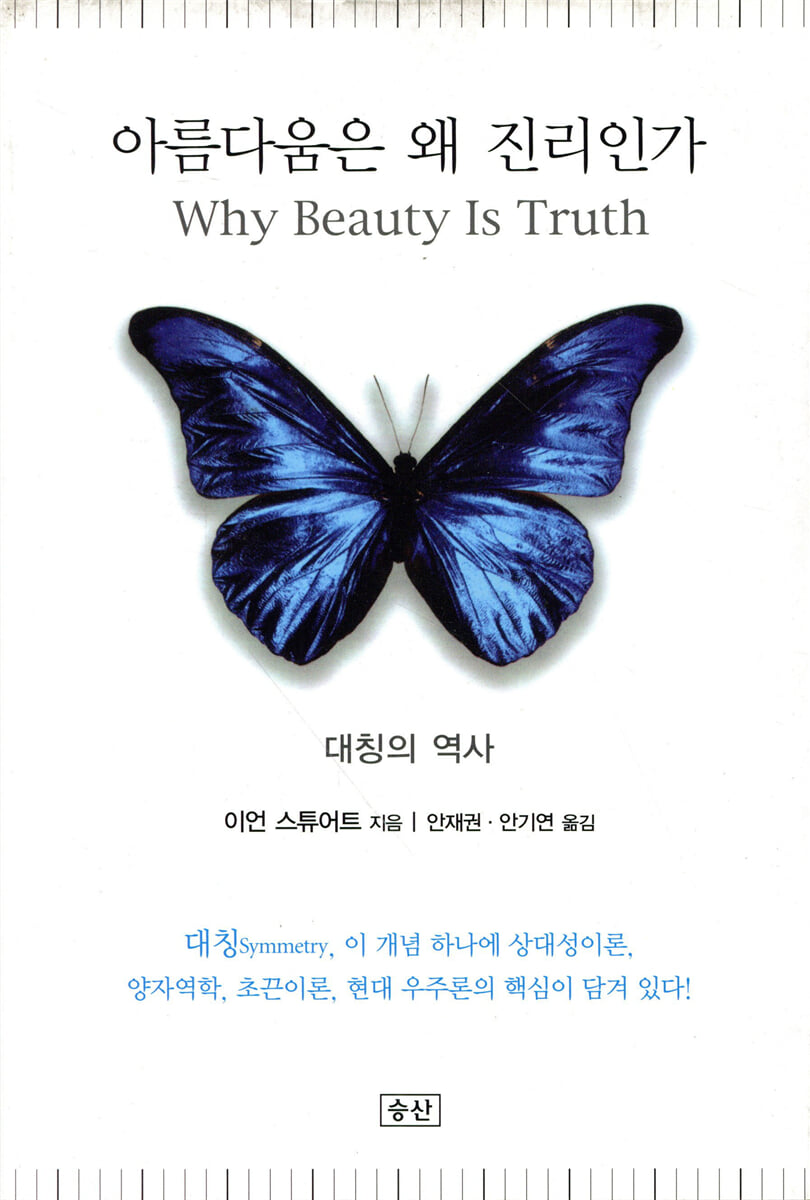 |
Description
Book Introduction
Symmetry, this one concept holds the key to relativity, quantum mechanics, string theory, and modern cosmology!
"Why Beauty is Truth" examines the relationship between mathematics and science (nature), that is, the relationship between beauty and truth, while also detailing the development of symmetry.
Symmetry, which emerged as the central idea of the most fundamental ideas that constitute physics and cosmology in the 20th century, is playing an increasingly important role not only in physics but also in various fields such as biotechnology, chemistry, art, and psychology.
The book tells the history of physics from ancient Babylonian times to modern times.
Its history is anything but ordinary, and the mathematicians who helped bring symmetry to dominance in mathematics and physics add dramatic depth and fascinating riddles to this story.
World-renowned mathematician Ian Stewart describes how symmetry became one of the most important concepts in science today, along with fascinating stories of bizarre and sometimes tragic geniuses.
"Why Beauty is Truth" will be a great introductory book for those interested in mathematics and science, leading them into the world of symmetry.
"Why Beauty is Truth" examines the relationship between mathematics and science (nature), that is, the relationship between beauty and truth, while also detailing the development of symmetry.
Symmetry, which emerged as the central idea of the most fundamental ideas that constitute physics and cosmology in the 20th century, is playing an increasingly important role not only in physics but also in various fields such as biotechnology, chemistry, art, and psychology.
The book tells the history of physics from ancient Babylonian times to modern times.
Its history is anything but ordinary, and the mathematicians who helped bring symmetry to dominance in mathematics and physics add dramatic depth and fascinating riddles to this story.
World-renowned mathematician Ian Stewart describes how symmetry became one of the most important concepts in science today, along with fascinating stories of bizarre and sometimes tragic geniuses.
"Why Beauty is Truth" will be a great introductory book for those interested in mathematics and science, leading them into the world of symmetry.
- You can preview some of the book's contents.
Preview
index
introduction
1.
The scribes of Babylon
2.
Signboard star
3.
Persian poet
4.
Gambling mathematician
5.
The fox that hides its footprints
6.
The frustrated doctor and the sickly genius
7.
The Unlucky Revolutionary
8.
An ordinary technician and an excellent professor
9.
Drunk person graffitied public facilities
10.
A soldier-to-be and a sickly bookworm
11.
Patent Office clerk
12.
Quantum Quintet
13.
The Man Who Lives in the 5th Dimension
14.
Political reporter
15.
Mathematicians in disarray
16.
People who seek truth and beauty
References
Search
1.
The scribes of Babylon
2.
Signboard star
3.
Persian poet
4.
Gambling mathematician
5.
The fox that hides its footprints
6.
The frustrated doctor and the sickly genius
7.
The Unlucky Revolutionary
8.
An ordinary technician and an excellent professor
9.
Drunk person graffitied public facilities
10.
A soldier-to-be and a sickly bookworm
11.
Patent Office clerk
12.
Quantum Quintet
13.
The Man Who Lives in the 5th Dimension
14.
Political reporter
15.
Mathematicians in disarray
16.
People who seek truth and beauty
References
Search
Publisher's Review
Confession of a world-renowned physicist,
"Beauty is a very successful criterion for choosing the right theory."
Nobel Prize winner in physics Murray Gell-Mann confessed this at the TED conference, which is known as a feast of the world's greatest minds.
It is not that we pursue a theory because it is more logical, but rather that we consider it true because it is beautiful.
Even when he discovered a new theory, he published it even though no less than seven experiments contradicted it.
The theory he discovered was so beautiful that it couldn't be wrong.
In fact, seven experiments that were inconsistent with the theory were later found to be faulty.
Gell-Mann says that Einstein also had a similar attitude toward the theory of relativity.
(Murray Gell-Mann's TED talk http://www.ted.com/talks/lang/eng/murray_gell_mann_on_beauty_and_truth_in_physics.html)
Why do scientists, who should be the most rational and logical of people, embrace the subjective and aesthetic standard of "beauty"? What exactly does "beauty" mean here? There are fundamental physical laws that govern the universe and this world.
And scientists discover these laws and express them mathematically.
At this time, when the mathematics is extremely simple, that is, when a theory is described mathematically in a concise expression without great complexity, it is called beauty.
From this perspective, the concept of beauty is closer to mathematics than to physics.
In fact, symmetry, which is an element of beauty, was developed in mathematics.
In "Why Beauty is Truth," Ian Stewart examines the relationship between mathematics and science (nature), that is, the relationship between beauty and truth, while also detailing the development of symmetry.
Symmetry, which emerged as the central idea of the most fundamental ideas that constitute physics and cosmology in the 20th century, is playing an increasingly important role not only in physics but also in various fields such as biotechnology, chemistry, art, and psychology.
However, the reality is that in Korea, there is still a significant lack of interest in and content related to symmetry.
"Why Beauty is Truth" will be a great introductory book for those interested in mathematics and science, leading them into the world of symmetry.
"Why Beauty is Truth: A History of Symmetry" fascinatingly blends the history of symmetry, developed over three thousand years, with the eccentric lives of mathematicians and the socio-cultural background of the time.
It also provides an answer to the intriguing mystery of how symmetry, developed in pure mathematics, became a key element in uncovering the laws of nature.
Symmetry originated from equations, not geometry?!
Symmetry did not originate in geometry, which is the path one might expect.
Rather, it is a concept that comes from algebra, which seems to have nothing to do with symmetry, and it is no exaggeration to say that the development of symmetry was the process of finding solutions to equations.
So most of the content of this book is about finding solutions to algebraic equations.
While it may seem like a bit of a technical topic, it's a fascinating exploration, and the quirky and dramatic lives of the leading scholars who studied it make it a fascinating read for anyone interested in mathematics and science.
Readers will learn about their love stories, duels, vicious arguments for dominance, and drinking habits, and along the way, how their mathematical thinking developed and how it changed our world.
The history of algebra, which began with Babylonian scholars' search for solutions to quadratic equations, flows as a story of countless scholars struggling to find solutions to equations of the nonexistent fifth degree.
At this time, the genius mathematician Galois, who died tragically at the age of 21, appears and proves that there is no solution to the 5th-degree equation and the reason for this, thereby moving on to the second topic of this book, groups.
Initially, the group was a means of analyzing the properties of what a 'solvable equation' was, but it was itself a new language for describing mathematical symmetry, and symmetry began to grow into a completely independent field in mathematics.
Starting with the era of Einstein and Heisenberg, when group theory revolutionized theoretical physics, the story moves on to the third topic of this book, fundamental physics.
Symmetry has now escaped the confines of mathematics.
As Murray Gell-Mann confessed, physicists believe that mathematical beauty is a prerequisite for physical truth.
Therefore, the process of unifying relativity and quantum theory, the two pillars that support modern physics, is considered a difficult mathematical task rather than a process requiring new and revolutionary experiments.
However, the author ends the book with the lingering thought that the answer to the question, “Why is beauty truth?” will remain a mystery that can never be solved.
We just ponder the complex relationship… …
"Beauty is a very successful criterion for choosing the right theory."
Nobel Prize winner in physics Murray Gell-Mann confessed this at the TED conference, which is known as a feast of the world's greatest minds.
It is not that we pursue a theory because it is more logical, but rather that we consider it true because it is beautiful.
Even when he discovered a new theory, he published it even though no less than seven experiments contradicted it.
The theory he discovered was so beautiful that it couldn't be wrong.
In fact, seven experiments that were inconsistent with the theory were later found to be faulty.
Gell-Mann says that Einstein also had a similar attitude toward the theory of relativity.
(Murray Gell-Mann's TED talk http://www.ted.com/talks/lang/eng/murray_gell_mann_on_beauty_and_truth_in_physics.html)
Why do scientists, who should be the most rational and logical of people, embrace the subjective and aesthetic standard of "beauty"? What exactly does "beauty" mean here? There are fundamental physical laws that govern the universe and this world.
And scientists discover these laws and express them mathematically.
At this time, when the mathematics is extremely simple, that is, when a theory is described mathematically in a concise expression without great complexity, it is called beauty.
From this perspective, the concept of beauty is closer to mathematics than to physics.
In fact, symmetry, which is an element of beauty, was developed in mathematics.
In "Why Beauty is Truth," Ian Stewart examines the relationship between mathematics and science (nature), that is, the relationship between beauty and truth, while also detailing the development of symmetry.
Symmetry, which emerged as the central idea of the most fundamental ideas that constitute physics and cosmology in the 20th century, is playing an increasingly important role not only in physics but also in various fields such as biotechnology, chemistry, art, and psychology.
However, the reality is that in Korea, there is still a significant lack of interest in and content related to symmetry.
"Why Beauty is Truth" will be a great introductory book for those interested in mathematics and science, leading them into the world of symmetry.
"Why Beauty is Truth: A History of Symmetry" fascinatingly blends the history of symmetry, developed over three thousand years, with the eccentric lives of mathematicians and the socio-cultural background of the time.
It also provides an answer to the intriguing mystery of how symmetry, developed in pure mathematics, became a key element in uncovering the laws of nature.
Symmetry originated from equations, not geometry?!
Symmetry did not originate in geometry, which is the path one might expect.
Rather, it is a concept that comes from algebra, which seems to have nothing to do with symmetry, and it is no exaggeration to say that the development of symmetry was the process of finding solutions to equations.
So most of the content of this book is about finding solutions to algebraic equations.
While it may seem like a bit of a technical topic, it's a fascinating exploration, and the quirky and dramatic lives of the leading scholars who studied it make it a fascinating read for anyone interested in mathematics and science.
Readers will learn about their love stories, duels, vicious arguments for dominance, and drinking habits, and along the way, how their mathematical thinking developed and how it changed our world.
The history of algebra, which began with Babylonian scholars' search for solutions to quadratic equations, flows as a story of countless scholars struggling to find solutions to equations of the nonexistent fifth degree.
At this time, the genius mathematician Galois, who died tragically at the age of 21, appears and proves that there is no solution to the 5th-degree equation and the reason for this, thereby moving on to the second topic of this book, groups.
Initially, the group was a means of analyzing the properties of what a 'solvable equation' was, but it was itself a new language for describing mathematical symmetry, and symmetry began to grow into a completely independent field in mathematics.
Starting with the era of Einstein and Heisenberg, when group theory revolutionized theoretical physics, the story moves on to the third topic of this book, fundamental physics.
Symmetry has now escaped the confines of mathematics.
As Murray Gell-Mann confessed, physicists believe that mathematical beauty is a prerequisite for physical truth.
Therefore, the process of unifying relativity and quantum theory, the two pillars that support modern physics, is considered a difficult mathematical task rather than a process requiring new and revolutionary experiments.
However, the author ends the book with the lingering thought that the answer to the question, “Why is beauty truth?” will remain a mystery that can never be solved.
We just ponder the complex relationship… …
GOODS SPECIFICS
- Date of issue: March 12, 2010
- Page count, weight, size: 424 pages | 654g | 148*210*30mm
- ISBN13: 9788961390323
- ISBN10: 8961390325
You may also like
카테고리
korean


korean

![GQ KOREA Mark (Monthly): December [2025]](http://librairie.coreenne.fr/cdn/shop/files/8ef265dbbfbf186523ed75ba7319009d.jpg?v=1765340328&width=3840)


