

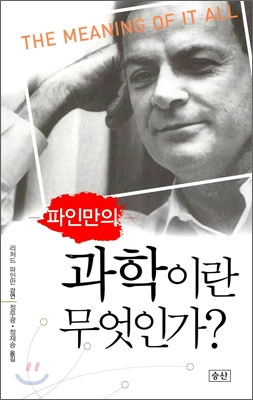
What is Feynman's science?
 |
Description
Book Introduction
A compilation of lectures given by physicist Richard Feynman at the University of Washington in 1963.
The lecture was delivered over three sessions, and he discussed what science is and how scientific thinking impacts other areas of society.
In his first lecture, he clearly explains what science is and points out some common misconceptions people have about science.
And he emphasizes that science allows us to look at the same problem with deeper insight through a single solution and further challenges us to take on new problems.
The second lecture deals with the scope and limits of science, especially the relationship between science and religion, and the third lecture, titled 'An Unscientific Age', explores the irrational aspects of society through several examples.
"What Is Feynman's Science?" contains the life of the brilliant physicist Richard Feynman, as well as his thoughts on religion, politics, and science, without any exaggeration.
The lecture was delivered over three sessions, and he discussed what science is and how scientific thinking impacts other areas of society.
In his first lecture, he clearly explains what science is and points out some common misconceptions people have about science.
And he emphasizes that science allows us to look at the same problem with deeper insight through a single solution and further challenges us to take on new problems.
The second lecture deals with the scope and limits of science, especially the relationship between science and religion, and the third lecture, titled 'An Unscientific Age', explores the irrational aspects of society through several examples.
"What Is Feynman's Science?" contains the life of the brilliant physicist Richard Feynman, as well as his thoughts on religion, politics, and science, without any exaggeration.
- You can preview some of the book's contents.
Preview
index
tribute
01 On the uncertainty of science
02 On the uncertainty of value
03 In the midst of an unscientific era
Translator's Note
Feynman's introduction
Search
01 On the uncertainty of science
02 On the uncertainty of value
03 In the midst of an unscientific era
Translator's Note
Feynman's introduction
Search
Into the book
Translator's Note
There's something special about Feynman.
Richard Feynman, a physicist who has already become a world-renowned icon.
He was a man with a natural talent for solving new problems with a scientific mindset.
In 1948, he solved a difficult problem in quantum electrodynamics (QED) with an original idea called the 'Feynman diagram', and presented a new way of understanding the microscopic world, for which he received the Nobel Prize in Physics in 1965.
His remarkable abilities shone even in areas far removed from his own field of expertise, such as when he discovered in a matter of weeks why the Challenger space shuttle exploded in 1986 and when he personally proved through experiments that Uri Geller, a psychic, was a fraud.
It is a well-known fact that he was the first person to come up with the concept of nanotechnology, which is in the spotlight these days.
The way he solved problems was always 'clear'.
It's like mixing the best parts of Columbo and Sherlock Holmes.
His ability to explain particularly difficult physics concepts in an easy-to-understand manner remains legendary, even decades later.
In other words, as a physics teacher, he was exceptional enough to be remembered in history.
Add to that his exceptional sense of humor, cheerful personality, and striking good looks—what more could you ask for? For these reasons, Feynman was constantly labeled with nicknames like "the Great Explainer" and "the Elvis Presley of science."
The Feynman Lectures on Physics series published by Seungsan Publishing.
As a young graduate student, he worked on the Manhattan Project, which created the first atomic bomb. He led the group that did the calculations, and he enjoyed learning how to open dial locks, sneaking into the safes of guards and colleagues, and leaving notes with his signature saying, “I was here.”
This childlike enjoyment of mischievous pranks continued throughout his life, and perhaps because of that influence, there is still a culture at Caltech, where he taught for over 40 years, in which students enjoy pranks called "pranks" similar to the ones Feynman enjoyed.
This book is about what science is and how it can impact other areas of our society.
As far as we know, this lecture transcript is the only other text in which Feynman directly expresses his thoughts on general topics such as society and religion.
He, who was known for his incomprehensible skills to the point of being called a “top-notch magician,” has finally attempted to make a social statement.
Feynman discussing with students, mixing in humorous gestures.
Usually, the word 'science' is often used to mean only advanced technology or knowledge about nature.
One of the things Feynman emphasizes throughout his three lectures is 'science as a method of solving problems.'
Since the early 17th century, when Galileo first devised and applied the empirical method of formulating hypotheses and testing them through experiments, science has begun to break down stereotypes and uncover new facts.
This change, which could be called revolutionary, began in the field of natural science.
If I were to summarize this in one word, it would be 'ask nature'.
First, choose a claim (hypothesis) to be tested for truth.
And then we conduct an experiment to see if that hypothesis is right or wrong.
Depending on the experimental results, which are usually expressed mathematically, a hypothesis is either accepted as a theory or discarded.
Isn't the idea that "the results of actual experiments are more accurate than the words of any authoritative philosopher or intellectual" perhaps the greatest idea in the history of science? As Feynman put it, "Ideas are indifferent to everyone."
"Are there any attitudes or experiences gained from working with scientific knowledge that can be useful in other fields?" To put it simply, the three lectures Feynman included in this book are the answers to this question.
His answer to this question is clear.
He argues that the methods used in science will help us understand not only natural phenomena but also social problems.
And through three lectures, he presents specific and diverse examples.
In a time when science is often perceived as an incomprehensible conversation between scientists behind closed doors, unrelated to the world we live in, I believe this is an insight we desperately need to heed.
This is why I hope that this lecture will be introduced to our society.
In fact, the word 'science' is commonly encountered in everyday life.
When we look at advertisements on television or in newspapers, we often see phrases that claim to be based on the authority of 'science' and try to increase the credibility of the product to consumers.
Moreover, many social issues these days, such as global warming, environmental problems resulting from development, genetically modified foods, stem cell research, nuclear power plant issues, and anxiety about mad cow disease quarantine, are important topics that can never be considered separately from science.
In fact, we often see scientists presenting information as 'experts' on TV and in newspapers about these issues.
If we passively accept this information without thinking, it would be irresponsible and even foolish to consider the impact these issues will have on our lives now and in the future.
We must listen to scientists and try to develop our own opinions about their claims, and scientists must be prepared to engage with the general public on the same level.
So, what attitude and basis should we have when accepting or criticizing this information? In other words, when scientists or companies claim, "This is a scientifically proven fact," what exactly should we interpret as meaning? Is science a collection of "immutable truths" that are 100% certain? What methods are used in scientific research, and how are scientific "facts" discovered? Digging deeper, what exactly is science? Can science provide solutions to all questions? The perennial Feynman.
After a lecture in Long Beach, California.
In the three lectures contained in this book, Feynman provides clear answers to these questions.
His ability to explain potentially difficult topics to the public in an easy-to-understand way with appropriate examples and brilliant insight elicits exclamations of "As expected from Feynman!"
While there are many books about the content of science or the lives of scientists, there has never been a book that focuses on 'science' itself like this one, neatly organizing what science is, what is real science, how to distinguish fake (pseudoscience), and how to apply scientific thinking to real life.
If I had to pick the single most important thing a non-scientist should know about science, I would answer without hesitation: "How to think scientifically."
I readily agree with Feynman's assertion that learning scientific thinking is as valuable to the general public as concepts like "individual freedom" or "democracy."
(syncopation)
Finally, the Feynman lectures included in this book were delivered in the spring of 1963 as part of the John Dance Lectures series at the University of Washington in Seattle.
Mr. John Dance has sponsored the annual lecture series by donating a portion of the profits from his local movie theater to the University of Washington, a tradition that continues to this day.
In the US and Europe, there are quite a few opportunities to hear lectures by scientists for the general public.
Ten years ago, I went to a lecture by an astronomer on "gravitational lensing" in Washington, D.C., and was shocked to see an elderly couple with white hair walking into the lecture hall together and enjoying the lecture as if they were at a concert.
Unlike science lecture halls in our country, the lecture hall there was mostly filled with adults. I was very envious of their earnest attitude as they listened to the witty lectures with interest and asked questions at the end.
When will we see lectures like this in Korea? When will we reach a time when science can be enjoyed as a cultural experience, like music or art? I hope there will be more frequent lectures where not only children and teenagers, but also adults can hear fascinating scientific lectures directly from scientists, and sometimes even engage in heated debates on scientific issues.
I hope that the day will soon come when adults who are deeply interested in the latest science will enjoy science as a form of culture by attending science lectures just as they enjoy music at concerts.
This was the most enviable part in the book.
- Jeong Mu-gwang, Jeong Jae-seung
There's something special about Feynman.
Richard Feynman, a physicist who has already become a world-renowned icon.
He was a man with a natural talent for solving new problems with a scientific mindset.
In 1948, he solved a difficult problem in quantum electrodynamics (QED) with an original idea called the 'Feynman diagram', and presented a new way of understanding the microscopic world, for which he received the Nobel Prize in Physics in 1965.
His remarkable abilities shone even in areas far removed from his own field of expertise, such as when he discovered in a matter of weeks why the Challenger space shuttle exploded in 1986 and when he personally proved through experiments that Uri Geller, a psychic, was a fraud.
It is a well-known fact that he was the first person to come up with the concept of nanotechnology, which is in the spotlight these days.
The way he solved problems was always 'clear'.
It's like mixing the best parts of Columbo and Sherlock Holmes.
His ability to explain particularly difficult physics concepts in an easy-to-understand manner remains legendary, even decades later.
In other words, as a physics teacher, he was exceptional enough to be remembered in history.
Add to that his exceptional sense of humor, cheerful personality, and striking good looks—what more could you ask for? For these reasons, Feynman was constantly labeled with nicknames like "the Great Explainer" and "the Elvis Presley of science."
The Feynman Lectures on Physics series published by Seungsan Publishing.
As a young graduate student, he worked on the Manhattan Project, which created the first atomic bomb. He led the group that did the calculations, and he enjoyed learning how to open dial locks, sneaking into the safes of guards and colleagues, and leaving notes with his signature saying, “I was here.”
This childlike enjoyment of mischievous pranks continued throughout his life, and perhaps because of that influence, there is still a culture at Caltech, where he taught for over 40 years, in which students enjoy pranks called "pranks" similar to the ones Feynman enjoyed.
This book is about what science is and how it can impact other areas of our society.
As far as we know, this lecture transcript is the only other text in which Feynman directly expresses his thoughts on general topics such as society and religion.
He, who was known for his incomprehensible skills to the point of being called a “top-notch magician,” has finally attempted to make a social statement.
Feynman discussing with students, mixing in humorous gestures.
Usually, the word 'science' is often used to mean only advanced technology or knowledge about nature.
One of the things Feynman emphasizes throughout his three lectures is 'science as a method of solving problems.'
Since the early 17th century, when Galileo first devised and applied the empirical method of formulating hypotheses and testing them through experiments, science has begun to break down stereotypes and uncover new facts.
This change, which could be called revolutionary, began in the field of natural science.
If I were to summarize this in one word, it would be 'ask nature'.
First, choose a claim (hypothesis) to be tested for truth.
And then we conduct an experiment to see if that hypothesis is right or wrong.
Depending on the experimental results, which are usually expressed mathematically, a hypothesis is either accepted as a theory or discarded.
Isn't the idea that "the results of actual experiments are more accurate than the words of any authoritative philosopher or intellectual" perhaps the greatest idea in the history of science? As Feynman put it, "Ideas are indifferent to everyone."
"Are there any attitudes or experiences gained from working with scientific knowledge that can be useful in other fields?" To put it simply, the three lectures Feynman included in this book are the answers to this question.
His answer to this question is clear.
He argues that the methods used in science will help us understand not only natural phenomena but also social problems.
And through three lectures, he presents specific and diverse examples.
In a time when science is often perceived as an incomprehensible conversation between scientists behind closed doors, unrelated to the world we live in, I believe this is an insight we desperately need to heed.
This is why I hope that this lecture will be introduced to our society.
In fact, the word 'science' is commonly encountered in everyday life.
When we look at advertisements on television or in newspapers, we often see phrases that claim to be based on the authority of 'science' and try to increase the credibility of the product to consumers.
Moreover, many social issues these days, such as global warming, environmental problems resulting from development, genetically modified foods, stem cell research, nuclear power plant issues, and anxiety about mad cow disease quarantine, are important topics that can never be considered separately from science.
In fact, we often see scientists presenting information as 'experts' on TV and in newspapers about these issues.
If we passively accept this information without thinking, it would be irresponsible and even foolish to consider the impact these issues will have on our lives now and in the future.
We must listen to scientists and try to develop our own opinions about their claims, and scientists must be prepared to engage with the general public on the same level.
So, what attitude and basis should we have when accepting or criticizing this information? In other words, when scientists or companies claim, "This is a scientifically proven fact," what exactly should we interpret as meaning? Is science a collection of "immutable truths" that are 100% certain? What methods are used in scientific research, and how are scientific "facts" discovered? Digging deeper, what exactly is science? Can science provide solutions to all questions? The perennial Feynman.
After a lecture in Long Beach, California.
In the three lectures contained in this book, Feynman provides clear answers to these questions.
His ability to explain potentially difficult topics to the public in an easy-to-understand way with appropriate examples and brilliant insight elicits exclamations of "As expected from Feynman!"
While there are many books about the content of science or the lives of scientists, there has never been a book that focuses on 'science' itself like this one, neatly organizing what science is, what is real science, how to distinguish fake (pseudoscience), and how to apply scientific thinking to real life.
If I had to pick the single most important thing a non-scientist should know about science, I would answer without hesitation: "How to think scientifically."
I readily agree with Feynman's assertion that learning scientific thinking is as valuable to the general public as concepts like "individual freedom" or "democracy."
(syncopation)
Finally, the Feynman lectures included in this book were delivered in the spring of 1963 as part of the John Dance Lectures series at the University of Washington in Seattle.
Mr. John Dance has sponsored the annual lecture series by donating a portion of the profits from his local movie theater to the University of Washington, a tradition that continues to this day.
In the US and Europe, there are quite a few opportunities to hear lectures by scientists for the general public.
Ten years ago, I went to a lecture by an astronomer on "gravitational lensing" in Washington, D.C., and was shocked to see an elderly couple with white hair walking into the lecture hall together and enjoying the lecture as if they were at a concert.
Unlike science lecture halls in our country, the lecture hall there was mostly filled with adults. I was very envious of their earnest attitude as they listened to the witty lectures with interest and asked questions at the end.
When will we see lectures like this in Korea? When will we reach a time when science can be enjoyed as a cultural experience, like music or art? I hope there will be more frequent lectures where not only children and teenagers, but also adults can hear fascinating scientific lectures directly from scientists, and sometimes even engage in heated debates on scientific issues.
I hope that the day will soon come when adults who are deeply interested in the latest science will enjoy science as a form of culture by attending science lectures just as they enjoy music at concerts.
This was the most enviable part in the book.
- Jeong Mu-gwang, Jeong Jae-seung
--- From the text
Publisher's Review
This book contains lectures given by legendary physicist Richard Feynman at the University of Washington in 1963.
Feynman, who was also known as a humorous and witty lecturer, gave three lectures explaining 'what science is' and 'how scientific thinking affects other areas of society.'
Of particular note for readers and listeners is Feynman's insight into the impact of scientific thinking on other areas of society, as mentioned in the latter.
He talks about how he views international politics and religion, which are somewhat sensitive topics, from a scientist's perspective.
While he offers humorous criticisms of the world's rampant pseudoscience, fake supernatural beings, and superstitions based on a scientific mindset, he also shows a warm side, paying close attention to areas such as poverty relief and education policies.
Moreover, it serves as a warning to the increasingly pervasive commercial culture and warns us not to be fooled by the pseudoscience used in such propaganda.
If we compare the various fields mentioned above to pearls that make up a necklace, Feynman consistently tries to string the beads with the needle and thread of 'science'.
This is a very interesting attempt.
It is an attempt to explain how the wider world, including our surroundings, appears through the eyes of a scientist, that is, through the eyes of someone who has sufficiently trained in scientific thinking.
Attempts along similar lines have been made in various fields.
Attempts to interpret various social phenomena within the categories of literature, philosophy, and art have been very frequent, and we have even seen instances of using more detailed categories such as movies and paintings as the thread and needle for stringing necklaces.
Such attempts must be undertaken with great caution.
Trying to explain a much higher category with only the narrow truths of a few specific fields, and furthermore, trying to penetrate the 'principle of all things', is likely to end up in the self-contradiction of arrogance and self-righteousness if done wrong.
Therefore, such 'attempts' were made by the best masters and virtuosos in any field.
Even for Feynman, who is called a 'legend' by everyone, the lectures included in this book were his first and last attempt.
A notable point in this book is the passage where it is emphasized that looking at other areas of society through a scientific lens is in itself the meaning of science.
The argument is that a scientific way of thinking that involves formulating a hypothesis, conducting rigorous experiments to confirm it, and judging whether the hypothesis is right or wrong based on the results will help us understand not only natural phenomena but also social problems.
Today, many people around us have a preconceived notion that science is about scientists in white coats, holding complicated experimental devices in stuffy, closed rooms, and engaging in incomprehensible conversations. Therefore, the true "meaning of science" that Feynman repeatedly emphasized has significant implications.
Feynman, who was also known as a humorous and witty lecturer, gave three lectures explaining 'what science is' and 'how scientific thinking affects other areas of society.'
Of particular note for readers and listeners is Feynman's insight into the impact of scientific thinking on other areas of society, as mentioned in the latter.
He talks about how he views international politics and religion, which are somewhat sensitive topics, from a scientist's perspective.
While he offers humorous criticisms of the world's rampant pseudoscience, fake supernatural beings, and superstitions based on a scientific mindset, he also shows a warm side, paying close attention to areas such as poverty relief and education policies.
Moreover, it serves as a warning to the increasingly pervasive commercial culture and warns us not to be fooled by the pseudoscience used in such propaganda.
If we compare the various fields mentioned above to pearls that make up a necklace, Feynman consistently tries to string the beads with the needle and thread of 'science'.
This is a very interesting attempt.
It is an attempt to explain how the wider world, including our surroundings, appears through the eyes of a scientist, that is, through the eyes of someone who has sufficiently trained in scientific thinking.
Attempts along similar lines have been made in various fields.
Attempts to interpret various social phenomena within the categories of literature, philosophy, and art have been very frequent, and we have even seen instances of using more detailed categories such as movies and paintings as the thread and needle for stringing necklaces.
Such attempts must be undertaken with great caution.
Trying to explain a much higher category with only the narrow truths of a few specific fields, and furthermore, trying to penetrate the 'principle of all things', is likely to end up in the self-contradiction of arrogance and self-righteousness if done wrong.
Therefore, such 'attempts' were made by the best masters and virtuosos in any field.
Even for Feynman, who is called a 'legend' by everyone, the lectures included in this book were his first and last attempt.
A notable point in this book is the passage where it is emphasized that looking at other areas of society through a scientific lens is in itself the meaning of science.
The argument is that a scientific way of thinking that involves formulating a hypothesis, conducting rigorous experiments to confirm it, and judging whether the hypothesis is right or wrong based on the results will help us understand not only natural phenomena but also social problems.
Today, many people around us have a preconceived notion that science is about scientists in white coats, holding complicated experimental devices in stuffy, closed rooms, and engaging in incomprehensible conversations. Therefore, the true "meaning of science" that Feynman repeatedly emphasized has significant implications.
GOODS SPECIFICS
- Date of issue: July 1, 2008
- Page count, weight, size: 187 pages | 300g | 153*224*20mm
- ISBN13: 9788961390132
- ISBN10: 8961390139
You may also like
카테고리
korean


korean

![GQ KOREA Mark (Monthly): December [2025]](http://librairie.coreenne.fr/cdn/shop/files/8ef265dbbfbf186523ed75ba7319009d.jpg?v=1765340328&width=3840)


