

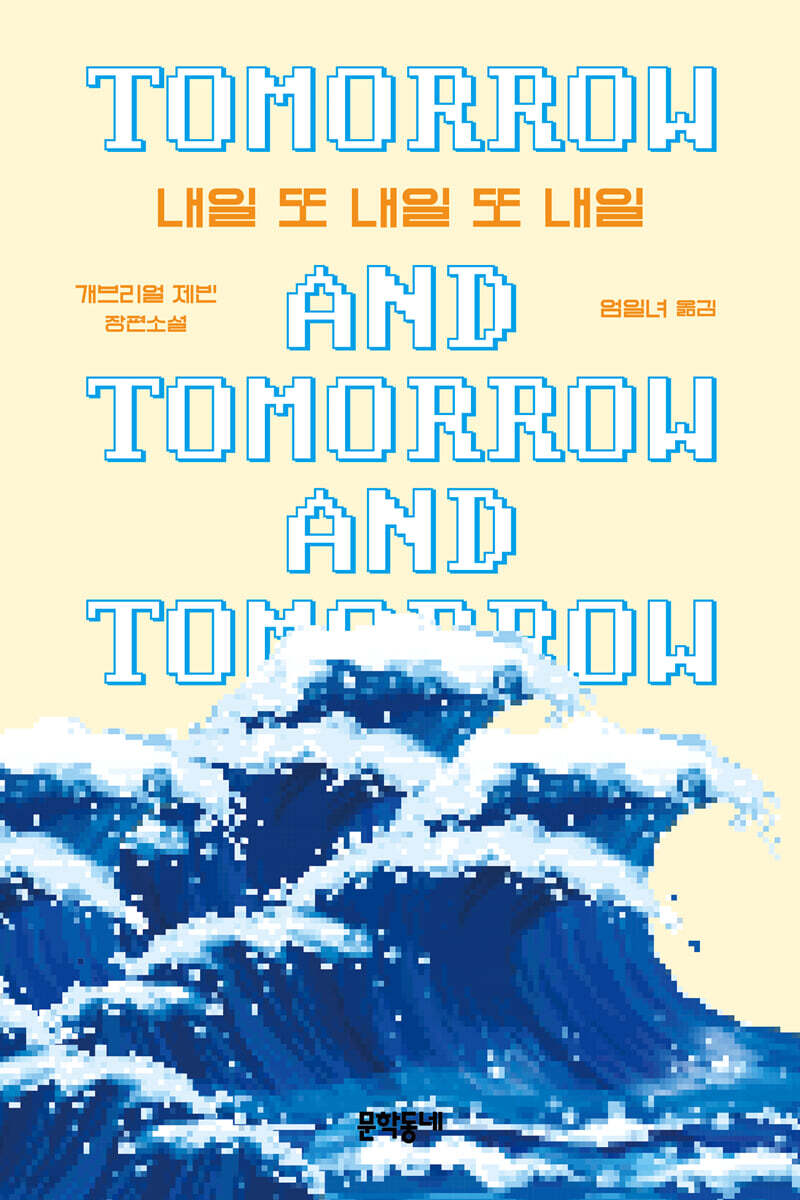
Tomorrow again tomorrow again tomorrow
 |
Description
Book Introduction
- A word from MD
- [If our lives could be expressed as a game] A must-read novel for anyone who loves games, love, and stories about growing up.
『Bookstore on the Island』 Gabriel Jevin this time deals with the growth of a young man and woman who met through a game.
An interesting masterpiece about a boy who grew up as childhood friends while playing a game, and later meets again, making various choices, making consequences, and creating another life.
- Novel/Poetry PD Kim Yu-ri
* #1 Amazon Book of the Year 2022
* A New York Times bestseller for over 40 weeks
* Over 1 million copies sold in English-speaking countries
* Paramount Pictures confirms film adaptation
* Jimmy Fallon Tonight Show Book Club Selection
* Winner of the Goodreads Choice Award
Gabriel Jevin, who captivated readers and critics with humorous sentences, creative compositions, and deep insights into life through the international bestseller 『The Bookstore on the Island』 (2014), which depicts the warm stories of people connected by books, and 『Viva, Jane』 (2017), which vividly portrays the reality of women, has published a full-length novel, 『Tomorrow, Tomorrow, and Tomorrow』 (2022).
This book, which deals with what happens when two childhood friends start making a game together, is a youth romance and coming-of-age story set in the "cultural pioneering era" of the 1990s, when college students could turn the gaming world upside down with a brilliant idea and a floppy disk.
This masterpiece condenses the intellectual yet affectionate world of Jebin's work, exploring the key words of life such as work, love, and youth through various formats such as role-playing games (RPGs), second-person perspectives, interviews, and game chat.
Selected as the #1 Amazon Book of the Year in 2022 and a New York Times bestseller for over 40 weeks, it is currently the hottest and most contemporary novel in the United States.
The title, "Tomorrow and Tomorrow and Tomorrow," comes from a soliloquy in Act 5, Scene 5 of Shakespeare's play "Macbeth," and hints at the game's infinite restartability.
The belief that there is always a new tomorrow and that nothing lasts forever, unlike the pessimistic reading in [Macbeth], is expanded in Jevin's novel into an affirmation of the present and infinite possibilities.
"Tomorrow, Tomorrow, and Tomorrow" is a work as deep and vast as the ocean in every way, conveying to us the flexible thinking and attitude of gamers who envision the infinite possibilities of another world, another choice and outcome, and another life.
“What game is it?” said Marks.
“Tomorrow, tomorrow, and tomorrow again.
The possibility of infinite resurrection and infinite salvation.
The concept that if you keep playing, you will eventually win.
No death is eternal, because nothing is eternal.” _Page 540
* A New York Times bestseller for over 40 weeks
* Over 1 million copies sold in English-speaking countries
* Paramount Pictures confirms film adaptation
* Jimmy Fallon Tonight Show Book Club Selection
* Winner of the Goodreads Choice Award
Gabriel Jevin, who captivated readers and critics with humorous sentences, creative compositions, and deep insights into life through the international bestseller 『The Bookstore on the Island』 (2014), which depicts the warm stories of people connected by books, and 『Viva, Jane』 (2017), which vividly portrays the reality of women, has published a full-length novel, 『Tomorrow, Tomorrow, and Tomorrow』 (2022).
This book, which deals with what happens when two childhood friends start making a game together, is a youth romance and coming-of-age story set in the "cultural pioneering era" of the 1990s, when college students could turn the gaming world upside down with a brilliant idea and a floppy disk.
This masterpiece condenses the intellectual yet affectionate world of Jebin's work, exploring the key words of life such as work, love, and youth through various formats such as role-playing games (RPGs), second-person perspectives, interviews, and game chat.
Selected as the #1 Amazon Book of the Year in 2022 and a New York Times bestseller for over 40 weeks, it is currently the hottest and most contemporary novel in the United States.
The title, "Tomorrow and Tomorrow and Tomorrow," comes from a soliloquy in Act 5, Scene 5 of Shakespeare's play "Macbeth," and hints at the game's infinite restartability.
The belief that there is always a new tomorrow and that nothing lasts forever, unlike the pessimistic reading in [Macbeth], is expanded in Jevin's novel into an affirmation of the present and infinite possibilities.
"Tomorrow, Tomorrow, and Tomorrow" is a work as deep and vast as the ocean in every way, conveying to us the flexible thinking and attitude of gamers who envision the infinite possibilities of another world, another choice and outcome, and another life.
“What game is it?” said Marks.
“Tomorrow, tomorrow, and tomorrow again.
The possibility of infinite resurrection and infinite salvation.
The concept that if you keep playing, you will eventually win.
No death is eternal, because nothing is eternal.” _Page 540
- You can preview some of the book's contents.
Preview
index
Chapter 1: Sick Children… 11
Chapter 2: Influence … 105
Chapter 3: Unfair Game … 205
Chapter 4: The Two Sides of the World… 287
Chapter 5 Pivot … 341
Chapter 6 Marriage… 401
Chapter 7 NPCs … 451
Chapter 8: Our Infinite Days… 491
Chapter 9: Pioneers… 545
Chapter 10: Freight Trains and Rails… 587
References and Acknowledgements … 639
Chapter 2: Influence … 105
Chapter 3: Unfair Game … 205
Chapter 4: The Two Sides of the World… 287
Chapter 5 Pivot … 341
Chapter 6 Marriage… 401
Chapter 7 NPCs … 451
Chapter 8: Our Infinite Days… 491
Chapter 9: Pioneers… 545
Chapter 10: Freight Trains and Rails… 587
References and Acknowledgements … 639
Into the book
Playing with other people is not without its risks.
It means opening up, revealing myself, and being willing to be hurt because of it.
If you hit a dog, it's like lying down with its belly exposed and its tail wagging─you could harm me, but I know you won't.
And this dog sticks its muzzle in my hand and licks it wildly, but never bites it.
Playing together requires trust and love.
“There’s nothing more personal and intimate than gaming, not even sex,” Sam said years later in an interview with gaming webzine Kotaku.
This comment sparked a lot of controversy, and the internet reacted like this:
No one who has ever had good sex would ever talk like that, there's definitely something seriously wrong with Sam.
--- p.44
“Why do you keep showing up?” Sadie asked.
“Because,” Sam thought, opening his mouth.
Clicking on this word will bring up all the links explaining its meaning.
Because you are my oldest friend.
Because you saved me when I hit rock bottom a long time ago.
Because if it weren't for you, I would be dead or in a children's mental hospital.
Because I owe you.
Because I dream of a future where we create incredible games together, if only you would just get up and leave.
“Because,” Sam stuttered.
--- p.101
I could point out what was wrong with any game you gave me, but I couldn't say I knew exactly what made a great game.
For every budding artist, there comes a point where their tastes outstrip their abilities.
The only way to get through this time is to try making something, whether it be porridge or rice.
--- p.116
“You can’t land on top of a pole, but Mario can.”
“That’s it.
I was able to save the princess, even when it was difficult to get out of bed.
Yeah, I want to be rich and famous.
As you know, I am a bottomless pit of ambition and desire.
But at the same time, I want to create something that makes me feel good.
“Something that little kids like us would want to play and forget about our problems for a while.”
--- p.119
The opposite of monopoly is a world where Western European whites create works about Western Europeans that contain only Western European white culture.
Replace Europe with any culture you want, whether African, Asian, Latin, or whatever.
A world where everyone is blind and deaf to cultures and experiences that are not their own.
Doesn't that world make you shiver? I'm afraid of it, I don't want to live in it, and as a mixed-race person, I don't exist in it.
--- pp.131~132
Because people—critics, gamers, the Opus marketing team—could more easily find Sam in the game, Ichigo became Sam's work, not Sadie's, and in that way, Sam became the director of an independent art film called Ichigo.
(As for Sam and Sadie's relationship, they were not siblings, not married/divorced, not lovers, and had never dated, so it was considered too mysterious to be worth digging into.)
--- p.216
The most important thing in a game is the order of events.
There are algorithms within the game, but gamers must also create their own playing algorithms to win.
Every victory has a sequence to follow.
There is an optimal way to play any game.
--- p.280
I felt like I was wearing failure all over my body, and I was sure that other people would see it and smell it.
Failure was like being covered in ashes.
But failure doesn't just cover the skin.
It entered her nose, her mouth, her lungs, her cells, and became a part of her.
It will never be removed in the future.
--- p.329
Compulsively licking and tending to wounds.
Sadie thought the paradoxical use of this expression was truly strange.
Licking a wound only makes it worse, right? The mouth is a breeding ground for bacteria.
But humans are easily addicted to the taste of their own misery and corpses.
--- p.355
Sadie thought that after Ichigo, she would never fail.
I thought I had reached the destination.
But life is constantly coming and going.
There is always another door to pass through.
(Until there are none left, of course.)
--- p.368
You're a gamer, which means you're the type of person who thinks "game over" is a component of the game.
The game only ends when you stop playing.
There is always another life.
Even the most brutal death in the world is not the end.
You can be poisoned, fall into a vat of hydrochloric acid, have your throat cut, or get shot a hundred times, but if you click restart, you can start over from the beginning.
I'll do it right next time.
Maybe we can win next time.
--- pp.483~484
“What game is it?” said Marks.
“Tomorrow, tomorrow, and tomorrow again.
The possibility of infinite resurrection and infinite salvation.
The concept that if you keep playing, you will eventually win.
“No death is eternal, because nothing is eternal.”
--- p.540
Perhaps the eternally infantile, tender part of every human being is the willingness to play.
Perhaps what saves people from despair is the willingness to play.
--- pp.619~620
“How can you not know that? Lovers are... common.” Sadie stared at Sam’s face.
“I liked the idea of making love to you, but I loved working with you even more.
“Because in life, it’s very rare to find a synergy partner who fits perfectly.”
--- p.629
"Isn't that the definition of insanity? Doing the same thing over and over again, expecting different results."
“That’s the life of a game character, too,” Sam said.
“A world of infinite restarts.
If you start over from the beginning, you can break it this time.
It's not like all our work was bad.
I love what we've created so much.
“We were a great team.”
It means opening up, revealing myself, and being willing to be hurt because of it.
If you hit a dog, it's like lying down with its belly exposed and its tail wagging─you could harm me, but I know you won't.
And this dog sticks its muzzle in my hand and licks it wildly, but never bites it.
Playing together requires trust and love.
“There’s nothing more personal and intimate than gaming, not even sex,” Sam said years later in an interview with gaming webzine Kotaku.
This comment sparked a lot of controversy, and the internet reacted like this:
No one who has ever had good sex would ever talk like that, there's definitely something seriously wrong with Sam.
--- p.44
“Why do you keep showing up?” Sadie asked.
“Because,” Sam thought, opening his mouth.
Clicking on this word will bring up all the links explaining its meaning.
Because you are my oldest friend.
Because you saved me when I hit rock bottom a long time ago.
Because if it weren't for you, I would be dead or in a children's mental hospital.
Because I owe you.
Because I dream of a future where we create incredible games together, if only you would just get up and leave.
“Because,” Sam stuttered.
--- p.101
I could point out what was wrong with any game you gave me, but I couldn't say I knew exactly what made a great game.
For every budding artist, there comes a point where their tastes outstrip their abilities.
The only way to get through this time is to try making something, whether it be porridge or rice.
--- p.116
“You can’t land on top of a pole, but Mario can.”
“That’s it.
I was able to save the princess, even when it was difficult to get out of bed.
Yeah, I want to be rich and famous.
As you know, I am a bottomless pit of ambition and desire.
But at the same time, I want to create something that makes me feel good.
“Something that little kids like us would want to play and forget about our problems for a while.”
--- p.119
The opposite of monopoly is a world where Western European whites create works about Western Europeans that contain only Western European white culture.
Replace Europe with any culture you want, whether African, Asian, Latin, or whatever.
A world where everyone is blind and deaf to cultures and experiences that are not their own.
Doesn't that world make you shiver? I'm afraid of it, I don't want to live in it, and as a mixed-race person, I don't exist in it.
--- pp.131~132
Because people—critics, gamers, the Opus marketing team—could more easily find Sam in the game, Ichigo became Sam's work, not Sadie's, and in that way, Sam became the director of an independent art film called Ichigo.
(As for Sam and Sadie's relationship, they were not siblings, not married/divorced, not lovers, and had never dated, so it was considered too mysterious to be worth digging into.)
--- p.216
The most important thing in a game is the order of events.
There are algorithms within the game, but gamers must also create their own playing algorithms to win.
Every victory has a sequence to follow.
There is an optimal way to play any game.
--- p.280
I felt like I was wearing failure all over my body, and I was sure that other people would see it and smell it.
Failure was like being covered in ashes.
But failure doesn't just cover the skin.
It entered her nose, her mouth, her lungs, her cells, and became a part of her.
It will never be removed in the future.
--- p.329
Compulsively licking and tending to wounds.
Sadie thought the paradoxical use of this expression was truly strange.
Licking a wound only makes it worse, right? The mouth is a breeding ground for bacteria.
But humans are easily addicted to the taste of their own misery and corpses.
--- p.355
Sadie thought that after Ichigo, she would never fail.
I thought I had reached the destination.
But life is constantly coming and going.
There is always another door to pass through.
(Until there are none left, of course.)
--- p.368
You're a gamer, which means you're the type of person who thinks "game over" is a component of the game.
The game only ends when you stop playing.
There is always another life.
Even the most brutal death in the world is not the end.
You can be poisoned, fall into a vat of hydrochloric acid, have your throat cut, or get shot a hundred times, but if you click restart, you can start over from the beginning.
I'll do it right next time.
Maybe we can win next time.
--- pp.483~484
“What game is it?” said Marks.
“Tomorrow, tomorrow, and tomorrow again.
The possibility of infinite resurrection and infinite salvation.
The concept that if you keep playing, you will eventually win.
“No death is eternal, because nothing is eternal.”
--- p.540
Perhaps the eternally infantile, tender part of every human being is the willingness to play.
Perhaps what saves people from despair is the willingness to play.
--- pp.619~620
“How can you not know that? Lovers are... common.” Sadie stared at Sam’s face.
“I liked the idea of making love to you, but I loved working with you even more.
“Because in life, it’s very rare to find a synergy partner who fits perfectly.”
--- p.629
"Isn't that the definition of insanity? Doing the same thing over and over again, expecting different results."
“That’s the life of a game character, too,” Sam said.
“A world of infinite restarts.
If you start over from the beginning, you can break it this time.
It's not like all our work was bad.
I love what we've created so much.
“We were a great team.”
--- pp.635~636
Publisher's Review
What saves us from despair is,
Willingness to play
Sadie, who has a sick older sister, and Sam, who has injured his leg in a car accident, first meet in the recreation room of a children's hospital.
The two become best friends who understand each other's loneliness while playing games together, but a small misunderstanding causes them to grow apart.
As time passes, Sam stumbles upon Sadie on the subway platform and hesitates before shouting out through the crowd:
“You died of dysentery!” This line from the game “Oregon Trail” was a joke between the two of them that brought back memories of playing games together.
Sadie turns around, and after a brief reunion, hands Sam a floppy disk containing a game she had created called "Solution."
Sam, who was not finding fun in his major, becomes convinced that he should create a game with Sadie after playing "Solution."
Sam's roommate, Marks, joins the project, and their lives are turned upside down when their first game, Ichigo, becomes an unexpected and enormous success.
Even after unexpected great success, hardships continue.
Sam, who has lived with a disability in his legs since a childhood accident, experiences increasingly worsening pain.
Sadie is unable to end her complicated and troubled relationship with her lover, Dove, a professor and game designer.
In addition to their personal struggles, they are constantly plagued by the harsh working conditions of the '90s gaming industry, the technological limitations that prevent them from keeping pace with their artistic ambitions, and the fear that the games they create, working eighteen-hour days, might be completely ignored by the public.
But in the midst of all this despair, what ultimately saves them is the game, and the will to play together.
"Tomorrow, Tomorrow, and Tomorrow" is a story about the games that dominate childhood and exert influence throughout life.
It's also a story for those who have made and are trying to make such games.
Inevitably, it becomes a story about desperate love, a story about loss and those left behind, and inevitably a story about the world.
Park Seo-ryeon (novelist)
The games that appear in the novel, including Oregon Trail, Donkey Kong, Super Mario, Tekken, Dungeons & Dragons, GTA, Tetris, Zelda, and King's Quest, which were popular in their time, stimulate nostalgia in gamers who love games and clearly show the appeal of games as a comprehensive narrative art to readers who are not familiar with games.
Jevin doesn't stop there, he skillfully incorporates the game genre into the form of literature.
Interviews with Sam and the real-life gaming webzine Kotaku are interspersed throughout the text, and the story progresses from a second-person perspective or through the lens of a role-playing game, with characters conversing via in-game chat. The world of games and the people who love and create them, portrayed by Jevin, whose parents worked at IBM and who confesses to having "killed a fair amount of virtual bison in his lifetime and groaned in the vast land, picking out pixelated pebbles," is fresh yet surprisingly vivid, and beautiful enough to make you want to linger in it for a long time.
There are no eternal winners or losers
The Game of Love and Life
A vivid virtual world brimming with possibilities
"Tomorrow, Tomorrow, and Tomorrow" suggests the possibility of relationships that are not limited to traditional meanings.
This is clearly a love story, but it is “a deep and complex magic that transcends anything that could be called a love story.”
Sam, a physically disabled Asian American working-class man, admires Sadie, who comes from a wealthy background and is free from childhood trauma, while also feeling inferior to her.
Sadie, who feels under-recognized for her contributions as a woman in the gaming industry and is drawn to the belief that games can be art rather than just a matter of public taste, both resents and worries about Sam, who acts as the face of the company with what she doesn't have.
Sharing life's most brilliant moments and tragic memories, and being the closest of friends yet knowing how to respect each other's secrets, these two people remain together for a long time without fitting into any of the relationship types prescribed by society.
“How can you not know that? Lovers are... common.” Sadie stared at Sam’s face.
“I liked the idea of making love to you, but I loved working with you even more.
“Because in life, it’s very rare to find a synergistic partner who fits perfectly.” _Page 629
Over ten years have passed since the winter of the end of the century when the two protagonists reunite on the subway platform. The world has changed and progressed, and in the meantime, unexpected tragedies have occurred.
Life flows and the shape of relationships changes, either in accordance with the great current or regardless of that current.
Despite the dramatic development and formal experimentation, it is precisely this naturalness that makes this book so easy to read.
Zebin adds clever formal experimentation and creates a brilliant novel from the most traditional perspective.
A novel that transcends time and space and experiences a period of youth as a kind of experience.
So, a novel that makes you keep turning the pages, a novel that makes you fall in love with all the characters, a novel that makes you come out a different person after getting through the story.
In this sparkling virtual world, we play a love we've never seen before, experience vivid games, and ride the waves of youth.
The panorama of life that begins with just a press of the play button will not stop easily.
Recommendation
The powerful synergy between novels and games is impressively depicted.
Jevin, who calls himself an "eternal gamer," could perhaps have crafted a tale of perfectly sealed nostalgia that only those who still cherish Space Invaders can understand.
But instead, she wrote about the pioneering days of the vast entertainment industry, captivating even bookworms who weren't paying attention to that side of the story.
With its unique depth and delicacy, it captures the unchanging charm of the flickering screen.
_The Washington Post
Truly powerful works, whatever their subject matter, immerse the reader in an unfamiliar world.
Moby Dick was like that, and Tomorrow and Tomorrow and Tomorrow is like that.
A vast and beautiful book that opens up entirely new literary possibilities.
Surprisingly, it succeeds in being both a serious art form and an interesting form of entertainment.
_NPR
It's impossible to guess exactly what, among the countless possibilities, will make you fall in love with "Tomorrow, and Tomorrow, and Tomorrow."
But eventually, as if by some unavoidable fate, you will fall into it.
Jevin's artistic and inclusive world is filled with authentic, lovable, and vivid characters.
And Sam and Sadie's relationship is a deep, complex, magical thing that transcends anything we might call a love story.
Whether you like video games or not, this is the novel you've been waiting for.
_Book page
This world, painted with lovely magic, will be loved by countless literary gamers.
Meanwhile, anyone who isn't a literary gamer might wonder why it took so long to recognize the beauty, drama, and suffering of human existence contained within video games.
_The New York Times
A densely woven novel that explores originality, appropriation, the similarities between video games and other art forms, the boundless possibilities of life in virtual worlds, and how platonic love as creative partnerships can be deeper and more meaningful than romantic love.
_The New Yorker
Gabriel Jevin's powerful new film opens with a memorable scene where Sam shouts "You died of dysentery" on a crowded subway platform, drawing the attention of his childhood friend Sadie.
Anyone who immediately thinks of Oregon Trail at this scene will enjoy this unpredictable tale of love and video games in the '90s, when indie game designers like Sam and Sadie could turn the world upside down with nothing more than a good idea and a bunch of floppy disks.
_The Philadelphia Inquirer
I assure you that this book is not only for those who understand life in pixels, but also for those who understand life in stories.
_Glamour
Willingness to play
Sadie, who has a sick older sister, and Sam, who has injured his leg in a car accident, first meet in the recreation room of a children's hospital.
The two become best friends who understand each other's loneliness while playing games together, but a small misunderstanding causes them to grow apart.
As time passes, Sam stumbles upon Sadie on the subway platform and hesitates before shouting out through the crowd:
“You died of dysentery!” This line from the game “Oregon Trail” was a joke between the two of them that brought back memories of playing games together.
Sadie turns around, and after a brief reunion, hands Sam a floppy disk containing a game she had created called "Solution."
Sam, who was not finding fun in his major, becomes convinced that he should create a game with Sadie after playing "Solution."
Sam's roommate, Marks, joins the project, and their lives are turned upside down when their first game, Ichigo, becomes an unexpected and enormous success.
Even after unexpected great success, hardships continue.
Sam, who has lived with a disability in his legs since a childhood accident, experiences increasingly worsening pain.
Sadie is unable to end her complicated and troubled relationship with her lover, Dove, a professor and game designer.
In addition to their personal struggles, they are constantly plagued by the harsh working conditions of the '90s gaming industry, the technological limitations that prevent them from keeping pace with their artistic ambitions, and the fear that the games they create, working eighteen-hour days, might be completely ignored by the public.
But in the midst of all this despair, what ultimately saves them is the game, and the will to play together.
"Tomorrow, Tomorrow, and Tomorrow" is a story about the games that dominate childhood and exert influence throughout life.
It's also a story for those who have made and are trying to make such games.
Inevitably, it becomes a story about desperate love, a story about loss and those left behind, and inevitably a story about the world.
Park Seo-ryeon (novelist)
The games that appear in the novel, including Oregon Trail, Donkey Kong, Super Mario, Tekken, Dungeons & Dragons, GTA, Tetris, Zelda, and King's Quest, which were popular in their time, stimulate nostalgia in gamers who love games and clearly show the appeal of games as a comprehensive narrative art to readers who are not familiar with games.
Jevin doesn't stop there, he skillfully incorporates the game genre into the form of literature.
Interviews with Sam and the real-life gaming webzine Kotaku are interspersed throughout the text, and the story progresses from a second-person perspective or through the lens of a role-playing game, with characters conversing via in-game chat. The world of games and the people who love and create them, portrayed by Jevin, whose parents worked at IBM and who confesses to having "killed a fair amount of virtual bison in his lifetime and groaned in the vast land, picking out pixelated pebbles," is fresh yet surprisingly vivid, and beautiful enough to make you want to linger in it for a long time.
There are no eternal winners or losers
The Game of Love and Life
A vivid virtual world brimming with possibilities
"Tomorrow, Tomorrow, and Tomorrow" suggests the possibility of relationships that are not limited to traditional meanings.
This is clearly a love story, but it is “a deep and complex magic that transcends anything that could be called a love story.”
Sam, a physically disabled Asian American working-class man, admires Sadie, who comes from a wealthy background and is free from childhood trauma, while also feeling inferior to her.
Sadie, who feels under-recognized for her contributions as a woman in the gaming industry and is drawn to the belief that games can be art rather than just a matter of public taste, both resents and worries about Sam, who acts as the face of the company with what she doesn't have.
Sharing life's most brilliant moments and tragic memories, and being the closest of friends yet knowing how to respect each other's secrets, these two people remain together for a long time without fitting into any of the relationship types prescribed by society.
“How can you not know that? Lovers are... common.” Sadie stared at Sam’s face.
“I liked the idea of making love to you, but I loved working with you even more.
“Because in life, it’s very rare to find a synergistic partner who fits perfectly.” _Page 629
Over ten years have passed since the winter of the end of the century when the two protagonists reunite on the subway platform. The world has changed and progressed, and in the meantime, unexpected tragedies have occurred.
Life flows and the shape of relationships changes, either in accordance with the great current or regardless of that current.
Despite the dramatic development and formal experimentation, it is precisely this naturalness that makes this book so easy to read.
Zebin adds clever formal experimentation and creates a brilliant novel from the most traditional perspective.
A novel that transcends time and space and experiences a period of youth as a kind of experience.
So, a novel that makes you keep turning the pages, a novel that makes you fall in love with all the characters, a novel that makes you come out a different person after getting through the story.
In this sparkling virtual world, we play a love we've never seen before, experience vivid games, and ride the waves of youth.
The panorama of life that begins with just a press of the play button will not stop easily.
Recommendation
The powerful synergy between novels and games is impressively depicted.
Jevin, who calls himself an "eternal gamer," could perhaps have crafted a tale of perfectly sealed nostalgia that only those who still cherish Space Invaders can understand.
But instead, she wrote about the pioneering days of the vast entertainment industry, captivating even bookworms who weren't paying attention to that side of the story.
With its unique depth and delicacy, it captures the unchanging charm of the flickering screen.
_The Washington Post
Truly powerful works, whatever their subject matter, immerse the reader in an unfamiliar world.
Moby Dick was like that, and Tomorrow and Tomorrow and Tomorrow is like that.
A vast and beautiful book that opens up entirely new literary possibilities.
Surprisingly, it succeeds in being both a serious art form and an interesting form of entertainment.
_NPR
It's impossible to guess exactly what, among the countless possibilities, will make you fall in love with "Tomorrow, and Tomorrow, and Tomorrow."
But eventually, as if by some unavoidable fate, you will fall into it.
Jevin's artistic and inclusive world is filled with authentic, lovable, and vivid characters.
And Sam and Sadie's relationship is a deep, complex, magical thing that transcends anything we might call a love story.
Whether you like video games or not, this is the novel you've been waiting for.
_Book page
This world, painted with lovely magic, will be loved by countless literary gamers.
Meanwhile, anyone who isn't a literary gamer might wonder why it took so long to recognize the beauty, drama, and suffering of human existence contained within video games.
_The New York Times
A densely woven novel that explores originality, appropriation, the similarities between video games and other art forms, the boundless possibilities of life in virtual worlds, and how platonic love as creative partnerships can be deeper and more meaningful than romantic love.
_The New Yorker
Gabriel Jevin's powerful new film opens with a memorable scene where Sam shouts "You died of dysentery" on a crowded subway platform, drawing the attention of his childhood friend Sadie.
Anyone who immediately thinks of Oregon Trail at this scene will enjoy this unpredictable tale of love and video games in the '90s, when indie game designers like Sam and Sadie could turn the world upside down with nothing more than a good idea and a bunch of floppy disks.
_The Philadelphia Inquirer
I assure you that this book is not only for those who understand life in pixels, but also for those who understand life in stories.
_Glamour
GOODS SPECIFICS
- Date of issue: August 24, 2023
- Page count, weight, size: 644 pages | 652g | 140*210*31mm
- ISBN13: 9788954694940
- ISBN10: 8954694942
You may also like
카테고리
korean


korean

![GQ KOREA Mark (Monthly): December [2025]](http://librairie.coreenne.fr/cdn/shop/files/8ef265dbbfbf186523ed75ba7319009d.jpg?v=1765340328&width=3840)


