

youngest
 |
Description
Book Introduction
- A word from MD
-
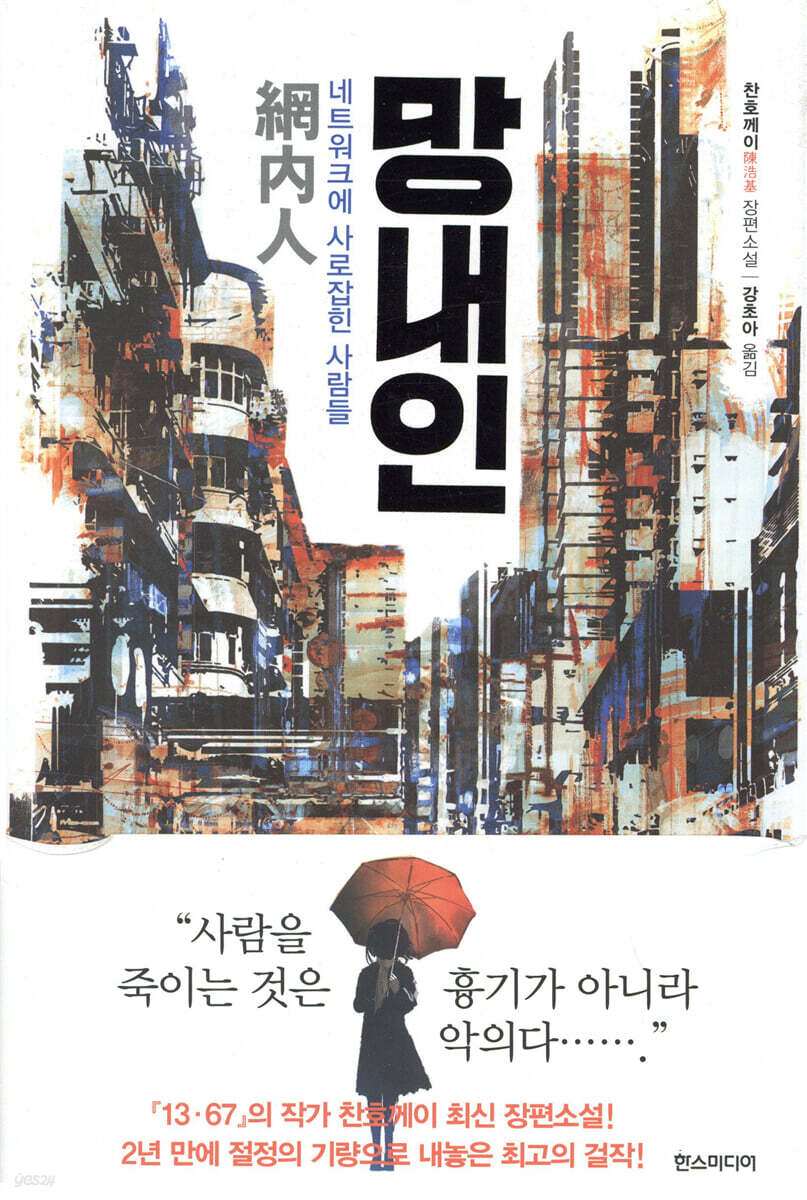
『13·67』 Chan Ho-kei's new mysteryA fifteen-year-old girl took her own life after enduring online bullying.
The older sister, who lost her only family, asks the hacker Agnie to track down the person who tormented her, and Agnie uncovers not only the suspect who spread the malicious comments, but also her younger sister's past.
The story is a masterpiece that asks the meaning of network human while also having many twists and turns.
January 5, 2018. Novel/Poetry PD
An age where truth cannot be discerned
We are all 'network-obsessed'
Chan Ho-kei, who heated up the Korean mystery novel world with "13·67," has returned with a masterpiece of over 700 pages.
Chan Ho-kei, who devoted two years of his life to this work since "13·67," has brought us a masterpiece as brilliant as a diamond, with a more mature narrative, a skillful and precise composition, and descriptions that penetrate the reader's heart.
The tight net he has woven traps us and prevents us from escaping no matter how hard we struggle.
The title of this work is 『Mangnaein』, which in our terms means ‘network human.’
The story is set in Hong Kong, just like in “13·67.”
However, while 『13·67』 traced Hong Kong's history in reverse chronological order, starting in 2013 and ending in 1967, 『The Last Man』 deals with events that occurred in 2015.
And the event transcends regions and countries to secure contemporaneity.
Because it is rooted in the online insults, malicious comments, slander, and malicious rumors that we are all so familiar with.
From the perspective of a mystery novel, this work can be considered to belong to the full-fledged mystery genre.
The protagonist of the detective role, Agnieszka, has all the characteristics that a detective should have.
The flow of the story also follows the traditional order of 'mystery (girl's suicide) → hidden culprit (kidkit727) → case investigation → truth'.
However, this work does not stop at finding out the truth of the incident.
After the flow of 'mystery → investigation → truth' ends, revenge (but crime) continues again.
Therefore, while this work is formally a full-fledged mystery, it also has aspects of a crime novel.
The themes of 『The Youngest Son』 are ‘karma and retribution,’ ‘resentment,’ and ‘revenge.’
The characters in the story either scoff at the idea of karma or firmly believe that evil is punished.
Even if you don't believe in fate, the results of your actions will pile up and come back to you.
Resentment is also an important element of this work.
What is resentment? Why do we seek revenge? Is revenge meaningful? The author says, "I don't intend to argue that giving up revenge is the solution, by offering empty rhetoric like forgiveness is a beautiful act."
Many people confuse 'understanding' with 'forgiveness'.
We may not forgive those who have committed evil deeds.
But the author emphasizes that not trying to understand the motives behind evil deeds is also a form of foolishness.
We are all 'network-obsessed'
Chan Ho-kei, who heated up the Korean mystery novel world with "13·67," has returned with a masterpiece of over 700 pages.
Chan Ho-kei, who devoted two years of his life to this work since "13·67," has brought us a masterpiece as brilliant as a diamond, with a more mature narrative, a skillful and precise composition, and descriptions that penetrate the reader's heart.
The tight net he has woven traps us and prevents us from escaping no matter how hard we struggle.
The title of this work is 『Mangnaein』, which in our terms means ‘network human.’
The story is set in Hong Kong, just like in “13·67.”
However, while 『13·67』 traced Hong Kong's history in reverse chronological order, starting in 2013 and ending in 1967, 『The Last Man』 deals with events that occurred in 2015.
And the event transcends regions and countries to secure contemporaneity.
Because it is rooted in the online insults, malicious comments, slander, and malicious rumors that we are all so familiar with.
From the perspective of a mystery novel, this work can be considered to belong to the full-fledged mystery genre.
The protagonist of the detective role, Agnieszka, has all the characteristics that a detective should have.
The flow of the story also follows the traditional order of 'mystery (girl's suicide) → hidden culprit (kidkit727) → case investigation → truth'.
However, this work does not stop at finding out the truth of the incident.
After the flow of 'mystery → investigation → truth' ends, revenge (but crime) continues again.
Therefore, while this work is formally a full-fledged mystery, it also has aspects of a crime novel.
The themes of 『The Youngest Son』 are ‘karma and retribution,’ ‘resentment,’ and ‘revenge.’
The characters in the story either scoff at the idea of karma or firmly believe that evil is punished.
Even if you don't believe in fate, the results of your actions will pile up and come back to you.
Resentment is also an important element of this work.
What is resentment? Why do we seek revenge? Is revenge meaningful? The author says, "I don't intend to argue that giving up revenge is the solution, by offering empty rhetoric like forgiveness is a beautiful act."
Many people confuse 'understanding' with 'forgiveness'.
We may not forgive those who have committed evil deeds.
But the author emphasizes that not trying to understand the motives behind evil deeds is also a form of foolishness.
index
letter
Chapter 1
Chapter 2
Chapter 3
Chapter 4
Chapter 5
Chapter 6
Chapter 7
Chapter 8
Chapter 9
The final chapter
Author's Note
Translator's Note
References
Chapter 1
Chapter 2
Chapter 3
Chapter 4
Chapter 5
Chapter 6
Chapter 7
Chapter 8
Chapter 9
The final chapter
Author's Note
Translator's Note
References
Into the book
Bang-.
A police car whizzed past the child.
The child was pulled from his thoughts about selling tremors by the sharp sound of a horn.
People were seen milling about in front of the Huanhualou apartment where she lived.
What happened? Yet, the child didn't hurry his pace.
She hated meddling in other people's business.
So when she was in school, her friends disliked her and called her an outsider, a hardliner, and a bookworm.
The child himself did not find such things unpleasant.
Everyone has the freedom to choose their own path.
It's foolish to try to fit yourself into someone else's way of thinking.
“Oh my god, a child! A child!”
--- p.11
My younger brother committed suicide.
When the child heard this from the police at the Fushan Funeral Home in Shatin, he could not contain his anger and retorted.
With a mouth that was shaking so much that he couldn't even pronounce things properly, he stammered out words like, "That's ridiculous," "Without even investigating properly," and "There's no way Xiao Yuan would commit suicide."
The detective in charge of the case was a thin man with gray hair, about fifty years old.
Although his appearance was a bit like that of a gangster, his eyes were kind.
Despite the child's hysterical reaction, he remained calm and comforted her in a calm voice.
And yet he threw out a statement that the child could not refute.
--- p.17
“Hey, don’t be afraid.
Sister, you're here too.
“Now, can you tell me what happened?”
The child read a hint of hesitation in Xiaoyuan's eyes.
He gave his younger brother a firm squeeze of his hand and offered silent encouragement.
Xiao Yuan glanced at the police officer, then looked at the report with his name and age written on it, then took a deep breath.
And he began to explain, piecemeal, what had happened a few hours earlier.
--- p.35
Xiao Yuan became quiet again after this incident.
The child was at a loss as to how to comfort his younger sibling.
All he said was, “Don’t worry, you have my sister” and “That bad guy will face the law.”
The child asked his boss for permission to take two days off to spend time with Xiaowen.
I had used up most of my vacation time attending my mother's funeral six months ago, so I hadn't been able to spend more than two days with Xiaowen.
When he got off work, all he could do was try to get home as quickly as possible.
--- p.44
When the child thought everything was back to normal, Xiaowen jumped from the window of the 22nd floor apartment.
He took his own life.
The child couldn't believe that his younger brother had committed suicide.
In her view, things were quieting down, and life should get back on track.
But then suddenly it came to this worst situation.
“Xiao Yuan would never commit suicide! Someone must have killed Xiao Yuan….”
The child reacted violently to the police officer's words, "Suicide," at the morgue.
“There is ample evidence that my younger brother committed suicide.”
--- p.55
The detective's words stabbed the child's soul like a cold blade.
A chill ran down the child's spine.
“If that’s true…….”
Detective Mo took another deep breath and continued.
“This is a kind of murder.”
A police car whizzed past the child.
The child was pulled from his thoughts about selling tremors by the sharp sound of a horn.
People were seen milling about in front of the Huanhualou apartment where she lived.
What happened? Yet, the child didn't hurry his pace.
She hated meddling in other people's business.
So when she was in school, her friends disliked her and called her an outsider, a hardliner, and a bookworm.
The child himself did not find such things unpleasant.
Everyone has the freedom to choose their own path.
It's foolish to try to fit yourself into someone else's way of thinking.
“Oh my god, a child! A child!”
--- p.11
My younger brother committed suicide.
When the child heard this from the police at the Fushan Funeral Home in Shatin, he could not contain his anger and retorted.
With a mouth that was shaking so much that he couldn't even pronounce things properly, he stammered out words like, "That's ridiculous," "Without even investigating properly," and "There's no way Xiao Yuan would commit suicide."
The detective in charge of the case was a thin man with gray hair, about fifty years old.
Although his appearance was a bit like that of a gangster, his eyes were kind.
Despite the child's hysterical reaction, he remained calm and comforted her in a calm voice.
And yet he threw out a statement that the child could not refute.
--- p.17
“Hey, don’t be afraid.
Sister, you're here too.
“Now, can you tell me what happened?”
The child read a hint of hesitation in Xiaoyuan's eyes.
He gave his younger brother a firm squeeze of his hand and offered silent encouragement.
Xiao Yuan glanced at the police officer, then looked at the report with his name and age written on it, then took a deep breath.
And he began to explain, piecemeal, what had happened a few hours earlier.
--- p.35
Xiao Yuan became quiet again after this incident.
The child was at a loss as to how to comfort his younger sibling.
All he said was, “Don’t worry, you have my sister” and “That bad guy will face the law.”
The child asked his boss for permission to take two days off to spend time with Xiaowen.
I had used up most of my vacation time attending my mother's funeral six months ago, so I hadn't been able to spend more than two days with Xiaowen.
When he got off work, all he could do was try to get home as quickly as possible.
--- p.44
When the child thought everything was back to normal, Xiaowen jumped from the window of the 22nd floor apartment.
He took his own life.
The child couldn't believe that his younger brother had committed suicide.
In her view, things were quieting down, and life should get back on track.
But then suddenly it came to this worst situation.
“Xiao Yuan would never commit suicide! Someone must have killed Xiao Yuan….”
The child reacted violently to the police officer's words, "Suicide," at the morgue.
“There is ample evidence that my younger brother committed suicide.”
--- p.55
The detective's words stabbed the child's soul like a cold blade.
A chill ran down the child's spine.
“If that’s true…….”
Detective Mo took another deep breath and continued.
“This is a kind of murder.”
--- From the text
Publisher's Review
A girl commits suicide by jumping off a building, but no one cares!
Except for the girl's older sister and the mysterious man...
The work is shocking from the beginning.
A fifteen-year-old girl throws herself from the 22nd floor of her house after enduring online bullying.
Ai, the older sister who lost her younger sibling, her only family member, seeks help from a detective agency to find those who tormented her younger sibling, but gets lost in front of cutting-edge internet technology.
A detective agency introduces a person to a child who doesn't know what to do.
A 'unlicensed detective' with an eccentric personality, no manners whatsoever, and who lives in a pigsty-like place.
His name is Anya, and he is also a mysterious hacker.
Not long after accepting the child's request, he compiles a list of suspects who spread malicious comments on the Internet and even uncovers details about the child's younger sibling's past that the child did not know about.
Things he believed only happened to a few delinquent youths also happened to his younger brother, Xiaowen.
Where does truth end and where does lies begin? What exactly has become of this cruel world? They say God punishes the good and protects the wicked, but is that really so? Will only the strong survive, and the weak be weeded out? The more I investigate the case, the more the child's mental anguish deepens.
Finally, Agnie completes her investigation and makes a very sweet offer to the child.
An offer you absolutely cannot refuse… … .
The moment the child accepts Agnie's proposal, the fates of all the characters in the story become intertwined, and each of their endings are determined by the child's 'choices' within the 'network' Agnie has woven.
What is "revenge"? Is it a salvation that covers regret, or an abyss into which humanity falls? What, then, is a "network"? Is the Internet a convenient tool, or a dangerous source of conflict?
Knowledge of computer and networking technologies plays a very important part in this work.
In movies and dramas, hackers are often deified.
Although this work features a hacker with amazing abilities, the author wanted to portray a hacker who is realistic.
This book even has a section explaining hacking-related techniques.
Computers and the Internet are not magic wands.
In a calculation such as '1+1=2', the left and right sides must be equal, so it is a logical tool above all else.
Hacking, which involves infiltrating a system and stealing data, also essentially goes through steps that even the average reader can understand.
We believe that this work will help readers raise their awareness of online safety.
Shimada Soji Mystery Novel Award, Taipei International Book Fair Grand Prize, and Yeoldokjikin Grand Prize
Chan Ho-kei's latest novel, winner of three major book awards
Chan Ho-kei, the author of this work, is a Hong Kong writer who was born and raised in Hong Kong.
He works in Hong Kong, a wasteland of mystery, and first became known in 2011 when he won the 2nd Shimada Soji Mystery Novel Award for his novel, "I Don't Remember, Detective."
He received praise for his “infinite talent” from Soji Shimada, who is called the god of Japanese mystery novels, and three years later, in 2014, his full-length mystery novel “13·67” was published, winning the grand prize at the 2015 Taipei International Book Fair, once again making waves in the Chinese-speaking world.
『13·67』 has been translated and published in over 10 countries, including Korea, the United States, the United Kingdom, France, Canada, Italy, and the Netherlands, and has set an unprecedented record in Chinese-language mystery novels, with director Wang Jiawei purchasing the film production rights.
Recently, it was translated and introduced in Japan, and won first place in the 2017 Overseas Mystery category (hosted by Weekly Bungei Shunju). Despite the great success of "13·67," Chan Ho-kei completed a work in a completely different style despite the psychological burden it felt.
He explained his motivation for writing 『The Youngest Son』 as follows:
“While writing this work, I tried to explore the relationship between ‘network’ and ‘humans.’
Is the network (Internet) a great invention? Has it brought us convenience, or has it created new problems that never existed before? How should we approach and utilize the network? This questioning is the origin of the book's title, "Mangnaein (Network Human)."
The work also includes several topics related to education and financial society.
Hong Kong's education system currently faces enormous challenges.
Due to the declining birth rate, schools are gradually disappearing, and those that survive are obsessed with nurturing gifted students, focusing on 'performance.'
One chapter in the work is a story based on this educational issue.
Another axis of the story relates to investment risks in the financial industry.
In today's booming technology startup scene, many companies focus solely on attracting investment, often ignoring the original purpose of the investment.
These two contents actually flow on the larger topics of networks and human relationships, karma, etc.
All problems in the work originate from human selfishness.
That is the ‘motive’ that led me to write this piece.”
Author's Note
『The Youngest Son』 is actually a story about ‘humans.’
Since this work is a detective novel, it must contain mystery and tricks.
But beyond that, I wanted to convey each character's position, thoughts, and joys and sorrows.
Even characters used in mysteries to mislead readers could not be portrayed as mere 'instrumental characters'.
And I wanted readers to feel like they were living in a city called Hong Kong in 2015.
The characters in the story come from all walks of life.
Although they cannot be considered to represent all Hong Kong people, they were able to show the diverse aspects of different classes.
I tried to show the differences between them through the plot (you can judge for yourself whether it was successful).
I once received a question from a reporter.
After writing 『13·67』, which was about Hong Kong in the past, I was asked if I had any plans to write a novel about Hong Kong today.
I think this work will answer that question.
Translator's Note
The word ‘mang’ in the title of the book, ‘Mangnaein’, means net.
While reading this work, I was reminded that we live in a densely interconnected web of countless causes and effects.
The characters in 『The Youngest』 are also intertwined with each other through causal relationships, big and small, to create this long and complex story.
I think that's the society we live in.
Anyone living in today's society will feel that the story of "The Youngest" is not someone else's, but their own.
Except for the girl's older sister and the mysterious man...
The work is shocking from the beginning.
A fifteen-year-old girl throws herself from the 22nd floor of her house after enduring online bullying.
Ai, the older sister who lost her younger sibling, her only family member, seeks help from a detective agency to find those who tormented her younger sibling, but gets lost in front of cutting-edge internet technology.
A detective agency introduces a person to a child who doesn't know what to do.
A 'unlicensed detective' with an eccentric personality, no manners whatsoever, and who lives in a pigsty-like place.
His name is Anya, and he is also a mysterious hacker.
Not long after accepting the child's request, he compiles a list of suspects who spread malicious comments on the Internet and even uncovers details about the child's younger sibling's past that the child did not know about.
Things he believed only happened to a few delinquent youths also happened to his younger brother, Xiaowen.
Where does truth end and where does lies begin? What exactly has become of this cruel world? They say God punishes the good and protects the wicked, but is that really so? Will only the strong survive, and the weak be weeded out? The more I investigate the case, the more the child's mental anguish deepens.
Finally, Agnie completes her investigation and makes a very sweet offer to the child.
An offer you absolutely cannot refuse… … .
The moment the child accepts Agnie's proposal, the fates of all the characters in the story become intertwined, and each of their endings are determined by the child's 'choices' within the 'network' Agnie has woven.
What is "revenge"? Is it a salvation that covers regret, or an abyss into which humanity falls? What, then, is a "network"? Is the Internet a convenient tool, or a dangerous source of conflict?
Knowledge of computer and networking technologies plays a very important part in this work.
In movies and dramas, hackers are often deified.
Although this work features a hacker with amazing abilities, the author wanted to portray a hacker who is realistic.
This book even has a section explaining hacking-related techniques.
Computers and the Internet are not magic wands.
In a calculation such as '1+1=2', the left and right sides must be equal, so it is a logical tool above all else.
Hacking, which involves infiltrating a system and stealing data, also essentially goes through steps that even the average reader can understand.
We believe that this work will help readers raise their awareness of online safety.
Shimada Soji Mystery Novel Award, Taipei International Book Fair Grand Prize, and Yeoldokjikin Grand Prize
Chan Ho-kei's latest novel, winner of three major book awards
Chan Ho-kei, the author of this work, is a Hong Kong writer who was born and raised in Hong Kong.
He works in Hong Kong, a wasteland of mystery, and first became known in 2011 when he won the 2nd Shimada Soji Mystery Novel Award for his novel, "I Don't Remember, Detective."
He received praise for his “infinite talent” from Soji Shimada, who is called the god of Japanese mystery novels, and three years later, in 2014, his full-length mystery novel “13·67” was published, winning the grand prize at the 2015 Taipei International Book Fair, once again making waves in the Chinese-speaking world.
『13·67』 has been translated and published in over 10 countries, including Korea, the United States, the United Kingdom, France, Canada, Italy, and the Netherlands, and has set an unprecedented record in Chinese-language mystery novels, with director Wang Jiawei purchasing the film production rights.
Recently, it was translated and introduced in Japan, and won first place in the 2017 Overseas Mystery category (hosted by Weekly Bungei Shunju). Despite the great success of "13·67," Chan Ho-kei completed a work in a completely different style despite the psychological burden it felt.
He explained his motivation for writing 『The Youngest Son』 as follows:
“While writing this work, I tried to explore the relationship between ‘network’ and ‘humans.’
Is the network (Internet) a great invention? Has it brought us convenience, or has it created new problems that never existed before? How should we approach and utilize the network? This questioning is the origin of the book's title, "Mangnaein (Network Human)."
The work also includes several topics related to education and financial society.
Hong Kong's education system currently faces enormous challenges.
Due to the declining birth rate, schools are gradually disappearing, and those that survive are obsessed with nurturing gifted students, focusing on 'performance.'
One chapter in the work is a story based on this educational issue.
Another axis of the story relates to investment risks in the financial industry.
In today's booming technology startup scene, many companies focus solely on attracting investment, often ignoring the original purpose of the investment.
These two contents actually flow on the larger topics of networks and human relationships, karma, etc.
All problems in the work originate from human selfishness.
That is the ‘motive’ that led me to write this piece.”
Author's Note
『The Youngest Son』 is actually a story about ‘humans.’
Since this work is a detective novel, it must contain mystery and tricks.
But beyond that, I wanted to convey each character's position, thoughts, and joys and sorrows.
Even characters used in mysteries to mislead readers could not be portrayed as mere 'instrumental characters'.
And I wanted readers to feel like they were living in a city called Hong Kong in 2015.
The characters in the story come from all walks of life.
Although they cannot be considered to represent all Hong Kong people, they were able to show the diverse aspects of different classes.
I tried to show the differences between them through the plot (you can judge for yourself whether it was successful).
I once received a question from a reporter.
After writing 『13·67』, which was about Hong Kong in the past, I was asked if I had any plans to write a novel about Hong Kong today.
I think this work will answer that question.
Translator's Note
The word ‘mang’ in the title of the book, ‘Mangnaein’, means net.
While reading this work, I was reminded that we live in a densely interconnected web of countless causes and effects.
The characters in 『The Youngest』 are also intertwined with each other through causal relationships, big and small, to create this long and complex story.
I think that's the society we live in.
Anyone living in today's society will feel that the story of "The Youngest" is not someone else's, but their own.
GOODS SPECIFICS
- Date of issue: June 20, 2023
- Page count, weight, size: 712 pages | 140*210*40mm
- ISBN13: 9791160079166
- ISBN10: 1160079161
You may also like
카테고리
korean


korean

![GQ KOREA Mark (Monthly): December [2025]](http://librairie.coreenne.fr/cdn/shop/files/8ef265dbbfbf186523ed75ba7319009d.jpg?v=1765340328&width=3840)


