

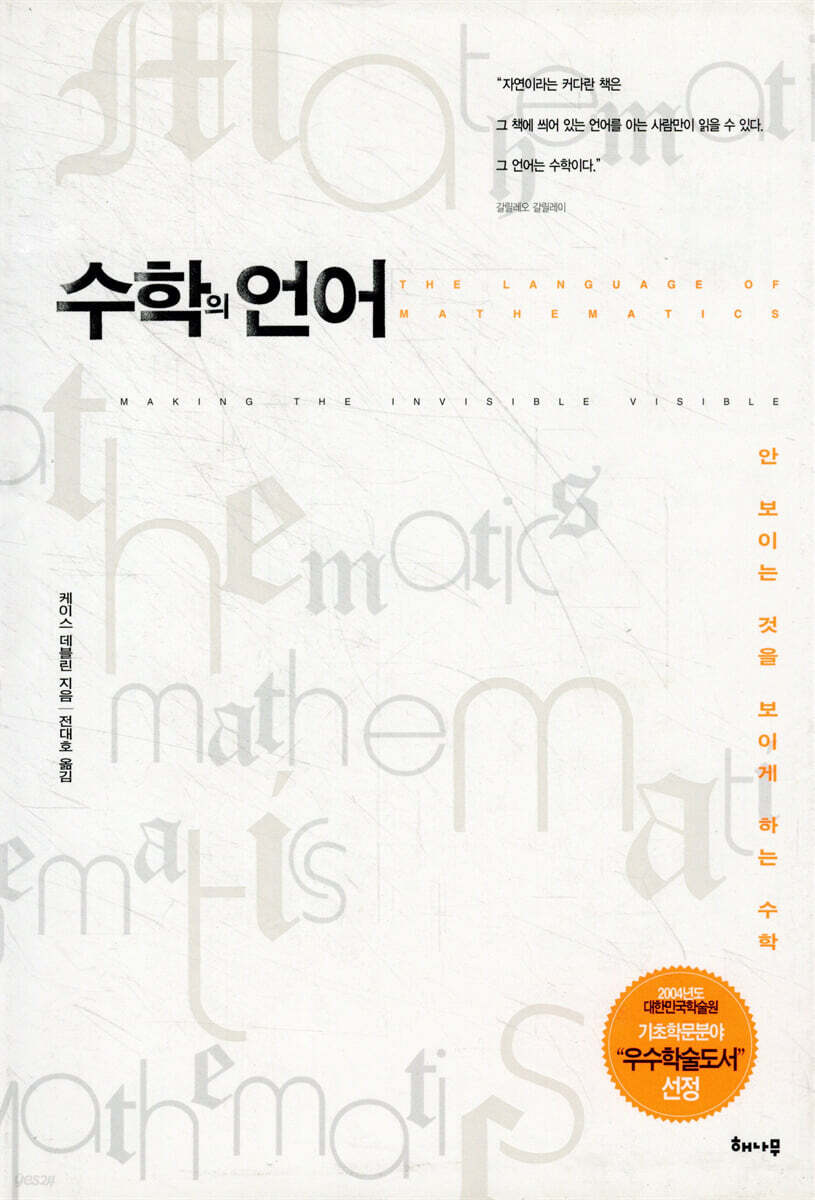
The language of mathematics
 |
Description
Book Introduction
What is mathematics? The most common answer is "the study of numbers."
However, this answer was already judged wrong a long time ago.
Therefore, this book provides an overview of what mathematics deals with today.
Unlike in the past, mathematics is now defined as a pattern, and the essence of human thought, communication, computers, society, and life itself is defined as a mathematical pattern.
"Mathematics, the science of patterns, is a way of seeing the world—the physical, biological, and social worlds outwardly, and the world of our minds and thoughts inwardly."
It reflects the profound and fundamental status of mathematical patterns in the human mind and the physical world by covering eight topics: patterns of counting, patterns of reasoning and communication, patterns of movement and change, patterns of shape, patterns of symmetry and regularity, patterns of position, and fundamental patterns of the universe, in order to convey new mathematical concepts.
It also clearly explains the historical development of mathematics and the current research results.
It reveals how mathematics has played a crucial role in our exploration of who we are and what the world we live in is like, and clearly explains new theories of complex mathematics that extend even to cosmology today.
However, this answer was already judged wrong a long time ago.
Therefore, this book provides an overview of what mathematics deals with today.
Unlike in the past, mathematics is now defined as a pattern, and the essence of human thought, communication, computers, society, and life itself is defined as a mathematical pattern.
"Mathematics, the science of patterns, is a way of seeing the world—the physical, biological, and social worlds outwardly, and the world of our minds and thoughts inwardly."
It reflects the profound and fundamental status of mathematical patterns in the human mind and the physical world by covering eight topics: patterns of counting, patterns of reasoning and communication, patterns of movement and change, patterns of shape, patterns of symmetry and regularity, patterns of position, and fundamental patterns of the universe, in order to convey new mathematical concepts.
It also clearly explains the historical development of mathematics and the current research results.
It reveals how mathematics has played a crucial role in our exploration of who we are and what the world we live in is like, and clearly explains new theories of complex mathematics that extend even to cosmology today.
index
1.
What is mathematics?
2.
Why numbers matter
3.
Patterns of the mind
4.
Math in Motion
5.
Math in Shape
6.
The Mathematics of Beauty
7.
Mathematics that has taken hold
8.
How do mathematicians calculate probability?
9.
Uncovering the Hidden Patterns of the Universe
What is mathematics?
2.
Why numbers matter
3.
Patterns of the mind
4.
Math in Motion
5.
Math in Shape
6.
The Mathematics of Beauty
7.
Mathematics that has taken hold
8.
How do mathematicians calculate probability?
9.
Uncovering the Hidden Patterns of the Universe
Into the book
As the level of abstraction in mathematics increased, mathematicians increasingly relied on the concept of abstract sets ('set' is a technical term introduced to refer to any collection of objects of any kind).
New mathematical concepts such as groups, integer domains, fields, topological spaces, and vector spaces were introduced and studied, and many of these concepts were defined as sets of objects, or more specifically, as sets of objects on which specific operations (such as various types of addition and multiplication) can be performed.
Familiar and old geometric concepts, such as the line, circle, triangle, plane, cube, and octahedron, were redefined as sets of points that each satisfy certain conditions.
As we have already seen, Boul also explored syllogisms using sets in his algebraic logic.
The first complete mathematical theory of abstract sets was developed by the German mathematician Cantor near the end of the 19th century.
Of course, the beginnings of set theory were clearly contained in the study of fire.
The basic idea of Cantor's theory can also be found in Boole's study of the syllogism.
The starting point of Cantor's theory is the development of 'arithmetic'.
New mathematical concepts such as groups, integer domains, fields, topological spaces, and vector spaces were introduced and studied, and many of these concepts were defined as sets of objects, or more specifically, as sets of objects on which specific operations (such as various types of addition and multiplication) can be performed.
Familiar and old geometric concepts, such as the line, circle, triangle, plane, cube, and octahedron, were redefined as sets of points that each satisfy certain conditions.
As we have already seen, Boul also explored syllogisms using sets in his algebraic logic.
The first complete mathematical theory of abstract sets was developed by the German mathematician Cantor near the end of the 19th century.
Of course, the beginnings of set theory were clearly contained in the study of fire.
The basic idea of Cantor's theory can also be found in Boole's study of the syllogism.
The starting point of Cantor's theory is the development of 'arithmetic'.
---pp.
126~127
126~127
Publisher's Review
Presenting a new perspective on the world of mathematics
The most common view of mathematics today is to regard mathematical properties as 'patterns' (formerly called concepts).
Because mathematics is not just the study of numbers, but also the study of recognizing and discovering patterns hidden in life.
The author demonstrates the precision, purity, and elegance of mathematics in simple, clear language that anyone can understand.
Through this, we will discover the beauty of mathematics that is unified as a 'pattern' rather than as a fragmented and individualized mathematics.
It gives us new eyes to look at life and the world.
Recognizing mathematics as patterns is a new way of thinking.
The new concept of pattern overcomes simple dichotomous thinking by replacing 'concept', 'regularity', and 'law'.
Patterns refer not only to concepts but also to objects.
In reality, concepts and objects cannot be separated.
The term "pattern" is clearly a new mentality, and Devlin is at the forefront of that trend.
Therefore, this book not only cultivates knowledge about mathematics in general, but also guides readers to savor mathematical thinking.
Mathematics as the "science of patterns"—this new perspective is key to understanding the rapidly developing cutting-edge fields of mathematics.
GOODS SPECIFICS
- Date of issue: May 6, 2003
- Format: Hardcover book binding method guide
- Page count, weight, size: 526 pages | 930g | 153*224*35mm
- ISBN13: 9788989799122
- ISBN10: 8989799120
You may also like
카테고리
korean


korean

![GQ KOREA Mark (Monthly): December [2025]](http://librairie.coreenne.fr/cdn/shop/files/8ef265dbbfbf186523ed75ba7319009d.jpg?v=1765340328&width=3840)


