

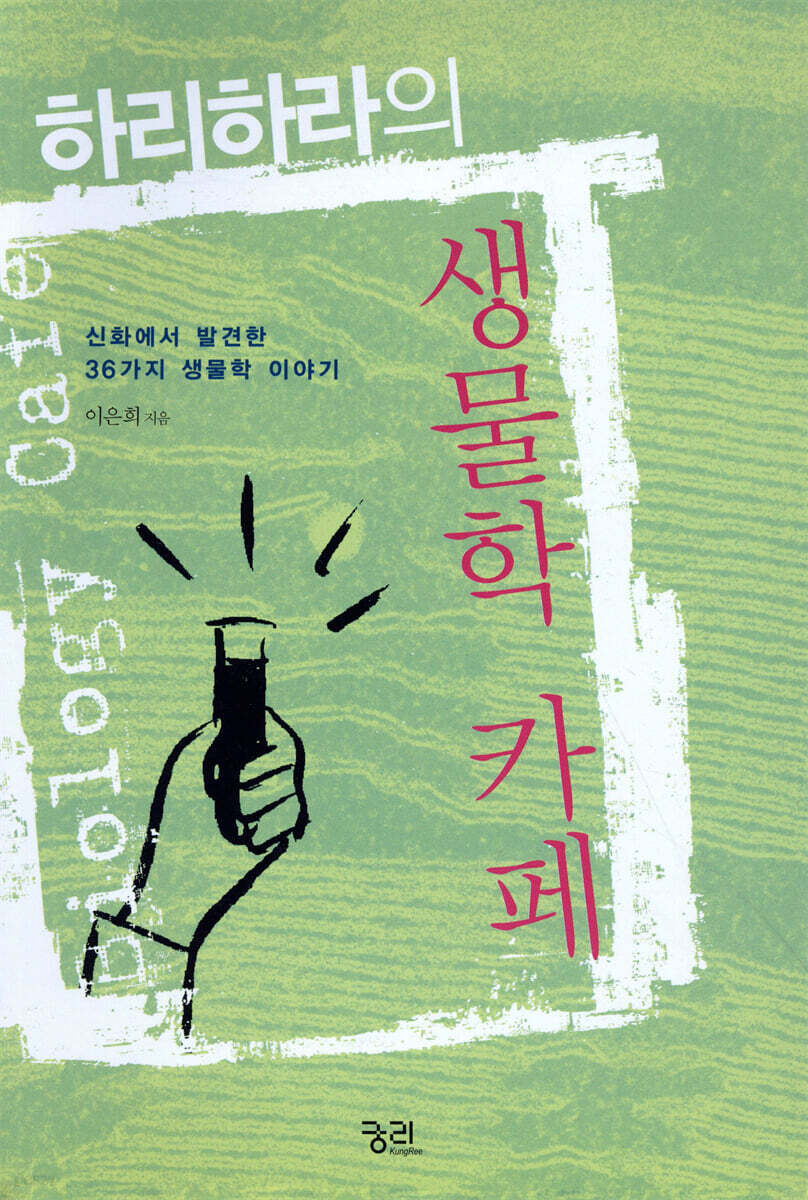
Harihara's Biology Cafe
 |
Description
Book Introduction
A collection of scientific essays on 36 topics of high interest in biology, written in an easy-to-read and fun way for the general public.
A biology story with friendly writing, lively illustrations and photos, and a mix of seriousness and fun about science.
This book was published after improving the quality of a biology column serialized on the Internet and adding a story of mythology.
The text conveys a lightheartedness of the new generation, yet a seriousness that is by no means light.
In the story of Sibyl, who desired eternal youth, and Tithonus, who became a cicada, we ponder 'the birth and aging of humans', and in the sad love song of Pyramus and Thesbes, we think of the relationship between 'love and hormones'! In the story of Pygmalion, a famous sculptor, creating a beautiful statue of Galatea, we think of 'artificial life'. Before getting into the biology story in earnest, we briefly mention the myth that served as the basis for each material in the beginning, creating a subtle contrast that makes reading more enjoyable.
A biology story with friendly writing, lively illustrations and photos, and a mix of seriousness and fun about science.
This book was published after improving the quality of a biology column serialized on the Internet and adding a story of mythology.
The text conveys a lightheartedness of the new generation, yet a seriousness that is by no means light.
In the story of Sibyl, who desired eternal youth, and Tithonus, who became a cicada, we ponder 'the birth and aging of humans', and in the sad love song of Pyramus and Thesbes, we think of the relationship between 'love and hormones'! In the story of Pygmalion, a famous sculptor, creating a beautiful statue of Galatea, we think of 'artificial life'. Before getting into the biology story in earnest, we briefly mention the myth that served as the basis for each material in the beginning, creating a subtle contrast that makes reading more enjoyable.
- You can preview some of the book's contents.
Preview
index
Chapter 1: The Birth and Aging of Life
1.
Birth from Chaos - The Meeting of Sperm and Egg
2.
Save Meleager, Mother, the Death of Meleager - The Struggle for Survival Between Mother and Fetus
3.
Leda and the Beautiful Swan - The Birth of Twins
4.
Hephaestus, cast down from heaven - congenital deformity
5.
Sibyl's Wish - A Story About Aging 1
6.
Tithonus Becomes a Cicada - A Story of Aging Part 2
Chapter 2: Evolution of Genes
7.
The Myrmidon Tribe Born from Ants - Genetic Immortality and Identity
8.
Erythirstython, the self-eating bacterium - Obesity and Genes
9.
The Death of Hercules - Genetic Imprinting
10.
The Story of Argos' Eyes Nestled in a Peacock's Tail - The Red Queen of Evolution
11.
Atalanta's Choice - The Gamble of Genes
12.
Where are the eyes of the cyclops? - Why is the heart on the left?
Chapter 3: The Evolution of Sex and Men and Women
13.
We have no son.
Amazon - Choice of Castle
14.
Peleus's acquisition of Thetis - the sale of eggs and sperm
15.
Athena, born from Zeus's head - About Norebo and contraception
16.
Cronus swallowed his children - the murder of male offspring
17.
Epistle, From Woman to Man: Sexual Identity and Tolerance in Our Society
18.
Apollo's Love for Hyacinthus - Homosexuality and Sexual Freedom
Chapter 4: About Hormones
19.
Aison's Rejuvenation - Growth Hormones and Aging
20.
The Unattainable Sad Love of Pyramus and Thisbe - Love and Hormones
21.
Achilles' Heal - Endorphins and Near-Death Experiences
22.
Psyche in the Sleep of Death - The Biological Clock and Melatonin
23.
Echoes of Depression and Serotonin
24.
Tiresias, who experienced the pleasure of both sexes - environmental hormones
Chapter 5 Disease and the Immune System
25.
Want beef for dinner? - Mad Cow Disease and Prions
26.
Bellerophon's Letter - Anthrax and Bioterrorism
27.
Niobe turned to rock - Life is not worth equal.
AIDS
28.
Nessus' Blood Vengeance - Blood Transfusions and Vaccinations
29.
The Frenzy of Dionysus - Immune System Misperception, Allergies, and Autoimmune Disease
30.
Pelops' Left Shoulder - About Organ Transplantation
Chapter 6: Biotechnology
31.
What's in Pandora's Box? - Biotechnology Opens the Future
32.
Pygmalion's Wish - On Artificial Life
33.
Half-human, half-horse Centaur - The Birth of Cloned Pigs and Artificial Organs
34.
The Elixir of Immortality, Hera's Milk - Transgenic Animals
35.
Perdix, the inventor of the saw - biomimicry, biomimetics
36.
Hypnos' Palace - Deathly Sleep, Biofreezing
1.
Birth from Chaos - The Meeting of Sperm and Egg
2.
Save Meleager, Mother, the Death of Meleager - The Struggle for Survival Between Mother and Fetus
3.
Leda and the Beautiful Swan - The Birth of Twins
4.
Hephaestus, cast down from heaven - congenital deformity
5.
Sibyl's Wish - A Story About Aging 1
6.
Tithonus Becomes a Cicada - A Story of Aging Part 2
Chapter 2: Evolution of Genes
7.
The Myrmidon Tribe Born from Ants - Genetic Immortality and Identity
8.
Erythirstython, the self-eating bacterium - Obesity and Genes
9.
The Death of Hercules - Genetic Imprinting
10.
The Story of Argos' Eyes Nestled in a Peacock's Tail - The Red Queen of Evolution
11.
Atalanta's Choice - The Gamble of Genes
12.
Where are the eyes of the cyclops? - Why is the heart on the left?
Chapter 3: The Evolution of Sex and Men and Women
13.
We have no son.
Amazon - Choice of Castle
14.
Peleus's acquisition of Thetis - the sale of eggs and sperm
15.
Athena, born from Zeus's head - About Norebo and contraception
16.
Cronus swallowed his children - the murder of male offspring
17.
Epistle, From Woman to Man: Sexual Identity and Tolerance in Our Society
18.
Apollo's Love for Hyacinthus - Homosexuality and Sexual Freedom
Chapter 4: About Hormones
19.
Aison's Rejuvenation - Growth Hormones and Aging
20.
The Unattainable Sad Love of Pyramus and Thisbe - Love and Hormones
21.
Achilles' Heal - Endorphins and Near-Death Experiences
22.
Psyche in the Sleep of Death - The Biological Clock and Melatonin
23.
Echoes of Depression and Serotonin
24.
Tiresias, who experienced the pleasure of both sexes - environmental hormones
Chapter 5 Disease and the Immune System
25.
Want beef for dinner? - Mad Cow Disease and Prions
26.
Bellerophon's Letter - Anthrax and Bioterrorism
27.
Niobe turned to rock - Life is not worth equal.
AIDS
28.
Nessus' Blood Vengeance - Blood Transfusions and Vaccinations
29.
The Frenzy of Dionysus - Immune System Misperception, Allergies, and Autoimmune Disease
30.
Pelops' Left Shoulder - About Organ Transplantation
Chapter 6: Biotechnology
31.
What's in Pandora's Box? - Biotechnology Opens the Future
32.
Pygmalion's Wish - On Artificial Life
33.
Half-human, half-horse Centaur - The Birth of Cloned Pigs and Artificial Organs
34.
The Elixir of Immortality, Hera's Milk - Transgenic Animals
35.
Perdix, the inventor of the saw - biomimicry, biomimetics
36.
Hypnos' Palace - Deathly Sleep, Biofreezing
Into the book
Previously, we talked about the genetic causes of aging, but this time, I would like to talk about environmental factors that cause aging.
Modern medicine has moved beyond the idea of aging as an inevitable process of deterioration of life and has come to recognize it as a 'disease'.
If aging is our destiny, we have no choice but to accept it, but if it is a disease, then there is a possibility that we can deal with it and prevent it.
We don't know the exact cause yet, but we've identified several possibilities.
First, there is the theory of consumption.
This is likening a living organism to a machine.
Just as machines wear out over time and their joints become worn out, causing them to break down more frequently, so too do humans become worn and creaky here and there as they go through the passage of time. This is aging.
The gist of this argument is that if you use your body too long and too harshly, its performance will decline, it will age, and eventually die.
This theory, while plausible, completely ignores the fact that, unlike machines, living organisms have the ability to regenerate themselves when something breaks down.
Secondly, there is the bioenergetic theory.
This is somewhat in line with the genetic destiny theory, which states that a living organism already has a certain amount of limiting energy when it is born.
Modern medicine has moved beyond the idea of aging as an inevitable process of deterioration of life and has come to recognize it as a 'disease'.
If aging is our destiny, we have no choice but to accept it, but if it is a disease, then there is a possibility that we can deal with it and prevent it.
We don't know the exact cause yet, but we've identified several possibilities.
First, there is the theory of consumption.
This is likening a living organism to a machine.
Just as machines wear out over time and their joints become worn out, causing them to break down more frequently, so too do humans become worn and creaky here and there as they go through the passage of time. This is aging.
The gist of this argument is that if you use your body too long and too harshly, its performance will decline, it will age, and eventually die.
This theory, while plausible, completely ignores the fact that, unlike machines, living organisms have the ability to regenerate themselves when something breaks down.
Secondly, there is the bioenergetic theory.
This is somewhat in line with the genetic destiny theory, which states that a living organism already has a certain amount of limiting energy when it is born.
--- PP.59-60
Usually, when conjoined twins are born, they undergo separation surgery to allow them to live 'normal' lives, but their parents refused to separate their children, and the issue eventually reached the courts, stimulating the ears of the world.
What makes them problematic is the special circumstances they find themselves in now.
Of the two children, Mary's heart and lungs have already stopped functioning (if they had been born separated, Mary would have already died), so she relies on Jody's cardiopulmonary function to survive.
Although Jodi's cardiopulmonary function was normal, she could not perform the functions of two people forever, so the doctors insisted that if they were left like this, both would die within a few months and that they should be separated as soon as possible to save at least one healthy child.
However, the twins' parents, who were Roman Catholics, insisted that "separating the children is not 'God's will' and that they should be allowed to grow up together even if they both die," which led to a legal dispute, and the entire nation was divided into two sides, debating for and against the separation surgery.
After a fierce battle, the British court finally ordered the separation of the conjoined twins. The parents, who had been adamant about appealing, for some reason gave up further proceedings, and the twins eventually underwent surgery.
Ultimately, this surgery resulted in Mary's death.
This issue is one that captures people's attention and can influence public opinion because it brings together many controversial issues: whether it is right to sacrifice one child to save another, how modern medical perspectives clash with religious beliefs, and what constitutes a normal life.
Hold on a second! Before we dive into this debate, let's take a quick look at how twins are born.
Usually, when conjoined twins are born, they undergo separation surgery to allow them to live 'normal' lives, but their parents refused to separate their children, and the issue eventually reached the courts, stimulating the ears of the world.
What makes them problematic is the special circumstances they find themselves in now.
Of the two children, Mary's heart and lungs have already stopped functioning (if they had been born separated, Mary would have already died), so she relies on Jody's cardiopulmonary function to survive.
Although Jodi's cardiopulmonary function was normal, she could not perform the functions of two people forever, so the doctors insisted that if they were left like this, both would die within a few months and that they should be separated as soon as possible to save at least one healthy child.
However, the twins' parents, who were Roman Catholics, insisted that "separating the children is not 'God's will' and that they should be allowed to grow up together even if they both die," which led to a legal dispute, and the entire nation was divided into two sides, debating for and against the separation surgery.
After a fierce battle, the British court finally ordered the separation of the conjoined twins. The parents, who had been adamant about appealing, for some reason gave up further proceedings, and the twins eventually underwent surgery.
Ultimately, this surgery resulted in Mary's death.
This issue is one that captures people's attention and can influence public opinion because it brings together many controversial issues: whether it is right to sacrifice one child to save another, how modern medical perspectives clash with religious beliefs, and what constitutes a normal life.
Hold on a second! Before we dive into this debate, let's take a quick look at how twins are born.
What makes them problematic is the special circumstances they find themselves in now.
Of the two children, Mary's heart and lungs have already stopped functioning (if they had been born separated, Mary would have already died), so she relies on Jody's cardiopulmonary function to survive.
Although Jodi's cardiopulmonary function was normal, she could not perform the functions of two people forever, so the doctors insisted that if they were left like this, both would die within a few months and that they should be separated as soon as possible to save at least one healthy child.
However, the twins' parents, who were Roman Catholics, insisted that "separating the children is not 'God's will' and that they should be allowed to grow up together even if they both die," which led to a legal dispute, and the entire nation was divided into two sides, debating for and against the separation surgery.
After a fierce battle, the British court finally ordered the separation of the conjoined twins. The parents, who had been adamant about appealing, for some reason gave up further proceedings, and the twins eventually underwent surgery.
Ultimately, this surgery resulted in Mary's death.
This issue is one that captures people's attention and can influence public opinion because it brings together many controversial issues: whether it is right to sacrifice one child to save another, how modern medical perspectives clash with religious beliefs, and what constitutes a normal life.
Hold on a second! Before we dive into this debate, let's take a quick look at how twins are born.
Usually, when conjoined twins are born, they undergo separation surgery to allow them to live 'normal' lives, but their parents refused to separate their children, and the issue eventually reached the courts, stimulating the ears of the world.
What makes them problematic is the special circumstances they find themselves in now.
Of the two children, Mary's heart and lungs have already stopped functioning (if they had been born separated, Mary would have already died), so she relies on Jody's cardiopulmonary function to survive.
Although Jodi's cardiopulmonary function was normal, she could not perform the functions of two people forever, so the doctors insisted that if they were left like this, both would die within a few months and that they should be separated as soon as possible to save at least one healthy child.
However, the twins' parents, who were Roman Catholics, insisted that "separating the children is not 'God's will' and that they should be allowed to grow up together even if they both die," which led to a legal dispute, and the entire nation was divided into two sides, debating for and against the separation surgery.
After a fierce battle, the British court finally ordered the separation of the conjoined twins. The parents, who had been adamant about appealing, for some reason gave up further proceedings, and the twins eventually underwent surgery.
Ultimately, this surgery resulted in Mary's death.
This issue is one that captures people's attention and can influence public opinion because it brings together many controversial issues: whether it is right to sacrifice one child to save another, how modern medical perspectives clash with religious beliefs, and what constitutes a normal life.
Hold on a second! Before we dive into this debate, let's take a quick look at how twins are born.
--- pp.35-37
A person who has undergone sex reassignment surgery like her and changed from their birth sex to another sex is called a transgender.
It is known that there are about 1,000 transgender people in Korea who have undergone sex reassignment surgery through various means, but due to the secret nature of the surgery, it is estimated that many more people have changed their birth sex.
However, among the thousands of transgender people, only three have ever legally taken action to have their gender changed.
For this reason, in 1995, when a transgender person was sexually assaulted, the perpetrators were charged with “forcible sexual assault” instead of “rape resulting in death.”
Since the Constitution clearly states that ‘rape’ is ‘a forced sexual act against a woman,’ the logic was that a transgender woman, who is legally a ‘man,’ is not a ‘woman,’ and therefore rape cannot be established.
In July 2002, the first amendment to the family register of transgender people was approved, demonstrating significant progress in their human rights.
So why aren't transgender people who transitioned from male to female recognized as women? Since most transgender people transition from male to female, this discussion will focus on those who transitioned from male to female.
A person who has undergone sex reassignment surgery like her and changed from their birth sex to another sex is called a transgender.
It is known that there are about 1,000 transgender people in Korea who have undergone sex reassignment surgery through various means, but due to the secret nature of the surgery, it is estimated that many more people have changed their birth sex.
However, among the thousands of transgender people, only three have ever legally taken action to have their gender changed.
For this reason, in 1995, when a transgender person was sexually assaulted, the perpetrators were charged with “forcible sexual assault” instead of “rape resulting in death.”
Since the Constitution clearly states that ‘rape’ is ‘a forced sexual act against a woman,’ the logic was that a transgender woman, who is legally a ‘man,’ is not a ‘woman,’ and therefore rape cannot be established.
In July 2002, the first amendment to the family register of transgender people was approved, demonstrating significant progress in their human rights.
So why aren't transgender people who transitioned from male to female recognized as women? Since most transgender people transition from male to female, this discussion will focus on those who transitioned from male to female.
It is known that there are about 1,000 transgender people in Korea who have undergone sex reassignment surgery through various means, but due to the secret nature of the surgery, it is estimated that many more people have changed their birth sex.
However, among the thousands of transgender people, only three have ever legally taken action to have their gender changed.
For this reason, in 1995, when a transgender person was sexually assaulted, the perpetrators were charged with “forcible sexual assault” instead of “rape resulting in death.”
Since the Constitution clearly states that ‘rape’ is ‘a forced sexual act against a woman,’ the logic was that a transgender woman, who is legally a ‘man,’ is not a ‘woman,’ and therefore rape cannot be established.
In July 2002, the first amendment to the family register of transgender people was approved, demonstrating significant progress in their human rights.
So why aren't transgender people who transitioned from male to female recognized as women? Since most transgender people transition from male to female, this discussion will focus on those who transitioned from male to female.
A person who has undergone sex reassignment surgery like her and changed from their birth sex to another sex is called a transgender.
It is known that there are about 1,000 transgender people in Korea who have undergone sex reassignment surgery through various means, but due to the secret nature of the surgery, it is estimated that many more people have changed their birth sex.
However, among the thousands of transgender people, only three have ever legally taken action to have their gender changed.
For this reason, in 1995, when a transgender person was sexually assaulted, the perpetrators were charged with “forcible sexual assault” instead of “rape resulting in death.”
Since the Constitution clearly states that ‘rape’ is ‘a forced sexual act against a woman,’ the logic was that a transgender woman, who is legally a ‘man,’ is not a ‘woman,’ and therefore rape cannot be established.
In July 2002, the first amendment to the family register of transgender people was approved, demonstrating significant progress in their human rights.
So why aren't transgender people who transitioned from male to female recognized as women? Since most transgender people transition from male to female, this discussion will focus on those who transitioned from male to female.
--- pp.149-150
GOODS SPECIFICS
- Date of issue: July 31, 2002
- Page count, weight, size: 307 pages | 519g | 153*224*30mm
- ISBN13: 9788988804674
- ISBN10: 8988804678
You may also like
카테고리
korean


korean

![GQ KOREA Mark (Monthly): December [2025]](http://librairie.coreenne.fr/cdn/shop/files/8ef265dbbfbf186523ed75ba7319009d.jpg?v=1765340328&width=3840)


