

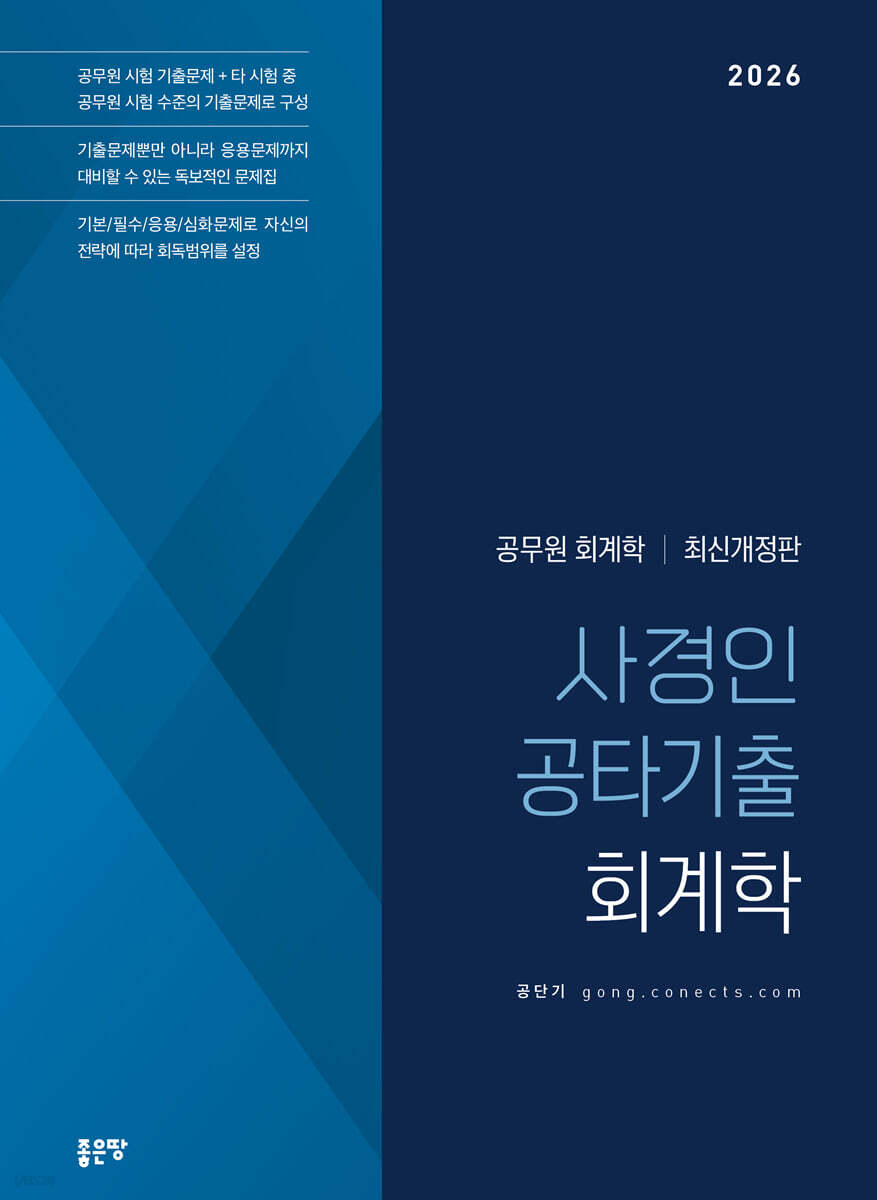
Accounting for the Sakyungin Gongtagi exam
 |
Description
Book Introduction
Accounting, which has a higher proportion of applied problems than other subjects, has the difficulty of being insufficiently prepared with only past exam questions.
To solve this problem, the Gongta Gi-chul is composed of 'past civil service exam questions + past questions from other exams (insurance actuary, customs broker, real estate appraiser, etc.) at the civil service exam level.'
The publication of this unique workbook, which covers not only past exam questions but also applied questions, has been loved by many test takers.
It has become established as the 'Bible of Civil Service Accounting' to the point that there is a saying in the student community that 'even if you follow another instructor's curriculum, buy the Gongta Exam Questions and solve them.'
For the past two years in a row, the civil service exam has been easy.
As cases of passing the exam in a short period of time by repeatedly solving only easy past exam questions arise, the question arises, "Is it really necessary to study difficult application problems anymore?"
Yet, on the other hand, there are voices of concern: "What if the exams become as difficult as before? Then I'll have to prepare for another year?"
In fact, if you look at past correct answer statistics, the difficulty of the exam changes in an unpredictable way every time the examiners change.
The test, which had been easy for two years in a row, suddenly became difficult, then easy again, and so on.
So how should test takers prepare?
I believe the best solution to this anxiety is to allow each test taker to divide their study area according to their individual circumstances and target scores.
Each test taker's situation is different.
Some students may only need to secure a minimum score in accounting because their general subject grades are good, while others, on the other hand, may not be able to raise their general subject grades and must obtain a high score in accounting.
While some students start studying in the spring and secure about a year, others start in the fall and aim to pass in a shorter period of time.
Some test takers aim to pass the exam in a short period of time if the exam is easy, while others want to pass no matter how the exam is given.
To help test takers divide their study areas according to their individual strategies, Gongtagi Chul has categorized past exam questions from the past 10 years by correct answer rate as follows:
① Basic questions: 300 questions for test takers who want to score 60 points in a short period of time.
② Required questions: Approximately 300 questions to secure the general passing score of 80 points.
③ Application Problems: Approximately 400 questions for test takers who need a high score of 90 points.
④ Advanced questions: About 100 questions that are not necessary to look at unless you are aiming for a perfect score.
Test takers who want to score 60 points in a short period of time can read through the 300 or so basic questions.
If you are aiming for an average passing score of around 80 points, you can add about 300 required questions.
If you are aiming for a high score in the 90s, please develop your applied skills through application problems.
The advanced questions are additional questions for test takers aiming for a perfect score in accounting.
We have released a unique collection of past exam questions that allows you to set your reading range according to your own strategy.
I believe that the pride and satisfaction I felt while writing this book will lead to the students passing their exams.
We will do our best to help you pass.
To solve this problem, the Gongta Gi-chul is composed of 'past civil service exam questions + past questions from other exams (insurance actuary, customs broker, real estate appraiser, etc.) at the civil service exam level.'
The publication of this unique workbook, which covers not only past exam questions but also applied questions, has been loved by many test takers.
It has become established as the 'Bible of Civil Service Accounting' to the point that there is a saying in the student community that 'even if you follow another instructor's curriculum, buy the Gongta Exam Questions and solve them.'
For the past two years in a row, the civil service exam has been easy.
As cases of passing the exam in a short period of time by repeatedly solving only easy past exam questions arise, the question arises, "Is it really necessary to study difficult application problems anymore?"
Yet, on the other hand, there are voices of concern: "What if the exams become as difficult as before? Then I'll have to prepare for another year?"
In fact, if you look at past correct answer statistics, the difficulty of the exam changes in an unpredictable way every time the examiners change.
The test, which had been easy for two years in a row, suddenly became difficult, then easy again, and so on.
So how should test takers prepare?
I believe the best solution to this anxiety is to allow each test taker to divide their study area according to their individual circumstances and target scores.
Each test taker's situation is different.
Some students may only need to secure a minimum score in accounting because their general subject grades are good, while others, on the other hand, may not be able to raise their general subject grades and must obtain a high score in accounting.
While some students start studying in the spring and secure about a year, others start in the fall and aim to pass in a shorter period of time.
Some test takers aim to pass the exam in a short period of time if the exam is easy, while others want to pass no matter how the exam is given.
To help test takers divide their study areas according to their individual strategies, Gongtagi Chul has categorized past exam questions from the past 10 years by correct answer rate as follows:
① Basic questions: 300 questions for test takers who want to score 60 points in a short period of time.
② Required questions: Approximately 300 questions to secure the general passing score of 80 points.
③ Application Problems: Approximately 400 questions for test takers who need a high score of 90 points.
④ Advanced questions: About 100 questions that are not necessary to look at unless you are aiming for a perfect score.
Test takers who want to score 60 points in a short period of time can read through the 300 or so basic questions.
If you are aiming for an average passing score of around 80 points, you can add about 300 required questions.
If you are aiming for a high score in the 90s, please develop your applied skills through application problems.
The advanced questions are additional questions for test takers aiming for a perfect score in accounting.
We have released a unique collection of past exam questions that allows you to set your reading range according to your own strategy.
I believe that the pride and satisfaction I felt while writing this book will lead to the students passing their exams.
We will do our best to help you pass.
- You can preview some of the book's contents.
Preview
index
Preface 2
Composition and Features 4
Public Reading Table 8
Part 1 Financial Accounting
01 Accounting Theory and Conceptual Framework 14
02 Financial Statement Presentation and Disclosure 47
03 Investment Real Estate 96
04 Tangible Assets 108
05 Intangible Assets 171
06 Inventory Assets 194
07 Biological Assets 242
08 Cash and Cash Equivalents 246
09 Accounts Receivable 259
10 Financial Assets 274
11 Financial Debt 299
12 Provisions and Other Liabilities 324
13 Capital 336
14 Revenue Recognition 374
15 Accounting Changes and Error Corrections 405
16 Cash Flow Statement 466
17 Financial Analysis 496
18 Lease and Exchange Rate Fluctuations 529
Part 2 Cost Accounting
01 Classification and Basics of Cost 536
02 Cost flow 545
03 Individual Cost Accounting System 562
04 Comprehensive Cost Accounting System 583
05 Cost Function and CVP Analysis 610
06 Variable Costing and Short-Term and Long-Term Decision Making 629
07 Standard Cost Variance Analysis and Performance Evaluation 648
Part 3 Government Accounting
01 Fundamentals of Government Accounting 666
02 Government Financial Statements 676
03 Valuation of Assets and Liabilities 706
Part 4: Past Exam Questions by Recent Years
01 2025 National Civil Service Exam Level 9 (Accounting) 724
02 2025 National Civil Service Exam Level 9 (Accounting Principles) 735
03 2025 Local Government Official Grade 9 (Accounting) 745
Composition and Features 4
Public Reading Table 8
Part 1 Financial Accounting
01 Accounting Theory and Conceptual Framework 14
02 Financial Statement Presentation and Disclosure 47
03 Investment Real Estate 96
04 Tangible Assets 108
05 Intangible Assets 171
06 Inventory Assets 194
07 Biological Assets 242
08 Cash and Cash Equivalents 246
09 Accounts Receivable 259
10 Financial Assets 274
11 Financial Debt 299
12 Provisions and Other Liabilities 324
13 Capital 336
14 Revenue Recognition 374
15 Accounting Changes and Error Corrections 405
16 Cash Flow Statement 466
17 Financial Analysis 496
18 Lease and Exchange Rate Fluctuations 529
Part 2 Cost Accounting
01 Classification and Basics of Cost 536
02 Cost flow 545
03 Individual Cost Accounting System 562
04 Comprehensive Cost Accounting System 583
05 Cost Function and CVP Analysis 610
06 Variable Costing and Short-Term and Long-Term Decision Making 629
07 Standard Cost Variance Analysis and Performance Evaluation 648
Part 3 Government Accounting
01 Fundamentals of Government Accounting 666
02 Government Financial Statements 676
03 Valuation of Assets and Liabilities 706
Part 4: Past Exam Questions by Recent Years
01 2025 National Civil Service Exam Level 9 (Accounting) 724
02 2025 National Civil Service Exam Level 9 (Accounting Principles) 735
03 2025 Local Government Official Grade 9 (Accounting) 745
Publisher's Review
'Accounting for Civil Service Exams' is a textbook that has achieved an unrivaled status among test takers, to the point where it is called the "Bible of Civil Service Accounting."
This book has the great advantage of being a practical study guide that allows you to prepare for both past exam questions and practical applications simultaneously by selecting and including high-quality questions appropriate to the civil service exam level from other exams, such as the civil service exam, insurance actuary exam, customs broker exam, and real estate appraiser exam.
In recent years, the difficulty of the civil service accounting exam has changed dramatically.
The pattern of questions being sometimes easy and sometimes difficult has been repeated, causing great confusion among test takers, and as a result, there has been a constant anxiety about whether "Is it enough to just solve past exam questions, or do I need to prepare for difficult applications?"
In this situation, the author organized the problems into four levels so that each test taker can selectively adjust the learning scope according to their target score and study period.
The step-by-step division into basic problems (targeting 60 points), essential problems (targeting 80 points), applied problems (targeting 90 points), and advanced problems (targeting full score) will allow test takers to choose strategic learning strategies that suit their individual situations.
It offers the optimal learning path for everyone, from those aiming to pass the exam in a short period of time to those aiming for a consistently high score.
Moreover, this textbook goes beyond simply providing problems; it also provides a "frame learning method" and a "public reading table" to maximize learning effectiveness.
By organizing the vast scope of accounting into the framework of "acquisition-evaluation-disposition," we drastically reduce the amount of learning required, and by applying interleaving to the reading list, we help to enhance long-term memory.
Through this, test takers will be able to respond naturally to situations where various topics are mixed together in an actual test.
'Accounting for the Sakyungin Public Accounting Exam' is more than just a workbook.
This textbook provides a flexible learning system that allows you to learn according to your own strategies and goals without being swayed by fluctuating test difficulty. It is a reliable guide proven by countless successful candidates.
I hope that through this book, you will gain the confidence to overcome the barriers of accounting and ultimately experience the joy of passing the exam.
This book has the great advantage of being a practical study guide that allows you to prepare for both past exam questions and practical applications simultaneously by selecting and including high-quality questions appropriate to the civil service exam level from other exams, such as the civil service exam, insurance actuary exam, customs broker exam, and real estate appraiser exam.
In recent years, the difficulty of the civil service accounting exam has changed dramatically.
The pattern of questions being sometimes easy and sometimes difficult has been repeated, causing great confusion among test takers, and as a result, there has been a constant anxiety about whether "Is it enough to just solve past exam questions, or do I need to prepare for difficult applications?"
In this situation, the author organized the problems into four levels so that each test taker can selectively adjust the learning scope according to their target score and study period.
The step-by-step division into basic problems (targeting 60 points), essential problems (targeting 80 points), applied problems (targeting 90 points), and advanced problems (targeting full score) will allow test takers to choose strategic learning strategies that suit their individual situations.
It offers the optimal learning path for everyone, from those aiming to pass the exam in a short period of time to those aiming for a consistently high score.
Moreover, this textbook goes beyond simply providing problems; it also provides a "frame learning method" and a "public reading table" to maximize learning effectiveness.
By organizing the vast scope of accounting into the framework of "acquisition-evaluation-disposition," we drastically reduce the amount of learning required, and by applying interleaving to the reading list, we help to enhance long-term memory.
Through this, test takers will be able to respond naturally to situations where various topics are mixed together in an actual test.
'Accounting for the Sakyungin Public Accounting Exam' is more than just a workbook.
This textbook provides a flexible learning system that allows you to learn according to your own strategies and goals without being swayed by fluctuating test difficulty. It is a reliable guide proven by countless successful candidates.
I hope that through this book, you will gain the confidence to overcome the barriers of accounting and ultimately experience the joy of passing the exam.
GOODS SPECIFICS
- Date of issue: September 23, 2025
- Page count, weight, size: 756 pages | 188*257*40mm
- ISBN13: 9791138847377
- ISBN10: 1138847372
You may also like
카테고리
korean


korean

![GQ KOREA Mark (Monthly): December [2025]](http://librairie.coreenne.fr/cdn/shop/files/8ef265dbbfbf186523ed75ba7319009d.jpg?v=1765340328&width=3840)


