

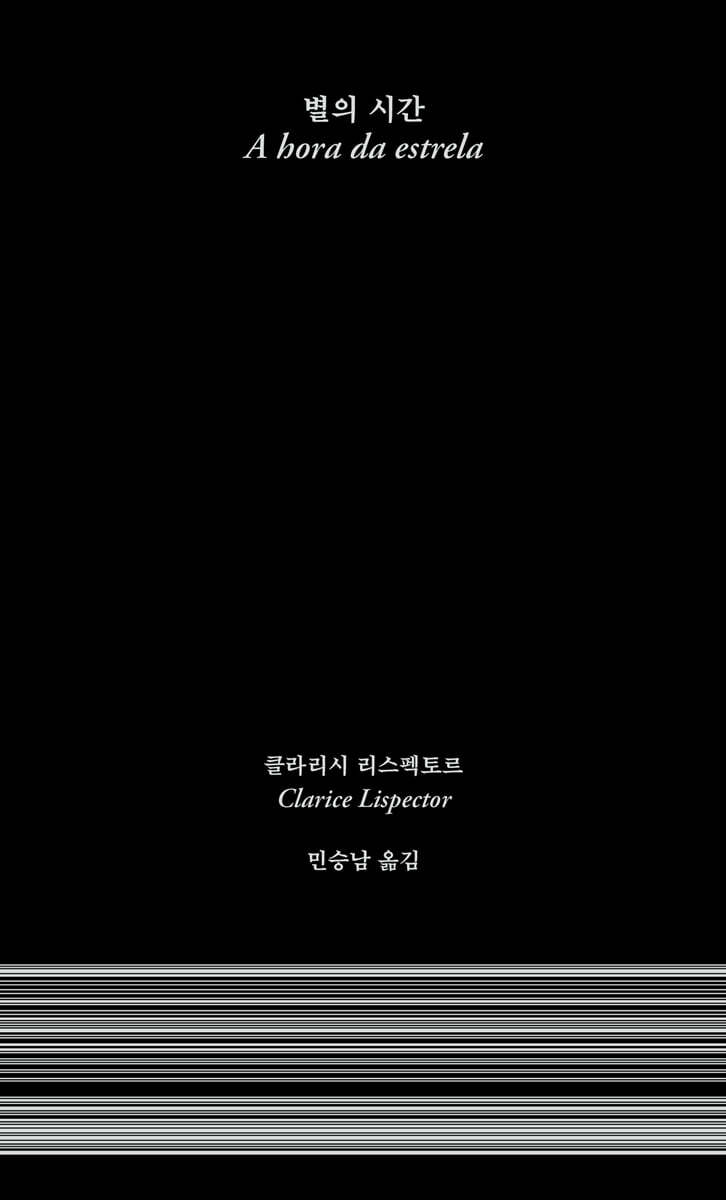
Star Time
 |
Description
Book Introduction
The writer who has gone the furthest through literature
Clarice Lispector's final destination
This is the last work written by Clarice Lispector.
Two characters appear, modeled after parts of the author's own life, but strangely enough, they seem very distant from the author compared to the characters (resembling Lispector) who appear in his previous works.
Maccabees, a figure particularly defying intellectual understanding, is a mystery that cannot be expressed in words.
Macabea's tragic life is so strangely intense and vivid that it comes across as a photograph rather than a narrative, like a moment of intense light that strikes and disappears in an instant.
This is the final destination of Lispector, who declared in his debut novel, Close to the Wild Heart, written at the age of twenty-three, that he would reach the furthest possible distance through language and thought.
A pure tragedy or world that renders linguistic thinking invalid.
Built in this empty and transparent wasteland, 『Time of the Stars』 feels like a cabin built for future generations.
This is the furthest I have ever been, so the future begins here.
The final sentence of this sad (perhaps the saddest of Lispector's works) book is strangely wide open.
Clarice Lispector's final destination
This is the last work written by Clarice Lispector.
Two characters appear, modeled after parts of the author's own life, but strangely enough, they seem very distant from the author compared to the characters (resembling Lispector) who appear in his previous works.
Maccabees, a figure particularly defying intellectual understanding, is a mystery that cannot be expressed in words.
Macabea's tragic life is so strangely intense and vivid that it comes across as a photograph rather than a narrative, like a moment of intense light that strikes and disappears in an instant.
This is the final destination of Lispector, who declared in his debut novel, Close to the Wild Heart, written at the age of twenty-three, that he would reach the furthest possible distance through language and thought.
A pure tragedy or world that renders linguistic thinking invalid.
Built in this empty and transparent wasteland, 『Time of the Stars』 feels like a cabin built for future generations.
This is the furthest I have ever been, so the future begins here.
The final sentence of this sad (perhaps the saddest of Lispector's works) book is strangely wide open.
- You can preview some of the book's contents.
Preview
index
Author's Dedication (actually written by Clarice Lispector)
Star Time
Star Time
Detailed image
Into the book
I swear this book was made without words.
This book is a muted photograph.
This book is a silence.
This book is a question.
--- p.27
Who hasn't wondered: Am I a monster, or does this mean I'm human?
--- p.24
She never questioned why she was always being punished.
But one doesn't need to know everything, and even not knowing was an important part of her life.
That ignorance might seem terrible, but it wasn't so bad.
A dog knows how to wag its tail without anyone teaching it, and a person knows how to feel hungry: you are born, and you just know.
She has learned a lot that way too.
So, no one will tell her how she should die, but she will still die one day like a protagonist who knows her role well.
Because when the time of death comes, the person becomes a shining star actor.
That moment is a glorious moment for everyone.
Then you will hear a new scream in the hymn choir.
--- p.47
They didn't know how to walk.
They walked through the pouring rain and stopped in front of a hardware store with pipes, cans, large bolts and nails displayed in the window.
And Macabea, fearing that silence might mean a breakup, spoke to her new boyfriend.
“I like bolts and nails, what about you?”
--- pp.73~74
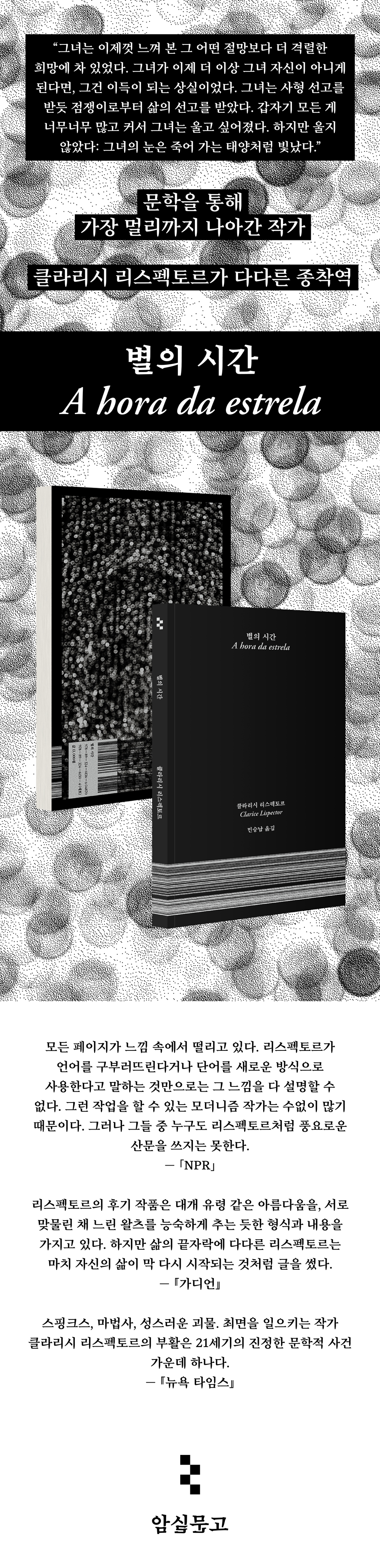
By the time she crossed the street, she was already a different person.
The one who conceived the future.
She was filled with a hope more intense than any despair she had ever felt.
If she were no longer herself, it would be a loss that would be gained.
She received a life sentence from the fortune teller as if she were being sentenced to death.
Suddenly everything was so big and so overwhelming that she felt like crying.
But she didn't cry: her eyes shone like a dying sun.
This book is a muted photograph.
This book is a silence.
This book is a question.
--- p.27
Who hasn't wondered: Am I a monster, or does this mean I'm human?
--- p.24
She never questioned why she was always being punished.
But one doesn't need to know everything, and even not knowing was an important part of her life.
That ignorance might seem terrible, but it wasn't so bad.
A dog knows how to wag its tail without anyone teaching it, and a person knows how to feel hungry: you are born, and you just know.
She has learned a lot that way too.
So, no one will tell her how she should die, but she will still die one day like a protagonist who knows her role well.
Because when the time of death comes, the person becomes a shining star actor.
That moment is a glorious moment for everyone.
Then you will hear a new scream in the hymn choir.
--- p.47
They didn't know how to walk.
They walked through the pouring rain and stopped in front of a hardware store with pipes, cans, large bolts and nails displayed in the window.
And Macabea, fearing that silence might mean a breakup, spoke to her new boyfriend.
“I like bolts and nails, what about you?”
--- pp.73~74
By the time she crossed the street, she was already a different person.
The one who conceived the future.
She was filled with a hope more intense than any despair she had ever felt.
If she were no longer herself, it would be a loss that would be gained.
She received a life sentence from the fortune teller as if she were being sentenced to death.
Suddenly everything was so big and so overwhelming that she felt like crying.
But she didn't cry: her eyes shone like a dying sun.
--- p.136
Publisher's Review
Lispector's last work,
Start with a little riddle
This work, Lispector's last, is preceded by a dedication.
But there is a mysterious sentence attached to it.
“This dedication was written by Clarice Lispector.” This sentence, which seeks to clarify the authorship, instead raises questions.
So, is there another "author" who could have written this tribute? How does this David Lynch-esque introductory setup work?
The word homem, which the author uses to refer to himself in this dedication, can be translated as 'man' or 'human'.
If this is interpreted as a male narrator, the dedication is written by Rodrigo, the first-person narrator and male author of the novel, and thus the dedication is incorporated into the novel.
On the other hand, if we interpret homem as a human being, then, in accordance with the customary nature of dedications that appear before the main text, this dedication is perceived as having been written by Lispector, the 'real author', 'outside the novel - in reality'.
Both of these possibilities are possible.
Therefore, this tribute is not located on the 'border between reality and fiction', but in a unique space where the parts of reality and fiction coexist, or 'it is both reality and fiction'.
This space, which blurs the wall between the author and the characters and disrupts the sense of reality, encompasses the entire 『Time of the Stars』.
Author and Creature A, Lispector and Rodrigo
Although they appear different on the surface due to their gender and the way they speak, Lispector and Rodrigo share a common identity.
A writer with a strange intellect and a brilliant writing style, successful enough to make a living.
Rodrigo is a character similar to the 'present' of the 'writer' named Lispector.
Even the introduction to 『Time of the Stars』 (which is supposedly written by Rodrigo) shows a typical Lispector-style development.
It is about discovering sentences by endlessly digging into one's inner self.
However, 『Time of the Stars』 attempts to break away from the world that Rodrigo (and Lispector) have enjoyed living in.
Rodrigo wants to break out of his inner world and write about someone very different from himself, and after hesitating for thirty pages in his own world, he finally takes the difficult step.
The strange world he arrived at was completely different from his own.
It is the world of a poor young woman who hardly speaks, who doesn't know what to say, who barely thinks.
Author and Creature B, Rodrigo and Maccabee
Rodrigo, a male writer belonging to the intellectual class, and Macabea, the 'poor woman' he created, seem like contrasting figures in both their backgrounds and personalities.
Maccabees grew up in poverty, was intellectually unskilled, and was therefore incapable of reflective thought, so he took suffering for granted and even considered himself happy.
Rodrigo created a character who was most unlike himself in order to go as far as possible in literature, but the intense light that illuminated that naive and ignorant world was too vivid to be expressed in language, that is, in “sounds injected from shadows (p. 29).”
Rodrigo is perplexed by his own creation.
However, Rodrigo and Maccabee are also connected.
Some of the words spoken by Rodrigo in his monologue are reborn as descriptions of Macabea or lines spoken by her over time.
Also, at one point when Macabea looks into the mirror, what is reflected in the mirror is Rodrigo's own face.
Moments like these show that the characters created by the author do not miraculously appear from outside the author's world.
What Rodrigo discovered through Macabea was not a mystery from outer space, but a part of his own inner self that he was not aware of (Lispector said in an interview:
He says that he has no such power of surrealism, and that he writes only through strict inner observation.
Ultimately, as Rodrigo writes his novel about the Maccabees, he finds himself being transformed by it.
So, is a novel a kind of essay or confession? Or perhaps all writing is an essay and a confession, and the writer ultimately encounters an unexpected aspect of himself? Is that writing?
The writer who has gone the furthest through literature
Clarice Lispector's final destination
Lispector, Rodrigo, and Maccabees.
They do not form a strict hierarchy as creator and creature, but rather influence each other.
Because they are all respecters.
However, this does not mean autobiographical literature in the general sense.
Lispector used himself as a subject not to promote himself, but because he believed that the world's greatest mystery was within himself.
Lispector's last work ends at the moment when he creates the most alien character, but when that character is the innermost soul of his own being, when he returns to the beginning by going the furthest.
A pure tragedy that nullifies linguistic thought, 『Time of the Stars』, set in this empty and transparent wasteland, feels like a cabin built for future generations.
This is the furthest I've ever been, so the future is now - start from here again.
The final sentence of this casually sad (perhaps the saddest of Lispector's works) book is strangely wide-open.
Recommendation
Lispector's later works often have a ghostly beauty, their form and content interlocking and skillfully dancing a slow waltz.
But Lispector, at the end of his life, wrote as if his life were just beginning again. - The Guardian
Every page is trembling with emotion.
Just saying that Lispector bends language or uses words in new ways doesn't quite capture the feeling.
Because there are countless modernist writers who can do such work.
But none of them writes prose as rich as Lispector. - NPR
Sphinx, wizard, holy monster.
The resurgence of the hypnotic writer Clarice Lispector is one of the true literary events of the 21st century. - The New York Times
Start with a little riddle
This work, Lispector's last, is preceded by a dedication.
But there is a mysterious sentence attached to it.
“This dedication was written by Clarice Lispector.” This sentence, which seeks to clarify the authorship, instead raises questions.
So, is there another "author" who could have written this tribute? How does this David Lynch-esque introductory setup work?
The word homem, which the author uses to refer to himself in this dedication, can be translated as 'man' or 'human'.
If this is interpreted as a male narrator, the dedication is written by Rodrigo, the first-person narrator and male author of the novel, and thus the dedication is incorporated into the novel.
On the other hand, if we interpret homem as a human being, then, in accordance with the customary nature of dedications that appear before the main text, this dedication is perceived as having been written by Lispector, the 'real author', 'outside the novel - in reality'.
Both of these possibilities are possible.
Therefore, this tribute is not located on the 'border between reality and fiction', but in a unique space where the parts of reality and fiction coexist, or 'it is both reality and fiction'.
This space, which blurs the wall between the author and the characters and disrupts the sense of reality, encompasses the entire 『Time of the Stars』.
Author and Creature A, Lispector and Rodrigo
Although they appear different on the surface due to their gender and the way they speak, Lispector and Rodrigo share a common identity.
A writer with a strange intellect and a brilliant writing style, successful enough to make a living.
Rodrigo is a character similar to the 'present' of the 'writer' named Lispector.
Even the introduction to 『Time of the Stars』 (which is supposedly written by Rodrigo) shows a typical Lispector-style development.
It is about discovering sentences by endlessly digging into one's inner self.
However, 『Time of the Stars』 attempts to break away from the world that Rodrigo (and Lispector) have enjoyed living in.
Rodrigo wants to break out of his inner world and write about someone very different from himself, and after hesitating for thirty pages in his own world, he finally takes the difficult step.
The strange world he arrived at was completely different from his own.
It is the world of a poor young woman who hardly speaks, who doesn't know what to say, who barely thinks.
Author and Creature B, Rodrigo and Maccabee
Rodrigo, a male writer belonging to the intellectual class, and Macabea, the 'poor woman' he created, seem like contrasting figures in both their backgrounds and personalities.
Maccabees grew up in poverty, was intellectually unskilled, and was therefore incapable of reflective thought, so he took suffering for granted and even considered himself happy.
Rodrigo created a character who was most unlike himself in order to go as far as possible in literature, but the intense light that illuminated that naive and ignorant world was too vivid to be expressed in language, that is, in “sounds injected from shadows (p. 29).”
Rodrigo is perplexed by his own creation.
However, Rodrigo and Maccabee are also connected.
Some of the words spoken by Rodrigo in his monologue are reborn as descriptions of Macabea or lines spoken by her over time.
Also, at one point when Macabea looks into the mirror, what is reflected in the mirror is Rodrigo's own face.
Moments like these show that the characters created by the author do not miraculously appear from outside the author's world.
What Rodrigo discovered through Macabea was not a mystery from outer space, but a part of his own inner self that he was not aware of (Lispector said in an interview:
He says that he has no such power of surrealism, and that he writes only through strict inner observation.
Ultimately, as Rodrigo writes his novel about the Maccabees, he finds himself being transformed by it.
So, is a novel a kind of essay or confession? Or perhaps all writing is an essay and a confession, and the writer ultimately encounters an unexpected aspect of himself? Is that writing?
The writer who has gone the furthest through literature
Clarice Lispector's final destination
Lispector, Rodrigo, and Maccabees.
They do not form a strict hierarchy as creator and creature, but rather influence each other.
Because they are all respecters.
However, this does not mean autobiographical literature in the general sense.
Lispector used himself as a subject not to promote himself, but because he believed that the world's greatest mystery was within himself.
Lispector's last work ends at the moment when he creates the most alien character, but when that character is the innermost soul of his own being, when he returns to the beginning by going the furthest.
A pure tragedy that nullifies linguistic thought, 『Time of the Stars』, set in this empty and transparent wasteland, feels like a cabin built for future generations.
This is the furthest I've ever been, so the future is now - start from here again.
The final sentence of this casually sad (perhaps the saddest of Lispector's works) book is strangely wide-open.
Recommendation
Lispector's later works often have a ghostly beauty, their form and content interlocking and skillfully dancing a slow waltz.
But Lispector, at the end of his life, wrote as if his life were just beginning again. - The Guardian
Every page is trembling with emotion.
Just saying that Lispector bends language or uses words in new ways doesn't quite capture the feeling.
Because there are countless modernist writers who can do such work.
But none of them writes prose as rich as Lispector. - NPR
Sphinx, wizard, holy monster.
The resurgence of the hypnotic writer Clarice Lispector is one of the true literary events of the 21st century. - The New York Times
GOODS SPECIFICS
- Date of issue: February 25, 2023
- Page count, weight, size: 152 pages | 192g | 115*190*20mm
- ISBN13: 9788932461366
- ISBN10: 8932461368
You may also like
카테고리
korean


korean

![GQ KOREA Mark (Monthly): December [2025]](http://librairie.coreenne.fr/cdn/shop/files/8ef265dbbfbf186523ed75ba7319009d.jpg?v=1765340328&width=3840)


