

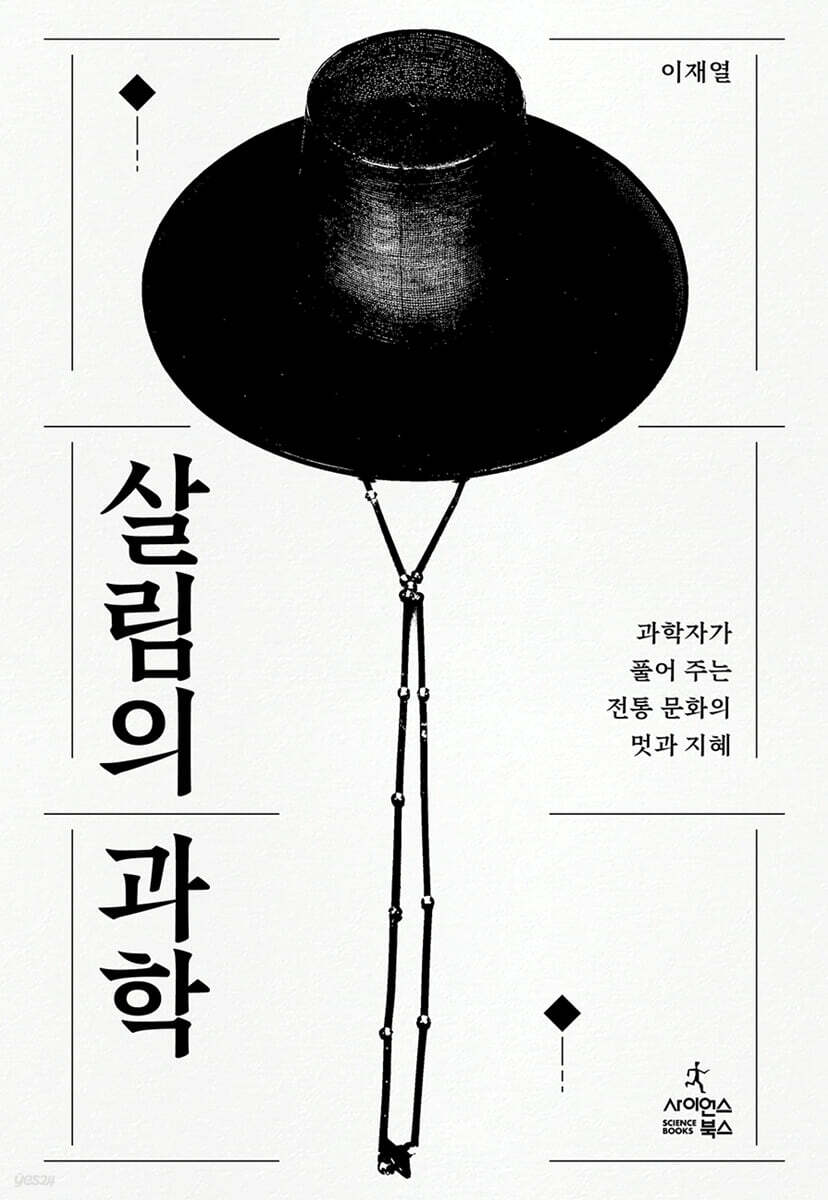
The Science of Living
 |
Description
Book Introduction
There was science in our lives!
The elegance, wisdom, and beauty hidden in Korean traditional household tools and culture.
A microbiologist's take on traditional culture: the sequel to the best-selling "Science in the Wall"!
The book "Science of Living," which explores a microbiologist's exploration of traditional culture, has been published.
Professor Emeritus Jae-Yeol Lee, an environmental microbiologist, has conducted pioneering research on a wide range of viruses, from those that destroy crops like apples and tobacco to those that have fatal effects on humans, such as the tuberculosis bacillus. He has also introduced the world of microorganisms that have had a profound impact on human history and civilization through books and translations such as 『Invisible Power』 and 『The Power of Microorganisms』. He has also conducted research with a deep interest in traditional culture, traditional science, and cultural heritage.
As a result, in 2009, he published “Science in the Wall,” which summarizes the scientific wisdom hidden in traditional Korean culture.
In addition, in 2013, he donated 157 pieces of ancient pottery from Baekje, Silla, and Gaya that he had collected over several decades to the Seoul Baekje Museum. The museum organized these pottery and held a special exhibition of donated materials titled “Vegetables Made of Earthenware, Pottery” in 2021.
The recently published 『Science of Living』 was published as an extension of these activities.
In this book, "The Science of Living," the professor goes inside a traditional house from the outside and looks around the kitchen, the inner room, the main room, the Sarangchae, and the yard, examining the scientific wisdom hidden here and there in traditional living. He examines in detail the small household tools that are useful for living and the things we have used and called "salimsal" in various places in the house.
The book examines the traditional greenhouse of the Joseon Dynasty (some say it is the world's first) featured in a recently popular drama through old agricultural books such as "Sangayo-rok," scientifically explaining the secrets of the traditional Korean paper used to make the book, and also covers traditional cooking methods and the utensils used for cooking, such as earthenware, pottery, and porcelain. It also analyzes the wise preservation methods of our ancestors to prevent food from spoiling from microbial attack.
We also introduce in detail our unique furniture and tableware, such as small tables and bowls, that add style to delicious food.
I thought scientists would only be looking at microorganisms through microscopes in laboratories, but they travel to every corner of the Korean Peninsula, examining the various forms and uses of ponds, folk painting screens, pillow covers, half-closed doors, hats, leems, millstones, metal types, and stone ice storages, meticulously examining their scientific significance.
The elegance, wisdom, and beauty hidden in Korean traditional household tools and culture.
A microbiologist's take on traditional culture: the sequel to the best-selling "Science in the Wall"!
The book "Science of Living," which explores a microbiologist's exploration of traditional culture, has been published.
Professor Emeritus Jae-Yeol Lee, an environmental microbiologist, has conducted pioneering research on a wide range of viruses, from those that destroy crops like apples and tobacco to those that have fatal effects on humans, such as the tuberculosis bacillus. He has also introduced the world of microorganisms that have had a profound impact on human history and civilization through books and translations such as 『Invisible Power』 and 『The Power of Microorganisms』. He has also conducted research with a deep interest in traditional culture, traditional science, and cultural heritage.
As a result, in 2009, he published “Science in the Wall,” which summarizes the scientific wisdom hidden in traditional Korean culture.
In addition, in 2013, he donated 157 pieces of ancient pottery from Baekje, Silla, and Gaya that he had collected over several decades to the Seoul Baekje Museum. The museum organized these pottery and held a special exhibition of donated materials titled “Vegetables Made of Earthenware, Pottery” in 2021.
The recently published 『Science of Living』 was published as an extension of these activities.
In this book, "The Science of Living," the professor goes inside a traditional house from the outside and looks around the kitchen, the inner room, the main room, the Sarangchae, and the yard, examining the scientific wisdom hidden here and there in traditional living. He examines in detail the small household tools that are useful for living and the things we have used and called "salimsal" in various places in the house.
The book examines the traditional greenhouse of the Joseon Dynasty (some say it is the world's first) featured in a recently popular drama through old agricultural books such as "Sangayo-rok," scientifically explaining the secrets of the traditional Korean paper used to make the book, and also covers traditional cooking methods and the utensils used for cooking, such as earthenware, pottery, and porcelain. It also analyzes the wise preservation methods of our ancestors to prevent food from spoiling from microbial attack.
We also introduce in detail our unique furniture and tableware, such as small tables and bowls, that add style to delicious food.
I thought scientists would only be looking at microorganisms through microscopes in laboratories, but they travel to every corner of the Korean Peninsula, examining the various forms and uses of ponds, folk painting screens, pillow covers, half-closed doors, hats, leems, millstones, metal types, and stone ice storages, meticulously examining their scientific significance.
- You can preview some of the book's contents.
Preview
index
Entering… … In Search of the Science of Life 7
Part 1 Home
Chapter 1: A House Resembling Nature 21
Chapter 2: A Book of Life Wisdom, Part 45
Chapter 3: Preparing and Cooking Food 71
Chapter 4: Various Vessels 91
Part 2: To the kitchen
Chapter 5: Rolling in the Salt Fields 111
Chapter 6: Double Poisoning and the Pill 129
Chapter 7: Traditional Liquor and Vinegar 155
Part 3: To the living room
Chapter 8: Our Clothes Story 179
Chapter 9: In Search of Folk Painting 197
10 Pillowcase Embroidery 223
To the 4th main hall
Chapter 11: The Story of the Soban 247
Chapter 12 Half-closed Half-closed 277
Chapter 13: The Story of the Old Refrigerator 305
Part 5 With Love
Chapter 14: The Nation of Hats 329
Chapter 15: The Goryeo Metal Movable Type Debate 355
Chapter 16: The Passion of the Hunminjeongeum Haeryebon 401
To the 6th yard
Chapter 17: Living Culture Made of Stone 435
Chapter 18: Springs, Wells, and Waterworks 465
Chapter 19: Miscellaneous Information about the Old House Gate 487
Going out… Small is beautiful 511
Reference 515
Search 520
Part 1 Home
Chapter 1: A House Resembling Nature 21
Chapter 2: A Book of Life Wisdom, Part 45
Chapter 3: Preparing and Cooking Food 71
Chapter 4: Various Vessels 91
Part 2: To the kitchen
Chapter 5: Rolling in the Salt Fields 111
Chapter 6: Double Poisoning and the Pill 129
Chapter 7: Traditional Liquor and Vinegar 155
Part 3: To the living room
Chapter 8: Our Clothes Story 179
Chapter 9: In Search of Folk Painting 197
10 Pillowcase Embroidery 223
To the 4th main hall
Chapter 11: The Story of the Soban 247
Chapter 12 Half-closed Half-closed 277
Chapter 13: The Story of the Old Refrigerator 305
Part 5 With Love
Chapter 14: The Nation of Hats 329
Chapter 15: The Goryeo Metal Movable Type Debate 355
Chapter 16: The Passion of the Hunminjeongeum Haeryebon 401
To the 6th yard
Chapter 17: Living Culture Made of Stone 435
Chapter 18: Springs, Wells, and Waterworks 465
Chapter 19: Miscellaneous Information about the Old House Gate 487
Going out… Small is beautiful 511
Reference 515
Search 520
Publisher's Review
Hat, half-closed door, grindstone, hojokban, … …
The scientific principles contained in old houses, clothes, and various household items
An overwhelming body of work unpacked!
― Kim Ki-seop (former director of the Hanseong Baekje Museum)
As you live, you may initially think that having just food, clothing, and a place to live is enough, but as time goes by, you realize that your life becomes more and more complicated as your belongings increase.
As a result, people want to live a life that is at least a little bit more comfortable and affluent, and within that, they also want fun, style, and beauty.
However, each person and each family has different circumstances and situations.
You can't afford to live a life as luxurious as you want.
We have no choice but to live within our means.
In the past, we empirically discovered and utilized various things that could be helpful in household management, and looking back today, we can say that these were the very things that were called 'wisdom of household management.'
The scientific study of this wisdom can be called life sciences, comparable to natural sciences.
-In the text
A book about a microbiologist's exploration of traditional culture has been published by Science Books.
That book is Professor Emeritus Lee Jae-yeol of Kyungpook National University's new book, "The Science of Living: The Style and Wisdom of Traditional Culture Unraveled by Scientists."
Professor Emeritus Jae-Yeol Lee, an environmental microbiologist, has conducted pioneering research on a wide range of viruses, from those that destroy crops like apples and tobacco to those that have fatal effects on humans, such as the tuberculosis bacillus. He has also introduced the world of microorganisms that have had a profound impact on human history and civilization through books and translations such as 『Invisible Power』 and 『The Power of Microorganisms』. He has also conducted research with a deep interest in traditional culture, traditional science, and cultural heritage.
As a result, in 2009, he published “Science in the Wall,” which summarizes the scientific wisdom hidden in traditional Korean culture.
In addition, in 2013, he donated 157 pieces of ancient pottery from Baekje, Silla, and Gaya that he had collected over several decades to the Seoul Baekje Museum. The museum organized these pottery and held a special exhibition of donated materials titled “Vegetables Made of Earthenware, Pottery” in 2021.
The recently published 『Science of Living』 was published as an extension of these activities.
In his previous work, “Science Inside the Wall,” Professor Lee Jae-yeol argued that “science inside the wall must meet science outside the wall.”
He emphasized that we should meet the wisdom of traditional culture, which is sufficiently rational and scientific, though not perfectly quantifiable or measurable, as “science within the walls,” and modern science, which can be called “science outside the walls,” imported from outside our culture.
The core argument was that we must find ways to scientifically study traditional culture and apply and develop the seeds of science contained within it into the modern era.
More than a decade has passed since the publication of this book, and fortunately, the study of traditional culture and its integration with modern science have progressed rapidly.
Many researchers trained in modern science have become involved in the study and inheritance of traditional culture, and the accumulation of scientific research on traditional culture is opening up new avenues for application.
These achievements are reflected in the recent global boom in Korean food, hanbok, etc.
It cannot be denied that the fusion of science within the walls and science outside the walls has been of great help to numerous activities that have the letter 'K' attached to them.
Professor Lee Jae-yeol takes this situation one step further.
With a microscopic gaze honed in microbiological research, he narrows his field of observation to the deeper parts of traditional culture and the various aspects of daily life.
And from it, we extract the ‘science of living.’
In this book, "The Science of Living," the professor goes inside a traditional house from the outside and looks around the kitchen, the inner room, the main room, the Sarangchae, and the yard, examining the scientific wisdom hidden here and there in traditional living. He examines in detail the small household tools that are useful for living and the things we have used and called "salimsal" in various places in the house.
The book examines the traditional greenhouse of the Joseon Dynasty (some say it is the world's first) featured in a recently popular drama through old agricultural books such as "Sangayo-rok," scientifically explaining the secrets of the traditional Korean paper used to make the book, and also covers traditional cooking methods and the utensils used for cooking, such as earthenware, pottery, and porcelain. It also analyzes the wise preservation methods of our ancestors to prevent food from spoiling from microbial attack.
We also introduce in detail our unique furniture and tableware, such as small tables and bowls, that add style to delicious food.
I thought scientists would only be looking at microorganisms through microscopes in laboratories, but they travel to every corner of the Korean Peninsula, examining the various forms and uses of ponds, folk painting screens, pillow covers, half-closed doors, hats, leems, millstones, metal types, and stone ice storages, meticulously examining their scientific significance.
In addition, it also covers the interesting history of controversies surrounding our cultural heritage.
It meticulously introduces the debate among metal type researchers surrounding 'Jeungdojaja', allowing us to revisit the issues pointed out in the recent 2025 state audit, and also introduces in detail the behind-the-scenes stories surrounding the so-called Sangju version of the 'Hunminjeongeum Haeryebon', which has remained unresolved for decades and has remained stuck in a state of stagnation.
In addition, this book introduces the latest research on each type of living.
Young researchers in various fields, including history, folklore, and architecture, vividly present the latest research and application results on traditional cultural objects in their respective fields.
These are evidences that show that the senior scholar's interest has gone beyond a mere hobby and reached a professional level.
As readers read this book, they will discover a new meaning in the objects that have been gathering dust and being forgotten in the corners of the house.
This book, like "Science in the Wall," will serve as a new milestone in the intersection of traditional culture and modern science.
We need to look more deeply into the science of living.
If we do so, it could inject new impetus into the K-culture that is currently captivating the world.
Perhaps readers will find the blueprint for the future in the wisdom of traditional living, in this book.
A microbiologist's take on traditional culture: the sequel to the best-selling "Science in the Wall"!
The scientific principles contained in old houses, clothes, and various household items
An overwhelming body of work unpacked!
― Kim Ki-seop (former director of the Hanseong Baekje Museum)
As you live, you may initially think that having just food, clothing, and a place to live is enough, but as time goes by, you realize that your life becomes more and more complicated as your belongings increase.
As a result, people want to live a life that is at least a little bit more comfortable and affluent, and within that, they also want fun, style, and beauty.
However, each person and each family has different circumstances and situations.
You can't afford to live a life as luxurious as you want.
We have no choice but to live within our means.
In the past, we empirically discovered and utilized various things that could be helpful in household management, and looking back today, we can say that these were the very things that were called 'wisdom of household management.'
The scientific study of this wisdom can be called life sciences, comparable to natural sciences.
-In the text
A book about a microbiologist's exploration of traditional culture has been published by Science Books.
That book is Professor Emeritus Lee Jae-yeol of Kyungpook National University's new book, "The Science of Living: The Style and Wisdom of Traditional Culture Unraveled by Scientists."
Professor Emeritus Jae-Yeol Lee, an environmental microbiologist, has conducted pioneering research on a wide range of viruses, from those that destroy crops like apples and tobacco to those that have fatal effects on humans, such as the tuberculosis bacillus. He has also introduced the world of microorganisms that have had a profound impact on human history and civilization through books and translations such as 『Invisible Power』 and 『The Power of Microorganisms』. He has also conducted research with a deep interest in traditional culture, traditional science, and cultural heritage.
As a result, in 2009, he published “Science in the Wall,” which summarizes the scientific wisdom hidden in traditional Korean culture.
In addition, in 2013, he donated 157 pieces of ancient pottery from Baekje, Silla, and Gaya that he had collected over several decades to the Seoul Baekje Museum. The museum organized these pottery and held a special exhibition of donated materials titled “Vegetables Made of Earthenware, Pottery” in 2021.
The recently published 『Science of Living』 was published as an extension of these activities.
In his previous work, “Science Inside the Wall,” Professor Lee Jae-yeol argued that “science inside the wall must meet science outside the wall.”
He emphasized that we should meet the wisdom of traditional culture, which is sufficiently rational and scientific, though not perfectly quantifiable or measurable, as “science within the walls,” and modern science, which can be called “science outside the walls,” imported from outside our culture.
The core argument was that we must find ways to scientifically study traditional culture and apply and develop the seeds of science contained within it into the modern era.
More than a decade has passed since the publication of this book, and fortunately, the study of traditional culture and its integration with modern science have progressed rapidly.
Many researchers trained in modern science have become involved in the study and inheritance of traditional culture, and the accumulation of scientific research on traditional culture is opening up new avenues for application.
These achievements are reflected in the recent global boom in Korean food, hanbok, etc.
It cannot be denied that the fusion of science within the walls and science outside the walls has been of great help to numerous activities that have the letter 'K' attached to them.
Professor Lee Jae-yeol takes this situation one step further.
With a microscopic gaze honed in microbiological research, he narrows his field of observation to the deeper parts of traditional culture and the various aspects of daily life.
And from it, we extract the ‘science of living.’
In this book, "The Science of Living," the professor goes inside a traditional house from the outside and looks around the kitchen, the inner room, the main room, the Sarangchae, and the yard, examining the scientific wisdom hidden here and there in traditional living. He examines in detail the small household tools that are useful for living and the things we have used and called "salimsal" in various places in the house.
The book examines the traditional greenhouse of the Joseon Dynasty (some say it is the world's first) featured in a recently popular drama through old agricultural books such as "Sangayo-rok," scientifically explaining the secrets of the traditional Korean paper used to make the book, and also covers traditional cooking methods and the utensils used for cooking, such as earthenware, pottery, and porcelain. It also analyzes the wise preservation methods of our ancestors to prevent food from spoiling from microbial attack.
We also introduce in detail our unique furniture and tableware, such as small tables and bowls, that add style to delicious food.
I thought scientists would only be looking at microorganisms through microscopes in laboratories, but they travel to every corner of the Korean Peninsula, examining the various forms and uses of ponds, folk painting screens, pillow covers, half-closed doors, hats, leems, millstones, metal types, and stone ice storages, meticulously examining their scientific significance.
In addition, it also covers the interesting history of controversies surrounding our cultural heritage.
It meticulously introduces the debate among metal type researchers surrounding 'Jeungdojaja', allowing us to revisit the issues pointed out in the recent 2025 state audit, and also introduces in detail the behind-the-scenes stories surrounding the so-called Sangju version of the 'Hunminjeongeum Haeryebon', which has remained unresolved for decades and has remained stuck in a state of stagnation.
In addition, this book introduces the latest research on each type of living.
Young researchers in various fields, including history, folklore, and architecture, vividly present the latest research and application results on traditional cultural objects in their respective fields.
These are evidences that show that the senior scholar's interest has gone beyond a mere hobby and reached a professional level.
As readers read this book, they will discover a new meaning in the objects that have been gathering dust and being forgotten in the corners of the house.
This book, like "Science in the Wall," will serve as a new milestone in the intersection of traditional culture and modern science.
We need to look more deeply into the science of living.
If we do so, it could inject new impetus into the K-culture that is currently captivating the world.
Perhaps readers will find the blueprint for the future in the wisdom of traditional living, in this book.
A microbiologist's take on traditional culture: the sequel to the best-selling "Science in the Wall"!
GOODS SPECIFICS
- Date of issue: October 31, 2025
- Page count, weight, size: 532 pages | 145*210*35mm
- ISBN13: 9791194087342
- ISBN10: 1194087345
You may also like
카테고리
korean


korean

![GQ KOREA Mark (Monthly): December [2025]](http://librairie.coreenne.fr/cdn/shop/files/8ef265dbbfbf186523ed75ba7319009d.jpg?v=1765340328&width=3840)


