

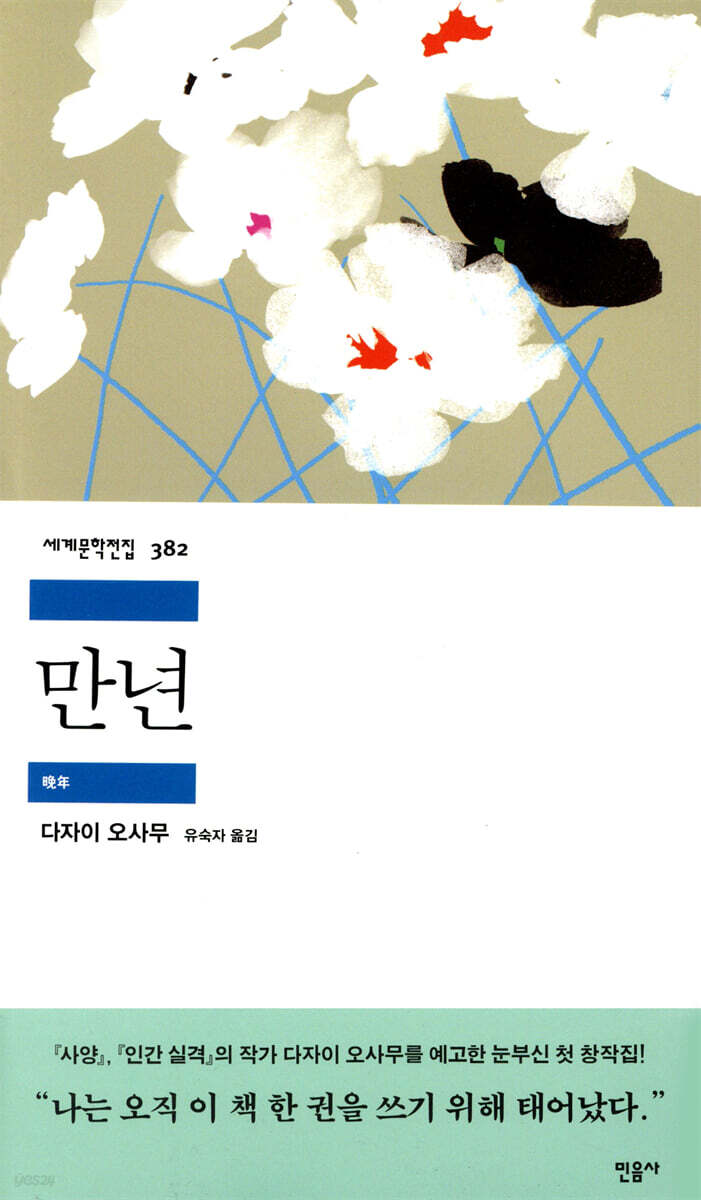
later years
 |
Description
Book Introduction
Osamu Dazai's first collection of works, "Mannyeon," was published as volume 382 in Minumsa's World Literature Collection. This is a complete translation of the book that was published in 1997 by the same translator in a paperback edition by Sohwa Publishing Company, twenty-four years later, and the existing translation has also been comprehensively revised. Translator Yoo Suk-ja said, “There are sentences that are almost like prose poems scattered throughout the work, and there are also works that are no different from poems,” and she made an effort to preserve the author’s unique sense of rhythm by carefully refining the length of sentences, parts of speech, and tone to suit today’s sensibilities. 『Mannyeon』 contains fifteen short stories written by a writer in his early twenties, who was prepared for death, with his posthumous work in mind. These include the autobiographical novel "Memories" which contains memories of a lonely childhood and vague first love, "Train" which was the first work published under the pen name of Osamu Dazai, "The Flower of the Fool" which reflects the guilt of surviving alone after attempting suicide by jumping with a woman, and "Romanesque" which satirizes the despair of young people at the time through the tragicomedy of three characters who experience failure and frustration the more they try their best. Born the son of a large landowner and embracing the inherent contradictions of joining the leftist movement, Dazai expressed in honest and poetic language a series of events and relationships that shook his youth, including the discord with his hometown family, the resulting hardships, and the guilt over the death of only the woman accompanying him after attempting suicide. |
- You can preview some of the book's contents.
Preview
index
Leaf 7
Memories 25
Fish and Pocket Records 73
Train 84
Globe Map 90
Monkey Island 101
Sparrow 112
The Clown's Flower 117
Young man with a monkey face 174
Retrograde 197
He's not the same person he used to be 216
Romanesque 262
Toy 292
Will-o'-the-wisps 300
The Blind Man's Tale 324
Commentary on the work 335
Author's Chronology 343
Memories 25
Fish and Pocket Records 73
Train 84
Globe Map 90
Monkey Island 101
Sparrow 112
The Clown's Flower 117
Young man with a monkey face 174
Retrograde 197
He's not the same person he used to be 216
Romanesque 262
Toy 292
Will-o'-the-wisps 300
The Blind Man's Tale 324
Commentary on the work 335
Author's Chronology 343
Detailed image

Into the book
I was thinking of dying.
This year, on Lunar New Year's Day, I received a roll of fabric.
It's a New Year's gift.
The cloth was hemp.
There were densely packed gray stripes.
It must be something to wear in the summer.
I thought I'd survive until summer.
--- p.7
“Death is the best.
No, it's not just me.
“At least it would be better if all those who play a negative role in social progress die.”
--- p.14
Full moon evening.
When I, unable to bear the hand that held us together to keep us from falling apart amidst the glittering, crashing, surging, and tumbling waves, deliberately shook it off, the woman was instantly swallowed by the waves and called out her name loudly.
That wasn't my name.
--- p.16
Before going to school in the morning, I would lay out cards on my desk and read my fortune for the day.
The heart was a great fortune.
Diamonds were half good, clubs were half bad, and spades were a great bad.
And around that time, almost every day, only spades came out.
--- p.46
My older brother, concerned about my enthusiasm for literature, sent me a long letter from home.
Chemistry has equations and geometry has theorems, which give us a complete key to interpreting them, but literature doesn't have that.
I believe that it is impossible to properly understand literature unless one reaches the appropriate age and environment.
It was written in such a stiff tone.
I thought so too.
Moreover, I believed that I was that acceptable human being.
--- p.55
Even if my novel fails because of this one line, I have no intention of lightly erasing it.
While I'm at it, let me just say one more thing.
Erasing that one line is like erasing my life up to this day.
--- p.126
“Get up! It’s an incident!” They enjoy fabricating incidents.
“Yo-chan’s great pose.” The modifier ‘great’ is used frequently in their conversation.
It must be because we want something to look forward to in this boring world.
--- p.129
As I was going to the bathroom in the middle of the night, I ran into a young woman who was staying in the same room in the hallway.
That's all.
But this is a major event.
Even if it was only a brief passing glance, Gosuge couldn't help but convey his unusual impression to the woman.
He doesn't have any specific intention of doing anything, but in that fleeting moment, he risks his life and strikes a pose.
Have serious expectations about life.
I imagine all the circumstances surrounding that woman for a moment, and my heart feels like it's going to burst.
They experience these breathtaking moments at least once a day.
So they don't let their guard down.
--- p.132
He wasn't an old man.
He was just over twenty-five years old.
But still, he was an old man.
--- p.197
“Imitate him, that guy.
There's no way that person would have an opinion.
I was all influenced by women.
When I was a literary girl, it was literature.
When I was a city person, I was cool.
It's obvious."
"no way.
“That kind of Chekhov-like.”
I said this and laughed, but my heart still ached.
If Seisen were here right now, I thought I would want to hug his slender shoulders tightly.
--- p.258
The name of a thing is something that you will know on your own without having to ask if it is a suitable name.
I heard it on my skin.
When I stare blankly at the object, the language of the object tickles my skin.
For example, thistle.
Bad names get no response.
There are some names that I have a hard time understanding no matter how many times I hear them.
For example, people.
This year, on Lunar New Year's Day, I received a roll of fabric.
It's a New Year's gift.
The cloth was hemp.
There were densely packed gray stripes.
It must be something to wear in the summer.
I thought I'd survive until summer.
--- p.7
“Death is the best.
No, it's not just me.
“At least it would be better if all those who play a negative role in social progress die.”
--- p.14
Full moon evening.
When I, unable to bear the hand that held us together to keep us from falling apart amidst the glittering, crashing, surging, and tumbling waves, deliberately shook it off, the woman was instantly swallowed by the waves and called out her name loudly.
That wasn't my name.
--- p.16
Before going to school in the morning, I would lay out cards on my desk and read my fortune for the day.
The heart was a great fortune.
Diamonds were half good, clubs were half bad, and spades were a great bad.
And around that time, almost every day, only spades came out.
--- p.46
My older brother, concerned about my enthusiasm for literature, sent me a long letter from home.
Chemistry has equations and geometry has theorems, which give us a complete key to interpreting them, but literature doesn't have that.
I believe that it is impossible to properly understand literature unless one reaches the appropriate age and environment.
It was written in such a stiff tone.
I thought so too.
Moreover, I believed that I was that acceptable human being.
--- p.55
Even if my novel fails because of this one line, I have no intention of lightly erasing it.
While I'm at it, let me just say one more thing.
Erasing that one line is like erasing my life up to this day.
--- p.126
“Get up! It’s an incident!” They enjoy fabricating incidents.
“Yo-chan’s great pose.” The modifier ‘great’ is used frequently in their conversation.
It must be because we want something to look forward to in this boring world.
--- p.129
As I was going to the bathroom in the middle of the night, I ran into a young woman who was staying in the same room in the hallway.
That's all.
But this is a major event.
Even if it was only a brief passing glance, Gosuge couldn't help but convey his unusual impression to the woman.
He doesn't have any specific intention of doing anything, but in that fleeting moment, he risks his life and strikes a pose.
Have serious expectations about life.
I imagine all the circumstances surrounding that woman for a moment, and my heart feels like it's going to burst.
They experience these breathtaking moments at least once a day.
So they don't let their guard down.
--- p.132
He wasn't an old man.
He was just over twenty-five years old.
But still, he was an old man.
--- p.197
“Imitate him, that guy.
There's no way that person would have an opinion.
I was all influenced by women.
When I was a literary girl, it was literature.
When I was a city person, I was cool.
It's obvious."
"no way.
“That kind of Chekhov-like.”
I said this and laughed, but my heart still ached.
If Seisen were here right now, I thought I would want to hug his slender shoulders tightly.
--- p.258
The name of a thing is something that you will know on your own without having to ask if it is a suitable name.
I heard it on my skin.
When I stare blankly at the object, the language of the object tickles my skin.
For example, thistle.
Bad names get no response.
There are some names that I have a hard time understanding no matter how many times I hear them.
For example, people.
--- p.296
Publisher's Review
“I was born just to write this one book.”
The first collection of original works by Osamu Dazai, author of "The Decline" and "No Longer Human," heralded the arrival of the author.
Eternal youth literature that embraces a wavering existence
The Most Beloved Classic Authors of 2021
Osamu Dazai
If 2020 was Camus and Orwell, 2021 is Osamu Dazai.
Looking at the sales trend of Minumsa World Literature Collection (January-June 2021), a barometer that can show the interests of classic readers at a glance, Camus's "The Plague" ranked first in sales during the same period last year when COVID-19 was emerging as a global problem, and Orwell's "1984," which suggested the keyword "surveillance society," also soared to fifth place, proving the timeliness of reading classics.
Meanwhile, Osamu Dazai's "No Longer Human" has maintained its number one spot in sales since the beginning of the year.
As of July 6, 2021, Minumsa's "No Longer Human" is ranked between 7th and 14th on the novel charts of major online bookstores such as Kyobo Bookstore, YES24, and Aladdin, which is an unrivaled ranking for a classic work.
Osamu Dazai was born the son of a large landowner in the Tohoku region of Japan, and as a person of means, he felt a heavy sense of indebtedness to the less fortunate throughout his life.
Because of this, after entering Tokyo Imperial University, he became absorbed in Marxism, but when the conflict with his hometown family, which held the key to his finances, worsened his financial difficulties, he took on contradictory attitudes such as quitting leftist movements and felt ashamed of himself.
In that sense, the 2021 "Dazai Osamu" craze is not only evidence of youth anxiety due to the prolonged COVID-19 situation, but also the result of readers' recognition and affection being projected onto a classic author who most honestly expressed keywords that describe the MZ generation, such as "fairness" and "justice."
Young Dazai's unfulfilled dream
What about the Akutagawa Prize?
During his school days, when he dreamed of becoming a writer, Osamu Dazai particularly admired Ryunosuke Akutagawa of Rashomon.
The Akutagawa Prize, awarded to new writers, was a goal he absolutely wanted to achieve.
In 1935, he challenged for the Akutagawa Prize, which was first awarded that year, with "Retrograde" (included in "Mannyeon"), but ended up finishing second.
At that time, when Yasunari Kawabata, the author of "Snow Country" who was on the selection committee, commented on the author's private life by saying, "The author's current life is clouded by dark clouds, and he regrets not being able to fully display his talents," Dazai responded by writing "To Kawabata" and asking, "Is raising birds and watching dances really such a wonderful life?" This is a famous anecdote.
The following year, he once again attempted to win the Akutagawa Prize with "Mannyeon," but was not even nominated due to the new rule that "authors who have already been nominated are excluded from the selection process."
“Please give me the Akutagawa Prize.
“I have absolutely no wishes,” said Dazai, who desperately wanted to receive the award.
His contradictory attitude of rebelling against the authoritative evaluations of the established literary world while at the same time wanting to be recognized more than anyone else reveals the inner self of Osamu Dazai, a young man who feared the world and others, yet could not give them up.
Completed after a hundred practice pieces
Archetypes of Osamu Dazai's Literature
“I wasted ten years on this one collection of short stories.
For ten years, I had not had a refreshing breakfast like most citizens.
(……) I tore up and threw away over a hundred novels.
50,000 sheets of manuscript paper.
And this is all that's left.
That's all." ―《Literary Magazine》(January 1936)
『Mannyeon』 is recognized as a literary historical significance as a pioneering work that explored the possibilities of a new modern literature different from the realism-oriented literature of the time in Japan.
The short story "The Clown's Flower" is a work that reflects the author's guilt of having attempted suicide by jumping into the sea with a woman while participating in leftist activities and surviving alone. In addition to the main character, "Oba Yozo," the author's self-consciousness intervenes and criticizes the flow of the entire work.
It was evaluated as the most avant-garde modern novel in that it attempted to express difficult truths through this dualistic method, and attracted the attention of contemporary intellectuals such as Sato Haruo and Kawabata Yasunari.
The value of "Mannyeon" is sufficient in providing a glimpse into Dazai's literary world that will unfold in the future.
The musical melody, influenced by the speech of the priestesses called "itako" of his hometown Tsugaru, or the Edo period narrative song "Gidayu" that the author was once engrossed in and learned, has completed the author's unique "speaking" language.
In addition, the 'narration technique', which seems to speak directly to each and every reader, adds persuasiveness to the self-confessional narrative that sinks deep into the inner self, and has a powerful, unchanging appeal that remains unchanged over time.
Leading to 『Specifications』 and 『No Longer Human』
Song of Eternal Youth
Osamu Dazai was born in 1909 and lived a short life of 39 years. 『Mannen』 is an early work published in his twenties, and 『The Decline』 and 『No Longer Human』 are later works published a year before and the year of his death, respectively.
The author, who was in critical condition after suffering from peritonitis following an appendectomy in 1935, became addicted to Fabinal, which he had used as a painkiller during his recovery period.
Eventually, the following year, he is admitted to a mental hospital for treatment of Fabinal addiction, and is deeply shocked by the fact that his wife and teacher Masuji Ibuse deceived him and admitted him.
The extreme distrust of humanity and self-deprecating attitude experienced at that time became the main motif that formed the atmosphere of 『No Longer Human』.
Added to this is the author's awareness of Japan's disappointing social situation after its defeat, and the author's personal despair, which began in "Mannyeon," is sublimated into public and social frustration.
Meanwhile, 『Sayō』, unlike the destructive worldview that usually comes to mind when thinking of 'Dazai literature', has a ray of hope.
The author, who fled with his family to his birthplace in Tsugaru, Aomori Prefecture during the Pacific War, met the end of the war there.
After the war, with the announcement of a new land reform, the Tsushima family, once a major landowner, entered a path of decline. Observing this, the author conceived the idea of "Sayoshi" while recalling Chekhov's "The Cherry Orchard."
However, the actual development of the work was different from 『The Cherry Orchard』.
This is because the center of gravity is on the will of a young woman who overcomes the turbulent times, pursues her dreams, and confidently navigates reality.
Osamu Dazai's self-redemption as a writer, reflected in "Mannen," and the paradoxical image of a human being who is most sincere in the face of life because he is prepared for death, come to full bloom through a woman's voice in "Sayings."
Osamu Dazai is a great storyteller.
─《Booklist》
The first collection of original works by Osamu Dazai, author of "The Decline" and "No Longer Human," heralded the arrival of the author.
Eternal youth literature that embraces a wavering existence
The Most Beloved Classic Authors of 2021
Osamu Dazai
If 2020 was Camus and Orwell, 2021 is Osamu Dazai.
Looking at the sales trend of Minumsa World Literature Collection (January-June 2021), a barometer that can show the interests of classic readers at a glance, Camus's "The Plague" ranked first in sales during the same period last year when COVID-19 was emerging as a global problem, and Orwell's "1984," which suggested the keyword "surveillance society," also soared to fifth place, proving the timeliness of reading classics.
Meanwhile, Osamu Dazai's "No Longer Human" has maintained its number one spot in sales since the beginning of the year.
As of July 6, 2021, Minumsa's "No Longer Human" is ranked between 7th and 14th on the novel charts of major online bookstores such as Kyobo Bookstore, YES24, and Aladdin, which is an unrivaled ranking for a classic work.
Osamu Dazai was born the son of a large landowner in the Tohoku region of Japan, and as a person of means, he felt a heavy sense of indebtedness to the less fortunate throughout his life.
Because of this, after entering Tokyo Imperial University, he became absorbed in Marxism, but when the conflict with his hometown family, which held the key to his finances, worsened his financial difficulties, he took on contradictory attitudes such as quitting leftist movements and felt ashamed of himself.
In that sense, the 2021 "Dazai Osamu" craze is not only evidence of youth anxiety due to the prolonged COVID-19 situation, but also the result of readers' recognition and affection being projected onto a classic author who most honestly expressed keywords that describe the MZ generation, such as "fairness" and "justice."
Young Dazai's unfulfilled dream
What about the Akutagawa Prize?
During his school days, when he dreamed of becoming a writer, Osamu Dazai particularly admired Ryunosuke Akutagawa of Rashomon.
The Akutagawa Prize, awarded to new writers, was a goal he absolutely wanted to achieve.
In 1935, he challenged for the Akutagawa Prize, which was first awarded that year, with "Retrograde" (included in "Mannyeon"), but ended up finishing second.
At that time, when Yasunari Kawabata, the author of "Snow Country" who was on the selection committee, commented on the author's private life by saying, "The author's current life is clouded by dark clouds, and he regrets not being able to fully display his talents," Dazai responded by writing "To Kawabata" and asking, "Is raising birds and watching dances really such a wonderful life?" This is a famous anecdote.
The following year, he once again attempted to win the Akutagawa Prize with "Mannyeon," but was not even nominated due to the new rule that "authors who have already been nominated are excluded from the selection process."
“Please give me the Akutagawa Prize.
“I have absolutely no wishes,” said Dazai, who desperately wanted to receive the award.
His contradictory attitude of rebelling against the authoritative evaluations of the established literary world while at the same time wanting to be recognized more than anyone else reveals the inner self of Osamu Dazai, a young man who feared the world and others, yet could not give them up.
Completed after a hundred practice pieces
Archetypes of Osamu Dazai's Literature
“I wasted ten years on this one collection of short stories.
For ten years, I had not had a refreshing breakfast like most citizens.
(……) I tore up and threw away over a hundred novels.
50,000 sheets of manuscript paper.
And this is all that's left.
That's all." ―《Literary Magazine》(January 1936)
『Mannyeon』 is recognized as a literary historical significance as a pioneering work that explored the possibilities of a new modern literature different from the realism-oriented literature of the time in Japan.
The short story "The Clown's Flower" is a work that reflects the author's guilt of having attempted suicide by jumping into the sea with a woman while participating in leftist activities and surviving alone. In addition to the main character, "Oba Yozo," the author's self-consciousness intervenes and criticizes the flow of the entire work.
It was evaluated as the most avant-garde modern novel in that it attempted to express difficult truths through this dualistic method, and attracted the attention of contemporary intellectuals such as Sato Haruo and Kawabata Yasunari.
The value of "Mannyeon" is sufficient in providing a glimpse into Dazai's literary world that will unfold in the future.
The musical melody, influenced by the speech of the priestesses called "itako" of his hometown Tsugaru, or the Edo period narrative song "Gidayu" that the author was once engrossed in and learned, has completed the author's unique "speaking" language.
In addition, the 'narration technique', which seems to speak directly to each and every reader, adds persuasiveness to the self-confessional narrative that sinks deep into the inner self, and has a powerful, unchanging appeal that remains unchanged over time.
Leading to 『Specifications』 and 『No Longer Human』
Song of Eternal Youth
Osamu Dazai was born in 1909 and lived a short life of 39 years. 『Mannen』 is an early work published in his twenties, and 『The Decline』 and 『No Longer Human』 are later works published a year before and the year of his death, respectively.
The author, who was in critical condition after suffering from peritonitis following an appendectomy in 1935, became addicted to Fabinal, which he had used as a painkiller during his recovery period.
Eventually, the following year, he is admitted to a mental hospital for treatment of Fabinal addiction, and is deeply shocked by the fact that his wife and teacher Masuji Ibuse deceived him and admitted him.
The extreme distrust of humanity and self-deprecating attitude experienced at that time became the main motif that formed the atmosphere of 『No Longer Human』.
Added to this is the author's awareness of Japan's disappointing social situation after its defeat, and the author's personal despair, which began in "Mannyeon," is sublimated into public and social frustration.
Meanwhile, 『Sayō』, unlike the destructive worldview that usually comes to mind when thinking of 'Dazai literature', has a ray of hope.
The author, who fled with his family to his birthplace in Tsugaru, Aomori Prefecture during the Pacific War, met the end of the war there.
After the war, with the announcement of a new land reform, the Tsushima family, once a major landowner, entered a path of decline. Observing this, the author conceived the idea of "Sayoshi" while recalling Chekhov's "The Cherry Orchard."
However, the actual development of the work was different from 『The Cherry Orchard』.
This is because the center of gravity is on the will of a young woman who overcomes the turbulent times, pursues her dreams, and confidently navigates reality.
Osamu Dazai's self-redemption as a writer, reflected in "Mannen," and the paradoxical image of a human being who is most sincere in the face of life because he is prepared for death, come to full bloom through a woman's voice in "Sayings."
Osamu Dazai is a great storyteller.
─《Booklist》
GOODS SPECIFICS
- Publication date: July 9, 2021
- Page count, weight, size: 360 pages | 412g | 132*225*17mm
- ISBN13: 9788937463822
- ISBN10: 8937463822
You may also like
카테고리
korean


korean

![GQ KOREA Mark (Monthly): December [2025]](http://librairie.coreenne.fr/cdn/shop/files/8ef265dbbfbf186523ed75ba7319009d.jpg?v=1765340328&width=3840)


