

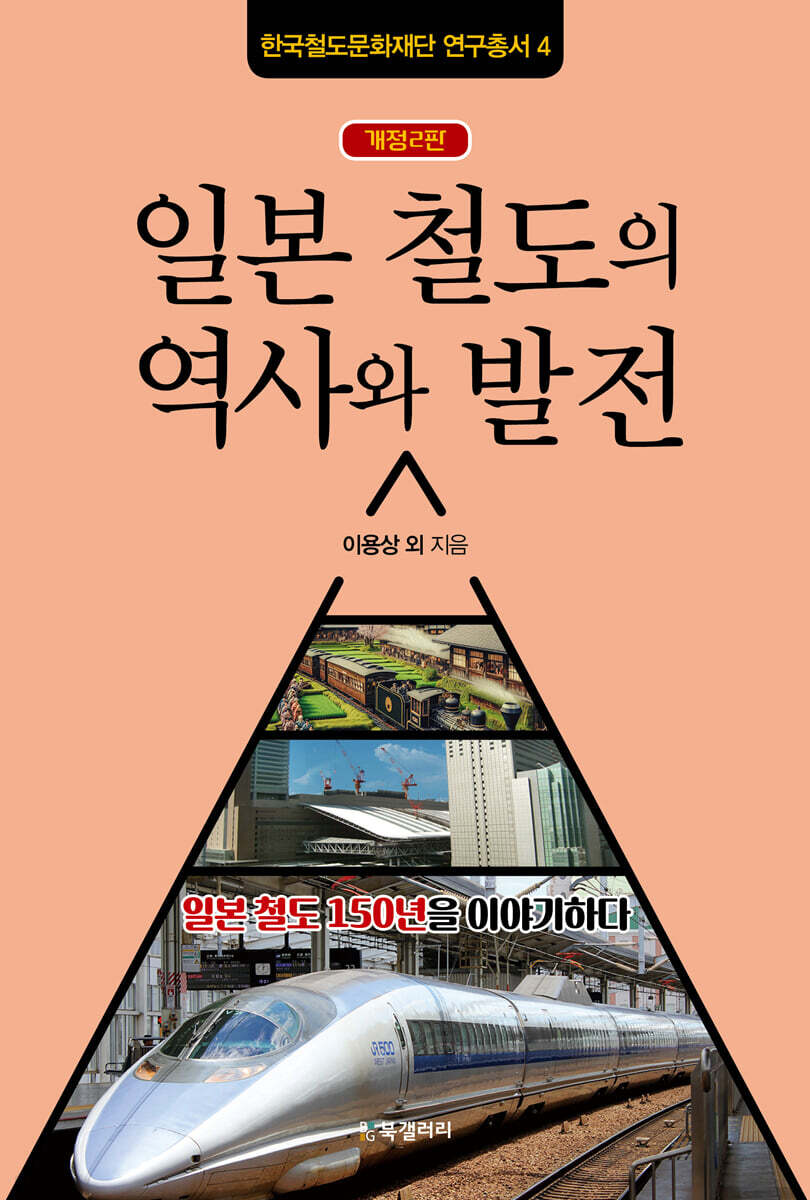
History and development of Japanese railways
 |
Description
Book Introduction
A book that analyzes 150 years of Japanese railway history and predicts the future!
This is the second revised edition of 『History and Development of Japanese Railways』, published approximately eight years after the first edition in 2005 and the revised edition in 2017.
This revised second edition, written by Japan's top railway experts and domestic experts, provides an in-depth analysis of 150 years of Japanese railway history and forecasts the future of East Asian railways.
This book, the fourth in the Korea Railroad Foundation's research series, systematically organizes the historical development and institutional changes of Japanese railways, their implications, and recent data.
This is the second revised edition of 『History and Development of Japanese Railways』, published approximately eight years after the first edition in 2005 and the revised edition in 2017.
This revised second edition, written by Japan's top railway experts and domestic experts, provides an in-depth analysis of 150 years of Japanese railway history and forecasts the future of East Asian railways.
This book, the fourth in the Korea Railroad Foundation's research series, systematically organizes the historical development and institutional changes of Japanese railways, their implications, and recent data.
index
Preface to the 2nd Revised Edition
Preface to the Revised Edition
Chapter 1: The Development of Railways and Their Influence
Section 1 | The Development and Flow of Japanese Railways
1.
Early development and nationalization of the railways
2.
From railway nationalization to World War II
3.
From the war to the present
4.
Characteristics of railway development
Section 2 | Characteristics and Development of Japanese Railways (1872–Pre-Privatization)
1.
Railways of the Meiji Era (from opening to nationalization)
2.
Railways during the interwar period (1907–1945)
3.
From JNR to JR
Section 3 | Changes in National Railway Management and the Development of the Division Policy
1.
National Railway Management and Division Privatization
2.
The period of management stability from the birth of public enterprises and national railways (1950s to late 1960s)
3.
The beginning of large-scale modernization investment and deficit management (late 1960s)
4.
Declining national railway usage and failure of management improvement plans (early 1970s)
5.
The worsening of the national railway's management difficulties and the collapse of its corporate structure (late 1970s)
6.
Management failure and the decision to privatize the national railway (1980s)
7. The Launch of the JR System and the New System's Support Organization (1986 System)
8. Establishment of the JR system and complete privatization of the three Honshu companies (from the 1990s to the 21st century)
9.
The advent of an era of deregulation and a shift away from the legacy of wealth (since 2000)
10.
Internal Factors Behind the Korail's Operating Difficulties - What Needed to Be Fixed?
11.
External factors behind the national railway's operational difficulties - Who hindered the national railway's management recovery?
Chapter 2: Railway Policy
Section 1 | Development and Function of the Railway Network
1.
Early railway policies and changes
2.
Changes in the railway network
3.
Railway policy and railway functions
4.
Conclusion
Section 2 | Privatization and Separation of Rail Freight
1.
Overview of Japan's railway freight company separation
2.
Key issues and progress in separating railway cargo
Section 3 | The Renaissance of Railway Stations
1.
Entering
2.
Renaissance of the Station
3.
change
4.
Conclusion
Chapter 3: Railway Operation
Section 1 | Accident Prevention and Safety in Railway Operations
1.
introduction
2.
History of railway accidents in Japan
3.
Status of railway accidents in Japan
4.
Three Challenges of Railway Safety
5.
The Fukuchiyama Line Accident and the Transformation of Transport Safety Administration
6.
Sintering
Section 2 | Japan's Railway Passenger Transport and Railway Business
1.
Current status of passenger railways in Japan
2.
Urban and regional railways: focusing on private railway management
Section 3 | High-speed Rail
1.
As you go in
2.
The birth of the Shinkansen
3.
Expansion of the Shinkansen network
4.
Shinkansen after the division and privatization of the Japanese National Railways
5.
An overview of each Shinkansen line and the challenges posed by new technologies.
6.
The effects of the opening of the Shinkansen
7.
Shinkansen safety measures, etc.
8.
Sintering
Section 4 | Changes and Developments in Freight Rail
1.
introduction
2.
Overview of freight railways
3.
Modernization of freight railways and improvement of transportation systems
4.
Competitive and cooperative transportation with other transportation agencies
5.
The future role of freight railways
Chapter 4: Regional and Overseas Expansion
Section 1 | The Crisis of Regional Railways and the Development of New Transportation Policies
1.
The formation and overview of Japan's regional railways
2.
Seeking a New Transportation Policy - Establishing the Regional Public Transportation Act
3.
Background of the Basic Transport Policy Act
4.
Basic Transport Policy Act and Related Bills
5.
New moves in regional railways
Section 2 | Overseas Expansion of Japanese Railways
1.
The development and activities of the Japan Overseas Railway Technology Cooperation Association
2.
Activities of the Overseas Railway Technology Cooperation Association: Japanese Railways' Expansion into Taiwan
Chapter 5: Development Plans for Korean Railways as Seen Through Japanese Railways
Section 1 | Lessons from East Asia Through the Railroad
Section 2 | Expanding the Role of Railways in Achieving Carbon Neutrality
Section 3 | Activating Railway Logistics to Build a Sustainable Transportation System
Section 4 | Establishing a System for the Roles and Responsibilities of Local Governments
Section 5 | Future Railway Routes and Proposals
Epilogue _ Modern and Contemporary Korean Railways and Their Challenges
Chronology _ Major History of Japanese Railways
References
Preface to the Revised Edition
Chapter 1: The Development of Railways and Their Influence
Section 1 | The Development and Flow of Japanese Railways
1.
Early development and nationalization of the railways
2.
From railway nationalization to World War II
3.
From the war to the present
4.
Characteristics of railway development
Section 2 | Characteristics and Development of Japanese Railways (1872–Pre-Privatization)
1.
Railways of the Meiji Era (from opening to nationalization)
2.
Railways during the interwar period (1907–1945)
3.
From JNR to JR
Section 3 | Changes in National Railway Management and the Development of the Division Policy
1.
National Railway Management and Division Privatization
2.
The period of management stability from the birth of public enterprises and national railways (1950s to late 1960s)
3.
The beginning of large-scale modernization investment and deficit management (late 1960s)
4.
Declining national railway usage and failure of management improvement plans (early 1970s)
5.
The worsening of the national railway's management difficulties and the collapse of its corporate structure (late 1970s)
6.
Management failure and the decision to privatize the national railway (1980s)
7. The Launch of the JR System and the New System's Support Organization (1986 System)
8. Establishment of the JR system and complete privatization of the three Honshu companies (from the 1990s to the 21st century)
9.
The advent of an era of deregulation and a shift away from the legacy of wealth (since 2000)
10.
Internal Factors Behind the Korail's Operating Difficulties - What Needed to Be Fixed?
11.
External factors behind the national railway's operational difficulties - Who hindered the national railway's management recovery?
Chapter 2: Railway Policy
Section 1 | Development and Function of the Railway Network
1.
Early railway policies and changes
2.
Changes in the railway network
3.
Railway policy and railway functions
4.
Conclusion
Section 2 | Privatization and Separation of Rail Freight
1.
Overview of Japan's railway freight company separation
2.
Key issues and progress in separating railway cargo
Section 3 | The Renaissance of Railway Stations
1.
Entering
2.
Renaissance of the Station
3.
change
4.
Conclusion
Chapter 3: Railway Operation
Section 1 | Accident Prevention and Safety in Railway Operations
1.
introduction
2.
History of railway accidents in Japan
3.
Status of railway accidents in Japan
4.
Three Challenges of Railway Safety
5.
The Fukuchiyama Line Accident and the Transformation of Transport Safety Administration
6.
Sintering
Section 2 | Japan's Railway Passenger Transport and Railway Business
1.
Current status of passenger railways in Japan
2.
Urban and regional railways: focusing on private railway management
Section 3 | High-speed Rail
1.
As you go in
2.
The birth of the Shinkansen
3.
Expansion of the Shinkansen network
4.
Shinkansen after the division and privatization of the Japanese National Railways
5.
An overview of each Shinkansen line and the challenges posed by new technologies.
6.
The effects of the opening of the Shinkansen
7.
Shinkansen safety measures, etc.
8.
Sintering
Section 4 | Changes and Developments in Freight Rail
1.
introduction
2.
Overview of freight railways
3.
Modernization of freight railways and improvement of transportation systems
4.
Competitive and cooperative transportation with other transportation agencies
5.
The future role of freight railways
Chapter 4: Regional and Overseas Expansion
Section 1 | The Crisis of Regional Railways and the Development of New Transportation Policies
1.
The formation and overview of Japan's regional railways
2.
Seeking a New Transportation Policy - Establishing the Regional Public Transportation Act
3.
Background of the Basic Transport Policy Act
4.
Basic Transport Policy Act and Related Bills
5.
New moves in regional railways
Section 2 | Overseas Expansion of Japanese Railways
1.
The development and activities of the Japan Overseas Railway Technology Cooperation Association
2.
Activities of the Overseas Railway Technology Cooperation Association: Japanese Railways' Expansion into Taiwan
Chapter 5: Development Plans for Korean Railways as Seen Through Japanese Railways
Section 1 | Lessons from East Asia Through the Railroad
Section 2 | Expanding the Role of Railways in Achieving Carbon Neutrality
Section 3 | Activating Railway Logistics to Build a Sustainable Transportation System
Section 4 | Establishing a System for the Roles and Responsibilities of Local Governments
Section 5 | Future Railway Routes and Proposals
Epilogue _ Modern and Contemporary Korean Railways and Their Challenges
Chronology _ Major History of Japanese Railways
References
Into the book
Japan built its railways in 1872 after the Meiji Restoration in 1868.
The Meiji Restoration was a forced modernization, and the railways were a product of this new change, a modernization from above.
At that time, railways were built as a means of centralization and strengthening the country.
Early Japanese railways were government-promoted, including through the introduction of foreign capital, due to lack of funds. However, as foreign capital alone was insufficient, private railways were also built.
In 1881, the Japan Railway Company, a government-subsidized private railway company, was established and railway construction was actively promoted.
--- p.151 "Chapter 1: The Development of Railways and Their Influence"
Another characteristic of Japanese railways is that there are many railway enthusiasts.
There are an estimated 500,000 to 600,000 railway enthusiasts in Japan, and they have contributed greatly to the development of railways.
Among them, about 50,000 to 70,000 enthusiasts make up the so-called avid readers who always buy books related to railways.
--- p.28 "Chapter 1: The Development of Railways and Their Influence"
In December 1905, after the Russo-Japanese War, the first Katsura Taro Cabinet decided on the so-called railway nationalization-related bills, including the "Railroad Nationalization Bill," "Outline of the Purpose of Railway Nationalization," "Record on Purchase Price," and "Record on Repayment of Public Bonds."
After the Katsura Cabinet resigned en masse, taking responsibility for the Hibiya arson incident, this bill was passed on to the Saionji Kinmochi Cabinet, which was formed in January 1906.
--- p.39 "Chapter 1: The Development of Railways and Their Influence"
The economic development of World War I led to a significant increase in the number of tracks opened by state-owned railways and the volume of passenger and freight transported, while the supervision of private railways and tracks also expanded.
The number of railway workers and the size of the budget also exceeded those of each province.
In this situation, under the Hara Takashi Seiyūkai cabinet, which promoted an active railway policy, the Railway Bureau was reorganized and promoted to the Ministry of Railways in May 1920.
--- p.46 "Chapter 1: The Development of Railways and Their Influence"
Amidst the damage caused by the war and the severe shortage of materials after the war, the operation of national railways was in dire straits.
The replacement of aging rails and rotting sleepers was also not smooth, and the railway's transport capacity fell to less than one-tenth of the pre-war level.
In this situation, the national railway had to take charge of transporting allied forces, refugees, repatriates from former colonies, and soldiers returning from the battlefield.
In addition, damage from natural disasters such as the 1946 Namhaedo earthquake (magnitude 8.0), Typhoon Kathleen in 1947, and the 1948 Fukui earthquake (magnitude 7.1) followed.
--- p.58 "Chapter 1: The Development of Railways and Their Influence"
Japanese National Railways (JNR) was split and privatized on April 1, 1987, and its operations were transferred to eleven corporations: six passenger railway companies (JR Hokkaido, JR East, JR Central, JR West, JR Shikoku, and JR Kyushu), Japan Freight Railway Company (JR Freight), the Shinkansen Railway Ownership Organization, the Railway Information System, the Railway Communications Corporation, and the Railway Research Institute (JR Soren). The JR system celebrated its 30th anniversary in 2017, and the Weekly Diamond (published March 25) compared the management of the JNR and JR companies in their later years to examine the "pros and cons of 30 years of privatization."
Accordingly, sales increased from 3.2 trillion yen to 6.8 trillion yen, single-year profit improved from a 1.8 trillion yen deficit to a 1.1 trillion yen surplus, and debt significantly decreased from 37.1 trillion yen to 6.5 trillion yen.
The number of employees, which once numbered 277,000, was reduced to 130,000, and productivity increased by about 3.2 times, from 1,155 yen to 3,739 yen.
And from 1986 to 1997, the average amount of subsidies received from the national and local governments was approximately 600 billion yen, but in 2013, the amount changed to approximately 410 billion yen in taxes.
--- p.72 "Chapter 1: The Development of Railways and Their Influence"
With the division and privatization of Japan National Railways (hereinafter referred to as JNR) in April 1987, the 115-year history of JNR came to an end.
The operating loss of 2 trillion yen per year before the JNR reform turned into an operating profit after the JNR was dismantled.
Under the newly launched JR Group system, JR Passenger Carriers has been striving to operate as independent railway companies, and is now achieving railway management efficiency that rivals that of private railways.
The company has adopted a traditional four-season management style and is achieving results in actively developing subsidiary businesses and forming group companies.
The success of Japan's national railway privatization policy, along with the success of the Shinkansen, which won competition with air transport, had a significant impact on the railway policies of advanced countries.
--- p.74 "Chapter 1: The Development of Railways and Their Influence"
In April 1987, the JR Group (6 passenger companies and 1 cargo company) was launched.
The passenger transport sector of the former Japanese National Railways was divided into six companies: JR Hokkaido, JR East, JR Central, JR West, JR Shikoku, and JR Kyushu, while the freight transport sector was operated nationwide under a single system by Japan Freight Railway Company (JR Freight).
--- p.85 "Chapter 1: The Development of Railways and Their Influence"
After the policy of national railway reform was decided and the final revision of the national railway train schedule was implemented in November 1986, eight laws related to national railway reform were enacted on November 28.
In addition, to ensure smooth business operations between passenger and freight railway companies after the division, the foundation for the new company was secured, including adjustments to track usage fees, train schedules, and post-consignment regulations.
The new company's timetable revision was completed on March 31, 1987, and Japan Freight Railway Company was launched on April 1, 1987.
--- p.131 "Chapter 2_Railroad Policy"
In the case of Korea, urban growth was centered around railway stations in the past, but with the development of automobile transportation, the functions and spatial structure of cities have become more complex, and the station area has lagged behind the urban development, and the need for development has become more evident.
New railway stations should not only contribute to the expansion of railway use by constructing complex and three-dimensional facilities in the surrounding area, but also comprehensively redevelop the railway station area to improve the development of the city and the quality of life of local residents.
--- p.148 "Chapter 2_Railroad Policy"
When considering railway safety issues, in addition to the operational accidents discussed so far, two additional areas of concern need to be considered.
One is related to natural disasters.
That is, it is the protection of railways from earthquakes, storms, heavy snow, etc.
Another is the suppression of crimes in railway facilities or on trains, or the reduction of damage when such crimes occur.
Although railway crimes have not yet occurred in large numbers in Japan, railways are frequently targeted by terrorist attacks and bombings occur overseas.
--- p.164 "Chapter 3_Railway Operation"
Japan's high-speed railway is called the Shinkansen, and its gauge is standard gauge (1,435 mm), unlike narrow gauge (1,067 mm).
Considering the safety of high-speed driving, it runs on a dedicated track without level crossings, and ATC (Automatic Train Control) is installed on the entire track.
According to the National Shinkansen Railway Maintenance Act (Act No. 71 of 1970) enacted in 1970, Shinkansen is defined as "a mainline train capable of running at speeds of 200 km/h or more on its main sections."
The maximum operating speed of the four lines opened during the JNR era was 210 km/h, but with subsequent improvements, the Sanyo Shinkansen and Tohoku Shinkansen now operate at speeds exceeding 300 km/h.
--- p.202 "Chapter 3_Railway Operation"
The opening of the Shinkansen greatly shortened travel time between cities, allowing more people to travel more quickly from one region to another or to another city.
For example, the border between Nagano and Gunma prefectures has the Usui Pass, with a maximum gradient of 66.7‰, which makes it very difficult to access for transportation, so it was necessary to connect and disconnect auxiliary locomotives, which made the travel time between Tokyo and Nagano about 3 hours.
However, with the opening of the Hokuriku Shinkansen, the travel time was reduced to 1 hour and 19 minutes, less than half of the previous time, and the Nagano region became a one-day travel zone from Tokyo.
The Hokuriku Shinkansen also serves as a potential alternative route to major Pacific mainlines such as the Tokaido Shinkansen.
--- p.229 "Chapter 3_Railway Operation"
In 20th century Japan, regional railways were operated by the national railway's local lines and private railways in each region, complementing each other, just like in metropolitan areas.
In the case of private railways, the low-density, quiet lines were abolished during the period of rapid economic growth in Japan when motorization (the spread of automobiles) spread, and the regional railways operated by private railways were left only in certain densely populated areas, mainly in local cities.
--- p.272 "Chapter 4_Regional and Overseas Expansion"
Japanese railways, which are highly regarded worldwide for their railway status and technology, are putting a lot of effort into expanding overseas based on railway technology cooperation.
In particular, the Japan Railway Technical Service (JARTS), a corporate body, is an organization that accumulates all railway-related technologies with the cooperation of the Ministry of Transport (currently the Ministry of Land, Infrastructure, Transport and Tourism) and support from Japan National Railways, Japan Railway Construction Public Corporation, and the Japan Expressway Transport Corporation. It was established on September 1, 1965, with the approval of the Minister of Transport.
--- p.292 "Chapter 4_Regional and Overseas Expansion"
In the future, the government should establish and implement policy goals to enable rail freight transport at least twice the current share, taking into account the socioeconomic value of rail freight transport in our country.
To this end, comprehensive policies are needed to foster the growth of the railway logistics business, including providing transportation subsidies for combined transport, which is widely used overseas, reforming the fuel subsidy system to establish a fuel subsidy support system for shuttle vehicles for combined rail and road transport, drastically reducing freight track usage fees, expanding support for improvement costs for investment in railway freight support infrastructure, reviving the logistics facility discount system, and regulating the operation of heavy-duty trucks.
--- p.315 "Chapter 5: Development Plans for Korean Railways as Seen Through Japanese Railways"
High-speed rail technology development is ongoing.
Recently, Japan is planning to open a magnetic levitation train in 2027, and in China, according to a recent announcement, a magnetic levitation train recorded a maximum speed of 623 km/h in a non-vacuum environment, and announced that it is considering a 1,000 km/h hyperloop train on the 150 km section between Shanghai and Hangzhou in the future.
We must continue to develop next-generation high-speed vehicles and components with international patents.
The recent development of hyperloop vehicles is considered valuable as a future-oriented research.
--- p.324 "Chapter 5: Development Plans for Korean Railways as Seen Through Japanese Railways"
Now, our railway network is expanding to the Gyeongbu, Honam, and inland axes, as well as the east, west, and south coasts.
As the railway network expands and transportation becomes more convenient, it is expected that regional development and improved living conditions will lead to the resolution of regional extinction through railways.
Additionally, the development of the station area will shorten the travel time for the elderly population, making life more convenient by making it more station-centered.
Additionally, in local cities, tram transportation will be activated to replace public transportation such as buses, which have now reached their limits.
Trams will contribute to the city's landscape and will also contribute to the city's vitality as they are convenient for the elderly.
The Meiji Restoration was a forced modernization, and the railways were a product of this new change, a modernization from above.
At that time, railways were built as a means of centralization and strengthening the country.
Early Japanese railways were government-promoted, including through the introduction of foreign capital, due to lack of funds. However, as foreign capital alone was insufficient, private railways were also built.
In 1881, the Japan Railway Company, a government-subsidized private railway company, was established and railway construction was actively promoted.
--- p.151 "Chapter 1: The Development of Railways and Their Influence"
Another characteristic of Japanese railways is that there are many railway enthusiasts.
There are an estimated 500,000 to 600,000 railway enthusiasts in Japan, and they have contributed greatly to the development of railways.
Among them, about 50,000 to 70,000 enthusiasts make up the so-called avid readers who always buy books related to railways.
--- p.28 "Chapter 1: The Development of Railways and Their Influence"
In December 1905, after the Russo-Japanese War, the first Katsura Taro Cabinet decided on the so-called railway nationalization-related bills, including the "Railroad Nationalization Bill," "Outline of the Purpose of Railway Nationalization," "Record on Purchase Price," and "Record on Repayment of Public Bonds."
After the Katsura Cabinet resigned en masse, taking responsibility for the Hibiya arson incident, this bill was passed on to the Saionji Kinmochi Cabinet, which was formed in January 1906.
--- p.39 "Chapter 1: The Development of Railways and Their Influence"
The economic development of World War I led to a significant increase in the number of tracks opened by state-owned railways and the volume of passenger and freight transported, while the supervision of private railways and tracks also expanded.
The number of railway workers and the size of the budget also exceeded those of each province.
In this situation, under the Hara Takashi Seiyūkai cabinet, which promoted an active railway policy, the Railway Bureau was reorganized and promoted to the Ministry of Railways in May 1920.
--- p.46 "Chapter 1: The Development of Railways and Their Influence"
Amidst the damage caused by the war and the severe shortage of materials after the war, the operation of national railways was in dire straits.
The replacement of aging rails and rotting sleepers was also not smooth, and the railway's transport capacity fell to less than one-tenth of the pre-war level.
In this situation, the national railway had to take charge of transporting allied forces, refugees, repatriates from former colonies, and soldiers returning from the battlefield.
In addition, damage from natural disasters such as the 1946 Namhaedo earthquake (magnitude 8.0), Typhoon Kathleen in 1947, and the 1948 Fukui earthquake (magnitude 7.1) followed.
--- p.58 "Chapter 1: The Development of Railways and Their Influence"
Japanese National Railways (JNR) was split and privatized on April 1, 1987, and its operations were transferred to eleven corporations: six passenger railway companies (JR Hokkaido, JR East, JR Central, JR West, JR Shikoku, and JR Kyushu), Japan Freight Railway Company (JR Freight), the Shinkansen Railway Ownership Organization, the Railway Information System, the Railway Communications Corporation, and the Railway Research Institute (JR Soren). The JR system celebrated its 30th anniversary in 2017, and the Weekly Diamond (published March 25) compared the management of the JNR and JR companies in their later years to examine the "pros and cons of 30 years of privatization."
Accordingly, sales increased from 3.2 trillion yen to 6.8 trillion yen, single-year profit improved from a 1.8 trillion yen deficit to a 1.1 trillion yen surplus, and debt significantly decreased from 37.1 trillion yen to 6.5 trillion yen.
The number of employees, which once numbered 277,000, was reduced to 130,000, and productivity increased by about 3.2 times, from 1,155 yen to 3,739 yen.
And from 1986 to 1997, the average amount of subsidies received from the national and local governments was approximately 600 billion yen, but in 2013, the amount changed to approximately 410 billion yen in taxes.
--- p.72 "Chapter 1: The Development of Railways and Their Influence"
With the division and privatization of Japan National Railways (hereinafter referred to as JNR) in April 1987, the 115-year history of JNR came to an end.
The operating loss of 2 trillion yen per year before the JNR reform turned into an operating profit after the JNR was dismantled.
Under the newly launched JR Group system, JR Passenger Carriers has been striving to operate as independent railway companies, and is now achieving railway management efficiency that rivals that of private railways.
The company has adopted a traditional four-season management style and is achieving results in actively developing subsidiary businesses and forming group companies.
The success of Japan's national railway privatization policy, along with the success of the Shinkansen, which won competition with air transport, had a significant impact on the railway policies of advanced countries.
--- p.74 "Chapter 1: The Development of Railways and Their Influence"
In April 1987, the JR Group (6 passenger companies and 1 cargo company) was launched.
The passenger transport sector of the former Japanese National Railways was divided into six companies: JR Hokkaido, JR East, JR Central, JR West, JR Shikoku, and JR Kyushu, while the freight transport sector was operated nationwide under a single system by Japan Freight Railway Company (JR Freight).
--- p.85 "Chapter 1: The Development of Railways and Their Influence"
After the policy of national railway reform was decided and the final revision of the national railway train schedule was implemented in November 1986, eight laws related to national railway reform were enacted on November 28.
In addition, to ensure smooth business operations between passenger and freight railway companies after the division, the foundation for the new company was secured, including adjustments to track usage fees, train schedules, and post-consignment regulations.
The new company's timetable revision was completed on March 31, 1987, and Japan Freight Railway Company was launched on April 1, 1987.
--- p.131 "Chapter 2_Railroad Policy"
In the case of Korea, urban growth was centered around railway stations in the past, but with the development of automobile transportation, the functions and spatial structure of cities have become more complex, and the station area has lagged behind the urban development, and the need for development has become more evident.
New railway stations should not only contribute to the expansion of railway use by constructing complex and three-dimensional facilities in the surrounding area, but also comprehensively redevelop the railway station area to improve the development of the city and the quality of life of local residents.
--- p.148 "Chapter 2_Railroad Policy"
When considering railway safety issues, in addition to the operational accidents discussed so far, two additional areas of concern need to be considered.
One is related to natural disasters.
That is, it is the protection of railways from earthquakes, storms, heavy snow, etc.
Another is the suppression of crimes in railway facilities or on trains, or the reduction of damage when such crimes occur.
Although railway crimes have not yet occurred in large numbers in Japan, railways are frequently targeted by terrorist attacks and bombings occur overseas.
--- p.164 "Chapter 3_Railway Operation"
Japan's high-speed railway is called the Shinkansen, and its gauge is standard gauge (1,435 mm), unlike narrow gauge (1,067 mm).
Considering the safety of high-speed driving, it runs on a dedicated track without level crossings, and ATC (Automatic Train Control) is installed on the entire track.
According to the National Shinkansen Railway Maintenance Act (Act No. 71 of 1970) enacted in 1970, Shinkansen is defined as "a mainline train capable of running at speeds of 200 km/h or more on its main sections."
The maximum operating speed of the four lines opened during the JNR era was 210 km/h, but with subsequent improvements, the Sanyo Shinkansen and Tohoku Shinkansen now operate at speeds exceeding 300 km/h.
--- p.202 "Chapter 3_Railway Operation"
The opening of the Shinkansen greatly shortened travel time between cities, allowing more people to travel more quickly from one region to another or to another city.
For example, the border between Nagano and Gunma prefectures has the Usui Pass, with a maximum gradient of 66.7‰, which makes it very difficult to access for transportation, so it was necessary to connect and disconnect auxiliary locomotives, which made the travel time between Tokyo and Nagano about 3 hours.
However, with the opening of the Hokuriku Shinkansen, the travel time was reduced to 1 hour and 19 minutes, less than half of the previous time, and the Nagano region became a one-day travel zone from Tokyo.
The Hokuriku Shinkansen also serves as a potential alternative route to major Pacific mainlines such as the Tokaido Shinkansen.
--- p.229 "Chapter 3_Railway Operation"
In 20th century Japan, regional railways were operated by the national railway's local lines and private railways in each region, complementing each other, just like in metropolitan areas.
In the case of private railways, the low-density, quiet lines were abolished during the period of rapid economic growth in Japan when motorization (the spread of automobiles) spread, and the regional railways operated by private railways were left only in certain densely populated areas, mainly in local cities.
--- p.272 "Chapter 4_Regional and Overseas Expansion"
Japanese railways, which are highly regarded worldwide for their railway status and technology, are putting a lot of effort into expanding overseas based on railway technology cooperation.
In particular, the Japan Railway Technical Service (JARTS), a corporate body, is an organization that accumulates all railway-related technologies with the cooperation of the Ministry of Transport (currently the Ministry of Land, Infrastructure, Transport and Tourism) and support from Japan National Railways, Japan Railway Construction Public Corporation, and the Japan Expressway Transport Corporation. It was established on September 1, 1965, with the approval of the Minister of Transport.
--- p.292 "Chapter 4_Regional and Overseas Expansion"
In the future, the government should establish and implement policy goals to enable rail freight transport at least twice the current share, taking into account the socioeconomic value of rail freight transport in our country.
To this end, comprehensive policies are needed to foster the growth of the railway logistics business, including providing transportation subsidies for combined transport, which is widely used overseas, reforming the fuel subsidy system to establish a fuel subsidy support system for shuttle vehicles for combined rail and road transport, drastically reducing freight track usage fees, expanding support for improvement costs for investment in railway freight support infrastructure, reviving the logistics facility discount system, and regulating the operation of heavy-duty trucks.
--- p.315 "Chapter 5: Development Plans for Korean Railways as Seen Through Japanese Railways"
High-speed rail technology development is ongoing.
Recently, Japan is planning to open a magnetic levitation train in 2027, and in China, according to a recent announcement, a magnetic levitation train recorded a maximum speed of 623 km/h in a non-vacuum environment, and announced that it is considering a 1,000 km/h hyperloop train on the 150 km section between Shanghai and Hangzhou in the future.
We must continue to develop next-generation high-speed vehicles and components with international patents.
The recent development of hyperloop vehicles is considered valuable as a future-oriented research.
--- p.324 "Chapter 5: Development Plans for Korean Railways as Seen Through Japanese Railways"
Now, our railway network is expanding to the Gyeongbu, Honam, and inland axes, as well as the east, west, and south coasts.
As the railway network expands and transportation becomes more convenient, it is expected that regional development and improved living conditions will lead to the resolution of regional extinction through railways.
Additionally, the development of the station area will shorten the travel time for the elderly population, making life more convenient by making it more station-centered.
Additionally, in local cities, tram transportation will be activated to replace public transportation such as buses, which have now reached their limits.
Trams will contribute to the city's landscape and will also contribute to the city's vitality as they are convenient for the elderly.
--- p.315 "Epilogue"
Publisher's Review
The second revised edition of “History and Development of Japanese Railways” has been published approximately eight years after the first edition was published in 2005 and the revised edition in 2017.
This revised second edition, written by Japan's top railway experts and domestic experts, provides an in-depth analysis of 150 years of Japanese railway history and forecasts the future of East Asian railways.
In particular, this revised second edition systematically organizes the historical development of Japanese railways, institutional changes, implications thereof, and recent data.
It consists of various components such as the development of Japanese railways, changes in transportation policy, and operation.
Looking at the overall structure of the fourth book in the Korea Railroad Culture Foundation's research series, "History and Development of Japanese Railways, Revised 2nd Edition," we first examine the development process and influence of Japanese railways, and then analyze railway policies and operations, high-speed railways, regional railways, and overseas expansion of Japanese railways.
In addition, it has a systematic and logical consistency, including a plan for the development of Korean railways through Japanese railways.
Looking at it by field, Professor Katsumasa Harada of Japan wrote about the history of Japanese railways, Professor Takahiko Saito wrote about the process of railway privatization and its results, Professor Seiji Abe wrote about the current status and safety issues of Japanese railways, and Professor Kenichi Shoji wrote about the current status and characteristics of private railways.
Professor Lee Yong-sang, the lead author, described Japan's transportation policy, high-speed railways centered on the Shinkansen, rail freight, railway systems, and the current status of overseas expansion.
In particular, Professor Harada emphasized that railways should be viewed not simply as a means of transportation, but as a system with various social functions, and that their meaning should be analyzed from an East Asian perspective.
In this 2025 revised second edition, Professor Yoshinobu Oigawa has newly written the railway history section, and Professor Saito's original manuscript has been included as is.
In addition, existing authors, including Professor Abe, Professor Shoji, Professor Yoshinobu Oigawa, and Professor Yutaka Yoshida, provided revised manuscripts, and domestic professors participated jointly.
Historical Developments and Institutional Changes in Japanese Railways, and Their Implications
And the introduction of new transportation methods such as the Linear Shinkansen and LRT are included.
Japan's railways, first established in 1872, have built a world-class railway system since the opening of the Shinkansen, the world's first high-speed railway, in 1964.
In 2022, to commemorate the 150th anniversary of the opening of the railway, “150 Years of Japanese Railway History” was published.
As of 2024, Japan's railway operating distance reached 27,114 km, there were 217 railway operators, and over 1 trillion yen in facility investment was made annually.
Japan also has experience in operating imperial railways from the late 19th century until the end of the war in 1945.
This book is the result of research that analyzes the development of Japanese railways from a historical perspective as well as from management, economic, and technological perspectives.
After the Meiji Restoration, Japanese railways developed into a key means of centralization and modernization, and in the early 20th century, they were also used as a means of continental invasion.
While Japan's railways have achieved continuous development through these historical developments, it is also true that they contain structural contradictions.
In particular, it has technical limitations that make interoperability with standard gauge Shinkansen impossible due to the existing narrow gauge line.
After the war, the management structure of Japanese railways changed from a national railway to a public enterprise called JR.
Starting in 1964, deficits began to mount, and in 1985, the company faced a financial crisis with operating losses reaching 2 trillion yen and long-term debt reaching 18 trillion yen.
Accordingly, in 1987, Japanese National Railways was split into six passenger companies and one freight company and privatized, and that system has been maintained to this day.
Currently, high-speed railways, centered around the Shinkansen, are operating profitably, but they face the structural challenge of stagnation in regional railways.
To solve these problems, Japan has recently been promoting the introduction of new transportation methods such as the Linear Shinkansen and LRT (Light Rail Transit).
The superconducting linear Shinkansen is expected to shorten the travel time between Tokyo and Osaka to 67 minutes, less than half of the current time. JR Central, the operator, began construction in 2014 with the goal of opening the Tokyo-Nagoya section in 2027 and the Nagoya-Osaka section in 2045.
However, environmental and technical challenges still remain, such as tunnels more than 40 meters deep and passage through the Southern Alps, which are 3,000 meters above sea level.
Meanwhile, the Utsunomiya LRT, which opened in 2022 to revitalize the region due to population decline, has been evaluated as a success, and discussions are actively underway to expand it nationwide.
It also includes recent developments, from the development of the Shinkansen to changes in regional railways and overseas expansion.
The composition of this revised second edition, which had to undergo considerable changes from the existing framework due to the passing of two of the authors who participated in the writing of the revised edition, is as follows.
First, in Chapter 1, ‘The Development Process of Railways and the Influence of Railways,’ the early development process of Japanese railways, the flow by period, the characteristics of Japanese railways, the changes in the management of the national railways, and the process of developing the division policy are clearly organized.
In Chapter 2, Railway Policy, we looked in detail at changes in railway policy, changes in the railway network, the privatization and separation of railway freight, and the renaissance of railway stations.
Chapter 3, "The Fate of the Railway," covers the prevention of railway accidents and safety, railway passenger transport and railway business, the birth of the Shinkansen, high-speed railways, and the changes and development of freight railways.
Chapter 4, Regional and Overseas Expansion, covers the crisis of regional railways, the development of new transportation policies, and the overseas expansion of Japanese railways.
Finally, Chapter 5, "Development Plans for Korean Railways Seen Through Japanese Railways," covers lessons learned from East Asia through railways, increasing the role of railways in achieving carbon neutrality, revitalizing railway logistics to build a sustainable transportation system, establishing a system for the roles and responsibilities of local governments, and future railway routes and proposals.
"Technological development and the advancement of the railway industry are key to advancing into an advanced railway industry."
Professor Lee Yong-sang, the lead author, said, “Japanese railways have presented a model that is unrivaled even on a global scale.
“Since the opening of the Shinkansen in 1964, Korea has not had a single fatal accident, and its safety, excellent punctuality, and efficient operation system have served as a model for the global railway industry,” he said. “Not only is the development of various profitable businesses and tourist trains through private railways noteworthy, but the rich railway culture, including over 100 railway museums across the country, railway literature, researchers, and railway fans, is also noteworthy.”
Professor Lee Yong-sang emphasized, “In order for our country’s railways to leap forward as advanced railways, technological development and the advancement of the railway industry are key, and several new alternatives are needed.” He added, “In order to strengthen our competitiveness in overseas expansion, we need to move beyond simple supervision and engineering-centered work and foster international private companies to enhance our ability to secure large-scale overseas orders, as well as active government support, expansion of the scale of parts companies, and globalization.”
This revised second edition, written by Japan's top railway experts and domestic experts, provides an in-depth analysis of 150 years of Japanese railway history and forecasts the future of East Asian railways.
In particular, this revised second edition systematically organizes the historical development of Japanese railways, institutional changes, implications thereof, and recent data.
It consists of various components such as the development of Japanese railways, changes in transportation policy, and operation.
Looking at the overall structure of the fourth book in the Korea Railroad Culture Foundation's research series, "History and Development of Japanese Railways, Revised 2nd Edition," we first examine the development process and influence of Japanese railways, and then analyze railway policies and operations, high-speed railways, regional railways, and overseas expansion of Japanese railways.
In addition, it has a systematic and logical consistency, including a plan for the development of Korean railways through Japanese railways.
Looking at it by field, Professor Katsumasa Harada of Japan wrote about the history of Japanese railways, Professor Takahiko Saito wrote about the process of railway privatization and its results, Professor Seiji Abe wrote about the current status and safety issues of Japanese railways, and Professor Kenichi Shoji wrote about the current status and characteristics of private railways.
Professor Lee Yong-sang, the lead author, described Japan's transportation policy, high-speed railways centered on the Shinkansen, rail freight, railway systems, and the current status of overseas expansion.
In particular, Professor Harada emphasized that railways should be viewed not simply as a means of transportation, but as a system with various social functions, and that their meaning should be analyzed from an East Asian perspective.
In this 2025 revised second edition, Professor Yoshinobu Oigawa has newly written the railway history section, and Professor Saito's original manuscript has been included as is.
In addition, existing authors, including Professor Abe, Professor Shoji, Professor Yoshinobu Oigawa, and Professor Yutaka Yoshida, provided revised manuscripts, and domestic professors participated jointly.
Historical Developments and Institutional Changes in Japanese Railways, and Their Implications
And the introduction of new transportation methods such as the Linear Shinkansen and LRT are included.
Japan's railways, first established in 1872, have built a world-class railway system since the opening of the Shinkansen, the world's first high-speed railway, in 1964.
In 2022, to commemorate the 150th anniversary of the opening of the railway, “150 Years of Japanese Railway History” was published.
As of 2024, Japan's railway operating distance reached 27,114 km, there were 217 railway operators, and over 1 trillion yen in facility investment was made annually.
Japan also has experience in operating imperial railways from the late 19th century until the end of the war in 1945.
This book is the result of research that analyzes the development of Japanese railways from a historical perspective as well as from management, economic, and technological perspectives.
After the Meiji Restoration, Japanese railways developed into a key means of centralization and modernization, and in the early 20th century, they were also used as a means of continental invasion.
While Japan's railways have achieved continuous development through these historical developments, it is also true that they contain structural contradictions.
In particular, it has technical limitations that make interoperability with standard gauge Shinkansen impossible due to the existing narrow gauge line.
After the war, the management structure of Japanese railways changed from a national railway to a public enterprise called JR.
Starting in 1964, deficits began to mount, and in 1985, the company faced a financial crisis with operating losses reaching 2 trillion yen and long-term debt reaching 18 trillion yen.
Accordingly, in 1987, Japanese National Railways was split into six passenger companies and one freight company and privatized, and that system has been maintained to this day.
Currently, high-speed railways, centered around the Shinkansen, are operating profitably, but they face the structural challenge of stagnation in regional railways.
To solve these problems, Japan has recently been promoting the introduction of new transportation methods such as the Linear Shinkansen and LRT (Light Rail Transit).
The superconducting linear Shinkansen is expected to shorten the travel time between Tokyo and Osaka to 67 minutes, less than half of the current time. JR Central, the operator, began construction in 2014 with the goal of opening the Tokyo-Nagoya section in 2027 and the Nagoya-Osaka section in 2045.
However, environmental and technical challenges still remain, such as tunnels more than 40 meters deep and passage through the Southern Alps, which are 3,000 meters above sea level.
Meanwhile, the Utsunomiya LRT, which opened in 2022 to revitalize the region due to population decline, has been evaluated as a success, and discussions are actively underway to expand it nationwide.
It also includes recent developments, from the development of the Shinkansen to changes in regional railways and overseas expansion.
The composition of this revised second edition, which had to undergo considerable changes from the existing framework due to the passing of two of the authors who participated in the writing of the revised edition, is as follows.
First, in Chapter 1, ‘The Development Process of Railways and the Influence of Railways,’ the early development process of Japanese railways, the flow by period, the characteristics of Japanese railways, the changes in the management of the national railways, and the process of developing the division policy are clearly organized.
In Chapter 2, Railway Policy, we looked in detail at changes in railway policy, changes in the railway network, the privatization and separation of railway freight, and the renaissance of railway stations.
Chapter 3, "The Fate of the Railway," covers the prevention of railway accidents and safety, railway passenger transport and railway business, the birth of the Shinkansen, high-speed railways, and the changes and development of freight railways.
Chapter 4, Regional and Overseas Expansion, covers the crisis of regional railways, the development of new transportation policies, and the overseas expansion of Japanese railways.
Finally, Chapter 5, "Development Plans for Korean Railways Seen Through Japanese Railways," covers lessons learned from East Asia through railways, increasing the role of railways in achieving carbon neutrality, revitalizing railway logistics to build a sustainable transportation system, establishing a system for the roles and responsibilities of local governments, and future railway routes and proposals.
"Technological development and the advancement of the railway industry are key to advancing into an advanced railway industry."
Professor Lee Yong-sang, the lead author, said, “Japanese railways have presented a model that is unrivaled even on a global scale.
“Since the opening of the Shinkansen in 1964, Korea has not had a single fatal accident, and its safety, excellent punctuality, and efficient operation system have served as a model for the global railway industry,” he said. “Not only is the development of various profitable businesses and tourist trains through private railways noteworthy, but the rich railway culture, including over 100 railway museums across the country, railway literature, researchers, and railway fans, is also noteworthy.”
Professor Lee Yong-sang emphasized, “In order for our country’s railways to leap forward as advanced railways, technological development and the advancement of the railway industry are key, and several new alternatives are needed.” He added, “In order to strengthen our competitiveness in overseas expansion, we need to move beyond simple supervision and engineering-centered work and foster international private companies to enhance our ability to secure large-scale overseas orders, as well as active government support, expansion of the scale of parts companies, and globalization.”
GOODS SPECIFICS
- Date of issue: October 20, 2025
- Page count, weight, size: 349 pages | 153*224*30mm
- ISBN13: 9788964953341
- ISBN10: 8964953347
You may also like
카테고리
korean


korean

![GQ KOREA Mark (Monthly): December [2025]](http://librairie.coreenne.fr/cdn/shop/files/8ef265dbbfbf186523ed75ba7319009d.jpg?v=1765340328&width=3840)


