

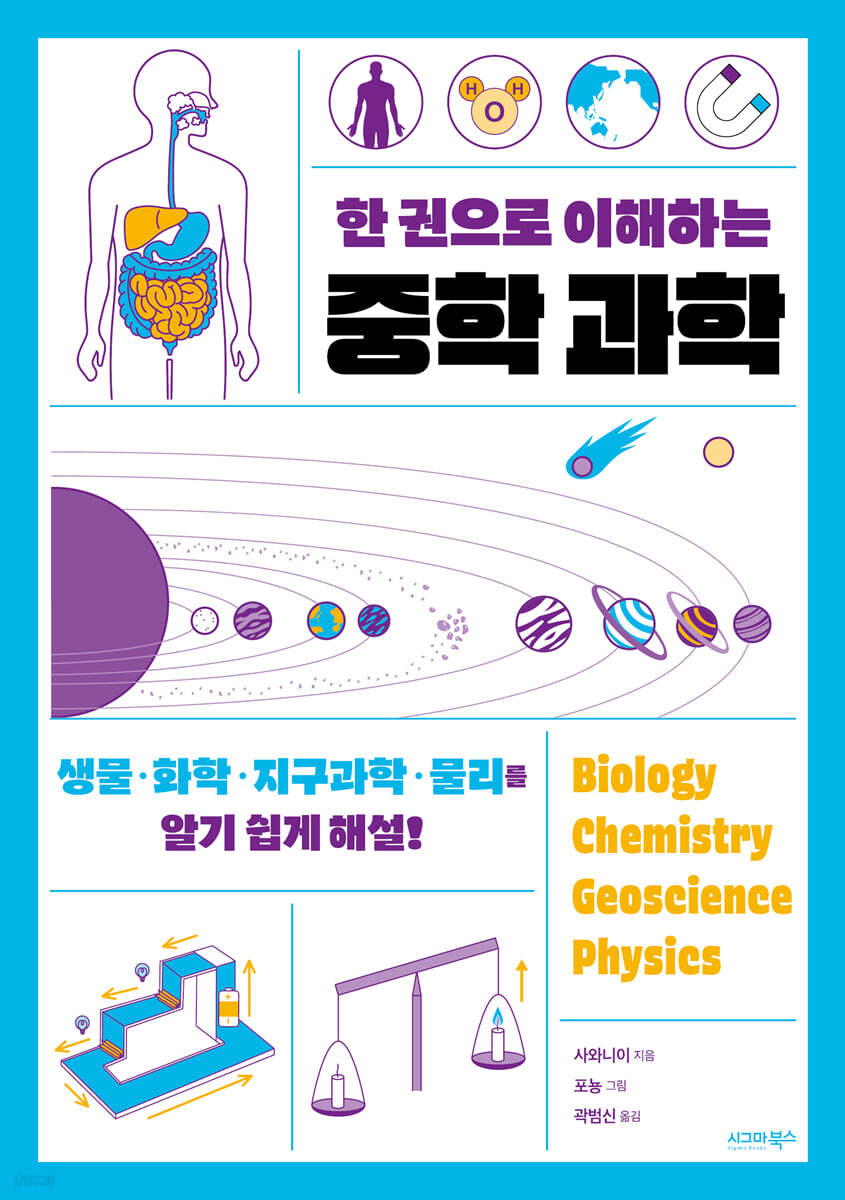
Middle School Science in One Book
 |
Description
Book Introduction
The most basic in one volume
You can learn scientific knowledge!
This book focuses on 'integrating science and everyday life' and 'relearning middle school science', providing easy-to-understand explanations of middle school biology, chemistry, earth science, and physics.
It is designed to help students acquire the knowledge of middle school science, which can be called the 'entrance to science', and will be helpful to middle school or high school students who are not confident in science, as well as adults who want to study science again.
'Learning science' means 'learning about nature.'
By reading this book, let's further develop our knowledge by connecting various phenomena found in everyday life with scientific theories!
You can learn scientific knowledge!
This book focuses on 'integrating science and everyday life' and 'relearning middle school science', providing easy-to-understand explanations of middle school biology, chemistry, earth science, and physics.
It is designed to help students acquire the knowledge of middle school science, which can be called the 'entrance to science', and will be helpful to middle school or high school students who are not confident in science, as well as adults who want to study science again.
'Learning science' means 'learning about nature.'
By reading this book, let's further develop our knowledge by connecting various phenomena found in everyday life with scientific theories!
- You can preview some of the book's contents.
Preview
index
To begin with
Chapter 1: Biology
1-1 Plants' efforts to transfer pollen
-What flowers do
1-2 The Mystery of the Fruits and Seeds of Plants
-Appearance of the plant before and after pollination
1-3 Angiosperms and Gymnosperms
-Difference between angiosperms and gymnosperms
1-4 Structure of leaves and roots of dicotyledons and monocotyledons
-Characteristics of dicotyledons and monocotyledons
1-5 Forked and Tubered Flowers - The Secret of the Dandelion Flower
- Structure of flower petals
1-6 Ferns and bryophytes multiply their mates without producing seeds?
-plants that do not produce seeds
1-7 Do you know the characteristics of vertebrates and what the five groups are?
-a group of vertebrates
1-8 Spiders aren't insects? What are arthropods?
- Invertebrate group
1-9 Legs grow from the head? The mystery of mollusks.
-A group of mollusks
1-10 What is the body of a living thing made of?
-Cell structure of plants and animals
1-11 What is Digestion? The Structure of the Human Digestive System
-Digestion and absorption
1-12 The principle of breathing possible even though the lungs have no muscles
-Structure and function of the lungs
1-13 Four components in human blood
-What blood does
1-14 Differences between arteries, veins, arterial blood, and venous blood
-Human blood vessels and blood circulation
1-15 Structure of the Human Eye - Are there places in the eye that cannot be detected?
-The structure and function of the eye
1-16 Structure of the Human Ear - Do humans balance with their ears?
-The structure and function of the ear
1-17 Stimulus and Response - The Mystery of the Nerve
-The principle of human reaction
1-18 What are sexual and asexual reproduction? Advantages and disadvantages
-How living things multiply
1-19 The Structure of Genetics - A Child's Blood Type Can Be Predicted
-The structure of genes
1-20 Food chain and biodiversity balance
-Eat and be eaten relationship
1-21 Why aren't mountains covered with corpses?
- Decomposers and the carbon cycle
Chapter 2 Chemistry
2-1 Is it a big misconception that metals stick to magnets?
-Common properties of metals
2-2 What are organic and inorganic substances? Let's learn about their origins.
-Organic and inorganic substances
What is 2-3 density? Let's learn through great people.
-Density size
2-4 What is a change of state? Changes in volume and mass
-Changes in state and volume and mass
2-5 What is temperature? Its relationship to changes in state.
-State change and temperature
2-6 Properties of familiar gases - focusing on oxygen and carbon dioxide
-Properties of gases
2-7 What is the difference between atoms and molecules?
-Difference between atoms and molecules
2-8 You can understand substances by looking at their chemical formulas.
-Chemical formula of a substance
2-9 Important Points on Writing Chemical Reaction Equations
-Order of writing chemical reaction equations
2-10 Changes in which oxygen is combined and removed
-Oxidation and reduction
2-11 Mass before and after chemical change and the law of conservation of mass
-Chemical changes and mass
2-12 What is an ion? The structure of atoms and the principles of ion formation.
-The principle of ion generation
2-13 Ionization tendency and battery structure
-Ionization tendency of metals
2-14 Acidic and alkaline properties and identity
-Acidity and alkalinity
2-15 Neutralization and Salts - The Principle of Neutralization as Explained by Ions
-Chinese and salt
Chapter 3 Earth Science
3-1 Where Do Rocks Come From? The Secrets of Igneous Rock
-Structure of igneous rocks
3-2 Is This a Gem? Minerals Learned in Middle School Science
-Various minerals
3-3 What is sedimentary rock? Rocks formed over long periods of time.
-How sedimentary rocks are formed
3-4 Understanding the Past of Earth through Fossils
- Award fossils and standard fossils
3-5 Difference between Magnitude and Progress
-The magnitude of the earthquake's shaking
3-6 Is the Earth Moving? What is Plate Tectonics?
-Plate tectonics
3-7 The difference between clear and cloudy skies, sleet and hail
-Weather types and weather symbols
3-8 How to memorize the 16 cardinal directions without getting confused
-Wind direction and 16 directions
3-9 What is the dew point? Why do water droplets form on cups in the summer?
-Dew point and saturated water vapor content
3-10 How Clouds Form - Why the Bottom of a Cloud Is Flat
-Water vapor and clouds
3-11 What is 100% humidity? Water vapor contained in the air.
-How to calculate humidity
3-12 What are low pressure and high pressure?
-Isobars and low and high pressure
3-13 What is a wire? The principles and characteristics of wire formation.
-Various wires
3-14 Characteristics of the Sun - Let's Learn About Different Dimensions of Energy
-The appearance of the sun
3-15 What is the Solar System? Characteristics of the Eight Planets
-Characteristics of the planets in the solar system
3-16 The movement of stars during a day - Earth's rotation and diurnal motion
-The daily motion of the stars
3-17 Where will you be living in six months? Earth's revolution and annual motion
-Star's performance movement
3-18 The Mystery of the Moon - The Mystery of the Nearest Celestial Body
-Moon phase changes
3-19 Solar and Lunar Eclipses - The Relationship Between the Sun and the Moon
-The structure of solar and lunar eclipses
3-20 Is Venus visible only in the morning or evening? Why?
-The way Venus looks
Chapter 4 Physics
4-1 The Mystery of Light - What is the principle by which things are seen?
-The way light and objects are seen
4-2 Refraction of Light - Why Objects Appear Bent
-Refraction of light
4-3 Why do fireworks sound so late?
-Difference between the speed of light and sound
4-4 Three Actions of Force and the Arrow of Force
-Action of force
4-5 What is the difference between force and pressure? Force applied in everyday life
-Difference between force and pressure
4-6 Water Pressure and Buoyancy - Understanding Their Meanings
-Difference between water pressure and buoyancy
4-7 The unit of weight is not kg?
-Difference between mass and weight
4-8 What are series and parallel circuits? There's only one key difference.
-How to view circuit diagrams
4-9 What is current? Let's understand it simply with images!
-What is current?
Knowing Voltage 4-10 Understands Circuits! - What's the Difference Between Current and Voltage?
-What is voltage?
4-11 Ohm's Law - There is no law more convenient than this.
-Calculation of Ohm's law
4-12 Why does static electricity occur? The principle of how electricity accumulates on objects.
-The principle of static electricity generation
4-13 What is the nature of current? Let's explore the mysteries of electrons.
- Current stagnation
4-14 What is a Magnetic Field? Its Mysterious Relationship with Electric Current
-Current and magnetic field
4-15 Electromagnetic Induction and Induced Currents - Principles of Power Generation
-Electromagnetic induction and induced current
4-16 Fleming's Left-Hand Rule - Let's Learn About That Famous Rule
-Relationship between current, magnetic field, and force
4-17 Why does the motor turn? The culmination of human wisdom.
-Motor structure
4-18 Uniform Rectangular Motion and the Law of Inertia
- Force and motion of objects
What is 4-19? What does science say about work and the principles of work?
-The relationship between power and work
4-20 What is the law of conservation of mechanical energy?
-Kinetic energy and potential energy
4-21 Conversion and Conservation of Energy
-Various energies
Chapter 1: Biology
1-1 Plants' efforts to transfer pollen
-What flowers do
1-2 The Mystery of the Fruits and Seeds of Plants
-Appearance of the plant before and after pollination
1-3 Angiosperms and Gymnosperms
-Difference between angiosperms and gymnosperms
1-4 Structure of leaves and roots of dicotyledons and monocotyledons
-Characteristics of dicotyledons and monocotyledons
1-5 Forked and Tubered Flowers - The Secret of the Dandelion Flower
- Structure of flower petals
1-6 Ferns and bryophytes multiply their mates without producing seeds?
-plants that do not produce seeds
1-7 Do you know the characteristics of vertebrates and what the five groups are?
-a group of vertebrates
1-8 Spiders aren't insects? What are arthropods?
- Invertebrate group
1-9 Legs grow from the head? The mystery of mollusks.
-A group of mollusks
1-10 What is the body of a living thing made of?
-Cell structure of plants and animals
1-11 What is Digestion? The Structure of the Human Digestive System
-Digestion and absorption
1-12 The principle of breathing possible even though the lungs have no muscles
-Structure and function of the lungs
1-13 Four components in human blood
-What blood does
1-14 Differences between arteries, veins, arterial blood, and venous blood
-Human blood vessels and blood circulation
1-15 Structure of the Human Eye - Are there places in the eye that cannot be detected?
-The structure and function of the eye
1-16 Structure of the Human Ear - Do humans balance with their ears?
-The structure and function of the ear
1-17 Stimulus and Response - The Mystery of the Nerve
-The principle of human reaction
1-18 What are sexual and asexual reproduction? Advantages and disadvantages
-How living things multiply
1-19 The Structure of Genetics - A Child's Blood Type Can Be Predicted
-The structure of genes
1-20 Food chain and biodiversity balance
-Eat and be eaten relationship
1-21 Why aren't mountains covered with corpses?
- Decomposers and the carbon cycle
Chapter 2 Chemistry
2-1 Is it a big misconception that metals stick to magnets?
-Common properties of metals
2-2 What are organic and inorganic substances? Let's learn about their origins.
-Organic and inorganic substances
What is 2-3 density? Let's learn through great people.
-Density size
2-4 What is a change of state? Changes in volume and mass
-Changes in state and volume and mass
2-5 What is temperature? Its relationship to changes in state.
-State change and temperature
2-6 Properties of familiar gases - focusing on oxygen and carbon dioxide
-Properties of gases
2-7 What is the difference between atoms and molecules?
-Difference between atoms and molecules
2-8 You can understand substances by looking at their chemical formulas.
-Chemical formula of a substance
2-9 Important Points on Writing Chemical Reaction Equations
-Order of writing chemical reaction equations
2-10 Changes in which oxygen is combined and removed
-Oxidation and reduction
2-11 Mass before and after chemical change and the law of conservation of mass
-Chemical changes and mass
2-12 What is an ion? The structure of atoms and the principles of ion formation.
-The principle of ion generation
2-13 Ionization tendency and battery structure
-Ionization tendency of metals
2-14 Acidic and alkaline properties and identity
-Acidity and alkalinity
2-15 Neutralization and Salts - The Principle of Neutralization as Explained by Ions
-Chinese and salt
Chapter 3 Earth Science
3-1 Where Do Rocks Come From? The Secrets of Igneous Rock
-Structure of igneous rocks
3-2 Is This a Gem? Minerals Learned in Middle School Science
-Various minerals
3-3 What is sedimentary rock? Rocks formed over long periods of time.
-How sedimentary rocks are formed
3-4 Understanding the Past of Earth through Fossils
- Award fossils and standard fossils
3-5 Difference between Magnitude and Progress
-The magnitude of the earthquake's shaking
3-6 Is the Earth Moving? What is Plate Tectonics?
-Plate tectonics
3-7 The difference between clear and cloudy skies, sleet and hail
-Weather types and weather symbols
3-8 How to memorize the 16 cardinal directions without getting confused
-Wind direction and 16 directions
3-9 What is the dew point? Why do water droplets form on cups in the summer?
-Dew point and saturated water vapor content
3-10 How Clouds Form - Why the Bottom of a Cloud Is Flat
-Water vapor and clouds
3-11 What is 100% humidity? Water vapor contained in the air.
-How to calculate humidity
3-12 What are low pressure and high pressure?
-Isobars and low and high pressure
3-13 What is a wire? The principles and characteristics of wire formation.
-Various wires
3-14 Characteristics of the Sun - Let's Learn About Different Dimensions of Energy
-The appearance of the sun
3-15 What is the Solar System? Characteristics of the Eight Planets
-Characteristics of the planets in the solar system
3-16 The movement of stars during a day - Earth's rotation and diurnal motion
-The daily motion of the stars
3-17 Where will you be living in six months? Earth's revolution and annual motion
-Star's performance movement
3-18 The Mystery of the Moon - The Mystery of the Nearest Celestial Body
-Moon phase changes
3-19 Solar and Lunar Eclipses - The Relationship Between the Sun and the Moon
-The structure of solar and lunar eclipses
3-20 Is Venus visible only in the morning or evening? Why?
-The way Venus looks
Chapter 4 Physics
4-1 The Mystery of Light - What is the principle by which things are seen?
-The way light and objects are seen
4-2 Refraction of Light - Why Objects Appear Bent
-Refraction of light
4-3 Why do fireworks sound so late?
-Difference between the speed of light and sound
4-4 Three Actions of Force and the Arrow of Force
-Action of force
4-5 What is the difference between force and pressure? Force applied in everyday life
-Difference between force and pressure
4-6 Water Pressure and Buoyancy - Understanding Their Meanings
-Difference between water pressure and buoyancy
4-7 The unit of weight is not kg?
-Difference between mass and weight
4-8 What are series and parallel circuits? There's only one key difference.
-How to view circuit diagrams
4-9 What is current? Let's understand it simply with images!
-What is current?
Knowing Voltage 4-10 Understands Circuits! - What's the Difference Between Current and Voltage?
-What is voltage?
4-11 Ohm's Law - There is no law more convenient than this.
-Calculation of Ohm's law
4-12 Why does static electricity occur? The principle of how electricity accumulates on objects.
-The principle of static electricity generation
4-13 What is the nature of current? Let's explore the mysteries of electrons.
- Current stagnation
4-14 What is a Magnetic Field? Its Mysterious Relationship with Electric Current
-Current and magnetic field
4-15 Electromagnetic Induction and Induced Currents - Principles of Power Generation
-Electromagnetic induction and induced current
4-16 Fleming's Left-Hand Rule - Let's Learn About That Famous Rule
-Relationship between current, magnetic field, and force
4-17 Why does the motor turn? The culmination of human wisdom.
-Motor structure
4-18 Uniform Rectangular Motion and the Law of Inertia
- Force and motion of objects
What is 4-19? What does science say about work and the principles of work?
-The relationship between power and work
4-20 What is the law of conservation of mechanical energy?
-Kinetic energy and potential energy
4-21 Conversion and Conservation of Energy
-Various energies
Detailed image

Into the book
Because insect pollination uses insects, it can be done effectively even with a small amount of pollen.
There are also various ways to attract insects, such as plants that attract flies with the smell of rotting meat or plants that imitate the appearance of female bees to attract male bees.
Some plants use the wind, rather than insects, to carry their pollen.
These plants are called 'wind-pollinated'.
--- "Chapter 1: Living Things"
The food chain starts with plants.
Plants can create nutrients such as starch from carbon dioxide, water, and light energy.
Organisms that can produce their own nutrients are called producers.
Plants can also be seen as beings that support life on Earth.
Next, there are creatures that obtain nutrients by eating plants.
It's a herbivore.
Herbivores cannot make their own food, so they eat plants to get their nutrients.
There are also carnivores that obtain nutrients by eating herbivores.
This relationship of eating and being eaten continues.
--- "Chapter 1: Living Things"
Now, if we can group substances into a group called 'metals', then metals will have some common properties.
So what kind of materials have the characteristics to be called metals?
Just think about it.
It would be really fun to talk about this in class at school.
There are three common properties of metals.
① It has a metallic luster, ② It conducts electricity and heat well, ③ It is malleable and ductile. These are the three characteristics.
--- "Chapter 2 Chemistry"
If the molecules are different like this, the properties of the substance will also be different.
Conversely, a molecule can be viewed as the smallest unit that represents the properties of a substance.
This is because if you separate the two oxygen atoms of an oxygen molecule, it will no longer be able to maintain the properties of an oxygen molecule.
There are 118 types of atoms (elements), but there are millions of types of molecules made up of atoms.
--- "Chapter 2 Chemistry"
Wegener came up with the theory of continental drift, which states that these coastlines were originally connected and that the continents moved to form their current shape, and announced this theory at the Geological Society in 1912.
Wegener collected a lot of information that served as the basis for his theory of continental drift, including not only topography but also fossils of living things, rocks, and strata.
And he explained that the current continent was originally one large continent, and named this continent 'Pangaea'.
--- "Chapter 3 Earth Science"
One of the reasons the moon waxes and wanes is because 'the moon shines by reflecting sunlight.'
A celestial body that shines on its own, like the sun, appears round no matter which direction it is viewed from.
However, the moon undergoes phase changes because it shines by reflecting sunlight.
--- "Chapter 3 Earth Science"
Pressure is a force that increases as the area of contact decreases.
If we think about the mechanical pencil we talked about earlier, when you stab with the cap, the contact area is large, and when you stab with the lead, the contact area is small.
That is, you can see that the smaller the contact area, the greater the pressure.
--- "Chapter 4 Physics"
Mass is a term that means 'the amount of an object itself', and its units are g and kg.
An object with a mass of 600g remains 600g whether on Earth or in space.
Because even if you go into space, the object itself does not disappear.
There are also various ways to attract insects, such as plants that attract flies with the smell of rotting meat or plants that imitate the appearance of female bees to attract male bees.
Some plants use the wind, rather than insects, to carry their pollen.
These plants are called 'wind-pollinated'.
--- "Chapter 1: Living Things"
The food chain starts with plants.
Plants can create nutrients such as starch from carbon dioxide, water, and light energy.
Organisms that can produce their own nutrients are called producers.
Plants can also be seen as beings that support life on Earth.
Next, there are creatures that obtain nutrients by eating plants.
It's a herbivore.
Herbivores cannot make their own food, so they eat plants to get their nutrients.
There are also carnivores that obtain nutrients by eating herbivores.
This relationship of eating and being eaten continues.
--- "Chapter 1: Living Things"
Now, if we can group substances into a group called 'metals', then metals will have some common properties.
So what kind of materials have the characteristics to be called metals?
Just think about it.
It would be really fun to talk about this in class at school.
There are three common properties of metals.
① It has a metallic luster, ② It conducts electricity and heat well, ③ It is malleable and ductile. These are the three characteristics.
--- "Chapter 2 Chemistry"
If the molecules are different like this, the properties of the substance will also be different.
Conversely, a molecule can be viewed as the smallest unit that represents the properties of a substance.
This is because if you separate the two oxygen atoms of an oxygen molecule, it will no longer be able to maintain the properties of an oxygen molecule.
There are 118 types of atoms (elements), but there are millions of types of molecules made up of atoms.
--- "Chapter 2 Chemistry"
Wegener came up with the theory of continental drift, which states that these coastlines were originally connected and that the continents moved to form their current shape, and announced this theory at the Geological Society in 1912.
Wegener collected a lot of information that served as the basis for his theory of continental drift, including not only topography but also fossils of living things, rocks, and strata.
And he explained that the current continent was originally one large continent, and named this continent 'Pangaea'.
--- "Chapter 3 Earth Science"
One of the reasons the moon waxes and wanes is because 'the moon shines by reflecting sunlight.'
A celestial body that shines on its own, like the sun, appears round no matter which direction it is viewed from.
However, the moon undergoes phase changes because it shines by reflecting sunlight.
--- "Chapter 3 Earth Science"
Pressure is a force that increases as the area of contact decreases.
If we think about the mechanical pencil we talked about earlier, when you stab with the cap, the contact area is large, and when you stab with the lead, the contact area is small.
That is, you can see that the smaller the contact area, the greater the pressure.
--- "Chapter 4 Physics"
Mass is a term that means 'the amount of an object itself', and its units are g and kg.
An object with a mass of 600g remains 600g whether on Earth or in space.
Because even if you go into space, the object itself does not disappear.
--- "Chapter 4 Physics"
Publisher's Review
Middle school science in one hand
This book is organized in the order of biology, chemistry, earth science, and physics.
In Chapter 1, we first look at plants.
It covers flowers, pollination, angiosperms and gymnosperms, dicotyledons and monocotyledons, and finally ferns and bryophytes.
Next, let's look at the characteristics of animals.
Observe vertebrates, invertebrates, and mollusks.
It also deals with the human body, one of the animals, and explains digestion and absorption, the lungs, blood and blood vessels, the structure of the eyes and ears, and nerves.
Finally, we look at reproduction, genetics, and the food chain.
Chapter 2, Chemistry, begins with learning about the properties of metals and then covers organic and inorganic substances.
After examining density, changes in state, temperature, and the properties of gases, it covers atoms and molecules, chemical formulas, oxidation and reduction, chemical changes, ions, acidity and alkalinity, neutralization, and salts.
In Chapter 3, Earth Science, we will look at rocks and minerals, then learn about fossils, earthquakes, and plate tectonics.
After looking at the weather, dew point, clouds, humidity, and various fronts, it tells you about the sun, the planets in the solar system, the moon, and solar and lunar eclipses.
Chapter 4 begins by learning about light and sound.
After explaining the differences and characteristics of force and pressure, water pressure and buoyancy, mass and weight, we move on to the circuit diagram.
Learn about series and parallel circuits, current, voltage, and resistance, and learn about static electricity, current and magnetic fields, and Fleming's left-hand rule.
Finally, it explains the laws of uniform rectilinear motion and inertia, force and work, kinetic energy and potential energy, and conversion and conservation of energy.
Middle school science may be the starting point for curiosity about science.
Just knowing middle school science is enough to discover various scientific phenomena around us.
This book will help spark your interest in science.
This book is organized in the order of biology, chemistry, earth science, and physics.
In Chapter 1, we first look at plants.
It covers flowers, pollination, angiosperms and gymnosperms, dicotyledons and monocotyledons, and finally ferns and bryophytes.
Next, let's look at the characteristics of animals.
Observe vertebrates, invertebrates, and mollusks.
It also deals with the human body, one of the animals, and explains digestion and absorption, the lungs, blood and blood vessels, the structure of the eyes and ears, and nerves.
Finally, we look at reproduction, genetics, and the food chain.
Chapter 2, Chemistry, begins with learning about the properties of metals and then covers organic and inorganic substances.
After examining density, changes in state, temperature, and the properties of gases, it covers atoms and molecules, chemical formulas, oxidation and reduction, chemical changes, ions, acidity and alkalinity, neutralization, and salts.
In Chapter 3, Earth Science, we will look at rocks and minerals, then learn about fossils, earthquakes, and plate tectonics.
After looking at the weather, dew point, clouds, humidity, and various fronts, it tells you about the sun, the planets in the solar system, the moon, and solar and lunar eclipses.
Chapter 4 begins by learning about light and sound.
After explaining the differences and characteristics of force and pressure, water pressure and buoyancy, mass and weight, we move on to the circuit diagram.
Learn about series and parallel circuits, current, voltage, and resistance, and learn about static electricity, current and magnetic fields, and Fleming's left-hand rule.
Finally, it explains the laws of uniform rectilinear motion and inertia, force and work, kinetic energy and potential energy, and conversion and conservation of energy.
Middle school science may be the starting point for curiosity about science.
Just knowing middle school science is enough to discover various scientific phenomena around us.
This book will help spark your interest in science.
GOODS SPECIFICS
- Date of issue: September 5, 2025
- Page count, weight, size: 336 pages | 552g | 140*210*20mm
- ISBN13: 9791168623996
- ISBN10: 1168623995
You may also like
카테고리
korean


korean

![GQ KOREA Mark (Monthly): December [2025]](http://librairie.coreenne.fr/cdn/shop/files/8ef265dbbfbf186523ed75ba7319009d.jpg?v=1765340328&width=3840)


