

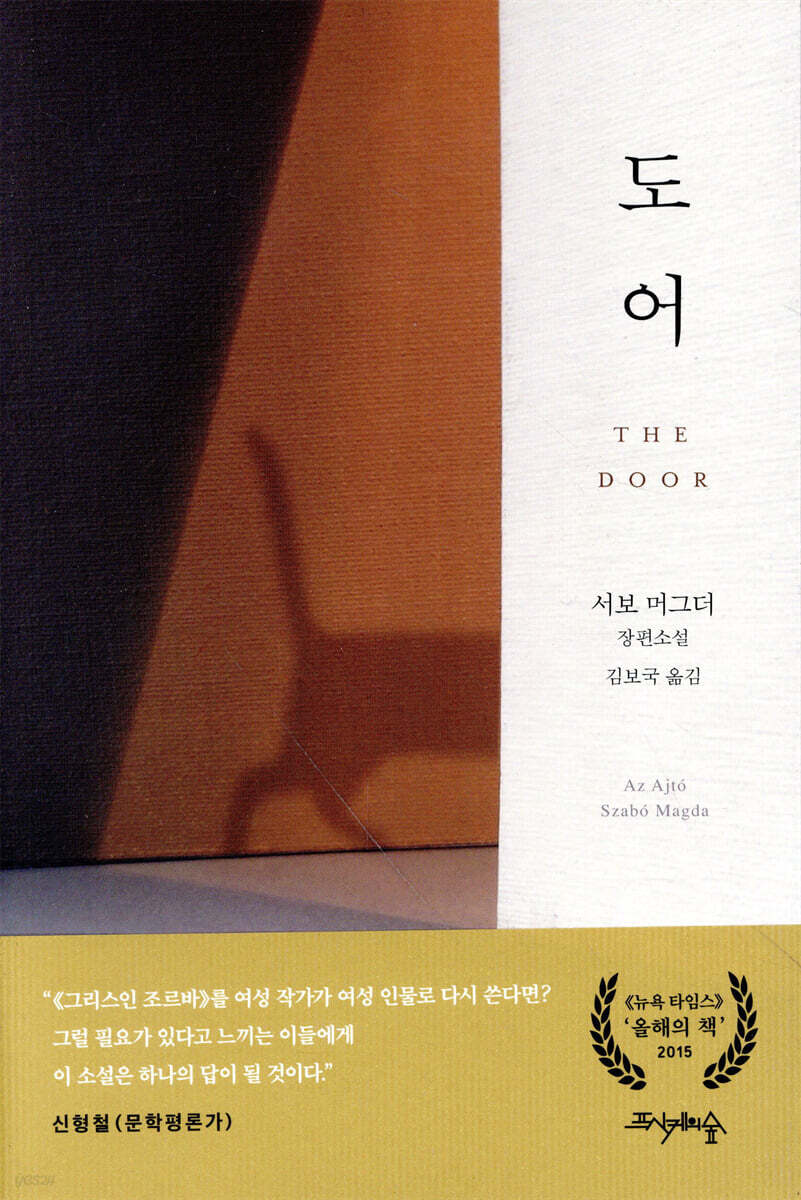
door
 |
Description
Book Introduction
- A word from MD
-
Critic Shin Hyeong-cheol recommends a Hungarian masterpiece novel.A masterpiece by Servo Magda, known as Hungary's 'national writer'.
"It is a solid record of the 20 years of friendship and rupture between two women: an elderly housekeeper who has done physical labor all her life and a middle-aged writer who is 20 years younger than her."
A good novel transcends geographic boundaries and generations.
Like this book.
November 19, 2019. Novel/Poetry PD Kim Do-hoon
Recommended by critic Shin Hyeong-cheol
"Four thousand pages of emotion condensed into four hundred."
[New York Times] 'Best Book of the Year' (2015)
Some books get noticed right away, while others slowly become known, creating ripples in our hearts.
This book, “Door,” is exactly like that.
First published in Hungary in 1987, he became a national writer in his home country, but it was much later that he began to receive international attention.
It won the French Prix Femina in 2003, and became a hot topic among New Yorkers and was selected as one of the New York Times' 'Best Books of the Year' in 2015.
If we just look at the trajectory of the work's re-examination, it strongly reminds us of John Williams's 'Stoner'.
It has been attracting attention for a long time, as rumors about it have spread and overlapped, touching the hearts of readers of many generations.
"The Door" is set in Budapest, Hungary and depicts a 20-year relationship between two women.
'I', a renowned writer, meets Emerence while looking for someone to take care of the housework.
However, Emerence is a very unique character, never docile and with a firm opinion.
There was no formal agreement on how many hours she would work each day, and she decided what her pay would be.
Sometimes he wouldn't come at all for a few days, and other times he would show up late at night and clean the kitchen until dawn.
However, her actions were carried out with a certain rationality, and surprisingly, they even opened up a new world that even I, a cultured person, did not know about.
'I' and Emerence, two women who are contrasting in every way, soon become indispensable to each other.
However, along with the success that 'I' had longed for as a writer, a breakdown is approaching between the two.
"Four thousand pages of emotion condensed into four hundred."
[New York Times] 'Best Book of the Year' (2015)
Some books get noticed right away, while others slowly become known, creating ripples in our hearts.
This book, “Door,” is exactly like that.
First published in Hungary in 1987, he became a national writer in his home country, but it was much later that he began to receive international attention.
It won the French Prix Femina in 2003, and became a hot topic among New Yorkers and was selected as one of the New York Times' 'Best Books of the Year' in 2015.
If we just look at the trajectory of the work's re-examination, it strongly reminds us of John Williams's 'Stoner'.
It has been attracting attention for a long time, as rumors about it have spread and overlapped, touching the hearts of readers of many generations.
"The Door" is set in Budapest, Hungary and depicts a 20-year relationship between two women.
'I', a renowned writer, meets Emerence while looking for someone to take care of the housework.
However, Emerence is a very unique character, never docile and with a firm opinion.
There was no formal agreement on how many hours she would work each day, and she decided what her pay would be.
Sometimes he wouldn't come at all for a few days, and other times he would show up late at night and clean the kitchen until dawn.
However, her actions were carried out with a certain rationality, and surprisingly, they even opened up a new world that even I, a cultured person, did not know about.
'I' and Emerence, two women who are contrasting in every way, soon become indispensable to each other.
However, along with the success that 'I' had longed for as a writer, a breakdown is approaching between the two.
- You can preview some of the book's contents.
Preview
index
Moon _007
Contract _011
Jesus' Brothers and Sisters _033
Viola _050
Relationships _070
Murano Glass _084
Waste Collection Day _105
Paulette _131
Politics _148
Nadori-Cheobeodul _164
Filming _188
That Moment _195
Lent _213
Christmas Surprise Gift _234
Operation _244
Without a headscarf _264
Awards Ceremony _277
Amnesia _298
Shutu _319
Finale _335
Legacy _345
Solution _358
Moon _366
Recommendation by Shin Hyeong-cheol (literary critic) _369
Contract _011
Jesus' Brothers and Sisters _033
Viola _050
Relationships _070
Murano Glass _084
Waste Collection Day _105
Paulette _131
Politics _148
Nadori-Cheobeodul _164
Filming _188
That Moment _195
Lent _213
Christmas Surprise Gift _234
Operation _244
Without a headscarf _264
Awards Ceremony _277
Amnesia _298
Shutu _319
Finale _335
Legacy _345
Solution _358
Moon _366
Recommendation by Shin Hyeong-cheol (literary critic) _369
Into the book
It was I who killed Emerence.
The statement that he did not want to kill her but to save her does not change the fact here.
--- p.10
“Do you know why I save money? It’s for the stone tomb.
A stone tomb, as large as the world and as beautiful as nothing else, with every window made of glass.
“You will see later what a wonderful light beam will fall on the coffins through the colorful windows as the sun rises and sets.”
--- p.48
He was intoxicated with a sense of victory, arrogantly and a little contemptuously.
And I think I know why she won't let me set foot in her house.
The omnipotent man's suspicion that there might be something valuable behind that door that was forever closed was justified.
--- p.79
No one mentioned the guest who never came.
When we got home, Emerence handed me the leash and waited for me to enter the garden.
And then, on this Virgilian night, where real and unreal elements were mixed, she whispered slowly, yet clearly, as if she were making an oath, that she would never forget what I did that day.
--- p.104
She poured the cherries into the pot.
The fruit has been seeded, and the juice starts to ooze out like blood from a wound, and it keeps swelling more and more.
Emerence wearing a black apron.
In the shade, a kerchief like a hood, a pot, that perfect tranquility.
--- p.141
I just listened and didn't say anything.
Saint Emerence, from Cheburdul, was a madman of unparalleled mercy who saved everyone.
The pursued person had to be saved.
Surely that would have saved the Grossman family and those who were chasing the Grossman family.
--- p.162
“People killed the cow and cut off its meat.
He showed me the whole spectacle of slaughtering and dismembering.
Don't ask me how I felt.
I hope you've learned the lesson: never love anyone to the point of death.
You will be sad.
If not now, then later.
“It’s best not to love anyone.”
--- p.186
"What if it was known that nine cats were living in this house? That's why I don't open the door.
I won't give even one to anyone else.
There will be no more cats hanging to death in this house.
They are prisoners locked up, but they are alive.
They are my family, and I have nothing else left.
Okay, go ahead.”
--- p.212
My heart pounded, and many emotions clashed within me: shame at the lie, hope, guilt, and relief.
Emerence raised his hand slightly and gestured for him to come closer to the bed.
My name was called again.
There was something different, something more in that sound.
There was something mysterious, a secret trembling like electricity.
It was deep bass, but not aggressive.
It sounded like the gentle cracking of a clam or the ripping of fabric.
The statement that he did not want to kill her but to save her does not change the fact here.
--- p.10
“Do you know why I save money? It’s for the stone tomb.
A stone tomb, as large as the world and as beautiful as nothing else, with every window made of glass.
“You will see later what a wonderful light beam will fall on the coffins through the colorful windows as the sun rises and sets.”
--- p.48
He was intoxicated with a sense of victory, arrogantly and a little contemptuously.
And I think I know why she won't let me set foot in her house.
The omnipotent man's suspicion that there might be something valuable behind that door that was forever closed was justified.
--- p.79
No one mentioned the guest who never came.
When we got home, Emerence handed me the leash and waited for me to enter the garden.
And then, on this Virgilian night, where real and unreal elements were mixed, she whispered slowly, yet clearly, as if she were making an oath, that she would never forget what I did that day.
--- p.104
She poured the cherries into the pot.
The fruit has been seeded, and the juice starts to ooze out like blood from a wound, and it keeps swelling more and more.
Emerence wearing a black apron.
In the shade, a kerchief like a hood, a pot, that perfect tranquility.
--- p.141
I just listened and didn't say anything.
Saint Emerence, from Cheburdul, was a madman of unparalleled mercy who saved everyone.
The pursued person had to be saved.
Surely that would have saved the Grossman family and those who were chasing the Grossman family.
--- p.162
“People killed the cow and cut off its meat.
He showed me the whole spectacle of slaughtering and dismembering.
Don't ask me how I felt.
I hope you've learned the lesson: never love anyone to the point of death.
You will be sad.
If not now, then later.
“It’s best not to love anyone.”
--- p.186
"What if it was known that nine cats were living in this house? That's why I don't open the door.
I won't give even one to anyone else.
There will be no more cats hanging to death in this house.
They are prisoners locked up, but they are alive.
They are my family, and I have nothing else left.
Okay, go ahead.”
--- p.212
My heart pounded, and many emotions clashed within me: shame at the lie, hope, guilt, and relief.
Emerence raised his hand slightly and gestured for him to come closer to the bed.
My name was called again.
There was something different, something more in that sound.
There was something mysterious, a secret trembling like electricity.
It was deep bass, but not aggressive.
It sounded like the gentle cracking of a clam or the ripping of fabric.
--- p.317
Publisher's Review
“This woman is that famous Greek man
“He shines proudly in contrast to Zorba.”
"The Door" takes great pains to portray the unique aspects of the character Emerence.
Emerence is a man who has lived a difficult life through the history of war and revolution.
She lost her parents at a young age and began working as a housekeeper at an early age, and of course, she did not receive any education.
But that doesn't mean she's ignorant.
In the novel, the intellectual and cultured 'I' is often amazed by Emerence's unique judgment, artistic sense, and view of history.
“A man who is a cool-headed pessimist, a cynical anti-intellectual, yet also a rugged life advocate and a passionate devotee.
“This woman, who evokes both boundless respect and pity, stands proudly as the polar opposite of the famous Greek man Zorba.” (Critic Shin Hyeong-cheol)
Author Servo Magder meticulously portrays Emerence as a subjective human being.
But what is unique is that it is not portrayed in the form of unconditional praise.
In some cases, Emerence's behavior can even be perceived as rude and unpleasant.
The author neither confirms nor denies such 'actions'.
However, I always try to understand that kind of 'attitude'.
It seems to be arguing that (subjective) dignity is more important than (honor based on the evaluation of others).
Moreover, Emerence is a city worker.
Despite being in a social position where it is easy to be subordinate, she firmly maintains her dignity.
Emerence is a woman with more autonomy than anyone else, and although she is tense and conflicted with the world, she follows her own path without worrying about the reactions of others.
Some readers might now be strongly tempted to erase Zorba and replace him with Emerence.
“To exist on Earth
“A story that celebrates a love that is so perfect”
Emerence is a man of many secrets.
Especially one 'door' inside her house.
All kinds of people gather in front of her house, but no one can enter behind the closed door.
There were all kinds of rumors about her, and the police actually came to investigate, but that closed door didn't budge.
The novel unfolds from beginning to end with a strong awareness of the existence of this door.
The door is the mystery of Emerence's life, and the process of opening it brings great regret to the 'I' in the work.
Ironically, the thing you do for the person you love more than anyone else ends up being the biggest betrayal.
“It changed the way I understand my own life.
“It is a work of rigorous honesty and delicate subtlety.” (The New York Times Book Review)
Author Servo Magda gradually builds the novel towards the secret of the 'door'.
The life of Emerence presented in the process is dramatic and tragic.
The best scene by far is the one that happens after the door finally opens.
Several media outlets have noted the work's excellent storytelling.
“This author has a knack for creating taut tension.” (Publisher’s Weekly) “The tension between the two women is captivating, and at times, even creepy.” (Cleaver Magazine) Her work has been published in over 40 countries.
Now it's Korean readers' turn to encounter "The Door."
Full text of 'Recommendation'
Shin Hyeong-cheol (literary critic)
I received the manuscript in the spring, but it's chilly now.
When it comes to Hungarian literature, people like Sándor Máray, Krystof Agota, and Imre Kertész come to mind, but seeing as Servo Magda is still unfamiliar to us, I wondered if he was not as good as them.
It was a poor prediction.
Over the summer and fall, I read this novel slowly three times.
A record of the friendship and ruptures between two women over 20 years: an elderly housekeeper who has done physical labor all her life and a middle-aged writer twenty years younger than her.
I had to read a novel of less than 400 pages as if it were a 4,000-page epic.
Because 4,000 pages of emotions were condensed into 400 pages.
First of all, it is a novel about a manual worker named Emerence.
The inner world of a Hungarian woman who has lived through both World Wars and reached old age is closed like an iron door, and the primary task of this novel is to open it.
The misfortunes he suffered were beyond human imagination, and yet he acquired the very character traits that a person must acquire to survive.
A cool-headed pessimist, a cynical anti-intellectual, yet also a staunch life advocate and a passionate devotee.
This woman, who evokes both boundless respect and pity, stands proudly as the polar opposite of the famous Greek man Zorba.
Just as Zorba was able to shine because the narrator, who resembled the writer Kazantzakis, formed a complementary contrast, so too is there a narrator here who resembles Servo Magda, and this novel is also his long and arduous confession.
The first half is a record of a lesson in which he learns the depth of life itself through the depth of a woman named Emerence, but the second half becomes a record of regret, like punishment for a certain irreversible choice.
There are times in life when I know that a choice I make is a betrayal, even though everyone else consoles me that it is not.
This novel watches over us all as if it were crushing us.
When contemporary science reduces humans to the brain and genes, literature marvels at the achievements but also feels a sense of emptiness.
Literature cannot abandon the idea that there is a price one human being must pay to understand another, and that price is probably the time it takes to share each other's pain.
What could replace the 20 years of the two characters in this novel?
“If you stab a person in the heart with a very sharp knife, they won’t fall right away.” Whenever I read a novel like this, where the characters fall slowly and belatedly, I dare to believe that the essence of humanity lies here.
“He shines proudly in contrast to Zorba.”
"The Door" takes great pains to portray the unique aspects of the character Emerence.
Emerence is a man who has lived a difficult life through the history of war and revolution.
She lost her parents at a young age and began working as a housekeeper at an early age, and of course, she did not receive any education.
But that doesn't mean she's ignorant.
In the novel, the intellectual and cultured 'I' is often amazed by Emerence's unique judgment, artistic sense, and view of history.
“A man who is a cool-headed pessimist, a cynical anti-intellectual, yet also a rugged life advocate and a passionate devotee.
“This woman, who evokes both boundless respect and pity, stands proudly as the polar opposite of the famous Greek man Zorba.” (Critic Shin Hyeong-cheol)
Author Servo Magder meticulously portrays Emerence as a subjective human being.
But what is unique is that it is not portrayed in the form of unconditional praise.
In some cases, Emerence's behavior can even be perceived as rude and unpleasant.
The author neither confirms nor denies such 'actions'.
However, I always try to understand that kind of 'attitude'.
It seems to be arguing that (subjective) dignity is more important than (honor based on the evaluation of others).
Moreover, Emerence is a city worker.
Despite being in a social position where it is easy to be subordinate, she firmly maintains her dignity.
Emerence is a woman with more autonomy than anyone else, and although she is tense and conflicted with the world, she follows her own path without worrying about the reactions of others.
Some readers might now be strongly tempted to erase Zorba and replace him with Emerence.
“To exist on Earth
“A story that celebrates a love that is so perfect”
Emerence is a man of many secrets.
Especially one 'door' inside her house.
All kinds of people gather in front of her house, but no one can enter behind the closed door.
There were all kinds of rumors about her, and the police actually came to investigate, but that closed door didn't budge.
The novel unfolds from beginning to end with a strong awareness of the existence of this door.
The door is the mystery of Emerence's life, and the process of opening it brings great regret to the 'I' in the work.
Ironically, the thing you do for the person you love more than anyone else ends up being the biggest betrayal.
“It changed the way I understand my own life.
“It is a work of rigorous honesty and delicate subtlety.” (The New York Times Book Review)
Author Servo Magda gradually builds the novel towards the secret of the 'door'.
The life of Emerence presented in the process is dramatic and tragic.
The best scene by far is the one that happens after the door finally opens.
Several media outlets have noted the work's excellent storytelling.
“This author has a knack for creating taut tension.” (Publisher’s Weekly) “The tension between the two women is captivating, and at times, even creepy.” (Cleaver Magazine) Her work has been published in over 40 countries.
Now it's Korean readers' turn to encounter "The Door."
Full text of 'Recommendation'
Shin Hyeong-cheol (literary critic)
I received the manuscript in the spring, but it's chilly now.
When it comes to Hungarian literature, people like Sándor Máray, Krystof Agota, and Imre Kertész come to mind, but seeing as Servo Magda is still unfamiliar to us, I wondered if he was not as good as them.
It was a poor prediction.
Over the summer and fall, I read this novel slowly three times.
A record of the friendship and ruptures between two women over 20 years: an elderly housekeeper who has done physical labor all her life and a middle-aged writer twenty years younger than her.
I had to read a novel of less than 400 pages as if it were a 4,000-page epic.
Because 4,000 pages of emotions were condensed into 400 pages.
First of all, it is a novel about a manual worker named Emerence.
The inner world of a Hungarian woman who has lived through both World Wars and reached old age is closed like an iron door, and the primary task of this novel is to open it.
The misfortunes he suffered were beyond human imagination, and yet he acquired the very character traits that a person must acquire to survive.
A cool-headed pessimist, a cynical anti-intellectual, yet also a staunch life advocate and a passionate devotee.
This woman, who evokes both boundless respect and pity, stands proudly as the polar opposite of the famous Greek man Zorba.
Just as Zorba was able to shine because the narrator, who resembled the writer Kazantzakis, formed a complementary contrast, so too is there a narrator here who resembles Servo Magda, and this novel is also his long and arduous confession.
The first half is a record of a lesson in which he learns the depth of life itself through the depth of a woman named Emerence, but the second half becomes a record of regret, like punishment for a certain irreversible choice.
There are times in life when I know that a choice I make is a betrayal, even though everyone else consoles me that it is not.
This novel watches over us all as if it were crushing us.
When contemporary science reduces humans to the brain and genes, literature marvels at the achievements but also feels a sense of emptiness.
Literature cannot abandon the idea that there is a price one human being must pay to understand another, and that price is probably the time it takes to share each other's pain.
What could replace the 20 years of the two characters in this novel?
“If you stab a person in the heart with a very sharp knife, they won’t fall right away.” Whenever I read a novel like this, where the characters fall slowly and belatedly, I dare to believe that the essence of humanity lies here.
GOODS SPECIFICS
- Publication date: November 10, 2019
- Page count, weight, size: 372 pages | 476g | 140*210*18mm
- ISBN13: 9791189336110
- ISBN10: 1189336111
You may also like
카테고리
korean


korean

![GQ KOREA Mark (Monthly): December [2025]](http://librairie.coreenne.fr/cdn/shop/files/8ef265dbbfbf186523ed75ba7319009d.jpg?v=1765340328&width=3840)


