

Toto at the Window
 |
Description
Book Introduction
Toto at the Window, reimagined after 20 years in Korean
Includes a total of 22 illustrations, including illustrations never before published in Korea.
The classic coming-of-age novel, "Toto at the Window," which has been published in 35 countries around the world and sold over 10 million copies in China alone, has been republished after 20 years since its domestic publication.
"Toto at the Window" is a book that tells the story of a girl who is labeled a "bad kid" because she is a little different from others, and how she grows up after meeting a teacher who sees her as she is, from a child's perspective.
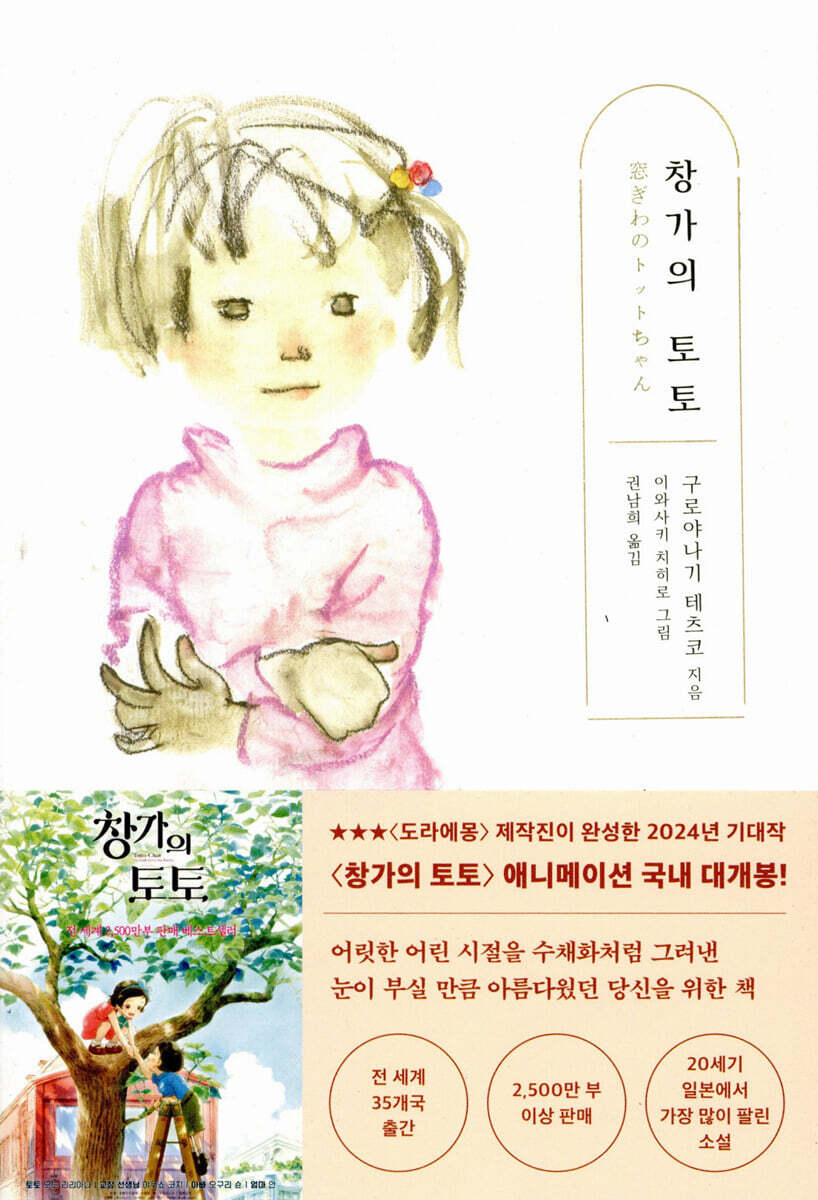
The republished 『Toto at the Window』 has been completely redesigned, from the format to the cover and interior design, translation, and included illustrations.
It was produced in a small format that matches the main character Toto, and the cover uses an illustration that evokes childhood nostalgia, but adds sophisticated design elements.
Additionally, Kwon Nam-hee, who has translated Japanese literature for nearly 30 years, including 『Fireflies』 and 『Tsubaki Stationery Store』, has translated it delicately to preserve the language of children, and has included a total of 22 illustrations, including about 10 illustrations that were not found in previously published works, increasing its collection value.
Includes a total of 22 illustrations, including illustrations never before published in Korea.
The classic coming-of-age novel, "Toto at the Window," which has been published in 35 countries around the world and sold over 10 million copies in China alone, has been republished after 20 years since its domestic publication.
"Toto at the Window" is a book that tells the story of a girl who is labeled a "bad kid" because she is a little different from others, and how she grows up after meeting a teacher who sees her as she is, from a child's perspective.
The republished 『Toto at the Window』 has been completely redesigned, from the format to the cover and interior design, translation, and included illustrations.
It was produced in a small format that matches the main character Toto, and the cover uses an illustration that evokes childhood nostalgia, but adds sophisticated design elements.
Additionally, Kwon Nam-hee, who has translated Japanese literature for nearly 30 years, including 『Fireflies』 and 『Tsubaki Stationery Store』, has translated it delicately to preserve the language of children, and has included a total of 22 illustrations, including about 10 illustrations that were not found in previously published works, increasing its collection value.
index
The first station I visited
Toto at the Window
new school
I like it
Principal
lunch
I'm going to school starting today.
subway classroom
class
What comes from the sea and what comes from the mountains
Chew it thoroughly
walk
School song
Leave it as it was
Name Story
Man-dam
The train is coming
swimming pool
Report card
Summer vacation has begun
Great Adventure
Courage Test
practice room
hot spring trip
Rhythmic
Lifelong wish
old clothes
Takahashi
Don't jump in
And then!
I was just joking
field meet
Issa Kobayashi
This is so amazing!
Speaking with hands
Sengakuji Temple
Masaoya!
Braiding hair
thank you
library
tail
Second Spring
Swan Lake
Farmer Teacher
Off-campus study
You are actually a really good kid
Rejected
shit school
ribbon
Visiting the sick
The bark of a tree that tells you whether you are sick or not
English-speaking child
school festival
chalk
Yasuaki is dead
spy
violin
promise
Loki is gone
tea party
Hello, hello
Author's Note
Toto at the Window
new school
I like it
Principal
lunch
I'm going to school starting today.
subway classroom
class
What comes from the sea and what comes from the mountains
Chew it thoroughly
walk
School song
Leave it as it was
Name Story
Man-dam
The train is coming
swimming pool
Report card
Summer vacation has begun
Great Adventure
Courage Test
practice room
hot spring trip
Rhythmic
Lifelong wish
old clothes
Takahashi
Don't jump in
And then!
I was just joking
field meet
Issa Kobayashi
This is so amazing!
Speaking with hands
Sengakuji Temple
Masaoya!
Braiding hair
thank you
library
tail
Second Spring
Swan Lake
Farmer Teacher
Off-campus study
You are actually a really good kid
Rejected
shit school
ribbon
Visiting the sick
The bark of a tree that tells you whether you are sick or not
English-speaking child
school festival
chalk
Yasuaki is dead
spy
violin
promise
Loki is gone
tea party
Hello, hello
Author's Note
Into the book
Toto didn't even know that he was expelled from school or that the adults around him were having a hard time because of him. He was originally bright and forgetful, so he seemed innocent.
But somewhere in his heart, Toto vaguely felt a sense of alienation, a sense that he was the only one receiving cold stares from the other children.
But being with this principal made me feel warm and secure, and I felt good.
'If it's this teacher, I'm happy to stay with him forever.'
--- p.36
“There is a haiku by Basho called ‘The sound of frogs jumping into an old pond…’
Basho wasn't the only one who saw a frog jump into a pond.
There must have been only one person, Watt or Newton, in the East or the West, past or present, who saw a steaming kettle or an apple fall.
“The people the world should fear are those who have eyes but do not know beauty, who have ears but do not hear music, who have hearts but do not know truth, who do not know how to be moved and do not burn… … such people.” --- p.133~134
Toto was a little surprised.
I've never heard the saying, 'You have to be kind to girls.'
It was always the boy who was the better.
Even in a house with many children, as Toto knew, boys always had priority when it came to food and snacks.
When the girl said something, her mother said, “Girls, keep quiet.”
But the principal told Oehan, "Take care of the girl."
Toto was curious.
And I was happy.
It was a pleasure to be treated with such respect by anyone.
--- p.204~205
It was true that the principal's words had planted in Toto's heart the confidence that 'I am a good kid.'
This is because Toto always remembered his teacher's words whenever he did something.
There were often times when I said, “Oops!” after committing an incident.
The principal kept saying these words, which were so important that they might have determined the course of Toto's life, throughout Toto's time at Domoe School.
“Toto, you are actually a very good kid.”
--- p.244
When I was young, Domoe School was just a happy memory.
But as I was writing the book, I realized things like, "Aha, so that's what Mr. Kobayashi was thinking back then!" and "He even took these things into consideration." Every time I did that, I was surprised, moved, and felt a renewed sense of gratitude.
I don't know how much the words you kept telling me, "You're actually a really good kid," have supported me until now.
If I hadn't entered Domoe School and met Mr. Kobayashi, no matter what I did, I would have been labeled a "bad kid."
I would have suffered from complexes and become an adult without knowing how to live.
But somewhere in his heart, Toto vaguely felt a sense of alienation, a sense that he was the only one receiving cold stares from the other children.
But being with this principal made me feel warm and secure, and I felt good.
'If it's this teacher, I'm happy to stay with him forever.'
--- p.36
“There is a haiku by Basho called ‘The sound of frogs jumping into an old pond…’
Basho wasn't the only one who saw a frog jump into a pond.
There must have been only one person, Watt or Newton, in the East or the West, past or present, who saw a steaming kettle or an apple fall.
“The people the world should fear are those who have eyes but do not know beauty, who have ears but do not hear music, who have hearts but do not know truth, who do not know how to be moved and do not burn… … such people.” --- p.133~134
Toto was a little surprised.
I've never heard the saying, 'You have to be kind to girls.'
It was always the boy who was the better.
Even in a house with many children, as Toto knew, boys always had priority when it came to food and snacks.
When the girl said something, her mother said, “Girls, keep quiet.”
But the principal told Oehan, "Take care of the girl."
Toto was curious.
And I was happy.
It was a pleasure to be treated with such respect by anyone.
--- p.204~205
It was true that the principal's words had planted in Toto's heart the confidence that 'I am a good kid.'
This is because Toto always remembered his teacher's words whenever he did something.
There were often times when I said, “Oops!” after committing an incident.
The principal kept saying these words, which were so important that they might have determined the course of Toto's life, throughout Toto's time at Domoe School.
“Toto, you are actually a very good kid.”
--- p.244
When I was young, Domoe School was just a happy memory.
But as I was writing the book, I realized things like, "Aha, so that's what Mr. Kobayashi was thinking back then!" and "He even took these things into consideration." Every time I did that, I was surprised, moved, and felt a renewed sense of gratitude.
I don't know how much the words you kept telling me, "You're actually a really good kid," have supported me until now.
If I hadn't entered Domoe School and met Mr. Kobayashi, no matter what I did, I would have been labeled a "bad kid."
I would have suffered from complexes and become an adult without knowing how to live.
--- From "The Author's Note"
Publisher's Review
Published in 35 countries worldwide, it was the best-selling novel in Japan in the 20th century.
A classic coming-of-age novel that depicts the tender moments of childhood like watercolors.
Toto, who just entered elementary school, gets scolded countless times for standing by the window during class and talking to people passing by and magpies.
Although he is eventually kicked out of the classroom, he is innocent enough to ask a teacher passing by in the hallway, “Teacher, why do I have to stand here?” and “Did I do something bad?”
But the adults at school couldn't tolerate Toto.
The school that Toto went to after being expelled for being different from other children was Tomoe School, founded by Mr. Kobayashi.
A school where 50 students study in classrooms built like subways without a set schedule, go for walks during class, or draw musical notes on the auditorium floor as if it were music sheets.
A school that makes you look forward to the next morning, sad to go home after class.
Here, only here, a pure and transparent story unfolds about children who do not need to damage or create themselves, and adults who embrace their existence as it is.
“Please take your daughter to another school!”
Alienation and Exclusion: The Growth of a Child Standing by the Window
The reason why the title of this book is 『Toto at the Window』 is because at the time of its publication in Japan (1980s), the term ‘Changgajok (族)’ was popular, referring to office workers who had been forced out of their jobs.
Toto, who always stood by the window during class, didn't know that he was expelled or that the adults around him were having a hard time because of him, but he vaguely felt that he was the only one receiving cold stares, unlike the other children.
In my first school, I felt a sense of alienation for some reason.
Such Toto becomes a different kid at Domoe School than before.
Toto, who used to rummage around at his desk during class, now sits up straight at his desk and studies, and can even sit quietly with other children and go on picnics.
“There is still a lot to write about the story of Domoe School.
But anyway, I want you to know one thing.
“Even a girl like Toto, who was expelled from school, can become a human being who lives together with everyone, depending on what the adults around her do.” _ From the author’s writing
Even now, there are probably countless Totos standing by the window, feeling alienated and anxious by the cold stares of those around them.
They are all born blessed and have the right to live happily.
"Toto at the Window" is a story about how the love and consideration of those around you can help you grow, whether you're an expelled child or someone ostracized from a group.
Readers will find great comfort in the book's characters' unique innocence, kindness, and affection for one another.
A teacher who doesn't ask, "What on earth are you doing?" or "Can I help you?"
Redefining a Good Adult
“As I was writing the book, I realized things like, ‘Aha, so that’s what Mr. Kobayashi was thinking back then!’ and ‘He even took these things into consideration.’ Every time I did that, I was surprised, moved, and felt a renewed sense of gratitude.
I don't know how much the words you kept telling me, "You're actually a really good kid," have supported me until now.
If I hadn't entered Domoe School and met Mr. Kobayashi, no matter what I did, I would have been labeled a "bad kid."
I would have suffered from complexes and become an adult without knowing how to live. “ _ From the author’s writings
Mr. Kobayashi, who appears in "Toto at the Window," founded the Tomoe School to raise children to be unique individuals.
What Mr. Kobayashi thinks is most important is for children to affirm themselves.
So, Mr. Kobayashi does not ignore children because they are young, nor does he easily judge their behavior.
Even if it seems like the child has done something clearly wrong, listen to what he or she has to say.
The day he first met Toto, Mr. Kobayashi listened to Toto's story for a full four hours.
At that time, Toto felt like he had met someone he really liked for the first time.
(Omitted) I think that before or after that, there was no adult who listened to my story so well” (page 35).
Readers who are tired of a society like school where even the slightest difference is treated as an oddity and where uniformity is emphasized over difference will find in Mr. Kobayashi in this work the image of a good adult they have hoped and dreamed of.
This book provides answers to readers who have been wondering what makes a good adult and how to avoid becoming a bad adult.
A classic coming-of-age novel that depicts the tender moments of childhood like watercolors.
Toto, who just entered elementary school, gets scolded countless times for standing by the window during class and talking to people passing by and magpies.
Although he is eventually kicked out of the classroom, he is innocent enough to ask a teacher passing by in the hallway, “Teacher, why do I have to stand here?” and “Did I do something bad?”
But the adults at school couldn't tolerate Toto.
The school that Toto went to after being expelled for being different from other children was Tomoe School, founded by Mr. Kobayashi.
A school where 50 students study in classrooms built like subways without a set schedule, go for walks during class, or draw musical notes on the auditorium floor as if it were music sheets.
A school that makes you look forward to the next morning, sad to go home after class.
Here, only here, a pure and transparent story unfolds about children who do not need to damage or create themselves, and adults who embrace their existence as it is.
“Please take your daughter to another school!”
Alienation and Exclusion: The Growth of a Child Standing by the Window
The reason why the title of this book is 『Toto at the Window』 is because at the time of its publication in Japan (1980s), the term ‘Changgajok (族)’ was popular, referring to office workers who had been forced out of their jobs.
Toto, who always stood by the window during class, didn't know that he was expelled or that the adults around him were having a hard time because of him, but he vaguely felt that he was the only one receiving cold stares, unlike the other children.
In my first school, I felt a sense of alienation for some reason.
Such Toto becomes a different kid at Domoe School than before.
Toto, who used to rummage around at his desk during class, now sits up straight at his desk and studies, and can even sit quietly with other children and go on picnics.
“There is still a lot to write about the story of Domoe School.
But anyway, I want you to know one thing.
“Even a girl like Toto, who was expelled from school, can become a human being who lives together with everyone, depending on what the adults around her do.” _ From the author’s writing
Even now, there are probably countless Totos standing by the window, feeling alienated and anxious by the cold stares of those around them.
They are all born blessed and have the right to live happily.
"Toto at the Window" is a story about how the love and consideration of those around you can help you grow, whether you're an expelled child or someone ostracized from a group.
Readers will find great comfort in the book's characters' unique innocence, kindness, and affection for one another.
A teacher who doesn't ask, "What on earth are you doing?" or "Can I help you?"
Redefining a Good Adult
“As I was writing the book, I realized things like, ‘Aha, so that’s what Mr. Kobayashi was thinking back then!’ and ‘He even took these things into consideration.’ Every time I did that, I was surprised, moved, and felt a renewed sense of gratitude.
I don't know how much the words you kept telling me, "You're actually a really good kid," have supported me until now.
If I hadn't entered Domoe School and met Mr. Kobayashi, no matter what I did, I would have been labeled a "bad kid."
I would have suffered from complexes and become an adult without knowing how to live. “ _ From the author’s writings
Mr. Kobayashi, who appears in "Toto at the Window," founded the Tomoe School to raise children to be unique individuals.
What Mr. Kobayashi thinks is most important is for children to affirm themselves.
So, Mr. Kobayashi does not ignore children because they are young, nor does he easily judge their behavior.
Even if it seems like the child has done something clearly wrong, listen to what he or she has to say.
The day he first met Toto, Mr. Kobayashi listened to Toto's story for a full four hours.
At that time, Toto felt like he had met someone he really liked for the first time.
(Omitted) I think that before or after that, there was no adult who listened to my story so well” (page 35).
Readers who are tired of a society like school where even the slightest difference is treated as an oddity and where uniformity is emphasized over difference will find in Mr. Kobayashi in this work the image of a good adult they have hoped and dreamed of.
This book provides answers to readers who have been wondering what makes a good adult and how to avoid becoming a bad adult.
GOODS SPECIFICS
- Date of publication: June 28, 2019
- Page count, weight, size: 352 pages | 492g | 128*188*30mm
- ISBN13: 9788934996309
- ISBN10: 8934996307
You may also like
카테고리
korean


korean

![GQ KOREA Mark (Monthly): December [2025]](http://librairie.coreenne.fr/cdn/shop/files/8ef265dbbfbf186523ed75ba7319009d.jpg?v=1765340328&width=3840)


