

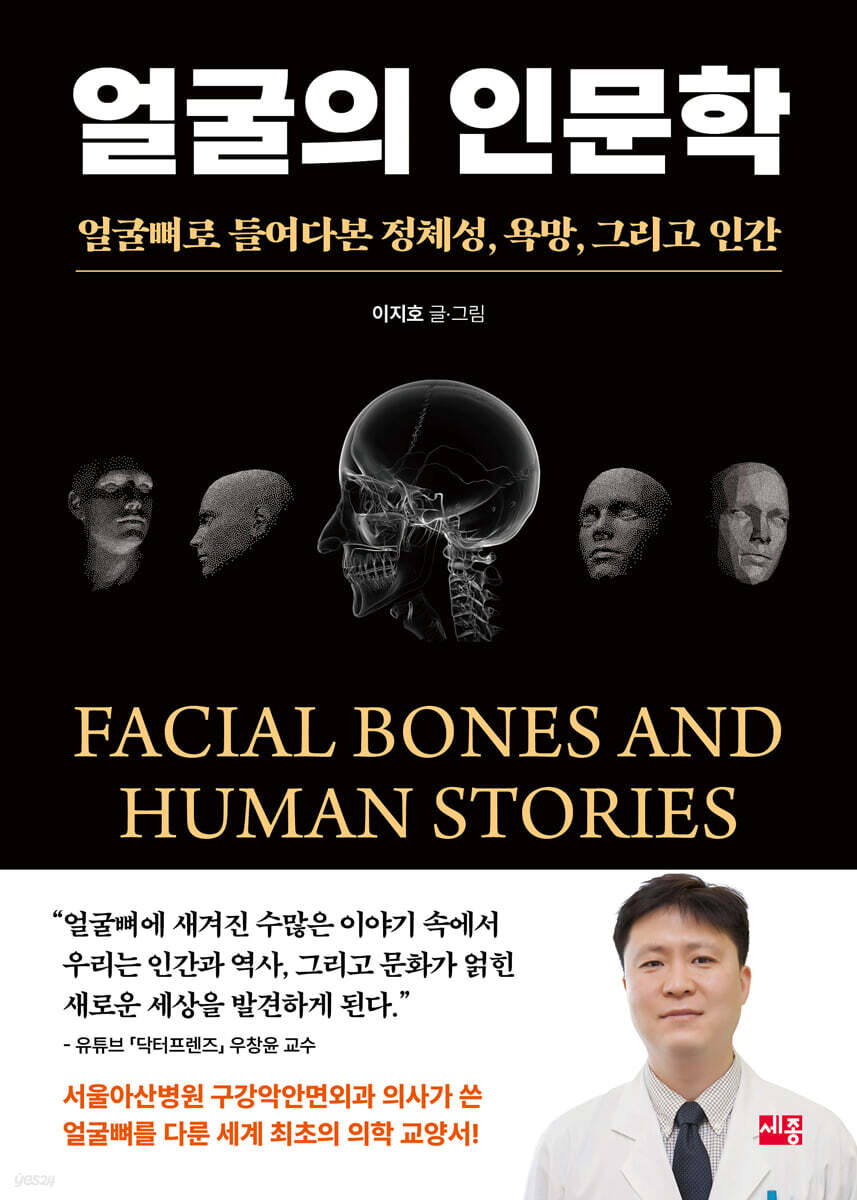
Humanities of the Face
 |
Description
Book Introduction
"Humanity's Desire Conveyed by the Bones in the Face"
Anatomy Outside the Classroom: Dissecting Identity!
Written and drawn directly by a practicing oral and maxillofacial surgeon,
The world's first medical textbook on facial bones
YouTube [Doctor Friends] Professor Woo Chang-yoon strongly recommends!
The face is where human identity is compressed, but its roots are in the 'bones'.
The facial bones are not simple structures.
It is a place where emotions pass and desires remain, and it is the beginning of the silhouette that ultimately forms the existence called 'me'.
"The Humanities of the Face" is a book that explores the human desire for beauty and identity through the facial bones, the most complex organ in the body. It is the first medical textbook to combine facial anatomy and humanities.
Although there are anatomy books that deal with bones, there has never been a book that examines human life and identity with a focus on the facial bones.
Author Lee Ji-ho, a professor and illustrator of the Department of Oral and Maxillofacial Surgery at Seoul Asan Medical Center and Ulsan University School of Medicine, has incorporated his clinical experience, accumulated over 20 years of meeting various patients, into this book with humanistic insight.
During my dental school days, anatomy was something I had to memorize without asking questions for exams.
But in the operating room, where we reconstruct the faces of patients with oral cancer and restore facial bones shattered in accidents, anatomy becomes a life-saving language, not cold knowledge.
This book is the account of a surgeon who learned to speak anatomy in that language.
The author unravels stories of facial bones in history and movies, including the skull, which symbolized fear in ancient times but evolved into an icon of festivals in modern times; the philosophy of memento mori in vanitas using skulls; the occupational disease of the match factory girl, which is as tragic as the Little Match Girl; Mazinger Z, which makes good use of human facial bones; and Tom Hanks' dangerous tooth extraction in "Cast Away." This book unfolds with detailed anatomy knowledge and humanistic reflection.
Moreover, you can catch a glimpse of the author's unique humor and philosophy in his personally drawn illustrations and webtoons.
Hwang Seung-jun, President of the Korean Society of Anatomists, Lee Jong-ho, Professor at the National Cancer Center, Woo Chang-yoon, Professor at Seoul Asan Medical Center of YouTube's "Doctor Friends," Kwon Bok-gyu, Professor at Ewha Womans University College of Medicine, and Shin Sang-mok, CEO, all praised the book, saying it is a rare book that goes beyond a simple anatomy textbook and fully unfolds the identity, history, and narrative of life contained in the space called the face.
Readers of this book will gain a correct understanding of the facial bones that make up the face, which has been the standard of beauty since ancient times, and will gain a new perspective on humanity's desire for beauty and human identity.
Anatomy Outside the Classroom: Dissecting Identity!
Written and drawn directly by a practicing oral and maxillofacial surgeon,
The world's first medical textbook on facial bones
YouTube [Doctor Friends] Professor Woo Chang-yoon strongly recommends!
The face is where human identity is compressed, but its roots are in the 'bones'.
The facial bones are not simple structures.
It is a place where emotions pass and desires remain, and it is the beginning of the silhouette that ultimately forms the existence called 'me'.
"The Humanities of the Face" is a book that explores the human desire for beauty and identity through the facial bones, the most complex organ in the body. It is the first medical textbook to combine facial anatomy and humanities.
Although there are anatomy books that deal with bones, there has never been a book that examines human life and identity with a focus on the facial bones.
Author Lee Ji-ho, a professor and illustrator of the Department of Oral and Maxillofacial Surgery at Seoul Asan Medical Center and Ulsan University School of Medicine, has incorporated his clinical experience, accumulated over 20 years of meeting various patients, into this book with humanistic insight.
During my dental school days, anatomy was something I had to memorize without asking questions for exams.
But in the operating room, where we reconstruct the faces of patients with oral cancer and restore facial bones shattered in accidents, anatomy becomes a life-saving language, not cold knowledge.
This book is the account of a surgeon who learned to speak anatomy in that language.
The author unravels stories of facial bones in history and movies, including the skull, which symbolized fear in ancient times but evolved into an icon of festivals in modern times; the philosophy of memento mori in vanitas using skulls; the occupational disease of the match factory girl, which is as tragic as the Little Match Girl; Mazinger Z, which makes good use of human facial bones; and Tom Hanks' dangerous tooth extraction in "Cast Away." This book unfolds with detailed anatomy knowledge and humanistic reflection.
Moreover, you can catch a glimpse of the author's unique humor and philosophy in his personally drawn illustrations and webtoons.
Hwang Seung-jun, President of the Korean Society of Anatomists, Lee Jong-ho, Professor at the National Cancer Center, Woo Chang-yoon, Professor at Seoul Asan Medical Center of YouTube's "Doctor Friends," Kwon Bok-gyu, Professor at Ewha Womans University College of Medicine, and Shin Sang-mok, CEO, all praised the book, saying it is a rare book that goes beyond a simple anatomy textbook and fully unfolds the identity, history, and narrative of life contained in the space called the face.
Readers of this book will gain a correct understanding of the facial bones that make up the face, which has been the standard of beauty since ancient times, and will gain a new perspective on humanity's desire for beauty and human identity.
- You can preview some of the book's contents.
Preview
index
Recommendation
Prologue: Anatomy Outside the Classroom: The Story of the Facial Bones
Chapter 1: The Facial Bone, a Puzzle of Mystery Containing the Soul
The facial bones tell many stories.
Gangnam of the facial bones_mandible
Am I the one who will become king (maxilla)_maxilla
Dangerous surgery that intentionally breaks the jaw?_Maxillofacial surgery
Carving Beauty and Civilization_Teeth
[Reading Medical History in Comics 1] Making Facial Bone Surgery Possible: General Anesthesia
Chapter 2: Making the Facial Bones Human
Madam, is my tongue still attached?_Tongue
The Duality of Communication and Blocking_Mucous Membrane
Gum disease: the ultimate chronic disease that has persistently plagued humanity.
Making bones and flesh human_nerves
The deadly side of the head that requires more caution than the back of the head_space
[Reading Medical History in Comics 2] The Oldest Healthcare Item in Human History: Toothbrushes
Chapter 3: Facial Bones and Human Civilization
A cruel fairy tale etched into the bone_Osteomyelitis
The Dead's Unburnable Fingerprints_Forensic Facial Bones
Swords, Humans, and Skate Blades on a Deserted Island_Tools
The struggle to regain humanity_Reconstruction
[Reading Medical History in Comics 3] Unit Chair: No Matter How Comfortable It Is, You Don't Want to Sit in It
[Reading Medical History in Comics 4] In Search of Sharper, Less Painful Tools - Dental Drills
Epilogue: Reflections on Another World
References
Prologue: Anatomy Outside the Classroom: The Story of the Facial Bones
Chapter 1: The Facial Bone, a Puzzle of Mystery Containing the Soul
The facial bones tell many stories.
Gangnam of the facial bones_mandible
Am I the one who will become king (maxilla)_maxilla
Dangerous surgery that intentionally breaks the jaw?_Maxillofacial surgery
Carving Beauty and Civilization_Teeth
[Reading Medical History in Comics 1] Making Facial Bone Surgery Possible: General Anesthesia
Chapter 2: Making the Facial Bones Human
Madam, is my tongue still attached?_Tongue
The Duality of Communication and Blocking_Mucous Membrane
Gum disease: the ultimate chronic disease that has persistently plagued humanity.
Making bones and flesh human_nerves
The deadly side of the head that requires more caution than the back of the head_space
[Reading Medical History in Comics 2] The Oldest Healthcare Item in Human History: Toothbrushes
Chapter 3: Facial Bones and Human Civilization
A cruel fairy tale etched into the bone_Osteomyelitis
The Dead's Unburnable Fingerprints_Forensic Facial Bones
Swords, Humans, and Skate Blades on a Deserted Island_Tools
The struggle to regain humanity_Reconstruction
[Reading Medical History in Comics 3] Unit Chair: No Matter How Comfortable It Is, You Don't Want to Sit in It
[Reading Medical History in Comics 4] In Search of Sharper, Less Painful Tools - Dental Drills
Epilogue: Reflections on Another World
References
Detailed image

Into the book
In the cool game of hide-and-seek with the oral cancer lurking somewhere on the patient's face, and the process of reconstructing the face that was left so bare and devastated after the cancer was removed, anatomy was no longer a subject to earn credits or knowledge to study simply for fun.
Sometimes, late at night, when I rushed to a patient's emergency room due to sudden bleeding, I would find myself in a situation where I couldn't tell where anything was due to the distorted structures and bleeding from the previous surgery.
In the meantime, anatomy served as a guide for me, like an experienced fisherman who feels the coastline, feeling the familiar currents and winds even on a dark night.
--- p.12~13
The overall shape of the facial bones is engraved with the history of race and evolution.
The shape of the orbit that holds the eyeball, the volume of the brain, the size and shape of the jawbone and teeth, the degree of development of the cheekbones, etc. are all the results of accumulation over hundreds of thousands or millions of years.
By looking at the teeth and jawbone, we can learn about what the owner of the bones ate and what diseases they suffered from.
Adding forensic technology to this allows you to dress flesh, eyes, hair, etc.
In this way, the facial bones tell the story of our lives.
--- p.25
Interestingly, Mazinger Z's head has clearly distinct skull and facial bones, just like a human's.
The hoverpiper is a kind of brain.
Only when the aircraft carrying the iron man merges with the empty space of the skull, does an invincible robot with the same personality as the pilot begin to function.
Although the terrifying expression remains constant, Mazinger Z's face, made of a solid special alloy, is the facial bone itself.
--- p.34~35
If the skull is a large office where office workers sit and make decisions, the facial bones can be likened to a complex and dynamic field worker who communicates with the world.
Stories told by field workers are always exciting and dynamic.
--- p.37
In Japan, there was a custom called Ohaguro, which involved dyeing teeth black.
It was used by the ancient imperial family and nobles to show off their status, but during the Edo period, it became established as a special makeup technique for those in the entertainment industry, such as geisha.
It was later abolished following the Meiji Restoration.
Now, only traces of this past custom remain, and can only be seen during traditional festivals.
In the past, when tartar removal and whitening technology were not developed, there was no way to hide teeth that had become yellow or damaged by cavities.
It would have been more aesthetically pleasing to dye the teeth black.
--- p.92~93
The scene of vomiting blood and dying immediately after drinking poison is a cliche that has been produced too often in historical dramas, and in fact, it took time for the poison to take effect after drinking it.
In some cases, people who did not die after drinking poison were executed by strangling them with a bowstring.
That was the case with Song Si-yeol.
I drank all the poison the king had given me, but it didn't work even after a while, so I had to just sit there in a daze.
However, strangling the neck of an octogenarian who was a big politician and a great scholar of Neo-Confucianism was something that even the royal inspector who came down from the court to execute the sentence could not bring himself to do.
Eventually, an unfunny situation arose where the royal inspector begged for the poison to be poured on him and he would die.
--- p.131
Sigmund Freud, the founder of psychoanalysis, was also a heavy smoker.
He suffered from heart and respiratory diseases due to excessive smoking, and lived with shortness of breath and chest pain, but he never gave up the pleasure of smoking.
Eventually, at the age of 67, he developed oral cancer on the roof of his mouth.
The first surgery was too painful to completely remove the cancer, and he had to undergo multiple oral cancer removal surgeries over the next 16 years before his death at age 83.
As the surgeries continued, his jawbone became so worn that there was hardly any bone left.
Each surgery required the fabrication or repair of special prosthetics, which ultimately left his face and mouth severely damaged.
Even Freud himself called it a 'monster'.
--- p.145~146
The story of a girl who froze to death while selling matches on Christmas Eve in the mid-19th century is a cruel fairy tale that makes you wonder if Andersen really wrote it for children.
On a cold winter night, he lights matches one by one on the street, imagining a warm home and delicious food, but the matches quickly go out, and he heads straight for a tragic ending.
That must have been the reality for many poor children at the time.
Although not as famous as The Little Match Girl, there was another gruesome fairy tale set in the same period, The Match Factory Girl.
--- p.203
At approximately 5:57 p.m. on June 29, 1995, the Sampoong Department Store in Seocho-dong, Seoul collapsed.
It was a major disaster that left 502 people dead and 30 missing, and it was the first case in Korea where forensic medicine was applied in earnest to personal identification.
After three months of work, police identified 79 of the 109 unidentified bodies and returned them to their families.
Since then, forensic medicine has played an important role in accidents where mass casualties occurred and identification was difficult, such as the Hwaseong Sealand fire in 1999 and the Daegu subway fire in 2003.
--- p.218
If the nose is cut off, two large holes are left in the middle of the face, giving the impression of a skeleton with only eyes and skin overlayed on it, no matter how handsome the other parts are.
The same goes for silence.
If you have a criminal record written on your forehead or cheek, it's like having a barcode on your face and carrying it with you wherever you go.
Even in modern medicine, removing a tattoo or reconstructing a nose is a challenging task.
The intention behind creating this punishment is clear.
The idea is to brand the criminal with a lifelong stigma beyond the initial physical pain and force him to live a life of isolation.
The ideas of those who created punishments seem to be almost the same regardless of time or region.
Fortunately, there is no mention of prohibiting nose reconstruction or erasing facial features after the punishment.
Sometimes, late at night, when I rushed to a patient's emergency room due to sudden bleeding, I would find myself in a situation where I couldn't tell where anything was due to the distorted structures and bleeding from the previous surgery.
In the meantime, anatomy served as a guide for me, like an experienced fisherman who feels the coastline, feeling the familiar currents and winds even on a dark night.
--- p.12~13
The overall shape of the facial bones is engraved with the history of race and evolution.
The shape of the orbit that holds the eyeball, the volume of the brain, the size and shape of the jawbone and teeth, the degree of development of the cheekbones, etc. are all the results of accumulation over hundreds of thousands or millions of years.
By looking at the teeth and jawbone, we can learn about what the owner of the bones ate and what diseases they suffered from.
Adding forensic technology to this allows you to dress flesh, eyes, hair, etc.
In this way, the facial bones tell the story of our lives.
--- p.25
Interestingly, Mazinger Z's head has clearly distinct skull and facial bones, just like a human's.
The hoverpiper is a kind of brain.
Only when the aircraft carrying the iron man merges with the empty space of the skull, does an invincible robot with the same personality as the pilot begin to function.
Although the terrifying expression remains constant, Mazinger Z's face, made of a solid special alloy, is the facial bone itself.
--- p.34~35
If the skull is a large office where office workers sit and make decisions, the facial bones can be likened to a complex and dynamic field worker who communicates with the world.
Stories told by field workers are always exciting and dynamic.
--- p.37
In Japan, there was a custom called Ohaguro, which involved dyeing teeth black.
It was used by the ancient imperial family and nobles to show off their status, but during the Edo period, it became established as a special makeup technique for those in the entertainment industry, such as geisha.
It was later abolished following the Meiji Restoration.
Now, only traces of this past custom remain, and can only be seen during traditional festivals.
In the past, when tartar removal and whitening technology were not developed, there was no way to hide teeth that had become yellow or damaged by cavities.
It would have been more aesthetically pleasing to dye the teeth black.
--- p.92~93
The scene of vomiting blood and dying immediately after drinking poison is a cliche that has been produced too often in historical dramas, and in fact, it took time for the poison to take effect after drinking it.
In some cases, people who did not die after drinking poison were executed by strangling them with a bowstring.
That was the case with Song Si-yeol.
I drank all the poison the king had given me, but it didn't work even after a while, so I had to just sit there in a daze.
However, strangling the neck of an octogenarian who was a big politician and a great scholar of Neo-Confucianism was something that even the royal inspector who came down from the court to execute the sentence could not bring himself to do.
Eventually, an unfunny situation arose where the royal inspector begged for the poison to be poured on him and he would die.
--- p.131
Sigmund Freud, the founder of psychoanalysis, was also a heavy smoker.
He suffered from heart and respiratory diseases due to excessive smoking, and lived with shortness of breath and chest pain, but he never gave up the pleasure of smoking.
Eventually, at the age of 67, he developed oral cancer on the roof of his mouth.
The first surgery was too painful to completely remove the cancer, and he had to undergo multiple oral cancer removal surgeries over the next 16 years before his death at age 83.
As the surgeries continued, his jawbone became so worn that there was hardly any bone left.
Each surgery required the fabrication or repair of special prosthetics, which ultimately left his face and mouth severely damaged.
Even Freud himself called it a 'monster'.
--- p.145~146
The story of a girl who froze to death while selling matches on Christmas Eve in the mid-19th century is a cruel fairy tale that makes you wonder if Andersen really wrote it for children.
On a cold winter night, he lights matches one by one on the street, imagining a warm home and delicious food, but the matches quickly go out, and he heads straight for a tragic ending.
That must have been the reality for many poor children at the time.
Although not as famous as The Little Match Girl, there was another gruesome fairy tale set in the same period, The Match Factory Girl.
--- p.203
At approximately 5:57 p.m. on June 29, 1995, the Sampoong Department Store in Seocho-dong, Seoul collapsed.
It was a major disaster that left 502 people dead and 30 missing, and it was the first case in Korea where forensic medicine was applied in earnest to personal identification.
After three months of work, police identified 79 of the 109 unidentified bodies and returned them to their families.
Since then, forensic medicine has played an important role in accidents where mass casualties occurred and identification was difficult, such as the Hwaseong Sealand fire in 1999 and the Daegu subway fire in 2003.
--- p.218
If the nose is cut off, two large holes are left in the middle of the face, giving the impression of a skeleton with only eyes and skin overlayed on it, no matter how handsome the other parts are.
The same goes for silence.
If you have a criminal record written on your forehead or cheek, it's like having a barcode on your face and carrying it with you wherever you go.
Even in modern medicine, removing a tattoo or reconstructing a nose is a challenging task.
The intention behind creating this punishment is clear.
The idea is to brand the criminal with a lifelong stigma beyond the initial physical pain and force him to live a life of isolation.
The ideas of those who created punishments seem to be almost the same regardless of time or region.
Fortunately, there is no mention of prohibiting nose reconstruction or erasing facial features after the punishment.
--- p.241
Publisher's Review
“The facial bones remember the traces of life.”
An oral and maxillofacial surgeon who draws pictures tells us
A story about a face read through bones
Why do people want to change their faces? Where do standards of beauty come from, and what makes a "good face"?
The face is a very important factor in forming relationships and determining first impressions.
Some people correct their teeth, get plastic surgery on their face, or undergo risky double jaw surgery to make a good impression on others.
But few people know what the bones of the face look like, what their function is, and what they mean.
The face is where human identity is compressed.
Just as the first thing we see when we meet someone is their face, everything we do to recognize people, judge their impressions, and convey emotions takes place in the space called the face.
The facial bones are the underlying structure.
When we chew hard foods, yawn, or even unconsciously clench our teeth, our facial bones and temporomandibular joints are constantly moving and withstanding stresses of all kinds.
We usually live without realizing the importance of these facial bones, but when we are injured in an accident or illness, we realize how precious the functions we took for granted are.
Professor Lee Ji-ho, an oral and maxillofacial surgeon at Seoul Asan Medical Center, works to restore these facial bones and find hope within them.
His clinical experience, accumulated over 20 years of meeting countless patients, extends beyond medical knowledge to include deep humanistic insights into humanity and society.
After a long period of reflection on the meaning of the various faces he encountered both inside and outside the operating room, he discovered that the facial bones are not simply functional structures, but the starting point of human identity.
Ultimately, 『The Humanities of the Face』, which contains stories about humans, is the first humanities textbook on facial bone anatomy in which Professor Lee Ji-ho tells the past and present of facial bones from a humanities perspective along with various historical episodes.
There are many anatomy books about the bones that make up our body, but none have delved into the field of facial bones and expanded it into the realm of humanities.
This book tells the fascinating story of the 'face', which defines our identity, including the facial bones, teeth, mucous membranes, tongue, and nerves.
"The Humanities of the Face" reads life from bones, humanity from science, and sheds new light on the question, "Who am I?" through the unfamiliar window of anatomy.
The skull, which symbolized fear in ancient times but has evolved into an icon of celebration in modern times, the philosophy of memento mori in Renaissance paintings and vanitas featuring skulls, and even today's maxillofacial surgery and aesthetic standards - the author explains the fact that all these stories of the face begin with 'bones' through detailed anatomy knowledge, flowing sentences, and personally drawn illustrations and webtoons.
Facial bone anatomy outside the classroom,
A look into human identity!
-Why do the Habsburgs have protruding chins?
-“Madam, is my tongue still attached?” Jang, who changed the world with his three-inch tongue
Even great scholars found it difficult to endure the loss of the pleasure of eating? Lee Saek's poem "Daesagudubu Naehyang"
-Even on his way to exile after losing the succession race, he could not forget his sister-in-law's beauty. 'Simple Hochi', derived from the poem "Naksinbu"
King Hyojong, the 17th king of Joseon, died at the age of 39 after putting a needle into a boil on his head without knowing it was a temporal infection.
- Agrippina, who confirmed the death of her rival through the first forensic dentistry in order to make her son Nero emperor.
Frontal X-ray images used as evidence to confirm Hitler's identity
The skull, once a symbol of death, now a symbol of love and memory: Vanitas, Mexico's Day of the Dead festival.
The match factory girl's occupational disease, "in-ak," is as tragic as the little match girl.
-In the movie "Alien VS Predator", the reason why the Predator always loses to the Alien is because of its lower jaw?
- In the movie "Cast Away," Tom Hanks was lucky to escape from the deserted island, but it was also a miracle that he pulled out a tooth with a skate blade and survived!
Many stories about the face, including standards of beauty, plastic surgery, maxillofacial surgery, aging, and disease, begin with the facial bones.
The facial bones are key in determining the shape of the face.
This book talks about the 'maxillofacial region' that makes up the face.
The maxillofacial region refers to the part of the skull that forms the 'face'.
Oral and maxillofacial surgeons are those who address the fundamental human suffering through facial bone restoration.
The doctor who translates anatomy into language in the treatment room and gives patients hope for life, and the author who thinks about society and humanity, quietly reveal the 'human' contained within solid bones.
Through this, the story of the face created by the facial bones and the human being who eats, speaks, and communicates was revealed.
This goes beyond simple anatomy to explore the identity, culture, emotions, and historical significance of the face.
Human efforts to change their natural faces,
A Record of Life and Identity Read Through Facial Bones
From teeth and tongue to mucous membranes and nerves, this book explores how each component of the facial bones is intertwined with human survival, communication, and aesthetic judgment.
The author reconstructs the history and civilization of mankind hidden within anatomical structures, much like an archaeologist reconstructs the past from a single bone fragment.
This book is largely divided into three topics.
First, we explore the identity and humanity of the face by looking into the most solid and primal facial bones.
It highlights the diverse human appearances formed by 22 pieces of bone that fit together like a puzzle, and the human effort to change the face that was born as fate.
Next, we examine the elements that make facial bones human.
To eat, speak, and express emotions, the facial bones must be closely connected to the tongue, mucosa, gums, nerves, etc., and space is needed for each component to communicate with each other.
Finally, we will examine the significance of facial bones in civilized society and the role they play in human life.
It tells the story of humanity beyond simple anatomy, focusing on the anatomy of the face, starting from dry bones and progressing to fleshy and vibrant expressions.
To unravel the human story created by the facial bones, the flesh that surrounds them, and the face, I used drawings as a tool to tell a story rather than realistically representing the anatomical structure.
Some chapters follow the typical textbook format with illustrations of anatomical structures, others feature occasional humorous jokes to keep readers from getting tired of long explanations, and still others use the webtoon format to tell the story with just pictures.
This book is easily accessible not only to medical and scientific readers interested in anatomy, but also to liberal arts readers interested in the human identity contained in the various faces of humanity.
Readers of this book will gain new insights into the human desires and identity contained in the facial bones.
An oral and maxillofacial surgeon who draws pictures tells us
A story about a face read through bones
Why do people want to change their faces? Where do standards of beauty come from, and what makes a "good face"?
The face is a very important factor in forming relationships and determining first impressions.
Some people correct their teeth, get plastic surgery on their face, or undergo risky double jaw surgery to make a good impression on others.
But few people know what the bones of the face look like, what their function is, and what they mean.
The face is where human identity is compressed.
Just as the first thing we see when we meet someone is their face, everything we do to recognize people, judge their impressions, and convey emotions takes place in the space called the face.
The facial bones are the underlying structure.
When we chew hard foods, yawn, or even unconsciously clench our teeth, our facial bones and temporomandibular joints are constantly moving and withstanding stresses of all kinds.
We usually live without realizing the importance of these facial bones, but when we are injured in an accident or illness, we realize how precious the functions we took for granted are.
Professor Lee Ji-ho, an oral and maxillofacial surgeon at Seoul Asan Medical Center, works to restore these facial bones and find hope within them.
His clinical experience, accumulated over 20 years of meeting countless patients, extends beyond medical knowledge to include deep humanistic insights into humanity and society.
After a long period of reflection on the meaning of the various faces he encountered both inside and outside the operating room, he discovered that the facial bones are not simply functional structures, but the starting point of human identity.
Ultimately, 『The Humanities of the Face』, which contains stories about humans, is the first humanities textbook on facial bone anatomy in which Professor Lee Ji-ho tells the past and present of facial bones from a humanities perspective along with various historical episodes.
There are many anatomy books about the bones that make up our body, but none have delved into the field of facial bones and expanded it into the realm of humanities.
This book tells the fascinating story of the 'face', which defines our identity, including the facial bones, teeth, mucous membranes, tongue, and nerves.
"The Humanities of the Face" reads life from bones, humanity from science, and sheds new light on the question, "Who am I?" through the unfamiliar window of anatomy.
The skull, which symbolized fear in ancient times but has evolved into an icon of celebration in modern times, the philosophy of memento mori in Renaissance paintings and vanitas featuring skulls, and even today's maxillofacial surgery and aesthetic standards - the author explains the fact that all these stories of the face begin with 'bones' through detailed anatomy knowledge, flowing sentences, and personally drawn illustrations and webtoons.
Facial bone anatomy outside the classroom,
A look into human identity!
-Why do the Habsburgs have protruding chins?
-“Madam, is my tongue still attached?” Jang, who changed the world with his three-inch tongue
Even great scholars found it difficult to endure the loss of the pleasure of eating? Lee Saek's poem "Daesagudubu Naehyang"
-Even on his way to exile after losing the succession race, he could not forget his sister-in-law's beauty. 'Simple Hochi', derived from the poem "Naksinbu"
King Hyojong, the 17th king of Joseon, died at the age of 39 after putting a needle into a boil on his head without knowing it was a temporal infection.
- Agrippina, who confirmed the death of her rival through the first forensic dentistry in order to make her son Nero emperor.
Frontal X-ray images used as evidence to confirm Hitler's identity
The skull, once a symbol of death, now a symbol of love and memory: Vanitas, Mexico's Day of the Dead festival.
The match factory girl's occupational disease, "in-ak," is as tragic as the little match girl.
-In the movie "Alien VS Predator", the reason why the Predator always loses to the Alien is because of its lower jaw?
- In the movie "Cast Away," Tom Hanks was lucky to escape from the deserted island, but it was also a miracle that he pulled out a tooth with a skate blade and survived!
Many stories about the face, including standards of beauty, plastic surgery, maxillofacial surgery, aging, and disease, begin with the facial bones.
The facial bones are key in determining the shape of the face.
This book talks about the 'maxillofacial region' that makes up the face.
The maxillofacial region refers to the part of the skull that forms the 'face'.
Oral and maxillofacial surgeons are those who address the fundamental human suffering through facial bone restoration.
The doctor who translates anatomy into language in the treatment room and gives patients hope for life, and the author who thinks about society and humanity, quietly reveal the 'human' contained within solid bones.
Through this, the story of the face created by the facial bones and the human being who eats, speaks, and communicates was revealed.
This goes beyond simple anatomy to explore the identity, culture, emotions, and historical significance of the face.
Human efforts to change their natural faces,
A Record of Life and Identity Read Through Facial Bones
From teeth and tongue to mucous membranes and nerves, this book explores how each component of the facial bones is intertwined with human survival, communication, and aesthetic judgment.
The author reconstructs the history and civilization of mankind hidden within anatomical structures, much like an archaeologist reconstructs the past from a single bone fragment.
This book is largely divided into three topics.
First, we explore the identity and humanity of the face by looking into the most solid and primal facial bones.
It highlights the diverse human appearances formed by 22 pieces of bone that fit together like a puzzle, and the human effort to change the face that was born as fate.
Next, we examine the elements that make facial bones human.
To eat, speak, and express emotions, the facial bones must be closely connected to the tongue, mucosa, gums, nerves, etc., and space is needed for each component to communicate with each other.
Finally, we will examine the significance of facial bones in civilized society and the role they play in human life.
It tells the story of humanity beyond simple anatomy, focusing on the anatomy of the face, starting from dry bones and progressing to fleshy and vibrant expressions.
To unravel the human story created by the facial bones, the flesh that surrounds them, and the face, I used drawings as a tool to tell a story rather than realistically representing the anatomical structure.
Some chapters follow the typical textbook format with illustrations of anatomical structures, others feature occasional humorous jokes to keep readers from getting tired of long explanations, and still others use the webtoon format to tell the story with just pictures.
This book is easily accessible not only to medical and scientific readers interested in anatomy, but also to liberal arts readers interested in the human identity contained in the various faces of humanity.
Readers of this book will gain new insights into the human desires and identity contained in the facial bones.
GOODS SPECIFICS
- Date of issue: September 10, 2025
- Page count, weight, size: 284 pages | 410g | 150*210*20mm
- ISBN13: 9788984078765
- ISBN10: 898407876X
You may also like
카테고리
korean


korean

![GQ KOREA Mark (Monthly): December [2025]](http://librairie.coreenne.fr/cdn/shop/files/8ef265dbbfbf186523ed75ba7319009d.jpg?v=1765340328&width=3840)


