

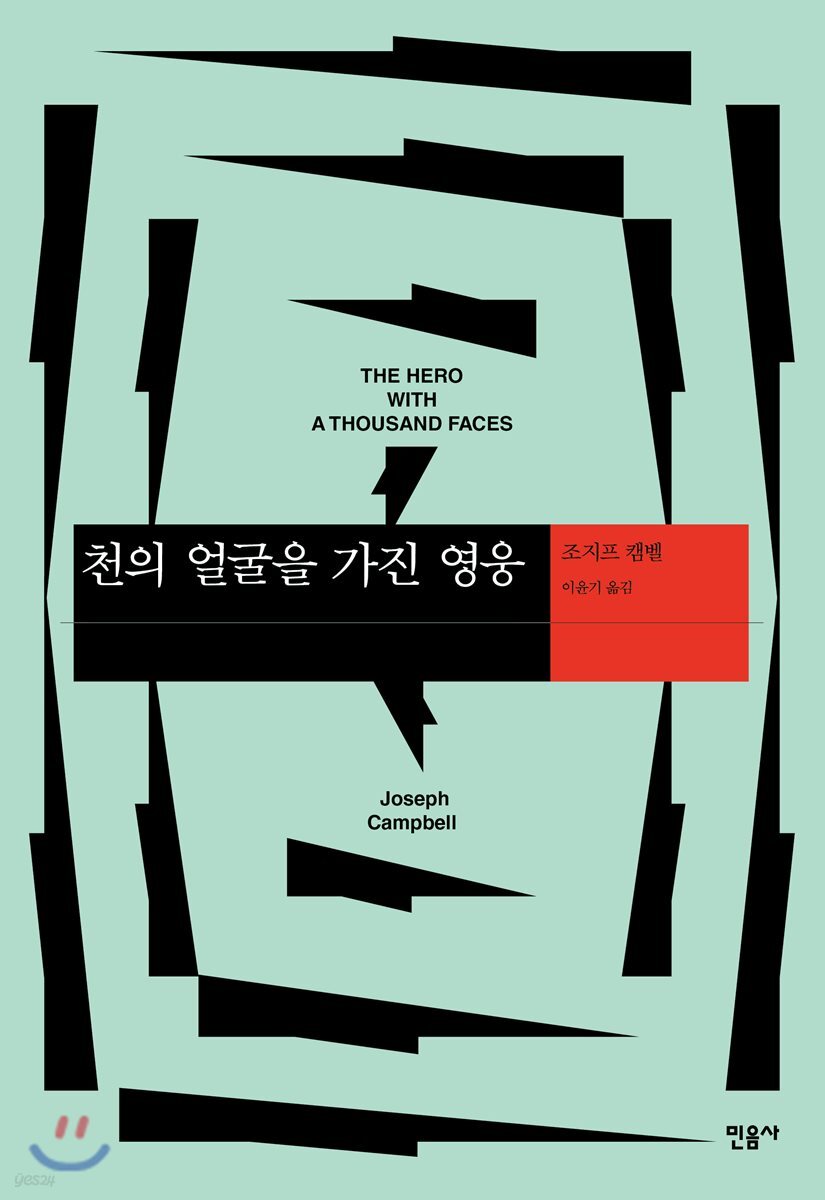
The Hero with a Thousand Faces
 |
Description
Book Introduction
Finding the 'archetype of the hero' in all myths of the East and the West,
Joseph Campbell's Commentary on Mythology
In this book, Campbell introduces a hero among countless heroes, including the sun god Apollo, the fairy tale frog king, the Norse god Odin, Buddha, and other protagonists from various religions and folktales… Among these heroes, he introduces one hero, the archetype that serves as the model for all myths: the “Hero with a Thousand Faces.”
A hero born abnormally, enduring hardships in childhood, finding helpers through wandering and adventure, and returning to fulfill a decisive heroic mission… This hero with a thousand faces is the image of our ancestors who poisoned their bows and wandered the grasslands, and of us modern people waiting for the traffic lights to change at the intersection.
This hero is one who is constantly rediscovered in the interpretation of dreams by modern depth psychologists, and one who modern people are still waiting for and unconsciously trying to create.
Joseph Campbell's Commentary on Mythology
In this book, Campbell introduces a hero among countless heroes, including the sun god Apollo, the fairy tale frog king, the Norse god Odin, Buddha, and other protagonists from various religions and folktales… Among these heroes, he introduces one hero, the archetype that serves as the model for all myths: the “Hero with a Thousand Faces.”
A hero born abnormally, enduring hardships in childhood, finding helpers through wandering and adventure, and returning to fulfill a decisive heroic mission… This hero with a thousand faces is the image of our ancestors who poisoned their bows and wandered the grasslands, and of us modern people waiting for the traffic lights to change at the intersection.
This hero is one who is constantly rediscovered in the interpretation of dreams by modern depth psychologists, and one who modern people are still waiting for and unconsciously trying to create.
- You can preview some of the book's contents.
Preview
index
Preface to the 1949 edition
Prologue: The Myth of the Primal
1 Myths and Dreams
2 Tragedy and Comedy
3 Heroes and Gods
4 The navel of the world
Part 1: The Hero's Adventure
Chapter 1 Departure
1 Call to Adventure
2. Refusal of the calling
3 Supernatural Assistance
4 Passing the first gate
5 Whale's Belly
Chapter 2 Introduction
1 The Path of Trials
2. Encounter with the Goddess
3 Women as Seducers
4 Reconciliation with Father
5 Deification
6 Hongik
Chapter 3: Return
1 Refusal of return
2 Mysterious Escape
3 Structure from outside
4 Passing through the Return Gate
5 The Master of Two Worlds
6 Freedom of Life
Chapter 4 Key
Part 2: Cosmogony Cycle
Chapter 1 leaked
1 From Psychology to Metaphysics
2 The Cycle of the Universe
3 In the void? Space
4 Life inside space
5 From one to many
6 Folktales of Creation
Chapter 2: The Virgin Conception
1 Mother Universe
2 Fateful Mother
3 The womb that gives birth to the Savior
4 Folk paintings of single mothers
Chapter 3: The Hero's Transformation
1 The First Hero and Man
2 The Childhood of a Human Hero
3 Hero as a Warrior
4 Hero as Lover
5 Hero as Emperor, Tyrant
6 Hero as Savior
7 Heroes as Saints
8 Death of a Hero
Chapter 4 Extinction
1 The End of the Microcosm
2 The End of the Universe
Epilogue: Myth and Society
1. Transformation material
2 The functions of myth, ritual, and meditation
3 Today's Heroes
Translator's Note
Notes on the Revised Version
Participating in the revision work
Acknowledgements
About the Joseph Campbell Foundation
main
References
List of pictures
Search
Prologue: The Myth of the Primal
1 Myths and Dreams
2 Tragedy and Comedy
3 Heroes and Gods
4 The navel of the world
Part 1: The Hero's Adventure
Chapter 1 Departure
1 Call to Adventure
2. Refusal of the calling
3 Supernatural Assistance
4 Passing the first gate
5 Whale's Belly
Chapter 2 Introduction
1 The Path of Trials
2. Encounter with the Goddess
3 Women as Seducers
4 Reconciliation with Father
5 Deification
6 Hongik
Chapter 3: Return
1 Refusal of return
2 Mysterious Escape
3 Structure from outside
4 Passing through the Return Gate
5 The Master of Two Worlds
6 Freedom of Life
Chapter 4 Key
Part 2: Cosmogony Cycle
Chapter 1 leaked
1 From Psychology to Metaphysics
2 The Cycle of the Universe
3 In the void? Space
4 Life inside space
5 From one to many
6 Folktales of Creation
Chapter 2: The Virgin Conception
1 Mother Universe
2 Fateful Mother
3 The womb that gives birth to the Savior
4 Folk paintings of single mothers
Chapter 3: The Hero's Transformation
1 The First Hero and Man
2 The Childhood of a Human Hero
3 Hero as a Warrior
4 Hero as Lover
5 Hero as Emperor, Tyrant
6 Hero as Savior
7 Heroes as Saints
8 Death of a Hero
Chapter 4 Extinction
1 The End of the Microcosm
2 The End of the Universe
Epilogue: Myth and Society
1. Transformation material
2 The functions of myth, ritual, and meditation
3 Today's Heroes
Translator's Note
Notes on the Revised Version
Participating in the revision work
Acknowledgements
About the Joseph Campbell Foundation
main
References
List of pictures
Search
Publisher's Review
A masterpiece by Joseph Campbell, the greatest myth interpreter of the 20th century.
Joseph Campbell's The Hero with a Thousand Faces, translated by Professor Lee Yun-gi, has inspired numerous mythologists since its publication in 1949.
This book, which tells profound mythological stories in a way that ordinary people can understand, rather than using difficult, jargon-like terms used only among scholars, has remained a bestseller worldwide.
Joseph Campbell, known as the greatest comparative mythologist of the 20th century, spent his entire life studying the common phenomena and functions of myths and religions from different cultures.
He encountered American Indian folktales as a child, and was struck by the striking similarity between the symbolic systems of these folktales and the Arthurian legend, with which he had no cultural contact whatsoever. He sought to find the archetype of the myth that runs through all cultures.
The culmination of this research is his four-part work, “The Hero with a Thousand Faces” and “The Mask of God.”
Exploring the archetypes of myths through the methods of comparative religion and depth psychology.
The purpose of Joseph Campbell's study of mythology was to gather together myths and folktales from all over the world and make the symbols speak for themselves.
He incorporates in this book any setting where heroes appear, whether from myths, folk tales, fairy tales, folklore, historical records, or scholarly research.
In this way, the similarities of all myths become immediately apparent (comparative religious method). This is how Joseph Campbell came to the view that “all myths have the same grammar as dreams.”
Therefore, it is argued that Freud's so-called "dream work", that is, the work of condensation, displacement, and configuration, is also applied to myth formation.
He completes the schematic of an unusual birth—a difficult childhood—wandering—meeting a helper—gaining miraculous powers—return, an experience shared by almost all heroes.
By doing so, by analyzing the countless hero myths of various cultures around the world that have no contact with each other and the symbolic system of heroes rediscovered in the dream interpretation of depth psychology (depth psychological method), one hero is completed among the heroes with a thousand faces, that is, one hero who becomes the model (archetype) of all hero myths.
In short, this book is an ambitious work that, while invoking the perspective of Jungian psychology (humans share a collective unconscious, a remnant of ancient experiences within the unconscious, and the archetypal patterns of dreams represent mythical symbols, remnants of ancient times), attempts to elucidate the human psyche through various heroic legends and even propose a principle of regeneration for modern civilization. (Lee Yun-gi, “Translator’s Note”)
In an effort to complete the system of mythology, he created 『The Hero with a Thousand Faces』 and revealed the six-stage development process of hero mythology.
Joseph Campbell says, “There can be no final system in the interpretation of myths, and it is unlikely that there ever will be one” (see epilogue). In other words, just as the Vedas say, “Truth is one, but the wise reveal it under many names,” Joseph Campbell says that God does not reveal all of his wisdom.
Yet, through the modern guide of 'psychoanalysis', he attempted to understand the unspoken meanings and symbolic grammar of the ancient sages, and then, in the next step, through the massive task of gathering myths and folk legends from all over the world, he made the symbols speak for themselves.
The 'hero with a thousand faces' thus obtained is not a figure that existed only in ancient times, but a hero that is constantly rediscovered in the interpretation of dreams by modern depth psychologists, and a hero that modern people are still waiting for and unconsciously trying to create.
A guide for those who wish to navigate the seas of mythology, religion, and psychology.
Professor Lee Yun-gi, who translated this book, said, “It is a book that combines mythology, religious studies, and psychological interests, so to speak, a book that prioritizes human interests,” comparing it to Eliade’s 『Cosmos and History』 and 『Shamanism』, and C.
I would cite G. Jung's "Man and His Symbols" and "The Masks of God" by the same author as "The Hero with a Thousand Faces."
Professor Lee Yun-gi translated this book before deciding to venture into the sea of myths and ancient religions in earnest, and he reveals that this interest later became the driving force behind his translations and publications of works such as the commentary on Greek mythology, Mythos (3 volumes), Shamanism, Man and Symbols, Bulfinch's The Age of Legend, Joseph Campbell's The Power of Myth, Ovid's Metamorphoses, and Freud's The Origins of Religion.
Joseph Campbell's The Hero with a Thousand Faces, translated by Professor Lee Yun-gi, has inspired numerous mythologists since its publication in 1949.
This book, which tells profound mythological stories in a way that ordinary people can understand, rather than using difficult, jargon-like terms used only among scholars, has remained a bestseller worldwide.
Joseph Campbell, known as the greatest comparative mythologist of the 20th century, spent his entire life studying the common phenomena and functions of myths and religions from different cultures.
He encountered American Indian folktales as a child, and was struck by the striking similarity between the symbolic systems of these folktales and the Arthurian legend, with which he had no cultural contact whatsoever. He sought to find the archetype of the myth that runs through all cultures.
The culmination of this research is his four-part work, “The Hero with a Thousand Faces” and “The Mask of God.”
Exploring the archetypes of myths through the methods of comparative religion and depth psychology.
The purpose of Joseph Campbell's study of mythology was to gather together myths and folktales from all over the world and make the symbols speak for themselves.
He incorporates in this book any setting where heroes appear, whether from myths, folk tales, fairy tales, folklore, historical records, or scholarly research.
In this way, the similarities of all myths become immediately apparent (comparative religious method). This is how Joseph Campbell came to the view that “all myths have the same grammar as dreams.”
Therefore, it is argued that Freud's so-called "dream work", that is, the work of condensation, displacement, and configuration, is also applied to myth formation.
He completes the schematic of an unusual birth—a difficult childhood—wandering—meeting a helper—gaining miraculous powers—return, an experience shared by almost all heroes.
By doing so, by analyzing the countless hero myths of various cultures around the world that have no contact with each other and the symbolic system of heroes rediscovered in the dream interpretation of depth psychology (depth psychological method), one hero is completed among the heroes with a thousand faces, that is, one hero who becomes the model (archetype) of all hero myths.
In short, this book is an ambitious work that, while invoking the perspective of Jungian psychology (humans share a collective unconscious, a remnant of ancient experiences within the unconscious, and the archetypal patterns of dreams represent mythical symbols, remnants of ancient times), attempts to elucidate the human psyche through various heroic legends and even propose a principle of regeneration for modern civilization. (Lee Yun-gi, “Translator’s Note”)
In an effort to complete the system of mythology, he created 『The Hero with a Thousand Faces』 and revealed the six-stage development process of hero mythology.
Joseph Campbell says, “There can be no final system in the interpretation of myths, and it is unlikely that there ever will be one” (see epilogue). In other words, just as the Vedas say, “Truth is one, but the wise reveal it under many names,” Joseph Campbell says that God does not reveal all of his wisdom.
Yet, through the modern guide of 'psychoanalysis', he attempted to understand the unspoken meanings and symbolic grammar of the ancient sages, and then, in the next step, through the massive task of gathering myths and folk legends from all over the world, he made the symbols speak for themselves.
The 'hero with a thousand faces' thus obtained is not a figure that existed only in ancient times, but a hero that is constantly rediscovered in the interpretation of dreams by modern depth psychologists, and a hero that modern people are still waiting for and unconsciously trying to create.
A guide for those who wish to navigate the seas of mythology, religion, and psychology.
Professor Lee Yun-gi, who translated this book, said, “It is a book that combines mythology, religious studies, and psychological interests, so to speak, a book that prioritizes human interests,” comparing it to Eliade’s 『Cosmos and History』 and 『Shamanism』, and C.
I would cite G. Jung's "Man and His Symbols" and "The Masks of God" by the same author as "The Hero with a Thousand Faces."
Professor Lee Yun-gi translated this book before deciding to venture into the sea of myths and ancient religions in earnest, and he reveals that this interest later became the driving force behind his translations and publications of works such as the commentary on Greek mythology, Mythos (3 volumes), Shamanism, Man and Symbols, Bulfinch's The Age of Legend, Joseph Campbell's The Power of Myth, Ovid's Metamorphoses, and Freud's The Origins of Religion.
GOODS SPECIFICS
- Date of issue: March 30, 2018
- Format: Hardcover book binding method guide
- Page count, weight, size: 564 pages | 914g | 153*224*35mm
- ISBN13: 9788937416378
- ISBN10: 8937416379
You may also like
카테고리
korean


korean

![GQ KOREA Mark (Monthly): December [2025]](http://librairie.coreenne.fr/cdn/shop/files/8ef265dbbfbf186523ed75ba7319009d.jpg?v=1765340328&width=3840)


