

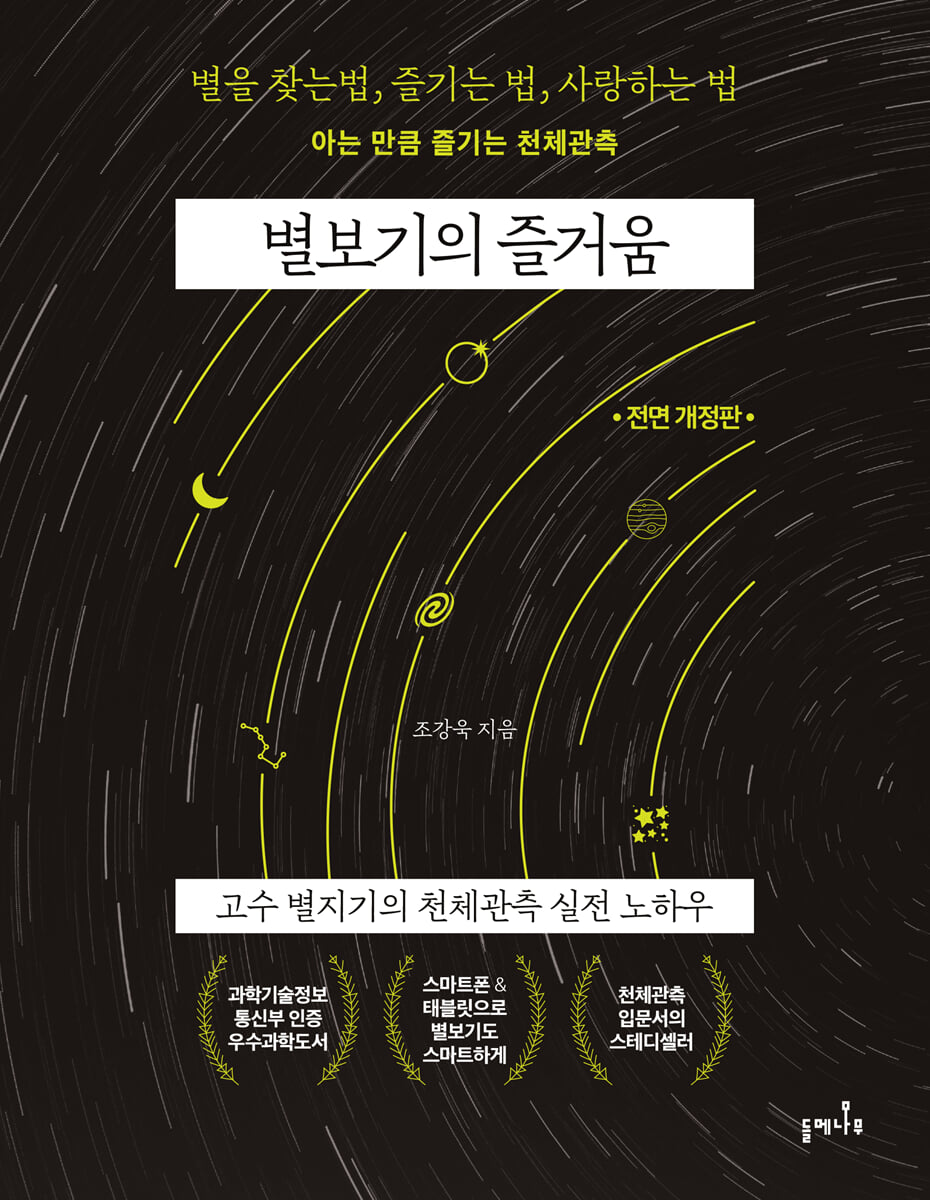
The joy of stargazing
 |
Description
Book Introduction
A story from a 30-year veteran who is crazy about stars
How to find, enjoy, and love stars
"The Joy of Stargazing" is a practical guidebook that addresses the most common questions and difficulties faced by beginners in stargazing, based on 30 years of observation experience and teaching know-how.
This book, which has been fully revised eight years after its first edition in 2017, incorporates the latest observation methods using digital devices such as smartphones and tablets, as well as vivid photos and drawings of Korean stargazers.
It covers the daily lives of people in Byeoldongnae, the basics of astronomical observation, observation methods for each object, detailed tips for beginners, and even your own stargazing know-how, making it a solid guide not only for beginners but also for intermediate users who want to enjoy systematic stargazing.
How to find, enjoy, and love stars
"The Joy of Stargazing" is a practical guidebook that addresses the most common questions and difficulties faced by beginners in stargazing, based on 30 years of observation experience and teaching know-how.
This book, which has been fully revised eight years after its first edition in 2017, incorporates the latest observation methods using digital devices such as smartphones and tablets, as well as vivid photos and drawings of Korean stargazers.
It covers the daily lives of people in Byeoldongnae, the basics of astronomical observation, observation methods for each object, detailed tips for beginners, and even your own stargazing know-how, making it a solid guide not only for beginners but also for intermediate users who want to enjoy systematic stargazing.
- You can preview some of the book's contents.
Preview
index
In publishing the revised edition
Prologue: Enjoy Astronomy the More You Know - Find, Enjoy, Love
Chapter A What is Observation?
The daily life of a stargazer
Photos and Annecy
Types of visual observation
* FAQ 1.
What types of telescopes are there?
Chapter B: Basics of Visual Observation
List & Star Atlas: List of celestial objects and star maps, including Messier
Hopping & Sweeping: How to Find Celestial Objects with a Telescope
Peripheral Vision & Dark Adaptation: How to Savor the Celestial Objects You've Found
Location & Weather: It's not the equipment, it's the sky.
3 stages of visual observation
* FAQ 2.
Where can I buy a telescope?
* FAQ 3.
I'd like to give my elementary school-aged child a telescope as a gift. Can you recommend a good product?
Chapter C: Observation Points by Target
The Moon: A Treasure Chest That's Close Yet Ignored
Planet: A Space Show of Ever-Changing Variations
Open Clusters: Follow the Stars
Globular Clusters: Every Globular Cluster is Special
Nebula: A complex and subtle cloud of stars in the night sky.
Galaxy: Beautiful because it's far away
Sun: What you see now, you will never see again.
* FAQ 4.
Please explain the terms related to observation!
* FAQ 5.
Basic etiquette at the observation site
Chapter D Finding Your Own Joy
Title: Academy: There is no right answer
Theme Observation: Let My Heart Flow
Messier Marathon: Midnight Run
Astronomical Sketch: The Royal Road to Visual Observation
Overseas Expeditions: Things You Can Only See Outside of Korea
* FAQ 6.
I want to join an astronomy club!
* FAQ 7.
Where does the observation go?
* FAQ 8.
I'm planning a family trip, and even if it's not an expedition, I'd like to enjoy the night sky while I can!
Chapter E How to See the Stars for a Lifetime
Don't buy a telescope first
Ansi? Photography? Focus on one thing
If you blindly believe in GO-TO, you'll never be able to overcome beginner level.
Don't covet your neighbor's telescope.
The Secret to Longevity in a Starry World: A Three-Step Virtuous Cycle of Observation
Widen the width for depth
Spectator responsibility system
Epilogue 'Shall We Look at the Stars?'
Prologue: Enjoy Astronomy the More You Know - Find, Enjoy, Love
Chapter A What is Observation?
The daily life of a stargazer
Photos and Annecy
Types of visual observation
* FAQ 1.
What types of telescopes are there?
Chapter B: Basics of Visual Observation
List & Star Atlas: List of celestial objects and star maps, including Messier
Hopping & Sweeping: How to Find Celestial Objects with a Telescope
Peripheral Vision & Dark Adaptation: How to Savor the Celestial Objects You've Found
Location & Weather: It's not the equipment, it's the sky.
3 stages of visual observation
* FAQ 2.
Where can I buy a telescope?
* FAQ 3.
I'd like to give my elementary school-aged child a telescope as a gift. Can you recommend a good product?
Chapter C: Observation Points by Target
The Moon: A Treasure Chest That's Close Yet Ignored
Planet: A Space Show of Ever-Changing Variations
Open Clusters: Follow the Stars
Globular Clusters: Every Globular Cluster is Special
Nebula: A complex and subtle cloud of stars in the night sky.
Galaxy: Beautiful because it's far away
Sun: What you see now, you will never see again.
* FAQ 4.
Please explain the terms related to observation!
* FAQ 5.
Basic etiquette at the observation site
Chapter D Finding Your Own Joy
Title: Academy: There is no right answer
Theme Observation: Let My Heart Flow
Messier Marathon: Midnight Run
Astronomical Sketch: The Royal Road to Visual Observation
Overseas Expeditions: Things You Can Only See Outside of Korea
* FAQ 6.
I want to join an astronomy club!
* FAQ 7.
Where does the observation go?
* FAQ 8.
I'm planning a family trip, and even if it's not an expedition, I'd like to enjoy the night sky while I can!
Chapter E How to See the Stars for a Lifetime
Don't buy a telescope first
Ansi? Photography? Focus on one thing
If you blindly believe in GO-TO, you'll never be able to overcome beginner level.
Don't covet your neighbor's telescope.
The Secret to Longevity in a Starry World: A Three-Step Virtuous Cycle of Observation
Widen the width for depth
Spectator responsibility system
Epilogue 'Shall We Look at the Stars?'
Detailed image

Into the book
There are roughly 10,000 celestial objects in the night sky that can be seen through a telescope by ordinary people, not just astronomers.
The night sky is filled with hidden delights that you can't see in a lifetime, including nebulae, star clusters, and galaxies, including the Orion Nebula, which is 1,500 light-years away.
All we have to do is carefully look for them one by one, like taking out candies one by one from a large bag of candy.
Could we only see these distant objects? If we narrow our view a bit, we can see many celestial bodies in our solar system, including planets, moons, comets, and meteors.
Consider the closest celestial body, the Moon.
If you observe the moon with your naked eyes every day, you can see the phases change from a gibbous moon to a half moon to a full moon, and if you zoom in with a telescope, you can vividly observe not only the individual craters created by meteorite impacts, but also the valleys and complex mountain ranges flowing between them, as if you were seeing them right before your eyes.
There are approximately 300,000 observable features on the lunar surface.
Even if you look at just one moon, it is full of hidden pictures that you will never be able to see in your entire life.
There is a clear limit to the number of celestial objects that a person can see with the naked eye or through a telescope, but that limit is deep enough that even if you diligently spend a lifetime looking, there will still be plenty of interesting objects left.
One of the great attractions of stargazing is that you don't have to worry about getting bored and giving up.
--- p.21~23 From “Those who look at stars do not go to the observatory”
Even if you look at the famous bright galaxies Andromeda (M 31) or the Rich Galaxy (M 51), when you first look at them through the eyepiece, all you see is an unexpectedly pale fluffy ball of dust.
Because galaxies are much farther away than other objects.
If you get discouraged and stop here, you will never be able to enjoy the deep joy of galaxy observation.
But we have averted vision, a report of the past.
When looking at the galaxy, you should always use your peripheral vision 100%.
There are similar nebulae, but there is nothing in the galaxy like the Orion Nebula, which is easily visible even with direct vision without thinking.
--- p.194 From “Peripheral poetry, peripheral poetry, only peripheral poetry!”
One of the strongest open clusters in the Northern Hemisphere, M35 (center) and its younger sibling M2158 (top left) in Gemini are among the best sights in winter.
While its own beauty is certainly wonderful, the M 35 has also had many nicknames.
Its most well-known nickname is probably the 'Salt and Pepper' cluster.
This is because it appears as if coarse salt (M 35) and fine pepper (NGC 2158) were sprinkled across the sky.
But not everyone thinks of salt and pepper.
Perhaps because I majored in engineering, the shape of the Star Chains in a constellation is often associated with the shape of an omega (Ω). However, Hyunho Lee, a stargazer, even made an octopus sausage instead of recording his observations because he thought the split Star Chains looked like octopus sausages. Namhee Kim, a music major, drew the Star Chain in the shape of a bell.
Salt and pepper, omega, octopus sausage, bell pepper... What's the answer? Of course, there's no right answer.
But it is very important to find your own answers there.
Because it can deepen the pleasure of looking at stars.
--- p.215~216 From "Finding Hidden Pictures in the Sky"
The biggest advantage of digital sketching is that it can be undoed.
If you make a mistake while sketching on paper, you can erase pencil and pastel with an eraser, and you can scrape pen with a knife, but it takes careful effort to erase it perfectly, and traces will inevitably remain on the paper.
However, in the case of digital, you can easily undo previous actions step by step with the (Undo) button, erase neatly with the eraser icon, and separate layers to edit, so you can draw and edit repeatedly without any burden.
(Omitted) Another big advantage is that when you are arranging the stars in the early stages of a sketch, you have to try your best to get the spacing and positions of the stars right by eye, but in the case of a digital device, you can easily get the perfect proportions by capturing the area on the electronic star chart, placing it as a semi-transparent layer, and then adjusting only the star brightness on top of it.
In this way, digital devices have a far superior advantage in terms of efficiency in establishing accurate composition.
--- p.286~287 From "Should I convert sketches to digital?"
I had often heard this before seeing the solar eclipse.
“Watching a total solar eclipse changes your life.” Out of pure curiosity, wondering, “What on earth could it be that changes your life?” I boarded a plane to China in 2009, then to Japan and Australia in 2012, to the Arctic island of Svalbard in 2015, to the United States in 2017, Chile in 2019, Australia in 2023, the United States in 2024, Spain in 2026, and even Egypt in 2027… All the overseas trips of my life have already been decided by heaven.
I will spend my life trying to see every total solar eclipse in my lifetime, and to be in the small shadow of the moon that covers the sun, no matter where I am on Earth.
In this way, the solar eclipse completely changed my life.
--- p.298~299 From "The World's Greatest Decisive Moment, the Miracle of a Total Solar Eclipse"
If you don't already own a telescope, reading this book will make you want to buy one right away.
However, buying equipment without any practical experience is a shortcut to failure.
Whether my taste is photography or non-photography, or whether I find it not very interesting, is something I cannot know until I actually look at the stars.
Before purchasing a telescope, you should definitely participate in at least three observation sessions of the club you wish to join.
At that point, I have a sense of what I need to do to have fun.
However, it is also true that it is not easy to participate in an unfamiliar gathering with a strong network of members without my own equipment.
‘What if I get ignored?’ ‘What if I get ignored or my pride gets hurt because I don’t know anything?’ Even if you’re an expert now, everyone was a beginner at some point.
And most astronomers are more than happy to explain their equipment and show celestial bodies to beginners.
If you feel uncomfortable just popping in, just buying a few cans of coffee is enough.
Buying equipment based solely on limited information gleaned from the internet, without even visiting an observatory, or after listening to the telescope salesperson (everyone only hears what they want to hear), or simply buying equipment they've never seen before at a second-hand market, might feel good for a while, but what about the future? I've seen countless people go through trial and error, buying and selling, and ultimately end up wasting money and time without ever getting a single proper observation, leaving the stars without ever experiencing the joy of astronomical observation.
Basically, the hobby of stargazing is an activity that is fun only when you 'look at the stars'.
The night sky is filled with hidden delights that you can't see in a lifetime, including nebulae, star clusters, and galaxies, including the Orion Nebula, which is 1,500 light-years away.
All we have to do is carefully look for them one by one, like taking out candies one by one from a large bag of candy.
Could we only see these distant objects? If we narrow our view a bit, we can see many celestial bodies in our solar system, including planets, moons, comets, and meteors.
Consider the closest celestial body, the Moon.
If you observe the moon with your naked eyes every day, you can see the phases change from a gibbous moon to a half moon to a full moon, and if you zoom in with a telescope, you can vividly observe not only the individual craters created by meteorite impacts, but also the valleys and complex mountain ranges flowing between them, as if you were seeing them right before your eyes.
There are approximately 300,000 observable features on the lunar surface.
Even if you look at just one moon, it is full of hidden pictures that you will never be able to see in your entire life.
There is a clear limit to the number of celestial objects that a person can see with the naked eye or through a telescope, but that limit is deep enough that even if you diligently spend a lifetime looking, there will still be plenty of interesting objects left.
One of the great attractions of stargazing is that you don't have to worry about getting bored and giving up.
--- p.21~23 From “Those who look at stars do not go to the observatory”
Even if you look at the famous bright galaxies Andromeda (M 31) or the Rich Galaxy (M 51), when you first look at them through the eyepiece, all you see is an unexpectedly pale fluffy ball of dust.
Because galaxies are much farther away than other objects.
If you get discouraged and stop here, you will never be able to enjoy the deep joy of galaxy observation.
But we have averted vision, a report of the past.
When looking at the galaxy, you should always use your peripheral vision 100%.
There are similar nebulae, but there is nothing in the galaxy like the Orion Nebula, which is easily visible even with direct vision without thinking.
--- p.194 From “Peripheral poetry, peripheral poetry, only peripheral poetry!”
One of the strongest open clusters in the Northern Hemisphere, M35 (center) and its younger sibling M2158 (top left) in Gemini are among the best sights in winter.
While its own beauty is certainly wonderful, the M 35 has also had many nicknames.
Its most well-known nickname is probably the 'Salt and Pepper' cluster.
This is because it appears as if coarse salt (M 35) and fine pepper (NGC 2158) were sprinkled across the sky.
But not everyone thinks of salt and pepper.
Perhaps because I majored in engineering, the shape of the Star Chains in a constellation is often associated with the shape of an omega (Ω). However, Hyunho Lee, a stargazer, even made an octopus sausage instead of recording his observations because he thought the split Star Chains looked like octopus sausages. Namhee Kim, a music major, drew the Star Chain in the shape of a bell.
Salt and pepper, omega, octopus sausage, bell pepper... What's the answer? Of course, there's no right answer.
But it is very important to find your own answers there.
Because it can deepen the pleasure of looking at stars.
--- p.215~216 From "Finding Hidden Pictures in the Sky"
The biggest advantage of digital sketching is that it can be undoed.
If you make a mistake while sketching on paper, you can erase pencil and pastel with an eraser, and you can scrape pen with a knife, but it takes careful effort to erase it perfectly, and traces will inevitably remain on the paper.
However, in the case of digital, you can easily undo previous actions step by step with the (Undo) button, erase neatly with the eraser icon, and separate layers to edit, so you can draw and edit repeatedly without any burden.
(Omitted) Another big advantage is that when you are arranging the stars in the early stages of a sketch, you have to try your best to get the spacing and positions of the stars right by eye, but in the case of a digital device, you can easily get the perfect proportions by capturing the area on the electronic star chart, placing it as a semi-transparent layer, and then adjusting only the star brightness on top of it.
In this way, digital devices have a far superior advantage in terms of efficiency in establishing accurate composition.
--- p.286~287 From "Should I convert sketches to digital?"
I had often heard this before seeing the solar eclipse.
“Watching a total solar eclipse changes your life.” Out of pure curiosity, wondering, “What on earth could it be that changes your life?” I boarded a plane to China in 2009, then to Japan and Australia in 2012, to the Arctic island of Svalbard in 2015, to the United States in 2017, Chile in 2019, Australia in 2023, the United States in 2024, Spain in 2026, and even Egypt in 2027… All the overseas trips of my life have already been decided by heaven.
I will spend my life trying to see every total solar eclipse in my lifetime, and to be in the small shadow of the moon that covers the sun, no matter where I am on Earth.
In this way, the solar eclipse completely changed my life.
--- p.298~299 From "The World's Greatest Decisive Moment, the Miracle of a Total Solar Eclipse"
If you don't already own a telescope, reading this book will make you want to buy one right away.
However, buying equipment without any practical experience is a shortcut to failure.
Whether my taste is photography or non-photography, or whether I find it not very interesting, is something I cannot know until I actually look at the stars.
Before purchasing a telescope, you should definitely participate in at least three observation sessions of the club you wish to join.
At that point, I have a sense of what I need to do to have fun.
However, it is also true that it is not easy to participate in an unfamiliar gathering with a strong network of members without my own equipment.
‘What if I get ignored?’ ‘What if I get ignored or my pride gets hurt because I don’t know anything?’ Even if you’re an expert now, everyone was a beginner at some point.
And most astronomers are more than happy to explain their equipment and show celestial bodies to beginners.
If you feel uncomfortable just popping in, just buying a few cans of coffee is enough.
Buying equipment based solely on limited information gleaned from the internet, without even visiting an observatory, or after listening to the telescope salesperson (everyone only hears what they want to hear), or simply buying equipment they've never seen before at a second-hand market, might feel good for a while, but what about the future? I've seen countless people go through trial and error, buying and selling, and ultimately end up wasting money and time without ever getting a single proper observation, leaving the stars without ever experiencing the joy of astronomical observation.
Basically, the hobby of stargazing is an activity that is fun only when you 'look at the stars'.
--- p.325~326 From “Don’t Buy a Telescope First”
Publisher's Review
■ Astronomical observation is more fun the more you know!
★ A completely revised edition presented after 8 years
★ Excellent science book certified by the Ministry of Science and ICT
★ Smart stargazing with your smartphone and tablet
★ A steady seller among introductory books on astronomy
As with music and art, each star is visible only to the extent that one knows it.
But when it comes to actually looking at the stars, numerous obstacles stand in the way: hopping, peripheral vision, technical terminology, equipment selection, and weather, location, and time constraints.
Because of this, many people give up before they even experience the joy of observation.
"The Joy of Stargazing" is a friendly guidebook that helps overcome these barriers, and is filled with the practical know-how of a veteran stargazer with 30 years of experience.
■ Efficient observation methods using smart devices (smartphones and tablets)
■ Detailed observation know-how for each target, including the moon, planets, and constellations
■ Various ways to enjoy the Messier Marathon, creating observation themes, sketching celestial bodies, and overseas expeditions
■ Useful tips and QR code information that can be used right away at the observation site
Understanding the night sky enriches your life.
"The Joy of Stargazing" is a practical yet passionate guide for those who want to make stargazing a lifelong hobby.
■ 'Enjoying Stargazing to the Fullest' by a Reckless Stargazer
This book is the result of the author's long-term communication with beginners about what they are interested in, what they need, and what they find difficult through years of astronomical observation and lectures. It covers in depth how to find stars, how to see them, how to enjoy them, and how to continue observing them.
Only by having a solid foundation can you develop your own observations, and only by having something of your own can you gain the energy to live a life that will never tire.
"The Joy of Stargazing" covers the daily life of a stargazer, the basics of astronomical observation, observation methods for each object, detailed advice for beginners, and even how to find your own joy. It will be an excellent guide not only for beginners but also for intermediate users who want to enjoy observation systematically.
■ Features of this book
■ Completely Revised Edition: Reflecting Astronomical Observation Trends in the Digital Age
■ Detailed observation guide for each target: moon, planets, constellations, nebulae, galaxies, etc.
■ Practical tips: Title academy, theme observation, celestial sketches, overseas expeditions, etc.
■ Customized for beginners and intermediate users: Includes easy explanations and numerous illustrations and photos to aid understanding.
■ QR code utilization: 3D learning possible with observation records and reference materials
Author's Note
“24 years in the Northern Hemisphere, 8 years in the Southern Hemisphere.
“I may not be the greatest stargazer on Earth, but I want to be remembered as the first stargazer to spend a lifetime observing the southern and northern skies.”
★ A completely revised edition presented after 8 years
★ Excellent science book certified by the Ministry of Science and ICT
★ Smart stargazing with your smartphone and tablet
★ A steady seller among introductory books on astronomy
As with music and art, each star is visible only to the extent that one knows it.
But when it comes to actually looking at the stars, numerous obstacles stand in the way: hopping, peripheral vision, technical terminology, equipment selection, and weather, location, and time constraints.
Because of this, many people give up before they even experience the joy of observation.
"The Joy of Stargazing" is a friendly guidebook that helps overcome these barriers, and is filled with the practical know-how of a veteran stargazer with 30 years of experience.
■ Efficient observation methods using smart devices (smartphones and tablets)
■ Detailed observation know-how for each target, including the moon, planets, and constellations
■ Various ways to enjoy the Messier Marathon, creating observation themes, sketching celestial bodies, and overseas expeditions
■ Useful tips and QR code information that can be used right away at the observation site
Understanding the night sky enriches your life.
"The Joy of Stargazing" is a practical yet passionate guide for those who want to make stargazing a lifelong hobby.
■ 'Enjoying Stargazing to the Fullest' by a Reckless Stargazer
This book is the result of the author's long-term communication with beginners about what they are interested in, what they need, and what they find difficult through years of astronomical observation and lectures. It covers in depth how to find stars, how to see them, how to enjoy them, and how to continue observing them.
Only by having a solid foundation can you develop your own observations, and only by having something of your own can you gain the energy to live a life that will never tire.
"The Joy of Stargazing" covers the daily life of a stargazer, the basics of astronomical observation, observation methods for each object, detailed advice for beginners, and even how to find your own joy. It will be an excellent guide not only for beginners but also for intermediate users who want to enjoy observation systematically.
■ Features of this book
■ Completely Revised Edition: Reflecting Astronomical Observation Trends in the Digital Age
■ Detailed observation guide for each target: moon, planets, constellations, nebulae, galaxies, etc.
■ Practical tips: Title academy, theme observation, celestial sketches, overseas expeditions, etc.
■ Customized for beginners and intermediate users: Includes easy explanations and numerous illustrations and photos to aid understanding.
■ QR code utilization: 3D learning possible with observation records and reference materials
Author's Note
“24 years in the Northern Hemisphere, 8 years in the Southern Hemisphere.
“I may not be the greatest stargazer on Earth, but I want to be remembered as the first stargazer to spend a lifetime observing the southern and northern skies.”
GOODS SPECIFICS
- Date of issue: August 12, 2025
- Page count, weight, size: 352 pages | 152*200*30mm
- ISBN13: 9791186889350
- ISBN10: 1186889357
You may also like
카테고리
korean


korean

![GQ KOREA Mark (Monthly): December [2025]](http://librairie.coreenne.fr/cdn/shop/files/8ef265dbbfbf186523ed75ba7319009d.jpg?v=1765340328&width=3840)


