

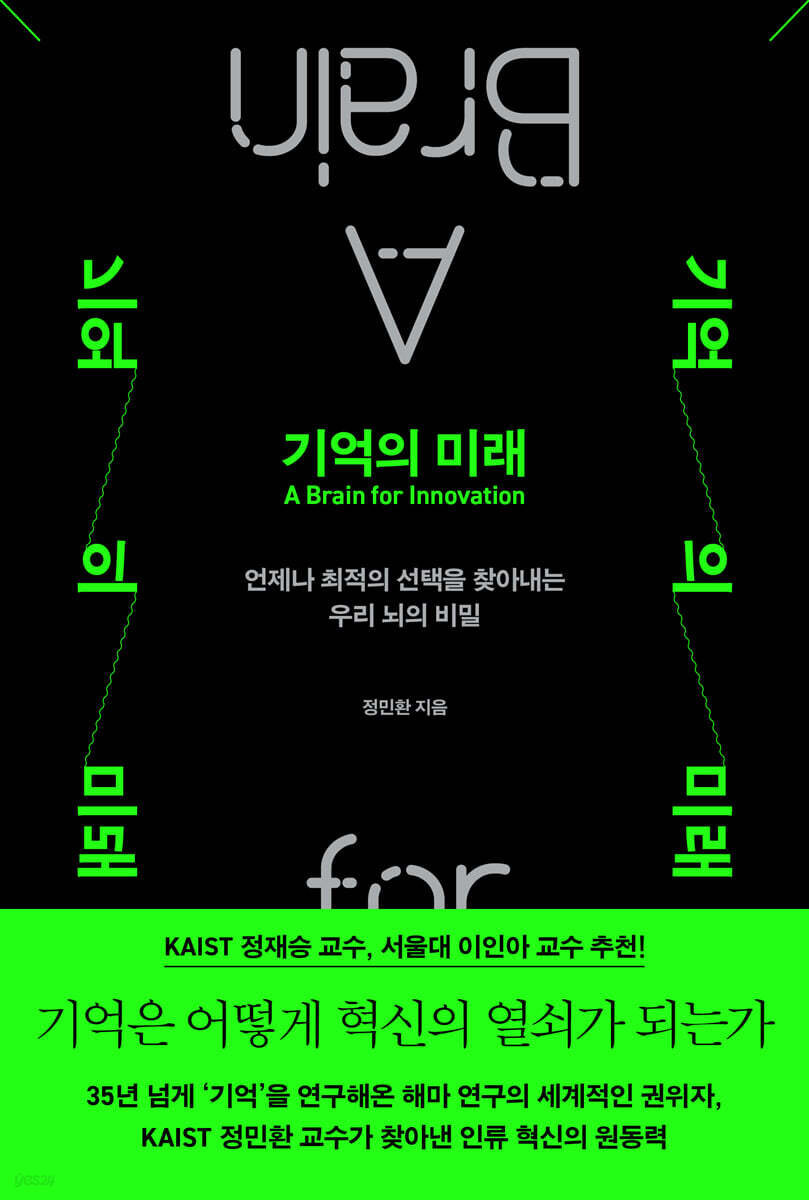
The Future of Memory
 |
Description
Book Introduction
A world-renowned authority on hippocampus research who has been studying 'memory' for over 35 years,
The driving force behind human development discovered by KAIST Professor Jeong Min-hwan
“A book that introduces the mysterious ability of our brain to simultaneously innovate, unleash imagination and creativity for the future beyond the stored past.”
-Lee In-ah (Professor, Department of Brain and Cognitive Sciences, Seoul National University Graduate School)
“Only when we understand memory as the 'art of reconstruction' rather than data can we imagine a better future through the past.”
- Jaeseung Jeong (Professor of Brain and Cognitive Sciences and Dean of the School of Convergence Studies, KAIST)
Biologically speaking, humans are not exceptional beings.
However, humans are the only species on Earth that has developed civilization.
What difference, exactly, could have produced this result? Professor Jeong Min-hwan of KAIST, author of "A Brain for Innovation: The Neuroscience of Imagination and Abstract Thinking," published by Simsim, attributes the reason to the human "ability to innovate."
And the ability that makes innovation possible is, he says, 'free imagination using abstract concepts.'
The author, who has studied 'memory' for a long time and is a world authority on the hippocampus, a key region involved in memory, looks back on the major discoveries and insights into imagination and abstract thinking achieved by modern brain science in this book.
It also expands the discussion to the possibilities of humanity living in the age of artificial intelligence.
This book, divided into four parts, begins with memory and expands to imagination and abstract thinking, exploring the basis of innovative ability as revealed by the latest brain science research.
Part 1 reviews the results of current hippocampus research and points out that the hippocampus is involved not only in memory but also in imagination.
In Part 2, we will look at the neurological aspects of how imagination works in more detail.
Part 3 explores the workings of humans' advanced abstract thinking abilities across various fields, including brain science, paleoanthropology, and artificial neural networks.
Part 4 explores how imagination and abstract thinking can create an innovative future.
We also discuss the attitudes we should have toward artificial intelligence, which is becoming increasingly closely related to our daily lives.
Finally, the appendix presents recent research and academic achievements for readers seeking specialized knowledge.
How did humanity achieve innovations that advanced civilization? "The Future of Memory," which introduces the human "innovation mechanism" that encompasses memory, imagination, and abstract thought, synthesizes the latest research in neuroscience, psychology, anthropology, and artificial intelligence to explore human potential and serve as a guide for our future.
The driving force behind human development discovered by KAIST Professor Jeong Min-hwan
“A book that introduces the mysterious ability of our brain to simultaneously innovate, unleash imagination and creativity for the future beyond the stored past.”
-Lee In-ah (Professor, Department of Brain and Cognitive Sciences, Seoul National University Graduate School)
“Only when we understand memory as the 'art of reconstruction' rather than data can we imagine a better future through the past.”
- Jaeseung Jeong (Professor of Brain and Cognitive Sciences and Dean of the School of Convergence Studies, KAIST)
Biologically speaking, humans are not exceptional beings.
However, humans are the only species on Earth that has developed civilization.
What difference, exactly, could have produced this result? Professor Jeong Min-hwan of KAIST, author of "A Brain for Innovation: The Neuroscience of Imagination and Abstract Thinking," published by Simsim, attributes the reason to the human "ability to innovate."
And the ability that makes innovation possible is, he says, 'free imagination using abstract concepts.'
The author, who has studied 'memory' for a long time and is a world authority on the hippocampus, a key region involved in memory, looks back on the major discoveries and insights into imagination and abstract thinking achieved by modern brain science in this book.
It also expands the discussion to the possibilities of humanity living in the age of artificial intelligence.
This book, divided into four parts, begins with memory and expands to imagination and abstract thinking, exploring the basis of innovative ability as revealed by the latest brain science research.
Part 1 reviews the results of current hippocampus research and points out that the hippocampus is involved not only in memory but also in imagination.
In Part 2, we will look at the neurological aspects of how imagination works in more detail.
Part 3 explores the workings of humans' advanced abstract thinking abilities across various fields, including brain science, paleoanthropology, and artificial neural networks.
Part 4 explores how imagination and abstract thinking can create an innovative future.
We also discuss the attitudes we should have toward artificial intelligence, which is becoming increasingly closely related to our daily lives.
Finally, the appendix presents recent research and academic achievements for readers seeking specialized knowledge.
How did humanity achieve innovations that advanced civilization? "The Future of Memory," which introduces the human "innovation mechanism" that encompasses memory, imagination, and abstract thought, synthesizes the latest research in neuroscience, psychology, anthropology, and artificial intelligence to explore human potential and serve as a guide for our future.
- You can preview some of the book's contents.
Preview
index
Preface: A Better Future Created by Imperfect Humans
Part 1: The Brain Creates the Future with Memory and Imagination
Chapter 1: From Memory to Imagination
Amnesia: A Memory Loss That Will Last Forever | Temporary Memory Storage | The Hippocampus's New Role | As We Rest, Our Brain Imagines the Future
Chapter 2: That Memory Could Be Fake
Memory Errors | The Memories That Turned My Father Into a Murderer | Planting False Memories | Memories Can Be Manipulated | A Picture Can Create a Thousand False Memories | Memories Made Up of Stored Fragments
Chapter 3: The Core of Memory and Imagination: Path Replay
The functions of the hippocampus revealed through animal studies | Place cells, the brain's navigation system | Proving the temporal element of memory | Theta sleep pathway replay | Slow-wave sleep pathway replay | The ability to recall the past and plan for the future | Rats imagine paths not taken | Humans recall the order of experiences, not just spatial ones | The brain organizes information even when resting
Part 2: How Memory and Imagination Come to Be
Chapter 4: The Imaginative Hippocampus
Regressive projection gives neural networks autonomy | Hippocampal neural networks | The hippocampus's creative CA3 neural network
Chapter 5: The Hippocampus: Evaluating Imagination
The CA1 Neural Network Still Shrouded in Mystery | Neural Networks Representing Context | Neural Networks Representing Utility | Imitation-Selection Guides Optimal Choices | The Brain's Learning to Make Better Choices
Chapter 6: Evolutionary Origins of Hippocampal Function
The hippocampus in mammals and birds | The mimicry-selection function absent in birds | The evolution of mimicry-selection | The reversed traits of whales and bats | The lapwing and zebra finches
Part 3: An Abstract World Expanding Imagination
Chapter 7: The Power That Made Humans the Subject of Innovation
Abstract thinking gained through experience | Innate abstract thinking | Humans' overwhelming capacity for abstract thinking | The importance of brain size and neuron density | Abstract thinking ability proportional to the evolution of the neocortex
Chapter 8: The prefrontal cortex, responsible for judgment and regulation
The executive that controls all actions | The brain region that determines personality | Perseverance and flexibility | The prefrontal cortex and abstract thinking
Chapter 9: The Human Revolution and the Precuneus
Evidence of Higher-Order Cognitive Abilities | The Emergence of Anatomically Modern Man | The Causes of the Human Revolution | Skull Shape Reveals Changes in the Brain's Nervous System | The Precuneus: The Core of Higher-Order Abstract Concepts
Chapter 10: Advances in Artificial Neural Networks
What is deep learning? | Self-learning deep neural networks | Approaching the essence of human intelligence | The intimate interaction of multi-level hidden layers | Can we evolve further?
Part 4 Beyond Imagination and Abstraction
Chapter 11 Imagination and Creativity
The Three Elements of Creativity | Memory is the Fuel of Imagination and Creativity | The Importance of Diverse Experiences | Allowing for Failure and Deviation | The Relationship Between Creativity and Persistence | The 3 B's that Promote Creativity | Deep Immersion in Creating Creative Ideas | Focus on Utilization, Not Development
Chapter 12: Artificial Intelligence and the Future of Innovation
The Present of AI | The Future of AI, Created by Humans | The Difference Between Human and AI Innovation Capabilities
Conclusion: Our actions determine our future.
Appendix 1: Regression Projection and Associative Memory
Appendix 2: Core Basis of the Model-Selection Theory
Appendix 3 CA1 neurons representing value
Appendix 4 Functions of the Dental Council
Huzhou
Image source
Part 1: The Brain Creates the Future with Memory and Imagination
Chapter 1: From Memory to Imagination
Amnesia: A Memory Loss That Will Last Forever | Temporary Memory Storage | The Hippocampus's New Role | As We Rest, Our Brain Imagines the Future
Chapter 2: That Memory Could Be Fake
Memory Errors | The Memories That Turned My Father Into a Murderer | Planting False Memories | Memories Can Be Manipulated | A Picture Can Create a Thousand False Memories | Memories Made Up of Stored Fragments
Chapter 3: The Core of Memory and Imagination: Path Replay
The functions of the hippocampus revealed through animal studies | Place cells, the brain's navigation system | Proving the temporal element of memory | Theta sleep pathway replay | Slow-wave sleep pathway replay | The ability to recall the past and plan for the future | Rats imagine paths not taken | Humans recall the order of experiences, not just spatial ones | The brain organizes information even when resting
Part 2: How Memory and Imagination Come to Be
Chapter 4: The Imaginative Hippocampus
Regressive projection gives neural networks autonomy | Hippocampal neural networks | The hippocampus's creative CA3 neural network
Chapter 5: The Hippocampus: Evaluating Imagination
The CA1 Neural Network Still Shrouded in Mystery | Neural Networks Representing Context | Neural Networks Representing Utility | Imitation-Selection Guides Optimal Choices | The Brain's Learning to Make Better Choices
Chapter 6: Evolutionary Origins of Hippocampal Function
The hippocampus in mammals and birds | The mimicry-selection function absent in birds | The evolution of mimicry-selection | The reversed traits of whales and bats | The lapwing and zebra finches
Part 3: An Abstract World Expanding Imagination
Chapter 7: The Power That Made Humans the Subject of Innovation
Abstract thinking gained through experience | Innate abstract thinking | Humans' overwhelming capacity for abstract thinking | The importance of brain size and neuron density | Abstract thinking ability proportional to the evolution of the neocortex
Chapter 8: The prefrontal cortex, responsible for judgment and regulation
The executive that controls all actions | The brain region that determines personality | Perseverance and flexibility | The prefrontal cortex and abstract thinking
Chapter 9: The Human Revolution and the Precuneus
Evidence of Higher-Order Cognitive Abilities | The Emergence of Anatomically Modern Man | The Causes of the Human Revolution | Skull Shape Reveals Changes in the Brain's Nervous System | The Precuneus: The Core of Higher-Order Abstract Concepts
Chapter 10: Advances in Artificial Neural Networks
What is deep learning? | Self-learning deep neural networks | Approaching the essence of human intelligence | The intimate interaction of multi-level hidden layers | Can we evolve further?
Part 4 Beyond Imagination and Abstraction
Chapter 11 Imagination and Creativity
The Three Elements of Creativity | Memory is the Fuel of Imagination and Creativity | The Importance of Diverse Experiences | Allowing for Failure and Deviation | The Relationship Between Creativity and Persistence | The 3 B's that Promote Creativity | Deep Immersion in Creating Creative Ideas | Focus on Utilization, Not Development
Chapter 12: Artificial Intelligence and the Future of Innovation
The Present of AI | The Future of AI, Created by Humans | The Difference Between Human and AI Innovation Capabilities
Conclusion: Our actions determine our future.
Appendix 1: Regression Projection and Associative Memory
Appendix 2: Core Basis of the Model-Selection Theory
Appendix 3 CA1 neurons representing value
Appendix 4 Functions of the Dental Council
Huzhou
Image source
Detailed image

Into the book
What drives human innovation? Perhaps it's the difference between our brains and those of other animals.
So what makes the human brain different? This question is the central theme of this book.
To find the answer, we will examine how imagination and abstract thinking occur in the human brain.
To achieve innovation, we need new insights that go beyond existing thinking, and a key element here is the ability to imagine.
Through imagination, we reassemble existing information and knowledge and create new technologies, knowledge, ideas, and art.
--- pp.8~9
Imagination is also constructed by combining pieces of stored information.
So, from the brain's perspective, it is more efficient for one organ to perform both functions rather than operating separate organs for memory and imagination.
Research suggests that the hippocampus plays just that role.
Although the hippocampus is somewhat disadvantaged in accurately recalling experienced events, it has a significant advantage in that it “allows us to flexibly use past information to simulate various future scenarios without actually acting on them.”
--- pp.48~49
Hippocampal pathway replay has been shown to be closely linked to internal thought processes such as recalling the past or imagining the future, working in conjunction with activation of the default network.
As animal and human research develops in a more closely linked manner, we will be able to gain a deeper understanding of how we recall the past and imagine the future, and how memories change and solidify in this process.
--- p.65
In this respect, it seems as if the Creator designed the CA3 neural network to incorporate randomness.
Although the highly random CA3 neural network may be disadvantaged in accurately reproducing past events, randomness may actually be advantageous in imagining or creating new events.
To emphasize these characteristics, our research team proposed viewing the CA3 neural network as a kind of simulator that generates neural activity patterns for various events. CA3 is not simply a memory storage device, but a creative neural network that explores new possibilities and imagines the future based on past experiences.
--- p.86
In this context, human innovative capacity cannot be explained by imagination alone.
It is highly likely that they are particularly innovative, possessing a higher level of abstract thinking ability than other animals.
In other words, human innovation ability comes from the basic ability of imagination, as well as the ability to think abstractly, which expands and deepens that ability.
--- p.124
In short, humans have evolved into innovative animals that have acquired the ability to think abstractly and innovate through the expansion of the neocortex, in addition to the imagination ability common to all mammals.
The hippocampus, the core organ of imagination, does not function independently of the neocortex.
The hippocampus is a higher-order association cortex located far from the sensory and motor organs, and communicates with the outside world primarily through the neocortex.
In other words, the content of memories and imagination handled by the hippocampus cannot help but be determined by the information provided by the neocortex.
Consequently, as the neocortex developed and the cognitive scope expanded, the content imagined by the hippocampus likely expanded beyond simple spatial pathways to more general areas that include abstract concepts.
--- pp.143~144
Deep neural networks have developed high-order properties such as quantity selectivity and face selectivity without any training, and these properties only appear in deep neural networks with sufficient hidden layers.
In other words, deep neural networks with a multi-level structure like the brains of higher animals have the foundation to recognize abstract concepts such as 'numbers' a priori without a learning process.
In this respect, Professor Baek's research provides crucial insights into understanding the neural origins of intelligence, particularly the boundary between innate and acquired intelligence.
The fact that high-level cognitive functions can be realized solely through the structure of deep neural networks greatly expands our understanding of the nature of intelligence.
--- p.190
Perhaps the reason we immerse ourselves in novels and dramas even though we know they are fiction is because the act of imagining events that could happen in reality is deeply rooted in human nature.
--- p.204
When the default network is activated, our memories are reassembled in various ways, facilitating creative thinking as existing knowledge is connected with new information.
Information acquired through reflection, imagination, and activation of the deliberation process and default network is inherently different from information passively received.
This is because information is not simply input, but rather reconstructed and expanded within our thoughts and experiences, leading to deeper understanding and creative thinking.
--- p.213
As generative artificial intelligence, such as ChatGPIT, becomes more deeply embedded in our daily lives, the capabilities required of humans to effectively utilize it are also changing.
Now, the ability to optimize interactions with AI, understand its limitations, and explore creative ways to utilize it is becoming increasingly important, rather than simply the ability to acquire and convey information.
Critical thinking is essential for that.
--- p.238
Perhaps we are now at a critical juncture where social consensus and practical measures are urgently needed to prevent the potential threats of artificial intelligence and ensure human safety.
--- p.249
As a result, the relationship between artificial intelligence and humans should move toward cooperation, not replacement.
Artificial intelligence possesses the strength of rapidly analyzing massive amounts of data and performing complex calculations, while humans possess the ability to conceive new concepts and give them meaning through creative thinking and intuition.
This combination will dramatically expand the range of knowledge and creativity available to us, enabling new forms of innovation.
So what makes the human brain different? This question is the central theme of this book.
To find the answer, we will examine how imagination and abstract thinking occur in the human brain.
To achieve innovation, we need new insights that go beyond existing thinking, and a key element here is the ability to imagine.
Through imagination, we reassemble existing information and knowledge and create new technologies, knowledge, ideas, and art.
--- pp.8~9
Imagination is also constructed by combining pieces of stored information.
So, from the brain's perspective, it is more efficient for one organ to perform both functions rather than operating separate organs for memory and imagination.
Research suggests that the hippocampus plays just that role.
Although the hippocampus is somewhat disadvantaged in accurately recalling experienced events, it has a significant advantage in that it “allows us to flexibly use past information to simulate various future scenarios without actually acting on them.”
--- pp.48~49
Hippocampal pathway replay has been shown to be closely linked to internal thought processes such as recalling the past or imagining the future, working in conjunction with activation of the default network.
As animal and human research develops in a more closely linked manner, we will be able to gain a deeper understanding of how we recall the past and imagine the future, and how memories change and solidify in this process.
--- p.65
In this respect, it seems as if the Creator designed the CA3 neural network to incorporate randomness.
Although the highly random CA3 neural network may be disadvantaged in accurately reproducing past events, randomness may actually be advantageous in imagining or creating new events.
To emphasize these characteristics, our research team proposed viewing the CA3 neural network as a kind of simulator that generates neural activity patterns for various events. CA3 is not simply a memory storage device, but a creative neural network that explores new possibilities and imagines the future based on past experiences.
--- p.86
In this context, human innovative capacity cannot be explained by imagination alone.
It is highly likely that they are particularly innovative, possessing a higher level of abstract thinking ability than other animals.
In other words, human innovation ability comes from the basic ability of imagination, as well as the ability to think abstractly, which expands and deepens that ability.
--- p.124
In short, humans have evolved into innovative animals that have acquired the ability to think abstractly and innovate through the expansion of the neocortex, in addition to the imagination ability common to all mammals.
The hippocampus, the core organ of imagination, does not function independently of the neocortex.
The hippocampus is a higher-order association cortex located far from the sensory and motor organs, and communicates with the outside world primarily through the neocortex.
In other words, the content of memories and imagination handled by the hippocampus cannot help but be determined by the information provided by the neocortex.
Consequently, as the neocortex developed and the cognitive scope expanded, the content imagined by the hippocampus likely expanded beyond simple spatial pathways to more general areas that include abstract concepts.
--- pp.143~144
Deep neural networks have developed high-order properties such as quantity selectivity and face selectivity without any training, and these properties only appear in deep neural networks with sufficient hidden layers.
In other words, deep neural networks with a multi-level structure like the brains of higher animals have the foundation to recognize abstract concepts such as 'numbers' a priori without a learning process.
In this respect, Professor Baek's research provides crucial insights into understanding the neural origins of intelligence, particularly the boundary between innate and acquired intelligence.
The fact that high-level cognitive functions can be realized solely through the structure of deep neural networks greatly expands our understanding of the nature of intelligence.
--- p.190
Perhaps the reason we immerse ourselves in novels and dramas even though we know they are fiction is because the act of imagining events that could happen in reality is deeply rooted in human nature.
--- p.204
When the default network is activated, our memories are reassembled in various ways, facilitating creative thinking as existing knowledge is connected with new information.
Information acquired through reflection, imagination, and activation of the deliberation process and default network is inherently different from information passively received.
This is because information is not simply input, but rather reconstructed and expanded within our thoughts and experiences, leading to deeper understanding and creative thinking.
--- p.213
As generative artificial intelligence, such as ChatGPIT, becomes more deeply embedded in our daily lives, the capabilities required of humans to effectively utilize it are also changing.
Now, the ability to optimize interactions with AI, understand its limitations, and explore creative ways to utilize it is becoming increasingly important, rather than simply the ability to acquire and convey information.
Critical thinking is essential for that.
--- p.238
Perhaps we are now at a critical juncture where social consensus and practical measures are urgently needed to prevent the potential threats of artificial intelligence and ensure human safety.
--- p.249
As a result, the relationship between artificial intelligence and humans should move toward cooperation, not replacement.
Artificial intelligence possesses the strength of rapidly analyzing massive amounts of data and performing complex calculations, while humans possess the ability to conceive new concepts and give them meaning through creative thinking and intuition.
This combination will dramatically expand the range of knowledge and creativity available to us, enabling new forms of innovation.
--- p.256
Publisher's Review
“Memory stores the past
“It is the ability to draw the future.”
The key to innovation revealed by 'imitation-selection theory'!
Hippocampus, the center of memory and imagination
How did humanity develop such a brilliant civilization? Professor Jeong Min-hwan attributes the advancement of human culture and civilization to the "innovative capacity" possessed by humans, and he attributes this ability to innovate to "free imagination using abstract concepts."
So why, unlike other animals, are humans able to imagine using abstract concepts? "The Future of Memory" explores this very question.
The author begins his journey to find the answer to this question with 'memory'.
The author's research team named the innovative human ability to create a new future by connecting memory and imagination the "imitation-selection theory."
The 'imitation-selection theory' is a theory that the hippocampus does not simply remember past events, but also learns by establishing and simulating optimal action plans for the future.
The hippocampus contains CA1 and CA3 neural networks. CA3 is responsible for imagination and creative simulation based on strong regressive projection, while the CA1 neural network, which together constitutes the hippocampus, is responsible for value evaluation representing utility value information.
We know that the hippocampus is primarily responsible for memory.
However, several studies conducted so far have revealed that imagination is also a role of the hippocampus.
This is evidenced by the phenomenon that people with hippocampal damage have a significantly reduced ability to imagine specific content when presented with specific content.
This shows that the hippocampus, which plays an important role in the brain neural mechanism of memory, is actually involved in imagination.
A study observing the activity of place cells in sleeping mice has provided a clue.
Place cells are cells that have the characteristic of being activated only in specific places, and can be called the 'GPS of the brain.'
The place cells in the rats were reactivated in the same order in which they had been activated when the rats searched for food in the maze.
This phenomenon is called 'path regeneration'.
What's surprising is that path replay can sometimes occur on paths that have never actually been traveled.
It's easy to understand if you think of navigation.
If navigation only calculates a few routes that take the shortest time, it is difficult to respond to variables such as traffic congestion or traffic control.
Real navigation simulates multiple routes and recommends the optimal route based on real-time traffic information.
Predicting the path of this navigation is precisely what the hippocampus does in our brain.
How did humans become special?
Imagination that enables reason and intellectual inquiry
What made us social animals
Prefrontal cortex and precuneus
As studies of the hippocampus of rats have shown, not only humans but also other mammals have the ability to imagine.
But the uniqueness of humans comes from the ‘expansion of imagination.’
The ability to imagine without boundaries not only physical space but also abstract concepts is the driving force that makes humans true agents of innovation.
In other words, “human innovative ability comes from the basic ability of imagination, as well as the ability to think abstractly, which expands and deepens it (p. 124).” An example of innovation utilizing this ability is ‘organization of a large-scale society.’
How did humans acquire these abilities, which played a crucial role in the development of human civilization?
The author attributes its beginning to the expansion of the neocortex.
The neocortex occupied a very small portion of the brain of early mammals.
However, looking at the recent evolutionary history of primates, brain size has increased from 350 grams to 1,300-1,400 grams in just 3 million years, and the proportion of the neocortex has expanded to 80 percent.
When we look at the brain structure of other animals, we see that the proportion of the neocortex is linked to the cognitive scope, which includes the ability to imagine and abstract concepts.
We routinely think across abstract and real (non-abstract) realms.
For example, when we recall a conversation with a friend, we remember specific elements like the friend's face or voice, but also abstract concepts like friendship or trust.
A person's ability to think abstractly comes naturally and requires no special effort.
Therefore, it appears that imagination in the abstract realm is also achieved through the same brain neural mechanisms as imagination of concrete objects (p. 134).
How the development of the neocortex is linked to advanced abstract thinking abilities can be seen by examining research in brain science, paleoanthropology, and artificial neural networks.
Based on research to date, there are two brain regions that are thought to enable higher-order abstract thinking.
One of them, the prefrontal cortex, is responsible for executive function, which controls lower brain functions such as reasoning and planning, and helps us choose appropriate actions.
We use the prefrontal cortex to adapt our behavior to different situations, and it is thanks to the high-level abstraction ability of the prefrontal cortex that we can function without problems in social situations such as school, work, and other gatherings.
Is the prefrontal cortex truly the only region central to human abstract and higher-order thinking? The parietal cortex is another brain region that activates alongside the prefrontal cortex when performing abstract tasks.
Among them, the precuneus leaflet plays a key role.
For example, art students had higher gray matter density in the precuneus and greater functional connectivity with the thalamus than non-art students.
In addition, it showed a significant relationship with linguistic creativity and originality of ideas, which suggests that the precuneus does not directly form high-level abstract concepts, but rather plays an active role in assisting them.
The brain's very nature of having a multi-level deep neural network structure, as well as the expansion of the neocortex and prefrontal cortex, may have enabled humans to develop outstanding abstract imagination abilities.
This is supported by research results showing that artificial neural networks can recognize abstract concepts when they have sufficient hidden layers.
Although much research has been conducted to find the origins of humans' highly abstract imagination abilities, no clear answer has yet emerged.
However, it is certain that this ability enabled humans to develop civilization by creating important concepts such as organization, society, and civilization.
The Creativity Required in the Age of Artificial Intelligence
A foundation for imagination that breaks the mold
Where does the capacity for innovation end?
The optimal choice to determine our future
Why did Apple's iPhone so astonish people? Why haven't there been many smartphones that received rave reviews since its introduction? The reason lies in creativity.
Creativity isn't as simple as it seems.
We consider an idea to be 'creative' only if it satisfies all three elements: novelty, value, and surprise.
So, can we cultivate creativity through effort? Creativity is closely related to imagination, and since imagination is inherent in human nature, the very idea of "cultivating imagination" doesn't hold water.
But creativity can be cultivated through effort.
Because innovation is a process of breaking existing frameworks, it is difficult to predict what kind of experience or knowledge will become the starting point of innovation.
The best we can do is to broaden our horizons by focusing on a variety of fields.
Just as a variety of ingredients are needed to make a delicious dish, creativity also comes from an abundance of ingredients.
No matter how great a chef is, if the ingredients are limited, the results will inevitably be limited.
The same goes for creativity.
Rich experience and extensive knowledge serve as the foundation for generating new ideas (p. 212).
There is a heated debate about whether artificial intelligence, which is closely related to our lives, such as ChatGPiT, Gemini, and Claude, can surpass human thinking.
Furthermore, there are persistent questions about whether humans can feel emotions like humans.
However, the issue that needs to be considered now is not “how far AI can catch up with human innovation, but how to harmonize human innovation ability with AI innovation ability (p. 256).”
Artificial intelligence is making rapid progress.
Let's think back to when ChatGPiT first appeared and now.
It has brought convenience to humans to the point that concerns about whether it could be used in real life and whether it would be effective are rendered meaningless.
But as convenience increases, more and more people are expressing concerns.
Some argue that effective control is difficult because the development of artificial intelligence technology is mainly led by companies, but the author says, “Perhaps we are now at a point where social consensus and practical measures are urgently needed to prevent potential threats from artificial intelligence and ensure the safety of humanity (p. 249),” and it is the responsibility of humans to recognize the risks of artificial intelligence and establish countermeasures against them.
To be precise, this is the role that human intelligence must play, and it depends on how much imagination, creativity, and abstract thinking ability, which are the foundation of innovative capabilities, are exerted.
As a result, the relationship between artificial intelligence and humans should move toward cooperation, not replacement.
Artificial intelligence possesses the strength of rapidly analyzing massive amounts of data and performing complex calculations, while humans possess the ability to conceive new concepts and give them meaning through creative thinking and intuition.
This combination will dramatically expand the range of knowledge and creativity available to us, enabling new forms of innovation (p. 256).
As the author says, humanity's capacity for innovation is a double-edged sword.
Humanity has developed civilization by utilizing this ability, but at the same time, it has also brought about global problems such as climate crisis due to environmental pollution and wars using advanced technology.
To survive, we must solve these problems.
If the civilization we enjoy today was achieved through human innovation, then how we shape the future is ultimately up to us.
We, living in the age of artificial intelligence, need to actively utilize this technology.
Depending on our choices, AI can be a great partner in creating new innovations, or it can be the opposite.
《The Future of Memory》 provides clues to harnessing this innovative capacity to find the optimal choices for the future to come.
“It is the ability to draw the future.”
The key to innovation revealed by 'imitation-selection theory'!
Hippocampus, the center of memory and imagination
How did humanity develop such a brilliant civilization? Professor Jeong Min-hwan attributes the advancement of human culture and civilization to the "innovative capacity" possessed by humans, and he attributes this ability to innovate to "free imagination using abstract concepts."
So why, unlike other animals, are humans able to imagine using abstract concepts? "The Future of Memory" explores this very question.
The author begins his journey to find the answer to this question with 'memory'.
The author's research team named the innovative human ability to create a new future by connecting memory and imagination the "imitation-selection theory."
The 'imitation-selection theory' is a theory that the hippocampus does not simply remember past events, but also learns by establishing and simulating optimal action plans for the future.
The hippocampus contains CA1 and CA3 neural networks. CA3 is responsible for imagination and creative simulation based on strong regressive projection, while the CA1 neural network, which together constitutes the hippocampus, is responsible for value evaluation representing utility value information.
We know that the hippocampus is primarily responsible for memory.
However, several studies conducted so far have revealed that imagination is also a role of the hippocampus.
This is evidenced by the phenomenon that people with hippocampal damage have a significantly reduced ability to imagine specific content when presented with specific content.
This shows that the hippocampus, which plays an important role in the brain neural mechanism of memory, is actually involved in imagination.
A study observing the activity of place cells in sleeping mice has provided a clue.
Place cells are cells that have the characteristic of being activated only in specific places, and can be called the 'GPS of the brain.'
The place cells in the rats were reactivated in the same order in which they had been activated when the rats searched for food in the maze.
This phenomenon is called 'path regeneration'.
What's surprising is that path replay can sometimes occur on paths that have never actually been traveled.
It's easy to understand if you think of navigation.
If navigation only calculates a few routes that take the shortest time, it is difficult to respond to variables such as traffic congestion or traffic control.
Real navigation simulates multiple routes and recommends the optimal route based on real-time traffic information.
Predicting the path of this navigation is precisely what the hippocampus does in our brain.
How did humans become special?
Imagination that enables reason and intellectual inquiry
What made us social animals
Prefrontal cortex and precuneus
As studies of the hippocampus of rats have shown, not only humans but also other mammals have the ability to imagine.
But the uniqueness of humans comes from the ‘expansion of imagination.’
The ability to imagine without boundaries not only physical space but also abstract concepts is the driving force that makes humans true agents of innovation.
In other words, “human innovative ability comes from the basic ability of imagination, as well as the ability to think abstractly, which expands and deepens it (p. 124).” An example of innovation utilizing this ability is ‘organization of a large-scale society.’
How did humans acquire these abilities, which played a crucial role in the development of human civilization?
The author attributes its beginning to the expansion of the neocortex.
The neocortex occupied a very small portion of the brain of early mammals.
However, looking at the recent evolutionary history of primates, brain size has increased from 350 grams to 1,300-1,400 grams in just 3 million years, and the proportion of the neocortex has expanded to 80 percent.
When we look at the brain structure of other animals, we see that the proportion of the neocortex is linked to the cognitive scope, which includes the ability to imagine and abstract concepts.
We routinely think across abstract and real (non-abstract) realms.
For example, when we recall a conversation with a friend, we remember specific elements like the friend's face or voice, but also abstract concepts like friendship or trust.
A person's ability to think abstractly comes naturally and requires no special effort.
Therefore, it appears that imagination in the abstract realm is also achieved through the same brain neural mechanisms as imagination of concrete objects (p. 134).
How the development of the neocortex is linked to advanced abstract thinking abilities can be seen by examining research in brain science, paleoanthropology, and artificial neural networks.
Based on research to date, there are two brain regions that are thought to enable higher-order abstract thinking.
One of them, the prefrontal cortex, is responsible for executive function, which controls lower brain functions such as reasoning and planning, and helps us choose appropriate actions.
We use the prefrontal cortex to adapt our behavior to different situations, and it is thanks to the high-level abstraction ability of the prefrontal cortex that we can function without problems in social situations such as school, work, and other gatherings.
Is the prefrontal cortex truly the only region central to human abstract and higher-order thinking? The parietal cortex is another brain region that activates alongside the prefrontal cortex when performing abstract tasks.
Among them, the precuneus leaflet plays a key role.
For example, art students had higher gray matter density in the precuneus and greater functional connectivity with the thalamus than non-art students.
In addition, it showed a significant relationship with linguistic creativity and originality of ideas, which suggests that the precuneus does not directly form high-level abstract concepts, but rather plays an active role in assisting them.
The brain's very nature of having a multi-level deep neural network structure, as well as the expansion of the neocortex and prefrontal cortex, may have enabled humans to develop outstanding abstract imagination abilities.
This is supported by research results showing that artificial neural networks can recognize abstract concepts when they have sufficient hidden layers.
Although much research has been conducted to find the origins of humans' highly abstract imagination abilities, no clear answer has yet emerged.
However, it is certain that this ability enabled humans to develop civilization by creating important concepts such as organization, society, and civilization.
The Creativity Required in the Age of Artificial Intelligence
A foundation for imagination that breaks the mold
Where does the capacity for innovation end?
The optimal choice to determine our future
Why did Apple's iPhone so astonish people? Why haven't there been many smartphones that received rave reviews since its introduction? The reason lies in creativity.
Creativity isn't as simple as it seems.
We consider an idea to be 'creative' only if it satisfies all three elements: novelty, value, and surprise.
So, can we cultivate creativity through effort? Creativity is closely related to imagination, and since imagination is inherent in human nature, the very idea of "cultivating imagination" doesn't hold water.
But creativity can be cultivated through effort.
Because innovation is a process of breaking existing frameworks, it is difficult to predict what kind of experience or knowledge will become the starting point of innovation.
The best we can do is to broaden our horizons by focusing on a variety of fields.
Just as a variety of ingredients are needed to make a delicious dish, creativity also comes from an abundance of ingredients.
No matter how great a chef is, if the ingredients are limited, the results will inevitably be limited.
The same goes for creativity.
Rich experience and extensive knowledge serve as the foundation for generating new ideas (p. 212).
There is a heated debate about whether artificial intelligence, which is closely related to our lives, such as ChatGPiT, Gemini, and Claude, can surpass human thinking.
Furthermore, there are persistent questions about whether humans can feel emotions like humans.
However, the issue that needs to be considered now is not “how far AI can catch up with human innovation, but how to harmonize human innovation ability with AI innovation ability (p. 256).”
Artificial intelligence is making rapid progress.
Let's think back to when ChatGPiT first appeared and now.
It has brought convenience to humans to the point that concerns about whether it could be used in real life and whether it would be effective are rendered meaningless.
But as convenience increases, more and more people are expressing concerns.
Some argue that effective control is difficult because the development of artificial intelligence technology is mainly led by companies, but the author says, “Perhaps we are now at a point where social consensus and practical measures are urgently needed to prevent potential threats from artificial intelligence and ensure the safety of humanity (p. 249),” and it is the responsibility of humans to recognize the risks of artificial intelligence and establish countermeasures against them.
To be precise, this is the role that human intelligence must play, and it depends on how much imagination, creativity, and abstract thinking ability, which are the foundation of innovative capabilities, are exerted.
As a result, the relationship between artificial intelligence and humans should move toward cooperation, not replacement.
Artificial intelligence possesses the strength of rapidly analyzing massive amounts of data and performing complex calculations, while humans possess the ability to conceive new concepts and give them meaning through creative thinking and intuition.
This combination will dramatically expand the range of knowledge and creativity available to us, enabling new forms of innovation (p. 256).
As the author says, humanity's capacity for innovation is a double-edged sword.
Humanity has developed civilization by utilizing this ability, but at the same time, it has also brought about global problems such as climate crisis due to environmental pollution and wars using advanced technology.
To survive, we must solve these problems.
If the civilization we enjoy today was achieved through human innovation, then how we shape the future is ultimately up to us.
We, living in the age of artificial intelligence, need to actively utilize this technology.
Depending on our choices, AI can be a great partner in creating new innovations, or it can be the opposite.
《The Future of Memory》 provides clues to harnessing this innovative capacity to find the optimal choices for the future to come.
GOODS SPECIFICS
- Date of issue: August 5, 2025
- Page count, weight, size: 332 pages | 520g | 145*210*27mm
- ISBN13: 9791172540661
- ISBN10: 1172540667
You may also like
카테고리
korean


korean

![GQ KOREA Mark (Monthly): December [2025]](http://librairie.coreenne.fr/cdn/shop/files/8ef265dbbfbf186523ed75ba7319009d.jpg?v=1765340328&width=3840)


