

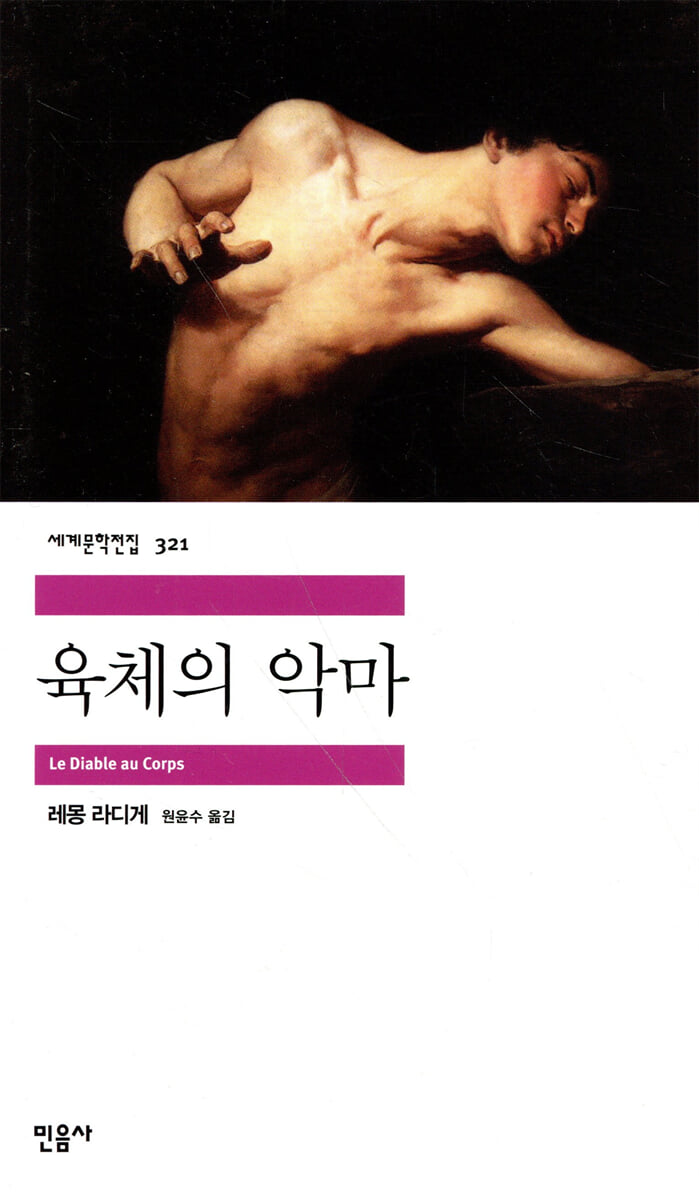
Demon of the flesh
 |
Description
Book Introduction
A masterpiece of psychological novels published at the age of 17 by Raymond Radiguet, a genius writer who died at the age of 20.
A boy's dangerous love and passion, and an insight into the human spirit driven by war.
Raymond Radiguet's controversial work, The Devil in the Flesh, published five years after the end of World War I, was published in Minumsa's World Literature Collection.
This work shocked French society at the time because it dealt with the immoral love between a sixteen-year-old boy and a soldier's wife, and because the author of this story was only seventeen years old.
Radiguet, who delicately and concisely depicted the self-centered desires, intangible impulses, and contradictory yet honest inner psychology of adolescent boys, is evaluated to have revived and perfected the French classical novel by brilliantly depicting the unstable psychology of humans driven into the inaction and nihilism spread by war through 『The Devil in the Flesh』.
A boy's dangerous love and passion, and an insight into the human spirit driven by war.
Raymond Radiguet's controversial work, The Devil in the Flesh, published five years after the end of World War I, was published in Minumsa's World Literature Collection.
This work shocked French society at the time because it dealt with the immoral love between a sixteen-year-old boy and a soldier's wife, and because the author of this story was only seventeen years old.
Radiguet, who delicately and concisely depicted the self-centered desires, intangible impulses, and contradictory yet honest inner psychology of adolescent boys, is evaluated to have revived and perfected the French classical novel by brilliantly depicting the unstable psychology of humans driven into the inaction and nihilism spread by war through 『The Devil in the Flesh』.
index
Demon of the flesh
Commentary on the work
Author's chronology
Commentary on the work
Author's chronology
Publisher's Review
■ A sixteen-year-old boy falls in a dangerous love affair with a soldier's wife.
For me, a sixteen-year-old boy, war was as boring as a long summer vacation.
While I was killing my boredom by reading books and writing love letters, I met Mart for the first time.
Mart is a sickly girl who was left alone after her husband was sent to the army when World War II broke out.
However, 'I' and Mart share tastes that cannot be shared with others, such as reading Rimbaud and Baudelaire and going to art school together, and gradually become closer.
Mart also consoles her loneliness and emptiness without a husband through 'I', and the two eventually fall into an immoral and dangerous love.
The impure joy of choosing bedroom furniture for a newlywed couple, the base joy of watching a lover lie to her husband and his family to meet her, the first taste of physical desire, the twisted possessiveness and obsession that even she doesn't realize what it is - 'I' shows the psychological anxiety and confusion that immature love brings.
But in addition to such selfish and reckless desires, this boy still has a pure and boyish side.
'I'm not afraid of Martha,' I repeated.
So the only things that stood in my way of leaning in and kissing her neck were her parents and my father.
Deep inside my heart, another boy was rejoicing in the presence of those troublemakers.
The boy in my heart thought this.
"It's a good thing I'm not alone with her! Because I won't be able to kiss her, and I won't have any excuses." - Page 34
An immature love that cannot accept or share emotions as they are, the love of these two faces a new situation with Marat's husband Jacques' vacation, Marat's pregnancy, and the end of World War II, and the end of summer comes to 'me' as well.
Raymond Radiguet, a genius writer comparable to Rimbaud
― A controversial work that shocked all of France before the scars of World War I had healed.
Raymond Radiguet, along with Rimbaud, is known as one of France's "child prodigies" and "genius writers who died young," for his life, which was short but intense and then disappeared, and the impact his few novels left on the world.
Raymond Radiguet spent his childhood on the banks of the Marne River in France, and stopped attending school at an early age to spend his time reading countless books.
At the age of just fifteen, he was writing for newspapers and magazines, associating with Cubist painters and meeting with avant-garde artists.
However, it is known that he does not belong to any school.
In 1920, he published a collection of poems titled “Burning Cheeks” and several other poems, and began writing novels that depicted inner psychology in a unique style.
Raymond Radiguet was also known to have been in a romantic relationship with Jean Cocteau, and when Radiguet died of illness at a young age, Jean Cocteau was said to have been so heartbroken that he stopped eating or drinking.
Jean Cocteau's epitaph includes a tribute to Radiguet, and it is also said that the "enfants terrible" (terrible children) that appear in his works are also allusions to Radiguet.
Radige himself said, “It is not pleasant for a writer to be treated as a prodigy,” and “the fault lies in the empty words ‘a novel written when I was seventeen’” and “in those who want to see miracles.”
However, Radiguet is considered an “extraordinary writer” who “stares with unwavering eyes at the soul in the most profound transitional period from boy to man and dissects it mercilessly,” and “The Devil in the Flesh” is evaluated as a problematic work that shocked all of France and a masterpiece of psychological novel.
■ A new revival of French classicism, a masterpiece of psychological novels, and a pioneering work of youth novels.
The concise and powerful style, which is hard to believe was written by a boy under twenty, and the delicate and sharp insight into the inner psychology that is difficult to grasp, astonished people of the time.
It is said that over 100,000 copies were sold in three months, making it a huge success at the time.
『The Devil in the Flesh』 is considered an indispensable work when examining the historical flow of French psychological novels.
As a drama with the characteristics of a bildungsroman and a tragic poem, it shows “how the debauchery and inaction brought about by war create a boy and a young man and kill a woman.”
The novel's narrator, a "clever genius and a shrewd devil," uses his clairvoyant powers to peel off the characters' masks, vividly portraying not only his own psychology but also that of those around him.
The emotions these characters display are nothing more than illusions, and they are merely putting on a play based on their emotions for themselves.
The subtlety of the analysis, the brevity of the sentences, and the complete mastery and control over the narrative make it a psychological novel and a new revival of the French classical novel.
Radiguet vividly recreated the French psychological novel, beginning with Madame de Lafayette, in a modern context, and sought to recapture classical beauty and rigor in an era rife with Dadaism and Cubism, and achieved this.
Even today, in the 21st century, readers from any country in the world will be able to sense the 'renewed' tradition of French classical literature in this novel written by a seventeen-year-old youth.
For me, a sixteen-year-old boy, war was as boring as a long summer vacation.
While I was killing my boredom by reading books and writing love letters, I met Mart for the first time.
Mart is a sickly girl who was left alone after her husband was sent to the army when World War II broke out.
However, 'I' and Mart share tastes that cannot be shared with others, such as reading Rimbaud and Baudelaire and going to art school together, and gradually become closer.
Mart also consoles her loneliness and emptiness without a husband through 'I', and the two eventually fall into an immoral and dangerous love.
The impure joy of choosing bedroom furniture for a newlywed couple, the base joy of watching a lover lie to her husband and his family to meet her, the first taste of physical desire, the twisted possessiveness and obsession that even she doesn't realize what it is - 'I' shows the psychological anxiety and confusion that immature love brings.
But in addition to such selfish and reckless desires, this boy still has a pure and boyish side.
'I'm not afraid of Martha,' I repeated.
So the only things that stood in my way of leaning in and kissing her neck were her parents and my father.
Deep inside my heart, another boy was rejoicing in the presence of those troublemakers.
The boy in my heart thought this.
"It's a good thing I'm not alone with her! Because I won't be able to kiss her, and I won't have any excuses." - Page 34
An immature love that cannot accept or share emotions as they are, the love of these two faces a new situation with Marat's husband Jacques' vacation, Marat's pregnancy, and the end of World War II, and the end of summer comes to 'me' as well.
Raymond Radiguet, a genius writer comparable to Rimbaud
― A controversial work that shocked all of France before the scars of World War I had healed.
Raymond Radiguet, along with Rimbaud, is known as one of France's "child prodigies" and "genius writers who died young," for his life, which was short but intense and then disappeared, and the impact his few novels left on the world.
Raymond Radiguet spent his childhood on the banks of the Marne River in France, and stopped attending school at an early age to spend his time reading countless books.
At the age of just fifteen, he was writing for newspapers and magazines, associating with Cubist painters and meeting with avant-garde artists.
However, it is known that he does not belong to any school.
In 1920, he published a collection of poems titled “Burning Cheeks” and several other poems, and began writing novels that depicted inner psychology in a unique style.
Raymond Radiguet was also known to have been in a romantic relationship with Jean Cocteau, and when Radiguet died of illness at a young age, Jean Cocteau was said to have been so heartbroken that he stopped eating or drinking.
Jean Cocteau's epitaph includes a tribute to Radiguet, and it is also said that the "enfants terrible" (terrible children) that appear in his works are also allusions to Radiguet.
Radige himself said, “It is not pleasant for a writer to be treated as a prodigy,” and “the fault lies in the empty words ‘a novel written when I was seventeen’” and “in those who want to see miracles.”
However, Radiguet is considered an “extraordinary writer” who “stares with unwavering eyes at the soul in the most profound transitional period from boy to man and dissects it mercilessly,” and “The Devil in the Flesh” is evaluated as a problematic work that shocked all of France and a masterpiece of psychological novel.
■ A new revival of French classicism, a masterpiece of psychological novels, and a pioneering work of youth novels.
The concise and powerful style, which is hard to believe was written by a boy under twenty, and the delicate and sharp insight into the inner psychology that is difficult to grasp, astonished people of the time.
It is said that over 100,000 copies were sold in three months, making it a huge success at the time.
『The Devil in the Flesh』 is considered an indispensable work when examining the historical flow of French psychological novels.
As a drama with the characteristics of a bildungsroman and a tragic poem, it shows “how the debauchery and inaction brought about by war create a boy and a young man and kill a woman.”
The novel's narrator, a "clever genius and a shrewd devil," uses his clairvoyant powers to peel off the characters' masks, vividly portraying not only his own psychology but also that of those around him.
The emotions these characters display are nothing more than illusions, and they are merely putting on a play based on their emotions for themselves.
The subtlety of the analysis, the brevity of the sentences, and the complete mastery and control over the narrative make it a psychological novel and a new revival of the French classical novel.
Radiguet vividly recreated the French psychological novel, beginning with Madame de Lafayette, in a modern context, and sought to recapture classical beauty and rigor in an era rife with Dadaism and Cubism, and achieved this.
Even today, in the 21st century, readers from any country in the world will be able to sense the 'renewed' tradition of French classical literature in this novel written by a seventeen-year-old youth.
GOODS SPECIFICS
- Date of publication: May 16, 2014
- Page count, weight, size: 212 pages | 295g | 132*225*20mm
- ISBN13: 9788937463211
- ISBN10: 8937463210
You may also like
카테고리
korean


korean

![GQ KOREA Mark (Monthly): December [2025]](http://librairie.coreenne.fr/cdn/shop/files/8ef265dbbfbf186523ed75ba7319009d.jpg?v=1765340328&width=3840)


