

Who ate all those singas?
 |
Description
Book Introduction
"Who Ate All Those Singa?" and "Was That Mountain Really There?" are autobiographical stories written solely from Park Wan-seo's own experiences, who has been incorporating her own experiences into her novels.
Among them, 『Who Ate All Those Singa』 is a work that fully captures the cultural shock experienced by a girl who was led by her mother, who was passionate about education, from her hometown in Gaepyeong, where rice paddies and fields were spread out, to a mountain village in Seoul, where shacks were built close together on top of a mountain. It also contains the author's childhood experiences, which included her memories as an elementary school student during the Japanese colonial period, her experience of changing her name to a Japanese one, the end of World War II, her admission to Seoul National University, and the turbulent times leading up to the Korean War.
It may have been a painful memory, but for a child in childhood, everything is incomprehensible, yet it is a new and splendid experience.
Reading this book allows us to experience and reflect on that era through Park Wan-seo's memories, and furthermore, it provides a foundation for reflecting on how this new era we live in will be remembered in the future. This work was selected for MBC's "Exclamation Point" program, "Let's Read Books," and has once again become a bestseller, evoking childhood memories for countless readers.
Among them, 『Who Ate All Those Singa』 is a work that fully captures the cultural shock experienced by a girl who was led by her mother, who was passionate about education, from her hometown in Gaepyeong, where rice paddies and fields were spread out, to a mountain village in Seoul, where shacks were built close together on top of a mountain. It also contains the author's childhood experiences, which included her memories as an elementary school student during the Japanese colonial period, her experience of changing her name to a Japanese one, the end of World War II, her admission to Seoul National University, and the turbulent times leading up to the Korean War.
It may have been a painful memory, but for a child in childhood, everything is incomprehensible, yet it is a new and splendid experience.
Reading this book allows us to experience and reflect on that era through Park Wan-seo's memories, and furthermore, it provides a foundation for reflecting on how this new era we live in will be remembered in the future. This work was selected for MBC's "Exclamation Point" program, "Let's Read Books," and has once again become a bestseller, evoking childhood memories for countless readers.
- You can preview some of the book's contents.
Preview
index
Planning article
Author's Note
1 Wild period
2 Faraway Seoul
3 Outside the door
4. A child without friends
5 Goebulmadang House
6 Grandfather and Grandmother
7 Brother and Mom
8 Spring in my hometown
9. A nameplate with a broken frame
10 Groping in the Dark
11 The peace of the night before
12 A Brilliant Premonition
commentary
Author's chronology
Author's Note
1 Wild period
2 Faraway Seoul
3 Outside the door
4. A child without friends
5 Goebulmadang House
6 Grandfather and Grandmother
7 Brother and Mom
8 Spring in my hometown
9. A nameplate with a broken frame
10 Groping in the Dark
11 The peace of the night before
12 A Brilliant Premonition
commentary
Author's chronology
Publisher's Review
A Self-Portrait Through Novels by Park Wan-seo, the Mother of Korean Literature 1
Memories of a brilliant childhood, intimate records of life
"Who Ate All Those Singa?" and "Was That Mountain Really There?" are autobiographical stories written solely from Park Wan-seo's own experiences, who has been incorporating her own experiences into her novels.
Among them, 『Who Ate All Those Singa』 is a work that fully captures the cultural shock experienced by a girl who was led by her mother, who was passionate about education, from her hometown in Gaepyeong, where rice paddies and fields were spread out, to a mountain village in Seoul, where shacks were built close together on top of a mountain. It also contains the author's childhood experiences, which included her memories as an elementary school student during the Japanese colonial period, her experience of changing her name to a Japanese one, the end of World War II, her admission to Seoul National University, and the turbulent times leading up to the Korean War.
It may have been a painful memory, but for a child in childhood, everything is incomprehensible, yet it is a new and splendid experience.
Reading this book allows us to experience and reflect on that era through Park Wan-seo's memories, and furthermore, it provides a foundation for reflecting on how this new era we live in will be remembered in the future. This work was selected for MBC's "Exclamation Point" program, "Let's Read Books," and has once again become a bestseller, evoking childhood memories for countless readers.
Park Wan-seo, the greatest legacy of Korean literature
A beautiful legacy that he personally maintained, polished, and touched up until the end of his life.
On January 22, 2012, in commemoration of the first anniversary of the death of Park Wan-seo, the mother of Korean literature, the manuscripts that the author had personally worked on during her lifetime were published in the definitive edition of the Park Wan-seo Novel Collection by Segyesa Publishing.
"The Definitive Edition of Park Wan-seo's Complete Novels" was a project originally scheduled to be published on October 20, 2011, the author's 80th birthday. It was a massive project that would gather and refine 15 novels (22 volumes) of Park Wan-seo's long novels and serial novels that have been consistently loved by readers since her first work, "Namok," in chronological order of when they were first written (based on when the serialization began).
Gathering the works of Park Wan-seo, who has explored the footsteps and transformations of Korean society from a personal perspective, is a meaningful undertaking that goes beyond simply collecting the works of one author; it is a literary endeavor that comprehensively captures the context of the flow and change of Korean society.
However, on January 22, 2011, the author, who was refining the manuscript, passed away from gallbladder cancer. The planning committee members who had been with the author and his descendants decided to continue the author's legacy and refine the manuscript, and publish it on the anniversary of his death.
This "Park Wan-seo Complete Novel Collection" includes the author's debut work, "Namok," the autobiographical novels depicting the author's childhood and youth, "Who Ate All Those Singa?" and "Was That Mountain Really There?" as well as her last full-length novel, "That Man's House." The author's only serial novel, "Mother's Stake," is also included in the list.
The "Park Wan-seo Complete Novel Collection" newly compiled for readers
The characteristic of Park Wan-seo's works is that they do not feel out of place even after reading them over time.
Accordingly, Oh Jin-kyung, who is considered one of the best book designers in Korea, designed the book to give the feeling of a carefully prepared gift to long-time readers who have already read the work, and to give a timeless, modern sensibility to unknown readers who will encounter the work in the future, while preserving the individuality of each work, and to bring the individual works together as the "Park Wan-seo Complete Novels Definitive Edition" to create the unity of the complete work and the unique style of Park Wan-seo's literature.
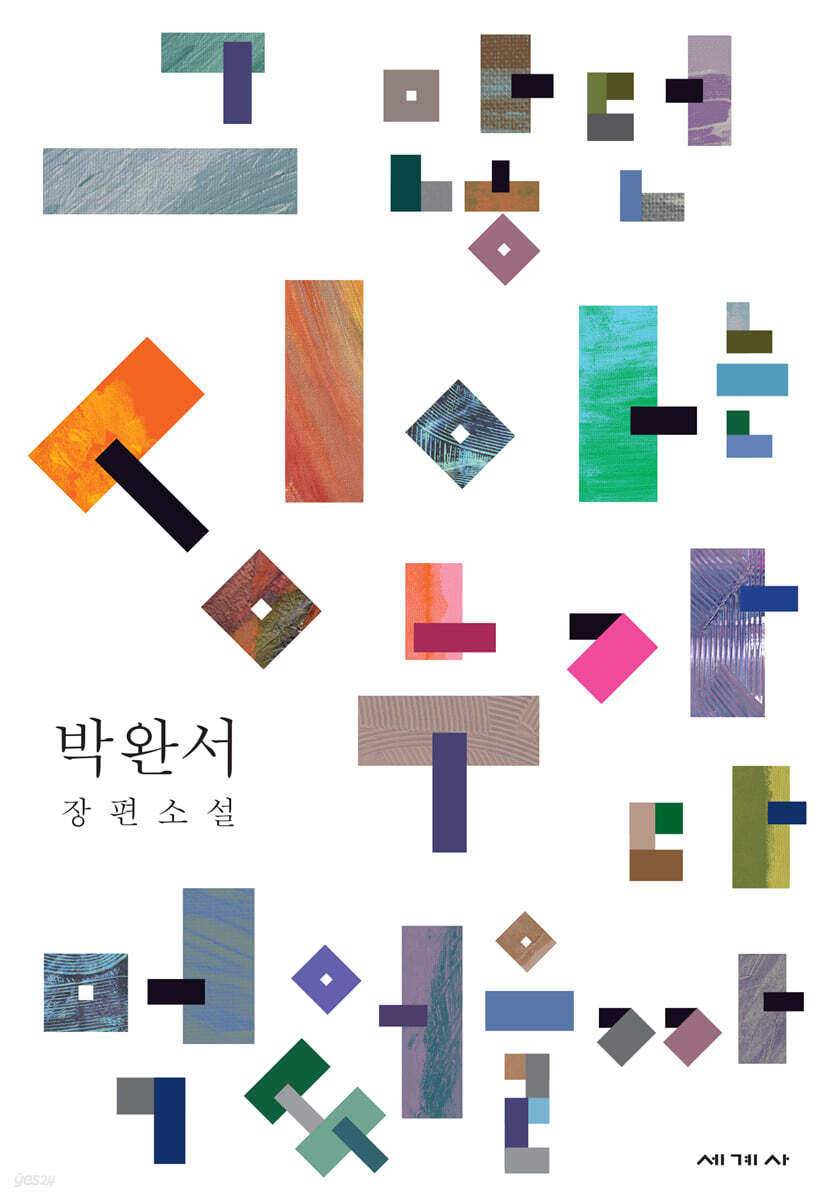
Since the titles of Park Wan-seo's works allow one to feel the author herself, we tried to utilize the titles in the design as much as possible to reveal the characteristics of the works.
Feeling that the existing fonts were insufficient to capture the characteristics of the works, I created fonts exclusively for the works in the “Park Wan-seo Complete Novel Collection” by adding strokes based on vertical and horizontal lines.
The motifs of the faint, hazy jokes, low-saturation warm colors, and simple textures were used, and other decorations were excluded as much as possible. Titles that seemed to be sewn together like a patchwork quilt while still highlighting the individuality of each work were created and used as the overall cover image.
Additionally, for new readers who are approaching the work for the first time, the author's pictorial was not included separately in the text.
Instead, the author's photographs were included in each of the twenty-two volumes of the complete collection, giving the impression that the author himself was telling the story when the book was opened.
Most of the author's photos included in the text and on the cover are photos taken at the time the work was written or photos that can capture the feel of the work. The photos mainly include photos taken by family and friends in everyday life, so although they may be a bit rough, they have a more natural and warm feel.
These are books that have been enjoyed and loved for a long time, but the spelling rules have changed a lot in the meantime.
In this newly published edition, we focused on maintaining the texture of the text while also following the spelling rules of the National Institute of the Korean Language, such as preserving the author's unique expressions, tone, and words that specify the era, to make it easier for new readers to read.
In addition, experts from various fields and regions who are interested in Park Wan-seo's literature, including domestic literature experts, East Asian culture experts, and foreign professors (Stephen Epstein, who translated Park Wan-seo's "Jaesugut" and "Who Ate Up All the Singa?"), have included in-depth commentary on Park Wan-seo's new interpretation for "The Definitive Edition of the Complete Novels of Park Wan-seo" to help readers understand.
The language of life and senses, accumulated over a turbulent 80 years of life.
The task of rereading and re-evaluating the teacher's novel was as vast as traversing a large mountain range.
It was a blessed time, confirming the breadth and depth of Park Wan-seo's literature and the potential for the future of Korean literature.
Park Wan-seo's literature is a treasure trove of language.
It revealed the true beauty of the mother tongue through a story that seemed to always spring up no matter how much was dug up, and through sophisticated expressions that were both simple and yet couldn't be more appropriate.
The power of interesting writing and lively language has captivated us, creating a beautiful literary landscape.
(From "Planning Article")
Park Wan-seo's writing reads as smoothly as flowing water, as if a voice is heard from afar.
And, as if in a treasure trove, unexpected words are hidden within the sentences without any awkwardness.
This also provides the fun of discovering new language that transcends time and region within soft sentences.
Park Wan-seo demonstrates through her works that one can maintain a sharp perspective and a critical eye without necessarily having to write in a rigid manner.
This is the author's basic tendency, but it is also influenced by various life experiences and language experiences.
Park Wan-seo incorporated into her literature the rapid and profound changes in Korean society that she experienced throughout her life, including the Japanese colonial period, liberation, the Korean War, the spread of democracy, and the deepening of class disparity.
By interpreting an individual's problem within the social vortex and accurately penetrating the core of the problems that Korean society had overlooked, the role of literature was expanded to reflect the current state of society and raise awareness of its problems.
Memories of a brilliant childhood, intimate records of life
"Who Ate All Those Singa?" and "Was That Mountain Really There?" are autobiographical stories written solely from Park Wan-seo's own experiences, who has been incorporating her own experiences into her novels.
Among them, 『Who Ate All Those Singa』 is a work that fully captures the cultural shock experienced by a girl who was led by her mother, who was passionate about education, from her hometown in Gaepyeong, where rice paddies and fields were spread out, to a mountain village in Seoul, where shacks were built close together on top of a mountain. It also contains the author's childhood experiences, which included her memories as an elementary school student during the Japanese colonial period, her experience of changing her name to a Japanese one, the end of World War II, her admission to Seoul National University, and the turbulent times leading up to the Korean War.
It may have been a painful memory, but for a child in childhood, everything is incomprehensible, yet it is a new and splendid experience.
Reading this book allows us to experience and reflect on that era through Park Wan-seo's memories, and furthermore, it provides a foundation for reflecting on how this new era we live in will be remembered in the future. This work was selected for MBC's "Exclamation Point" program, "Let's Read Books," and has once again become a bestseller, evoking childhood memories for countless readers.
Park Wan-seo, the greatest legacy of Korean literature
A beautiful legacy that he personally maintained, polished, and touched up until the end of his life.
On January 22, 2012, in commemoration of the first anniversary of the death of Park Wan-seo, the mother of Korean literature, the manuscripts that the author had personally worked on during her lifetime were published in the definitive edition of the Park Wan-seo Novel Collection by Segyesa Publishing.
"The Definitive Edition of Park Wan-seo's Complete Novels" was a project originally scheduled to be published on October 20, 2011, the author's 80th birthday. It was a massive project that would gather and refine 15 novels (22 volumes) of Park Wan-seo's long novels and serial novels that have been consistently loved by readers since her first work, "Namok," in chronological order of when they were first written (based on when the serialization began).
Gathering the works of Park Wan-seo, who has explored the footsteps and transformations of Korean society from a personal perspective, is a meaningful undertaking that goes beyond simply collecting the works of one author; it is a literary endeavor that comprehensively captures the context of the flow and change of Korean society.
However, on January 22, 2011, the author, who was refining the manuscript, passed away from gallbladder cancer. The planning committee members who had been with the author and his descendants decided to continue the author's legacy and refine the manuscript, and publish it on the anniversary of his death.
This "Park Wan-seo Complete Novel Collection" includes the author's debut work, "Namok," the autobiographical novels depicting the author's childhood and youth, "Who Ate All Those Singa?" and "Was That Mountain Really There?" as well as her last full-length novel, "That Man's House." The author's only serial novel, "Mother's Stake," is also included in the list.
The "Park Wan-seo Complete Novel Collection" newly compiled for readers
The characteristic of Park Wan-seo's works is that they do not feel out of place even after reading them over time.
Accordingly, Oh Jin-kyung, who is considered one of the best book designers in Korea, designed the book to give the feeling of a carefully prepared gift to long-time readers who have already read the work, and to give a timeless, modern sensibility to unknown readers who will encounter the work in the future, while preserving the individuality of each work, and to bring the individual works together as the "Park Wan-seo Complete Novels Definitive Edition" to create the unity of the complete work and the unique style of Park Wan-seo's literature.
Since the titles of Park Wan-seo's works allow one to feel the author herself, we tried to utilize the titles in the design as much as possible to reveal the characteristics of the works.
Feeling that the existing fonts were insufficient to capture the characteristics of the works, I created fonts exclusively for the works in the “Park Wan-seo Complete Novel Collection” by adding strokes based on vertical and horizontal lines.
The motifs of the faint, hazy jokes, low-saturation warm colors, and simple textures were used, and other decorations were excluded as much as possible. Titles that seemed to be sewn together like a patchwork quilt while still highlighting the individuality of each work were created and used as the overall cover image.
Additionally, for new readers who are approaching the work for the first time, the author's pictorial was not included separately in the text.
Instead, the author's photographs were included in each of the twenty-two volumes of the complete collection, giving the impression that the author himself was telling the story when the book was opened.
Most of the author's photos included in the text and on the cover are photos taken at the time the work was written or photos that can capture the feel of the work. The photos mainly include photos taken by family and friends in everyday life, so although they may be a bit rough, they have a more natural and warm feel.
These are books that have been enjoyed and loved for a long time, but the spelling rules have changed a lot in the meantime.
In this newly published edition, we focused on maintaining the texture of the text while also following the spelling rules of the National Institute of the Korean Language, such as preserving the author's unique expressions, tone, and words that specify the era, to make it easier for new readers to read.
In addition, experts from various fields and regions who are interested in Park Wan-seo's literature, including domestic literature experts, East Asian culture experts, and foreign professors (Stephen Epstein, who translated Park Wan-seo's "Jaesugut" and "Who Ate Up All the Singa?"), have included in-depth commentary on Park Wan-seo's new interpretation for "The Definitive Edition of the Complete Novels of Park Wan-seo" to help readers understand.
The language of life and senses, accumulated over a turbulent 80 years of life.
The task of rereading and re-evaluating the teacher's novel was as vast as traversing a large mountain range.
It was a blessed time, confirming the breadth and depth of Park Wan-seo's literature and the potential for the future of Korean literature.
Park Wan-seo's literature is a treasure trove of language.
It revealed the true beauty of the mother tongue through a story that seemed to always spring up no matter how much was dug up, and through sophisticated expressions that were both simple and yet couldn't be more appropriate.
The power of interesting writing and lively language has captivated us, creating a beautiful literary landscape.
(From "Planning Article")
Park Wan-seo's writing reads as smoothly as flowing water, as if a voice is heard from afar.
And, as if in a treasure trove, unexpected words are hidden within the sentences without any awkwardness.
This also provides the fun of discovering new language that transcends time and region within soft sentences.
Park Wan-seo demonstrates through her works that one can maintain a sharp perspective and a critical eye without necessarily having to write in a rigid manner.
This is the author's basic tendency, but it is also influenced by various life experiences and language experiences.
Park Wan-seo incorporated into her literature the rapid and profound changes in Korean society that she experienced throughout her life, including the Japanese colonial period, liberation, the Korean War, the spread of democracy, and the deepening of class disparity.
By interpreting an individual's problem within the social vortex and accurately penetrating the core of the problems that Korean society had overlooked, the role of literature was expanded to reflect the current state of society and raise awareness of its problems.
GOODS SPECIFICS
- Date of issue: January 22, 2012
- Format: Hardcover book binding method guide
- Page count, weight, size: 301 pages | 446g | 148*210*30mm
- ISBN13: 9788933801925
- ISBN10: 8933801928
You may also like
카테고리
korean


korean

![GQ KOREA Mark (Monthly): December [2025]](http://librairie.coreenne.fr/cdn/shop/files/8ef265dbbfbf186523ed75ba7319009d.jpg?v=1765340328&width=3840)


