

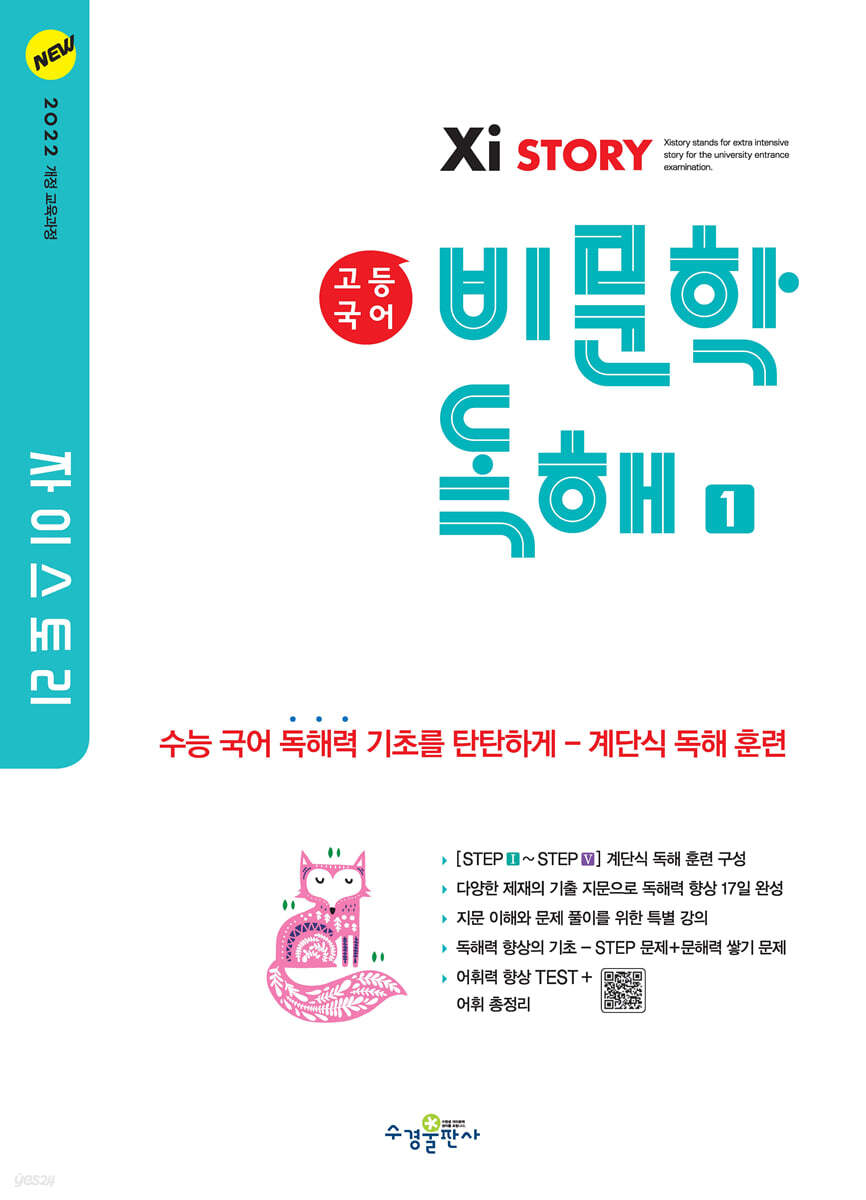
Zaistory High School Korean Non-Fiction Reading 1 (for 2026)
 |
Description
Book Introduction
The questions from the National Academic Achievement Test for the first year of high school are arranged according to difficulty.
To help you take your skills to the next level, STEP V also includes questions from the National High School Academic Achievement Test.
To help you take your skills to the next level, STEP V also includes questions from the National High School Academic Achievement Test.
- You can preview some of the book's contents.
Preview
index
STEP Ⅰ: Finding Key Words and Central Sentences (2 days)
DAY 01 Characteristics and Significance of Cubism [Art]
+ Special lecture on fingerprint analysis
+ Special lecture on problem solving
Price Elasticity of Demand [Society]
DAY 02 Futurist Painting [Art]
Five Basic Human Needs and Conflict Resolution Methods Suggested by Reality Therapy [Humanities]
STEP Ⅱ: Summarizing Paragraphs and Understanding Relationships Between Paragraphs (3 Days)
DAY 03 Principles and Methods of Dendrochronology [Technology]
+ Special lecture on fingerprint analysis
+ Special lecture on problem solving
Jeong Yak-yong's Views on Human Nature [Humanities]
DAY 04 Types and Characteristics of Vortices [Science]
The Potlatch Custom and Levi-Strauss's Structuralism [Humanities]
DAY 05: The Concept and Principle of Ocean Thermal Energy Generation [Science]
The Impact of Tariffs on the Domestic Economy and International Trade [Society]
STEP Ⅲ: Understanding the Structure of the Text and Finding the Topic (4 days)
DAY 06 When the Legal Effect of a Legal Act Loses Its Validity [Society]
+ Special lecture on fingerprint analysis
+ Special lecture on problem solving
The People-Oriented Thought of Joseon Dynasty Confucian Scholars [Humanities]
DAY 07 Decision-making Methods in Direct Democracy [Society]
Nuclear Fission and Nuclear Fusion [Science]
DAY 08: Characteristics and Related Theories of Claims for Compensation for Losses [Society]
How Appetite Works [Science]
DAY 09 (A) Sunja's Thought [Humanities], (B) Hobbes' Social Contract Theory [Humanities]
+ Special lecture on fingerprint analysis
+ Special lecture on problem solving
(a) Thomas Aquinas's Love [Humanities], (b) Kant's Practical Dimension of Love [Humanities]
STEP Ⅳ Skill Improvement Test (3 days)
DAY 10 Digital Image Watermarking [Technology]
Classical logic and the standard form of elementary propositions [Humanities]
The Functions and Roles of Banks [Society]
DAY 11: The System of Limited Capacity and the Protection of Contracting Parties [Society]
The Nature of Politics and the Importance of the Public Sphere [Humanities]
The Geological Time Scale Using Radioisotopes [Science]
DAY 12: Cost Accounting Concepts and Cost Classification [Humanities]
Caching: How Computers Process Data [Technology]
(a) Painting art that reveals the world's various aspects of existence [humanities + arts],
(I) Conflicting Perceptions of the Relationship Between Art and Reality [Humanities + Arts]
STEP Ⅴ Mock Test for the Strongest Skills (5 days)
DAY 13: The Bullwhip Effect in Supply Chains [Society]
How the Cochlea Perceives Sound and Pitch [Science]
(A) Perspectives and characteristics of architecture during the modernist period [Humanities + Arts]
(I) Perspectives and Characteristics of Postmodern Architecture [Humanities + Arts]
DAY 14: Simmel and Benjamin's Views on Space [Humanities]
'Subordinate regulations' attached to administrative actions [Society]
(a) Theories explaining altruistic behavior of animals [Society + Science],
(I) Theories explaining human altruistic behavior [Society + Science]
DAY 15 Hypothesis Testing and Errors [Humanities]
Right to Self-Determination of Personal Information [Society]
How Drugs Work in the Body [Science]
DAY 16: Market Price Adjustment from a Macroeconomic Perspective [Society]
Natural language processing technology for artificial intelligence voice assistant systems [Technology]
(a) Adorno's view on enlightenment [Humanities + Society],
(I) Understanding Expressionism [Humanities + Arts]
DAY 17 Neoclassicism and Romanticism [Art]
Tenant Protection and the Housing Lease Protection Act [Society]
Tower Crane Principles [Technology]
DAY 01 Characteristics and Significance of Cubism [Art]
+ Special lecture on fingerprint analysis
+ Special lecture on problem solving
Price Elasticity of Demand [Society]
DAY 02 Futurist Painting [Art]
Five Basic Human Needs and Conflict Resolution Methods Suggested by Reality Therapy [Humanities]
STEP Ⅱ: Summarizing Paragraphs and Understanding Relationships Between Paragraphs (3 Days)
DAY 03 Principles and Methods of Dendrochronology [Technology]
+ Special lecture on fingerprint analysis
+ Special lecture on problem solving
Jeong Yak-yong's Views on Human Nature [Humanities]
DAY 04 Types and Characteristics of Vortices [Science]
The Potlatch Custom and Levi-Strauss's Structuralism [Humanities]
DAY 05: The Concept and Principle of Ocean Thermal Energy Generation [Science]
The Impact of Tariffs on the Domestic Economy and International Trade [Society]
STEP Ⅲ: Understanding the Structure of the Text and Finding the Topic (4 days)
DAY 06 When the Legal Effect of a Legal Act Loses Its Validity [Society]
+ Special lecture on fingerprint analysis
+ Special lecture on problem solving
The People-Oriented Thought of Joseon Dynasty Confucian Scholars [Humanities]
DAY 07 Decision-making Methods in Direct Democracy [Society]
Nuclear Fission and Nuclear Fusion [Science]
DAY 08: Characteristics and Related Theories of Claims for Compensation for Losses [Society]
How Appetite Works [Science]
DAY 09 (A) Sunja's Thought [Humanities], (B) Hobbes' Social Contract Theory [Humanities]
+ Special lecture on fingerprint analysis
+ Special lecture on problem solving
(a) Thomas Aquinas's Love [Humanities], (b) Kant's Practical Dimension of Love [Humanities]
STEP Ⅳ Skill Improvement Test (3 days)
DAY 10 Digital Image Watermarking [Technology]
Classical logic and the standard form of elementary propositions [Humanities]
The Functions and Roles of Banks [Society]
DAY 11: The System of Limited Capacity and the Protection of Contracting Parties [Society]
The Nature of Politics and the Importance of the Public Sphere [Humanities]
The Geological Time Scale Using Radioisotopes [Science]
DAY 12: Cost Accounting Concepts and Cost Classification [Humanities]
Caching: How Computers Process Data [Technology]
(a) Painting art that reveals the world's various aspects of existence [humanities + arts],
(I) Conflicting Perceptions of the Relationship Between Art and Reality [Humanities + Arts]
STEP Ⅴ Mock Test for the Strongest Skills (5 days)
DAY 13: The Bullwhip Effect in Supply Chains [Society]
How the Cochlea Perceives Sound and Pitch [Science]
(A) Perspectives and characteristics of architecture during the modernist period [Humanities + Arts]
(I) Perspectives and Characteristics of Postmodern Architecture [Humanities + Arts]
DAY 14: Simmel and Benjamin's Views on Space [Humanities]
'Subordinate regulations' attached to administrative actions [Society]
(a) Theories explaining altruistic behavior of animals [Society + Science],
(I) Theories explaining human altruistic behavior [Society + Science]
DAY 15 Hypothesis Testing and Errors [Humanities]
Right to Self-Determination of Personal Information [Society]
How Drugs Work in the Body [Science]
DAY 16: Market Price Adjustment from a Macroeconomic Perspective [Society]
Natural language processing technology for artificial intelligence voice assistant systems [Technology]
(a) Adorno's view on enlightenment [Humanities + Society],
(I) Understanding Expressionism [Humanities + Arts]
DAY 17 Neoclassicism and Romanticism [Art]
Tenant Protection and the Housing Lease Protection Act [Society]
Tower Crane Principles [Technology]
Detailed image

Publisher's Review
[Problem] Features
1.
Step-by-step reading comprehension improvement learning method
Learn what to focus on and read by following each step.
Before you know it, your reading comprehension skills for the CSAT will improve rapidly.
·STEP (1) - Finding keywords and central sentences
·STEP (2) - Summarizing paragraphs and understanding relationships between paragraphs
·STEP (3) - Understanding the structure of the text and finding the topic
·STEP (4) - Skill Test
·STEP (5) - The ultimate mock exam
2.
Special problem structure to develop reading comprehension skills in a fun way
· Literacy building problem
- You can understand the meaning of directives, conjunctions, sentences, and passages.
- By solving literacy building problems, you can summarize the main points of the text.
· Step-by-step reading comprehension questions
- If you train with the STEP-by-STEP reading comprehension improvement learning method, you will be able to understand the text easily.
- You can quickly improve your reading comprehension by practicing the learning elements step by step.
· National Union past exam questions
- The questions from the National Academic Achievement Test for the first year of high school are arranged according to difficulty.
- To help you take your skills to the next level, STEP V also includes questions from the National Academic Achievement Test for the second year of high school.
3.
My Private Tutor - "Special Lecture on Fingerprint Analysis" and "Special Lecture on Problem Solving"
· Special lecture on fingerprint analysis
It helps you practice quickly and accurately understanding the content of a text.
· Special lecture on problem solving
It teaches you how to solve problems and why choices are right or wrong.
4.
Vocabulary Enhancement Test + Background Knowledge
· Vocabulary Improvement Test
You can solidify your vocabulary by solving various types of problems using the vocabulary in the text and problems.
· Vocabulary summary
- We have compiled essential vocabulary for each day.
- In the case of Chinese characters, the pronunciation and meaning of the Chinese characters are also presented.
[Commentary] Features
1.
The entire text is included in the commentary, and the text, questions, and choice options are explained in detail so that you can understand at a glance why the answer is correct or incorrect.
2.
We summarize the content of each paragraph and display the keywords and central sentences of the entire text to help you quickly understand the content of the text.
3.
The relationship between topics and paragraphs and the structure of the text are presented to help readers fully understand the content of the text.
4.
By asking 'Why is it correct?' and 'Why is it wrong?', we provide the basis for the correct and incorrect answers, thereby increasing understanding of the problem.
5.
High-difficulty problems are classified as ‘1st grade problems’ and special explanations are provided.
Building a Solid Foundation for the College Scholastic Ability Test's Korean Reading Comprehension Skills - Step-by-Step Reading Training
· [STEP Ⅰ~ STEP Ⅴ] Step-by-step reading training structure
· Improve your reading comprehension with past exam questions on various subjects. Complete in 17 days.
· Special lectures for understanding fingerprints and solving problems
· The foundation for improving reading comprehension - step problems + literacy building problems
· Vocabulary Improvement Test + Vocabulary Summary
1.
Step-by-step reading comprehension improvement learning method
Learn what to focus on and read by following each step.
Before you know it, your reading comprehension skills for the CSAT will improve rapidly.
·STEP (1) - Finding keywords and central sentences
·STEP (2) - Summarizing paragraphs and understanding relationships between paragraphs
·STEP (3) - Understanding the structure of the text and finding the topic
·STEP (4) - Skill Test
·STEP (5) - The ultimate mock exam
2.
Special problem structure to develop reading comprehension skills in a fun way
· Literacy building problem
- You can understand the meaning of directives, conjunctions, sentences, and passages.
- By solving literacy building problems, you can summarize the main points of the text.
· Step-by-step reading comprehension questions
- If you train with the STEP-by-STEP reading comprehension improvement learning method, you will be able to understand the text easily.
- You can quickly improve your reading comprehension by practicing the learning elements step by step.
· National Union past exam questions
- The questions from the National Academic Achievement Test for the first year of high school are arranged according to difficulty.
- To help you take your skills to the next level, STEP V also includes questions from the National Academic Achievement Test for the second year of high school.
3.
My Private Tutor - "Special Lecture on Fingerprint Analysis" and "Special Lecture on Problem Solving"
· Special lecture on fingerprint analysis
It helps you practice quickly and accurately understanding the content of a text.
· Special lecture on problem solving
It teaches you how to solve problems and why choices are right or wrong.
4.
Vocabulary Enhancement Test + Background Knowledge
· Vocabulary Improvement Test
You can solidify your vocabulary by solving various types of problems using the vocabulary in the text and problems.
· Vocabulary summary
- We have compiled essential vocabulary for each day.
- In the case of Chinese characters, the pronunciation and meaning of the Chinese characters are also presented.
[Commentary] Features
1.
The entire text is included in the commentary, and the text, questions, and choice options are explained in detail so that you can understand at a glance why the answer is correct or incorrect.
2.
We summarize the content of each paragraph and display the keywords and central sentences of the entire text to help you quickly understand the content of the text.
3.
The relationship between topics and paragraphs and the structure of the text are presented to help readers fully understand the content of the text.
4.
By asking 'Why is it correct?' and 'Why is it wrong?', we provide the basis for the correct and incorrect answers, thereby increasing understanding of the problem.
5.
High-difficulty problems are classified as ‘1st grade problems’ and special explanations are provided.
Building a Solid Foundation for the College Scholastic Ability Test's Korean Reading Comprehension Skills - Step-by-Step Reading Training
· [STEP Ⅰ~ STEP Ⅴ] Step-by-step reading training structure
· Improve your reading comprehension with past exam questions on various subjects. Complete in 17 days.
· Special lectures for understanding fingerprints and solving problems
· The foundation for improving reading comprehension - step problems + literacy building problems
· Vocabulary Improvement Test + Vocabulary Summary
GOODS SPECIFICS
- Date of issue: August 20, 2024
- Page count, weight, size: 320 pages | 215*297*30mm
- ISBN13: 9791162406007
- ISBN10: 1162406003
You may also like
카테고리
korean


korean

![GQ KOREA Mark (Monthly): December [2025]](http://librairie.coreenne.fr/cdn/shop/files/8ef265dbbfbf186523ed75ba7319009d.jpg?v=1765340328&width=3840)


