

Gravity in Mathematics
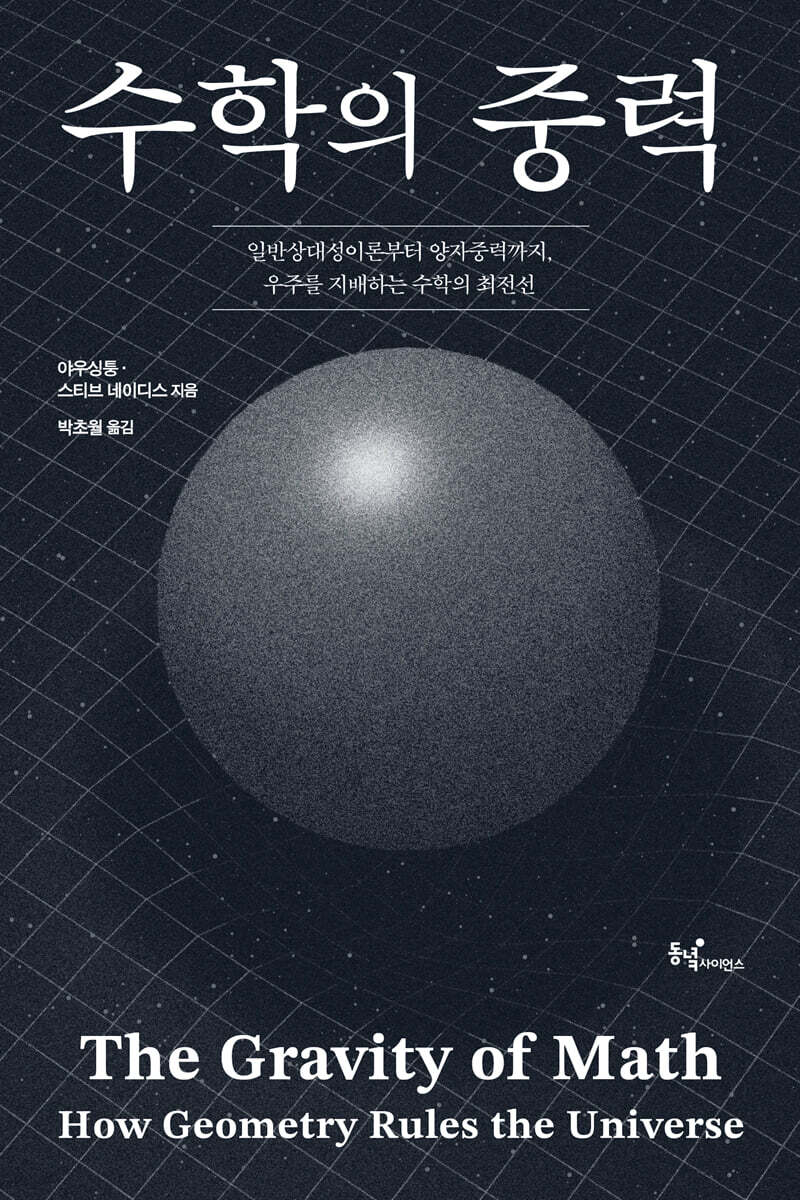 |
Description
Book Introduction
★★ Followed by Yau Shing-tung, Professor Emeritus of Mathematics at Harvard University and Fields Medalist
The footsteps of geometry that reveal the secrets of space and time!★★
The forefront of physics and mathematics, encompassing all mathematical developments since the theory of general relativity.
How did the equations and cosmologies that describe space-time come into being?
An epic tale of remarkable discoveries written by mathematics and physics.
In the summer of 2023, the international astrophysics research team NANOGrav (North American Nanohertz Gravitational Laboratory) detected gravitational waves and confirmed their existence.
The most significant physics achievement since LIGO's discovery of gravitational waves in 2015 stems from a single equation Einstein formulated in 1915.
But this was by no means an achievement solely for Einstein as an individual or for the single academic discipline of physics.
It was an idea that would never have been possible without the language of mathematics.
"Mathematical Gravity" reveals that the theory of gravity, previously considered solely a language of physics, was in fact born from the intimate intertwining of mathematics and physics, and sheds new light on the development of general relativity.
Einstein's equations, created through mathematics, lead to the forefront of modern mathematics and physics, from the singularities inside black holes that hide the deep mysteries of the universe to the unknown dimensions of string theory.
The book was co-authored by renowned mathematician and Fields Medalist Yau Shing-tung and science journalist Steve Nades.
Yau Shing-tung is a world-renowned scholar who solved the 'positive mass conjecture', a major challenge in the theory of general relativity, and proved the existence of the Calabi-Yau manifold, which is considered the fundamental structure of string theory.
In this book, Yau Shing-tung summarizes the relationship between general relativity and mathematics that he has been exploring for over 50 years.
This book, which contains the mathematical research and achievements he has pursued throughout his life, will help us gain a deeper and richer understanding of the universe in which we live.
Yau Shing-tung was studying geometry in his youth, and while attending a physics lecture, he was shocked to learn that the physical phenomenon of 'gravity' was directly connected to the geometric concept of 'curvature'.
Since then, he has studied the mathematical foundations of general relativity in depth and has provided mathematical solutions to core problems such as black holes, the positive mass theorem, and quantum gravity.
This book contains insights he discovered during his long journey.
The footsteps of geometry that reveal the secrets of space and time!★★
The forefront of physics and mathematics, encompassing all mathematical developments since the theory of general relativity.
How did the equations and cosmologies that describe space-time come into being?
An epic tale of remarkable discoveries written by mathematics and physics.
In the summer of 2023, the international astrophysics research team NANOGrav (North American Nanohertz Gravitational Laboratory) detected gravitational waves and confirmed their existence.
The most significant physics achievement since LIGO's discovery of gravitational waves in 2015 stems from a single equation Einstein formulated in 1915.
But this was by no means an achievement solely for Einstein as an individual or for the single academic discipline of physics.
It was an idea that would never have been possible without the language of mathematics.
"Mathematical Gravity" reveals that the theory of gravity, previously considered solely a language of physics, was in fact born from the intimate intertwining of mathematics and physics, and sheds new light on the development of general relativity.
Einstein's equations, created through mathematics, lead to the forefront of modern mathematics and physics, from the singularities inside black holes that hide the deep mysteries of the universe to the unknown dimensions of string theory.
The book was co-authored by renowned mathematician and Fields Medalist Yau Shing-tung and science journalist Steve Nades.
Yau Shing-tung is a world-renowned scholar who solved the 'positive mass conjecture', a major challenge in the theory of general relativity, and proved the existence of the Calabi-Yau manifold, which is considered the fundamental structure of string theory.
In this book, Yau Shing-tung summarizes the relationship between general relativity and mathematics that he has been exploring for over 50 years.
This book, which contains the mathematical research and achievements he has pursued throughout his life, will help us gain a deeper and richer understanding of the universe in which we live.
Yau Shing-tung was studying geometry in his youth, and while attending a physics lecture, he was shocked to learn that the physical phenomenon of 'gravity' was directly connected to the geometric concept of 'curvature'.
Since then, he has studied the mathematical foundations of general relativity in depth and has provided mathematical solutions to core problems such as black holes, the positive mass theorem, and quantum gravity.
This book contains insights he discovered during his long journey.
- You can preview some of the book's contents.
Preview
index
Entering the dance of physics and mathematics
There is more than one way to cut a prelude cone.
Chapter 1: Falling Objects, a Paradigm Shift
: Clues to special relativity and gravity theory
Chapter 2: A Journey to the Common Path
: Development of Riemannian geometry and general relativity
Chapter 3 Nonlinear Interactions
: Completion of the gravitational field equations
Chapter 4: The Most Unusual Answer
: The first solution of the equation, black holes and singularities
Chapter 5: In Search of Gravity Waves
: Mathematical proof and observation of the existence of gravitational waves
Chapter 6: Equations of the Entire Universe
: Modern cosmology born from general relativity
Chapter 7 Mass of Matter
: Positive mass conjecture and definition of mass
Chapter 8: The Quest for Unification
: Unification theory, quantum gravity, and string theory
Postlude: Where the True Mystery Spot is Hidden
Looking back on the past half century of general relativity
Translator's Note
Americas
Search
There is more than one way to cut a prelude cone.
Chapter 1: Falling Objects, a Paradigm Shift
: Clues to special relativity and gravity theory
Chapter 2: A Journey to the Common Path
: Development of Riemannian geometry and general relativity
Chapter 3 Nonlinear Interactions
: Completion of the gravitational field equations
Chapter 4: The Most Unusual Answer
: The first solution of the equation, black holes and singularities
Chapter 5: In Search of Gravity Waves
: Mathematical proof and observation of the existence of gravitational waves
Chapter 6: Equations of the Entire Universe
: Modern cosmology born from general relativity
Chapter 7 Mass of Matter
: Positive mass conjecture and definition of mass
Chapter 8: The Quest for Unification
: Unification theory, quantum gravity, and string theory
Postlude: Where the True Mystery Spot is Hidden
Looking back on the past half century of general relativity
Translator's Note
Americas
Search
Detailed image

Into the book
Based on this realization, Einstein came up with a conceptual diagram that could geometrically represent gravity.
Just as Minkowski geometricized special relativity.
But Einstein's great realization was only a turning point, not the end of the story.
Now it was time to move on to the next step.
We had to find a way to formalize mathematically and fully reveal the exact connection between spacetime curvature and the associated gravitational effects.
That was exactly the problem.
Einstein said that the road ahead was “harder than I thought” because “I had to abandon Euclidean geometry.”
It meant giving up the mathematics he knew and jumping into the unfamiliar and strange realm of curved spacetime.
--- p.68
The gravitational field equations prove what Einstein long believed by linking together two previously unrelated phenomena.
That spacetime curvature or gravity is largely determined by the distribution of mass and energy, and vice versa.
The left side of the gravitational field equation represents the curvature of spacetime, and the right side represents mass and energy.
In other words, Einstein's equations tell us that what we call gravity is not actually a force.
Gravity is simply a result of the curvature of spacetime.
--- p.123
In this way, Grossmann clearly played more than a 'cameo' role in the process of completing the general theory of relativity.
But he never sought attention.
Rather, he applauded his friend's efforts without hesitation, without claiming to be a co-discoverer of general relativity.
“To anyone who witnessed Einstein’s first arduous attempts in 1912 and 1913, it must have seemed like a composer composing a melody, climbing an inaccessible mountain in the middle of the night.
A mountain with no path, no direction, and no place to set foot.
Experience and reasoning provided only a few shaky foundations.
Therefore, we must value this intellectual feat more highly.”
--- p.126
On December 22, 1915, Schwarzschild sent a letter to Einstein.
And it describes the gravitational field outside the point of mass (excluding the gravitational field at the point of mass).
It was the first result of obtaining an exact solution to the field equations of general relativity, which had been announced just four weeks earlier.
Strictly speaking, Schwarzschild's results were mathematical solutions to nonlinear differential equations related to field equations, but they illuminated the future of physics applied in that situation.
--- p.149
What Schwarzschild discovered inside the star model was truly astonishing.
If the mass M of a star is packed into a sufficiently small spherical region (radius r) (i.e., if M/r exceeds some threshold value), then nothing can escape the star's powerful gravity.
Even the light.
--- p.151
As we have seen, the discovery of gravitational waves was a result of a delicate blend of physics, mathematics, and computer science.
Since then, LIGO and Virgo have detected nearly 100 gravitational wave events, including the merger of two black holes or two neutron stars, or in at least one case, a black hole merging with a neutron star.
As more powerful telescopes are deployed on the ground and in space, more phenomena will undoubtedly be observed.
--- p.212
Predictions about the expansion of the universe originated in mathematics and were later verified experimentally.
But of course, this is not the end of the story.
Because it raises some obvious questions.
Why is the universe expanding? And what exactly is it expanding from?
--- p.230
General relativity has been developed from the beginning, and in some sense even before the field was 'officially' launched, based on collaboration between mathematicians and physicists.
This was true not only in the early 20th century, but also today.
Sometimes they develop separately.
On one side, physicists conduct research, on the other side, mathematicians conduct research.
But we are confident that when these efforts are intertwined and mutually reinforcing, the quest to understand the universe and its mysterious objects will be on a more solid foundation.
Even if its foundation turns out to be a seemingly unrealistic four-dimensional mixture of space and time.
Just as Minkowski geometricized special relativity.
But Einstein's great realization was only a turning point, not the end of the story.
Now it was time to move on to the next step.
We had to find a way to formalize mathematically and fully reveal the exact connection between spacetime curvature and the associated gravitational effects.
That was exactly the problem.
Einstein said that the road ahead was “harder than I thought” because “I had to abandon Euclidean geometry.”
It meant giving up the mathematics he knew and jumping into the unfamiliar and strange realm of curved spacetime.
--- p.68
The gravitational field equations prove what Einstein long believed by linking together two previously unrelated phenomena.
That spacetime curvature or gravity is largely determined by the distribution of mass and energy, and vice versa.
The left side of the gravitational field equation represents the curvature of spacetime, and the right side represents mass and energy.
In other words, Einstein's equations tell us that what we call gravity is not actually a force.
Gravity is simply a result of the curvature of spacetime.
--- p.123
In this way, Grossmann clearly played more than a 'cameo' role in the process of completing the general theory of relativity.
But he never sought attention.
Rather, he applauded his friend's efforts without hesitation, without claiming to be a co-discoverer of general relativity.
“To anyone who witnessed Einstein’s first arduous attempts in 1912 and 1913, it must have seemed like a composer composing a melody, climbing an inaccessible mountain in the middle of the night.
A mountain with no path, no direction, and no place to set foot.
Experience and reasoning provided only a few shaky foundations.
Therefore, we must value this intellectual feat more highly.”
--- p.126
On December 22, 1915, Schwarzschild sent a letter to Einstein.
And it describes the gravitational field outside the point of mass (excluding the gravitational field at the point of mass).
It was the first result of obtaining an exact solution to the field equations of general relativity, which had been announced just four weeks earlier.
Strictly speaking, Schwarzschild's results were mathematical solutions to nonlinear differential equations related to field equations, but they illuminated the future of physics applied in that situation.
--- p.149
What Schwarzschild discovered inside the star model was truly astonishing.
If the mass M of a star is packed into a sufficiently small spherical region (radius r) (i.e., if M/r exceeds some threshold value), then nothing can escape the star's powerful gravity.
Even the light.
--- p.151
As we have seen, the discovery of gravitational waves was a result of a delicate blend of physics, mathematics, and computer science.
Since then, LIGO and Virgo have detected nearly 100 gravitational wave events, including the merger of two black holes or two neutron stars, or in at least one case, a black hole merging with a neutron star.
As more powerful telescopes are deployed on the ground and in space, more phenomena will undoubtedly be observed.
--- p.212
Predictions about the expansion of the universe originated in mathematics and were later verified experimentally.
But of course, this is not the end of the story.
Because it raises some obvious questions.
Why is the universe expanding? And what exactly is it expanding from?
--- p.230
General relativity has been developed from the beginning, and in some sense even before the field was 'officially' launched, based on collaboration between mathematicians and physicists.
This was true not only in the early 20th century, but also today.
Sometimes they develop separately.
On one side, physicists conduct research, on the other side, mathematicians conduct research.
But we are confident that when these efforts are intertwined and mutually reinforcing, the quest to understand the universe and its mysterious objects will be on a more solid foundation.
Even if its foundation turns out to be a seemingly unrealistic four-dimensional mixture of space and time.
--- p.292
Publisher's Review
Standing on the shoulders of mathematical giants
Einstein, who established the general theory of relativity
The discovery of mathematics that existed at every turning point in physics,
An amazing and wondrous collaboration between physics and mathematics!
In 1915, Einstein realized that spacetime could be warped by linking rotational motion and gravity, and proposed an interpretation of gravity as a curvature of spacetime rather than a force.
It was an innovation that shook the classical mechanics concepts of Newton that had been maintained until then.
But this was by no means the achievement of Einstein alone or of a single academic discipline, physics, and it was an idea that could never have been formulated without the language of mathematics.
Riemannian geometry, tensor calculus, non-Euclidean space, and absolute differential calculus, which Einstein used to establish the general theory of relativity, were achievements that many mathematicians had accumulated over decades and centuries.
It could be said that mathematics was at the center of physics, not on the outskirts.
This book covers a vast range of academic trends, from the birth of general relativity to the forefront of modern theoretical physics.
First, it shows how the mathematics of the past has been 'recycled' at every turning point in physics, starting with the study of conic sections by the ancient Greek geometer Apollonius, which was used in Kepler's planetary laws.
Next, he explains in detail how he drew on tools provided by mathematicians such as Grossmann, Minkowski, Levi-Civita, and Hilbert in the process of formulating Einstein's gravitational field equations.
Black holes and gravitational waves, string theory and quantum gravity…
From theoretical development to experimental progress
To understand gravity and space-time in the universe
A chronicle of the intellectual adventures of physics and mathematics.
The book also shows how Einstein's general theory of relativity predicted black holes and gravitational waves and remains the foundational framework of physics to this day.
Einstein's general theory of relativity has been used to make numerous physical predictions for over 100 years since its creation.
The black hole derived from the Schwarzschild Sea was extended by Penrose and Kerr with the singularity theorem and the theory of rotating black holes, and gravitational waves were first detected by LIGO in 2015.
The figures include Schoen and Yau, who proved the existence of a solution inside a black hole, Choquet-Bruat, who proved the stability of the gravitational wave solution, and numerical relativists who designed the data for Gravitational Probe B.
This was all the result of mathematics and physics repeatedly working together.
Throughout this process, mathematics remained at the center of physics, not at the periphery.
The latter part of the book unfolds the influence of general relativity further and deeper.
Faced with the unsolved problem of quantum gravity, modern physics increasingly relies on mathematical theories such as string theory, M-theory, Kaluza-Klein higher-dimensional theory, gauge symmetry, and Calabi-Yau manifolds.
From mirror symmetry and enumeration geometry to Ricci flow and the Poincaré conjecture, and even four-dimensional topology? The impact of general relativity on both physics and mathematics is profound.
This book covers not only the development of theory but also experimental progress.
From Gravity Probe B, the spacetime corrections in the GPS system, the detection of the gravitational wave background by Nanograph, and even the 27-year observation of the orbital precession of the star S2 in Chile? All of these have confirmed the precise predictions of general relativity.
The thrill of seeing mathematical calculations match experimental observations is precisely what this book calls the "gravity of mathematics."
Mathematics for Drawing Maps, Physics for Finding Reality
A book that shows how mathematics structures, predicts, and explains the world!
Mathematics is not a castle in the air, unrelated to reality, but the most precise language we have devised to understand the universe.
And general relativity is the best example of how this mathematics can reconstruct, predict, and explain the world.
This book shows how mathematics and physics have traveled together on an unfinished path, and invites readers to join them on that journey.
The structure in which mathematics first draws a map and physicists use that map to find reality has continued for a long time.
The process of advancing by refining theoretical calculations and geometric definitions on one hand, and confirming or refuting predictions through observation and experiment on the other is what the author calls "the most exciting adventure."
The development of physics and mathematics is not yet over.
In the final chapter, the author states that countless mathematical spaces yet to be discovered and physical hypotheses yet to be experimentally verified await us, and that "the true mystery spot is not where the road signs point, but the gap where theory and experiment meet."
And once again, the two disciplines of physics and mathematics join hands and invite readers on the path toward unlocking the secrets of the universe.
Passengers of the spaceship called Earth, fasten your seat belts.
“The journey across time and space will be an exciting and unpredictable one, full of twists and turns.” ? From the text
Einstein, who established the general theory of relativity
The discovery of mathematics that existed at every turning point in physics,
An amazing and wondrous collaboration between physics and mathematics!
In 1915, Einstein realized that spacetime could be warped by linking rotational motion and gravity, and proposed an interpretation of gravity as a curvature of spacetime rather than a force.
It was an innovation that shook the classical mechanics concepts of Newton that had been maintained until then.
But this was by no means the achievement of Einstein alone or of a single academic discipline, physics, and it was an idea that could never have been formulated without the language of mathematics.
Riemannian geometry, tensor calculus, non-Euclidean space, and absolute differential calculus, which Einstein used to establish the general theory of relativity, were achievements that many mathematicians had accumulated over decades and centuries.
It could be said that mathematics was at the center of physics, not on the outskirts.
This book covers a vast range of academic trends, from the birth of general relativity to the forefront of modern theoretical physics.
First, it shows how the mathematics of the past has been 'recycled' at every turning point in physics, starting with the study of conic sections by the ancient Greek geometer Apollonius, which was used in Kepler's planetary laws.
Next, he explains in detail how he drew on tools provided by mathematicians such as Grossmann, Minkowski, Levi-Civita, and Hilbert in the process of formulating Einstein's gravitational field equations.
Black holes and gravitational waves, string theory and quantum gravity…
From theoretical development to experimental progress
To understand gravity and space-time in the universe
A chronicle of the intellectual adventures of physics and mathematics.
The book also shows how Einstein's general theory of relativity predicted black holes and gravitational waves and remains the foundational framework of physics to this day.
Einstein's general theory of relativity has been used to make numerous physical predictions for over 100 years since its creation.
The black hole derived from the Schwarzschild Sea was extended by Penrose and Kerr with the singularity theorem and the theory of rotating black holes, and gravitational waves were first detected by LIGO in 2015.
The figures include Schoen and Yau, who proved the existence of a solution inside a black hole, Choquet-Bruat, who proved the stability of the gravitational wave solution, and numerical relativists who designed the data for Gravitational Probe B.
This was all the result of mathematics and physics repeatedly working together.
Throughout this process, mathematics remained at the center of physics, not at the periphery.
The latter part of the book unfolds the influence of general relativity further and deeper.
Faced with the unsolved problem of quantum gravity, modern physics increasingly relies on mathematical theories such as string theory, M-theory, Kaluza-Klein higher-dimensional theory, gauge symmetry, and Calabi-Yau manifolds.
From mirror symmetry and enumeration geometry to Ricci flow and the Poincaré conjecture, and even four-dimensional topology? The impact of general relativity on both physics and mathematics is profound.
This book covers not only the development of theory but also experimental progress.
From Gravity Probe B, the spacetime corrections in the GPS system, the detection of the gravitational wave background by Nanograph, and even the 27-year observation of the orbital precession of the star S2 in Chile? All of these have confirmed the precise predictions of general relativity.
The thrill of seeing mathematical calculations match experimental observations is precisely what this book calls the "gravity of mathematics."
Mathematics for Drawing Maps, Physics for Finding Reality
A book that shows how mathematics structures, predicts, and explains the world!
Mathematics is not a castle in the air, unrelated to reality, but the most precise language we have devised to understand the universe.
And general relativity is the best example of how this mathematics can reconstruct, predict, and explain the world.
This book shows how mathematics and physics have traveled together on an unfinished path, and invites readers to join them on that journey.
The structure in which mathematics first draws a map and physicists use that map to find reality has continued for a long time.
The process of advancing by refining theoretical calculations and geometric definitions on one hand, and confirming or refuting predictions through observation and experiment on the other is what the author calls "the most exciting adventure."
The development of physics and mathematics is not yet over.
In the final chapter, the author states that countless mathematical spaces yet to be discovered and physical hypotheses yet to be experimentally verified await us, and that "the true mystery spot is not where the road signs point, but the gap where theory and experiment meet."
And once again, the two disciplines of physics and mathematics join hands and invite readers on the path toward unlocking the secrets of the universe.
Passengers of the spaceship called Earth, fasten your seat belts.
“The journey across time and space will be an exciting and unpredictable one, full of twists and turns.” ? From the text
GOODS SPECIFICS
- Date of issue: April 7, 2025
- Page count, weight, size: 344 pages | 444g | 135*210*20mm
- ISBN13: 9788990247919
- ISBN10: 8990247918
You may also like
카테고리
korean


korean

![GQ KOREA Mark (Monthly): December [2025]](http://librairie.coreenne.fr/cdn/shop/files/8ef265dbbfbf186523ed75ba7319009d.jpg?v=1765340328&width=3840)


