

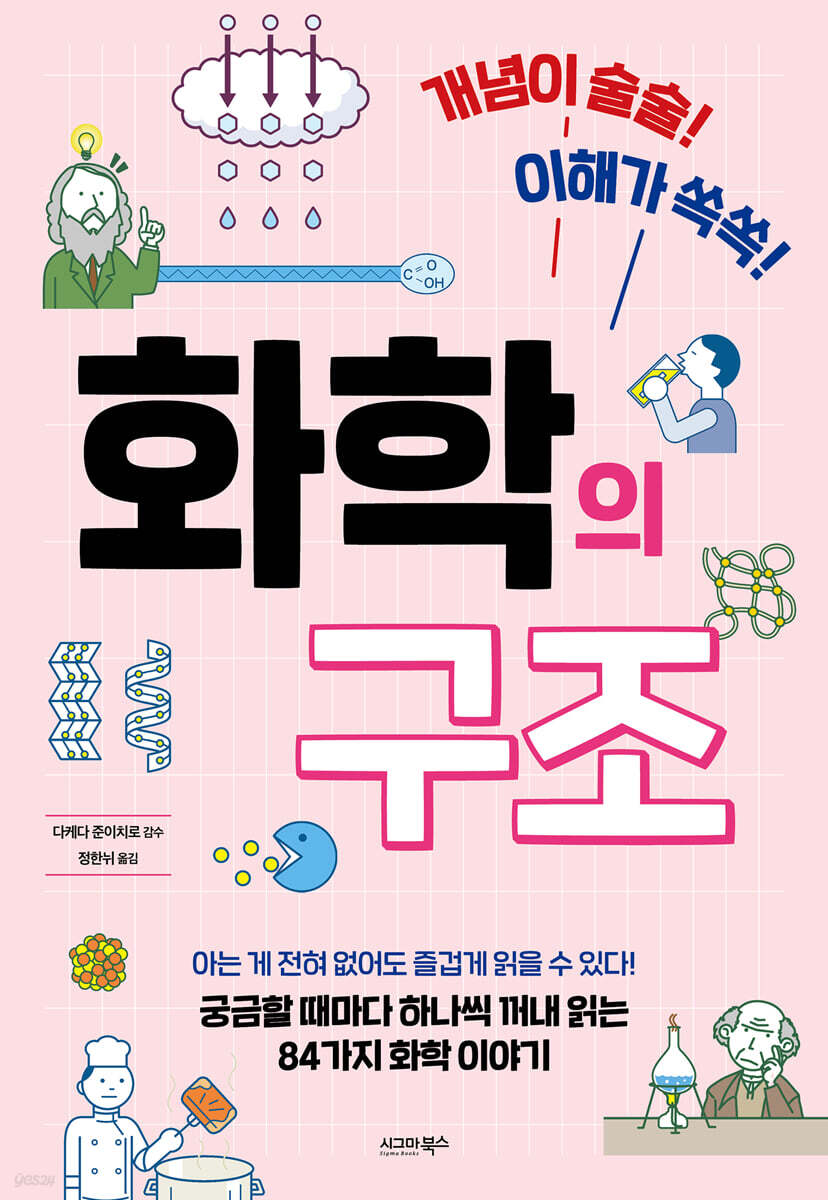
The structure of chemistry
 |
Description
Book Introduction
Even if you know nothing about it, you can still enjoy reading it!
84 Chemistry Stories to Read One by One Whenever You're Curious
How does soap remove grease? Why do fireflies glow? Why does boiling meat make it tender? How does an eraser erase writing?... We often overlook these mysteries, but never really consider their "why?" behind countless other worldly principles. The mysterious mechanisms of chemistry are at work!
"Concepts Flow! Understand with Ease! The Structure of Chemistry" is a "chemistry book for everyone," making it easy and enjoyable to learn about the chemical structures surrounding us.
From the chemical principles of everyday objects to the discovery and development of substances that transformed human life, discover 84 fascinating stories about chemistry that will captivate even those with no prior knowledge of chemistry.
If you open it and read it one by one as you like, you will soon find yourself getting closer to the boundless world of chemistry.
84 Chemistry Stories to Read One by One Whenever You're Curious
How does soap remove grease? Why do fireflies glow? Why does boiling meat make it tender? How does an eraser erase writing?... We often overlook these mysteries, but never really consider their "why?" behind countless other worldly principles. The mysterious mechanisms of chemistry are at work!
"Concepts Flow! Understand with Ease! The Structure of Chemistry" is a "chemistry book for everyone," making it easy and enjoyable to learn about the chemical structures surrounding us.
From the chemical principles of everyday objects to the discovery and development of substances that transformed human life, discover 84 fascinating stories about chemistry that will captivate even those with no prior knowledge of chemistry.
If you open it and read it one by one as you like, you will soon find yourself getting closer to the boundless world of chemistry.
- You can preview some of the book's contents.
Preview
index
preface
Chapter 1.
The structure of chemistry and the questions surrounding us
01 Why does bread rise?
02 Why does rice become soft when cooked?
Selective Chemistry: A Look at It ① Is cup ramen more delicious when boiled at the summit of Mt. Halla or Mt. Everest?
03 Why does ice float on water?
04 Why do leaves change color?
05 Why do fireflies glow?
06 Is gold leaf really gold?
Selective Chemistry: A Close Look ② Where Does the Smell of the Sea Come From?
07 Why does meat change color when grilled?
08 Why does meat become tender when cooked?
09 Why is milk white?
10 Why don't water and oil mix?
11 Why does perm make my hair curly?
12 Ions Protect Hair? The Hidden Chemistry in Shampoo and Conditioner
13 Why does my hair get frizzy on rainy days?
Selective Chemistry: A Close Look ③ Why Does My Hair Get Messy While I Sleep?
14 What Happens to the Food You Eat? The Hidden Chemistry of Digestion
15 What chemical changes are involved in making alcohol?
16 What is the principle of sobering up after being drunk?
17 How do illegal drugs work in the body?
18 Why does vinegar taste sour?
19 Why do sweet potatoes taste sweet?
20 Why are ripe fruits sweet?
21 Why are oils classified into liquid and solid?
Chemistry in detail ④ What is the 'white substance' that appears when honey is left alone?
Great Chemist ① Robert Boyle
Chapter 2.
I want to know more! The ins and outs of chemistry
22 How does a microwave oven heat food?
23 How does an eraser erase pencil writing?
24 Erasable ballpoint pens! How do you erase them?
A Look at Selective Chemistry ⑤ Luminol Reagent, the Bloodstain Reagent! What Reaction Will It Produce?
25 What is a liquid crystal display? How does it display images?
26 How does adhesive stick things together?
27 What is the secret behind a wrinkle-free shirt?
28 Why does rust rust?
29 Do the air tanks used for diving only contain air?
30 How does a fire extinguisher put out a fire?
Chemistry in detail ⑥ What is the identity of the powder sprinkled when melting snow?
31 What is the principle by which soap removes grease?
32 Why shouldn't you mix bleach?
33 What kind of material is a plastic bottle?
34 How to Get Rid of Odors? The Hidden Chemistry in Deodorants
35 How do disposable diapers absorb water?
36 Sulfuric acid, which dissolves anything! An important raw material in industry?
37 What is the identity of the fuel gas we use?
Great Chemist ② Marie Curie
Chapter 3.
I see! The discovery and development of chemistry
38 Let's find out the starting point of 'chemistry'.
39 How were atoms, the source of all matter, discovered?
40. A Guide to Chemical Research? The Invention of the Periodic Table
Chemistry in Detail ⑦ What element does the symbol Dalton invented represent?
41 Humans have used iron since before the Common Era? The history of iron production.
42 The energy revolution began with burning stones and coal?
43 The Battle for Rubber? The Invention of Rubber Vulcanization
44 The invention of artificial nitrogen fertilizer that saved humanity from food shortages
45 Black Powder and Dynamite! The History of Explosives
46. Not Just Bubbles? The Public Achievement of Carbonated Soda
47 Why did humans make herbs into medicine?
48 Is it true that the synthesis of quinine was the catalyst for the development of medicine worldwide?
49 An Indispensable Process in Medicine? The Discovery and Development of Disinfection
Killing only 50 germs? Discovery of Chemotherapy ①
51 Using Fungi as Antibiotics? The Discovery of Chemotherapy ②
52 The first photographs were developed on asphalt?
From Film to Digital! The Evolution of Cameras
54 Synthetic dye discovered by chance
55 Did the invention of rayon and nylon change clothing?
56 How is the plastic around us made?
57 What is ceramic that has been used from ancient times to the present?
58 The black liquid that sustains distribution? The gasoline refining process.
59 How was nuclear fission discovered and studied?
Selective Chemistry: A Close Look ⑧ What is the battery with the longest lifespan?
Great Chemist ③ Yoan Udagawa
Chapter 4.
A chemistry story I want to share with my friends right now
Japanese researcher who won the 60th Nobel Prize in Chemistry
61 Why do raw eggs harden when heated?
62 What are food additives?
63. There's a flavoring ingredient? What is the umami ingredient?
64 What is the most powerful 'strongest poison'?
65 What is an eco-friendly and convenient catalyst?
Chemistry in Detail ⑨ Can the weather be changed with the power of chemistry?
66 There is a plastic that conducts electricity?
67 Are 'dream chemicals' actually destroying the planet?
68 What are the advantages of biofuels?
69 What is green chemistry?
70 How are PET bottles recycled?
71 Biodegradable plastics that are good for the environment
Selective Chemistry ⑩ What elements should be analyzed to investigate fossils from tens of thousands of years ago?
72 Can Natural Compounds Be Made Artificially?
73 Analyzing with the Power of Chemistry! Destructive and Nondestructive Testing
Selective Chemistry ⑪ Can we create humans artificially?
Great Chemist ④ Jokichi Takamine
References
Chapter 1.
The structure of chemistry and the questions surrounding us
01 Why does bread rise?
02 Why does rice become soft when cooked?
Selective Chemistry: A Look at It ① Is cup ramen more delicious when boiled at the summit of Mt. Halla or Mt. Everest?
03 Why does ice float on water?
04 Why do leaves change color?
05 Why do fireflies glow?
06 Is gold leaf really gold?
Selective Chemistry: A Close Look ② Where Does the Smell of the Sea Come From?
07 Why does meat change color when grilled?
08 Why does meat become tender when cooked?
09 Why is milk white?
10 Why don't water and oil mix?
11 Why does perm make my hair curly?
12 Ions Protect Hair? The Hidden Chemistry in Shampoo and Conditioner
13 Why does my hair get frizzy on rainy days?
Selective Chemistry: A Close Look ③ Why Does My Hair Get Messy While I Sleep?
14 What Happens to the Food You Eat? The Hidden Chemistry of Digestion
15 What chemical changes are involved in making alcohol?
16 What is the principle of sobering up after being drunk?
17 How do illegal drugs work in the body?
18 Why does vinegar taste sour?
19 Why do sweet potatoes taste sweet?
20 Why are ripe fruits sweet?
21 Why are oils classified into liquid and solid?
Chemistry in detail ④ What is the 'white substance' that appears when honey is left alone?
Great Chemist ① Robert Boyle
Chapter 2.
I want to know more! The ins and outs of chemistry
22 How does a microwave oven heat food?
23 How does an eraser erase pencil writing?
24 Erasable ballpoint pens! How do you erase them?
A Look at Selective Chemistry ⑤ Luminol Reagent, the Bloodstain Reagent! What Reaction Will It Produce?
25 What is a liquid crystal display? How does it display images?
26 How does adhesive stick things together?
27 What is the secret behind a wrinkle-free shirt?
28 Why does rust rust?
29 Do the air tanks used for diving only contain air?
30 How does a fire extinguisher put out a fire?
Chemistry in detail ⑥ What is the identity of the powder sprinkled when melting snow?
31 What is the principle by which soap removes grease?
32 Why shouldn't you mix bleach?
33 What kind of material is a plastic bottle?
34 How to Get Rid of Odors? The Hidden Chemistry in Deodorants
35 How do disposable diapers absorb water?
36 Sulfuric acid, which dissolves anything! An important raw material in industry?
37 What is the identity of the fuel gas we use?
Great Chemist ② Marie Curie
Chapter 3.
I see! The discovery and development of chemistry
38 Let's find out the starting point of 'chemistry'.
39 How were atoms, the source of all matter, discovered?
40. A Guide to Chemical Research? The Invention of the Periodic Table
Chemistry in Detail ⑦ What element does the symbol Dalton invented represent?
41 Humans have used iron since before the Common Era? The history of iron production.
42 The energy revolution began with burning stones and coal?
43 The Battle for Rubber? The Invention of Rubber Vulcanization
44 The invention of artificial nitrogen fertilizer that saved humanity from food shortages
45 Black Powder and Dynamite! The History of Explosives
46. Not Just Bubbles? The Public Achievement of Carbonated Soda
47 Why did humans make herbs into medicine?
48 Is it true that the synthesis of quinine was the catalyst for the development of medicine worldwide?
49 An Indispensable Process in Medicine? The Discovery and Development of Disinfection
Killing only 50 germs? Discovery of Chemotherapy ①
51 Using Fungi as Antibiotics? The Discovery of Chemotherapy ②
52 The first photographs were developed on asphalt?
From Film to Digital! The Evolution of Cameras
54 Synthetic dye discovered by chance
55 Did the invention of rayon and nylon change clothing?
56 How is the plastic around us made?
57 What is ceramic that has been used from ancient times to the present?
58 The black liquid that sustains distribution? The gasoline refining process.
59 How was nuclear fission discovered and studied?
Selective Chemistry: A Close Look ⑧ What is the battery with the longest lifespan?
Great Chemist ③ Yoan Udagawa
Chapter 4.
A chemistry story I want to share with my friends right now
Japanese researcher who won the 60th Nobel Prize in Chemistry
61 Why do raw eggs harden when heated?
62 What are food additives?
63. There's a flavoring ingredient? What is the umami ingredient?
64 What is the most powerful 'strongest poison'?
65 What is an eco-friendly and convenient catalyst?
Chemistry in Detail ⑨ Can the weather be changed with the power of chemistry?
66 There is a plastic that conducts electricity?
67 Are 'dream chemicals' actually destroying the planet?
68 What are the advantages of biofuels?
69 What is green chemistry?
70 How are PET bottles recycled?
71 Biodegradable plastics that are good for the environment
Selective Chemistry ⑩ What elements should be analyzed to investigate fossils from tens of thousands of years ago?
72 Can Natural Compounds Be Made Artificially?
73 Analyzing with the Power of Chemistry! Destructive and Nondestructive Testing
Selective Chemistry ⑪ Can we create humans artificially?
Great Chemist ④ Jokichi Takamine
References
Detailed image
.jpg)
Into the book
The reason bread rises is because the dough has been fermented.
Fermentation is a phenomenon that occurs when microorganisms in food multiply, and yeast is used to cause fermentation in bread.
Yeast grows at room temperature and consumes glucose produced by breaking down carbohydrates, including flour, to produce alcohol and carbon dioxide. This is called alcoholic fermentation.
The carbon dioxide produced during this fermentation process causes the dough to rise.
--- p.14
There are two types of oil: animal oil and vegetable oil.
Animal fats such as lard and butter solidify at room temperature, but vegetable oils such as salad oil do not solidify.
This is because their melting points are different.
Vegetable oils with low melting points are liquid at room temperature, while animal oils with high melting points are solid at room temperature.
--- p.60
The household penetration rate of microwave ovens is almost 100%.
A microwave oven is a cooking appliance that heats food using electromagnetic waves.
The principle of heating food is to vibrate water molecules strongly.
The more intense the movement of the atoms and molecules that make up a substance, the higher the temperature.
In 1945, American Percy Spencer was standing in front of an operating radar and got the idea to invent it when the chocolate in his pocket melted due to the electromagnetic waves.
--- p.66
When soap dissolves in water, its molecules attach themselves to grease molecules in a circular fashion, forming micelles, spherical particles with hydrophilic groups facing outward and hydrophobic groups facing inward.
And the oil stains fall off the surface of the clothes and enter the micelles, where they are dispersed in the water as fine particles, thus cleaning the clothes (Figure 2).
Substances that have this action, such as emulsifiers, hydrophilic groups, and hydrophobic groups, are called surfactants.
--- p.88
In ancient Greece, there was a philosopher who thought that 'all matter is made up of countless atoms (unbreakable particles)'.
However, until the 17th century, the theory of the four elements, which states that “all matter is made up of four elements: fire, water, air, and earth,” was dominant.
Until modern times, chemists studied substances only by imagining them, without knowing what form they took.
--- p.106
The first person to create a device that captured the landscape seen through a camera obscura and captured it in a photograph was the French chemist Joseph Nicéphore Niépce.
Niepce took advantage of the property of asphalt (a hydrocarbon found in crude oil) to harden when exposed to light, washed away the unhardened portion, and created a disk.
Holes are created in the areas that are not exposed to light, and by pouring ink through those holes, you can draw an image on the paper like a print (etching).
This technique is called heliography, and the device is called a heliograph.
--- p.134
The reason processed meats like ham and sausages have a bright red color like fresh raw meat even though they have been heat-treated is because they contain a coloring agent called sodium nitrite.
The reason meat is bright red is because of a pigment called myoglobin in the muscles, and sodium nitrite prevents oxidation, which helps maintain this bright red color.
--- p.160
Chemical recycling is a method of chemically decomposing waste, returning it to its raw material state, and then recycling it.
This method allows recycling of colored PET bottles and yields high-quality PET resin.
Washed and crushed PET flakes are chemically decomposed to remove impurities.
When this is chemically synthesized (polymerized) in a dedicated reactor, a new PET resin is created, which is used as a raw material to make recycled PET bottles.
Another method is to remove impurities by crushing and washing PET resin and treating it at high temperature under low pressure.
Fermentation is a phenomenon that occurs when microorganisms in food multiply, and yeast is used to cause fermentation in bread.
Yeast grows at room temperature and consumes glucose produced by breaking down carbohydrates, including flour, to produce alcohol and carbon dioxide. This is called alcoholic fermentation.
The carbon dioxide produced during this fermentation process causes the dough to rise.
--- p.14
There are two types of oil: animal oil and vegetable oil.
Animal fats such as lard and butter solidify at room temperature, but vegetable oils such as salad oil do not solidify.
This is because their melting points are different.
Vegetable oils with low melting points are liquid at room temperature, while animal oils with high melting points are solid at room temperature.
--- p.60
The household penetration rate of microwave ovens is almost 100%.
A microwave oven is a cooking appliance that heats food using electromagnetic waves.
The principle of heating food is to vibrate water molecules strongly.
The more intense the movement of the atoms and molecules that make up a substance, the higher the temperature.
In 1945, American Percy Spencer was standing in front of an operating radar and got the idea to invent it when the chocolate in his pocket melted due to the electromagnetic waves.
--- p.66
When soap dissolves in water, its molecules attach themselves to grease molecules in a circular fashion, forming micelles, spherical particles with hydrophilic groups facing outward and hydrophobic groups facing inward.
And the oil stains fall off the surface of the clothes and enter the micelles, where they are dispersed in the water as fine particles, thus cleaning the clothes (Figure 2).
Substances that have this action, such as emulsifiers, hydrophilic groups, and hydrophobic groups, are called surfactants.
--- p.88
In ancient Greece, there was a philosopher who thought that 'all matter is made up of countless atoms (unbreakable particles)'.
However, until the 17th century, the theory of the four elements, which states that “all matter is made up of four elements: fire, water, air, and earth,” was dominant.
Until modern times, chemists studied substances only by imagining them, without knowing what form they took.
--- p.106
The first person to create a device that captured the landscape seen through a camera obscura and captured it in a photograph was the French chemist Joseph Nicéphore Niépce.
Niepce took advantage of the property of asphalt (a hydrocarbon found in crude oil) to harden when exposed to light, washed away the unhardened portion, and created a disk.
Holes are created in the areas that are not exposed to light, and by pouring ink through those holes, you can draw an image on the paper like a print (etching).
This technique is called heliography, and the device is called a heliograph.
--- p.134
The reason processed meats like ham and sausages have a bright red color like fresh raw meat even though they have been heat-treated is because they contain a coloring agent called sodium nitrite.
The reason meat is bright red is because of a pigment called myoglobin in the muscles, and sodium nitrite prevents oxidation, which helps maintain this bright red color.
--- p.160
Chemical recycling is a method of chemically decomposing waste, returning it to its raw material state, and then recycling it.
This method allows recycling of colored PET bottles and yields high-quality PET resin.
Washed and crushed PET flakes are chemically decomposed to remove impurities.
When this is chemically synthesized (polymerized) in a dedicated reactor, a new PET resin is created, which is used as a raw material to make recycled PET bottles.
Another method is to remove impurities by crushing and washing PET resin and treating it at high temperature under low pressure.
--- p.178
Publisher's Review
Discover the laws of chemistry hidden in every corner of our daily lives!
A chemistry book for everyone who wants to become familiar with chemistry.
The world we live in is full of various chemical reactions.
Plastics, fibers, and rubber, which are essential materials in our daily lives, are all made through chemical reactions.
The reason we can eat delicious food is because chemical reactions occur in the ingredients during cooking, such as steaming or grilling.
The process by which food eaten in this way is digested in the body and converted into energy is also a chemical reaction.
Although chemistry is undoubtedly a discipline closely related to our lives, there are countless instances where we cannot experience it even if we want to.
The reason is simple.
Because it is difficult.
Even if you become interested in chemistry and eagerly open a chemistry book on the market, you will soon become intimidated and take a step back because of the complex symbols and chemical formulas that are pouring out.
“Chemistry is a subject where you have to memorize element symbols, reaction equations, and do a lot of headache-inducing calculations, right?”, “I learned it in school, but I can’t even remember the element symbols, let alone the reaction equations.” From students who have built a wall around chemistry to adults who want to learn chemistry again, 『Concepts are Fluid! Understand it! The Structure of Chemistry』 is a book for all those ‘chemistry idiots’ who want to become familiar with chemistry but are caught in the dilemma of not being able to do so.
Stop the compulsion to read in order!
You can open any page and read it
The World of Chemistry Beyond the Classroom
Chapter 1, "Questions Around Us and the Structure of Chemistry," explains common phenomena we encounter around us, such as "Why don't water and oil mix?" and "Why does ice float on water?", from a chemical perspective in an easy and fun way.
Chapter 2, "I Want to Know More! The Ins and Outs of Chemistry," delves into the chemical structures of everyday objects, focusing on topics like "How do adhesives stick together?" and "How does soap remove grease?"
In Chapter 3, "That's Right! The Discovery and Development of Chemistry," we explore the invention and discovery of essential scientific products in modern society, such as coal, petroleum, rubber, synthetic fibers, iron, and pharmaceuticals, and how these substances have transformed human life.
The final chapter, Chapter 4, "Chemistry Stories You'll Want to Share with Your Friends Right Now," introduces other interesting chemistry issues, such as "What are the benefits of biofuels?" and "What is green chemistry?"
Included throughout the text are 11 interesting chemistry trivia questions, such as "Would cup ramen taste better boiled at the summit of Hallasan or Mount Everest?" and "Can the weather be changed with the power of chemistry?", along with stories of great figures who will forever be remembered in the history of chemistry.
Here's a tip for those reading "Concepts Flow! Understand It Quickly! The Structure of Chemistry."
Let's abandon the compulsion to read from beginning to end, like a textbook or reference book! This book is structured so that you can open to any page and grasp and enjoy a single, engaging topic at a glance.
With each page you turn, you will discover a colorful array of stories about the chemistry hidden around us: how bread rises, the difference between shampoo and conditioner, how a fire extinguisher puts out a fire, the history of iron production, and more.
A chemistry book for everyone who wants to become familiar with chemistry.
The world we live in is full of various chemical reactions.
Plastics, fibers, and rubber, which are essential materials in our daily lives, are all made through chemical reactions.
The reason we can eat delicious food is because chemical reactions occur in the ingredients during cooking, such as steaming or grilling.
The process by which food eaten in this way is digested in the body and converted into energy is also a chemical reaction.
Although chemistry is undoubtedly a discipline closely related to our lives, there are countless instances where we cannot experience it even if we want to.
The reason is simple.
Because it is difficult.
Even if you become interested in chemistry and eagerly open a chemistry book on the market, you will soon become intimidated and take a step back because of the complex symbols and chemical formulas that are pouring out.
“Chemistry is a subject where you have to memorize element symbols, reaction equations, and do a lot of headache-inducing calculations, right?”, “I learned it in school, but I can’t even remember the element symbols, let alone the reaction equations.” From students who have built a wall around chemistry to adults who want to learn chemistry again, 『Concepts are Fluid! Understand it! The Structure of Chemistry』 is a book for all those ‘chemistry idiots’ who want to become familiar with chemistry but are caught in the dilemma of not being able to do so.
Stop the compulsion to read in order!
You can open any page and read it
The World of Chemistry Beyond the Classroom
Chapter 1, "Questions Around Us and the Structure of Chemistry," explains common phenomena we encounter around us, such as "Why don't water and oil mix?" and "Why does ice float on water?", from a chemical perspective in an easy and fun way.
Chapter 2, "I Want to Know More! The Ins and Outs of Chemistry," delves into the chemical structures of everyday objects, focusing on topics like "How do adhesives stick together?" and "How does soap remove grease?"
In Chapter 3, "That's Right! The Discovery and Development of Chemistry," we explore the invention and discovery of essential scientific products in modern society, such as coal, petroleum, rubber, synthetic fibers, iron, and pharmaceuticals, and how these substances have transformed human life.
The final chapter, Chapter 4, "Chemistry Stories You'll Want to Share with Your Friends Right Now," introduces other interesting chemistry issues, such as "What are the benefits of biofuels?" and "What is green chemistry?"
Included throughout the text are 11 interesting chemistry trivia questions, such as "Would cup ramen taste better boiled at the summit of Hallasan or Mount Everest?" and "Can the weather be changed with the power of chemistry?", along with stories of great figures who will forever be remembered in the history of chemistry.
Here's a tip for those reading "Concepts Flow! Understand It Quickly! The Structure of Chemistry."
Let's abandon the compulsion to read from beginning to end, like a textbook or reference book! This book is structured so that you can open to any page and grasp and enjoy a single, engaging topic at a glance.
With each page you turn, you will discover a colorful array of stories about the chemistry hidden around us: how bread rises, the difference between shampoo and conditioner, how a fire extinguisher puts out a fire, the history of iron production, and more.
GOODS SPECIFICS
- Date of issue: February 10, 2025
- Page count, weight, size: 192 pages | 382g | 145*210*15mm
- ISBN13: 9791168623163
- ISBN10: 1168623162
You may also like
카테고리
korean


korean

![GQ KOREA Mark (Monthly): December [2025]](http://librairie.coreenne.fr/cdn/shop/files/8ef265dbbfbf186523ed75ba7319009d.jpg?v=1765340328&width=3840)


