

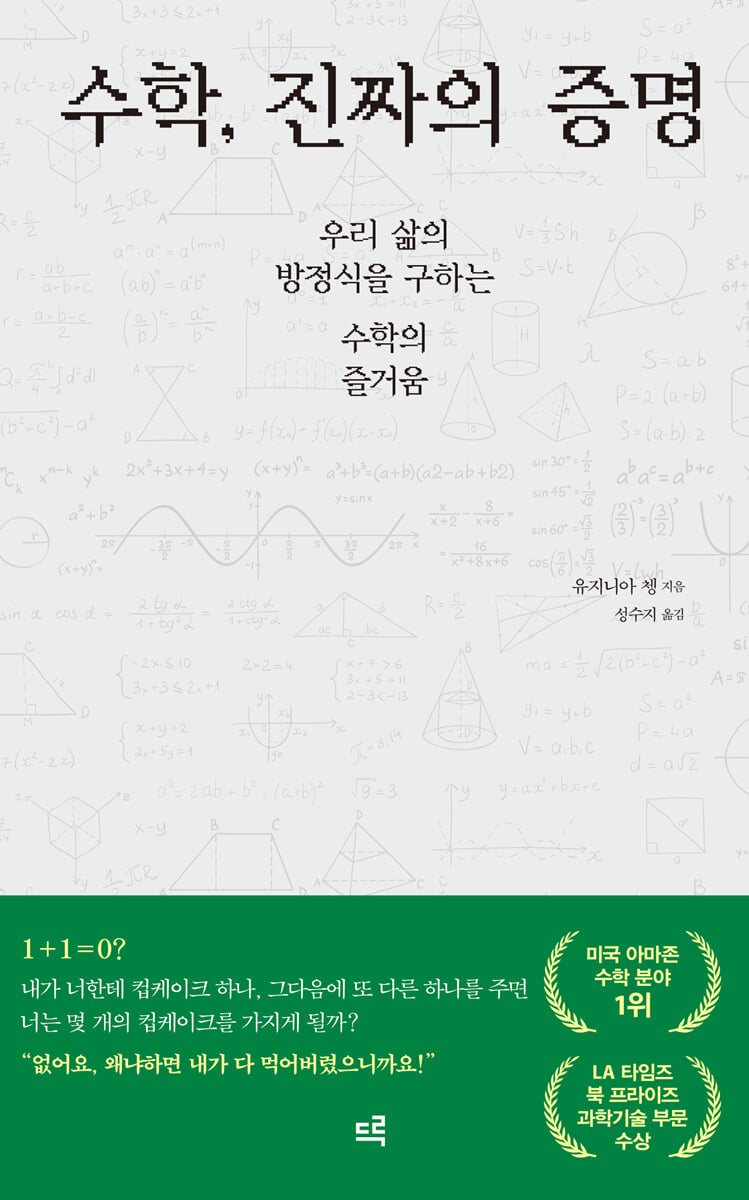
Mathematics, the proof of truth
 |
Description
Book Introduction
★#1 Math Book on Amazon in the US★
★LA Times Book Prize Winner in the Science and Technology Category★
Is mathematics, which cannot be felt or seen with the eyes, real?
“Mathematics doesn’t really exist, but it is ‘real’!”
A way to face real mathematics and enjoy life with mathematics!
Some people love math, while others hate it.
What's surprising here is that the reasons we love math and the reasons we hate math are often the same.
While some people say they love math because it has clear answers, others say that because it has clear answers, it fails to reflect many aspects of life.
The latter also add that one cannot find joy in life through black-and-white logic.
But the image of a "rigid world with clear answers" is a very limited view of mathematics, the book's authors argue.
Rather, the deeper you delve into it, the more you realize that there are no clear answers in mathematics, and that mathematics is a discipline that studies various aspects, and therefore, you may find multiple answers.
So, is mathematics, which has no right answer and extends infinitely, truly "real"? Can something we can't touch or see be called real? "Mathematics: Proof of Reality" argues that all the questions we ask about mathematics are crucial.
So, let's start with the little things: where does math come from, how does math work, why do we do math, what makes math fun, etc.
After that, we talk about the specific elements that make up mathematics, such as letters, formulas, and pictures.
And renowned mathematicians have had similar questions, and they even provide examples of how they connected existing knowledge to answer those questions.
If you have always hated math because it is difficult, this book will be your chance to become familiar with it again.
★LA Times Book Prize Winner in the Science and Technology Category★
Is mathematics, which cannot be felt or seen with the eyes, real?
“Mathematics doesn’t really exist, but it is ‘real’!”
A way to face real mathematics and enjoy life with mathematics!
Some people love math, while others hate it.
What's surprising here is that the reasons we love math and the reasons we hate math are often the same.
While some people say they love math because it has clear answers, others say that because it has clear answers, it fails to reflect many aspects of life.
The latter also add that one cannot find joy in life through black-and-white logic.
But the image of a "rigid world with clear answers" is a very limited view of mathematics, the book's authors argue.
Rather, the deeper you delve into it, the more you realize that there are no clear answers in mathematics, and that mathematics is a discipline that studies various aspects, and therefore, you may find multiple answers.
So, is mathematics, which has no right answer and extends infinitely, truly "real"? Can something we can't touch or see be called real? "Mathematics: Proof of Reality" argues that all the questions we ask about mathematics are crucial.
So, let's start with the little things: where does math come from, how does math work, why do we do math, what makes math fun, etc.
After that, we talk about the specific elements that make up mathematics, such as letters, formulas, and pictures.
And renowned mathematicians have had similar questions, and they even provide examples of how they connected existing knowledge to answer those questions.
If you have always hated math because it is difficult, this book will be your chance to become familiar with it again.
- You can preview some of the book's contents.
Preview
index
Entering
Chapter 1: Where Does Mathematics Come From?
Chapter 2: How Math Works
Chapter 3: Why We Do Math
Chapter 4: What Makes Math Great?
Chapter 5 Characters
Chapter 6 Formula
Chapter 7 Figure
Chapter 8 Story
In conclusion
Acknowledgements
Chapter 1: Where Does Mathematics Come From?
Chapter 2: How Math Works
Chapter 3: Why We Do Math
Chapter 4: What Makes Math Great?
Chapter 5 Characters
Chapter 6 Formula
Chapter 7 Figure
Chapter 8 Story
In conclusion
Acknowledgements
Detailed image

Into the book
There is a difference between the reality of mathematics and the perception of mathematics.
I want to close that gap.
There are too many people who hate math to the point of being unnecessary.
In reality, it is an important question that gets to the heart of the matter, but I cringe because I feel like I am asking such a basic question.
Even those around me scold me for asking that important question, calling it a stupid question or something that shouldn't be asked in math.
I would like to answer such questions.
--- p.12
Mathematics doesn't 'really exist', but it is 'real'.
Mathematics is about real ideas, real thoughts, and real understanding.
I love the clarity that mathematics provides.
However, it is unfortunate that this clarity sometimes seems to divide everything into strict black and white rather than clarifying ambiguities.
But I also sympathize with people who think that way.
That's probably because of the way you mainly approach math.
I too had that experience during my school days.
--- p.18
Viral diseases spread through repeated replication.
This is the principle that each infected person infects a certain number of people on average.
Let's assume there are 3 infected people.
Then, each of those 3 infected people will infect an average of 3 people, which is 3 x 3 = 9 people.
And each of those 9 infected people will infect 3 more people, making 3 x 9 = 27 people.
At each stage, the total number of new infections is the result of multiplying the number of existing infections by 3.
This 'exponential', which represents repeated multiplication, is a field studied abstractly, much like how mathematicians study repeated addition.
--- p.61
The question, 'Why can't we divide by zero?' has plagued people for centuries.
Some people say this is obvious.
If we were to divide up a bunch of cookies and give each person 0 cookies, we would never be able to use all the cookies.
However, this depends on the interpretation of what is meant by 'divide'.
Here's where another interpretation comes in.
If we were to distribute a bundle of cookies among zero people, how many cookies would each person get? That's a bit of a tricky question.
Because it may seem like everyone has 0 cookies.
Also, since 0 people each have 1 cookie, we can consider that everyone has 1 cookie.
In the same way, we can also say that everyone has two cookies.
--- p.120
People have long thought that infinity actually means thousands of years.
The questions posed by mathematicians and philosophers thousands of years ago are the same ones that curious children often ask today.
What is infinity? Are numbers infinite? Can we reach infinity? Are there infinite things in the world? If something were divided into an infinite number of pieces, how large would each piece be? Many of these questions were explored by the Greek philosopher Zeno and his colleagues.
And here the mysteries are compressed into Zeno's contradictions.
My favorite part is the part where it describes 'how to keep chocolate cake forever'.
Eat half of a chocolate cake, then eat half of that remaining half, then eat half of that remaining half.
This is to continue.
--- p.197
It is true that letters are more abstract than numbers.
But numbers are already more abstract than the things they are trying to integrate, and most of us have only a vague grasp of that abstraction.
That's also something I understood at a fairly young age.
This shows that we are all capable of abstract thinking.
It can be confusing if you don't know why you're thinking abstractly.
In most cases like that, there will be no clear motive.
If you had more motivation, like catching a ball or ironing, you would naturally learn how to do it, but you still can't do it because you don't have the motivation to do it.
--- p.284
Florence Nightingale, also known as the "angel with the lamp," is perhaps most widely remembered as a great nurse.
The important thing is that she was actually a brilliant mathematician and statistician.
She implemented measures to dramatically reduce the death rate, including improving the soldiers' diet, hospital cleaning, ventilation, and sewage systems.
But here, she not only did this analysis, but she also understood how important it was to communicate the data clearly and vividly to those in power who might not understand it, so she devised a visually appealing way to present the data.
What she came up with was a pie chart version, which she called a "mandrami."
But now it has a rather common name: 'polar area diagram'.
I want to close that gap.
There are too many people who hate math to the point of being unnecessary.
In reality, it is an important question that gets to the heart of the matter, but I cringe because I feel like I am asking such a basic question.
Even those around me scold me for asking that important question, calling it a stupid question or something that shouldn't be asked in math.
I would like to answer such questions.
--- p.12
Mathematics doesn't 'really exist', but it is 'real'.
Mathematics is about real ideas, real thoughts, and real understanding.
I love the clarity that mathematics provides.
However, it is unfortunate that this clarity sometimes seems to divide everything into strict black and white rather than clarifying ambiguities.
But I also sympathize with people who think that way.
That's probably because of the way you mainly approach math.
I too had that experience during my school days.
--- p.18
Viral diseases spread through repeated replication.
This is the principle that each infected person infects a certain number of people on average.
Let's assume there are 3 infected people.
Then, each of those 3 infected people will infect an average of 3 people, which is 3 x 3 = 9 people.
And each of those 9 infected people will infect 3 more people, making 3 x 9 = 27 people.
At each stage, the total number of new infections is the result of multiplying the number of existing infections by 3.
This 'exponential', which represents repeated multiplication, is a field studied abstractly, much like how mathematicians study repeated addition.
--- p.61
The question, 'Why can't we divide by zero?' has plagued people for centuries.
Some people say this is obvious.
If we were to divide up a bunch of cookies and give each person 0 cookies, we would never be able to use all the cookies.
However, this depends on the interpretation of what is meant by 'divide'.
Here's where another interpretation comes in.
If we were to distribute a bundle of cookies among zero people, how many cookies would each person get? That's a bit of a tricky question.
Because it may seem like everyone has 0 cookies.
Also, since 0 people each have 1 cookie, we can consider that everyone has 1 cookie.
In the same way, we can also say that everyone has two cookies.
--- p.120
People have long thought that infinity actually means thousands of years.
The questions posed by mathematicians and philosophers thousands of years ago are the same ones that curious children often ask today.
What is infinity? Are numbers infinite? Can we reach infinity? Are there infinite things in the world? If something were divided into an infinite number of pieces, how large would each piece be? Many of these questions were explored by the Greek philosopher Zeno and his colleagues.
And here the mysteries are compressed into Zeno's contradictions.
My favorite part is the part where it describes 'how to keep chocolate cake forever'.
Eat half of a chocolate cake, then eat half of that remaining half, then eat half of that remaining half.
This is to continue.
--- p.197
It is true that letters are more abstract than numbers.
But numbers are already more abstract than the things they are trying to integrate, and most of us have only a vague grasp of that abstraction.
That's also something I understood at a fairly young age.
This shows that we are all capable of abstract thinking.
It can be confusing if you don't know why you're thinking abstractly.
In most cases like that, there will be no clear motive.
If you had more motivation, like catching a ball or ironing, you would naturally learn how to do it, but you still can't do it because you don't have the motivation to do it.
--- p.284
Florence Nightingale, also known as the "angel with the lamp," is perhaps most widely remembered as a great nurse.
The important thing is that she was actually a brilliant mathematician and statistician.
She implemented measures to dramatically reduce the death rate, including improving the soldiers' diet, hospital cleaning, ventilation, and sewage systems.
But here, she not only did this analysis, but she also understood how important it was to communicate the data clearly and vividly to those in power who might not understand it, so she devised a visually appealing way to present the data.
What she came up with was a pie chart version, which she called a "mandrami."
But now it has a rather common name: 'polar area diagram'.
--- p.393
Publisher's Review
The Origins and Abstraction of Mathematics
Mathematics originated from the human instinct to understand better.
To do this, we found a way to see the world more simply and more clearly.
That is 'abstraction'.
Abstraction is the art of focusing on only what is important in a complex reality, while not forgetting that other elements exist.
And the result of abstraction is numbers.
Numbers are not simply tools for counting.
This is a wonderful invention of our thinking, the essence of abstract thinking that simplifies reality without losing sight of its essence.
"Mathematics, the Real Proof" tells us that such numbers were born through such a profound process, and kindly explains why numbers can feel so boring.
Abstraction is just the beginning of mathematics.
Abstraction, so to speak, was an early tool we used to understand and explain the world.
But mathematics is not just a bunch of boring numbers; it's a truly revolutionary way of looking at the world and things in a new way, which is why it's such a wonderful language in itself.
"Mathematics, the Real Proof" continues the story of why numbers had to inevitably come into being and why the beginning of mathematics is the beginning of abstraction.
This book looks back at the background behind the numbers we simply think of as 1, 2, 3, and shows how mathematics has shaped our thinking.
Mathematics, the Language of Insight: A Journey of Understanding and Discovery
Mathematics is not simply a discipline of memorization or calculation.
As mentioned earlier, mathematics originated from our instinct to better understand the world, and has developed through countless controversies and conflicts along the way.
The discovery of concepts such as negative numbers and zero has caused great controversy in the past.
Nonetheless, mathematics has played a role in resolving these controversies and raising human thinking to the next level.
The reason we study mathematics is not simply to solve problems.
Sometimes it's because I want to see more clearly some truth that's been looming in the distance, and sometimes it's because I don't want to just accept other people's answers.
Sometimes I have a specific problem I want to solve, and other times I just explore math for fun.
Mathematics satisfies these diverse motivations and needs, opening up infinite possibilities for human thought.
Good mathematics is not simply about determining what is true and what is false.
And mathematics goes further and provides deep insight into the truth.
This goes beyond simply organizing concepts; it empowers us to integrate diverse situations into a single logical system and apply that logic more broadly.
For example, concepts such as recurring decimals and complex numbers are not simply extensions of numbers.
These concepts expand the boundaries of mathematical thinking and offer new perspectives on how humans view problems.
Calculus is also a tool for understanding the natural world, and it presents a logical structure that is both innovative and beautiful in itself.
Interestingly, mathematics goes beyond the logical arrangement of numbers and symbols and is deeply connected to the human worldview.
This book explores not only the development of mathematical concepts, but also how ideas such as progressivism and colonialism have influenced mathematics.
It also shows that mathematics is not simply an academic discipline, but a language that operates within the historical and philosophical context of humankind.
Why do we need letters to understand letters, formulas, and mathematics?
When dealing with only numbers in mathematics, it may feel relatively simple, but the moment you start using letters, you may have felt that it is difficult and useless.
However, the reason for converting numbers to letters is that it is an efficient way to express more numbers at once.
It helps us deal with more complex concepts and acts as a tool that opens the way to a deeper understanding of the world through reasoning.
A formula is not simply a list of symbols to be memorized; it is a powerful tool with infinite possibilities.
Formulas concisely express the relationships between numbers and letters, allowing complex problems to be dealt with concisely.
If you fully understand the formula, you will naturally remember it without having to force yourself to memorize it.
"Mathematics, the Real Proof" explains formulas not as simple calculation tools, but as a means of expanding thinking and intuition.
So, in other words, an equation can be seen as a sentence that expresses the relationship between numbers.
Formulas developed from these equations condense complex calculations or inferences into a single, concise expression, helping us solve more problems effectively.
In mathematics, pictures are a powerful visual tool for understanding abstract concepts.
Graphs visually represent complex formulas, making it easier to intuitively understand relationships made up of only numbers and letters.
Graphs allow us to go beyond simply calculating formulas and understand the shapes and trends contained within them.
Of course, graphs can be somewhat lacking in formal and rigorous mathematical processes.
However, it is very effective in helping intuitive understanding and presenting complex mathematical concepts at a glance.
For this reason, pictures play an important role in visualizing abstract mathematical concepts and making them easier to understand.
『Mathematics, the Real Proof』 provides clear answers to questions that anyone would have while learning mathematics.
This book persuasively demonstrates that mathematics is more than just a tool for calculation; it enriches human thought and broadens our understanding.
Letters, formulas, and pictures are important elements of the language of mathematics.
These tools allow us to go beyond simple calculations and gain a deeper understanding of the complex relationships of the world.
"Mathematics, the Real Proof" explores the essence of mathematical thinking and helps readers experience the charm of mathematics.
Mathematics originated from the human instinct to understand better.
To do this, we found a way to see the world more simply and more clearly.
That is 'abstraction'.
Abstraction is the art of focusing on only what is important in a complex reality, while not forgetting that other elements exist.
And the result of abstraction is numbers.
Numbers are not simply tools for counting.
This is a wonderful invention of our thinking, the essence of abstract thinking that simplifies reality without losing sight of its essence.
"Mathematics, the Real Proof" tells us that such numbers were born through such a profound process, and kindly explains why numbers can feel so boring.
Abstraction is just the beginning of mathematics.
Abstraction, so to speak, was an early tool we used to understand and explain the world.
But mathematics is not just a bunch of boring numbers; it's a truly revolutionary way of looking at the world and things in a new way, which is why it's such a wonderful language in itself.
"Mathematics, the Real Proof" continues the story of why numbers had to inevitably come into being and why the beginning of mathematics is the beginning of abstraction.
This book looks back at the background behind the numbers we simply think of as 1, 2, 3, and shows how mathematics has shaped our thinking.
Mathematics, the Language of Insight: A Journey of Understanding and Discovery
Mathematics is not simply a discipline of memorization or calculation.
As mentioned earlier, mathematics originated from our instinct to better understand the world, and has developed through countless controversies and conflicts along the way.
The discovery of concepts such as negative numbers and zero has caused great controversy in the past.
Nonetheless, mathematics has played a role in resolving these controversies and raising human thinking to the next level.
The reason we study mathematics is not simply to solve problems.
Sometimes it's because I want to see more clearly some truth that's been looming in the distance, and sometimes it's because I don't want to just accept other people's answers.
Sometimes I have a specific problem I want to solve, and other times I just explore math for fun.
Mathematics satisfies these diverse motivations and needs, opening up infinite possibilities for human thought.
Good mathematics is not simply about determining what is true and what is false.
And mathematics goes further and provides deep insight into the truth.
This goes beyond simply organizing concepts; it empowers us to integrate diverse situations into a single logical system and apply that logic more broadly.
For example, concepts such as recurring decimals and complex numbers are not simply extensions of numbers.
These concepts expand the boundaries of mathematical thinking and offer new perspectives on how humans view problems.
Calculus is also a tool for understanding the natural world, and it presents a logical structure that is both innovative and beautiful in itself.
Interestingly, mathematics goes beyond the logical arrangement of numbers and symbols and is deeply connected to the human worldview.
This book explores not only the development of mathematical concepts, but also how ideas such as progressivism and colonialism have influenced mathematics.
It also shows that mathematics is not simply an academic discipline, but a language that operates within the historical and philosophical context of humankind.
Why do we need letters to understand letters, formulas, and mathematics?
When dealing with only numbers in mathematics, it may feel relatively simple, but the moment you start using letters, you may have felt that it is difficult and useless.
However, the reason for converting numbers to letters is that it is an efficient way to express more numbers at once.
It helps us deal with more complex concepts and acts as a tool that opens the way to a deeper understanding of the world through reasoning.
A formula is not simply a list of symbols to be memorized; it is a powerful tool with infinite possibilities.
Formulas concisely express the relationships between numbers and letters, allowing complex problems to be dealt with concisely.
If you fully understand the formula, you will naturally remember it without having to force yourself to memorize it.
"Mathematics, the Real Proof" explains formulas not as simple calculation tools, but as a means of expanding thinking and intuition.
So, in other words, an equation can be seen as a sentence that expresses the relationship between numbers.
Formulas developed from these equations condense complex calculations or inferences into a single, concise expression, helping us solve more problems effectively.
In mathematics, pictures are a powerful visual tool for understanding abstract concepts.
Graphs visually represent complex formulas, making it easier to intuitively understand relationships made up of only numbers and letters.
Graphs allow us to go beyond simply calculating formulas and understand the shapes and trends contained within them.
Of course, graphs can be somewhat lacking in formal and rigorous mathematical processes.
However, it is very effective in helping intuitive understanding and presenting complex mathematical concepts at a glance.
For this reason, pictures play an important role in visualizing abstract mathematical concepts and making them easier to understand.
『Mathematics, the Real Proof』 provides clear answers to questions that anyone would have while learning mathematics.
This book persuasively demonstrates that mathematics is more than just a tool for calculation; it enriches human thought and broadens our understanding.
Letters, formulas, and pictures are important elements of the language of mathematics.
These tools allow us to go beyond simple calculations and gain a deeper understanding of the complex relationships of the world.
"Mathematics, the Real Proof" explores the essence of mathematical thinking and helps readers experience the charm of mathematics.
GOODS SPECIFICS
- Date of issue: December 31, 2024
- Format: Hardcover book binding method guide
- Page count, weight, size: 476 pages | 676g | 135*210*27mm
- ISBN13: 9791172174842
You may also like
카테고리
korean


korean

![GQ KOREA Mark (Monthly): December [2025]](http://librairie.coreenne.fr/cdn/shop/files/8ef265dbbfbf186523ed75ba7319009d.jpg?v=1765340328&width=3840)


