

Song Ki-won's Post-Genome Era
 |
Description
Book Introduction
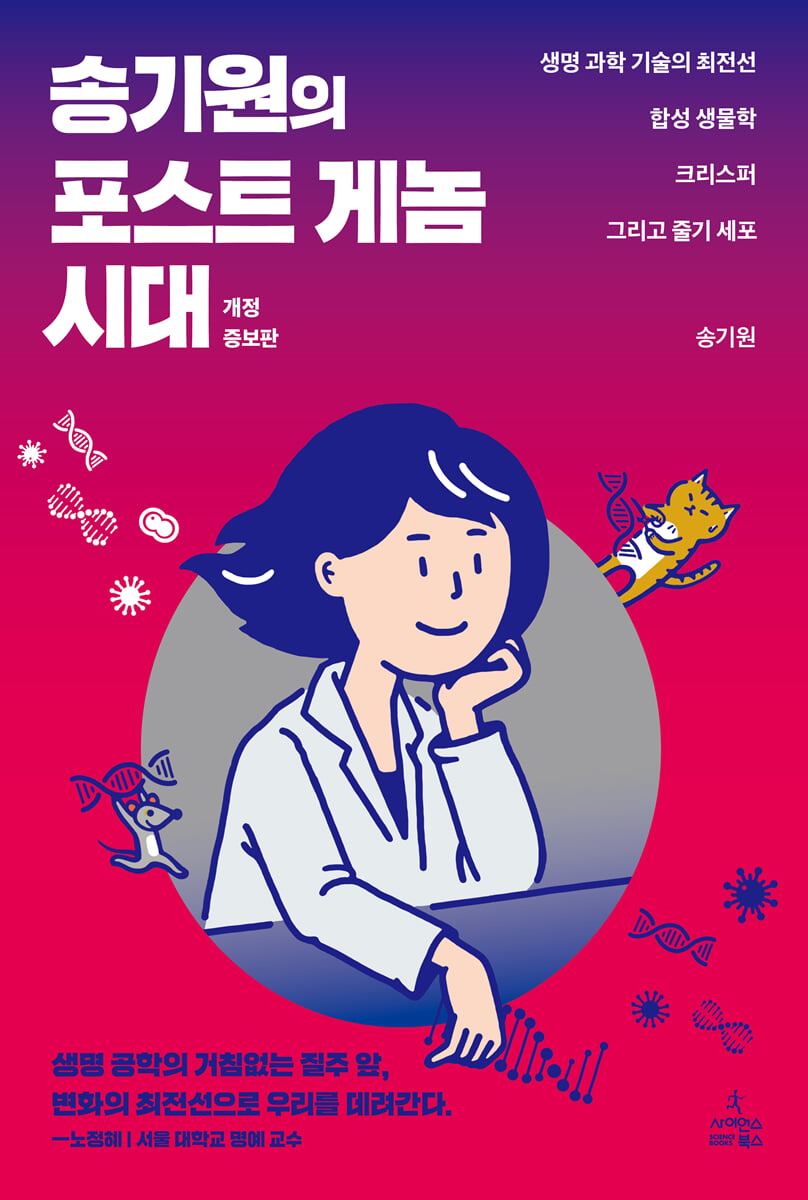
An essential textbook for the post-genomic era, where humans edit and rewrite the secrets of life.
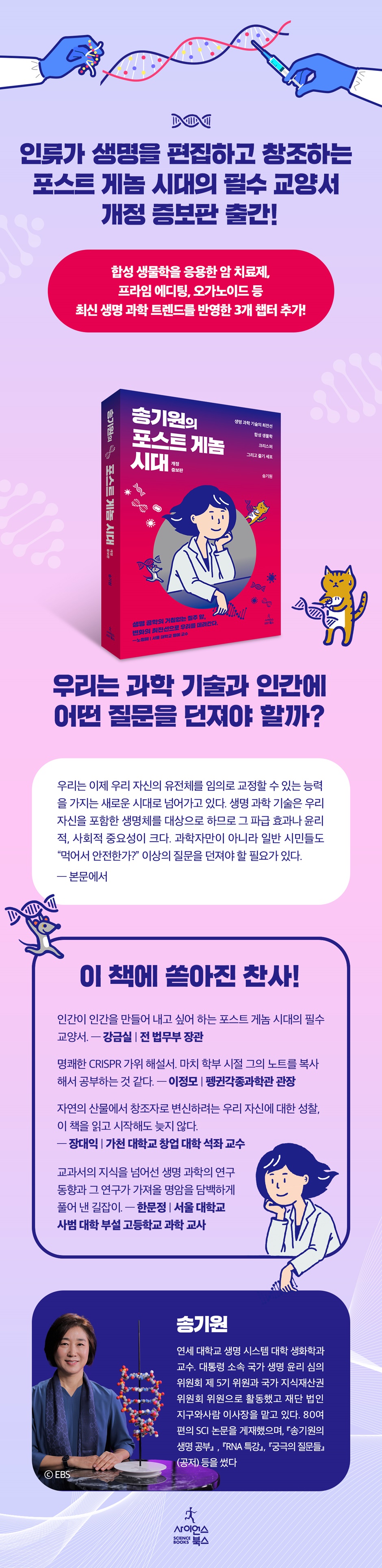
In the 2020s, when the Nobel Prize was awarded to CRISPR-CAS9 gene scissors and RNA research,
Synthetic biology applications in cancer therapeutics, prime editing, organoids, etc.
Three new chapters reflecting the latest life science trends!
The relentless advance of biotechnology takes us to the forefront of change.
- Noh Jeong-hye (Professor Emeritus, Seoul National University)
We live in a scientifically dramatic era, where we must prepare for the challenges of climate change, environmental pollution, artificial intelligence, and the transformations that genetics will bring.
- Han Moon-jeong (science teacher at Seoul National University College of Education High School)
Recently, Nature Biotechnology published news about the development of a cancer diagnosis platform using CRISPR gene scissors.
A project was also introduced that analyzes the entire human genome using artificial intelligence and transfers the generated data to a big data platform.
Various map projects and their respective data platform operations are already significantly changing research methods in life sciences, and this trend will only accelerate.
Life science is moving beyond laboratories where cells are examined and genes are extracted, toward information science, where questions and answers related to life phenomena are found on data platforms built in virtual spaces.
It is also a time when new standards and information are needed more than ever to embrace the latest modern technologies that have changed the direction and pace of development in life sciences.
Professor Song Ki-won, a biochemist currently a professor in the Department of Biochemistry at Yonsei University, has published "Song Ki-won's Post-Genome Era: The Frontier of Life Science Technology, Synthetic Biology, CRISPR, and Stem Cells" (revised and expanded edition), a guide to correctly understanding the discussions surrounding life science, which is advancing rapidly every day, and to drawing the big picture.
In the 2020s, when the Nobel Prize was awarded to CRISPR-CAS9 gene scissors and RNA research,
Synthetic biology applications in cancer therapeutics, prime editing, organoids, etc.
Three new chapters reflecting the latest life science trends!
The relentless advance of biotechnology takes us to the forefront of change.
- Noh Jeong-hye (Professor Emeritus, Seoul National University)
We live in a scientifically dramatic era, where we must prepare for the challenges of climate change, environmental pollution, artificial intelligence, and the transformations that genetics will bring.
- Han Moon-jeong (science teacher at Seoul National University College of Education High School)
Recently, Nature Biotechnology published news about the development of a cancer diagnosis platform using CRISPR gene scissors.
A project was also introduced that analyzes the entire human genome using artificial intelligence and transfers the generated data to a big data platform.
Various map projects and their respective data platform operations are already significantly changing research methods in life sciences, and this trend will only accelerate.
Life science is moving beyond laboratories where cells are examined and genes are extracted, toward information science, where questions and answers related to life phenomena are found on data platforms built in virtual spaces.
It is also a time when new standards and information are needed more than ever to embrace the latest modern technologies that have changed the direction and pace of development in life sciences.
Professor Song Ki-won, a biochemist currently a professor in the Department of Biochemistry at Yonsei University, has published "Song Ki-won's Post-Genome Era: The Frontier of Life Science Technology, Synthetic Biology, CRISPR, and Stem Cells" (revised and expanded edition), a guide to correctly understanding the discussions surrounding life science, which is advancing rapidly every day, and to drawing the big picture.
- You can preview some of the book's contents.
Preview
index
A New Landscape and New Perspective on Biology in the Revised and Expanded Edition
Prologue: Humans, finally in the Creator's place?
Part 1: Designing Life
Chapter 1: The Beginning of Synthetic Biology: This is Life Made by Humans
Chapter 2: The Emergence of Synthetic Biology: We Can Make Machines, So Why Can't We Make Living Things?
Chapter 3: Mechanization of Life: Stacking the Building Blocks of Life
Part 2: The 21st Century Hybrid Mammoths Arrive
Chapter 4: A History of Life Modification: How Did 'Genetically Modified' Salmon Come to Be?
Chapter 5: Achievements of Synthetic Biology: These Jeans Are Made from Corn
Chapter 6: Extinct Genomes and Animal Restoration: A Mouse That Died 16 Years Ago Comes Back to Life!
Part 3: The Two Faces of Synthetic Biology
Chapter 7: Popularizing Synthetic Biology: You Build PCs? I Make Life!
Chapter 8: The Risks of Synthetic Biology: What if a 'Zombie Virus' Leaks?
Chapter 9 Synthetic Biology and Bioethics: I, Not God, am the Creator of Life!
Chapter 10: Genome Planning: One Step Closer to Writing: Success in Eukaryotic Model Genome Design and Synthesis
Chapter 11: Therapeutics Using Cells Reengineered with Synthetic Biology: Did You Take Medicine in the Old Days?
Part 4: Discovering the CRISPR Gene Scissors
Chapter 12: The Meaning of Gene Scissors Technology: CRISPR, a Gene Scissors That Could Be Called Revolutionary
Chapter 13: The History of Gene Scissors Technology
Why do we need genetic scissors?
Chapter 14 Application of Gene Scissors Technology: Gene Scissors, GMO but Not GMO?
Part 5: How CRISPR Technology Changed the World
Chapter 15: Gene Scissors and Gene Drives: A Groundbreaking Way to Reduce Malaria Mosquitoes, Did You Know?
Chapter 16: Using Gene Scissors: Gene Scissors Open the Way to a Cure for AIDS
Chapter 17: Gene Scissors and Gene Therapy: Confronting the "Fault in Parental Genes" Fate
Part 6: Who is this technology for?
Chapter 18 Understanding Human Embryonic Genome Editing: What if Gene Scissors Were Used in People?
Chapter 19: The Controversy Raised by Human Embryo Genome Editing: China's CRISPR Research: Impact and Limitations
Chapter 20: The Limitations of Human Embryo Genome Editing: Gene Editing for Disease-Free Babies? A Dangerous Attempt!
Chapter 21: The Current State of Human Embryo Genome Editing: The Potential for "Designer Babies" Sparks Ethical Controversy
Part 7: The Inconvenient Truth About Universal Gene Scissors
Chapter 22: The Mystery of Gene Scissors Technology: Is CRISPR Really a Universal Gene Scissors?
Chapter 23: Various Gene Scissors: In Search of More Accurate, Better, and Greater 'Scissors'
Chapter 24: Innovations in Gene Scissors Technology: A New Technology Called Prime Editing
Chapter 25: Reflections on Gene Scissors Technology: How Much Do We Know About CRISPR, the "DNA Revolution"?
Part 8: A savior in the treatment of incurable diseases?
Chapter 26: The Era of Cell Therapy: The Age of Personalized Treatment Begins
Chapter 27: Immunotherapy: The Future of Cancer Treatments Made from Our Own Cells
Chapter 28: Stem Cell Therapy: Reversing the Fate of Somatic Cells, the Future of Universal Therapeutics
Chapter 29: Miniature Organ Organoids Made from Cells: A New Approach to Personalized Therapies
Epilogue: Facing More Questions
Special contribution: Dedicated to the 2020 Nobel Prize
Further Reading
Glossary of Terms
Huzhou
Search
Prologue: Humans, finally in the Creator's place?
Part 1: Designing Life
Chapter 1: The Beginning of Synthetic Biology: This is Life Made by Humans
Chapter 2: The Emergence of Synthetic Biology: We Can Make Machines, So Why Can't We Make Living Things?
Chapter 3: Mechanization of Life: Stacking the Building Blocks of Life
Part 2: The 21st Century Hybrid Mammoths Arrive
Chapter 4: A History of Life Modification: How Did 'Genetically Modified' Salmon Come to Be?
Chapter 5: Achievements of Synthetic Biology: These Jeans Are Made from Corn
Chapter 6: Extinct Genomes and Animal Restoration: A Mouse That Died 16 Years Ago Comes Back to Life!
Part 3: The Two Faces of Synthetic Biology
Chapter 7: Popularizing Synthetic Biology: You Build PCs? I Make Life!
Chapter 8: The Risks of Synthetic Biology: What if a 'Zombie Virus' Leaks?
Chapter 9 Synthetic Biology and Bioethics: I, Not God, am the Creator of Life!
Chapter 10: Genome Planning: One Step Closer to Writing: Success in Eukaryotic Model Genome Design and Synthesis
Chapter 11: Therapeutics Using Cells Reengineered with Synthetic Biology: Did You Take Medicine in the Old Days?
Part 4: Discovering the CRISPR Gene Scissors
Chapter 12: The Meaning of Gene Scissors Technology: CRISPR, a Gene Scissors That Could Be Called Revolutionary
Chapter 13: The History of Gene Scissors Technology
Why do we need genetic scissors?
Chapter 14 Application of Gene Scissors Technology: Gene Scissors, GMO but Not GMO?
Part 5: How CRISPR Technology Changed the World
Chapter 15: Gene Scissors and Gene Drives: A Groundbreaking Way to Reduce Malaria Mosquitoes, Did You Know?
Chapter 16: Using Gene Scissors: Gene Scissors Open the Way to a Cure for AIDS
Chapter 17: Gene Scissors and Gene Therapy: Confronting the "Fault in Parental Genes" Fate
Part 6: Who is this technology for?
Chapter 18 Understanding Human Embryonic Genome Editing: What if Gene Scissors Were Used in People?
Chapter 19: The Controversy Raised by Human Embryo Genome Editing: China's CRISPR Research: Impact and Limitations
Chapter 20: The Limitations of Human Embryo Genome Editing: Gene Editing for Disease-Free Babies? A Dangerous Attempt!
Chapter 21: The Current State of Human Embryo Genome Editing: The Potential for "Designer Babies" Sparks Ethical Controversy
Part 7: The Inconvenient Truth About Universal Gene Scissors
Chapter 22: The Mystery of Gene Scissors Technology: Is CRISPR Really a Universal Gene Scissors?
Chapter 23: Various Gene Scissors: In Search of More Accurate, Better, and Greater 'Scissors'
Chapter 24: Innovations in Gene Scissors Technology: A New Technology Called Prime Editing
Chapter 25: Reflections on Gene Scissors Technology: How Much Do We Know About CRISPR, the "DNA Revolution"?
Part 8: A savior in the treatment of incurable diseases?
Chapter 26: The Era of Cell Therapy: The Age of Personalized Treatment Begins
Chapter 27: Immunotherapy: The Future of Cancer Treatments Made from Our Own Cells
Chapter 28: Stem Cell Therapy: Reversing the Fate of Somatic Cells, the Future of Universal Therapeutics
Chapter 29: Miniature Organ Organoids Made from Cells: A New Approach to Personalized Therapies
Epilogue: Facing More Questions
Special contribution: Dedicated to the 2020 Nobel Prize
Further Reading
Glossary of Terms
Huzhou
Search
Detailed image
Publisher's Review
In the first edition of this book, 『Song Ki-won's Post-Genome Era』 (Science Books, 2018), Professor Song Ki-won provides a colorful and in-depth look at what gene scissors technology, synthetic biology, and stem cell research are and what impact they will have on our society.
This book by Professor Song Ki-won, a first-class researcher who has published over 80 SCI-level papers as a biochemist and a renowned activist who fulfills his social voice and responsibility by serving as a member of the Presidential Committee on Bioethics and the National Intellectual Property Rights Commission, has been loved by many readers as a book that introduces the cutting edge of life sciences, which are developing rapidly in the 21st century, and reflects on its social repercussions.
The reading world has been captivated by Professor Song Ki-won's writing, which embraces and introduces modern science, delving into the core of life—once considered a taboo domain—in a way that strikes a balance between fearless intellectual inquiry and careful social reflection.
However, since the publication of this book, there have been significant, revolutionary changes in the field of life sciences.
For example, the CRISPR-Cas9 gene scissors technology of Emmanuel Charpentier and Jennifer Doudna, which inspired Professor Song to write this book, won the 2020 Nobel Prize in Chemistry.
Additionally, efforts to improve the off-target potential of existing gene scissors technology and increase accuracy resulted in the development of a groundbreaking technology called prime editing.
Synthetic biology, which allows us to control the functions of cells themselves by inserting new genetic circuits, is beginning to be actively utilized in the development of therapeutics.
The method of creating organoids, miniature organs from stem cells, to understand the mysteries of life development and to use them for personalized treatment of various diseases has become common.
In the first edition of this book, the author predicted that we were moving from an era of reading the code of life contained in our genes to an era of writing it.
But the times have surpassed even that forecast in just seven years.
Professor Song Ki-won diagnoses the current situation as follows.
“Informatization of life sciences.”
To explain this diagnosis, Professor Song Ki-won has published a new revised and expanded edition of Song Ki-won's Life Studies, an introductory book on life sciences, and a special lecture on RNA. He has also published a revised and expanded edition of this book, which was first published in 2018.
If you read these three books together, you will be able to get an overview of the revolution in life sciences called “the information science of life sciences.”
Professor Song felt the urgency of reflecting the new information pouring in every day, and decided to publish a revised and expanded edition that would transcend the "post-genome era."
First, we thoroughly reviewed the contents of the existing edition, identified chapters that needed sufficient information updates and those that required complete revision, and organized them.
And new scientific technologies that have emerged over the past seven years have been covered in new chapters.
This revised and expanded edition includes three additional chapters: Chapter 11, which covers the medical and pharmaceutical applications of synthetic biology; Chapter 24, which covers innovations in gene-editing technology, including prime editing; and Chapter 29, which covers the ins and outs of organoid technology.
The systematic and dense text, suitable for both beginners and experts, is complemented by illustrations to aid reader comprehension.
Beyond the genome era, where we can read the information of life,
Into the post-genomic era of editing and creating life forms
It's not too late to start reflecting on ourselves, the creators we dream of, by reading this book.
―Jang Dae-ik (Professor Emeritus, College of Entrepreneurship, Gachon University)
This book provides easy, specific, and accurate information on cutting-edge life sciences, such as synthetic biology and genetic scissors, areas that should be receiving public attention but are actually overlooked and difficult to understand in their entirety. —Kang Geum-sil (former Minister of Justice)
Song Ki-won's Post-Genome Era is largely divided into three parts that explain synthetic biology, genetic scissors, and stem cells.
Parts 1 through 3 introduce the discipline of synthetic biology.
Part 1 introduces the history of the emergence of synthetic biology and the latest research results, showing the progress of synthetic biology in providing new perspectives on life.
Part 2 presents several examples of how synthetic biology has been applied to modify living organisms.
We also discuss the dual nature of synthetic biology: while restoring and spreading viruses could cause serious social harm, it could also save biodiversity by reviving extinct animals.
Part 3 warns of the potential for synthetic biology to be used in dangerous ways, introduces the yeast genome redesign study announced in the summer of 2018 and its implications, and raises the need for an open discussion about the future of synthetic biology.
Parts 4 through 7 focus on gene scissors, a key technology that enables synthetic biology, and among them, gene scissors, which has recently received the most attention.
Part 4 describes the history of genetic scissors.
We review the history of gene scissors before CRISPR and summarize the development of synthetic biology since the advent of CRISPR.
Part 5 introduces new uses of gene scissors, such as gene drive technology and gene therapy, made possible by the development of CRISPR.
Part 6 summarizes the gene scissors technology used to edit the human embryo genome and the resulting social issues, and Part 7 introduces the advantages and disadvantages of CRISPR gene scissors compared to other gene scissors technologies and outlines the future of gene scissors technology.
Part 8 is about cell therapy.
There are two types of cell therapy: immunotherapy, which involves extracting cells, genetically modifying them to destroy only the specific cells that cause disease, and reinjecting them; and stem cell therapy, which involves injecting stem cells from cells that are not functioning properly into the body to restore bodily functions.
Since cell therapy seeks to find and resolve the root cause of disease, it is predicted that if this technology develops further, existing treatments using drugs will completely disappear and personalized treatments using cells will become the mainstream.
Balance between science and ethics
A guide to life sciences beyond textbook knowledge
Books introducing techniques for life sciences often follow one of two paths.
Either you actively support technology or you oppose technology.
It's a very convenient method.
But it is self-evident that neither is right.
It takes effort to walk a tightrope, maintaining an appropriate tension between the two positions.
This is why democratic citizens should read Song Ki-won's Post-Genome Era.
Lee Jeong-mo (Director of Penguin Science Museum)
By the early 21st century, humanity had decoded most of the human genome, but to truly understand its implications, we need information from many people about how individual genome differences lead to phenotypic differences.
A large amount of genetic information about the genome and the phenotypes derived from it is essential for accurate personalized treatment based on genetic information, which will become the trend of the future.
Since the completion of the Human Genome Project in 2003, life sciences have advanced at an astonishing pace.
In the life sciences, efforts are underway to accumulate data related to all cells and genomes that make up the human body and to build related platforms, including the Cancer Genome Atlas (TCGA) program, which began in 2006, and the Human Virome Program (HVP), which began in 2022.
In May 2016, world-renowned synthetic biology experts gathered at Harvard Medical School to seriously discuss a project to synthesize the human genome, and in August 2017, a joint research team from Korea and the United States announced the success of editing the genome of a human embryo using CRISPR-Cas9 gene scissors.
And in the summer of 2018, the synthetic biology research group of the Chinese Academy of Sciences and the research team of Professor Jeff Boecke of New York University reported that they had redesigned yeast by splicing 16 chromosomes into 1 and 2 chromosomes respectively, and that these yeasts were able to maintain life without any problems.
We are living in the 'post-genomic era', where the possibility of humans directly synthesizing genomes to create living beings, including humans, has opened up.
Song Ki-won's Post-Genome Era provides cutting-edge life science knowledge while also addressing the ethical issues that may arise from advances in life science technology.
While this book raises concerns that the rapid advancement of life sciences may be overtaking the ethical framework of human society too quickly, it maintains that scientific progress cannot be halted by human concerns or arguments, arguing that science has never been halted by controversy or ethical issues throughout human history.
At the same time, the author considers teaching students to ask questions about science and technology to be a very important value.
We cannot stop the progress of science, but we argue that social and ethical discussions must keep pace with the pace of progress.
This book by Professor Song Ki-won, a first-class researcher who has published over 80 SCI-level papers as a biochemist and a renowned activist who fulfills his social voice and responsibility by serving as a member of the Presidential Committee on Bioethics and the National Intellectual Property Rights Commission, has been loved by many readers as a book that introduces the cutting edge of life sciences, which are developing rapidly in the 21st century, and reflects on its social repercussions.
The reading world has been captivated by Professor Song Ki-won's writing, which embraces and introduces modern science, delving into the core of life—once considered a taboo domain—in a way that strikes a balance between fearless intellectual inquiry and careful social reflection.
However, since the publication of this book, there have been significant, revolutionary changes in the field of life sciences.
For example, the CRISPR-Cas9 gene scissors technology of Emmanuel Charpentier and Jennifer Doudna, which inspired Professor Song to write this book, won the 2020 Nobel Prize in Chemistry.
Additionally, efforts to improve the off-target potential of existing gene scissors technology and increase accuracy resulted in the development of a groundbreaking technology called prime editing.
Synthetic biology, which allows us to control the functions of cells themselves by inserting new genetic circuits, is beginning to be actively utilized in the development of therapeutics.
The method of creating organoids, miniature organs from stem cells, to understand the mysteries of life development and to use them for personalized treatment of various diseases has become common.
In the first edition of this book, the author predicted that we were moving from an era of reading the code of life contained in our genes to an era of writing it.
But the times have surpassed even that forecast in just seven years.
Professor Song Ki-won diagnoses the current situation as follows.
“Informatization of life sciences.”
To explain this diagnosis, Professor Song Ki-won has published a new revised and expanded edition of Song Ki-won's Life Studies, an introductory book on life sciences, and a special lecture on RNA. He has also published a revised and expanded edition of this book, which was first published in 2018.
If you read these three books together, you will be able to get an overview of the revolution in life sciences called “the information science of life sciences.”
Professor Song felt the urgency of reflecting the new information pouring in every day, and decided to publish a revised and expanded edition that would transcend the "post-genome era."
First, we thoroughly reviewed the contents of the existing edition, identified chapters that needed sufficient information updates and those that required complete revision, and organized them.
And new scientific technologies that have emerged over the past seven years have been covered in new chapters.
This revised and expanded edition includes three additional chapters: Chapter 11, which covers the medical and pharmaceutical applications of synthetic biology; Chapter 24, which covers innovations in gene-editing technology, including prime editing; and Chapter 29, which covers the ins and outs of organoid technology.
The systematic and dense text, suitable for both beginners and experts, is complemented by illustrations to aid reader comprehension.
Beyond the genome era, where we can read the information of life,
Into the post-genomic era of editing and creating life forms
It's not too late to start reflecting on ourselves, the creators we dream of, by reading this book.
―Jang Dae-ik (Professor Emeritus, College of Entrepreneurship, Gachon University)
This book provides easy, specific, and accurate information on cutting-edge life sciences, such as synthetic biology and genetic scissors, areas that should be receiving public attention but are actually overlooked and difficult to understand in their entirety. —Kang Geum-sil (former Minister of Justice)
Song Ki-won's Post-Genome Era is largely divided into three parts that explain synthetic biology, genetic scissors, and stem cells.
Parts 1 through 3 introduce the discipline of synthetic biology.
Part 1 introduces the history of the emergence of synthetic biology and the latest research results, showing the progress of synthetic biology in providing new perspectives on life.
Part 2 presents several examples of how synthetic biology has been applied to modify living organisms.
We also discuss the dual nature of synthetic biology: while restoring and spreading viruses could cause serious social harm, it could also save biodiversity by reviving extinct animals.
Part 3 warns of the potential for synthetic biology to be used in dangerous ways, introduces the yeast genome redesign study announced in the summer of 2018 and its implications, and raises the need for an open discussion about the future of synthetic biology.
Parts 4 through 7 focus on gene scissors, a key technology that enables synthetic biology, and among them, gene scissors, which has recently received the most attention.
Part 4 describes the history of genetic scissors.
We review the history of gene scissors before CRISPR and summarize the development of synthetic biology since the advent of CRISPR.
Part 5 introduces new uses of gene scissors, such as gene drive technology and gene therapy, made possible by the development of CRISPR.
Part 6 summarizes the gene scissors technology used to edit the human embryo genome and the resulting social issues, and Part 7 introduces the advantages and disadvantages of CRISPR gene scissors compared to other gene scissors technologies and outlines the future of gene scissors technology.
Part 8 is about cell therapy.
There are two types of cell therapy: immunotherapy, which involves extracting cells, genetically modifying them to destroy only the specific cells that cause disease, and reinjecting them; and stem cell therapy, which involves injecting stem cells from cells that are not functioning properly into the body to restore bodily functions.
Since cell therapy seeks to find and resolve the root cause of disease, it is predicted that if this technology develops further, existing treatments using drugs will completely disappear and personalized treatments using cells will become the mainstream.
Balance between science and ethics
A guide to life sciences beyond textbook knowledge
Books introducing techniques for life sciences often follow one of two paths.
Either you actively support technology or you oppose technology.
It's a very convenient method.
But it is self-evident that neither is right.
It takes effort to walk a tightrope, maintaining an appropriate tension between the two positions.
This is why democratic citizens should read Song Ki-won's Post-Genome Era.
Lee Jeong-mo (Director of Penguin Science Museum)
By the early 21st century, humanity had decoded most of the human genome, but to truly understand its implications, we need information from many people about how individual genome differences lead to phenotypic differences.
A large amount of genetic information about the genome and the phenotypes derived from it is essential for accurate personalized treatment based on genetic information, which will become the trend of the future.
Since the completion of the Human Genome Project in 2003, life sciences have advanced at an astonishing pace.
In the life sciences, efforts are underway to accumulate data related to all cells and genomes that make up the human body and to build related platforms, including the Cancer Genome Atlas (TCGA) program, which began in 2006, and the Human Virome Program (HVP), which began in 2022.
In May 2016, world-renowned synthetic biology experts gathered at Harvard Medical School to seriously discuss a project to synthesize the human genome, and in August 2017, a joint research team from Korea and the United States announced the success of editing the genome of a human embryo using CRISPR-Cas9 gene scissors.
And in the summer of 2018, the synthetic biology research group of the Chinese Academy of Sciences and the research team of Professor Jeff Boecke of New York University reported that they had redesigned yeast by splicing 16 chromosomes into 1 and 2 chromosomes respectively, and that these yeasts were able to maintain life without any problems.
We are living in the 'post-genomic era', where the possibility of humans directly synthesizing genomes to create living beings, including humans, has opened up.
Song Ki-won's Post-Genome Era provides cutting-edge life science knowledge while also addressing the ethical issues that may arise from advances in life science technology.
While this book raises concerns that the rapid advancement of life sciences may be overtaking the ethical framework of human society too quickly, it maintains that scientific progress cannot be halted by human concerns or arguments, arguing that science has never been halted by controversy or ethical issues throughout human history.
At the same time, the author considers teaching students to ask questions about science and technology to be a very important value.
We cannot stop the progress of science, but we argue that social and ethical discussions must keep pace with the pace of progress.
GOODS SPECIFICS
- Date of issue: November 15, 2024
- Format: Hardcover book binding method guide
- Page count, weight, size: 304 pages | 644g | 148*220*23mm
- ISBN13: 9791194087090
- ISBN10: 1194087094
You may also like
카테고리
korean


korean

![GQ KOREA Mark (Monthly): December [2025]](http://librairie.coreenne.fr/cdn/shop/files/8ef265dbbfbf186523ed75ba7319009d.jpg?v=1765340328&width=3840)


