

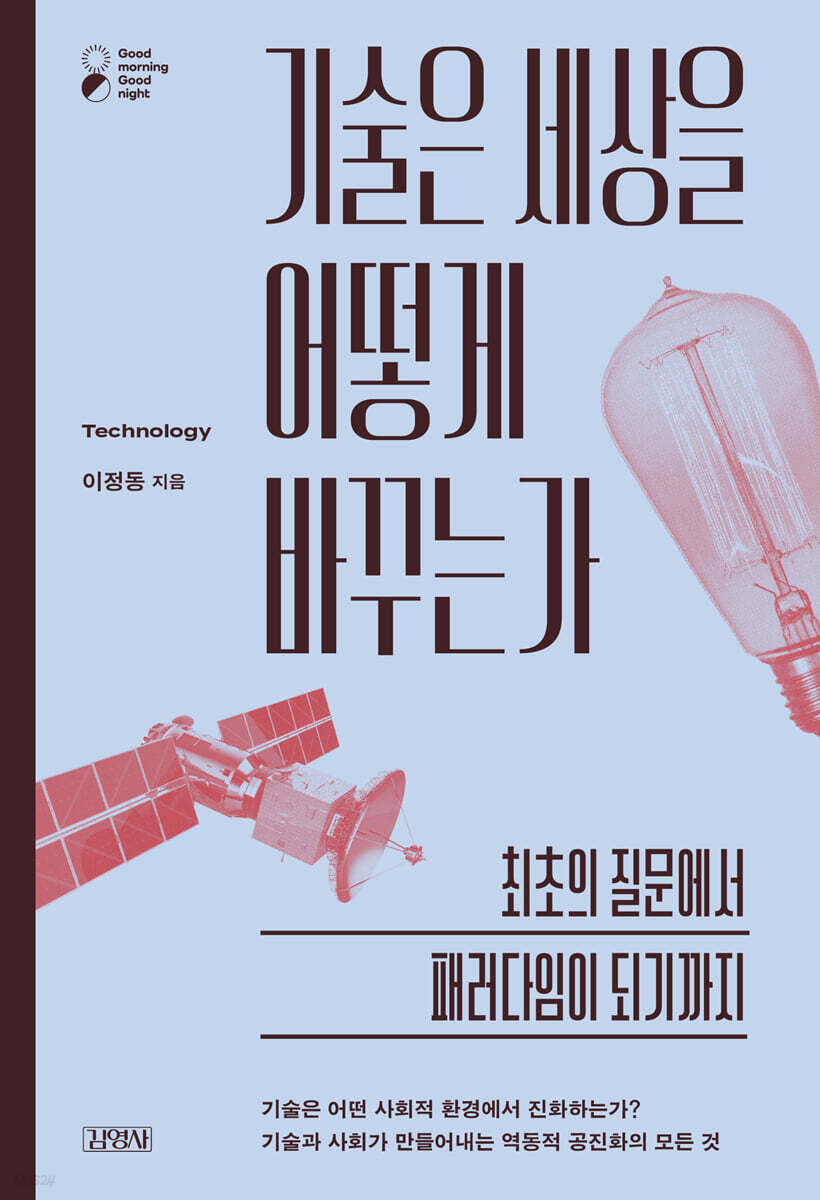
How Technology Changes the World
 |
Description
Book Introduction
How are innovative technologies that advance society created?
Professor Lee Jeong-dong, who created a sensation by introducing a new agenda called “conceptual design” to the Korean industry, which has been steadily depleting its potential growth rate, through “Time of Accumulation” and “Road of Accumulation,” now challenges the long-held notion that “innovative technologies are created by creative geniuses.”
Innovative technologies are not invented by special individuals, but are social products, and innovative technologies can only be born when the social environment and conditions are right.
"How Technology Changes the World" details the birth and evolution of technology, and the co-evolution of technology and society, delivering a weighty message about how to drive technology and lead it to a better future.
This is the seventeenth book in the 'Good Morning, Good Night' series, created by leading scholars and researchers in each field for future generations.
Professor Lee Jeong-dong, who created a sensation by introducing a new agenda called “conceptual design” to the Korean industry, which has been steadily depleting its potential growth rate, through “Time of Accumulation” and “Road of Accumulation,” now challenges the long-held notion that “innovative technologies are created by creative geniuses.”
Innovative technologies are not invented by special individuals, but are social products, and innovative technologies can only be born when the social environment and conditions are right.
"How Technology Changes the World" details the birth and evolution of technology, and the co-evolution of technology and society, delivering a weighty message about how to drive technology and lead it to a better future.
This is the seventeenth book in the 'Good Morning, Good Night' series, created by leading scholars and researchers in each field for future generations.
- You can preview some of the book's contents.
Preview
index
prolog
Chapter 1: The Beginning of Curiosity
1.
Will technology evolve like living things?
2.
Why You Need to Understand Technological Evolution
3.
Why is technology important?
Chapter 2: From Idea to New Technology
1.
The Birth of the Bagless Vacuum Cleaner
2.
Scale-up: The Starting Point for the Birth of New Technologies
3.
First Question: The Premise of Scale-Up
Chapter 3: The Birth, Aging, Illness, and Death of Technology
1.
How will technology spread?
2.
Which technology will become the dominant standard?
3.
Until the replacement and extinction of technology
4.
Social change driven by general-purpose technology
Chapter 4: Technology, Like Living Things, Has Evolutionary Laws
1.
Darwin's Pigeon
2.
In search of the logic of technological evolution
3.
Law of Technological Evolution 1: Combinatorial Evolution
4.
Law of Technological Evolution 2: Adaptation
5.
Law of Technological Evolution #3: Small Bets and Adaptive Exploration
6.
Law 4 of Technological Evolution: Accumulation and Transfer of Experience
7.
Law 5 of Technological Evolution: Preadaptation and Differentiation
8.
Law of Technological Evolution 6: Symbiosis with Ecosystems
Chapter 5: Technology Changes Society, and Society Changes Technology
1.
The Future of Technology and the Imagination of the Technium
2.
What is the difference between biological evolution and technological evolution?
3.
The impact of human society on technological evolution
4.
The impact of technological evolution on human society
5.
How will artificial intelligence change the future of technology?
6.
How to Predict the Future: Backcasting
Epilogue
main
Chapter 1: The Beginning of Curiosity
1.
Will technology evolve like living things?
2.
Why You Need to Understand Technological Evolution
3.
Why is technology important?
Chapter 2: From Idea to New Technology
1.
The Birth of the Bagless Vacuum Cleaner
2.
Scale-up: The Starting Point for the Birth of New Technologies
3.
First Question: The Premise of Scale-Up
Chapter 3: The Birth, Aging, Illness, and Death of Technology
1.
How will technology spread?
2.
Which technology will become the dominant standard?
3.
Until the replacement and extinction of technology
4.
Social change driven by general-purpose technology
Chapter 4: Technology, Like Living Things, Has Evolutionary Laws
1.
Darwin's Pigeon
2.
In search of the logic of technological evolution
3.
Law of Technological Evolution 1: Combinatorial Evolution
4.
Law of Technological Evolution 2: Adaptation
5.
Law of Technological Evolution #3: Small Bets and Adaptive Exploration
6.
Law 4 of Technological Evolution: Accumulation and Transfer of Experience
7.
Law 5 of Technological Evolution: Preadaptation and Differentiation
8.
Law of Technological Evolution 6: Symbiosis with Ecosystems
Chapter 5: Technology Changes Society, and Society Changes Technology
1.
The Future of Technology and the Imagination of the Technium
2.
What is the difference between biological evolution and technological evolution?
3.
The impact of human society on technological evolution
4.
The impact of technological evolution on human society
5.
How will artificial intelligence change the future of technology?
6.
How to Predict the Future: Backcasting
Epilogue
main
Detailed image

Into the book
“Technology has freed humans from biological constraints and enabled them to fully realize their imaginative potential.
In a word, technology frees humans and expands their scope of activity.
Since the dawn of humanity, humans have developed as one with technology, and while the biological form of humans has remained unchanged, thanks to technology, the complex of technology and humans has evolved into a greater being.
The result is the modern civilization we enjoy today.”
--- p.24
“Technology is born, grows, matures, and then goes through a process of birth, aging, illness, and death similar to that of a living organism until it is finally pushed out by the next generation of new technologies.
When a living thing dies, it returns to the soil and becomes the foundation for the creation of other living things.
Similarly, technology is pushed out by new technologies, but it does not disappear completely.
“Many of the elements that make up existing technologies are used as materials for the creation of new technologies.”
--- p.65
“Technological evolution and biological evolution have many similarities.
First of all, there are so many different variants, new technologies or variants are constantly emerging, existing technologies disappear from the scene, and component technologies are recycled into new technologies.
Therefore, it can be said that the most basic logic of biological evolution, the logic of mutation-selection-transmission, is applied as is.”
--- p.82
“The implications of the story of combinatorial evolution for those who dream of new technologies are clear.
If you want to create amazing new technologies, rather than waiting for a stroke of genius, the most important thing is to find the perfect combination of ingredients and experiment with as many combinations as possible.”
--- p.96
“The important thing here is that if Jensen Huang hadn’t worked on creating a development tool called CUDA to enable GPUs to be used in more applications, Alex might not have used GPUs.
“It wasn’t luck that came to Jensen Huang, it was Jensen Huang who paved the way for luck to come to him.”
--- p.104
“I don’t believe in the singularity argument.
This is because technological evolution and biological evolution differ in one crucial aspect.
In technological evolution, human will, dreams, visions and hopes have a decisive influence.
“This is the final piece of the technological evolution puzzle.”
--- p.150
“While the will of human society has a decisive influence on technological evolution as a selection environment, conversely, the emergence of new technologies changes human society itself.
“Accordingly, the path and speed of technological evolution itself are again affected.”
--- p.169
“Technology cannot be an end in itself, but human existence is an end in itself.”
In a word, technology frees humans and expands their scope of activity.
Since the dawn of humanity, humans have developed as one with technology, and while the biological form of humans has remained unchanged, thanks to technology, the complex of technology and humans has evolved into a greater being.
The result is the modern civilization we enjoy today.”
--- p.24
“Technology is born, grows, matures, and then goes through a process of birth, aging, illness, and death similar to that of a living organism until it is finally pushed out by the next generation of new technologies.
When a living thing dies, it returns to the soil and becomes the foundation for the creation of other living things.
Similarly, technology is pushed out by new technologies, but it does not disappear completely.
“Many of the elements that make up existing technologies are used as materials for the creation of new technologies.”
--- p.65
“Technological evolution and biological evolution have many similarities.
First of all, there are so many different variants, new technologies or variants are constantly emerging, existing technologies disappear from the scene, and component technologies are recycled into new technologies.
Therefore, it can be said that the most basic logic of biological evolution, the logic of mutation-selection-transmission, is applied as is.”
--- p.82
“The implications of the story of combinatorial evolution for those who dream of new technologies are clear.
If you want to create amazing new technologies, rather than waiting for a stroke of genius, the most important thing is to find the perfect combination of ingredients and experiment with as many combinations as possible.”
--- p.96
“The important thing here is that if Jensen Huang hadn’t worked on creating a development tool called CUDA to enable GPUs to be used in more applications, Alex might not have used GPUs.
“It wasn’t luck that came to Jensen Huang, it was Jensen Huang who paved the way for luck to come to him.”
--- p.104
“I don’t believe in the singularity argument.
This is because technological evolution and biological evolution differ in one crucial aspect.
In technological evolution, human will, dreams, visions and hopes have a decisive influence.
“This is the final piece of the technological evolution puzzle.”
--- p.150
“While the will of human society has a decisive influence on technological evolution as a selection environment, conversely, the emergence of new technologies changes human society itself.
“Accordingly, the path and speed of technological evolution itself are again affected.”
--- p.169
“Technology cannot be an end in itself, but human existence is an end in itself.”
--- p.197
Publisher's Review
Crucial questions and insights raised by Professor Lee Jeong-dong in "Time of Accumulation"
How are innovative technologies that advance society created?
Professor Lee Jeong-dong (Department of Technology Management, Economics and Policy, Seoul National University), who first raised the issue of Korean industries depleting their potential growth rate through scale-up, caused a stir in his first talk. This time, he shares insights into the evolution of technology and the future we must move toward.
The biggest stereotype about technology is that innovation is born from creative genius.
However, Professor Lee Jeong-dong refutes this misconception and says that technology is not created by a special individual, but is created and evolved socially.
Therefore, he emphasizes that rather than waiting for creative geniuses, it is important to create a social environment and conditions in which innovative technologies can be born and evolve.
"How Technology Changes the World" explains the principles of technological evolution and the dynamic co-evolution of technology and society through various examples and vivid anecdotes.
The author's fascinating and crucial questions and their answers reveal the future of technology we will advance toward.
ㆍWhat is the difference between technology and science?
ㆍIn what kind of society do creative geniuses emerge?
ㆍDoes technology evolve like living things?
ㆍThe first question is how does it scale up?
ㆍHow does society influence the diffusion and replacement of technology?
How does technology spread?
Which technology will dominate the era?
The first step in creating a new technology is asking the 'first question'.
The first question that came to mind for industrial designer Dyson, who was tired of having to empty the vacuum cleaner's dust bag every time, was 'What if we made a vacuum cleaner without a dust bag?'
But the answer won't be easy from the start.
The first version is rough and doesn't work properly, but if you improve it little by little, a proper product is born. This process is the second stage, 'scale-up'.
All new technologies are born from a process of ‘first question’ and ‘scale-up.’
The story of a genius coming up with a brilliant idea and creating a new technology overnight is almost a myth.
No skill is perfected overnight.
In the mid-to-late 1990s, when a new technology called Internet search was just emerging, various forms of technology were proliferating.
Netscape, Yahoo, Lycos, AltaVista, and others all competed with their own search technologies, but now, after 20 years, only one company, Google, has become the standard for search engines.
There are only a very small number of technologies that end up being used by everyone.
Most new technologies are used by the first 13.5% of users, called early adopters, and then disappear, a stage called the 'chasm'.
In a time of product innovation where various technologies compete, only a very small number survive to become market standards and be adopted by the public.
A technology that has become a trend is called a dominant standard.
Technologies that become dominant standards are path-dependent, so developers, users, and even social infrastructure support them, reinforcing the paradigm.
The DVORAK keyboard used in the keyboard was more efficient than the QWERTY keyboard, but it was defeated by the already established QWERTY paradigm.
Even in the early 20th century battle between electric and gasoline cars, the support of stakeholders and the vast supply chain that stretches from crude oil extraction and refining to gas stations were decisive factors in the gasoline car's victory.
However, even technologies that become dominant standards will eventually be eclipsed by other innovative technologies over time.
Users of existing technologies compete with new technologies by further improving existing technologies and maximizing their efficiency, but they are unable to overcome the flow of the times and end up leaving the market.
Instead, many of the elements that made up existing technologies do not completely disappear but leave traces as they are utilized as materials for new technologies.
Does technology evolve like living things?
In search of the laws of technological evolution
The process of technology's birth, growth, maturity, and decline is very similar to the life of a living organism.
Technology, like living things, goes through birth, aging, illness, and death, and evolves according to the laws of evolution.
Just as living organisms are composed of various combinations of 20 amino acids, technology is also created by combining existing theories and materials into new ones.
Einstein's theory of relativity required the theory of electromagnetism, Mach's principle, and the mathematical theory of curvature, and Apple created iTunes by combining the existing MP3 and Napster.
Sometimes the purpose changes.
Just as feathers initially evolved to maintain body temperature and later evolved to enable flight, Nvidia's GPUs were developed as specialized chips to quickly process graphic information in games, but are now gaining attention as core computing chips for AI.
The evolution of biology and technology also resembles progress in one step.
Evolution is the result of small bets, looking around and taking steps in the best direction for immediate gain, without any grand goal in mind.
The same goes for technology: even the scientists who won the Nobel Prize for inventing the first point-contact transistor simply wanted to further develop the vacuum tube, and could not have imagined today's computer chips containing hundreds of billions of transistors.
Both living things and technology exist within a vast ecosystem.
Just as living things coexist and share benefits with other species in a large ecosystem, Taiwan's TSMC receives chip designs from fabless companies and collaborates with various small companies in design, packaging, and wafer manufacturing to actually manufacture the chips.
In this global era, collaboration between companies with complementary technologies has become a necessity, not an option.
In this way, technology evolves, competes, and cooperates within the ecosystem of society, just like a living organism.
The laws of birth, aging, illness, death, and evolution of these technologies clearly demonstrate that technology cannot exist independently from society, but is a social product that co-evolves with it.
The Coevolution of Technology and Society, and the Future of Humanity
The future of technology is determined by humans!
“The best way to predict the future is to create it yourself.”
Innovative technologies like cell phones, computers, and the Internet are changing the world, but society is also influenced by technology.
This is why more manpower and capital are invested in obesity treatments than in new drugs to cure critical diseases prevalent in Africa, such as malaria.
In this way, technological evolution is not neutral, but is subject to preconceptions and biases, and is sometimes influenced by circumstances and luck.
This is where technological evolution diverges from biological evolution.
Biological evolution evolves in a direction suitable for the environment, but technology can evolve in the direction we want.
Technology evolves along the topography of human society's preferences and biases.
Technology cannot set the direction of its own evolution, but humans can set the direction toward the society they desire.
This is why human will is important in the evolution of technology.
"How Technology Changes the World" will provide the knowledge and insight we need to know about technology to create a better future, from the principles of how innovative technologies are born and evolve to how we can lead their evolution and development.
Today's culture, future wisdom, every day
The 'Good Morning, Good Night' series, a knowledge library that starts in the morning and ends in the evening.
'Good Morning, Good Night' sets a new standard for knowledge in the 21st century.
Written by the best writers, we share wisdom on how to view the world.
We take a look at where we are, what changes we are facing, and what we need to prepare for.
The world is changing.
The paradigm is shifting in all fields.
These are uncertain times, where we don't know what will happen tomorrow.
What choices will you make in the face of the great tide of change?
Will you fall into crisis because you can't read the changes, or will you actively respond to the changes and create opportunities?
Where do we stand, what changes are we facing, and what should we prepare for?
Leading scholars and researchers from each field have come together to create a comprehensive collection of knowledge and culture for future generations.
This knowledge library historically examines the changes and issues facing us in this era of transition across all fields, including the humanities, social sciences, economics, natural sciences, and the arts, and comprehensively examines phenomena and their essence to seek solutions and alternatives.
It is a paperback book that can be read by anyone of all generations, from middle school students to college students and the general public, and contains core knowledge and culture in one volume, so you can keep it close by and refer to it every day.
The 'Good Morning, Good Night' library will present a new standard for 21st century knowledge and serve as a guide to providing wisdom for viewing the world.
We await you, seeking wisdom and insight.
How are innovative technologies that advance society created?
Professor Lee Jeong-dong (Department of Technology Management, Economics and Policy, Seoul National University), who first raised the issue of Korean industries depleting their potential growth rate through scale-up, caused a stir in his first talk. This time, he shares insights into the evolution of technology and the future we must move toward.
The biggest stereotype about technology is that innovation is born from creative genius.
However, Professor Lee Jeong-dong refutes this misconception and says that technology is not created by a special individual, but is created and evolved socially.
Therefore, he emphasizes that rather than waiting for creative geniuses, it is important to create a social environment and conditions in which innovative technologies can be born and evolve.
"How Technology Changes the World" explains the principles of technological evolution and the dynamic co-evolution of technology and society through various examples and vivid anecdotes.
The author's fascinating and crucial questions and their answers reveal the future of technology we will advance toward.
ㆍWhat is the difference between technology and science?
ㆍIn what kind of society do creative geniuses emerge?
ㆍDoes technology evolve like living things?
ㆍThe first question is how does it scale up?
ㆍHow does society influence the diffusion and replacement of technology?
How does technology spread?
Which technology will dominate the era?
The first step in creating a new technology is asking the 'first question'.
The first question that came to mind for industrial designer Dyson, who was tired of having to empty the vacuum cleaner's dust bag every time, was 'What if we made a vacuum cleaner without a dust bag?'
But the answer won't be easy from the start.
The first version is rough and doesn't work properly, but if you improve it little by little, a proper product is born. This process is the second stage, 'scale-up'.
All new technologies are born from a process of ‘first question’ and ‘scale-up.’
The story of a genius coming up with a brilliant idea and creating a new technology overnight is almost a myth.
No skill is perfected overnight.
In the mid-to-late 1990s, when a new technology called Internet search was just emerging, various forms of technology were proliferating.
Netscape, Yahoo, Lycos, AltaVista, and others all competed with their own search technologies, but now, after 20 years, only one company, Google, has become the standard for search engines.
There are only a very small number of technologies that end up being used by everyone.
Most new technologies are used by the first 13.5% of users, called early adopters, and then disappear, a stage called the 'chasm'.
In a time of product innovation where various technologies compete, only a very small number survive to become market standards and be adopted by the public.
A technology that has become a trend is called a dominant standard.
Technologies that become dominant standards are path-dependent, so developers, users, and even social infrastructure support them, reinforcing the paradigm.
The DVORAK keyboard used in the keyboard was more efficient than the QWERTY keyboard, but it was defeated by the already established QWERTY paradigm.
Even in the early 20th century battle between electric and gasoline cars, the support of stakeholders and the vast supply chain that stretches from crude oil extraction and refining to gas stations were decisive factors in the gasoline car's victory.
However, even technologies that become dominant standards will eventually be eclipsed by other innovative technologies over time.
Users of existing technologies compete with new technologies by further improving existing technologies and maximizing their efficiency, but they are unable to overcome the flow of the times and end up leaving the market.
Instead, many of the elements that made up existing technologies do not completely disappear but leave traces as they are utilized as materials for new technologies.
Does technology evolve like living things?
In search of the laws of technological evolution
The process of technology's birth, growth, maturity, and decline is very similar to the life of a living organism.
Technology, like living things, goes through birth, aging, illness, and death, and evolves according to the laws of evolution.
Just as living organisms are composed of various combinations of 20 amino acids, technology is also created by combining existing theories and materials into new ones.
Einstein's theory of relativity required the theory of electromagnetism, Mach's principle, and the mathematical theory of curvature, and Apple created iTunes by combining the existing MP3 and Napster.
Sometimes the purpose changes.
Just as feathers initially evolved to maintain body temperature and later evolved to enable flight, Nvidia's GPUs were developed as specialized chips to quickly process graphic information in games, but are now gaining attention as core computing chips for AI.
The evolution of biology and technology also resembles progress in one step.
Evolution is the result of small bets, looking around and taking steps in the best direction for immediate gain, without any grand goal in mind.
The same goes for technology: even the scientists who won the Nobel Prize for inventing the first point-contact transistor simply wanted to further develop the vacuum tube, and could not have imagined today's computer chips containing hundreds of billions of transistors.
Both living things and technology exist within a vast ecosystem.
Just as living things coexist and share benefits with other species in a large ecosystem, Taiwan's TSMC receives chip designs from fabless companies and collaborates with various small companies in design, packaging, and wafer manufacturing to actually manufacture the chips.
In this global era, collaboration between companies with complementary technologies has become a necessity, not an option.
In this way, technology evolves, competes, and cooperates within the ecosystem of society, just like a living organism.
The laws of birth, aging, illness, death, and evolution of these technologies clearly demonstrate that technology cannot exist independently from society, but is a social product that co-evolves with it.
The Coevolution of Technology and Society, and the Future of Humanity
The future of technology is determined by humans!
“The best way to predict the future is to create it yourself.”
Innovative technologies like cell phones, computers, and the Internet are changing the world, but society is also influenced by technology.
This is why more manpower and capital are invested in obesity treatments than in new drugs to cure critical diseases prevalent in Africa, such as malaria.
In this way, technological evolution is not neutral, but is subject to preconceptions and biases, and is sometimes influenced by circumstances and luck.
This is where technological evolution diverges from biological evolution.
Biological evolution evolves in a direction suitable for the environment, but technology can evolve in the direction we want.
Technology evolves along the topography of human society's preferences and biases.
Technology cannot set the direction of its own evolution, but humans can set the direction toward the society they desire.
This is why human will is important in the evolution of technology.
"How Technology Changes the World" will provide the knowledge and insight we need to know about technology to create a better future, from the principles of how innovative technologies are born and evolve to how we can lead their evolution and development.
Today's culture, future wisdom, every day
The 'Good Morning, Good Night' series, a knowledge library that starts in the morning and ends in the evening.
'Good Morning, Good Night' sets a new standard for knowledge in the 21st century.
Written by the best writers, we share wisdom on how to view the world.
We take a look at where we are, what changes we are facing, and what we need to prepare for.
The world is changing.
The paradigm is shifting in all fields.
These are uncertain times, where we don't know what will happen tomorrow.
What choices will you make in the face of the great tide of change?
Will you fall into crisis because you can't read the changes, or will you actively respond to the changes and create opportunities?
Where do we stand, what changes are we facing, and what should we prepare for?
Leading scholars and researchers from each field have come together to create a comprehensive collection of knowledge and culture for future generations.
This knowledge library historically examines the changes and issues facing us in this era of transition across all fields, including the humanities, social sciences, economics, natural sciences, and the arts, and comprehensively examines phenomena and their essence to seek solutions and alternatives.
It is a paperback book that can be read by anyone of all generations, from middle school students to college students and the general public, and contains core knowledge and culture in one volume, so you can keep it close by and refer to it every day.
The 'Good Morning, Good Night' library will present a new standard for 21st century knowledge and serve as a guide to providing wisdom for viewing the world.
We await you, seeking wisdom and insight.
GOODS SPECIFICS
- Date of issue: September 30, 2024
- Page count, weight, size: 204 pages | 132*193*20mm
- ISBN13: 9791194330158
- ISBN10: 1194330150
You may also like
카테고리
korean


korean

![GQ KOREA Mark (Monthly): December [2025]](http://librairie.coreenne.fr/cdn/shop/files/8ef265dbbfbf186523ed75ba7319009d.jpg?v=1765340328&width=3840)


