

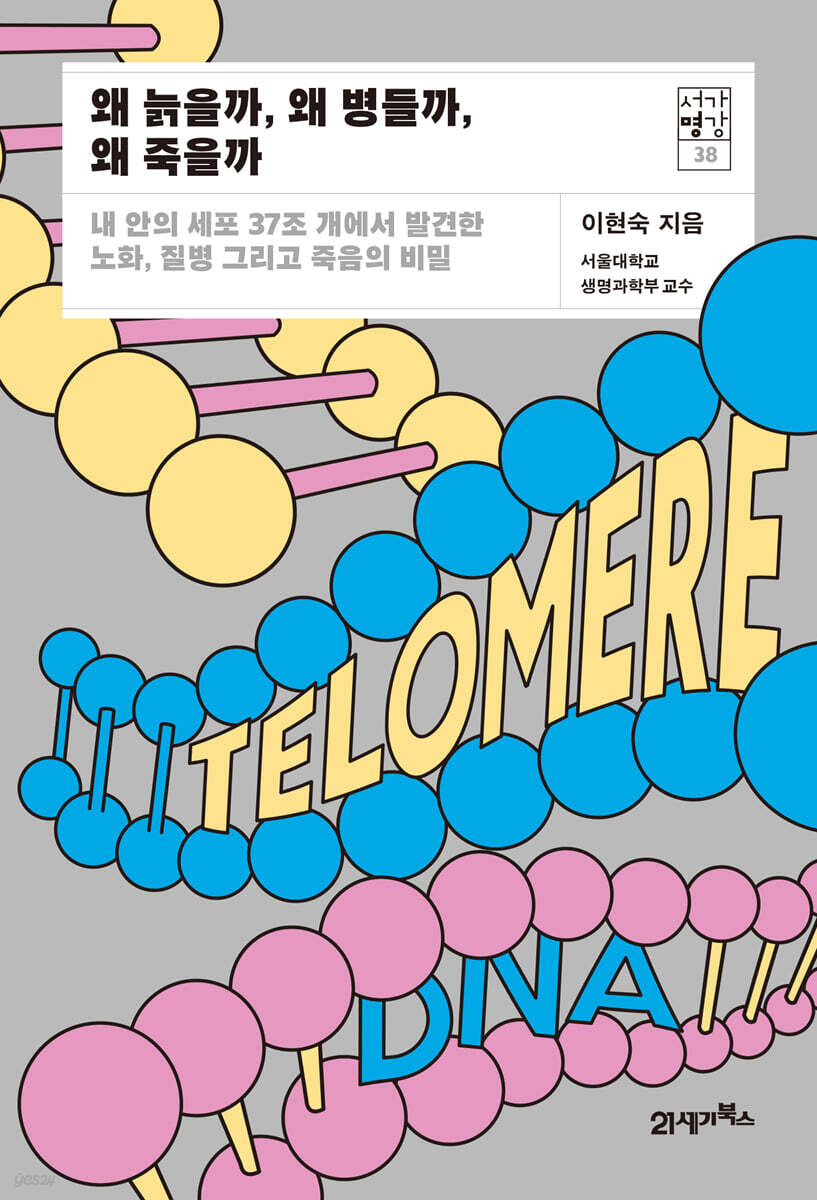
Why do we grow old, why do we get sick, why do we die?
 |
Description
Book Introduction
"Seogamyeonggang": A famous lecture you can attend without going to Seoul National University. The Secrets of Aging, Disease, and Death Discovered in the 37 Trillion Cells Within Us Discover Korea's finest lectures in book form! The thirty-eighth volume of the "Seogamyeonggang" series, featuring carefully curated lectures by current Seoul National University faculty, has been published. The Seoga Myunggang series, which transcribes the lectures of Seoul National University's top professors in various fields, including history, philosophy, science, medicine, and art, into books, provides readers with the expansion of knowledge and the joy of learning. "Why Do We Age, Why Do We Get Sick, Why Do We Die?" is a book that contains the secrets of our bodies that Professor Lee Hyun-sook of the Department of Life Sciences at Seoul National University has studied for over 30 years, focusing on "cells," the foundation of all life, from the operating principles of cells to birth, aging, illness, and death, precision medicine, and bio-artificial intelligence. Professor Lee Hyun-sook is the first Korean to be admitted to the Cambridge Institute of Molecular Biology, the birthplace of molecular biology and home to numerous Nobel Prize winners. She is a life scientist who has made remarkable achievements in identifying the cause of cancer by uncovering the molecular function of the breast cancer suppressor BRCA2 to unlock the secrets of genomic instability, a characteristic of cancer cells. This book, his first foray into the public domain, explores the profound question, “Why do humans age, get sick, and die?” through the journey of cells from birth to death. Furthermore, it expands our perspective on life by allowing us to rediscover the principles of nature through the lens of ‘cells.’ |
- You can preview some of the book's contents.
Preview
index
Classification of Academic Studies Before Reading This Book
Main keywords
Introduction: Learning Humanistic Imagination Through the Journey of Cells
Part 1: Why We Age and Get Sick
Discovery of the cells that control our bodies
Why we get sick more easily as we age
Redefining Life Phenomena through Cell Metabolism
Q/A Ask and Answer
Part 2: If you live long enough, you will inevitably get cancer.
The history of cancer, a story that has accompanied human history
The Mystery of Cancer Unraveled by Modern Science
The first events that lead to the birth of cancer cells
Genes that cause cancer, genes that prevent cancer
Q/A Ask and Answer
Part 3: Surviving with Telomeres: Turning Back the Biological Clock
The true meaning of growing old
Can aging be cured?
Extending Healthy Lifespan with Telomeres
Q/A Ask and Answer
Part 4: Rediscovery of the Gene That Controls Cancer
A new world of precision medicine created with genomic big data
The Birth of Personalized Cancer Treatment
Life Sciences: Empowering Artificial Intelligence
Q/A Ask and Answer
The Future of Science: Between the Closed and Open Worlds
annotation
Main keywords
Introduction: Learning Humanistic Imagination Through the Journey of Cells
Part 1: Why We Age and Get Sick
Discovery of the cells that control our bodies
Why we get sick more easily as we age
Redefining Life Phenomena through Cell Metabolism
Q/A Ask and Answer
Part 2: If you live long enough, you will inevitably get cancer.
The history of cancer, a story that has accompanied human history
The Mystery of Cancer Unraveled by Modern Science
The first events that lead to the birth of cancer cells
Genes that cause cancer, genes that prevent cancer
Q/A Ask and Answer
Part 3: Surviving with Telomeres: Turning Back the Biological Clock
The true meaning of growing old
Can aging be cured?
Extending Healthy Lifespan with Telomeres
Q/A Ask and Answer
Part 4: Rediscovery of the Gene That Controls Cancer
A new world of precision medicine created with genomic big data
The Birth of Personalized Cancer Treatment
Life Sciences: Empowering Artificial Intelligence
Q/A Ask and Answer
The Future of Science: Between the Closed and Open Worlds
annotation
Detailed image

Into the book
Proteins in the cell cycle have precise timing for when they appear and when they disappear.
If this circuit is ignored and someone steps forward to promote themselves, the symphony will become difficult to hear, and serious problems will arise in the cells, such as cancer cells or inflammatory cells with metabolic abnormalities.
If the immune system doesn't handle it properly, it can cause illness and death.
--- From "Introduction | Learning Humanistic Imagination through the Journey of Cells"
A single cell is not eternal and must die.
Instead, it divides into cells with the same DNA as itself, creating many descendant cells.
This is the feeling of the phenomenon of life and the definition of life.
This is also where life is distinguished from inanimate matter, and why viruses are not fully alive.
Viruses cannot divide on their own, and can only replicate and replicate their genes by entering a host cell and using the host cell's cellular machinery.
--- From "Part 1 | Why We Age and Get Sick"
There is a leading figure in cancer biology at MIT in the United States named Robert Weinberg.
“As we live longer, we are all destined to get cancer at some point,” he says.
This isn't to say we should be anxious, but it may actually be saying that cancer is what determines our lifespan.
--- From "Part 2 | If you live long enough, you will inevitably get cancer"
As a life scientist, I have many experiences where social phenomena can be explained through life phenomena, as social phenomena resemble life phenomena.
Cells are often cited in our lives.
In some companies, organizations are sometimes called 'cell units'.
In this way, learning about cells in life science will not only teach us about our bodies, but also provide inspiration and lessons for our society.
--- From "Part 2 | If you live long enough, you will inevitably get cancer: Page 79"
Let's look at the first scientific data to study 'What is aging?'
This is an experiment by Leonard Hayflick at the Wistar Institute in the United States in 1961.
Skin cells that make up the human dermis were taken out and grown in a medium containing all the nutrients necessary for culture.
Then, after the cells divided about 50 to 70 times, they stopped growing and just became stretched out, entering a stage that seemed to age.
I tried it two or three times in case I did it wrong, but the same thing happened every time.
It was discovered that the phenomenon of cell division continuing and then stopping is programmed within the cell.
In other words, the number of cell divisions was programmed.
--- From "Part 3 | Surviving with Telomeres: Turning Back the Biological Clock"
Jobs was a person who had access to cutting-edge science better than anyone else and knew all the information.
So when the pancreatic cancer recurred, he thought:
'New medical technologies are too slow to reach hospitals.
And I don't really trust surgeons.
I already had surgery once, but it relapsed.
"If they sequenced all of my genes, wouldn't they be able to find out which mutations I have and find a drug that targets them? Then they could cure my disease!" So Jobs, along with the Brodin Institute, sequenced his own genome several times.
--- From "Part 4 | Rediscovery of the Gene That Controls Cancer"
The secret to maintaining the human species on Earth is that genes with many errors pass away and the genes of the healthiest people are passed on to future generations.
Let us just maintain our greed to the extent of wanting to live as long and healthily as possible.
If this circuit is ignored and someone steps forward to promote themselves, the symphony will become difficult to hear, and serious problems will arise in the cells, such as cancer cells or inflammatory cells with metabolic abnormalities.
If the immune system doesn't handle it properly, it can cause illness and death.
--- From "Introduction | Learning Humanistic Imagination through the Journey of Cells"
A single cell is not eternal and must die.
Instead, it divides into cells with the same DNA as itself, creating many descendant cells.
This is the feeling of the phenomenon of life and the definition of life.
This is also where life is distinguished from inanimate matter, and why viruses are not fully alive.
Viruses cannot divide on their own, and can only replicate and replicate their genes by entering a host cell and using the host cell's cellular machinery.
--- From "Part 1 | Why We Age and Get Sick"
There is a leading figure in cancer biology at MIT in the United States named Robert Weinberg.
“As we live longer, we are all destined to get cancer at some point,” he says.
This isn't to say we should be anxious, but it may actually be saying that cancer is what determines our lifespan.
--- From "Part 2 | If you live long enough, you will inevitably get cancer"
As a life scientist, I have many experiences where social phenomena can be explained through life phenomena, as social phenomena resemble life phenomena.
Cells are often cited in our lives.
In some companies, organizations are sometimes called 'cell units'.
In this way, learning about cells in life science will not only teach us about our bodies, but also provide inspiration and lessons for our society.
--- From "Part 2 | If you live long enough, you will inevitably get cancer: Page 79"
Let's look at the first scientific data to study 'What is aging?'
This is an experiment by Leonard Hayflick at the Wistar Institute in the United States in 1961.
Skin cells that make up the human dermis were taken out and grown in a medium containing all the nutrients necessary for culture.
Then, after the cells divided about 50 to 70 times, they stopped growing and just became stretched out, entering a stage that seemed to age.
I tried it two or three times in case I did it wrong, but the same thing happened every time.
It was discovered that the phenomenon of cell division continuing and then stopping is programmed within the cell.
In other words, the number of cell divisions was programmed.
--- From "Part 3 | Surviving with Telomeres: Turning Back the Biological Clock"
Jobs was a person who had access to cutting-edge science better than anyone else and knew all the information.
So when the pancreatic cancer recurred, he thought:
'New medical technologies are too slow to reach hospitals.
And I don't really trust surgeons.
I already had surgery once, but it relapsed.
"If they sequenced all of my genes, wouldn't they be able to find out which mutations I have and find a drug that targets them? Then they could cure my disease!" So Jobs, along with the Brodin Institute, sequenced his own genome several times.
--- From "Part 4 | Rediscovery of the Gene That Controls Cancer"
The secret to maintaining the human species on Earth is that genes with many errors pass away and the genes of the healthiest people are passed on to future generations.
Let us just maintain our greed to the extent of wanting to live as long and healthily as possible.
--- From "Outgoing Writing | Between the Closed and Open Worlds, the Future of Science"
Publisher's Review
How can we age healthily?
From 'aging' and 'cancer' that everyone wants to overcome
From the 'Telomere Revolution' to the Secret of the Biological Clock
Life sciences for modern people who want to live a long and healthy life
Can aging be controlled? Is cancer a conquerable threat? In the "100-Year-Old Era," how can we age healthily? With average life expectancy increasing to the point where the concept of "slow aging" has become a trend, interest in health and aging continues to grow.
We all dream of living a long and healthy life.
But one day we grow old, get sick, and die.
It can only prevent aging and disease.
So how can we prepare for the future? The answer lies in our cells.
"Why Do We Age, Why Do We Get Sick, Why Do We Die?" is a book written by Professor Lee Hyun-sook of the Department of Life Sciences at Seoul National University, in an easy-to-understand way for the general public to understand the mechanisms by which cancer develops and we become sick and die, as she explains them through the journey of the 37 trillion cells in our bodies.
This book, which culminates over 30 years of the author's research, provides a fascinating exploration of how cells function in our bodies and how they govern our lives.
Moreover, the wonders of life learned from cells that contain all the information about birth, aging, illness, and death redefine our perception of life and death.
“The reason science is boring is because it only explains functions.
When there are people, poetry, and humanistic interpretations in the story of science, it becomes a very interesting story.
I hope this book will inspire your humanistic imagination.” - From the text
The splendid world of life guided by molecular and cellular biology
A wonderful and fascinating story about life and ourselves!
The author, who currently leads the Cancer Cell Biology Laboratory at Seoul National University's Department of Life Sciences, has a major research topic: 'How do normal cells transform into cancer cells?'
The author unravels the secrets of cells layer by layer using the keywords 'cancer' and 'aging', which are the biggest concerns of modern people and are both familiar and fearful.
One interesting fact is that the 'elixir of life' that Qin Shi Huang was looking for already exists within our bodies.
The main character is the substance of eternal life, telomerase.
Telomeres, which are the ends of chromosomes, play a role in determining the lifespan of a cell. The protein enzyme that protects the length of telomeres and prevents aging is called telomerase.
In other words, telomere maintenance is possible as long as telomerase is present.
So where is telomerase found in our bodies? It's found in germ cells and stem cells.
Therefore, in order to live a long and healthy life, we must protect the telomeres of stem cells.
Maintaining healthy stem cells for a long time allows us to create cells whenever we need them, ensuring health and a long life.
On the other hand, excessive expression of telomerase may also lead to the birth of cancer cells.
The fascinating cell story the author unfolds helps us gain a practical understanding of cancer and aging, which we only knew superficially.
If you know 'cells', you don't have to fear the 'future'!
Uncover the amazing possibilities that start from cells!
This book is divided into four parts.
First, in Part 1, 'Why Do We Age and Get Sick?', we learn about cells, the basic unit of life.
Understanding the structure and function of cells can help us understand the fundamental workings of life.
We closely examine the birth and death of life, as well as why we become more susceptible to disease as we age, through the cells that govern our bodies.
Part 2 delves into cancer, the number one cause of death among Koreans, with the theme, "If you live long enough, you will inevitably get cancer."
It begins with the history of cancer that has accompanied human history, and discusses the birth of cancer cells that cause extremely fatal problems to life, the genes that cause cancer and those that suppress cancer, and the various causes of cancer, from energy metabolism in cells.
The theme of the next three parts is 'Surviving with Telomeres that Turn Back the Biological Clock'.
By exploring why we inevitably develop cancer as we age through telomeres, which can be used as indicators of aging and cancer, we explore the possibility of treating aging.
This will shed light on a question that many people are wondering: Can aging and death be overcome?
Plus, we'll learn how to overcome aging and extend your healthy lifespan through the 'telomere revolution', which can turn back your biological clock.
Finally, Part 4, “Rediscovery of Genes That Control Cancer,” examines the current state of cancer treatment and explores the new world of precision medicine created by genomic big data.
We will guide you through the impact that precision medicine and next-generation biotechnology, which are rapidly developing through convergence with artificial intelligence technology, will have on our lives.
In this way, the author insightfully combines scientific research on cells with the modern person's greatest concern, 'health,' to reveal the mysteries of our body in an engaging way.
At the end of this book's cellular journey, readers will encounter a new understanding of life and our own existence.
From 'aging' and 'cancer' that everyone wants to overcome
From the 'Telomere Revolution' to the Secret of the Biological Clock
Life sciences for modern people who want to live a long and healthy life
Can aging be controlled? Is cancer a conquerable threat? In the "100-Year-Old Era," how can we age healthily? With average life expectancy increasing to the point where the concept of "slow aging" has become a trend, interest in health and aging continues to grow.
We all dream of living a long and healthy life.
But one day we grow old, get sick, and die.
It can only prevent aging and disease.
So how can we prepare for the future? The answer lies in our cells.
"Why Do We Age, Why Do We Get Sick, Why Do We Die?" is a book written by Professor Lee Hyun-sook of the Department of Life Sciences at Seoul National University, in an easy-to-understand way for the general public to understand the mechanisms by which cancer develops and we become sick and die, as she explains them through the journey of the 37 trillion cells in our bodies.
This book, which culminates over 30 years of the author's research, provides a fascinating exploration of how cells function in our bodies and how they govern our lives.
Moreover, the wonders of life learned from cells that contain all the information about birth, aging, illness, and death redefine our perception of life and death.
“The reason science is boring is because it only explains functions.
When there are people, poetry, and humanistic interpretations in the story of science, it becomes a very interesting story.
I hope this book will inspire your humanistic imagination.” - From the text
The splendid world of life guided by molecular and cellular biology
A wonderful and fascinating story about life and ourselves!
The author, who currently leads the Cancer Cell Biology Laboratory at Seoul National University's Department of Life Sciences, has a major research topic: 'How do normal cells transform into cancer cells?'
The author unravels the secrets of cells layer by layer using the keywords 'cancer' and 'aging', which are the biggest concerns of modern people and are both familiar and fearful.
One interesting fact is that the 'elixir of life' that Qin Shi Huang was looking for already exists within our bodies.
The main character is the substance of eternal life, telomerase.
Telomeres, which are the ends of chromosomes, play a role in determining the lifespan of a cell. The protein enzyme that protects the length of telomeres and prevents aging is called telomerase.
In other words, telomere maintenance is possible as long as telomerase is present.
So where is telomerase found in our bodies? It's found in germ cells and stem cells.
Therefore, in order to live a long and healthy life, we must protect the telomeres of stem cells.
Maintaining healthy stem cells for a long time allows us to create cells whenever we need them, ensuring health and a long life.
On the other hand, excessive expression of telomerase may also lead to the birth of cancer cells.
The fascinating cell story the author unfolds helps us gain a practical understanding of cancer and aging, which we only knew superficially.
If you know 'cells', you don't have to fear the 'future'!
Uncover the amazing possibilities that start from cells!
This book is divided into four parts.
First, in Part 1, 'Why Do We Age and Get Sick?', we learn about cells, the basic unit of life.
Understanding the structure and function of cells can help us understand the fundamental workings of life.
We closely examine the birth and death of life, as well as why we become more susceptible to disease as we age, through the cells that govern our bodies.
Part 2 delves into cancer, the number one cause of death among Koreans, with the theme, "If you live long enough, you will inevitably get cancer."
It begins with the history of cancer that has accompanied human history, and discusses the birth of cancer cells that cause extremely fatal problems to life, the genes that cause cancer and those that suppress cancer, and the various causes of cancer, from energy metabolism in cells.
The theme of the next three parts is 'Surviving with Telomeres that Turn Back the Biological Clock'.
By exploring why we inevitably develop cancer as we age through telomeres, which can be used as indicators of aging and cancer, we explore the possibility of treating aging.
This will shed light on a question that many people are wondering: Can aging and death be overcome?
Plus, we'll learn how to overcome aging and extend your healthy lifespan through the 'telomere revolution', which can turn back your biological clock.
Finally, Part 4, “Rediscovery of Genes That Control Cancer,” examines the current state of cancer treatment and explores the new world of precision medicine created by genomic big data.
We will guide you through the impact that precision medicine and next-generation biotechnology, which are rapidly developing through convergence with artificial intelligence technology, will have on our lives.
In this way, the author insightfully combines scientific research on cells with the modern person's greatest concern, 'health,' to reveal the mysteries of our body in an engaging way.
At the end of this book's cellular journey, readers will encounter a new understanding of life and our own existence.
GOODS SPECIFICS
- Date of issue: September 2, 2024
- Page count, weight, size: 240 pages | 128*188*20mm
- ISBN13: 9791171177653
- ISBN10: 1171177658
You may also like
카테고리
korean


korean

![GQ KOREA Mark (Monthly): December [2025]](http://librairie.coreenne.fr/cdn/shop/files/8ef265dbbfbf186523ed75ba7319009d.jpg?v=1765340328&width=3840)


