

Amazing SNS Math
 |
Description
Book Introduction
# Develop interest in and concepts of mathematics with math puzzles popular on social media.
# Math tricks and magic are just a hair's breadth apart!
You who shudder at the thought of math!
Have you ever laughed while watching puzzles on Facebook or YouTube?
If you hate math but love math puzzles that make you leave comments like a charm, then you've stepped into the world of math.
This book analyzes why math puzzles attract people's attention on social media and goes on to explain what mathematical concepts we should learn through such puzzles.
# Math tricks and magic are just a hair's breadth apart!
You who shudder at the thought of math!
Have you ever laughed while watching puzzles on Facebook or YouTube?
If you hate math but love math puzzles that make you leave comments like a charm, then you've stepped into the world of math.
This book analyzes why math puzzles attract people's attention on social media and goes on to explain what mathematical concepts we should learn through such puzzles.
- You can preview some of the book's contents.
Preview
index
preface
Chapter 1: Heart-Pounding Math Tricks - Math Tricks and Tips
Chapter 2: My Childhood Wasn't Like That - Math Goes Viral in the Pre-Internet Era
Chapter 3: Back to School - Hot Topic Test Questions and Classroom Challenges
Chapter 4: Incorrect Operations - The Troublesome Sequence of Operations
Chapter 5: Bad Math - When Facebook Met Algebra
Chapter 6: Into the World of Shapes - Knee-slapping Geometry Problems
Conclusion - What is the future of mathematics, a hot topic on social media?
solution
Chapter 1: Heart-Pounding Math Tricks - Math Tricks and Tips
Chapter 2: My Childhood Wasn't Like That - Math Goes Viral in the Pre-Internet Era
Chapter 3: Back to School - Hot Topic Test Questions and Classroom Challenges
Chapter 4: Incorrect Operations - The Troublesome Sequence of Operations
Chapter 5: Bad Math - When Facebook Met Algebra
Chapter 6: Into the World of Shapes - Knee-slapping Geometry Problems
Conclusion - What is the future of mathematics, a hot topic on social media?
solution
Detailed image
Into the book
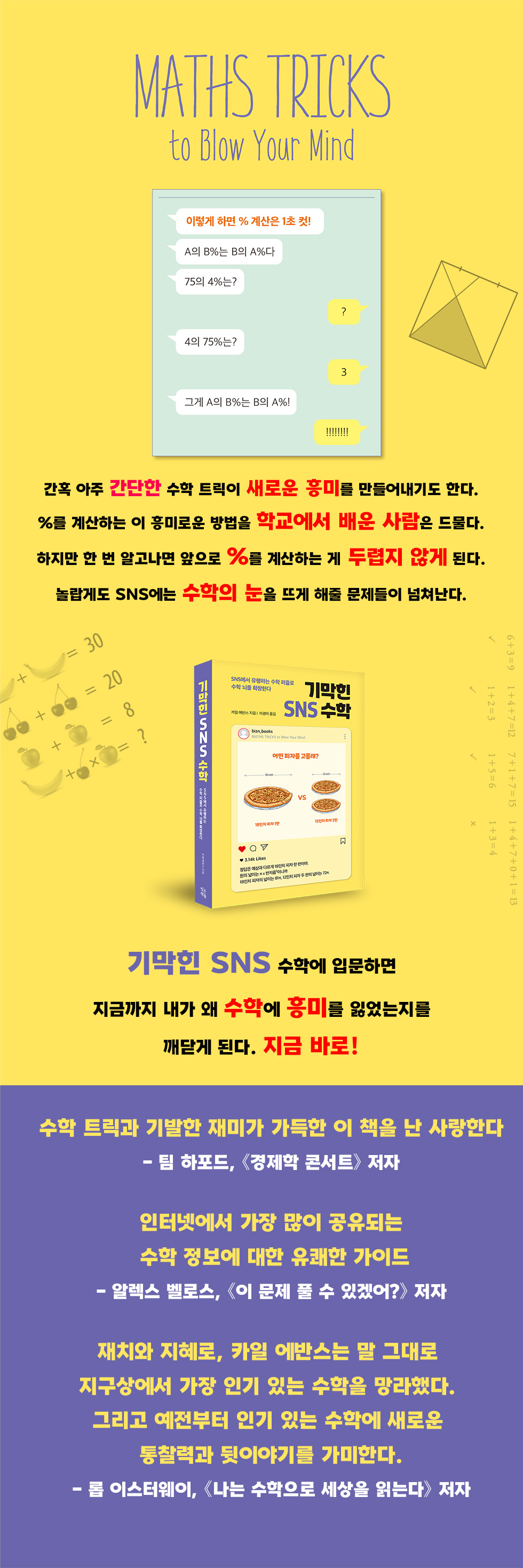
Did you know that 8% of 25 is equal to 25% of 8? This is a great example of the positive side of math that's "going viral on social media."
This is a problem that anyone with formal education can relate to and understand once they see it, but most people graduate from school without ever hearing about it.
Could there be a greater social media influence than this? Raising the public's mathematical literacy.
Who could have a negative attitude towards this?
--- p.8
Three women went out to lunch together.
At the restaurant, they ordered food for 10 pounds each and placed three 10-pound notes on the table.
The waiter took the money to the cash register, and the manager informed us that the food we ordered was on special offer, costing 25 pounds for three people.
The waiter placed five one-pound coins on the table as change.
The guests each took one pound and gave the waiter two pounds as a tip.
The guests came to the restaurant with 10 pounds each, 3 people for 30 pounds.
Each person paid 9 pounds for the meal, so the total amount paid by the three people was 27 pounds.
Add the £2 tip I gave the waiter and it comes to £29.
So where did the remaining pound go?
--- p.49
When I wrote this book, I vowed never to include the phrase, "Would anyone argue with this issue?"
Especially in our collective experience with social media, people are so insistent that black is white.
--- p.60
A dragon lives in a cave.
The dragon doubled in size every day.
After 20 days, the dragon's body filled the cave.
How many days will it take for the dragon's body to fill half of the cave?
This is a problem that anyone with formal education can relate to and understand once they see it, but most people graduate from school without ever hearing about it.
Could there be a greater social media influence than this? Raising the public's mathematical literacy.
Who could have a negative attitude towards this?
--- p.8
Three women went out to lunch together.
At the restaurant, they ordered food for 10 pounds each and placed three 10-pound notes on the table.
The waiter took the money to the cash register, and the manager informed us that the food we ordered was on special offer, costing 25 pounds for three people.
The waiter placed five one-pound coins on the table as change.
The guests each took one pound and gave the waiter two pounds as a tip.
The guests came to the restaurant with 10 pounds each, 3 people for 30 pounds.
Each person paid 9 pounds for the meal, so the total amount paid by the three people was 27 pounds.
Add the £2 tip I gave the waiter and it comes to £29.
So where did the remaining pound go?
--- p.49
When I wrote this book, I vowed never to include the phrase, "Would anyone argue with this issue?"
Especially in our collective experience with social media, people are so insistent that black is white.
--- p.60
A dragon lives in a cave.
The dragon doubled in size every day.
After 20 days, the dragon's body filled the cave.
How many days will it take for the dragon's body to fill half of the cave?
--- p.94
Publisher's Review
# Even those who fail at math like SNS math puzzles.
You who shudder at the thought of math!
Have you ever laughed while watching puzzles on Facebook or YouTube?
If you hate math but love math puzzles that make you leave comments like a charm, then you've stepped into the world of math.
This book analyzes why math puzzles attract people's attention on social media and goes on to explain what mathematical concepts we should learn through such puzzles.
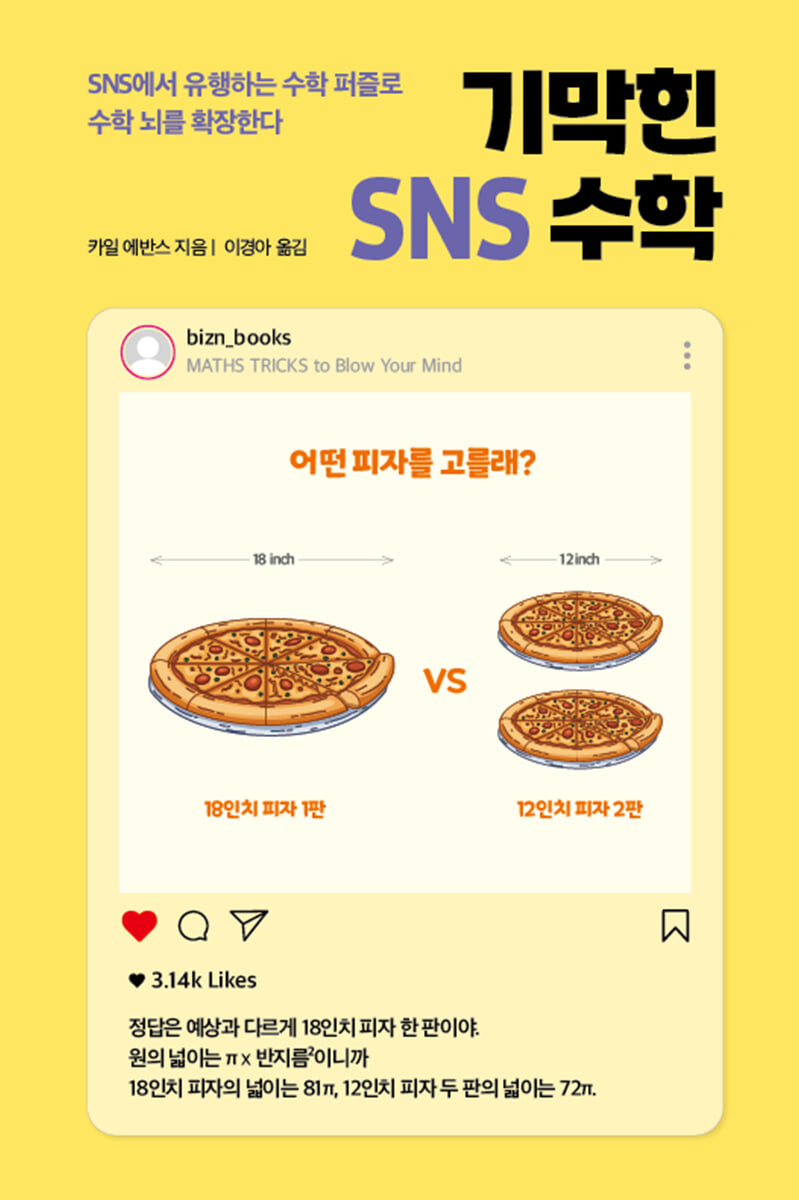
For example, let's look at the question asked on the cover of a book.
You ask which pizza is better: one 18-inch pizza or two 12-inch pizzas.
Intuitively, it seems like choosing two 12-inch pizzas would be more advantageous.
You probably do a rough calculation like this in your head:
'There are two 12-inch ones, so it's roughly 24, which is definitely bigger than 18.'
But this intuitive thinking is wrong.
If you think about it, we already memorized the formula for calculating the area of a circle in middle school.
I just didn't use it.
The phrase 'pi squared' will come to mind.
In symbols, it is written as ????².
?? is a value of approximately 3.14, but you don't need to calculate this.
Because we only need to compare the areas of two pizzas.
?? refers to the radius.
So the radius of an 18-inch pizza is 9, so when you square it, it's 81.
The radius of a 12-inch pizza is 6.
If you square it, it's 36, and if you add the two plates, it's 72.
Since it's 81 and 72, an 18-inch pizza is wider.
# SNS Math Boosts Math Interest
When people see problems like this on social media, they get curious and try to solve them.
The same goes for people who hate math.
And as you watch the solution, you'll exclaim, "Aha!" and recall simple mathematical concepts you learned previously. This is a positive function of SNS mathematics.
Also, when I look at problems like the 'mystery of the lost pound' (in Korea, it's a problem that comes up when you search for 'jeweler's loss'), I get lost wondering where the pound has gone.
If you organize it mathematically, it's very simple, but it's a trick that confuses people.
By looking at these various problems, you can experience the concepts expanding to algebra, exponents, equations, shapes, and even differentiation.
Of course, all the mathematics explained in this book can be sufficiently understood at the level we learned in middle school.
The author also takes the time to put difficult concepts at the back of the book, so that readers can look them up if they really need to.
If we consider what kind of math puzzles people find interesting, we can find answers to why we lost interest in math.
Math used to be fun and something close to everyday life, but you may have lost interest in it because you were only solving random problems.
'Amazing Social Media Math' shows you how to get that excitement back.
You who shudder at the thought of math!
Have you ever laughed while watching puzzles on Facebook or YouTube?
If you hate math but love math puzzles that make you leave comments like a charm, then you've stepped into the world of math.
This book analyzes why math puzzles attract people's attention on social media and goes on to explain what mathematical concepts we should learn through such puzzles.
For example, let's look at the question asked on the cover of a book.
You ask which pizza is better: one 18-inch pizza or two 12-inch pizzas.
Intuitively, it seems like choosing two 12-inch pizzas would be more advantageous.
You probably do a rough calculation like this in your head:
'There are two 12-inch ones, so it's roughly 24, which is definitely bigger than 18.'
But this intuitive thinking is wrong.
If you think about it, we already memorized the formula for calculating the area of a circle in middle school.
I just didn't use it.
The phrase 'pi squared' will come to mind.
In symbols, it is written as ????².
?? is a value of approximately 3.14, but you don't need to calculate this.
Because we only need to compare the areas of two pizzas.
?? refers to the radius.
So the radius of an 18-inch pizza is 9, so when you square it, it's 81.
The radius of a 12-inch pizza is 6.
If you square it, it's 36, and if you add the two plates, it's 72.
Since it's 81 and 72, an 18-inch pizza is wider.
# SNS Math Boosts Math Interest
When people see problems like this on social media, they get curious and try to solve them.
The same goes for people who hate math.
And as you watch the solution, you'll exclaim, "Aha!" and recall simple mathematical concepts you learned previously. This is a positive function of SNS mathematics.
Also, when I look at problems like the 'mystery of the lost pound' (in Korea, it's a problem that comes up when you search for 'jeweler's loss'), I get lost wondering where the pound has gone.
If you organize it mathematically, it's very simple, but it's a trick that confuses people.
By looking at these various problems, you can experience the concepts expanding to algebra, exponents, equations, shapes, and even differentiation.
Of course, all the mathematics explained in this book can be sufficiently understood at the level we learned in middle school.
The author also takes the time to put difficult concepts at the back of the book, so that readers can look them up if they really need to.
If we consider what kind of math puzzles people find interesting, we can find answers to why we lost interest in math.
Math used to be fun and something close to everyday life, but you may have lost interest in it because you were only solving random problems.
'Amazing Social Media Math' shows you how to get that excitement back.
GOODS SPECIFICS
- Date of issue: May 24, 2024
- Page count, weight, size: 288 pages | 374g | 140*210*20mm
- ISBN13: 9791171210671
- ISBN10: 1171210671
You may also like
카테고리
korean


korean

![GQ KOREA Mark (Monthly): December [2025]](http://librairie.coreenne.fr/cdn/shop/files/8ef265dbbfbf186523ed75ba7319009d.jpg?v=1765340328&width=3840)


