

Kim Seung-hwan's PSAT Data Interpretation 55 Topics 3.0
 |
Description
Book Introduction
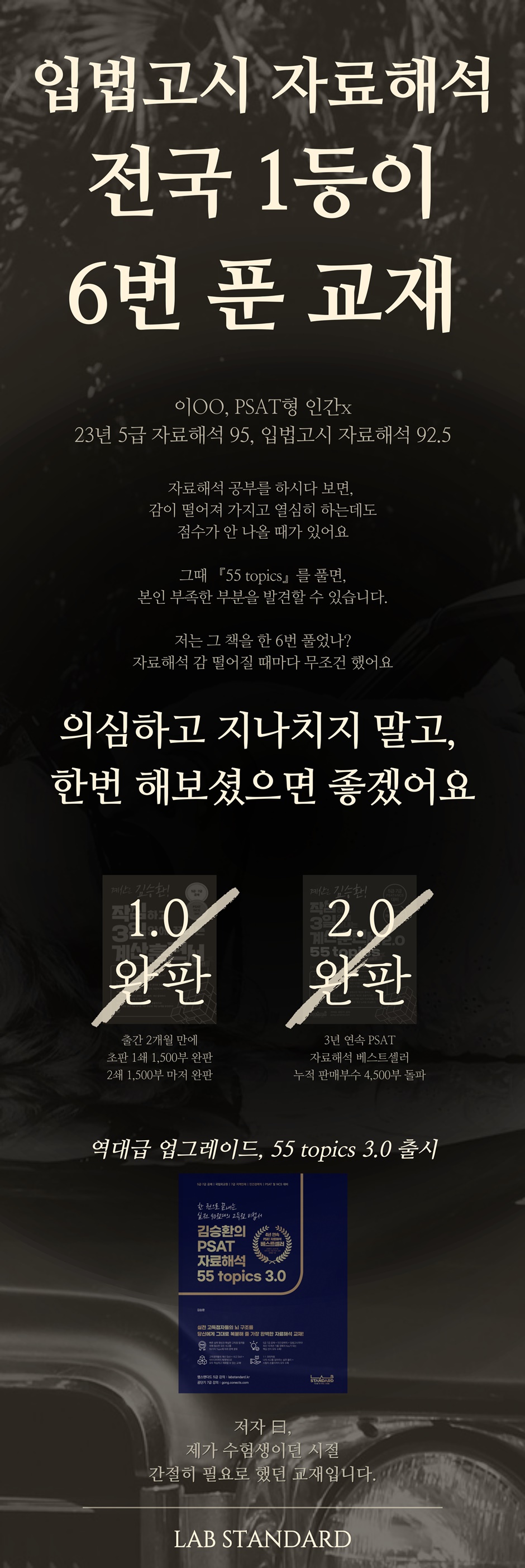
The world's fastest and most effective data analysis textbook, written by Seung-Hwan Kim, who has produced numerous high scorers in the 90s and improved their scores by 20 points or more over many years, including the top scorer in the PSAT data interpretation for the Legislative Examination (Finance and Economics) and the second-highest scorer in the 5th-grade civil service exam.
This high-score secret book provides all the concepts, calculation skills, and ideas needed for PSAT data interpretation, from beginners to experts, in a single volume.
This textbook, with its systematic structure and friendly, intuitive explanations, will copy the brain structure of high-scoring students into your own hands.
1.
All the thinking you need to quickly improve your skills and achieve a high score is perfectly categorized into 55 topics.
2.
From the 5th and 7th grade civil service exams, to the private sector career exams and the Legislative Exam, we've carefully selected the most important questions for mastering the latest 15 years of data interpretation!
3.
A textbook that systematically teaches and internalizes the calculation skills, thinking skills, and even ideas of high-scoring students!
4.
Includes practical solutions that will help you focus your thinking, like a 1:1 tutoring session, and even practice exercises for the exam.
This textbook provides answers to all the concerns that test takers may encounter during the data interpretation learning process.
If you establish and internalize consistent standards through this textbook, you will definitely reach your goals.
This high-score secret book provides all the concepts, calculation skills, and ideas needed for PSAT data interpretation, from beginners to experts, in a single volume.
This textbook, with its systematic structure and friendly, intuitive explanations, will copy the brain structure of high-scoring students into your own hands.
1.
All the thinking you need to quickly improve your skills and achieve a high score is perfectly categorized into 55 topics.
2.
From the 5th and 7th grade civil service exams, to the private sector career exams and the Legislative Exam, we've carefully selected the most important questions for mastering the latest 15 years of data interpretation!
3.
A textbook that systematically teaches and internalizes the calculation skills, thinking skills, and even ideas of high-scoring students!
4.
Includes practical solutions that will help you focus your thinking, like a 1:1 tutoring session, and even practice exercises for the exam.
This textbook provides answers to all the concerns that test takers may encounter during the data interpretation learning process.
If you establish and internalize consistent standards through this textbook, you will definitely reach your goals.
- You can preview some of the book's contents.
Preview
index
preface
How to Use This Book & Recommended Study Plan
Data Interpretation High-Score Paradigm
1.
Criteria for comparative verification
2.
Efficient use of given information
3.
Intuitive understanding and use of ideas
4.
When going straight is fast, go straight
5.
Interpretation of distribution (high-score peak thinking)
Step 1.
Tools
[The beginning of the accident]
1.
Draw a diagonal line
2.
Structural visualization
3.
Keep it
4.
Marking the spot
5.
Merge
[Accident Efficiency]
6.
View larger/smaller
7.
Utilizing square numbers
8.
The Fugitive and the Pursuer
9.
Reversing the predicate (reciprocal, opposite interpretation)
10.
Avatar
11.
Valid digits
[The Art of Confirmation]
12.
Numbering
13.
Adding like counting
14.
Write in between
15.
Mistake Prevention Kit (Twin Table/Even Table/Label Merge/Range Limit)
Step 2.
Skills
[Fractional comparison]
16.
Fraction comparison (most)
17.
Fraction comparison (nth)
18.
Compare fractions (3 or more)
19.
Fraction comparison (integer multiplication)
20.
Most A, Most B
21.
Comparison of fractions of different scales
22.
Comparison of fractions by operation combination (table processing)
[Increase rate, decrease rate]
23.
Flow Analysis (Trying Gap)
24.
Comparison of rate of increase/decrease (rate of change)
25.
Increase rate↔Decrease rate conversion
26.
Decrease rate↔Residual rate conversion
[Multiplication comparison]
27.
Conceptual shift
28.
3 variables (multiplication comparison)
[Comparison of combined car]
29.
Vertical sum, horizontal sum estimate
30.
Compare totals, compare differences
31.
3 variables (increase/decrease comparison)
[Information Inference]
32.
Choggam Mountain
33.
Bundle Mountain
34.
Nano calculation (place marking)
35.
Error correction
36.
Cumulative increase/decrease rate
37.
5% (15, 35, 65, 85%)
38.
Get off
39.
Relative ratio
40.
+tip Pass by
Step 3.
Idea
[Ratio Inference]
41.
% and %p
[Proportional Thinking]
42.
proportional thinking
43.
Proportional thinking (distance, speed, time, fuel economy, exchange rate)
[Statistical Inference]
44.
Simple average (comparison, variation, interpretation)
45.
Weighted average (capture and utilization, calculation and interpretation)
[Set, Range Inference]
46.
Least intersection
47.
MaxMin accident resolution
[Dynamic Inference]
48.
Using the difference value (delta)
49.
Electricity cost inversion
50.
Intercept and slope
[Conceptual Reasoning]
51.
Integer concept and approximate calculation
52.
Active use of Korean units
53.
Numeral system, notation system
[Information Link]
54.
simultaneous equations
55.
Interpretation of distribution
How to Use This Book & Recommended Study Plan
Data Interpretation High-Score Paradigm
1.
Criteria for comparative verification
2.
Efficient use of given information
3.
Intuitive understanding and use of ideas
4.
When going straight is fast, go straight
5.
Interpretation of distribution (high-score peak thinking)
Step 1.
Tools
[The beginning of the accident]
1.
Draw a diagonal line
2.
Structural visualization
3.
Keep it
4.
Marking the spot
5.
Merge
[Accident Efficiency]
6.
View larger/smaller
7.
Utilizing square numbers
8.
The Fugitive and the Pursuer
9.
Reversing the predicate (reciprocal, opposite interpretation)
10.
Avatar
11.
Valid digits
[The Art of Confirmation]
12.
Numbering
13.
Adding like counting
14.
Write in between
15.
Mistake Prevention Kit (Twin Table/Even Table/Label Merge/Range Limit)
Step 2.
Skills
[Fractional comparison]
16.
Fraction comparison (most)
17.
Fraction comparison (nth)
18.
Compare fractions (3 or more)
19.
Fraction comparison (integer multiplication)
20.
Most A, Most B
21.
Comparison of fractions of different scales
22.
Comparison of fractions by operation combination (table processing)
[Increase rate, decrease rate]
23.
Flow Analysis (Trying Gap)
24.
Comparison of rate of increase/decrease (rate of change)
25.
Increase rate↔Decrease rate conversion
26.
Decrease rate↔Residual rate conversion
[Multiplication comparison]
27.
Conceptual shift
28.
3 variables (multiplication comparison)
[Comparison of combined car]
29.
Vertical sum, horizontal sum estimate
30.
Compare totals, compare differences
31.
3 variables (increase/decrease comparison)
[Information Inference]
32.
Choggam Mountain
33.
Bundle Mountain
34.
Nano calculation (place marking)
35.
Error correction
36.
Cumulative increase/decrease rate
37.
5% (15, 35, 65, 85%)
38.
Get off
39.
Relative ratio
40.
+tip Pass by
Step 3.
Idea
[Ratio Inference]
41.
% and %p
[Proportional Thinking]
42.
proportional thinking
43.
Proportional thinking (distance, speed, time, fuel economy, exchange rate)
[Statistical Inference]
44.
Simple average (comparison, variation, interpretation)
45.
Weighted average (capture and utilization, calculation and interpretation)
[Set, Range Inference]
46.
Least intersection
47.
MaxMin accident resolution
[Dynamic Inference]
48.
Using the difference value (delta)
49.
Electricity cost inversion
50.
Intercept and slope
[Conceptual Reasoning]
51.
Integer concept and approximate calculation
52.
Active use of Korean units
53.
Numeral system, notation system
[Information Link]
54.
simultaneous equations
55.
Interpretation of distribution
Detailed image
Publisher's Review
I can confidently say that this textbook is the most complete data interpretation textbook that has ever existed in the world.
After completing this textbook, your skills will have improved dramatically.
We hope you can overcome all your weaknesses and concerns regarding data interpretation and achieve your goals with ease.
Kim Seung-hwan's dream.
* Lab Standard Level 5 PSAT Lecture: labstandard.kr
* Gongdangi 7th grade PSAT lecture: gong.conects.com
* Official YouTube Channel: Rap Standard
After completing this textbook, your skills will have improved dramatically.
We hope you can overcome all your weaknesses and concerns regarding data interpretation and achieve your goals with ease.
Kim Seung-hwan's dream.
* Lab Standard Level 5 PSAT Lecture: labstandard.kr
* Gongdangi 7th grade PSAT lecture: gong.conects.com
* Official YouTube Channel: Rap Standard
GOODS SPECIFICS
- Date of issue: September 25, 2023
- Page count, weight, size: 413 pages | 1,236g | 210*297*26mm
- ISBN13: 9791192656120
- ISBN10: 1192656121
You may also like
카테고리
korean


korean

![GQ KOREA Mark (Monthly): December [2025]](http://librairie.coreenne.fr/cdn/shop/files/8ef265dbbfbf186523ed75ba7319009d.jpg?v=1765340328&width=3840)


