

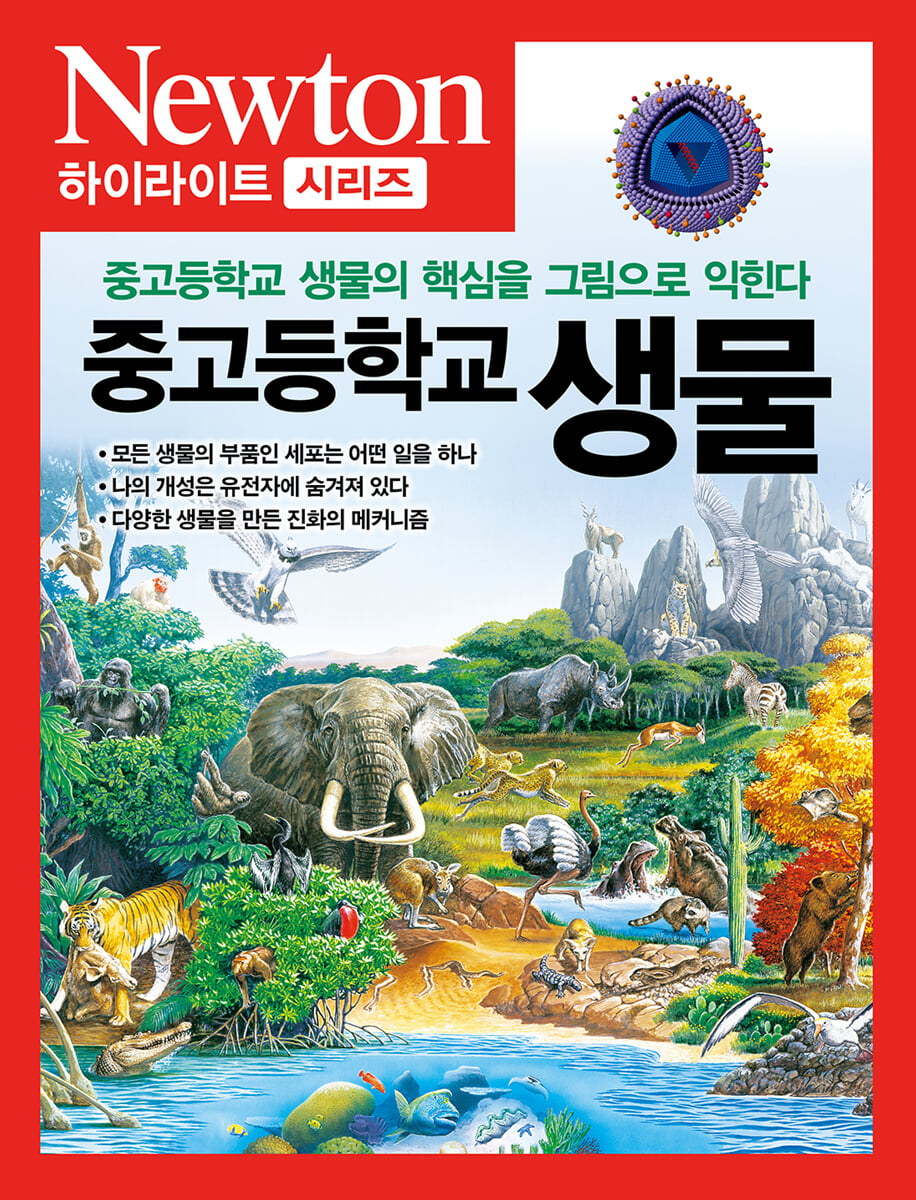
NEWTON HIGHLIGHT Newton High School Biology
 |
Description
Book Introduction
Earth is a planet of life.
From invisible bacteria to gigantic whales, a wide variety of living things live in close relationships with one another.
Biology is the study of knowledge and theories about living things on Earth.
This book covers all the important topics of biology learned from middle school to high school.
While living things have 'diversity', such as differences between species such as animals and plants and differences in ecosystems, there is also 'commonality', such as all living things having cells and the continuity of life being maintained through a mechanism called heredity.
Through these contents, middle and high school biology is about learning what a living thing is and what a person is.
Chapter 1 examines the 'cell,' the most important basic unit of life and a symbol of the commonality of living things.
In the following two chapters, we learn how an individual organism is born and how the 'internal environment' is maintained to establish it as an individual.
In Chapter 3, we learn about "genetics." We'll learn about the process of creating various types of "proteins" based on the genetic information in DNA.
Chapter 4 introduces 'Reproduction and Sex', such as how genes, the blueprint of life, are passed on to the next generation and why sex exists.
Chapter 5, the final chapter, examines ‘Evolution and Ecology.’
Based on the terrestrial ecosystem, which symbolizes biodiversity, we introduce the history and research results of how organisms have adapted and evolved.
We hope you enjoy reading about the diverse and wide world of living things with rich illustrations.
From invisible bacteria to gigantic whales, a wide variety of living things live in close relationships with one another.
Biology is the study of knowledge and theories about living things on Earth.
This book covers all the important topics of biology learned from middle school to high school.
While living things have 'diversity', such as differences between species such as animals and plants and differences in ecosystems, there is also 'commonality', such as all living things having cells and the continuity of life being maintained through a mechanism called heredity.
Through these contents, middle and high school biology is about learning what a living thing is and what a person is.
Chapter 1 examines the 'cell,' the most important basic unit of life and a symbol of the commonality of living things.
In the following two chapters, we learn how an individual organism is born and how the 'internal environment' is maintained to establish it as an individual.
In Chapter 3, we learn about "genetics." We'll learn about the process of creating various types of "proteins" based on the genetic information in DNA.
Chapter 4 introduces 'Reproduction and Sex', such as how genes, the blueprint of life, are passed on to the next generation and why sex exists.
Chapter 5, the final chapter, examines ‘Evolution and Ecology.’
Based on the terrestrial ecosystem, which symbolizes biodiversity, we introduce the history and research results of how organisms have adapted and evolved.
We hope you enjoy reading about the diverse and wide world of living things with rich illustrations.
- You can preview some of the book's contents.
Preview
index
1 Cells that make up the body of a living organism
Cell diversity/Overall appearance of a cell/Cell nucleus ①/Cell nucleus ②/Origin of cell organelles/Endoplasmic reticulum/Golgi apparatus/Mitochondria/Cell membrane/Metabolism/Plant cells/Cell division/Cell death/Virus/Cancer
2 Start of the object
Eggs and sperm, fertilization/totipotency and the three germ layers/induction/blood and immunity/homeostasis/nerve cells/innate and learned behavior/glycolysis and the TCA cycle/digestion and absorption
The Mystery of 3 Genes
Children resemble their parents/Laws of heredity/Genes and chromosomes/Gene reconstruction/DNA/Central dogma/Codons and the genetic code/Proteins and enzymes/Gene expression regulation/RNA processing/Genome/columa1 What is passed on through inheritance?
4 Mechanisms of Reproduction and Sex
Asexual reproduction/sexual reproduction/sex determination/SRY gene/sex change/why did sex evolve/column 2 Is it true that sons resemble their mothers and daughters resemble their fathers?
5 Evolution and Ecology
Gene pool/Hardy-Weinberg equilibrium/mutation/natural selection/sexual selection/genetic drift/gene flow/Darwin's Origin of Species/adaptive radiation/chemical evolution/cyanobacteria/Cambrian explosion/mass extinction and prosperity/humanity/food webs and energy flow/ecosystem/global warming/column 3 Gene editing being used nearby
Cell diversity/Overall appearance of a cell/Cell nucleus ①/Cell nucleus ②/Origin of cell organelles/Endoplasmic reticulum/Golgi apparatus/Mitochondria/Cell membrane/Metabolism/Plant cells/Cell division/Cell death/Virus/Cancer
2 Start of the object
Eggs and sperm, fertilization/totipotency and the three germ layers/induction/blood and immunity/homeostasis/nerve cells/innate and learned behavior/glycolysis and the TCA cycle/digestion and absorption
The Mystery of 3 Genes
Children resemble their parents/Laws of heredity/Genes and chromosomes/Gene reconstruction/DNA/Central dogma/Codons and the genetic code/Proteins and enzymes/Gene expression regulation/RNA processing/Genome/columa1 What is passed on through inheritance?
4 Mechanisms of Reproduction and Sex
Asexual reproduction/sexual reproduction/sex determination/SRY gene/sex change/why did sex evolve/column 2 Is it true that sons resemble their mothers and daughters resemble their fathers?
5 Evolution and Ecology
Gene pool/Hardy-Weinberg equilibrium/mutation/natural selection/sexual selection/genetic drift/gene flow/Darwin's Origin of Species/adaptive radiation/chemical evolution/cyanobacteria/Cambrian explosion/mass extinction and prosperity/humanity/food webs and energy flow/ecosystem/global warming/column 3 Gene editing being used nearby
Detailed image

Publisher's Review
Learn about the structure and function of cells, the basic unit of life.
Cells are the most important basic units of life in living organisms, and within cells, chemical reactions called 'metabolism' that produce energy are constantly occurring.
And cells contain DNA, the blueprint for life. Thanks to DNA, organisms can pass on their lives to future generations.
Explains DNA and metabolism, focusing on cells, which are common to all living things.
Learn about the various mechanisms that create and maintain individuals.
We will examine how the fertilized egg, created by fertilization between an egg and sperm, undergoes a process called cleavage and changes into each part of our body.
It also explains in detail the mechanisms that maintain homeostasis in our body, the immune mechanisms that defend against viruses and bacteria from the outside, and how food, which is a nutrient, is converted into energy to sustain life.
Exploring the mysteries of genes and heredity
The reason children resemble their parents is because the parents' 'genes' are passed down to the children.
In sexual reproduction, the offspring resemble the parents, but are not exact copies.
It has characteristics that seem to be a combination of the characteristics of the father and the mother.
So, what genes are combined in this process? The mysteries of genes and heredity are explained with illustrations.
Explain in detail the mechanisms of reproduction and sex
Why did living things create "gender"? Among living things, there are many different forms of gender, including those without gender, those that have gender but only give birth to female offspring, and those that change gender during birth.
What is sex in living things? Explaining the mechanisms of reproduction and sex.
A look at the history and ecosystem of evolution
The history of life is the history of evolution derived from ancestors.
This book introduces the path that living things have evolved along.
We also look at the diverse vegetation and ecosystems that exist on Earth.
Cells are the most important basic units of life in living organisms, and within cells, chemical reactions called 'metabolism' that produce energy are constantly occurring.
And cells contain DNA, the blueprint for life. Thanks to DNA, organisms can pass on their lives to future generations.
Explains DNA and metabolism, focusing on cells, which are common to all living things.
Learn about the various mechanisms that create and maintain individuals.
We will examine how the fertilized egg, created by fertilization between an egg and sperm, undergoes a process called cleavage and changes into each part of our body.
It also explains in detail the mechanisms that maintain homeostasis in our body, the immune mechanisms that defend against viruses and bacteria from the outside, and how food, which is a nutrient, is converted into energy to sustain life.
Exploring the mysteries of genes and heredity
The reason children resemble their parents is because the parents' 'genes' are passed down to the children.
In sexual reproduction, the offspring resemble the parents, but are not exact copies.
It has characteristics that seem to be a combination of the characteristics of the father and the mother.
So, what genes are combined in this process? The mysteries of genes and heredity are explained with illustrations.
Explain in detail the mechanisms of reproduction and sex
Why did living things create "gender"? Among living things, there are many different forms of gender, including those without gender, those that have gender but only give birth to female offspring, and those that change gender during birth.
What is sex in living things? Explaining the mechanisms of reproduction and sex.
A look at the history and ecosystem of evolution
The history of life is the history of evolution derived from ancestors.
This book introduces the path that living things have evolved along.
We also look at the diverse vegetation and ecosystems that exist on Earth.
GOODS SPECIFICS
- Date of issue: March 15, 2024
- Page count, weight, size: 144 pages | 210*275*20mm
- ISBN13: 9791161961293
- ISBN10: 1161961291
You may also like
카테고리
korean


korean

![GQ KOREA Mark (Monthly): December [2025]](http://librairie.coreenne.fr/cdn/shop/files/8ef265dbbfbf186523ed75ba7319009d.jpg?v=1765340328&width=3840)


