

The Stanford Mindset That Makes Math Greater
 |
Description
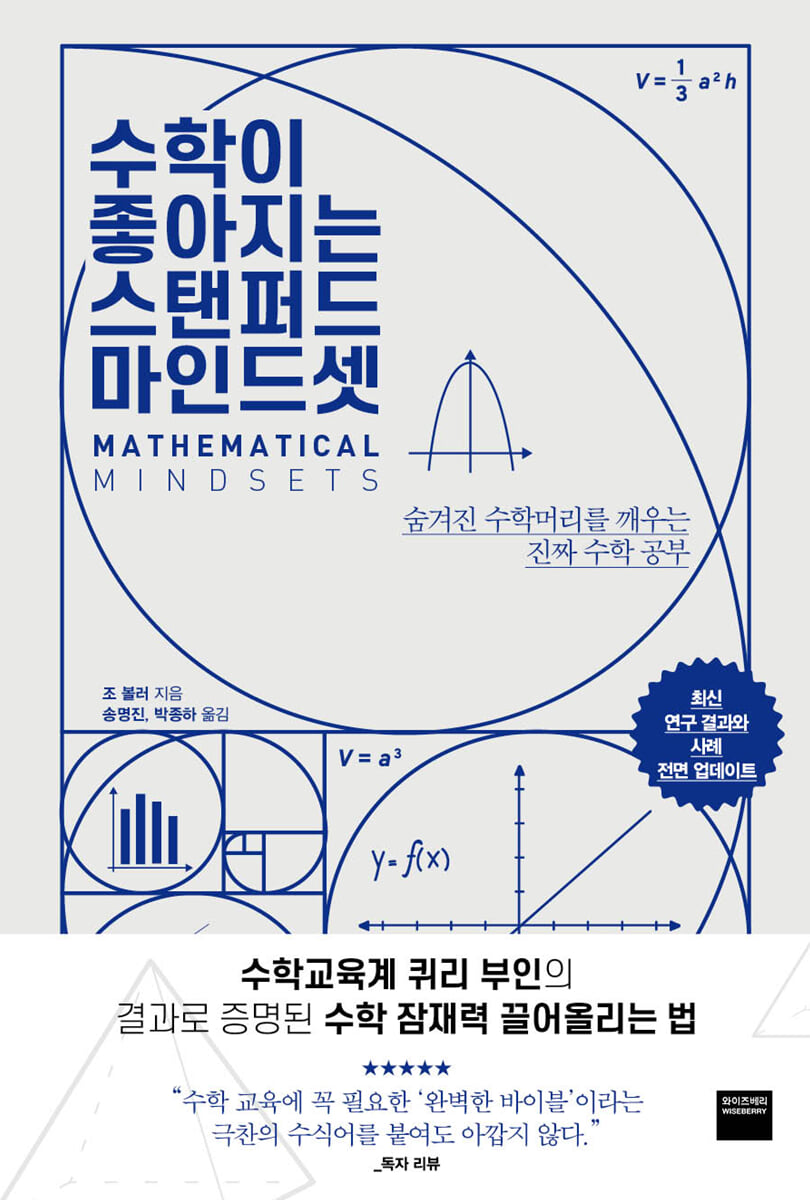
Book Introduction
The Stanford Math Study Method (2017) is reborn!
Fully updated with the latest research findings and case studies
Are math geniuses born with it?
Are there people who are suited to mathematics?
Why do so many students hate math and give up on it?
…
The answer lies in ‘mindset’!
Turning distrust in mathematics into confidence
Stanford mindset
‘Math is an innate talent’, ‘People who are good at math are smart’, ‘Math is not suitable for me’…
Deep-rooted myths about mathematics scare many people away, making them difficult and giving up on math.
To correct these misunderstandings about mathematics, Joe Boller, a professor of mathematics education at Stanford University and known as Madame Curie of the mathematics education world, has stepped forward.
Professor Bowler, who has studied in depth why so many students around the world hate math and give up so easily, recently published a completely revised and newly published book, "The Stanford Mindset: A Math-Enhancing Approach," provides clear methods to eliminate our widespread fear of math and increase our potential and confidence in math.
The most important thing is your ‘mindset’ towards math.
Breaking the stereotype that math is only for the smartest people and recognizing that anyone can excel at math is the key to becoming good at math: a growth mindset.
Through a wealth of cutting-edge research and case studies, the author demonstrates that proper math study depends on a growth mindset, and provides detailed guidance on how to cultivate this mindset.
We also reveal very practical and effective ways to directly apply this growth mindset to education and parenting.
Let's embark on a journey to learn a growth mindset, guided by this book.
Anyone can be good at math and achieve high levels.
Now, it's time to 'study real math'.
Fully updated with the latest research findings and case studies
Are math geniuses born with it?
Are there people who are suited to mathematics?
Why do so many students hate math and give up on it?
…
The answer lies in ‘mindset’!
Turning distrust in mathematics into confidence
Stanford mindset
‘Math is an innate talent’, ‘People who are good at math are smart’, ‘Math is not suitable for me’…
Deep-rooted myths about mathematics scare many people away, making them difficult and giving up on math.
To correct these misunderstandings about mathematics, Joe Boller, a professor of mathematics education at Stanford University and known as Madame Curie of the mathematics education world, has stepped forward.
Professor Bowler, who has studied in depth why so many students around the world hate math and give up so easily, recently published a completely revised and newly published book, "The Stanford Mindset: A Math-Enhancing Approach," provides clear methods to eliminate our widespread fear of math and increase our potential and confidence in math.
The most important thing is your ‘mindset’ towards math.
Breaking the stereotype that math is only for the smartest people and recognizing that anyone can excel at math is the key to becoming good at math: a growth mindset.
Through a wealth of cutting-edge research and case studies, the author demonstrates that proper math study depends on a growth mindset, and provides detailed guidance on how to cultivate this mindset.
We also reveal very practical and effective ways to directly apply this growth mindset to education and parenting.
Let's embark on a journey to learn a growth mindset, guided by this book.
Anyone can be good at math and achieve high levels.
Now, it's time to 'study real math'.
- You can preview some of the book's contents.
Preview
index
Recommended Reading: “I’m good at math!” _Carol Dweck
Preface to the Revised Edition: Finding the Best Way to Do Well in Math
Preface to the First Edition: A Mindset That Breaks Down Stereotypes About Mathematics
Chapter 1: There is no such thing as a brain that is good at math.
Chapter 2: The Power of Mistakes to Grow Your Brain
Chapter 3: Mathematics is not a subject of calculation.
Chapter 4: Cultivating a Mathematical Mindset
Chapter 5 Math Assignments to Build a Growth Mindset
Chapter 6 Mathematical Equality and Human Equality
Chapter 7: From Level-Based Learning to Growth Mindset Learning
Chapter 8: Assessing Mathematical Growth Mindset
Chapter 9: Teaching Math for a Growth Mindset
supplement
References
Preface to the Revised Edition: Finding the Best Way to Do Well in Math
Preface to the First Edition: A Mindset That Breaks Down Stereotypes About Mathematics
Chapter 1: There is no such thing as a brain that is good at math.
Chapter 2: The Power of Mistakes to Grow Your Brain
Chapter 3: Mathematics is not a subject of calculation.
Chapter 4: Cultivating a Mathematical Mindset
Chapter 5 Math Assignments to Build a Growth Mindset
Chapter 6 Mathematical Equality and Human Equality
Chapter 7: From Level-Based Learning to Growth Mindset Learning
Chapter 8: Assessing Mathematical Growth Mindset
Chapter 9: Teaching Math for a Growth Mindset
supplement
References
Detailed image
Into the book
With a growth mindset, he worked hard at his work and in life, and the more he failed, the harder he worked.
A wealth of scientific evidence has revealed that the difference between successful and unsuccessful people stems not from differences in innate brain power, but from differences in attitudes toward life, education, and perceptions of self-potential.
--- From "Chapter 1: There is no such thing as a brain that is good at math"
At that moment, I gave my daughter a very direct and important message.
“Do you know what just happened? Your brain grows when you can’t solve a problem.
When you get the answer right, nothing happens in your brain.
“It doesn’t grow.” When students give incorrect answers, teachers should respond to each student one-on-one like this.
My daughter looked at me with wide eyes, and I knew she understood the importance of this idea.
Now my daughter is completely different.
--- From "Chapter 2: The Power of Mistakes to Grow the Brain"
But mathematical thinking is more than that.
How we think about how to spend our days, how many meetings and tasks to fit into our schedules, how much space we have to move our cars and furniture, the probability of a particular event occurring, and how many people a message sent on social media will reach is all centered around mathematics.
--- From "Chapter 3 Mathematics is not a subject of calculation"
The only thing that can be compressed is a concept.
Rules and methods cannot be compressed.
Therefore, students who are unable to think conceptually see mathematics as a series of formulas to be memorized.
Because they do not go through the important process of compression, their brains cannot categorize, organize, and store ideas in memory.
As a result, you end up trying to memorize countless rules and methods.
This is precisely why it is important to help students always approach mathematics conceptually.
Approaching mathematics conceptually is at the heart of what I call a mathematical mindset.
--- From "Chapter 4: Cultivating a Mathematical Mindset"
Another good strategy for raising the ceiling on an assignment is to ask students who have already solved a problem to create a similar but more difficult problem.
We used this strategy frequently when teaching mixed-achievement groups of students at after-school summer school, especially when some students finished ahead of others.
--- From "Chapter 5 Mathematical Assignments for Creating a Growth Mindset"
We interviewed about 30 people of various ages, races, achievement levels, and socioeconomic backgrounds.
Every interview began with the question, “What do you think about mathematics?”
As a result, everyone answered immediately how well they did in math at school.
If you had asked me what I thought about art, science, or literature, I wouldn't have gotten an answer like this.
But for people raised in a performance-oriented culture, math is a violent tool used to measure and judge one's worth.
--- From “Chapter 6 Mathematical Equality and Human Equality”
Working with students who have different ideas can help each other.
By giving each other the opportunity to think more deeply and explain things to each other, we can broaden our understanding.
Rather than lowering the level of the group due to the presence of low-achieving students, group conversations are raised to the level of the most capable students.
If you only group students with similar achievement levels, they won't be helpful to each other.
--- From "Chapter 7: From Level-Based Learning to Growth Mindset Learning"
He said that in his 20-plus years as a high school math teacher, he had always graded his students' work, but last year he stopped doing that, and the impact of the change was surprising.
The entire classroom has been transformed into an open learning space where students study harder and achieve higher levels of achievement.
Instead of grading students, he assessed how many problems they answered.
If a question was too difficult to answer correctly, I would check it on the test paper and get help from the book to answer.
--- From "Chapter 8: Assessing Mathematical Growth Mindset"
The best way to solve problems and understand math is to draw pictures.
When students hit a wall while solving a problem and can't go any further, ask them this question:
“Have you ever tried drawing a picture of the problem?” It’s not easy at first, but students soon learn how to draw and find help through the pictures.
A wealth of scientific evidence has revealed that the difference between successful and unsuccessful people stems not from differences in innate brain power, but from differences in attitudes toward life, education, and perceptions of self-potential.
--- From "Chapter 1: There is no such thing as a brain that is good at math"
At that moment, I gave my daughter a very direct and important message.
“Do you know what just happened? Your brain grows when you can’t solve a problem.
When you get the answer right, nothing happens in your brain.
“It doesn’t grow.” When students give incorrect answers, teachers should respond to each student one-on-one like this.
My daughter looked at me with wide eyes, and I knew she understood the importance of this idea.
Now my daughter is completely different.
--- From "Chapter 2: The Power of Mistakes to Grow the Brain"
But mathematical thinking is more than that.
How we think about how to spend our days, how many meetings and tasks to fit into our schedules, how much space we have to move our cars and furniture, the probability of a particular event occurring, and how many people a message sent on social media will reach is all centered around mathematics.
--- From "Chapter 3 Mathematics is not a subject of calculation"
The only thing that can be compressed is a concept.
Rules and methods cannot be compressed.
Therefore, students who are unable to think conceptually see mathematics as a series of formulas to be memorized.
Because they do not go through the important process of compression, their brains cannot categorize, organize, and store ideas in memory.
As a result, you end up trying to memorize countless rules and methods.
This is precisely why it is important to help students always approach mathematics conceptually.
Approaching mathematics conceptually is at the heart of what I call a mathematical mindset.
--- From "Chapter 4: Cultivating a Mathematical Mindset"
Another good strategy for raising the ceiling on an assignment is to ask students who have already solved a problem to create a similar but more difficult problem.
We used this strategy frequently when teaching mixed-achievement groups of students at after-school summer school, especially when some students finished ahead of others.
--- From "Chapter 5 Mathematical Assignments for Creating a Growth Mindset"
We interviewed about 30 people of various ages, races, achievement levels, and socioeconomic backgrounds.
Every interview began with the question, “What do you think about mathematics?”
As a result, everyone answered immediately how well they did in math at school.
If you had asked me what I thought about art, science, or literature, I wouldn't have gotten an answer like this.
But for people raised in a performance-oriented culture, math is a violent tool used to measure and judge one's worth.
--- From “Chapter 6 Mathematical Equality and Human Equality”
Working with students who have different ideas can help each other.
By giving each other the opportunity to think more deeply and explain things to each other, we can broaden our understanding.
Rather than lowering the level of the group due to the presence of low-achieving students, group conversations are raised to the level of the most capable students.
If you only group students with similar achievement levels, they won't be helpful to each other.
--- From "Chapter 7: From Level-Based Learning to Growth Mindset Learning"
He said that in his 20-plus years as a high school math teacher, he had always graded his students' work, but last year he stopped doing that, and the impact of the change was surprising.
The entire classroom has been transformed into an open learning space where students study harder and achieve higher levels of achievement.
Instead of grading students, he assessed how many problems they answered.
If a question was too difficult to answer correctly, I would check it on the test paper and get help from the book to answer.
--- From "Chapter 8: Assessing Mathematical Growth Mindset"
The best way to solve problems and understand math is to draw pictures.
When students hit a wall while solving a problem and can't go any further, ask them this question:
“Have you ever tried drawing a picture of the problem?” It’s not easy at first, but students soon learn how to draw and find help through the pictures.
--- From "Chapter 9: Math Education Methods for a Growth Mindset"
Publisher's Review
Math Trauma Within Us
Fix it with a growth mindset
The term 'supoja', or 'math dropout', is now so common that it feels like there's nothing particularly special about it.
Why has giving up on math become so commonplace? Joe Boller, a professor of mathematics education at Stanford University and an educator named one of the BBC's "8 People Who Changed Education," attributes it to deeply held misconceptions about math that permeate society.
Mathematics is a talent, and that talent must be innate.
In a word, it is the belief that 'there are people who are good at math' that we commonly think of.
As this misleading message was passed down from generation to generation, many students quickly came to believe that they were simply not good at math.
In fact, many parents and teachers are in the position of comforting students by telling them not to be discouraged if they are not good at math.
In this atmosphere, students find math difficult and avoid it, saying, “Math is not for me.”
Eventually, these superstitions wound us, knowingly or unknowingly, and become traumatic.
This is why Joe Boller published "The Stanford Mindset for Math Love."
Professor Bowler emphasizes in his book that we must study and teach the mindset within mathematics, rather than the general mathematics studies we have done so far, and he corrects the fundamental approach to studying mathematics.
“You’re really smart!” vs “You worked really hard!”
What Parents and Teachers Are Saying About Changing the Path of Math Learning
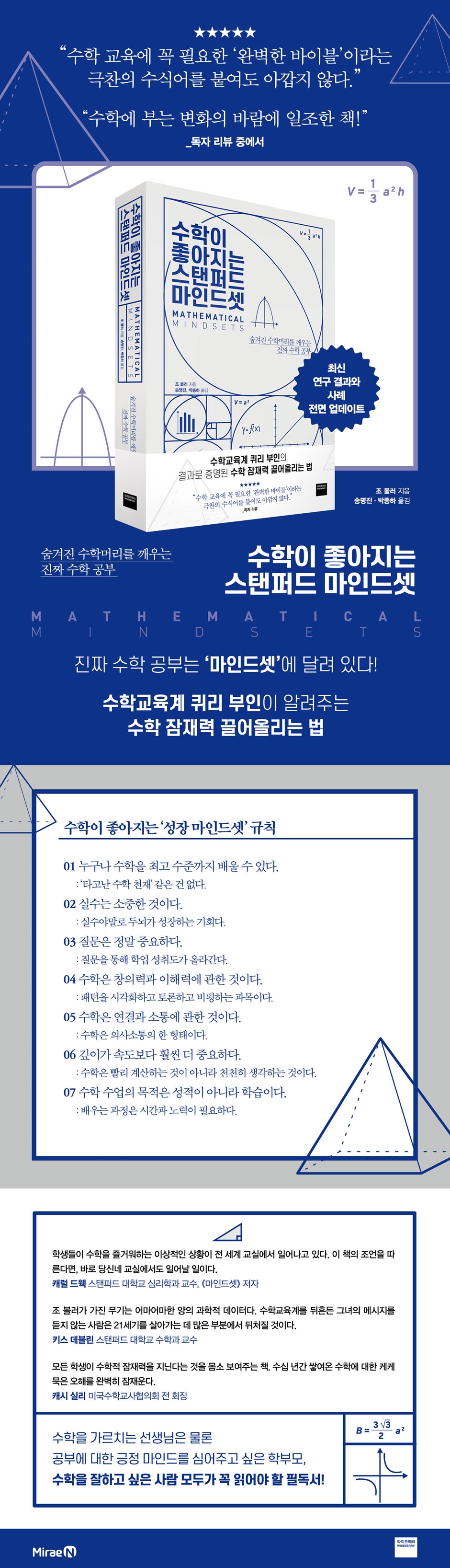
In this book, Professor Bowler introduces the concepts of 'fixed mindset' and 'growth mindset'.
A fixed mindset is a mindset that views human abilities as fixed, fixed qualities. People with a fixed mindset believe that while they can learn knowledge, their basic level of intelligence cannot be changed.
On the other hand, a growth mindset is a mindset that sees all abilities as qualities that grow through learning, and people with a growth mindset believe that their intelligence will improve if they work hard.
This book proves through numerous neuroscience research results and case studies that there is no brain that is innately capable of learning.
Of course, this doesn't mean that everyone is born with the same brain.
It emphasizes that innate brain differences are minimal compared to the differences in brain growth that children experience throughout their lives.
If a fixed mindset persists, it will have a negative impact on children, regardless of whether their grades are good or bad.
This is especially bad for students with good grades.
This is because they are reluctant to attempt difficult tasks for fear that if they make mistakes, people will think they are not smart.
On the other hand, students with a growth mindset use mistakes as motivation to move forward and take on more challenging tasks.
One of the many factors that determines what kind of mindset a student will develop is the type of praise given by parents and teachers.
In a related study, students who were praised with, “You’re really smart!” chose easier problems on the next test, while students who were praised with, “You worked really hard!” chose harder problems.
To improve students' grades, we need to praise their efforts rather than praising fixed characteristics.
When you try again without being anxious about making mistakes, your brain grows.
This is the growth mindset that will help you improve your math scores.
In other words, small changes on the part of educators and parents can completely change the path students take in learning math.
Making math fun
For 'real math study'
The beauty of this book is that it is filled with teaching methods, learning techniques, and math homework that can be applied directly in real classrooms and at home.
These growth mindset strategies were implemented directly by Stanford University professors and researchers in elementary, middle, and high school classrooms and confirmed through changes in students. Approximately two-thirds of the book is filled with these practical methods.
In particular, the author explains the core of growth mindset learning with the expression, "a task with a low floor and a high ceiling."
A low floor means that anyone can access the idea, and a high ceiling means that the idea can be raised to a high level.
In other words, it is very important to have math assignments that are accessible to a wide range of students and that can expand their thinking to a high level.
This book presents precisely such challenges.
Through these practical assignments, students who were previously unsure about math will become interested in it, and beyond that, they will gradually achieve high grades.
There is no such thing as a 'natural math genius'.
Anyone can excel in math and reach a high level by following the guidance in this book and adopting a growth mindset.
Mathematics is not simply a study of calculations.
To develop mathematical thinking skills, thinking deeply is much more important than solving problems quickly.
Now, it's time to 'study real math'.
Fix it with a growth mindset
The term 'supoja', or 'math dropout', is now so common that it feels like there's nothing particularly special about it.
Why has giving up on math become so commonplace? Joe Boller, a professor of mathematics education at Stanford University and an educator named one of the BBC's "8 People Who Changed Education," attributes it to deeply held misconceptions about math that permeate society.
Mathematics is a talent, and that talent must be innate.
In a word, it is the belief that 'there are people who are good at math' that we commonly think of.
As this misleading message was passed down from generation to generation, many students quickly came to believe that they were simply not good at math.
In fact, many parents and teachers are in the position of comforting students by telling them not to be discouraged if they are not good at math.
In this atmosphere, students find math difficult and avoid it, saying, “Math is not for me.”
Eventually, these superstitions wound us, knowingly or unknowingly, and become traumatic.
This is why Joe Boller published "The Stanford Mindset for Math Love."
Professor Bowler emphasizes in his book that we must study and teach the mindset within mathematics, rather than the general mathematics studies we have done so far, and he corrects the fundamental approach to studying mathematics.
“You’re really smart!” vs “You worked really hard!”
What Parents and Teachers Are Saying About Changing the Path of Math Learning
In this book, Professor Bowler introduces the concepts of 'fixed mindset' and 'growth mindset'.
A fixed mindset is a mindset that views human abilities as fixed, fixed qualities. People with a fixed mindset believe that while they can learn knowledge, their basic level of intelligence cannot be changed.
On the other hand, a growth mindset is a mindset that sees all abilities as qualities that grow through learning, and people with a growth mindset believe that their intelligence will improve if they work hard.
This book proves through numerous neuroscience research results and case studies that there is no brain that is innately capable of learning.
Of course, this doesn't mean that everyone is born with the same brain.
It emphasizes that innate brain differences are minimal compared to the differences in brain growth that children experience throughout their lives.
If a fixed mindset persists, it will have a negative impact on children, regardless of whether their grades are good or bad.
This is especially bad for students with good grades.
This is because they are reluctant to attempt difficult tasks for fear that if they make mistakes, people will think they are not smart.
On the other hand, students with a growth mindset use mistakes as motivation to move forward and take on more challenging tasks.
One of the many factors that determines what kind of mindset a student will develop is the type of praise given by parents and teachers.
In a related study, students who were praised with, “You’re really smart!” chose easier problems on the next test, while students who were praised with, “You worked really hard!” chose harder problems.
To improve students' grades, we need to praise their efforts rather than praising fixed characteristics.
When you try again without being anxious about making mistakes, your brain grows.
This is the growth mindset that will help you improve your math scores.
In other words, small changes on the part of educators and parents can completely change the path students take in learning math.
Making math fun
For 'real math study'
The beauty of this book is that it is filled with teaching methods, learning techniques, and math homework that can be applied directly in real classrooms and at home.
These growth mindset strategies were implemented directly by Stanford University professors and researchers in elementary, middle, and high school classrooms and confirmed through changes in students. Approximately two-thirds of the book is filled with these practical methods.
In particular, the author explains the core of growth mindset learning with the expression, "a task with a low floor and a high ceiling."
A low floor means that anyone can access the idea, and a high ceiling means that the idea can be raised to a high level.
In other words, it is very important to have math assignments that are accessible to a wide range of students and that can expand their thinking to a high level.
This book presents precisely such challenges.
Through these practical assignments, students who were previously unsure about math will become interested in it, and beyond that, they will gradually achieve high grades.
There is no such thing as a 'natural math genius'.
Anyone can excel in math and reach a high level by following the guidance in this book and adopting a growth mindset.
Mathematics is not simply a study of calculations.
To develop mathematical thinking skills, thinking deeply is much more important than solving problems quickly.
Now, it's time to 'study real math'.
GOODS SPECIFICS
- Date of issue: February 20, 2024
- Page count, weight, size: 460 pages | 843g | 152*225mm
- ISBN13: 9791168417793
- ISBN10: 1168417791
You may also like
카테고리
korean


korean

![GQ KOREA Mark (Monthly): December [2025]](http://librairie.coreenne.fr/cdn/shop/files/8ef265dbbfbf186523ed75ba7319009d.jpg?v=1765340328&width=3840)


