

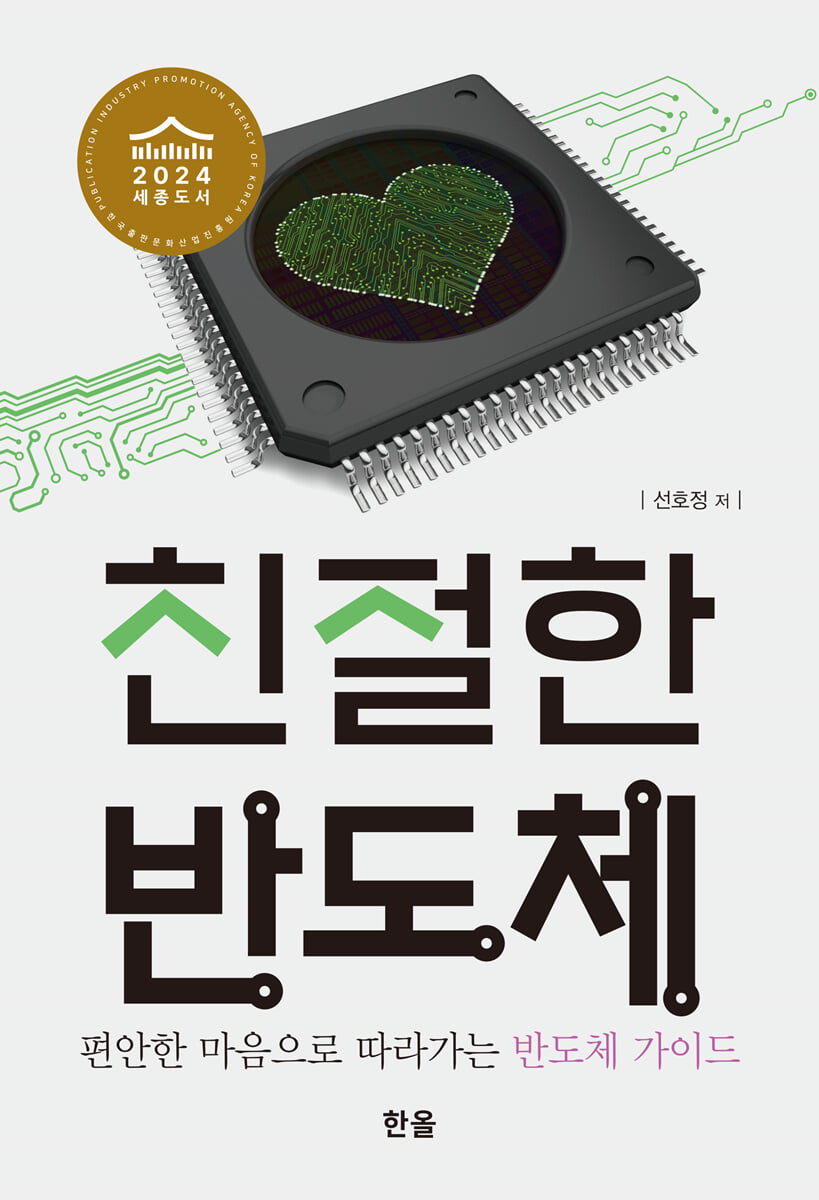
Friendly Semiconductor
 |
Description
Book Introduction
A semiconductor textbook that anyone with basic scientific knowledge can read.
This book comprehensively covers everything from the basic principles of semiconductors to integration concepts and manufacturing processes, explaining the content in the easiest and most user-friendly way possible.
A humanities textbook that reveals the architectural characteristics of semiconductor manufacturing and the formative beauty of semiconductor architecture.
A book filled with advice from top semiconductor experts from companies like SK Hynix, IBM, Applied Materials, ASML, TES, Eugene Tech, and DNF.
A convenient semiconductor guide for those working in the semiconductor industry, those interested in investing in semiconductor-related companies, college students and job seekers, and anyone interested in semiconductor technology.
Those of you at our partner companies,
Often, people don't know how the materials, components, and equipment they develop or produce are used in the semiconductor manufacturing process.
This can also create barriers to communication with customers.
To overcome this, it is necessary to understand semiconductors from a broader perspective.
For those interested in investing,
It is important to understand what the target company's products are and how the associated value chains are intertwined.
In the world of semiconductors, many issues are intertwined in various ways.
If you can unravel this thread, you can find good investment opportunities.
For college students,
It is necessary to take an interest in acquiring basic knowledge not only in one's own major but also in various academic fields related to semiconductors.
It is difficult to fully learn and master everything within the limited time of four years in college.
However, this awareness itself will serve as a foundation for growing into a solid talent.
For job seekers,
It would be helpful to have a rough idea of what the target company's products are and where they fit within the overall semiconductor manufacturing process.
This way, you can decide whether to apply for a job or not based on whether it matches your aptitude.
Also, by attending the interview, you can increase your chances of passing.
This book comprehensively covers everything from the basic principles of semiconductors to integration concepts and manufacturing processes, explaining the content in the easiest and most user-friendly way possible.
A humanities textbook that reveals the architectural characteristics of semiconductor manufacturing and the formative beauty of semiconductor architecture.
A book filled with advice from top semiconductor experts from companies like SK Hynix, IBM, Applied Materials, ASML, TES, Eugene Tech, and DNF.
A convenient semiconductor guide for those working in the semiconductor industry, those interested in investing in semiconductor-related companies, college students and job seekers, and anyone interested in semiconductor technology.
Those of you at our partner companies,
Often, people don't know how the materials, components, and equipment they develop or produce are used in the semiconductor manufacturing process.
This can also create barriers to communication with customers.
To overcome this, it is necessary to understand semiconductors from a broader perspective.
For those interested in investing,
It is important to understand what the target company's products are and how the associated value chains are intertwined.
In the world of semiconductors, many issues are intertwined in various ways.
If you can unravel this thread, you can find good investment opportunities.
For college students,
It is necessary to take an interest in acquiring basic knowledge not only in one's own major but also in various academic fields related to semiconductors.
It is difficult to fully learn and master everything within the limited time of four years in college.
However, this awareness itself will serve as a foundation for growing into a solid talent.
For job seekers,
It would be helpful to have a rough idea of what the target company's products are and where they fit within the overall semiconductor manufacturing process.
This way, you can decide whether to apply for a job or not based on whether it matches your aptitude.
Also, by attending the interview, you can increase your chances of passing.
- You can preview some of the book's contents.
Preview
index
Recommendation
prolog
Part 1.
What is a semiconductor?
The real name for semiconductors is integrated circuits
· What is an integrated circuit?
· The birth of integrated circuits
· Ultra-high-density integrated circuits
Semiconductors around us
· Memory semiconductors
· System semiconductors
· Classification of semiconductor companies
Memory semiconductor memory method
· Methods of storing digital information
· DRAM information storage principles
· Estimating memory capacity
How electrons move
· Linguistic properties of mathematics
· Electrical conductivity of a material
· Basic knowledge for handling the flow of electricity
· How electrons move inside objects
Silicon with diamond casing
· The shape of an atom
· Silicon atoms and crystal structure
silicon semiconductors
· Generation and movement of mobile charges
· Silicon semiconductors
· Silicon semiconductor substrate (wafer)
The Story of the Transistor
· MOS transistor
· pn junction
· CMOS
Capacitor story
· Atomic polarization
· Ion polarization
· Charge storage principle of capacitor
· Capacitance of capacitor
Part 2.
Semiconductors and Construction
DRAM architecture
· An integrated circuit is a building.
· DRAM construction method
· Fundamentals of Integrated Circuit Architecture
· Building DRAM
The Evolution of DRAM Architecture
· The evolution of cell transistor architecture
· Evolution of cell capacitor architecture
Completing DRAM construction
· Building DRAM cells
· Completing DRAM construction
NAND flash memory memory
· Structure of cell transistor
· Information storage principles
· Store multiple bits
Architecture of NAND flash memory
· Basic cell structure
· Vertically aligning cell transistors
· Manufacturing process of 3D NAND flash memory cells
Architecture of System Semiconductors
· Modified Si gate MOSFET
· High dielectric constant gate MOSFET
· FinFET and GAAFET
· Features of multilayer wiring
· Completing the integrated circuit architecture
Semiconductors and Art
· Integrated circuit architecture and art
· Mathematics and Abstraction
Part 3.
semiconductor manufacturing method
Thermal oxidation and ion implantation
· Thermal oxidation of silicon
· Ion implantation
· Rapid heat treatment
· Revisiting the MOS transistor manufacturing process
Chemical thin film coating
· Chemical vapor deposition
Chemically made thin film
· Plasma-enhanced chemical vapor deposition
· Chemical vapor deposition of metals
Building up atoms one layer at a time
· Atomic layer deposition
Billiards and inlaid celadon
· Physical vapor deposition
· Electroplating
Thin film equipment, components, and materials
· Thin film equipment and components
· Thin film equipment, components, and materials related companies
Carving patterns with light
· Story of Light
· Photolithography
· Exposure principles and resolution
The development of light engraving technology
· ArF immersion exposure
· Multi-patterning
· EUV exposure
· Companies related to photolithography equipment and materials
Pattern cutting
· Vertical etching
· Etching
· Companies related to etching equipment, parts, and materials
Grind and wipe
· Chemical mechanical polishing
· sejung
Epilogue
prolog
Part 1.
What is a semiconductor?
The real name for semiconductors is integrated circuits
· What is an integrated circuit?
· The birth of integrated circuits
· Ultra-high-density integrated circuits
Semiconductors around us
· Memory semiconductors
· System semiconductors
· Classification of semiconductor companies
Memory semiconductor memory method
· Methods of storing digital information
· DRAM information storage principles
· Estimating memory capacity
How electrons move
· Linguistic properties of mathematics
· Electrical conductivity of a material
· Basic knowledge for handling the flow of electricity
· How electrons move inside objects
Silicon with diamond casing
· The shape of an atom
· Silicon atoms and crystal structure
silicon semiconductors
· Generation and movement of mobile charges
· Silicon semiconductors
· Silicon semiconductor substrate (wafer)
The Story of the Transistor
· MOS transistor
· pn junction
· CMOS
Capacitor story
· Atomic polarization
· Ion polarization
· Charge storage principle of capacitor
· Capacitance of capacitor
Part 2.
Semiconductors and Construction
DRAM architecture
· An integrated circuit is a building.
· DRAM construction method
· Fundamentals of Integrated Circuit Architecture
· Building DRAM
The Evolution of DRAM Architecture
· The evolution of cell transistor architecture
· Evolution of cell capacitor architecture
Completing DRAM construction
· Building DRAM cells
· Completing DRAM construction
NAND flash memory memory
· Structure of cell transistor
· Information storage principles
· Store multiple bits
Architecture of NAND flash memory
· Basic cell structure
· Vertically aligning cell transistors
· Manufacturing process of 3D NAND flash memory cells
Architecture of System Semiconductors
· Modified Si gate MOSFET
· High dielectric constant gate MOSFET
· FinFET and GAAFET
· Features of multilayer wiring
· Completing the integrated circuit architecture
Semiconductors and Art
· Integrated circuit architecture and art
· Mathematics and Abstraction
Part 3.
semiconductor manufacturing method
Thermal oxidation and ion implantation
· Thermal oxidation of silicon
· Ion implantation
· Rapid heat treatment
· Revisiting the MOS transistor manufacturing process
Chemical thin film coating
· Chemical vapor deposition
Chemically made thin film
· Plasma-enhanced chemical vapor deposition
· Chemical vapor deposition of metals
Building up atoms one layer at a time
· Atomic layer deposition
Billiards and inlaid celadon
· Physical vapor deposition
· Electroplating
Thin film equipment, components, and materials
· Thin film equipment and components
· Thin film equipment, components, and materials related companies
Carving patterns with light
· Story of Light
· Photolithography
· Exposure principles and resolution
The development of light engraving technology
· ArF immersion exposure
· Multi-patterning
· EUV exposure
· Companies related to photolithography equipment and materials
Pattern cutting
· Vertical etching
· Etching
· Companies related to etching equipment, parts, and materials
Grind and wipe
· Chemical mechanical polishing
· sejung
Epilogue
Detailed image

Into the book
In this way, semiconductor is a material expression in terms of electrical conductivity, and is used as a general term for electronic components such as memory semiconductors and system semiconductors that play a key role in electronic devices.
However, a more appropriate term for them is 'integrated circuit'.
In the past, this name was used a lot, but at some point, the tendency to just call it a semiconductor became stronger.
As we will see, strictly speaking, it is not appropriate to refer to integrated circuits as semiconductors, since integrated circuits use not only semiconductors but also conductors and insulators.
Nevertheless, it seems that semiconductors are preferred over integrated circuits because integrated circuits originated from semiconductors and the name itself sounds more comfortable.
--- p.17
Let's look again at the cross-section photo of the DRAM shown in the front.
This is the same picture presented in Chapter 1.
At that time, I would have been completely unable to understand this picture.
But what about now? Congratulations! If you can see this picture now, your semiconductor skills have greatly improved.
I mean this very thing.
Even those who get jobs at semiconductor-related companies find it takes quite some time to understand the overall architecture.
This is because comprehensive semiconductor knowledge acquired through various tasks is required.
--- p.168
The artistic appeal of integrated circuits is even more evident in three-dimensional architecture.
Earlier, I explained various aspects of integrated circuit manufacturing using an analogy to construction.
Architecture is so deeply connected to art that it can be considered a branch of art.
When constructing a building, engineering elements such as mechanics are given priority, but because it is a space where people move, beauty and functionality are equally important.
But, as in architecture, the architecture of integrated circuits also has considerable aesthetic beauty.
However, a clear difference from architecture is that architecture takes aesthetic elements into account from the design stage, whereas integrated circuits pursue only extreme functionality and productivity.
Nonetheless, the result has considerable sculptural beauty.
--- p.214
W is extremely heavy with an atomic number of 74.
In the periodic table, the higher the atomic number, the heavier the element. It is about 7 times heavier than Al (number 13) and about 3 times heavier than Cu (number 29).
If you make a W marble the size of a glass marble you used to play with as a child and place it on your palm, you will be surprised by its weight.
What is surprising is that when F binds to W to form WF6, it is in a gaseous state at room temperature.
It is difficult to find a precursor that is a gas and contains such heavy elements.
It almost seems like six winged fluorine (F) angels are flying around, carrying tungsten (W) atoms on strings.
Come to think of it, the WF6 molecule looks like that.
I don't know if it's a coincidence or fate, but this is a significant blessing for the semiconductor industry.
This excellent WF6 is naturally one of the representative gases for semiconductors.
--- p.260
However, there is a special name given to this Cu wiring process.
This is called the 'damascene' process.
The pronunciation of the word is a bit difficult, but if you write it as it sounds in Korean, it is 'Damashin'.
And if you look up the meaning in an English-Korean dictionary, it comes up as ‘Sanggambeop.’
When I think of the Sanggam method, something comes to mind.
Yes, that's right.
This is Goryeo celadon.
The technique of carving the surface with a sharp tool, like the inlaid celadon above, and then filling it with clay of a different color to create a pattern is similar to damascene.
The advanced electroplating techniques used in semiconductor manufacturing have their origins in older technologies, and the wiring formation process is linked to the celadon manufacturing techniques of the Goryeo Dynasty.
As such, the Cu damascene process using electroplating has an interesting characteristic.
--- p.285
Advances in integrated circuit manufacturing technology, whether memory semiconductors or system semiconductors, are in line with advancements in chip miniaturization technology.
In order to reduce the line width, advanced photolithography technology must be supported, but the problem is that the existing
As we continue to refine line widths using exposure equipment, we will eventually reach a limit.
This limitation implies a limitation in resolution.
As we saw in the previous chapter, to overcome this, we need to find ways to apply shorter wavelengths of light and accommodate more light.
Therefore, ‘development of exposure technology’ is almost synonymous with ‘development of equipment that uses a light source with a small wavelength and has a high numerical aperture.’
--- p.328
The interesting thing is that the PR strip process is similar to a combustion process.
Combustion is a phenomenon in which a substance reacts with oxygen to produce a large amount of heat and light.
This is exactly what we see when we burn wood.
Wood is organic, meaning it is composed mainly of carbon and hydrogen.
When high heat is applied, the carbon and hydrogen in the wood combine with oxygen in the air and burn, producing heat and light.
Considering this point, the PR strip process is also called 'O2 plasma ashing', meaning 'burning the photosensitive film to ash'.
O+ has little effect on the etchant film.
That is, the etchant film cannot be burned.
Therefore, only the photosensitive film can be selectively removed.
Because of these advantages, oxygen plasma ashing is used to remove photoresist films.
--- p.357
To avoid these problems, the 'single wafer spin cleaning method' depicted in the figure on the right is currently mainly used.
This method is similar to spin coating for applying a photosensitive film.
However, since it is a cleaning process, the process is performed by rotating the substrate while spraying cleaning solution rather than coating solution.
Since the solution that has been cleaned from the wafer surface is discharged, there is no need to worry about re-adsorption of contaminants, and the ability to remove foreign substances is excellent.
It's the same reason why washing your hands under running water with the faucet turned on is cleaner than washing them under a sink with water in it.
However, a more appropriate term for them is 'integrated circuit'.
In the past, this name was used a lot, but at some point, the tendency to just call it a semiconductor became stronger.
As we will see, strictly speaking, it is not appropriate to refer to integrated circuits as semiconductors, since integrated circuits use not only semiconductors but also conductors and insulators.
Nevertheless, it seems that semiconductors are preferred over integrated circuits because integrated circuits originated from semiconductors and the name itself sounds more comfortable.
--- p.17
Let's look again at the cross-section photo of the DRAM shown in the front.
This is the same picture presented in Chapter 1.
At that time, I would have been completely unable to understand this picture.
But what about now? Congratulations! If you can see this picture now, your semiconductor skills have greatly improved.
I mean this very thing.
Even those who get jobs at semiconductor-related companies find it takes quite some time to understand the overall architecture.
This is because comprehensive semiconductor knowledge acquired through various tasks is required.
--- p.168
The artistic appeal of integrated circuits is even more evident in three-dimensional architecture.
Earlier, I explained various aspects of integrated circuit manufacturing using an analogy to construction.
Architecture is so deeply connected to art that it can be considered a branch of art.
When constructing a building, engineering elements such as mechanics are given priority, but because it is a space where people move, beauty and functionality are equally important.
But, as in architecture, the architecture of integrated circuits also has considerable aesthetic beauty.
However, a clear difference from architecture is that architecture takes aesthetic elements into account from the design stage, whereas integrated circuits pursue only extreme functionality and productivity.
Nonetheless, the result has considerable sculptural beauty.
--- p.214
W is extremely heavy with an atomic number of 74.
In the periodic table, the higher the atomic number, the heavier the element. It is about 7 times heavier than Al (number 13) and about 3 times heavier than Cu (number 29).
If you make a W marble the size of a glass marble you used to play with as a child and place it on your palm, you will be surprised by its weight.
What is surprising is that when F binds to W to form WF6, it is in a gaseous state at room temperature.
It is difficult to find a precursor that is a gas and contains such heavy elements.
It almost seems like six winged fluorine (F) angels are flying around, carrying tungsten (W) atoms on strings.
Come to think of it, the WF6 molecule looks like that.
I don't know if it's a coincidence or fate, but this is a significant blessing for the semiconductor industry.
This excellent WF6 is naturally one of the representative gases for semiconductors.
--- p.260
However, there is a special name given to this Cu wiring process.
This is called the 'damascene' process.
The pronunciation of the word is a bit difficult, but if you write it as it sounds in Korean, it is 'Damashin'.
And if you look up the meaning in an English-Korean dictionary, it comes up as ‘Sanggambeop.’
When I think of the Sanggam method, something comes to mind.
Yes, that's right.
This is Goryeo celadon.
The technique of carving the surface with a sharp tool, like the inlaid celadon above, and then filling it with clay of a different color to create a pattern is similar to damascene.
The advanced electroplating techniques used in semiconductor manufacturing have their origins in older technologies, and the wiring formation process is linked to the celadon manufacturing techniques of the Goryeo Dynasty.
As such, the Cu damascene process using electroplating has an interesting characteristic.
--- p.285
Advances in integrated circuit manufacturing technology, whether memory semiconductors or system semiconductors, are in line with advancements in chip miniaturization technology.
In order to reduce the line width, advanced photolithography technology must be supported, but the problem is that the existing
As we continue to refine line widths using exposure equipment, we will eventually reach a limit.
This limitation implies a limitation in resolution.
As we saw in the previous chapter, to overcome this, we need to find ways to apply shorter wavelengths of light and accommodate more light.
Therefore, ‘development of exposure technology’ is almost synonymous with ‘development of equipment that uses a light source with a small wavelength and has a high numerical aperture.’
--- p.328
The interesting thing is that the PR strip process is similar to a combustion process.
Combustion is a phenomenon in which a substance reacts with oxygen to produce a large amount of heat and light.
This is exactly what we see when we burn wood.
Wood is organic, meaning it is composed mainly of carbon and hydrogen.
When high heat is applied, the carbon and hydrogen in the wood combine with oxygen in the air and burn, producing heat and light.
Considering this point, the PR strip process is also called 'O2 plasma ashing', meaning 'burning the photosensitive film to ash'.
O+ has little effect on the etchant film.
That is, the etchant film cannot be burned.
Therefore, only the photosensitive film can be selectively removed.
Because of these advantages, oxygen plasma ashing is used to remove photoresist films.
--- p.357
To avoid these problems, the 'single wafer spin cleaning method' depicted in the figure on the right is currently mainly used.
This method is similar to spin coating for applying a photosensitive film.
However, since it is a cleaning process, the process is performed by rotating the substrate while spraying cleaning solution rather than coating solution.
Since the solution that has been cleaned from the wafer surface is discharged, there is no need to worry about re-adsorption of contaminants, and the ability to remove foreign substances is excellent.
It's the same reason why washing your hands under running water with the faucet turned on is cleaner than washing them under a sink with water in it.
--- p.374
Publisher's Review
This book may seem like a general textbook or a specialized book, but it is a general textbook that anyone with basic scientific knowledge can read.
This book is divided into three main parts.
In Part 1, we explained what an integrated circuit, also known as a semiconductor, is and introduced the components that make up an integrated circuit.
The background knowledge necessary to understand the operating principles of devices, such as electrical conductivity of materials, properties of silicon semiconductors, and the principles of MOS transistors and capacitors, are explained in an easy and friendly manner.
Integrating DRAM, NAND flash memory, and system semiconductors has many similarities to building a building.
Inspired by this, Part 2 introduces the concept and process of integration, revealing the importance of architecture and construction.
The aim was to provide an insight into integrated circuits.
And in the final chapter, we pause to consider the aesthetic beauty of semiconductors.
Part 3 covers semiconductor manufacturing.
We introduced methods for forming thin films that make up the layers of integrated circuits, photolithography that uses light to engrave patterns, and etching processes that remove materials.
We also include equipment, parts, materials and related companies needed for the process in appropriate locations.
Although it is a general textbook, it provides practical help in semiconductor-related work and investment.
This book is divided into three main parts.
In Part 1, we explained what an integrated circuit, also known as a semiconductor, is and introduced the components that make up an integrated circuit.
The background knowledge necessary to understand the operating principles of devices, such as electrical conductivity of materials, properties of silicon semiconductors, and the principles of MOS transistors and capacitors, are explained in an easy and friendly manner.
Integrating DRAM, NAND flash memory, and system semiconductors has many similarities to building a building.
Inspired by this, Part 2 introduces the concept and process of integration, revealing the importance of architecture and construction.
The aim was to provide an insight into integrated circuits.
And in the final chapter, we pause to consider the aesthetic beauty of semiconductors.
Part 3 covers semiconductor manufacturing.
We introduced methods for forming thin films that make up the layers of integrated circuits, photolithography that uses light to engrave patterns, and etching processes that remove materials.
We also include equipment, parts, materials and related companies needed for the process in appropriate locations.
Although it is a general textbook, it provides practical help in semiconductor-related work and investment.
GOODS SPECIFICS
- Date of issue: February 26, 2024
- Page count, weight, size: 384 pages | 153*224*30mm
- ISBN13: 9791166474156
You may also like
카테고리
korean


korean

![GQ KOREA Mark (Monthly): December [2025]](http://librairie.coreenne.fr/cdn/shop/files/8ef265dbbfbf186523ed75ba7319009d.jpg?v=1765340328&width=3840)


