

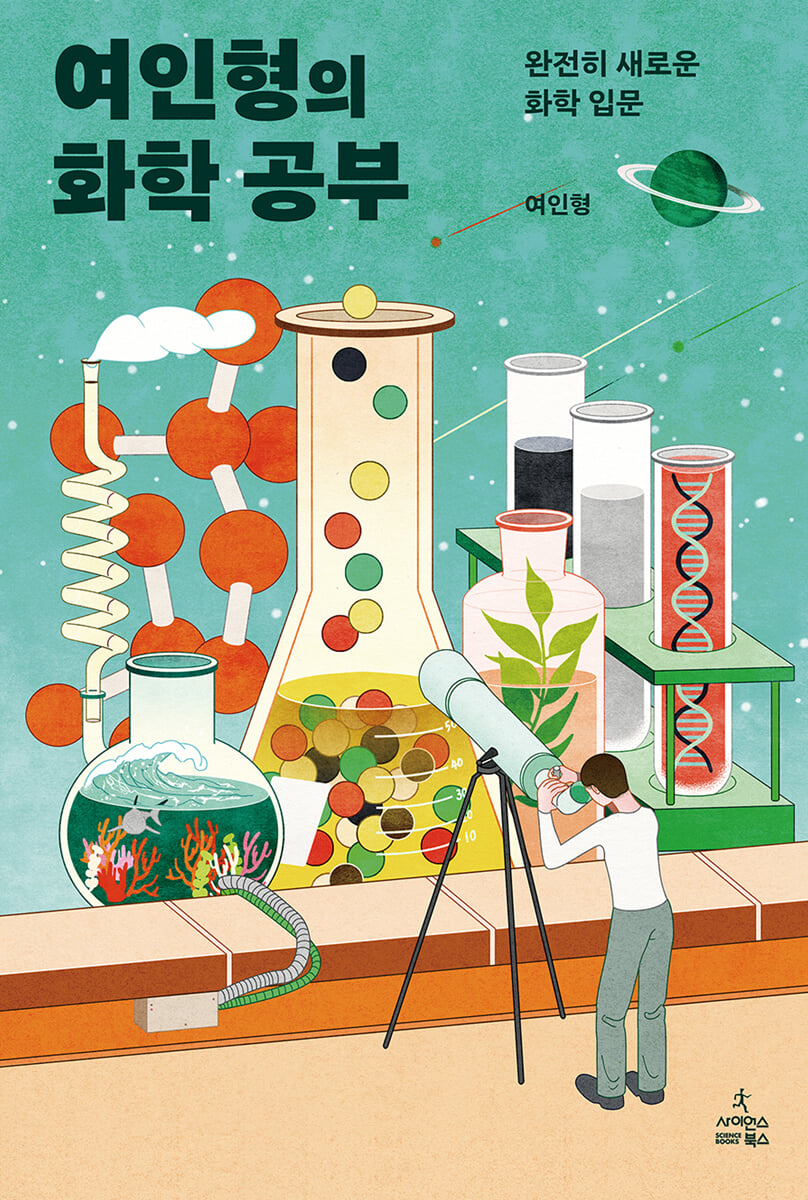
A woman's study of chemistry
 |
Description
Book Introduction
Chemistry Textbook of the Future
It was taken away without me even knowing English
A lifeline that can revive your curiosity about nature!
Jeong Taek-dong (Professor, Department of Chemistry, Seoul National University)
A special lecture on chemistry by Professor Yeo In-hyeong, the representative chemistry teacher of Naver Knowledge Encyclopedia, who has recorded 10 million cumulative views!
The proverb, “The more you know, the better you see,” applies to chemistry as well.
Therefore, if you know even the basics of chemistry, you will have the eyes to see and understand the numerous works (materials) and their changes displayed in the exhibition hall called natural space.
Moreover, if you realize that life itself cannot be considered separately from chemistry, your perspective on the world will change, and if you understand that not only the substances you encounter in your daily life but also everything in the universe is made of chemicals, wouldn't you be inspired to study chemistry a little more? ―From the text
Our lives, our world, are chemicals.
From the paper on which this article is written and the display of our smartphones, to the food we eat (chemical fertilizers), the clothes we wear (chemical fibers), and the homes we live in (building materials), we cannot think of anything without chemistry.
Chemistry is a fundamental science that studies the structure and properties of atoms and molecules, the elements that make up matter. It includes not only all things in the universe, but also the human brain and mind, which are influenced by neuromodulators.
The importance of chemistry cannot be overemphasized, as it is so close to us and forms the basis of all industries that deal with materials.
If someone asks what science is useful for, just look at what chemistry has accomplished.
However, just as we cannot appreciate the value of clean air without a trigger like fine dust, it is true that the value of chemistry is also relatively distant from our attention.
While the lab can spark curiosity with its colorful, sound-producing, and light-emitting chemical reactions, studying from a book can be challenging for many because it requires imagination and understanding.
Moreover, there are so many different chemical substances in the world and so many laws and theories that explain them, that even college students who came to the chemistry department because they liked chemistry often lose interest in studying them and end up using them as a means to graduate and get a job.
This time, the chemistry textbook 『Yeong-hyung's Study of Chemistry』 by Professor Emeritus Yeo In-hyung of Dongguk University, published by Science Books Co., Ltd., is a 'chemistry textbook of the future' that contains the study secrets and know-how that the old professor, who spent her entire life teaching chemistry, built up while communicating with the public, in order to share with more people the fun of this discipline that, like air, "you can live without knowing it, but you cannot live without it."
This book by former Dongguk University professor Yeo In-hyeong, who recorded 10 million cumulative views with her serial "Chemical Walk" on Naver's liberal arts content service, Knowledge Encyclopedia, is designed to help us naturally gain a correct understanding of chemistry through many things we do in our daily lives without thinking about, such as what actually happens when we plug our smartphones into a charger every day, why lemon slices come with our sashimi, and the principle behind how perms and chemicals at beauty salons make our hair curly.
Professor Yeo In-hyeong is a scholar who has published approximately 70 research papers in international academic journals while working at the Department of Chemistry at Dongguk University. He is also a renowned lecturer who has received the Dongguk University Academic Award, the Distinguished Lecture Award, and the Jeon Min-je Chemistry Award from the Korean Chemical Society.
He has also dedicated himself to making science more accessible and widely known to the public, including running an online KMOOC chemistry course for students and the general public, writing columns for Naver Encyclopedia and the Korean Chemical Society's monthly magazine "Chemical World," and serving as the third president of the reading discussion group "Science Reading Academy," which has been in operation since 1999.
He is still sharing his knowledge of chemistry through Naver Premium Channel ("Building Chemistry and Chemistry") and donating his educational talents through lectures at elementary, middle, and high schools, as well as universities across the country.
This book, which contains the experience of over 30 years of teaching and promoting chemistry, is composed of a format and ideas that are completely different from existing chemistry textbooks in terms of content and order, in order to lower the threshold for studying chemistry as much as possible.
Chapter 1, “What is Chemistry?” explains “Why all roads lead to chemistry and why we must learn chemistry?” Chapter 2, “The Alphabet of Nature,” learns the characteristics of the periodic table, which organizes the 118 elements that form the basis of all things in the universe; Chapter 3, “Key Concepts,” covers basic terms and concepts for studying and understanding chemistry; Chapter 4, “Bonding,” explains the types and characteristics of chemical bonds that make up substances; Chapter 5, “Reactions,” guides and classifies the process of converting one substance into another through examples that can be experienced in everyday life; Chapter 6, “Synthesis and Analysis,” looks at real-life cases of creating, confirming, and understanding substances; Chapter 7, “Energy,” learns about the energy changes that inevitably accompany the transformation of chemical substances; Chapter 8, “Reaction Rates,” understands the meaning of reaction rates that indicate the characteristics of chemical substances; Chapter 9, “Calculation Processes,” try out various calculations that actually occur in chemistry; and Chapter 10, “Future Chemistry,” outlines the challenges that future chemists who read the book will face.
This content, which naturally leads us to realize that the substances and phenomena we encounter in our daily lives are in fact chemistry, is interspersed with the author's unique memorization techniques and snippets of knowledge derived from his own experiences to help readers understand.
In order to create a book that explains chemistry and materials in Korean step by step, like a grandfather telling a story to his grandchild, the author sought advice from people from all walks of life, from physicists to scholarship recipients and educational donation activists. Among them, Professor Jeong Taek-dong of the Department of Chemistry at Seoul National University, Professor Ok Kang-min of the Department of Chemistry at Sogang University, Professor Jang Hye-young of the Department of Chemistry at Ajou University, Park Hae-cheon, a chemistry teacher at Bundang Seohyeon Middle School, and former Chairman Heo Byeong-du of the non-profit organization Bookttase were so moved by the author's love for chemistry and the public that they wrote letters of recommendation full of affection.
It was taken away without me even knowing English
A lifeline that can revive your curiosity about nature!
Jeong Taek-dong (Professor, Department of Chemistry, Seoul National University)
A special lecture on chemistry by Professor Yeo In-hyeong, the representative chemistry teacher of Naver Knowledge Encyclopedia, who has recorded 10 million cumulative views!
The proverb, “The more you know, the better you see,” applies to chemistry as well.
Therefore, if you know even the basics of chemistry, you will have the eyes to see and understand the numerous works (materials) and their changes displayed in the exhibition hall called natural space.
Moreover, if you realize that life itself cannot be considered separately from chemistry, your perspective on the world will change, and if you understand that not only the substances you encounter in your daily life but also everything in the universe is made of chemicals, wouldn't you be inspired to study chemistry a little more? ―From the text
Our lives, our world, are chemicals.
From the paper on which this article is written and the display of our smartphones, to the food we eat (chemical fertilizers), the clothes we wear (chemical fibers), and the homes we live in (building materials), we cannot think of anything without chemistry.
Chemistry is a fundamental science that studies the structure and properties of atoms and molecules, the elements that make up matter. It includes not only all things in the universe, but also the human brain and mind, which are influenced by neuromodulators.
The importance of chemistry cannot be overemphasized, as it is so close to us and forms the basis of all industries that deal with materials.
If someone asks what science is useful for, just look at what chemistry has accomplished.
However, just as we cannot appreciate the value of clean air without a trigger like fine dust, it is true that the value of chemistry is also relatively distant from our attention.
While the lab can spark curiosity with its colorful, sound-producing, and light-emitting chemical reactions, studying from a book can be challenging for many because it requires imagination and understanding.
Moreover, there are so many different chemical substances in the world and so many laws and theories that explain them, that even college students who came to the chemistry department because they liked chemistry often lose interest in studying them and end up using them as a means to graduate and get a job.
This time, the chemistry textbook 『Yeong-hyung's Study of Chemistry』 by Professor Emeritus Yeo In-hyung of Dongguk University, published by Science Books Co., Ltd., is a 'chemistry textbook of the future' that contains the study secrets and know-how that the old professor, who spent her entire life teaching chemistry, built up while communicating with the public, in order to share with more people the fun of this discipline that, like air, "you can live without knowing it, but you cannot live without it."
This book by former Dongguk University professor Yeo In-hyeong, who recorded 10 million cumulative views with her serial "Chemical Walk" on Naver's liberal arts content service, Knowledge Encyclopedia, is designed to help us naturally gain a correct understanding of chemistry through many things we do in our daily lives without thinking about, such as what actually happens when we plug our smartphones into a charger every day, why lemon slices come with our sashimi, and the principle behind how perms and chemicals at beauty salons make our hair curly.
Professor Yeo In-hyeong is a scholar who has published approximately 70 research papers in international academic journals while working at the Department of Chemistry at Dongguk University. He is also a renowned lecturer who has received the Dongguk University Academic Award, the Distinguished Lecture Award, and the Jeon Min-je Chemistry Award from the Korean Chemical Society.
He has also dedicated himself to making science more accessible and widely known to the public, including running an online KMOOC chemistry course for students and the general public, writing columns for Naver Encyclopedia and the Korean Chemical Society's monthly magazine "Chemical World," and serving as the third president of the reading discussion group "Science Reading Academy," which has been in operation since 1999.
He is still sharing his knowledge of chemistry through Naver Premium Channel ("Building Chemistry and Chemistry") and donating his educational talents through lectures at elementary, middle, and high schools, as well as universities across the country.
This book, which contains the experience of over 30 years of teaching and promoting chemistry, is composed of a format and ideas that are completely different from existing chemistry textbooks in terms of content and order, in order to lower the threshold for studying chemistry as much as possible.
Chapter 1, “What is Chemistry?” explains “Why all roads lead to chemistry and why we must learn chemistry?” Chapter 2, “The Alphabet of Nature,” learns the characteristics of the periodic table, which organizes the 118 elements that form the basis of all things in the universe; Chapter 3, “Key Concepts,” covers basic terms and concepts for studying and understanding chemistry; Chapter 4, “Bonding,” explains the types and characteristics of chemical bonds that make up substances; Chapter 5, “Reactions,” guides and classifies the process of converting one substance into another through examples that can be experienced in everyday life; Chapter 6, “Synthesis and Analysis,” looks at real-life cases of creating, confirming, and understanding substances; Chapter 7, “Energy,” learns about the energy changes that inevitably accompany the transformation of chemical substances; Chapter 8, “Reaction Rates,” understands the meaning of reaction rates that indicate the characteristics of chemical substances; Chapter 9, “Calculation Processes,” try out various calculations that actually occur in chemistry; and Chapter 10, “Future Chemistry,” outlines the challenges that future chemists who read the book will face.
This content, which naturally leads us to realize that the substances and phenomena we encounter in our daily lives are in fact chemistry, is interspersed with the author's unique memorization techniques and snippets of knowledge derived from his own experiences to help readers understand.
In order to create a book that explains chemistry and materials in Korean step by step, like a grandfather telling a story to his grandchild, the author sought advice from people from all walks of life, from physicists to scholarship recipients and educational donation activists. Among them, Professor Jeong Taek-dong of the Department of Chemistry at Seoul National University, Professor Ok Kang-min of the Department of Chemistry at Sogang University, Professor Jang Hye-young of the Department of Chemistry at Ajou University, Park Hae-cheon, a chemistry teacher at Bundang Seohyeon Middle School, and former Chairman Heo Byeong-du of the non-profit organization Bookttase were so moved by the author's love for chemistry and the public that they wrote letters of recommendation full of affection.
- You can preview some of the book's contents.
Preview
index
Preface: Chemistry in Korean 005
Periodic Table 012
Note 014
Chapter 1: What is Chemistry? 017
Chapter 2: Alphabet of Nature 029
Chapter 3 Key Concepts 107
Chapter 4 Combination 159
Chapter 5 Reaction 247
Chapter 6: Synthesis and Analysis 365
Chapter 7 Energy 401
Chapter 8 Reaction Rate 483
Chapter 9: Calculation Process 543
Chapter 10: The Chemistry of the Future 589
Conclusion: To experience and enjoy the 'taste of chemistry', 610
Reference 615
Copyright 617
Search 619
Periodic Table 012
Note 014
Chapter 1: What is Chemistry? 017
Chapter 2: Alphabet of Nature 029
Chapter 3 Key Concepts 107
Chapter 4 Combination 159
Chapter 5 Reaction 247
Chapter 6: Synthesis and Analysis 365
Chapter 7 Energy 401
Chapter 8 Reaction Rate 483
Chapter 9: Calculation Process 543
Chapter 10: The Chemistry of the Future 589
Conclusion: To experience and enjoy the 'taste of chemistry', 610
Reference 615
Copyright 617
Search 619
Detailed image
.jpg)
Publisher's Review
Want to build chemistry with science
An Introduction to Chemistry for Everyone
As long as humanity exists, efforts to improve our understanding of chemistry and the workings of chemicals will continue.
That's why studying chemistry and chemistry to improve your understanding of chemicals is even more important.
I hope that readers will enjoy and experience the taste of chemistry together.
- In the text
It was a vaccine developed by chemists that brought an end to COVID-19, the cause of a global pandemic that has claimed countless lives in recent years and the impetus for Professor Yeo In-hyeong to give back to society by publishing a "Korean chemistry book that is easy to read and learn" in the face of an unpredictable future.
Chemistry also holds the key to addressing the climate crisis that threatens humanity and to increasing human happiness beyond the age of 100.
The solution to saving not only our lives today but also the future of humanity and the Earth lies in chemistry.
Despite being such a central science, so vital and integral to all natural sciences, interest in chemistry among youth and the general public is waning in South Korea's educational environment, which places emphasis solely on entrance exams and building up credentials.
Despite the chemical industry accounting for 7 percent of the gross domestic product (GDP), the fact that only 0.8 percent of students choose Chemistry II on the college entrance exam vividly illustrates the way Korean society treats chemistry.
Chemistry, which has lacked the opportunity to fully enjoy its charm.
From students who had to solve problems from the workbook right away rather than understand the concepts, to the general public who had their curiosity about nature stolen without even knowing why, we hope that you will now enjoy the 'taste of chemistry' with Professor Yeo In-hyung, the best chemistry teacher in Korea, through 'Yeom-hyung's Chemistry Study' and encounter a new world that opens up through it.
What You Can Learn from "The Female Doll's Chemistry Study"
Chapter 1: "What is Chemistry?"
· Why are the concepts of hypothesis, theory, principle, and law necessary to understand nature?
· Why does all our activities ultimately come down to chemistry?
· Why does studying chemistry require so much time, patience, and effort?
Chapter 2: "Nature's Alphabet"
· A way to end the tedious task of memorizing element symbols and atomic numbers in Korean.
· The properties and behavior of electrons, the adhesives of elements essential for chemical reactions.
· What secrets of the formation of all things in the universe are revealed by the 118 elements of the periodic table?
Chapter 3: "Key Concepts"
· The differences between units used in chemistry and everyday units, and how to convert between the two units.
· The order and method of expressing and completing chemical reactions in formulas.
· Why are there so many chemicals in the world?
· What if the human body were represented by a chemical formula?
.
Chapter 4 "Combination"
·Types and characteristics of chemical bonds, such as ionic bonds, covalent bonds, hydrogen bonds, metallic bonds, and coordinate covalent bonds.
· What is the relationship between optical isomers and cataracts and Alzheimer's disease, which are common diseases among the elderly?
· The properties of hydrogen bonds that made the mystery of the birth of life possible.
· Why is carbon monoxide poisoning our bodies?
Chapter 5 "Reaction"
· Acid-base reactions, precipitation reactions, oxidation-reduction reactions, decomposition reactions, and substitution reactions learned through examples that can be experienced in everyday life.
· How to chemically clean water stains on a kettle?
· Why do lemon slices come with sashimi?
· What was the secret that allowed our ancestors to extract saltpeter, the raw material for gunpowder, from the soil?
Chapter 6: Synthesis and Analysis
· Actual examples of various syntheses, including organic synthesis, inorganic synthesis, total synthesis, and retrosynthesis.
· Synthesis of lithium-ion battery electrode materials, which led to the 2019 Nobel Prize in Chemistry.
· Dioxin analysis, where chemical substance analysis data is used as the basis for environmental policy.
· What is the principle between the qualitative analysis of sodium and fireworks?
· Frederick Sanger, a chemist who won the Nobel Prize in Chemistry twice, and insulin.
Chapter 7: "Energy"
· What is the true meaning of the law of conservation of energy?
· An easy way to remember thermodynamic functions and thermodynamic equations through diagrams.
· Understand through chemistry how the sun's light energy is transferred to the Earth's ecosystem.
· How much energy would our bodies use in a day's life be converted into electricity bills?
Chapter 8 "Reaction Speed"
· Understand the properties of chemicals through the rate of chemical reactions.
· Learn about the role of temperature, pressure, and catalysts in affecting the rate of chemical reactions and perform direct calculations.
· Why can one kilogram of freon gas destroy 30,000 kilograms of the Earth's ozone layer?
· The secret to knowing the age of fossils by carbon reaction speed.
Chapter 9: "The Computational Process"
· Chemical calculations and concentration expression methods calculated using actual experimental data.
· What is the secret of the '×1' calculation method that allows unit conversion by simply multiplying by 1?
· Learn the ABCDE laws that govern gaseous chemicals.
Chapter 10: "The Chemistry of the Future"
· A look at the new challenges facing future chemists.
· How will chemistry contribute to the development of artificial intelligence?
· Is it possible for a future to come where people live only on grass, like termites or cows?
· What will the future hydrogen economy brought about by chemical development look like?
An Introduction to Chemistry for Everyone
As long as humanity exists, efforts to improve our understanding of chemistry and the workings of chemicals will continue.
That's why studying chemistry and chemistry to improve your understanding of chemicals is even more important.
I hope that readers will enjoy and experience the taste of chemistry together.
- In the text
It was a vaccine developed by chemists that brought an end to COVID-19, the cause of a global pandemic that has claimed countless lives in recent years and the impetus for Professor Yeo In-hyeong to give back to society by publishing a "Korean chemistry book that is easy to read and learn" in the face of an unpredictable future.
Chemistry also holds the key to addressing the climate crisis that threatens humanity and to increasing human happiness beyond the age of 100.
The solution to saving not only our lives today but also the future of humanity and the Earth lies in chemistry.
Despite being such a central science, so vital and integral to all natural sciences, interest in chemistry among youth and the general public is waning in South Korea's educational environment, which places emphasis solely on entrance exams and building up credentials.
Despite the chemical industry accounting for 7 percent of the gross domestic product (GDP), the fact that only 0.8 percent of students choose Chemistry II on the college entrance exam vividly illustrates the way Korean society treats chemistry.
Chemistry, which has lacked the opportunity to fully enjoy its charm.
From students who had to solve problems from the workbook right away rather than understand the concepts, to the general public who had their curiosity about nature stolen without even knowing why, we hope that you will now enjoy the 'taste of chemistry' with Professor Yeo In-hyung, the best chemistry teacher in Korea, through 'Yeom-hyung's Chemistry Study' and encounter a new world that opens up through it.
What You Can Learn from "The Female Doll's Chemistry Study"
Chapter 1: "What is Chemistry?"
· Why are the concepts of hypothesis, theory, principle, and law necessary to understand nature?
· Why does all our activities ultimately come down to chemistry?
· Why does studying chemistry require so much time, patience, and effort?
Chapter 2: "Nature's Alphabet"
· A way to end the tedious task of memorizing element symbols and atomic numbers in Korean.
· The properties and behavior of electrons, the adhesives of elements essential for chemical reactions.
· What secrets of the formation of all things in the universe are revealed by the 118 elements of the periodic table?
Chapter 3: "Key Concepts"
· The differences between units used in chemistry and everyday units, and how to convert between the two units.
· The order and method of expressing and completing chemical reactions in formulas.
· Why are there so many chemicals in the world?
· What if the human body were represented by a chemical formula?
.
Chapter 4 "Combination"
·Types and characteristics of chemical bonds, such as ionic bonds, covalent bonds, hydrogen bonds, metallic bonds, and coordinate covalent bonds.
· What is the relationship between optical isomers and cataracts and Alzheimer's disease, which are common diseases among the elderly?
· The properties of hydrogen bonds that made the mystery of the birth of life possible.
· Why is carbon monoxide poisoning our bodies?
Chapter 5 "Reaction"
· Acid-base reactions, precipitation reactions, oxidation-reduction reactions, decomposition reactions, and substitution reactions learned through examples that can be experienced in everyday life.
· How to chemically clean water stains on a kettle?
· Why do lemon slices come with sashimi?
· What was the secret that allowed our ancestors to extract saltpeter, the raw material for gunpowder, from the soil?
Chapter 6: Synthesis and Analysis
· Actual examples of various syntheses, including organic synthesis, inorganic synthesis, total synthesis, and retrosynthesis.
· Synthesis of lithium-ion battery electrode materials, which led to the 2019 Nobel Prize in Chemistry.
· Dioxin analysis, where chemical substance analysis data is used as the basis for environmental policy.
· What is the principle between the qualitative analysis of sodium and fireworks?
· Frederick Sanger, a chemist who won the Nobel Prize in Chemistry twice, and insulin.
Chapter 7: "Energy"
· What is the true meaning of the law of conservation of energy?
· An easy way to remember thermodynamic functions and thermodynamic equations through diagrams.
· Understand through chemistry how the sun's light energy is transferred to the Earth's ecosystem.
· How much energy would our bodies use in a day's life be converted into electricity bills?
Chapter 8 "Reaction Speed"
· Understand the properties of chemicals through the rate of chemical reactions.
· Learn about the role of temperature, pressure, and catalysts in affecting the rate of chemical reactions and perform direct calculations.
· Why can one kilogram of freon gas destroy 30,000 kilograms of the Earth's ozone layer?
· The secret to knowing the age of fossils by carbon reaction speed.
Chapter 9: "The Computational Process"
· Chemical calculations and concentration expression methods calculated using actual experimental data.
· What is the secret of the '×1' calculation method that allows unit conversion by simply multiplying by 1?
· Learn the ABCDE laws that govern gaseous chemicals.
Chapter 10: "The Chemistry of the Future"
· A look at the new challenges facing future chemists.
· How will chemistry contribute to the development of artificial intelligence?
· Is it possible for a future to come where people live only on grass, like termites or cows?
· What will the future hydrogen economy brought about by chemical development look like?
GOODS SPECIFICS
- Date of issue: December 15, 2023
- Format: Hardcover book binding method guide
- Page count, weight, size: 640 pages | 1,160g | 148*220*45mm
- ISBN13: 9791192908274
- ISBN10: 1192908279
You may also like
카테고리
korean


korean

![GQ KOREA Mark (Monthly): December [2025]](http://librairie.coreenne.fr/cdn/shop/files/8ef265dbbfbf186523ed75ba7319009d.jpg?v=1765340328&width=3840)


