

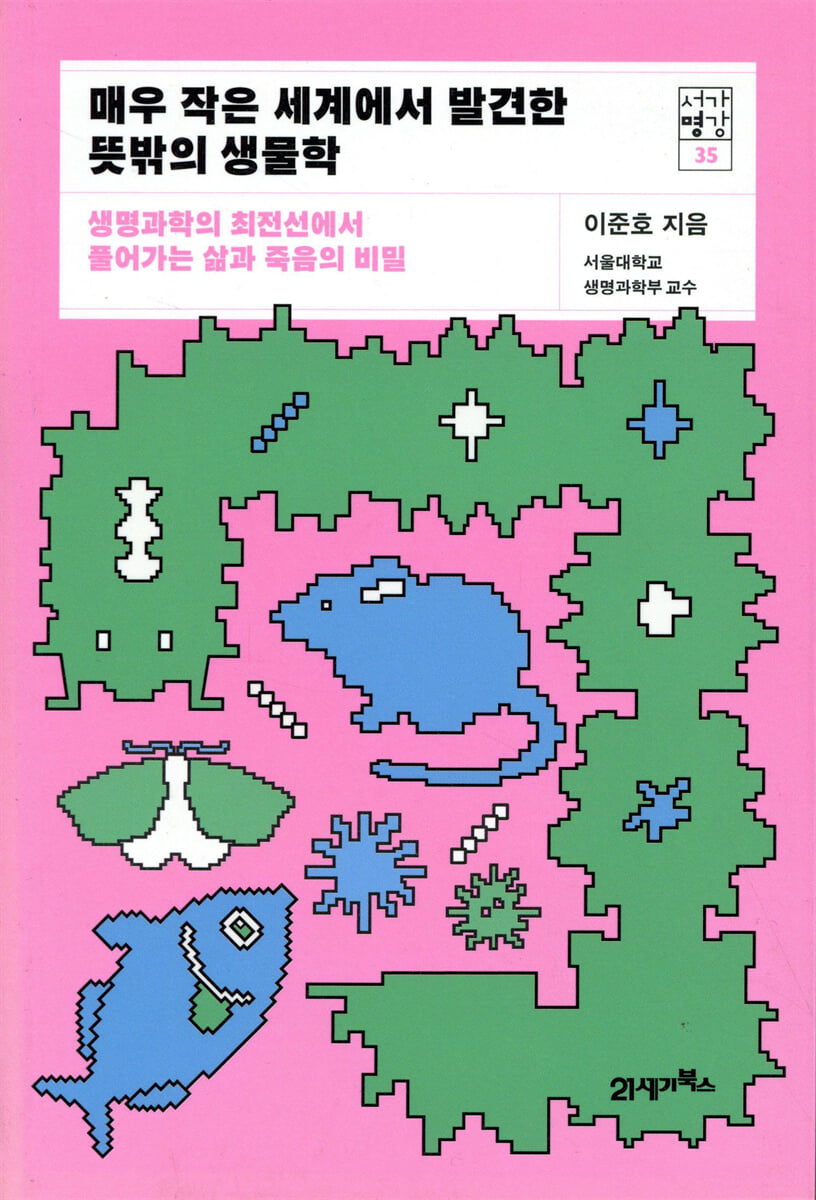
Unexpected Biology Discovered in a Very Small World
 |
Description
Book Introduction
The birth and death of life as told by small creatures JTBC's [China Class] Lecture: A Seoul National University Professor Who's Been Talking About Biologist Discovers First DNA Section That Turns Back the Aging Clock "Seogamyeonggang": A famous lecture you can attend without going to Seoul National University. From the birth of life on Earth to evolution, heredity, aging, and the laws of death! How are we born and why do we die? Discover Korea's finest lectures in book form! The thirty-fifth volume in the "Seogamyeonggang" series, featuring carefully curated lectures by current Seoul National University faculty, has been published. The Seoga Myunggang series, which transcribes the lectures of Seoul National University's top professors in various fields, including history, philosophy, science, medicine, and art, into books, provides readers with the expansion of knowledge and the joy of learning. Professor Lee Jun-ho of Seoul National University's Department of Life Sciences, who became a hot topic by presenting the present and future of genetics with the story of "The World's Most Beautiful Bug" on JTBC's "China Class," has published his first solo book, "Unexpected Biology Discovered in a Very Small World." This book guides even those unfamiliar with biology through fascinating research cases, making it easy to understand the laws of life phenomena, from the origin of life on Earth to evolution, heredity, aging, and finally death. The author of this book, Professor Lee Jun-ho, a life scientist, had a fateful encounter with the 'pretty C. elegans' while he was pursuing his doctorate at the California Institute of Technology in 1989. Afterwards, he studied the nematode C. elegans, the optimal model organism with more than 40% of its genetic information identical to that of humans, for 30 years, and achieved remarkable feats in the field of human aging, such as discovering the world's first DNA region that reverses the cellular aging clock. The author points out that the development of mRNA vaccines, which helped overcome the COVID-19 pandemic, was made possible thanks to research in life sciences, emphasizing that “life sciences are inseparable from our daily lives and will be at the center of countless adversities that humanity will face in the future.” I also encourage more people to join me on this journey through this book. |
- You can preview some of the book's contents.
Preview
index
Classification of Academic Studies Before Reading This Book
Main keywords
Introduction: Biological discoveries that enhance the world's resolution.
Part 1: An Invitation to the World of Biology
Life phenomena that stimulate curiosity and imagination
Two Questions That Will Unravel the Secrets of Life
A Wonderful World Discovered in the Dance of C. elegans
Proving and applying life phenomena
Every life phenomenon has a reason.
Q/A Ask and Answer
Part 2: The World's Smallest, Greatest Discovery
Three Conditions for an Attractive Model Organism
Nobel Prize-winning C. elegans
The fruit fly that rewrote the history of biology
Newly born mice through genetic targeting
Q/A Ask and Answer
Part 3: The Law of Such Amazing Life Phenomena
All life begins in a single cell.
Genes are discriminatory
Find the genes required for development
Death is programmed
Can humans overcome aging?
Q/A Ask and Answer
Part 4: The Mystery of Life: Converging Again into Evolution
How is biodiversity created?
Evolution, the Engine of Genetics and Mutation
How new traits are born
The thornback whale knows the secrets of evolution.
In search of species diversity and its origins
Q/A Ask and Answer
Outgoing Article: We Have Scientist's Genes Within Us
References
Main keywords
Introduction: Biological discoveries that enhance the world's resolution.
Part 1: An Invitation to the World of Biology
Life phenomena that stimulate curiosity and imagination
Two Questions That Will Unravel the Secrets of Life
A Wonderful World Discovered in the Dance of C. elegans
Proving and applying life phenomena
Every life phenomenon has a reason.
Q/A Ask and Answer
Part 2: The World's Smallest, Greatest Discovery
Three Conditions for an Attractive Model Organism
Nobel Prize-winning C. elegans
The fruit fly that rewrote the history of biology
Newly born mice through genetic targeting
Q/A Ask and Answer
Part 3: The Law of Such Amazing Life Phenomena
All life begins in a single cell.
Genes are discriminatory
Find the genes required for development
Death is programmed
Can humans overcome aging?
Q/A Ask and Answer
Part 4: The Mystery of Life: Converging Again into Evolution
How is biodiversity created?
Evolution, the Engine of Genetics and Mutation
How new traits are born
The thornback whale knows the secrets of evolution.
In search of species diversity and its origins
Q/A Ask and Answer
Outgoing Article: We Have Scientist's Genes Within Us
References
Detailed image

Into the book
Earth is a truly beautiful planet, and its beauty comes from the presence of life.
In particular, biodiversity is what allows us to maintain a healthy ecosystem on Earth.
(Omitted) Climate change and other changes in the Earth's ecosystem are becoming more serious in the 21st century.
While this change cannot be entirely attributed to humans, it cannot be said that they are entirely free from responsibility either.
There is no reason why research and knowledge on biodiversity cannot become a godsend that will save the Earth in the future.
--- p.12-13, from “Introduction | Discoveries in biology that increase the resolution of the world”
What does it mean to "study life sciences"? It means challenging questions about life phenomena that no one has ever asked, or questions for which there are still no known answers.
Finding new questions that no one has ever asked before is never easy.
Still, if you don't overlook small curiosities and small questions, you can discover new questions.
If there is a life phenomenon that can stimulate curiosity, if we can find a small question from it, then all of that is the subject of life science.
--- p.21, from “Part 1 | Invitation to the World of Biology”
In other words, model organisms are used in research because of the universality of life.
And the most basic universality is that all species on Earth use the same alphabet.
Here, the alphabet does not refer to language, but to genetic information.
The genetic code is made up of a sequence of four bases.
From viruses to humans, all living things almost always use the same alphabet, although there are some exceptions.
Therefore, when understanding humans is the ultimate goal, model organism research is a very good tool.
--- p.65-66, from “Part 2 | The World’s Smallest but Greatest Discovery”
Let's think about when an animal is born, or more precisely, when life begins.
All animals begin from a single cell.
In fact, it may not be so strange if five cells come together to form one entity.
However, all animals that have actually evolved on Earth go through a process where a sperm and an egg meet to create a single cell, and everything is created from that cell, that is, the fertilized egg.
Here the most fundamental question arises.
(Omitted) 'How can a complex organism with such a variety of cells be created from a single cell?' This fundamental question has created a very important field in life science.
It is none other than ‘embryology’.
--- p.111-112, from “Part 3 | The Law of Such Wonderful Life Phenomena”
We always say that the Earth is beautiful.
At that time, what was said to be beautiful was not the Earth's climate, but the various life forms that lived within it.
It is not that one or two lives are beautiful, but that countless diverse lives are beautiful in harmony with one another.
Perhaps the Earth is beautiful because diversity has been secured through the process of evolution.
--- p.157, from “Part 4 | The Mystery of Life Converging Again into Evolution”
I often get asked, "What kind of skills do I need to major in biology?"
I dare say that biology is a discipline that begins with curiosity and is completed with perseverance.
Without curiosity, it's difficult to find the motivation to persevere through repeated difficult experiments and repeated failures.
Curiosity is what allows new questions to develop into scientific questions.
(Omitted) As you overcome countless obstacles, endure failures, and move forward little by little, you will reach a completely new realm, and the driving force behind that is untiring perseverance.
In particular, biodiversity is what allows us to maintain a healthy ecosystem on Earth.
(Omitted) Climate change and other changes in the Earth's ecosystem are becoming more serious in the 21st century.
While this change cannot be entirely attributed to humans, it cannot be said that they are entirely free from responsibility either.
There is no reason why research and knowledge on biodiversity cannot become a godsend that will save the Earth in the future.
--- p.12-13, from “Introduction | Discoveries in biology that increase the resolution of the world”
What does it mean to "study life sciences"? It means challenging questions about life phenomena that no one has ever asked, or questions for which there are still no known answers.
Finding new questions that no one has ever asked before is never easy.
Still, if you don't overlook small curiosities and small questions, you can discover new questions.
If there is a life phenomenon that can stimulate curiosity, if we can find a small question from it, then all of that is the subject of life science.
--- p.21, from “Part 1 | Invitation to the World of Biology”
In other words, model organisms are used in research because of the universality of life.
And the most basic universality is that all species on Earth use the same alphabet.
Here, the alphabet does not refer to language, but to genetic information.
The genetic code is made up of a sequence of four bases.
From viruses to humans, all living things almost always use the same alphabet, although there are some exceptions.
Therefore, when understanding humans is the ultimate goal, model organism research is a very good tool.
--- p.65-66, from “Part 2 | The World’s Smallest but Greatest Discovery”
Let's think about when an animal is born, or more precisely, when life begins.
All animals begin from a single cell.
In fact, it may not be so strange if five cells come together to form one entity.
However, all animals that have actually evolved on Earth go through a process where a sperm and an egg meet to create a single cell, and everything is created from that cell, that is, the fertilized egg.
Here the most fundamental question arises.
(Omitted) 'How can a complex organism with such a variety of cells be created from a single cell?' This fundamental question has created a very important field in life science.
It is none other than ‘embryology’.
--- p.111-112, from “Part 3 | The Law of Such Wonderful Life Phenomena”
We always say that the Earth is beautiful.
At that time, what was said to be beautiful was not the Earth's climate, but the various life forms that lived within it.
It is not that one or two lives are beautiful, but that countless diverse lives are beautiful in harmony with one another.
Perhaps the Earth is beautiful because diversity has been secured through the process of evolution.
--- p.157, from “Part 4 | The Mystery of Life Converging Again into Evolution”
I often get asked, "What kind of skills do I need to major in biology?"
I dare say that biology is a discipline that begins with curiosity and is completed with perseverance.
Without curiosity, it's difficult to find the motivation to persevere through repeated difficult experiments and repeated failures.
Curiosity is what allows new questions to develop into scientific questions.
(Omitted) As you overcome countless obstacles, endure failures, and move forward little by little, you will reach a completely new realm, and the driving force behind that is untiring perseverance.
--- p.195-196, from “Outgoing Writing | We Have Scientist’s Genes Within Us”
Publisher's Review
Biology, a discipline born from curiosity and completed with perseverance.
We have the DNA of a scientist in us!
Professor Lee Jun-ho says, “Biology is a discipline that begins with curiosity and is completed with perseverance,” and asserts that anyone with these two qualities is born with the qualities of a life scientist.
Curiosity is what allows new questions to develop into scientific questions, and the perseverance that allows us to never give up despite difficult experiments and repeated failures also stems from curiosity.
The same is true for Drew Weissman and Katalin Kariko, winners of the 2023 Nobel Prize in Physiology or Medicine, who are mentioned in this book.
Although the development of the core technology of mRNA vaccines was a great achievement that liberated humanity from the COVID-19 pandemic, the world did not initially take notice of this research.
In fact, Katharine Curriko was not even appointed as a professor because she had been conducting basic research on mRNA for so long that it was considered useless, and was even demoted to a part-time researcher.
In this book, the author defines studying life sciences as a challenge to questions about life phenomena that no one has ever asked or to which no answers have been found until now.
He says that the beginning comes from an attitude of not dismissing even the smallest curiosity lightly and connecting it with a question.
Now that we've identified the scientist gene within us, what's the next step in uncovering the secrets of life?
Increasing the resolution of the world
A great discovery in biology unfolds!
What questions should we ask to discover the universal truths that all life on Earth possesses? There are two core questions in biology that seek answers to this question.
The answer is “how” and “why.”
So, Part 1 of this book guides you through the methods of proving and applying life phenomena, focusing on two questions: “How do life phenomena occur?” and “Why do life phenomena occur?”
To illustrate this process clearly, the author presents fascinating stories such as the discovery of a new type of black peppered moth, the nictation behavior of the pretty little nematode, and the lake thorn fish that lost its spines.
Part 2, 'The World's Smallest but Greatest Discovery', showcases the various model organisms used to understand human life phenomena.
From the fruit fly, the greatest model organism that rewrote the history of biology, to the three-time Nobel Prize-winning C. elegans, to the mouse, which finally became the center of genetic research thanks to gene-editing technology, you can examine in detail the great achievements of model organisms that have accompanied the development of biology.
We can find the truth about life phenomena even in small creatures that appear completely different from us.
The following third part tells the story of the wondrous laws of life that occur between the birth and death of life on Earth.
From the mystery of 'development', where a single fertilized egg becomes a complex entity made up of trillions of cells, to 'evolution', which is caused by mutations that are the core of the diversity of life, to the 'genetic' phenomenon that selects discrimination to create various organs with the same genes, to the magical discovery of 'aging' called the 'Yamanaka Factor' that turns old mice into young mice, and finally, to 'death', the cell death process that all life can never avoid, the secrets of the magnificent phenomenon of life are concisely revealed.
Part 4, which concludes the book, explains in detail why the Earth we live on is so beautiful from the perspective of biodiversity and evolution.
In particular, when we examine the process by which a "mistake" called mutation acts as a driving force for evolution, the author's message mentioned in the introduction of the book, "There is no life phenomenon that occurs without meaning," becomes clearer, and our understanding of the world we live in deepens.
Biology is so interesting!
In the end, biology will save humanity.
This book is not an introductory biology book that explains biology from A to Z without leaving out anything.
It was written with the explicit goal of helping readers feel and realize that biology is a fascinating, even maddeningly fun, discipline, focusing on the core topics that must be known in the vast and profound study of life sciences.
Some might think, "Life science seems to be the domain of experts, just like the COVID-19 vaccine was developed exclusively by scientists. Why should ordinary people be interested?"
However, it is clear that humanity will once again face unforeseen adversities like the COVID-19 pandemic in the future, and life sciences will be at the center of the solution.
Even though biological discoveries carry with them the uncertainty of how and when they will save humanity, this is why they require greater public attention and support.
In that sense, this book, "Unexpected Biology Discovered in a Very Small World," will help readers breathe together with the present and future of life science, which is still quietly advancing.
It will also provide an answer to the fundamental question that humans have always cherished: "How were we born and why do we die?" from a biological perspective.
Now it's time to awaken the scientist gene within us.
We have the DNA of a scientist in us!
Professor Lee Jun-ho says, “Biology is a discipline that begins with curiosity and is completed with perseverance,” and asserts that anyone with these two qualities is born with the qualities of a life scientist.
Curiosity is what allows new questions to develop into scientific questions, and the perseverance that allows us to never give up despite difficult experiments and repeated failures also stems from curiosity.
The same is true for Drew Weissman and Katalin Kariko, winners of the 2023 Nobel Prize in Physiology or Medicine, who are mentioned in this book.
Although the development of the core technology of mRNA vaccines was a great achievement that liberated humanity from the COVID-19 pandemic, the world did not initially take notice of this research.
In fact, Katharine Curriko was not even appointed as a professor because she had been conducting basic research on mRNA for so long that it was considered useless, and was even demoted to a part-time researcher.
In this book, the author defines studying life sciences as a challenge to questions about life phenomena that no one has ever asked or to which no answers have been found until now.
He says that the beginning comes from an attitude of not dismissing even the smallest curiosity lightly and connecting it with a question.
Now that we've identified the scientist gene within us, what's the next step in uncovering the secrets of life?
Increasing the resolution of the world
A great discovery in biology unfolds!
What questions should we ask to discover the universal truths that all life on Earth possesses? There are two core questions in biology that seek answers to this question.
The answer is “how” and “why.”
So, Part 1 of this book guides you through the methods of proving and applying life phenomena, focusing on two questions: “How do life phenomena occur?” and “Why do life phenomena occur?”
To illustrate this process clearly, the author presents fascinating stories such as the discovery of a new type of black peppered moth, the nictation behavior of the pretty little nematode, and the lake thorn fish that lost its spines.
Part 2, 'The World's Smallest but Greatest Discovery', showcases the various model organisms used to understand human life phenomena.
From the fruit fly, the greatest model organism that rewrote the history of biology, to the three-time Nobel Prize-winning C. elegans, to the mouse, which finally became the center of genetic research thanks to gene-editing technology, you can examine in detail the great achievements of model organisms that have accompanied the development of biology.
We can find the truth about life phenomena even in small creatures that appear completely different from us.
The following third part tells the story of the wondrous laws of life that occur between the birth and death of life on Earth.
From the mystery of 'development', where a single fertilized egg becomes a complex entity made up of trillions of cells, to 'evolution', which is caused by mutations that are the core of the diversity of life, to the 'genetic' phenomenon that selects discrimination to create various organs with the same genes, to the magical discovery of 'aging' called the 'Yamanaka Factor' that turns old mice into young mice, and finally, to 'death', the cell death process that all life can never avoid, the secrets of the magnificent phenomenon of life are concisely revealed.
Part 4, which concludes the book, explains in detail why the Earth we live on is so beautiful from the perspective of biodiversity and evolution.
In particular, when we examine the process by which a "mistake" called mutation acts as a driving force for evolution, the author's message mentioned in the introduction of the book, "There is no life phenomenon that occurs without meaning," becomes clearer, and our understanding of the world we live in deepens.
Biology is so interesting!
In the end, biology will save humanity.
This book is not an introductory biology book that explains biology from A to Z without leaving out anything.
It was written with the explicit goal of helping readers feel and realize that biology is a fascinating, even maddeningly fun, discipline, focusing on the core topics that must be known in the vast and profound study of life sciences.
Some might think, "Life science seems to be the domain of experts, just like the COVID-19 vaccine was developed exclusively by scientists. Why should ordinary people be interested?"
However, it is clear that humanity will once again face unforeseen adversities like the COVID-19 pandemic in the future, and life sciences will be at the center of the solution.
Even though biological discoveries carry with them the uncertainty of how and when they will save humanity, this is why they require greater public attention and support.
In that sense, this book, "Unexpected Biology Discovered in a Very Small World," will help readers breathe together with the present and future of life science, which is still quietly advancing.
It will also provide an answer to the fundamental question that humans have always cherished: "How were we born and why do we die?" from a biological perspective.
Now it's time to awaken the scientist gene within us.
GOODS SPECIFICS
- Date of issue: December 18, 2023
- Page count, weight, size: 204 pages | 128*188*20mm
- ISBN13: 9791171173167
- ISBN10: 1171173164
You may also like
카테고리
korean


korean

![GQ KOREA Mark (Monthly): December [2025]](http://librairie.coreenne.fr/cdn/shop/files/8ef265dbbfbf186523ed75ba7319009d.jpg?v=1765340328&width=3840)


