

Elementary classical literature
 |
Description
Book Introduction
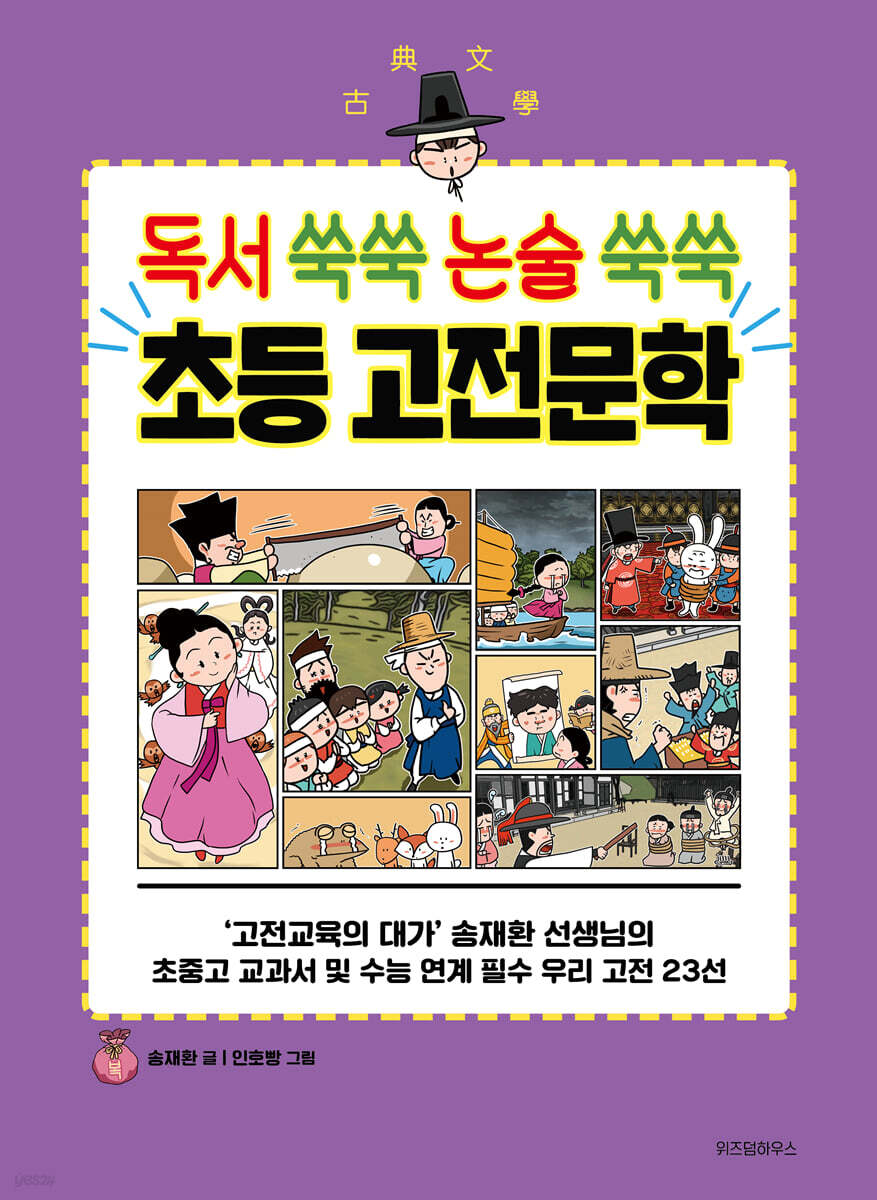
One piece a day, one month to complete, vocabulary × literacy skills increase vertically! Teacher Song Jae-hwan's 23 Korean Classics: A Solid Foundation for Korean Language Studies Confidence in learning and writing grows steadily through linking elementary, middle, and high school textbooks. The fourth installment of the bestselling classic educational comic series, "SsukSsuk Series!" Many classical works of literature are included in elementary, middle, and high school Korean language curriculums, many of which are essential for elementary school students to access in connection with their future essay writing and college entrance exam preparation. With this one book, your child will not only be able to access a wide range of classical literature they need to know before entering middle school, but they will also experience improvements in their literacy, vocabulary, and Chinese character skills. If you lay the foundation for your Korean language studies with the 23 representative classical Korean works selected by Song Jae-hwan, a master of elementary education, your studies will become much more interesting and enjoyable. Through this book, children will naturally acquire the joy of reading our classics and develop confidence in learning. |
- You can preview some of the book's contents.
Preview
index
- Prologue
- How is this book structured?
Chapter 1.
Learning from our ancestors about rewarding good and punishing evil
1.
[Heungbu and Nolbu] Good people are blessed, bad people are punished.
2.
[Simcheongjeon] Simcheong, the filial daughter who threw herself into offering 300 seok of rice
3.
[Kongjwi and Patjwi Story] Kongjwi goes to a banquet wearing flower shoes
4.
[Onggojipjeon] A fake Onggojip that looks more real than the real thing
5.
[The Story of Yu Chung-ryeol] Yu Chung-ryeol, Who Saved the Emperor and His Family
6.
[Jeon Woochi] The Taoist Master Who Shamed a Corrupt Official
Chapter 2.
Overcoming trials and achieving life
7.
[Rabbit War] A rabbit putting in and taking out liver
8.
[Chunhyangjeon] Love between a man and a woman that transcends class barriers
9.
[The Tale of Hong Gildong] Hong Gildong, who cannot call his father "father"
10.
[Golden Bell Story] Gold Bell Finally Transforms into a Beautiful Woman
11.
[Ondaljeon] The Fool Ondal Becomes General Ondal
12.
[Operation] A heartbreaking love that leads to death
13.
[Lee Saeng-gyu's Story] A heartbreaking love that transcends life and death.
Chapter 3.
The wisdom of life we need
14.
[Bait Battle] Stubborn Bait
15.
[Yangbanjeon] A world where noble status is bought and sold for money.
16.
[The Story of Mrs. Park] The Woman Who Defeated the Enemy General and Saved the Nation
17.
[The Seven Sisters of the Gyūjok] The Seven Sisters of the Gyūjok who act like they know everything only to get scolded.
18.
[Thick Jeon] A Fox Played by a Toad's Talk
19.
[Heosaengjeon] Heosaeng, who made a million nyang with ten thousand nyang
20.
[Hojil] A nobleman rebuked by a tiger
21.
[Park Mun-su's Story] The secret royal inspector is here!
22.
[The Tale of Janghwa and Hongryeon] Janghwa and Hongryeon died after being falsely accused.
23.
[Sleep Theory] Which is more important, a head lice or a dog?
- A resting yard
- Special Appendix 1.
A Parent's Guide to Classic Literature: How to Teach Classic Literature
# Why is classical literature important to elementary school students?
# Things to note when using this book
- Special Appendix 2.
Quiz Answer Sheet
- Special Appendix 3.
Vocabulary Growth Chinese Character Writing Note
- How is this book structured?
Chapter 1.
Learning from our ancestors about rewarding good and punishing evil
1.
[Heungbu and Nolbu] Good people are blessed, bad people are punished.
2.
[Simcheongjeon] Simcheong, the filial daughter who threw herself into offering 300 seok of rice
3.
[Kongjwi and Patjwi Story] Kongjwi goes to a banquet wearing flower shoes
4.
[Onggojipjeon] A fake Onggojip that looks more real than the real thing
5.
[The Story of Yu Chung-ryeol] Yu Chung-ryeol, Who Saved the Emperor and His Family
6.
[Jeon Woochi] The Taoist Master Who Shamed a Corrupt Official
Chapter 2.
Overcoming trials and achieving life
7.
[Rabbit War] A rabbit putting in and taking out liver
8.
[Chunhyangjeon] Love between a man and a woman that transcends class barriers
9.
[The Tale of Hong Gildong] Hong Gildong, who cannot call his father "father"
10.
[Golden Bell Story] Gold Bell Finally Transforms into a Beautiful Woman
11.
[Ondaljeon] The Fool Ondal Becomes General Ondal
12.
[Operation] A heartbreaking love that leads to death
13.
[Lee Saeng-gyu's Story] A heartbreaking love that transcends life and death.
Chapter 3.
The wisdom of life we need
14.
[Bait Battle] Stubborn Bait
15.
[Yangbanjeon] A world where noble status is bought and sold for money.
16.
[The Story of Mrs. Park] The Woman Who Defeated the Enemy General and Saved the Nation
17.
[The Seven Sisters of the Gyūjok] The Seven Sisters of the Gyūjok who act like they know everything only to get scolded.
18.
[Thick Jeon] A Fox Played by a Toad's Talk
19.
[Heosaengjeon] Heosaeng, who made a million nyang with ten thousand nyang
20.
[Hojil] A nobleman rebuked by a tiger
21.
[Park Mun-su's Story] The secret royal inspector is here!
22.
[The Tale of Janghwa and Hongryeon] Janghwa and Hongryeon died after being falsely accused.
23.
[Sleep Theory] Which is more important, a head lice or a dog?
- A resting yard
- Special Appendix 1.
A Parent's Guide to Classic Literature: How to Teach Classic Literature
# Why is classical literature important to elementary school students?
# Things to note when using this book
- Special Appendix 2.
Quiz Answer Sheet
- Special Appendix 3.
Vocabulary Growth Chinese Character Writing Note
Detailed image

Publisher's Review
Numerous parents have already proven its effectiveness.
The fourth installment of the classic educational comic series from the bestselling "SsukSsuk Series."
Chosen by elementary education expert Song Jae-hwan
23 Essential Classical Literatures for Elementary, Middle, and High School Textbooks and the College Scholastic Ability Test
The fourth installment of the best-selling classic educational comic series for elementary school students, "Reading, Writing, Elementary Classic Literature," has been published by Wisdom House.
'Classical literature' is a collection of works that embody the insights and wisdom of our ancestors, the foundation of our lives. It is content that has resonated with countless people over the years, as generations have passed.
Exposure to good works that can be considered classics during elementary school not only increases one's understanding of literature, but also has a significant impact on improving one's reading skills.
Additionally, it is necessary to become closer to the essential classical literature for learning Korean language in elementary, middle, and high school.
Many classical literary works appear in textbooks for not only elementary schools but also middle and high schools.
At this time, children who have been exposed to and read classical literature in advance can more easily accept and understand the work.
If you know the plot and character traits of a work, you can quickly grasp the context while reading the text and feel confident in your learning.
This book introduces '23 essential classic Korean literature pieces' carefully selected by Song Jae-hwan, a leading expert in elementary education.
If you consistently read one work a day, think about it, and learn related idioms and Chinese characters, your child's vocabulary and reading skills will grow rapidly.
Literacy × Vocabulary × Chinese Character Skills Vertically Increased!
A must-read book to improve vocabulary through comics and post-reading activities.
Build a solid foundation in Korean language learning with 'Classical Literature'!
In 『Reading, Writing, Elementary Classic Literature』, 23 classics are organized in an easy-to-understand and fun way, ranging from works like "The Story of Heungbu and Nolbu," "The Story of Simcheong," and "The Story of the Rabbit," which we have been exposed to as fairy tales since childhood, to works that depict historical situations well, such as "The Story of Jeon Woochi," "The Story of Mrs. Park," and "The Story of the Nobleman."
In each work, interesting or important parts are drawn into a cartoon to capture attention, and the storyline is introduced at a level that children can understand.
Additionally, it introduces the characters, background, and characteristics of the work in detail, helping children understand the work from a broad perspective.
This part is knowledge that is likely to appear on tests in middle and high school, so it is also very helpful for learning Korean language.
In addition, there are a wealth of post-reading activity materials available to effectively enhance elementary school students' vocabulary, thinking skills, and expressive abilities, such as learning the word of the day, tracing Chinese characters, and thinking and expressing from the perspective of the main character in the story.
With this one book, your child will not only be able to access a wide range of classical literature that they must know before entering middle school, but they will also experience improvements in their literacy, vocabulary, and Chinese character skills.
In elementary school, interest and confidence come first in any subject.
Studying becomes much more interesting and fun when you learn the basics of Korean through our classics.
This is why elementary school children must be exposed to our 'classical literature'.
30 minutes a day, read and write along and make it your own
Boost your literacy! "Classic Learning Comics: Ssuk Ssuk Series"
The three books in the 'Classical Learning Comics Ssuksuk Series', led by 'Character Ssuksuk Hanja Ssuksuk Elementary School Sajasohak', have become bestsellers, receiving much attention from parents as books that help children improve their vocabulary and comprehension skills, and have established themselves as classic learning books for elementary school students.
Today, improving literacy is one of the biggest concerns for parents of elementary school-aged children.
'Literacy' is the 'ability to read and understand text' and is deeply connected to a child's learning comprehension, vocabulary, and thinking ability. Education experts also emphasize that without literacy, it is impossible to build a foundation for studying and writing skills.
In this way, something that cannot be left out in improving important literacy skills is ‘Chinese characters’.
Since more than 80 percent of the vocabulary that children learn consists of Chinese characters, it is very important to build up ‘Chinese character skills.’
The Chinese characters that appear in the 'SsukSsuk Series' are not that high level.
Because the same Chinese characters often appear repeatedly, your Chinese character skills will naturally improve just by reading and writing them.
Even classical Chinese characters that may seem somewhat boring and difficult can be learned easily with this book that combines fun cartoons.
The 'SsukSsuk Series' helps you improve your Chinese character skills by writing Chinese characters yourself and looking at their meanings.
And this ultimately helps greatly in improving children's literacy and writing skills.
Read along and write along for 30 minutes a day.
Your child's literacy and writing skills will grow rapidly.
The fourth installment of the classic educational comic series from the bestselling "SsukSsuk Series."
Chosen by elementary education expert Song Jae-hwan
23 Essential Classical Literatures for Elementary, Middle, and High School Textbooks and the College Scholastic Ability Test
The fourth installment of the best-selling classic educational comic series for elementary school students, "Reading, Writing, Elementary Classic Literature," has been published by Wisdom House.
'Classical literature' is a collection of works that embody the insights and wisdom of our ancestors, the foundation of our lives. It is content that has resonated with countless people over the years, as generations have passed.
Exposure to good works that can be considered classics during elementary school not only increases one's understanding of literature, but also has a significant impact on improving one's reading skills.
Additionally, it is necessary to become closer to the essential classical literature for learning Korean language in elementary, middle, and high school.
Many classical literary works appear in textbooks for not only elementary schools but also middle and high schools.
At this time, children who have been exposed to and read classical literature in advance can more easily accept and understand the work.
If you know the plot and character traits of a work, you can quickly grasp the context while reading the text and feel confident in your learning.
This book introduces '23 essential classic Korean literature pieces' carefully selected by Song Jae-hwan, a leading expert in elementary education.
If you consistently read one work a day, think about it, and learn related idioms and Chinese characters, your child's vocabulary and reading skills will grow rapidly.
Literacy × Vocabulary × Chinese Character Skills Vertically Increased!
A must-read book to improve vocabulary through comics and post-reading activities.
Build a solid foundation in Korean language learning with 'Classical Literature'!
In 『Reading, Writing, Elementary Classic Literature』, 23 classics are organized in an easy-to-understand and fun way, ranging from works like "The Story of Heungbu and Nolbu," "The Story of Simcheong," and "The Story of the Rabbit," which we have been exposed to as fairy tales since childhood, to works that depict historical situations well, such as "The Story of Jeon Woochi," "The Story of Mrs. Park," and "The Story of the Nobleman."
In each work, interesting or important parts are drawn into a cartoon to capture attention, and the storyline is introduced at a level that children can understand.
Additionally, it introduces the characters, background, and characteristics of the work in detail, helping children understand the work from a broad perspective.
This part is knowledge that is likely to appear on tests in middle and high school, so it is also very helpful for learning Korean language.
In addition, there are a wealth of post-reading activity materials available to effectively enhance elementary school students' vocabulary, thinking skills, and expressive abilities, such as learning the word of the day, tracing Chinese characters, and thinking and expressing from the perspective of the main character in the story.
With this one book, your child will not only be able to access a wide range of classical literature that they must know before entering middle school, but they will also experience improvements in their literacy, vocabulary, and Chinese character skills.
In elementary school, interest and confidence come first in any subject.
Studying becomes much more interesting and fun when you learn the basics of Korean through our classics.
This is why elementary school children must be exposed to our 'classical literature'.
30 minutes a day, read and write along and make it your own
Boost your literacy! "Classic Learning Comics: Ssuk Ssuk Series"
The three books in the 'Classical Learning Comics Ssuksuk Series', led by 'Character Ssuksuk Hanja Ssuksuk Elementary School Sajasohak', have become bestsellers, receiving much attention from parents as books that help children improve their vocabulary and comprehension skills, and have established themselves as classic learning books for elementary school students.
Today, improving literacy is one of the biggest concerns for parents of elementary school-aged children.
'Literacy' is the 'ability to read and understand text' and is deeply connected to a child's learning comprehension, vocabulary, and thinking ability. Education experts also emphasize that without literacy, it is impossible to build a foundation for studying and writing skills.
In this way, something that cannot be left out in improving important literacy skills is ‘Chinese characters’.
Since more than 80 percent of the vocabulary that children learn consists of Chinese characters, it is very important to build up ‘Chinese character skills.’
The Chinese characters that appear in the 'SsukSsuk Series' are not that high level.
Because the same Chinese characters often appear repeatedly, your Chinese character skills will naturally improve just by reading and writing them.
Even classical Chinese characters that may seem somewhat boring and difficult can be learned easily with this book that combines fun cartoons.
The 'SsukSsuk Series' helps you improve your Chinese character skills by writing Chinese characters yourself and looking at their meanings.
And this ultimately helps greatly in improving children's literacy and writing skills.
Read along and write along for 30 minutes a day.
Your child's literacy and writing skills will grow rapidly.
GOODS SPECIFICS
- Date of issue: August 14, 2024
- Page count, weight, size: 248 pages | 658g | 188*257*12mm
- ISBN13: 9791171712472
- ISBN10: 1171712472
- KC Certification: Certification Type: Conformity Confirmation
You may also like
카테고리
korean


korean

![ELLE 엘르 스페셜 에디션 A형 : 12월 [2025]](http://librairie.coreenne.fr/cdn/shop/files/b8e27a3de6c9538896439686c6b0e8fb.jpg?v=1766436872&width=3840)


