

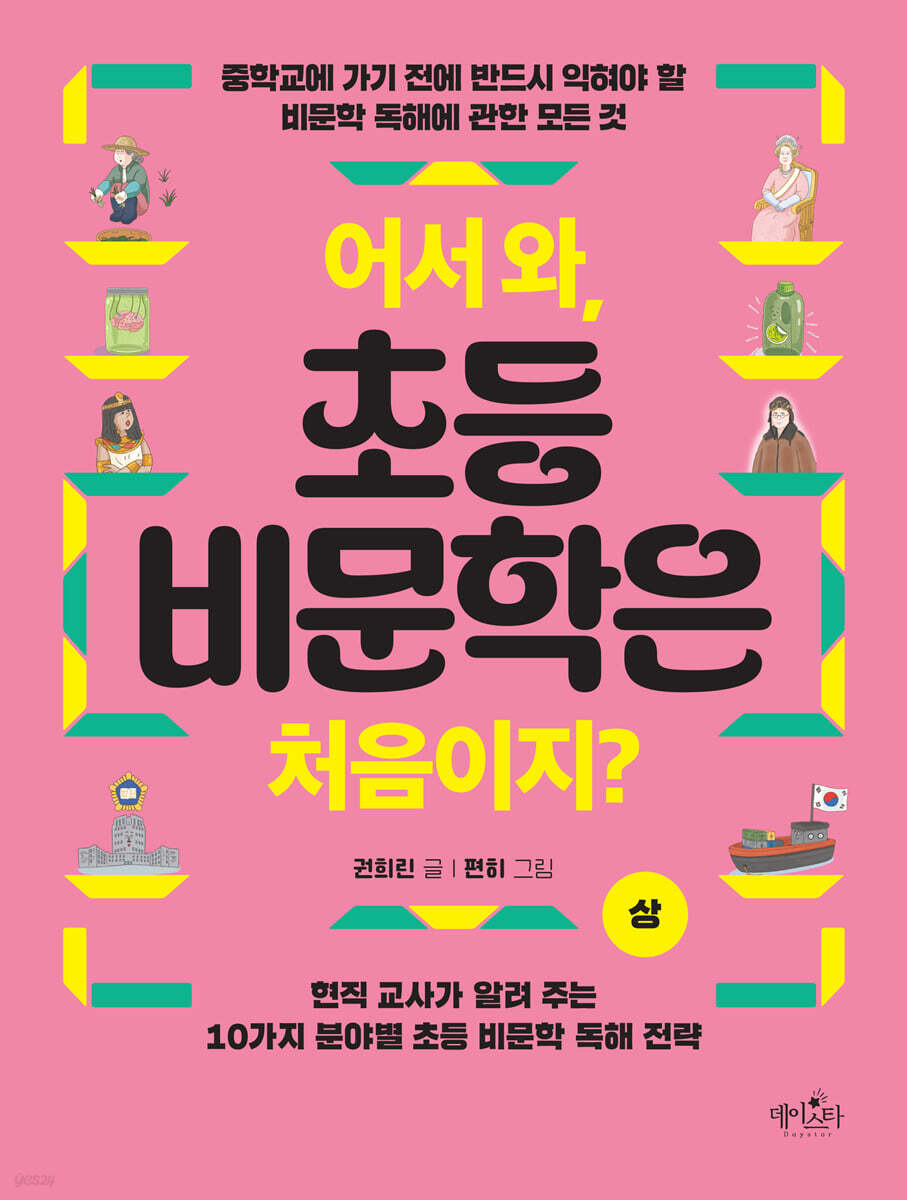
Welcome, is this your first time at Elementary Non-Fiction? (Part 1)
 |
Description
Book Introduction
“The beginning of all subjects is non-literature reading comprehension,
“If you raise it now, you will be able to write any article later!”
A child who reads a text but doesn't know what it's about,
A child who gets a headache when reading long texts,
For children who are more familiar with YouTube videos than text
A Basic Strategy for Completing Non-Fiction Reading
This book is a non-fiction training book written by a current teacher based on his extensive teaching experience to help children develop reading habits that enable them to think and express themselves independently.
This isn't just a reading comprehension book for solving problems; it cultivates critical thinking skills through worldly topics. Covering a variety of real-world topics, including AI textbooks, the four-day workweek, the environment, history, and philosophy, it helps children learn how to "read the world through words."
All texts are written in short, clear sentences suitable for elementary school students, and after reading, readers naturally experience the process of finding the main points, making connections, and organizing their thoughts.
It is a structure designed so that reading power expands into thinking power, and thinking power expands into expressive power.
Through this, children go beyond simply reading text and experience the process of understanding the information in the text, organizing its structure, and expressing their thoughts in their own words.
If you accumulate enough reading experience in elementary school, you will gain the confidence to read and understand longer texts without fear when you come to middle school.
“If you raise it now, you will be able to write any article later!”
A child who reads a text but doesn't know what it's about,
A child who gets a headache when reading long texts,
For children who are more familiar with YouTube videos than text
A Basic Strategy for Completing Non-Fiction Reading
This book is a non-fiction training book written by a current teacher based on his extensive teaching experience to help children develop reading habits that enable them to think and express themselves independently.
This isn't just a reading comprehension book for solving problems; it cultivates critical thinking skills through worldly topics. Covering a variety of real-world topics, including AI textbooks, the four-day workweek, the environment, history, and philosophy, it helps children learn how to "read the world through words."
All texts are written in short, clear sentences suitable for elementary school students, and after reading, readers naturally experience the process of finding the main points, making connections, and organizing their thoughts.
It is a structure designed so that reading power expands into thinking power, and thinking power expands into expressive power.
Through this, children go beyond simply reading text and experience the process of understanding the information in the text, organizing its structure, and expressing their thoughts in their own words.
If you accumulate enough reading experience in elementary school, you will gain the confidence to read and understand longer texts without fear when you come to middle school.
- You can preview some of the book's contents.
Preview
index
prolog
Chapter 1 Society
1.
Are there really this many people who have trouble with kiosks?
2.
How did a diabetes drug become an obesity treatment?
3.
Is technological advancement always a good thing? The downsides of AI advancements.
4.
"Please don't post my photos on social media." The right to be forgotten and sharenting.
5.
What will change when the four-day workweek is introduced?
6.
Horses go to Jeju, people go to Seoul? The extinction of local areas.
7.
The 'tragedy of the commons' is now a thing of the past, and we are moving towards a commons where we can all live well together.
8.
Painting it green doesn't make it eco-friendly! Greenwashing
Chapter 2 History
1.
Controversy over UNESCO World Heritage listing of the Sado Mine, which exploited Koreans
2.
Haegwi, Joseon's first black mercenary who appeared during the Imjin War
3.
From Queen Seondeok to Cleopatra, female monarchs who dominated history
4.
Zombies aren't just in movies, they exist in real life?
5.
Interesting backstories from history that only I didn't know about
6.
Bang Jeong-hwan, who gave the name "Children" to children with many dreams
7.
Kwon Ki-ok, Korea's first female pilot, took to the skies for independence.
8.
Was it possible to get divorced during the Joseon Dynasty?
Chapter 3 Humanities
1.
Why did Kant faint when he saw the butler who had worked for him for ten years?
2.
Why did Nietzsche suddenly hug a horse and cry in the middle of the road?
3.
Is it okay to pursue pleasure in order to be happy?
4.
What was the utopia envisioned by the greatest philosopher of ancient Greece?
5.
Am I the same person today as I was yesterday? Theseus' Ship
6.
Is the reality we experience real? Brain in a vat
7.
The philosopher Rousseau, who said, "Humans are inherently good," abandoned his five children.
8.
Schopenhauer: You must know suffering to be happy.
Chapter 4 Politics
1.
Why can't 17-year-olds vote, but 18-year-olds and older can?
2.
What does the outcome of other countries' elections have to do with our economy and security?
3.
Different forms of government exist in different countries, from presidents to prime ministers to kings.
4.
Why is the maximum sentence different in the US (100 years) and Korea (50 years)?
5.
Same words but different countries: China, Hong Kong, and Taiwan
6.
What does it mean for a country to have no sovereignty?
7.
Let's maintain balance by dividing into three, separation of powers
8.
Japan's pursuit of Dokdo and Russia's pursuit of the Kuril Islands
Chapter 5 Education
1. Are the advantages or disadvantages of AI textbooks greater?
2.
AI that does your homework for you is more harmful than helpful.
3.
Zero new students, schools closing, and low birth rates
4.
Going to school, competing, a day in the life of a special sports student
5.
Is handwriting effective for learning?
6.
What does low birth rate have to do with private education? China's ban on private education.
7.
You're saying that even if you commit a crime, you won't be punished?
8. ADHD? Borderline Intelligence? Different, But How to Learn and Live Together
Chapter 1 Society
1.
Are there really this many people who have trouble with kiosks?
2.
How did a diabetes drug become an obesity treatment?
3.
Is technological advancement always a good thing? The downsides of AI advancements.
4.
"Please don't post my photos on social media." The right to be forgotten and sharenting.
5.
What will change when the four-day workweek is introduced?
6.
Horses go to Jeju, people go to Seoul? The extinction of local areas.
7.
The 'tragedy of the commons' is now a thing of the past, and we are moving towards a commons where we can all live well together.
8.
Painting it green doesn't make it eco-friendly! Greenwashing
Chapter 2 History
1.
Controversy over UNESCO World Heritage listing of the Sado Mine, which exploited Koreans
2.
Haegwi, Joseon's first black mercenary who appeared during the Imjin War
3.
From Queen Seondeok to Cleopatra, female monarchs who dominated history
4.
Zombies aren't just in movies, they exist in real life?
5.
Interesting backstories from history that only I didn't know about
6.
Bang Jeong-hwan, who gave the name "Children" to children with many dreams
7.
Kwon Ki-ok, Korea's first female pilot, took to the skies for independence.
8.
Was it possible to get divorced during the Joseon Dynasty?
Chapter 3 Humanities
1.
Why did Kant faint when he saw the butler who had worked for him for ten years?
2.
Why did Nietzsche suddenly hug a horse and cry in the middle of the road?
3.
Is it okay to pursue pleasure in order to be happy?
4.
What was the utopia envisioned by the greatest philosopher of ancient Greece?
5.
Am I the same person today as I was yesterday? Theseus' Ship
6.
Is the reality we experience real? Brain in a vat
7.
The philosopher Rousseau, who said, "Humans are inherently good," abandoned his five children.
8.
Schopenhauer: You must know suffering to be happy.
Chapter 4 Politics
1.
Why can't 17-year-olds vote, but 18-year-olds and older can?
2.
What does the outcome of other countries' elections have to do with our economy and security?
3.
Different forms of government exist in different countries, from presidents to prime ministers to kings.
4.
Why is the maximum sentence different in the US (100 years) and Korea (50 years)?
5.
Same words but different countries: China, Hong Kong, and Taiwan
6.
What does it mean for a country to have no sovereignty?
7.
Let's maintain balance by dividing into three, separation of powers
8.
Japan's pursuit of Dokdo and Russia's pursuit of the Kuril Islands
Chapter 5 Education
1. Are the advantages or disadvantages of AI textbooks greater?
2.
AI that does your homework for you is more harmful than helpful.
3.
Zero new students, schools closing, and low birth rates
4.
Going to school, competing, a day in the life of a special sports student
5.
Is handwriting effective for learning?
6.
What does low birth rate have to do with private education? China's ban on private education.
7.
You're saying that even if you commit a crime, you won't be punished?
8. ADHD? Borderline Intelligence? Different, But How to Learn and Live Together
Detailed image

Into the book
Technological advancements have made our lives more convenient.
A representative example is quickly ordering and paying at a kiosk at a place like McDonald's.
But do everyone find kiosks convenient?
--- p.17
The right to be forgotten is the right to have your information or photos posted on the Internet later deleted.
This right is recognized by law in the European Union and helps individuals avoid having past information they wish to erase.
--- p.29
Tumblers and eco-bags can become victims of greenwashing depending on how they are used.
It is better to share unnecessary products with others and buy them from the second-hand market rather than buying new ones.
When purchasing a product, it is important to consider its impact on the environment.
By developing these healthy consumption habits, we can become more proactive in protecting the environment.
--- p.47
Kant always asked himself the question, “Are my actions good for everyone?”
For example, if you lie, people will not trust each other, and if you throw trash anywhere, the world will become dirty. I thought about the consequences of my actions.
--- p.87
Rousseau said that education should not simply be about imparting knowledge, but should be a process that helps children think freely and independently.
In this process, it was emphasized that children should be able to maintain their innocence and freedom while connecting with society.
--- p.111
Security issues are also important.
If Trump addresses North Korea directly, South Korea's security situation could become unstable, and if he insists that South Korea shoulder more of the cost of stationing U.S. troops, tensions could arise between South Korea and the United States.
This can happen.
--- p.123
Many students say they find AI really smart when they use it to do homework or summarize books.
However, relying too heavily on AI can lead to various problems.
--- p.157
Recent studies have shown that writing by hand is better for learning than using a keyboard.
In elementary schools in California, all students are required to take handwriting classes and, starting in third grade, are required to practice cursive writing.
--- p.169
People sometimes say, “Juvenile offenders don’t get punished even if they commit a crime,” but this statement is misleading.
--- p.177
Small acts of kindness can go a long way between friends. Friends with ADHD need short, focused study sessions, physical activity, praise, and positive words.
For friends with borderline intelligence, repetitive learning, setting small goals, and creating a study plan can be helpful.
Every friend has their own pace and way of doing things, so if we understand and support each other's differences, we can all have fun.
A representative example is quickly ordering and paying at a kiosk at a place like McDonald's.
But do everyone find kiosks convenient?
--- p.17
The right to be forgotten is the right to have your information or photos posted on the Internet later deleted.
This right is recognized by law in the European Union and helps individuals avoid having past information they wish to erase.
--- p.29
Tumblers and eco-bags can become victims of greenwashing depending on how they are used.
It is better to share unnecessary products with others and buy them from the second-hand market rather than buying new ones.
When purchasing a product, it is important to consider its impact on the environment.
By developing these healthy consumption habits, we can become more proactive in protecting the environment.
--- p.47
Kant always asked himself the question, “Are my actions good for everyone?”
For example, if you lie, people will not trust each other, and if you throw trash anywhere, the world will become dirty. I thought about the consequences of my actions.
--- p.87
Rousseau said that education should not simply be about imparting knowledge, but should be a process that helps children think freely and independently.
In this process, it was emphasized that children should be able to maintain their innocence and freedom while connecting with society.
--- p.111
Security issues are also important.
If Trump addresses North Korea directly, South Korea's security situation could become unstable, and if he insists that South Korea shoulder more of the cost of stationing U.S. troops, tensions could arise between South Korea and the United States.
This can happen.
--- p.123
Many students say they find AI really smart when they use it to do homework or summarize books.
However, relying too heavily on AI can lead to various problems.
--- p.157
Recent studies have shown that writing by hand is better for learning than using a keyboard.
In elementary schools in California, all students are required to take handwriting classes and, starting in third grade, are required to practice cursive writing.
--- p.169
People sometimes say, “Juvenile offenders don’t get punished even if they commit a crime,” but this statement is misleading.
--- p.177
Small acts of kindness can go a long way between friends. Friends with ADHD need short, focused study sessions, physical activity, praise, and positive words.
For friends with borderline intelligence, repetitive learning, setting small goals, and creating a study plan can be helpful.
Every friend has their own pace and way of doing things, so if we understand and support each other's differences, we can all have fun.
--- p.181
Publisher's Review
“Welcome, is this your first time in elementary non-fiction?”
For children who are afraid and find reading difficult
A non-fiction reading comprehension training book that lays the foundation for elementary school thinking skills.
Looking at elementary school students these days, there are many who cannot properly understand or organize the content of books or textbooks even when reading them.
This is because there is a lack of practice in finding key sentences and points.
Children who are accustomed to reading books that only contain pictures or short texts lose concentration and have difficulty reading when they see slightly longer texts.
For these elementary school students, 『Welcome, Is This Your First Time with Elementary Non-Fiction?』 was published.
This series, consisting of two volumes, is designed to help students build the foundation for reading non-fiction, which is essential before entering middle school, starting in elementary school.
Non-literary reading comprehension is a core skill that forms the basis for learning not only Korean language but also all subjects, including social studies, science, history, and art.
Written by a practicing teacher, this book covers ten fields and covers a wide range of interesting topics, from current issues to philosophy, the environment, and historical stories, ensuring you'll never be bored.
Children who read this book will not only broaden their understanding of the world through writing on a variety of topics that relate to their own lives, but will also naturally practice grasping the central point of the text and summarizing it through a structure that helps them read and think independently.
It doesn't end with reading,
Step-by-step learning at elementary level that allows you to think, express, and expand.
Completing the Foundations of Non-Fiction Reading
"Welcome, First Time to Elementary Non-Fiction?" is more than just a reading practice book; it's a multi-faceted reading comprehension textbook that expands your thinking and expressive skills.
As the name 'Training Book' suggests, it is structured well.
For each passage, specific reading strategies are presented, including key paragraph structure, finding the central sentence, and summarizing practice.
In the 'Analyze Smartly' stage, you will understand the logical development, in 'Think Freely', you will connect the topic of the text to your own experiences, and in 'Read Extendedly', you will explore related people and events to expand your background knowledge.
This series of courses is a systematic thinking training step that can be practiced at the elementary level, and has a structure that both teachers and parents can trust.
The goal of this book is not simply to improve reading comprehension in the Korean language.
It is about building the foundation of literacy and thinking skills, which are the foundation of all learning, by being able to select the core without losing focus even in complex texts, and to organize thoughts and construct meaning on one's own.
The ability to read, organize thoughts, and express them confidently is essential not only for future learning but also for communicating with others and understanding the world.
Children who have experienced proper training in elementary school can grasp the topic, summarize the main points, and develop their own thoughts when faced with any long text after middle school.
In that sense, this book, which is infused with the experiences of current teachers, will serve as the first step toward such growth.
For children who are afraid and find reading difficult
A non-fiction reading comprehension training book that lays the foundation for elementary school thinking skills.
Looking at elementary school students these days, there are many who cannot properly understand or organize the content of books or textbooks even when reading them.
This is because there is a lack of practice in finding key sentences and points.
Children who are accustomed to reading books that only contain pictures or short texts lose concentration and have difficulty reading when they see slightly longer texts.
For these elementary school students, 『Welcome, Is This Your First Time with Elementary Non-Fiction?』 was published.
This series, consisting of two volumes, is designed to help students build the foundation for reading non-fiction, which is essential before entering middle school, starting in elementary school.
Non-literary reading comprehension is a core skill that forms the basis for learning not only Korean language but also all subjects, including social studies, science, history, and art.
Written by a practicing teacher, this book covers ten fields and covers a wide range of interesting topics, from current issues to philosophy, the environment, and historical stories, ensuring you'll never be bored.
Children who read this book will not only broaden their understanding of the world through writing on a variety of topics that relate to their own lives, but will also naturally practice grasping the central point of the text and summarizing it through a structure that helps them read and think independently.
It doesn't end with reading,
Step-by-step learning at elementary level that allows you to think, express, and expand.
Completing the Foundations of Non-Fiction Reading
"Welcome, First Time to Elementary Non-Fiction?" is more than just a reading practice book; it's a multi-faceted reading comprehension textbook that expands your thinking and expressive skills.
As the name 'Training Book' suggests, it is structured well.
For each passage, specific reading strategies are presented, including key paragraph structure, finding the central sentence, and summarizing practice.
In the 'Analyze Smartly' stage, you will understand the logical development, in 'Think Freely', you will connect the topic of the text to your own experiences, and in 'Read Extendedly', you will explore related people and events to expand your background knowledge.
This series of courses is a systematic thinking training step that can be practiced at the elementary level, and has a structure that both teachers and parents can trust.
The goal of this book is not simply to improve reading comprehension in the Korean language.
It is about building the foundation of literacy and thinking skills, which are the foundation of all learning, by being able to select the core without losing focus even in complex texts, and to organize thoughts and construct meaning on one's own.
The ability to read, organize thoughts, and express them confidently is essential not only for future learning but also for communicating with others and understanding the world.
Children who have experienced proper training in elementary school can grasp the topic, summarize the main points, and develop their own thoughts when faced with any long text after middle school.
In that sense, this book, which is infused with the experiences of current teachers, will serve as the first step toward such growth.
GOODS SPECIFICS
- Date of issue: November 20, 2025
- Page count, weight, size: 184 pages | 402g | 170*225*12mm
- ISBN13: 9791168273641
- ISBN10: 1168273641
- KC Certification: Certification Type: Conformity Confirmation
You may also like
카테고리
korean


korean

![ELLE 엘르 스페셜 에디션 A형 : 12월 [2025]](http://librairie.coreenne.fr/cdn/shop/files/b8e27a3de6c9538896439686c6b0e8fb.jpg?v=1766436872&width=3840)


