

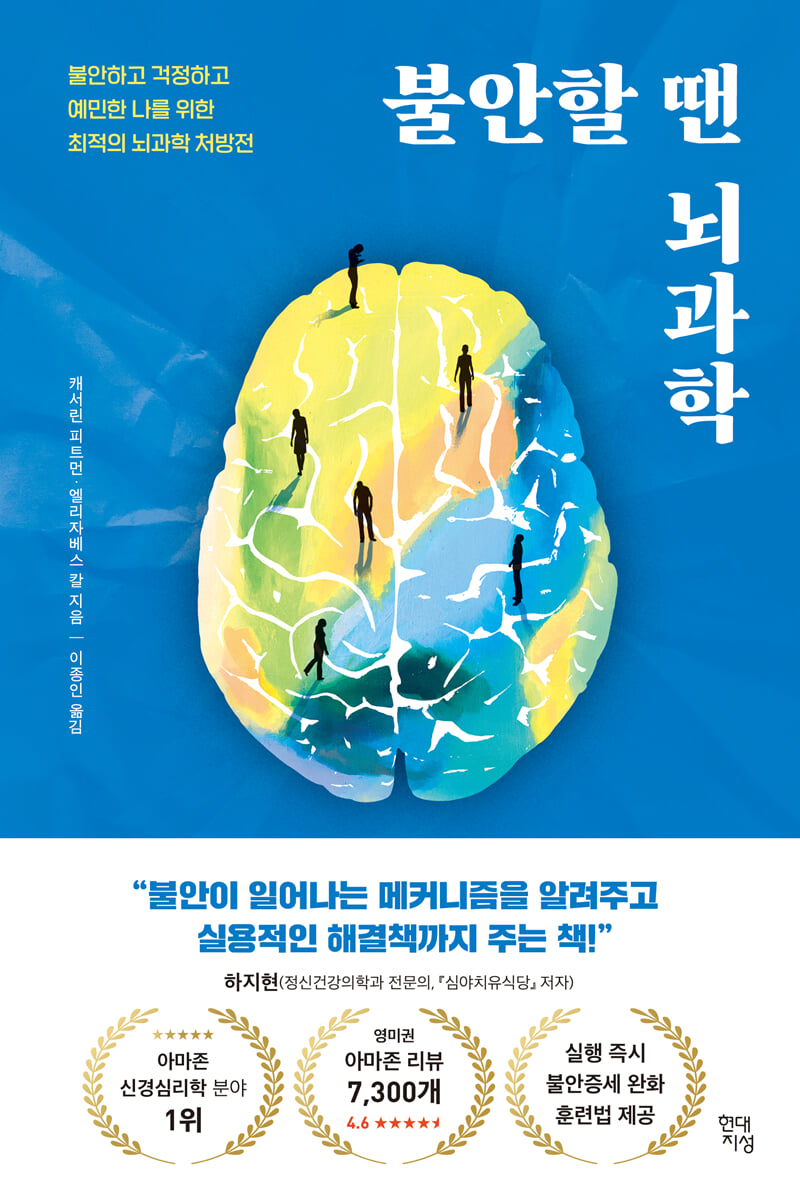
Brain Science When You're Anxious
 |
Description
Book Introduction
“Why can’t anxiety be resolved with just sound logic and persuasion?”
Based on 35 years of experience treating patients with anxiety disorders and brain injuries,
It even includes specific, proven solutions that relieve anxiety symptoms immediately after you start using it!
“Everyone feels anxious”, “Just think positive thoughts”, “You can overcome it with willpower.”
It's something that people who don't know much often say out of pity.
But anxiety is not a matter of 'will', but a matter of safety (felt through the brain).
In this book, the author teaches us how to see anxiety for what it is, and introduces proven knowledge-based methods for dealing with anxiety in real-life situations without panicking.
By reading this book, you will be able to clearly understand where, why, and how anxiety arises, and thus be able to manage it better.
You can immediately apply the theory explained in the preceding section through 80 relatable case studies, training methods that help you find application points in everyday life, and clinically proven anxiety relief methods.
Regardless of the degree, if you suffer from anxiety, an anxiety disorder, or panic attacks, this book will be of great help.
Based on 35 years of experience treating patients with anxiety disorders and brain injuries,
It even includes specific, proven solutions that relieve anxiety symptoms immediately after you start using it!
“Everyone feels anxious”, “Just think positive thoughts”, “You can overcome it with willpower.”
It's something that people who don't know much often say out of pity.
But anxiety is not a matter of 'will', but a matter of safety (felt through the brain).
In this book, the author teaches us how to see anxiety for what it is, and introduces proven knowledge-based methods for dealing with anxiety in real-life situations without panicking.
By reading this book, you will be able to clearly understand where, why, and how anxiety arises, and thus be able to manage it better.
You can immediately apply the theory explained in the preceding section through 80 relatable case studies, training methods that help you find application points in everyday life, and clinically proven anxiety relief methods.
Regardless of the degree, if you suffer from anxiety, an anxiety disorder, or panic attacks, this book will be of great help.
- You can preview some of the book's contents.
Preview
index
Recommendation
Introduction | There Are Two Pathways to Anxiety 5
Part 1 | The Minimum You Need to Know About the Anxious Brain
Chapter 1.
Why am I so anxious for no reason?
Chapter 2.
The amygdala leaves a deep mark on emotions.
Chapter 3.
How the Cortex Creates Anxiety
Chapter 4.
Identify the source of anxiety
Part 2: Amygdala-Based Anxiety Control
Chapter 5.
Stress response and panic
Chapter 6.
Relaxation techniques that suppress amygdala activation
Chapter 7.
Understanding Triggers
Chapter 8.
Create a bypass in your brain
Chapter 9.
Why Every Doctor and Brain Scientist Recommends Exercise and Sleep
Part 3 | Controlling Cortical-Based Anxiety
Chapter 10.
Anxiety-inducing thought patterns
Chapter 11.
How to calm the cortex
Outgoing Post | Anxiety-Free Life is Possible
Acknowledgements
Related materials
References
Translator's Note|The most surefire way to escape anxiety?
Introduction | There Are Two Pathways to Anxiety 5
Part 1 | The Minimum You Need to Know About the Anxious Brain
Chapter 1.
Why am I so anxious for no reason?
Chapter 2.
The amygdala leaves a deep mark on emotions.
Chapter 3.
How the Cortex Creates Anxiety
Chapter 4.
Identify the source of anxiety
Part 2: Amygdala-Based Anxiety Control
Chapter 5.
Stress response and panic
Chapter 6.
Relaxation techniques that suppress amygdala activation
Chapter 7.
Understanding Triggers
Chapter 8.
Create a bypass in your brain
Chapter 9.
Why Every Doctor and Brain Scientist Recommends Exercise and Sleep
Part 3 | Controlling Cortical-Based Anxiety
Chapter 10.
Anxiety-inducing thought patterns
Chapter 11.
How to calm the cortex
Outgoing Post | Anxiety-Free Life is Possible
Acknowledgements
Related materials
References
Translator's Note|The most surefire way to escape anxiety?
Detailed image

Into the book
These studies have uncovered a crucial finding: that anxiety is generated by two distinct pathways in the brain.
…
The cerebral cortex and the amygdala are the two pathways in the brain that create anxiety.
Some types of anxiety are more cortical, while others arise directly from the amygdala.
Until now, in psychotherapy for anxiety, the attention of both therapists and patients has usually focused on cortical pathways.
Accordingly, treatment methods that help people who experience anxiety 'change their thinking and respond logically to their anxiety' have become widely used.
But a growing body of research suggests that a deeper understanding of the amygdala's role is needed to gain a more complete picture of how anxiety is generated and how it can be controlled.
This book provides a comprehensive understanding of anxiety by detailing the two pathways—the cortex and the amygdala—and shows how to eliminate anxiety, regardless of its origins in the cortex or the amygdala.
…
The amygdala is a key area where anxiety responses are produced.
Although the cortex may cause or contribute to anxiety, the amygdala is always involved in situations or places that trigger an anxiety response.
Because of this, to thoroughly address anxiety, we need to understand both cortical and amygdala pathways.
--- p.20-22, from “Introduction”
To understand the amygdala's role in anxiety, we must first understand this fact.
For example, as you go about your day, your amygdala notices sounds, sights, and events, even if you're not very conscious of them.
The amygdala carefully scans any target for potential harm.
Once a potential danger is detected, a fear response is triggered, which is a kind of alarm signal for the body's protection, preparing the body for fight or flight.
--- p.34, Chapter 1.
Why am I so anxious for no reason?
When someone exhibits one of the three major responses—fight, flight, or freeze—the amygdala is in control, and the person in question is in the passenger seat.
Because of this, in emergency situations, it often feels like someone is watching you react unconsciously rather than consciously.
In those moments, there's clearly a reason why we don't feel in control of the situation or why we can't control our anxiety.
The amygdala is not only fast, but also has the neural ability to 'stop' other brain processes (LeDoux 1996).
--- p.48, Chapter 1.
Why am I so anxious for no reason?
If you want to change your instinctive response to an object (say, a rat) or a situation (say, a noisy crowd), your amygdala must first be able to experience the same object or situation in a new way.
Observing others also influences the amygdala, but learning is most effective when the anxious person interacts directly with an object or situation.
Anxious patients can argue logically with their amygdala for hours, but if the goal is to change amygdala-based anxiety, such tactics won't work; instead, a few minutes of hands-on experience is far more effective.
--- p.83-84, Chapter 2.
From "The amygdala leaves deep traces on emotions"
Confusing thoughts with reality is a very easy temptation, stemming from the cortex's confidence that it fully understands the true meaning of every thought, emotion, or bodily sensation.
In fact, the cortex is surprisingly prone to misunderstandings and mistakes.
You have thoughts that are wrong, unrealistic, or illogical, or you experience emotions that don't make sense.
You don't have to take every emotion or thought that comes into your head seriously.
Don't worry too much about those thoughts and emotions, don't analyze them deeply, just let them flow through your head.
Cognitive fusion will be discussed in detail in Chapter 11.
Knowing this information will help you assess whether you are prone to cognitive fusion and learn how to let go of such thoughts.
--- p.90, Chapter 3.
From “How the Cortex Creates Anxiety”
You should not listen to anyone who advises you that panic attacks and anxiety are just delusions (cortical thought processes) that are happening in your head and that you can overcome them.
Panic attacks are caused by an overreaction of the amygdala.
This is a stark biological reality, and you cannot escape a panic attack by utilizing cortical thinking.
When your central nervous system begins to trigger a panic attack, you should actively employ several of the coping strategies discussed in this chapter.
--- p.140, Chapter 5.
From “Stress Response and Panic”
To redesign a circuit, the amygdala must have a specific experience.
During exposure therapy, you are asked to experience certain sights, sounds, and stimuli that cause anxiety.
This will activate the precise neural circuits that contain the emotional memory you want to modify.
This circuit activation forms new connections between different neurons.
Such connections then modify the amygdala's response.
So, we create this new network
To do this, neurons must be activated.
To conquer something, you must first experience the fear or anxiety it causes.
The old saying, "You have to get back on the horse that threw you down," is a lesson cowboys emphasize when taming wild horses, and it applies equally to anxiety treatment.
--- p.189, Chapter 8.
From "Create a Bypass in the Brain"
Remember that there are countless other channels broadcasting on the Life Broadcasting Station besides that channel.
You just have to decide to turn that channel.
If you focus on the anxiety channel, you may miss out on some of the best experiences of your life.
As with all things, the beginning is half the work.
In stressful situations, focusing for just one minute at a time can be very helpful.
Sometimes enduring a certain moment may be all we can handle.
Focusing on just one situation at a time is a very reasonable approach.
Fortunately, life is given to us one minute at a time, or rather one second at a time.
The past is gone and the future has not yet arrived.
All we can know for sure is one second, one minute of this moment.
What we really need is to get through each minute safely.
It is to do.
Especially when you face anxiety head on.
Sometimes, for an anxious person, just holding out for a few minutes can be a feeling of accomplishment.
Life becomes much easier to handle if you focus on it one minute at a time.
…
The cerebral cortex and the amygdala are the two pathways in the brain that create anxiety.
Some types of anxiety are more cortical, while others arise directly from the amygdala.
Until now, in psychotherapy for anxiety, the attention of both therapists and patients has usually focused on cortical pathways.
Accordingly, treatment methods that help people who experience anxiety 'change their thinking and respond logically to their anxiety' have become widely used.
But a growing body of research suggests that a deeper understanding of the amygdala's role is needed to gain a more complete picture of how anxiety is generated and how it can be controlled.
This book provides a comprehensive understanding of anxiety by detailing the two pathways—the cortex and the amygdala—and shows how to eliminate anxiety, regardless of its origins in the cortex or the amygdala.
…
The amygdala is a key area where anxiety responses are produced.
Although the cortex may cause or contribute to anxiety, the amygdala is always involved in situations or places that trigger an anxiety response.
Because of this, to thoroughly address anxiety, we need to understand both cortical and amygdala pathways.
--- p.20-22, from “Introduction”
To understand the amygdala's role in anxiety, we must first understand this fact.
For example, as you go about your day, your amygdala notices sounds, sights, and events, even if you're not very conscious of them.
The amygdala carefully scans any target for potential harm.
Once a potential danger is detected, a fear response is triggered, which is a kind of alarm signal for the body's protection, preparing the body for fight or flight.
--- p.34, Chapter 1.
Why am I so anxious for no reason?
When someone exhibits one of the three major responses—fight, flight, or freeze—the amygdala is in control, and the person in question is in the passenger seat.
Because of this, in emergency situations, it often feels like someone is watching you react unconsciously rather than consciously.
In those moments, there's clearly a reason why we don't feel in control of the situation or why we can't control our anxiety.
The amygdala is not only fast, but also has the neural ability to 'stop' other brain processes (LeDoux 1996).
--- p.48, Chapter 1.
Why am I so anxious for no reason?
If you want to change your instinctive response to an object (say, a rat) or a situation (say, a noisy crowd), your amygdala must first be able to experience the same object or situation in a new way.
Observing others also influences the amygdala, but learning is most effective when the anxious person interacts directly with an object or situation.
Anxious patients can argue logically with their amygdala for hours, but if the goal is to change amygdala-based anxiety, such tactics won't work; instead, a few minutes of hands-on experience is far more effective.
--- p.83-84, Chapter 2.
From "The amygdala leaves deep traces on emotions"
Confusing thoughts with reality is a very easy temptation, stemming from the cortex's confidence that it fully understands the true meaning of every thought, emotion, or bodily sensation.
In fact, the cortex is surprisingly prone to misunderstandings and mistakes.
You have thoughts that are wrong, unrealistic, or illogical, or you experience emotions that don't make sense.
You don't have to take every emotion or thought that comes into your head seriously.
Don't worry too much about those thoughts and emotions, don't analyze them deeply, just let them flow through your head.
Cognitive fusion will be discussed in detail in Chapter 11.
Knowing this information will help you assess whether you are prone to cognitive fusion and learn how to let go of such thoughts.
--- p.90, Chapter 3.
From “How the Cortex Creates Anxiety”
You should not listen to anyone who advises you that panic attacks and anxiety are just delusions (cortical thought processes) that are happening in your head and that you can overcome them.
Panic attacks are caused by an overreaction of the amygdala.
This is a stark biological reality, and you cannot escape a panic attack by utilizing cortical thinking.
When your central nervous system begins to trigger a panic attack, you should actively employ several of the coping strategies discussed in this chapter.
--- p.140, Chapter 5.
From “Stress Response and Panic”
To redesign a circuit, the amygdala must have a specific experience.
During exposure therapy, you are asked to experience certain sights, sounds, and stimuli that cause anxiety.
This will activate the precise neural circuits that contain the emotional memory you want to modify.
This circuit activation forms new connections between different neurons.
Such connections then modify the amygdala's response.
So, we create this new network
To do this, neurons must be activated.
To conquer something, you must first experience the fear or anxiety it causes.
The old saying, "You have to get back on the horse that threw you down," is a lesson cowboys emphasize when taming wild horses, and it applies equally to anxiety treatment.
--- p.189, Chapter 8.
From "Create a Bypass in the Brain"
Remember that there are countless other channels broadcasting on the Life Broadcasting Station besides that channel.
You just have to decide to turn that channel.
If you focus on the anxiety channel, you may miss out on some of the best experiences of your life.
As with all things, the beginning is half the work.
In stressful situations, focusing for just one minute at a time can be very helpful.
Sometimes enduring a certain moment may be all we can handle.
Focusing on just one situation at a time is a very reasonable approach.
Fortunately, life is given to us one minute at a time, or rather one second at a time.
The past is gone and the future has not yet arrived.
All we can know for sure is one second, one minute of this moment.
What we really need is to get through each minute safely.
It is to do.
Especially when you face anxiety head on.
Sometimes, for an anxious person, just holding out for a few minutes can be a feeling of accomplishment.
Life becomes much easier to handle if you focus on it one minute at a time.
--- p.282-283, from "Outgoing Writings"
Publisher's Review
★★★7,300 Amazon reviews, #1 in Neuropsychology
★ Practical knowledge based on 35 years of experience treating anxiety disorders
★ Providing vivid insights through the co-author's experience with anxiety disorder.
★ Easy understanding and application through 80 real-life examples
★ From mild worries and concerns to anxiety, obsessive and compulsive symptoms, panic disorder,
Even post-traumatic stress disorder (PTSD)…
A comprehensive mobilization of knowledge and techniques proven effective in clinical practice.
“It tells you the mechanism by which anxiety occurs.
“A book that even provides practical solutions!”
Ha Ji-hyeon, psychiatrist, author of "Worries are Worries"
There are two channels to anxiety!
Everyone else is fine, but there are situations or places where I feel particularly anxious.
Even though I have no reason to feel anxious in my head, I feel uneasy, sweaty, and unable to focus on my work.
There are people who make you feel anxious and uncomfortable for no reason when you are with them, even though they have done nothing wrong.
For example, people who are afraid of taking elevators or hate flying, people whose mind goes blank when they think of speaking in front of people for more than 5 minutes, people who wash their hands dozens of times a day because they think they are dirty, etc.
Post-traumatic stress disorder (PTSD), which causes pain along with an unwanted, intense physical reaction when a specific trigger is encountered, even though there are usually no problems, is also classified as an anxiety disorder.
In particular, statistics were released showing that the number of patients receiving treatment for depression and anxiety disorders due to the aftermath of the COVID-19 pandemic, which has lasted for more than three years, is approaching 9 million, and compared to before COVID-19, the number of patients in their 20s increased by 42.3%, those under 10 increased by 33.5%, and those in their 30s increased by 24.9% (as of October 2022).
I'm not just talking about a vague sense of anxiety.
With the number of people diagnosed with anxiety disorder or anxiety disorder at that level, adding personal anxiety and unexplained depression, it can truly be said that we are living in an 'age of anxiety.'
At first, in order to 'overcome' such anxiety, I tried to change my mood by listening to music, watching movies, traveling, and eating delicious food.
I'm trying to understand anxiety in my own way by reading various books and attending lectures.
But no matter how hard you try, you can only explain about 50% at best.
Because there are two very different ways anxiety starts.
Anxiety originates in two very different areas of the brain: the cortex and the amygdala.
We experience anxiety through two pathways: the cortex and the amygdala.
The cerebral cortex creates anxiety with various thoughts and images in the head, and the amygdala is an organization that 'automatically' reacts to danger and intervenes to protect our body from any danger.
This book is a practical guide that explains the differences between the two pathways, shows how anxiety is generated in each pathway, and provides practical ways to modify the 'neural circuits' in each pathway to help readers eliminate anxiety from their lives as much as possible.
In particular, the book is filled with a feast of clear and easy-to-understand knowledge, presented by a clinical expert who has focused solely on psychological and brain issues related to anxiety disorders for 35 years, along with 80 real-life cases, so you can apply some of the concepts that apply to you more deeply.
Solid explanations, simple training methods, and effective solutions.
· Solid explanation: This book provides both a theoretical framework for understanding the problem and a practical guide for patients to help themselves.
The two main pathways that trigger or increase anxiety are the cortex and the amygdala.
One pathway begins in the cerebral cortex, the large, sinuous gray area of the brain that determines how we perceive and think about many situations in our daily lives.
Another pathway travels through the amygdalas, two almond-shaped structures located on each side of the brain.
The amygdala is a very old brain tissue that has been passed down through generations without any changes since the appearance of vertebrates on Earth, and it triggers the fight-or-flight response in vertebrates.
The two paths are described separately because the effective level of intervention and training direction will vary depending on each case, but the two are always connected.
Once you understand how each pathway creates or reinforces anxiety, you can then use that knowledge to develop specific plans to combat, prevent, and control anxiety.
· Simple Training Methods: This book goes beyond simply introducing well-organized theories and provides “Anxiety Symptom Relief Training Methods” that enable you to understand and reduce almost any anxiety-related situation through 37 practical training exercises (and accurate self-diagnosis).
For example, as you read the book, it provides practical and simple training methods for areas that you are naturally curious about or need practice, such as “Identifying left-brain (right-brain)-based anxiety,” “Identifying anxiety experiences with unknown causes,” “Enjoying the progressive muscle relaxation process,” and “Image-based relaxation practice,” helping you fully understand.
· Effective solution: Until now, in psychotherapy for anxiety, the attention of therapists and patients has usually focused on cortical pathways.
Accordingly, treatment methods that help people who experience anxiety 'change their thinking and respond logically to their anxiety' have become widely used.
But a growing body of research suggests that a deeper understanding of the role of the amygdala is needed to gain a more complete picture of how anxiety is generated and how it can be controlled.
The amygdala is a key area where anxiety responses are produced.
Although the cortex may cause or contribute to anxiety, the amygdala is always involved in situations or places that trigger an anxiety response.
Because of this, to thoroughly address anxiety, we need to understand both cortical and amygdala pathways.
Until recently, anxiety treatment has not given much consideration to the amygdala pathway.
Therefore, this book focuses on how the amygdala creates and generates anxiety in response to various experiences and creates memories.
In particular, simply identifying the concept of “modifying the amygdala circuit” and a few effective solutions would vastly expand our neuroscientific knowledge of anxiety.
In an era where 9 million people suffer from anxiety disorders,
A book I'd like to gift to myself, who lives with anxiety.
There are times when you can understand a person's behavior intellectually, but feel uncomfortable and annoyed when you are with them.
Even though I was perfectly prepared, there are times when I get overwhelmed with tension and anxiety.
In these cases, most likely the amygdala, not the cortex, is working.
The discomfort you feel without realizing it when someone suddenly invades your personal space or sticks their face in comes from this amygdala.
On the other hand, if you meet someone who resembles your grandmother and feel a warm affection for that strange lady, this too is the amygdala at work.
In short, if the cortex is the area of understanding, the amygdala is the area of emotion and instinct.
right.
There was a reason to be anxious "for no reason"! When you notice signs of anxiety, instead of panicking like you used to, you can think, "The amygdala is activating. This is an opportunity to 'rewire' my brain and create a bypass for anxiety."
You can also learn the secret of slowly 'exposing' yourself to anxiety-provoking situations until the anxiety almost completely disappears.
This book contains practical knowledge that applies to everything from mild anxiety that anyone can feel ("I'm about to have a test and I'm not prepared") to those with urgent anxiety disorders and panic attacks that require treatment. Its theoretical explanations and application methods are clear.
You can understand what is happening in your body, why it is happening, and how to deal with it.
Practice meditation and muscle relaxation, and pinpoint which thoughts are causing your depression.
“I wish I could go back 14 years and give this book to my 20-year-old self.” “As someone who has suffered from anxiety and tried many things to relieve it, this is the first book I’ve read that explains it at a neurological level.
You'll find that Amazon reader reviews like these are no exaggeration: "I felt completely liberated, having gained a much deeper understanding of this topic," "This book gave me a whole new perspective on human suffering," and "The scientific evidence is unlike anything I've read before."
★ Practical knowledge based on 35 years of experience treating anxiety disorders
★ Providing vivid insights through the co-author's experience with anxiety disorder.
★ Easy understanding and application through 80 real-life examples
★ From mild worries and concerns to anxiety, obsessive and compulsive symptoms, panic disorder,
Even post-traumatic stress disorder (PTSD)…
A comprehensive mobilization of knowledge and techniques proven effective in clinical practice.
“It tells you the mechanism by which anxiety occurs.
“A book that even provides practical solutions!”
Ha Ji-hyeon, psychiatrist, author of "Worries are Worries"
There are two channels to anxiety!
Everyone else is fine, but there are situations or places where I feel particularly anxious.
Even though I have no reason to feel anxious in my head, I feel uneasy, sweaty, and unable to focus on my work.
There are people who make you feel anxious and uncomfortable for no reason when you are with them, even though they have done nothing wrong.
For example, people who are afraid of taking elevators or hate flying, people whose mind goes blank when they think of speaking in front of people for more than 5 minutes, people who wash their hands dozens of times a day because they think they are dirty, etc.
Post-traumatic stress disorder (PTSD), which causes pain along with an unwanted, intense physical reaction when a specific trigger is encountered, even though there are usually no problems, is also classified as an anxiety disorder.
In particular, statistics were released showing that the number of patients receiving treatment for depression and anxiety disorders due to the aftermath of the COVID-19 pandemic, which has lasted for more than three years, is approaching 9 million, and compared to before COVID-19, the number of patients in their 20s increased by 42.3%, those under 10 increased by 33.5%, and those in their 30s increased by 24.9% (as of October 2022).
I'm not just talking about a vague sense of anxiety.
With the number of people diagnosed with anxiety disorder or anxiety disorder at that level, adding personal anxiety and unexplained depression, it can truly be said that we are living in an 'age of anxiety.'
At first, in order to 'overcome' such anxiety, I tried to change my mood by listening to music, watching movies, traveling, and eating delicious food.
I'm trying to understand anxiety in my own way by reading various books and attending lectures.
But no matter how hard you try, you can only explain about 50% at best.
Because there are two very different ways anxiety starts.
Anxiety originates in two very different areas of the brain: the cortex and the amygdala.
We experience anxiety through two pathways: the cortex and the amygdala.
The cerebral cortex creates anxiety with various thoughts and images in the head, and the amygdala is an organization that 'automatically' reacts to danger and intervenes to protect our body from any danger.
This book is a practical guide that explains the differences between the two pathways, shows how anxiety is generated in each pathway, and provides practical ways to modify the 'neural circuits' in each pathway to help readers eliminate anxiety from their lives as much as possible.
In particular, the book is filled with a feast of clear and easy-to-understand knowledge, presented by a clinical expert who has focused solely on psychological and brain issues related to anxiety disorders for 35 years, along with 80 real-life cases, so you can apply some of the concepts that apply to you more deeply.
Solid explanations, simple training methods, and effective solutions.
· Solid explanation: This book provides both a theoretical framework for understanding the problem and a practical guide for patients to help themselves.
The two main pathways that trigger or increase anxiety are the cortex and the amygdala.
One pathway begins in the cerebral cortex, the large, sinuous gray area of the brain that determines how we perceive and think about many situations in our daily lives.
Another pathway travels through the amygdalas, two almond-shaped structures located on each side of the brain.
The amygdala is a very old brain tissue that has been passed down through generations without any changes since the appearance of vertebrates on Earth, and it triggers the fight-or-flight response in vertebrates.
The two paths are described separately because the effective level of intervention and training direction will vary depending on each case, but the two are always connected.
Once you understand how each pathway creates or reinforces anxiety, you can then use that knowledge to develop specific plans to combat, prevent, and control anxiety.
· Simple Training Methods: This book goes beyond simply introducing well-organized theories and provides “Anxiety Symptom Relief Training Methods” that enable you to understand and reduce almost any anxiety-related situation through 37 practical training exercises (and accurate self-diagnosis).
For example, as you read the book, it provides practical and simple training methods for areas that you are naturally curious about or need practice, such as “Identifying left-brain (right-brain)-based anxiety,” “Identifying anxiety experiences with unknown causes,” “Enjoying the progressive muscle relaxation process,” and “Image-based relaxation practice,” helping you fully understand.
· Effective solution: Until now, in psychotherapy for anxiety, the attention of therapists and patients has usually focused on cortical pathways.
Accordingly, treatment methods that help people who experience anxiety 'change their thinking and respond logically to their anxiety' have become widely used.
But a growing body of research suggests that a deeper understanding of the role of the amygdala is needed to gain a more complete picture of how anxiety is generated and how it can be controlled.
The amygdala is a key area where anxiety responses are produced.
Although the cortex may cause or contribute to anxiety, the amygdala is always involved in situations or places that trigger an anxiety response.
Because of this, to thoroughly address anxiety, we need to understand both cortical and amygdala pathways.
Until recently, anxiety treatment has not given much consideration to the amygdala pathway.
Therefore, this book focuses on how the amygdala creates and generates anxiety in response to various experiences and creates memories.
In particular, simply identifying the concept of “modifying the amygdala circuit” and a few effective solutions would vastly expand our neuroscientific knowledge of anxiety.
In an era where 9 million people suffer from anxiety disorders,
A book I'd like to gift to myself, who lives with anxiety.
There are times when you can understand a person's behavior intellectually, but feel uncomfortable and annoyed when you are with them.
Even though I was perfectly prepared, there are times when I get overwhelmed with tension and anxiety.
In these cases, most likely the amygdala, not the cortex, is working.
The discomfort you feel without realizing it when someone suddenly invades your personal space or sticks their face in comes from this amygdala.
On the other hand, if you meet someone who resembles your grandmother and feel a warm affection for that strange lady, this too is the amygdala at work.
In short, if the cortex is the area of understanding, the amygdala is the area of emotion and instinct.
right.
There was a reason to be anxious "for no reason"! When you notice signs of anxiety, instead of panicking like you used to, you can think, "The amygdala is activating. This is an opportunity to 'rewire' my brain and create a bypass for anxiety."
You can also learn the secret of slowly 'exposing' yourself to anxiety-provoking situations until the anxiety almost completely disappears.
This book contains practical knowledge that applies to everything from mild anxiety that anyone can feel ("I'm about to have a test and I'm not prepared") to those with urgent anxiety disorders and panic attacks that require treatment. Its theoretical explanations and application methods are clear.
You can understand what is happening in your body, why it is happening, and how to deal with it.
Practice meditation and muscle relaxation, and pinpoint which thoughts are causing your depression.
“I wish I could go back 14 years and give this book to my 20-year-old self.” “As someone who has suffered from anxiety and tried many things to relieve it, this is the first book I’ve read that explains it at a neurological level.
You'll find that Amazon reader reviews like these are no exaggeration: "I felt completely liberated, having gained a much deeper understanding of this topic," "This book gave me a whole new perspective on human suffering," and "The scientific evidence is unlike anything I've read before."
GOODS SPECIFICS
- Date of issue: September 1, 2023
- Page count, weight, size: 304 pages | 464g | 150*225*18mm
- ISBN13: 9791139715989
- ISBN10: 1139715984
You may also like
카테고리
korean


korean

![GQ KOREA Mark (Monthly): December [2025]](http://librairie.coreenne.fr/cdn/shop/files/8ef265dbbfbf186523ed75ba7319009d.jpg?v=1765340328&width=3840)


