

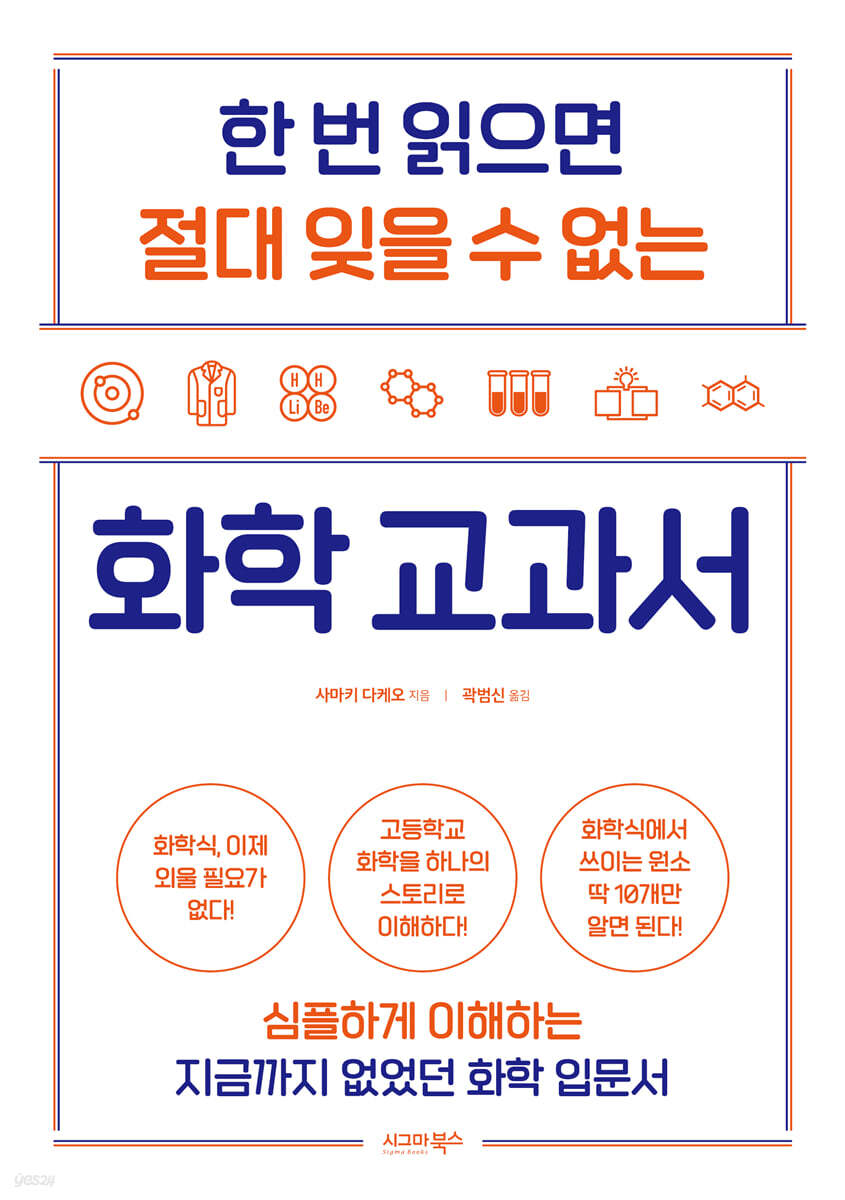
A chemistry textbook you'll never forget once you read it.
 |
Description
Book Introduction
Why on earth do we find chemistry difficult?
Is it that you don't understand properly?
The science you learn in school becomes difficult after the beginning.
It's the same whether it's water, food, or land.
Then, as you advance in grade level, there comes a time when you have to choose among science subjects.
They say that if you are good at memorizing, choose biology, and if you are good at abstract concepts or complex calculations, choose physics.
Although it varies slightly every year, it is said that among the science subjects that Korean students choose for the CSAT, the most common is Earth Science, and the least is Physics.
So what about chemistry? It's a subject that falls somewhere in between.
Although not as much as physics, there is a lot of abstract content and quite a few calculation problems.
In addition, there is a certain amount of content that must be memorized, such as biology or earth science.
However, this book, "A Chemistry Textbook You'll Never Forget Once You Read It," explains chemistry without requiring difficult calculations and memorization.
This book is for those who want to become familiar with chemistry even though it is difficult, and those who need to study chemistry right away but have no idea what it is talking about.
Because chemistry is ultimately a story about atoms, it explains them in detail and in writing so that you can imagine atoms that cannot be seen with your eyes.
Is it that you don't understand properly?
The science you learn in school becomes difficult after the beginning.
It's the same whether it's water, food, or land.
Then, as you advance in grade level, there comes a time when you have to choose among science subjects.
They say that if you are good at memorizing, choose biology, and if you are good at abstract concepts or complex calculations, choose physics.
Although it varies slightly every year, it is said that among the science subjects that Korean students choose for the CSAT, the most common is Earth Science, and the least is Physics.
So what about chemistry? It's a subject that falls somewhere in between.
Although not as much as physics, there is a lot of abstract content and quite a few calculation problems.
In addition, there is a certain amount of content that must be memorized, such as biology or earth science.
However, this book, "A Chemistry Textbook You'll Never Forget Once You Read It," explains chemistry without requiring difficult calculations and memorization.
This book is for those who want to become familiar with chemistry even though it is difficult, and those who need to study chemistry right away but have no idea what it is talking about.
Because chemistry is ultimately a story about atoms, it explains them in detail and in writing so that you can imagine atoms that cannot be seen with your eyes.
- You can preview some of the book's contents.
Preview
index
To begin with, chemistry is a story about atoms!
[Homeroom ①] Why do so many people find chemistry difficult?
[Homeroom ②] The Basics of Chemistry: Chemistry is about atoms!
[Homeroom ③] A Guide to Chemistry: The Periodic Table
[homeroom ④] The arrangement of elements on the periodic table is all meaningful!
[homeroom ⑤] Only 10 element symbols appear in chemical formulas and chemical reaction equations.
What is a prototypical atom?
[Objects and Matter] What is a substitute material?
[Properties of atoms ①] All matter is made of atoms.
[Properties of atoms ②] Even if an atom undergoes repeated chemical changes, it does not change.
Chapter 1: Reconstruction of the Atom
Chapter 1 Summary
[Pure Substances and Mixtures] Separating a mixture yields a pure substance.
[Elemental and Compound Substances] The element name changes depending on whether it is a simple element or a compound.
[State of Matter (3 States)] Solid, liquid, and gas have different molecular connection states.
[Changes in state and melting point/boiling point] Water changes from solid to liquid to gas, but the substance itself does not change.
[Chemical change] A chemical change in which an original substance is transformed into a new substance.
[Law of Conservation of Mass] The law of conservation of mass applies to both physical and chemical changes.
[Chemical Reaction] There are two types of chemical reactions: exothermic and endothermic.
[Chemical formula] First, just the element symbols and chemical formulas!
[Coefficient] 5H2O means 'there are 5 H2O'
[Chemical Reaction Formula ①] Representing the combustion of carbon as a chemical reaction formula
[Chemical Reaction Formula ②] Representing the combustion of methane as a chemical reaction formula
[Chemical Reaction Formula ③] Representing the oxidation and combustion of metals as a chemical reaction formula
Chapter 2: The History of Chemistry Before the Periodic Table Was Created
Chapter 2 Summary
[The Beginning of Chemistry] Everything Started with Fire
[Atomism] Ancient Greek Atomism and the Four Elements
Alchemy, which flourished for 2,000 years, was the cornerstone of chemistry.
[Gas] The identity of the gas similar to air was gas.
[Chemical Revolution] The correct theory of combustion is established, and the chemical revolution begins.
[Fixed Air] Carbon dioxide, nitrogen, oxygen, and hydrogen are discovered in sequence.
[Atomic Weight] Dalton's Atomic Theory Following Lavoisier's Chemical Revolution
[The Birth of the Periodic Table] Elements were organized into the periodic table, creating a map of the physical world.
Chapter 3: A Guide to Chemistry: The Periodic Table
Chapter 3 Summary
[Structure of the atomic nucleus] Elements are distinguished by the number of protons in the nucleus.
[Electron Configuration] Atoms tend to approach the electron configuration of noble gases.
[Ionic compound] An ionic compound in which cations and anions are electrically balanced
[Covalent bond] Non-metal elements form molecules through covalent bonds.
[Metallic bond] Metallic bond between metal elements
[The Three Major Substances] The world's substances are largely divided into three types.
[Hydrogen Bond] Water is familiar to us, but has very unique properties.
Chapter 4: The World of Inorganic Materials
Chapter 4 Summary
[Hydrogen] H: The smallest atom and molecule, found on Earth in the form of water.
[Carbon] C: A major component of living organisms, forming the world of organic compounds.
[Nitrogen] N: Nitrogen, which makes up about 78% of the air
[Oxygen] O: Oxygen, which combines with various elements to form oxides.
[Goat] Cl: Humanity's first poison gas weapon, chlorine
[Sulfur] S: When burned, it produces toxic sulfur dioxide gas.
Sodium (Na): A soft metal that can be easily cut with a cutter knife.
[Magnesium] Mg: A metal that burns with a dazzling light and turns into magnesium oxide.
[Calcium] Ca: One of the main components of living organisms that forms bones, teeth, shells, etc.
[Aluminum] Al: Aluminum is a leading light metal.
[Iron] Fe: Even now, we are in the age of iron civilization.
[Copper] Cu: The third most used metal after iron and aluminum.
[Zinc] Zn: Zinc used as a cathode in batteries or batteries.
Chapter 5 Density is calculated in terms of quantities such as moles.
Chapter 5 Summary
[Density] Another meaning of heavy/light is mass per unit volume.
[Atomic mass unit] When learning about atomic weight, the atomic mass unit u is attached to the mass of one hydrogen atom.
[Mol] A mole is a unit of quantity that connects the microscopic and macroscopic worlds.
[Percentage Concentration] How to express the concentration of a solution: Percentage Concentration and ppm, ppb
[Molar concentration] In addition to percent concentration, it can also be expressed in terms of molar concentration.
[Avogadro's Law] The volume of 1 mole of a gas is the same regardless of the type of substance.
[Boyle-Charles' Law] Boyle-Charles' Law allows us to understand the molecular motion and absolute temperature of gases!
[Ideal Gases and Real Gases] Distinguishing Between Ideal Gases and Real Gases
Chapter 6 Acids, Bases, and Redox
Chapter 6 Summary
[Acids and Bases] Most of what we learn in high school chemistry classes is Arrhenius' definition of acids and bases.
[Hydrogen ion H+] Hydrogen ion H+ does not exist in water.
[pH (hydrogen ion concentration index)] If the temperature is constant, the ionic product of water is constant.
[Neutralization] Salt and water are produced through the neutralization of acids and bases.
[Neutralization titration] The relationship that is established when an acid and a base are completely neutralized
[Oxidation-Reduction] Redox Considered Without Oxygen
[Oxidation number] Depending on the oxidation number, you can determine whether the reaction is oxidation or reduction.
[Battery] Let's learn about batteries through the structure of the Daniel battery.
[Electrolysis] When electrolyzing water, a sodium hydroxide solution is used.
[Molten Salt Electrolysis] Metals with a strong tendency to ionize can be obtained through molten salt electrolysis.
Chapter 7: The World of Organic Matter
Chapter 7 Summary
[Artificial Organics] Success in Creating Organics from Inorganic Materials
[Activation Energy] Why was it difficult to artificially create organic matter?
[Electronegativity] Properties of elements revealed by electronegativity values
[Atomic Bonding] Carbon atoms that form the skeleton of organic matter with four bonding hands
[Substitution reaction/addition reaction] Ethylene is the simplest substance among chain-like unsaturated hydrocarbons.
[Benzene's structural formula] Kekulé, who discovered the mysterious benzene structural formula.
[Functional group] You can find out the general properties through the functional group.
[Condensation Reaction/Dehydration Condensation Reaction] Let's compare the properties of methanol and ethanol with those of water.
[Alcohol Oxidation] Both drunkenness and hangovers are caused by ethanol.
[Addition Polymerization] Understanding Polymer Compounds, From Addition Polymerization from Ethylene to Polyethylene
In conclusion
[Homeroom ①] Why do so many people find chemistry difficult?
[Homeroom ②] The Basics of Chemistry: Chemistry is about atoms!
[Homeroom ③] A Guide to Chemistry: The Periodic Table
[homeroom ④] The arrangement of elements on the periodic table is all meaningful!
[homeroom ⑤] Only 10 element symbols appear in chemical formulas and chemical reaction equations.
What is a prototypical atom?
[Objects and Matter] What is a substitute material?
[Properties of atoms ①] All matter is made of atoms.
[Properties of atoms ②] Even if an atom undergoes repeated chemical changes, it does not change.
Chapter 1: Reconstruction of the Atom
Chapter 1 Summary
[Pure Substances and Mixtures] Separating a mixture yields a pure substance.
[Elemental and Compound Substances] The element name changes depending on whether it is a simple element or a compound.
[State of Matter (3 States)] Solid, liquid, and gas have different molecular connection states.
[Changes in state and melting point/boiling point] Water changes from solid to liquid to gas, but the substance itself does not change.
[Chemical change] A chemical change in which an original substance is transformed into a new substance.
[Law of Conservation of Mass] The law of conservation of mass applies to both physical and chemical changes.
[Chemical Reaction] There are two types of chemical reactions: exothermic and endothermic.
[Chemical formula] First, just the element symbols and chemical formulas!
[Coefficient] 5H2O means 'there are 5 H2O'
[Chemical Reaction Formula ①] Representing the combustion of carbon as a chemical reaction formula
[Chemical Reaction Formula ②] Representing the combustion of methane as a chemical reaction formula
[Chemical Reaction Formula ③] Representing the oxidation and combustion of metals as a chemical reaction formula
Chapter 2: The History of Chemistry Before the Periodic Table Was Created
Chapter 2 Summary
[The Beginning of Chemistry] Everything Started with Fire
[Atomism] Ancient Greek Atomism and the Four Elements
Alchemy, which flourished for 2,000 years, was the cornerstone of chemistry.
[Gas] The identity of the gas similar to air was gas.
[Chemical Revolution] The correct theory of combustion is established, and the chemical revolution begins.
[Fixed Air] Carbon dioxide, nitrogen, oxygen, and hydrogen are discovered in sequence.
[Atomic Weight] Dalton's Atomic Theory Following Lavoisier's Chemical Revolution
[The Birth of the Periodic Table] Elements were organized into the periodic table, creating a map of the physical world.
Chapter 3: A Guide to Chemistry: The Periodic Table
Chapter 3 Summary
[Structure of the atomic nucleus] Elements are distinguished by the number of protons in the nucleus.
[Electron Configuration] Atoms tend to approach the electron configuration of noble gases.
[Ionic compound] An ionic compound in which cations and anions are electrically balanced
[Covalent bond] Non-metal elements form molecules through covalent bonds.
[Metallic bond] Metallic bond between metal elements
[The Three Major Substances] The world's substances are largely divided into three types.
[Hydrogen Bond] Water is familiar to us, but has very unique properties.
Chapter 4: The World of Inorganic Materials
Chapter 4 Summary
[Hydrogen] H: The smallest atom and molecule, found on Earth in the form of water.
[Carbon] C: A major component of living organisms, forming the world of organic compounds.
[Nitrogen] N: Nitrogen, which makes up about 78% of the air
[Oxygen] O: Oxygen, which combines with various elements to form oxides.
[Goat] Cl: Humanity's first poison gas weapon, chlorine
[Sulfur] S: When burned, it produces toxic sulfur dioxide gas.
Sodium (Na): A soft metal that can be easily cut with a cutter knife.
[Magnesium] Mg: A metal that burns with a dazzling light and turns into magnesium oxide.
[Calcium] Ca: One of the main components of living organisms that forms bones, teeth, shells, etc.
[Aluminum] Al: Aluminum is a leading light metal.
[Iron] Fe: Even now, we are in the age of iron civilization.
[Copper] Cu: The third most used metal after iron and aluminum.
[Zinc] Zn: Zinc used as a cathode in batteries or batteries.
Chapter 5 Density is calculated in terms of quantities such as moles.
Chapter 5 Summary
[Density] Another meaning of heavy/light is mass per unit volume.
[Atomic mass unit] When learning about atomic weight, the atomic mass unit u is attached to the mass of one hydrogen atom.
[Mol] A mole is a unit of quantity that connects the microscopic and macroscopic worlds.
[Percentage Concentration] How to express the concentration of a solution: Percentage Concentration and ppm, ppb
[Molar concentration] In addition to percent concentration, it can also be expressed in terms of molar concentration.
[Avogadro's Law] The volume of 1 mole of a gas is the same regardless of the type of substance.
[Boyle-Charles' Law] Boyle-Charles' Law allows us to understand the molecular motion and absolute temperature of gases!
[Ideal Gases and Real Gases] Distinguishing Between Ideal Gases and Real Gases
Chapter 6 Acids, Bases, and Redox
Chapter 6 Summary
[Acids and Bases] Most of what we learn in high school chemistry classes is Arrhenius' definition of acids and bases.
[Hydrogen ion H+] Hydrogen ion H+ does not exist in water.
[pH (hydrogen ion concentration index)] If the temperature is constant, the ionic product of water is constant.
[Neutralization] Salt and water are produced through the neutralization of acids and bases.
[Neutralization titration] The relationship that is established when an acid and a base are completely neutralized
[Oxidation-Reduction] Redox Considered Without Oxygen
[Oxidation number] Depending on the oxidation number, you can determine whether the reaction is oxidation or reduction.
[Battery] Let's learn about batteries through the structure of the Daniel battery.
[Electrolysis] When electrolyzing water, a sodium hydroxide solution is used.
[Molten Salt Electrolysis] Metals with a strong tendency to ionize can be obtained through molten salt electrolysis.
Chapter 7: The World of Organic Matter
Chapter 7 Summary
[Artificial Organics] Success in Creating Organics from Inorganic Materials
[Activation Energy] Why was it difficult to artificially create organic matter?
[Electronegativity] Properties of elements revealed by electronegativity values
[Atomic Bonding] Carbon atoms that form the skeleton of organic matter with four bonding hands
[Substitution reaction/addition reaction] Ethylene is the simplest substance among chain-like unsaturated hydrocarbons.
[Benzene's structural formula] Kekulé, who discovered the mysterious benzene structural formula.
[Functional group] You can find out the general properties through the functional group.
[Condensation Reaction/Dehydration Condensation Reaction] Let's compare the properties of methanol and ethanol with those of water.
[Alcohol Oxidation] Both drunkenness and hangovers are caused by ethanol.
[Addition Polymerization] Understanding Polymer Compounds, From Addition Polymerization from Ethylene to Polyethylene
In conclusion
Detailed image
.jpg)
Into the book
Carbon dioxide is absorbed as a raw material by plants during photosynthesis, and some of it dissolves in water and enters the bodies of living things.
The organic matter produced by plants through photosynthesis becomes food for animals and humans on Earth.
So, if we trace back to the 'root' of the food we eat, we can say that it was carbon dioxide in the air.
The carbon in carbon dioxide does not disappear like this, but circulates around the Earth.
--- From the "Prologue"
Sodium chloride is a state in which chlorine atoms and sodium atoms are not bonded to a specific partner, but rather each bonded to several surrounding sodium and chlorine atoms.
To explain in more detail, sodium changes into a cation called sodium ion, and chlorine changes into an anion called chloride ion. The two attract each other due to the electrostatic force (Coulomb force) of positive and negative charges, forming a crystal.
--- From "Chapter 1"
In 1774, Joseph Priestley (1733-1804) of England published a book titled “Experiments and Observations on the Varieties of Air.”
Priestley collected various gases and investigated their properties by substituting them with mercury rather than by substituting them with water.
Even gases that are highly soluble in water and cannot be collected by water substitution can be collected using this method.
Priestley also succeeded in investigating hydrogen chloride (which, when dissolved in water, forms hydrochloric acid) and ammonia.
But Priestley's greatest discovery, no matter what anyone says, was oxygen.
--- From Chapter 2
The tendency of an atom to release or gain electrons can be determined by looking at its position on the periodic table.
It has to do with the distance between the nucleus and the outermost shell.
The farther away the outermost shell is from the nucleus, the easier it is to shed electrons from the outermost shell, and the closer the outermost shell is from the nucleus, the easier it is to accept electrons into the outermost shell.
The third period, located in the center of the periodic table, is largely divided into two groups: metallic elements and non-metallic elements, based on aluminum.
When a metallic element and a non-metallic element react, in most cases an ionic compound (ionic crystal) is formed.
--- From Chapter 3
Protein is an important nutrient that makes up the human body.
Proteins are very large molecules (polymers) formed by the combination of many amino acids containing nitrogen atoms.
The characteristic of amino acids is that, in addition to carbon, hydrogen, and oxygen, they always contain nitrogen as a constituent element.
There are also amino acids that contain sulfur.
Our body's soft tissues, such as hair, skin, internal organs, and tendons, are all made of protein.
Also, enzymes that carry out various chemical reactions in the body are made of proteins.
--- From Chapter 4
Avogadro's law states that 'equal volumes of gases at the same temperature and pressure contain the same number of molecules.
For example, at 0℃ and 1.013×10⁵Pa (=1013hPa), 1 mol of gas occupies 22.4L.
Also, I told you that Boyle's law holds true regardless of the type of gas.
The equation of state of a gas is also derived from Charles-Boyle's law.
According to Charles's law, the volume of a gas increases or decreases by 1/273 of its volume at 0℃ for every 1℃ increase or decrease in temperature under constant pressure, regardless of the type of gas.
--- From Chapter 5
In both the reaction of copper with oxygen and the reaction of copper with chlorine, copper releases electrons and changes into copper(II) ions.
If we look at oxidation-reduction from the perspective of electron movement, losing (releasing) electrons is called oxidation, and conversely, gaining (receiving) electrons is called reduction.
In this way, chemists further expanded the range of reactions known as oxidation and reduction.
Oxidation can no longer be viewed solely as a reaction with oxygen.
However, in the case of copper atoms, copper(II) ions, oxygen molecules, and oxide ions, the movement of electrons was distinct, so it did not matter. However, what about oxidation-reduction between molecules formed by covalent bonds between atoms?
--- From Chapter 6
It is beginning to be discovered that various organic substances can be artificially created from inorganic substances.
Most organic substances have a carbon skeleton, and organic substances are accepted as 'substances based on hydrocarbons with hydrogen bonded to a carbon skeleton, and containing oxygen atoms, nitrogen atoms, etc.'
However, diamond, graphite (a simple element of carbon) and carbonates were originally treated as minerals and are therefore classified as inorganic substances.
The same goes for carbon dioxide, carbon monoxide, and hydrogen cyanide.
The organic matter produced by plants through photosynthesis becomes food for animals and humans on Earth.
So, if we trace back to the 'root' of the food we eat, we can say that it was carbon dioxide in the air.
The carbon in carbon dioxide does not disappear like this, but circulates around the Earth.
--- From the "Prologue"
Sodium chloride is a state in which chlorine atoms and sodium atoms are not bonded to a specific partner, but rather each bonded to several surrounding sodium and chlorine atoms.
To explain in more detail, sodium changes into a cation called sodium ion, and chlorine changes into an anion called chloride ion. The two attract each other due to the electrostatic force (Coulomb force) of positive and negative charges, forming a crystal.
--- From "Chapter 1"
In 1774, Joseph Priestley (1733-1804) of England published a book titled “Experiments and Observations on the Varieties of Air.”
Priestley collected various gases and investigated their properties by substituting them with mercury rather than by substituting them with water.
Even gases that are highly soluble in water and cannot be collected by water substitution can be collected using this method.
Priestley also succeeded in investigating hydrogen chloride (which, when dissolved in water, forms hydrochloric acid) and ammonia.
But Priestley's greatest discovery, no matter what anyone says, was oxygen.
--- From Chapter 2
The tendency of an atom to release or gain electrons can be determined by looking at its position on the periodic table.
It has to do with the distance between the nucleus and the outermost shell.
The farther away the outermost shell is from the nucleus, the easier it is to shed electrons from the outermost shell, and the closer the outermost shell is from the nucleus, the easier it is to accept electrons into the outermost shell.
The third period, located in the center of the periodic table, is largely divided into two groups: metallic elements and non-metallic elements, based on aluminum.
When a metallic element and a non-metallic element react, in most cases an ionic compound (ionic crystal) is formed.
--- From Chapter 3
Protein is an important nutrient that makes up the human body.
Proteins are very large molecules (polymers) formed by the combination of many amino acids containing nitrogen atoms.
The characteristic of amino acids is that, in addition to carbon, hydrogen, and oxygen, they always contain nitrogen as a constituent element.
There are also amino acids that contain sulfur.
Our body's soft tissues, such as hair, skin, internal organs, and tendons, are all made of protein.
Also, enzymes that carry out various chemical reactions in the body are made of proteins.
--- From Chapter 4
Avogadro's law states that 'equal volumes of gases at the same temperature and pressure contain the same number of molecules.
For example, at 0℃ and 1.013×10⁵Pa (=1013hPa), 1 mol of gas occupies 22.4L.
Also, I told you that Boyle's law holds true regardless of the type of gas.
The equation of state of a gas is also derived from Charles-Boyle's law.
According to Charles's law, the volume of a gas increases or decreases by 1/273 of its volume at 0℃ for every 1℃ increase or decrease in temperature under constant pressure, regardless of the type of gas.
--- From Chapter 5
In both the reaction of copper with oxygen and the reaction of copper with chlorine, copper releases electrons and changes into copper(II) ions.
If we look at oxidation-reduction from the perspective of electron movement, losing (releasing) electrons is called oxidation, and conversely, gaining (receiving) electrons is called reduction.
In this way, chemists further expanded the range of reactions known as oxidation and reduction.
Oxidation can no longer be viewed solely as a reaction with oxygen.
However, in the case of copper atoms, copper(II) ions, oxygen molecules, and oxide ions, the movement of electrons was distinct, so it did not matter. However, what about oxidation-reduction between molecules formed by covalent bonds between atoms?
--- From Chapter 6
It is beginning to be discovered that various organic substances can be artificially created from inorganic substances.
Most organic substances have a carbon skeleton, and organic substances are accepted as 'substances based on hydrocarbons with hydrogen bonded to a carbon skeleton, and containing oxygen atoms, nitrogen atoms, etc.'
However, diamond, graphite (a simple element of carbon) and carbonates were originally treated as minerals and are therefore classified as inorganic substances.
The same goes for carbon dioxide, carbon monoxide, and hydrogen cyanide.
--- From Chapter 7
Publisher's Review
From ancient alchemy to modern alchemy,
Looking back at the history of chemistry
Explaining the invisible world!
Chemistry is a 'difficult subject'.
Why is it difficult? It's not simply difficult because it's difficult.
As with all science, it is difficult because we have to imagine a world we cannot see with our eyes.
But when we make the invisible world visible, chemistry becomes exciting rather than difficult.
"A Chemistry Textbook You Can't Forget Once You Read It" is a book that reorganizes the high school chemistry curriculum.
Since chemistry is 'a story surrounding atoms,' each unit is reconstructed and explained with atoms as the main character.
It is not simply an introductory book to chemistry, but a storybook related to chemistry.
Chemistry, in a word, is the study of 'changes in matter'.
Change is an area that cannot be understood simply by memorizing it.
Conversely, this also means that if you understand it, you don't have to struggle to memorize it.
If you understand it, you don't have to memorize the entire periodic table, which has nearly 100 elements.
Moreover, this book says that you only need to memorize about 10 of them, which usually appear countless times in chemical formulas and chemical reaction equations.
We are talking about hydrogen, carbon, oxygen, etc. that we are familiar with.
Understand the adventure of the atom as one story,
Let's take chemistry step by step!
The history of chemistry begins with ancient Greek philosophers who sought to answer the question, “What is everything made of?”
Although it may seem like an unrelated field of study in our daily lives, we live surrounded by products and substances related to chemistry and the chemical industry.
The superconductor 'LK-99', a recent hot issue, is also closely related to chemistry.
Among the data published by the research team at Korea University, the chemical formula of LK-99 [Pb9Cu(PO4)6] is like that.
If LK-99 were proven to be a true superconductor, perhaps many people would memorize its chemical formula. Chemistry is not far removed from our daily lives.
This book is based on the Japanese high school curriculum, but it is also similar to the Korean high school chemistry curriculum.
In the introduction, we discuss the characteristics of matter, that is, what atoms are and what substances they are made of.
Chapter 1 deals with the state of atoms, changes in matter, and chemical reaction equations representing them.
Chapter 2 looks back at the history of chemistry, which is the foundation of modern chemistry.
It covers the period from ancient Greece to the chemical revolution of the 18th century and the birth of the periodic table in the 19th century.
Chapter 3 analyzes the periodic table in detail, and Chapter 4 focuses on the ten most commonly used elements in the periodic table.
Chapter 5 explains in detail the 'mol', the basic unit of measurement in chemistry.
Chapter 6 covers redox reactions in detail, and the final chapter, Chapter 7, explores the world of organic matter.
Looking back at the history of chemistry
Explaining the invisible world!
Chemistry is a 'difficult subject'.
Why is it difficult? It's not simply difficult because it's difficult.
As with all science, it is difficult because we have to imagine a world we cannot see with our eyes.
But when we make the invisible world visible, chemistry becomes exciting rather than difficult.
"A Chemistry Textbook You Can't Forget Once You Read It" is a book that reorganizes the high school chemistry curriculum.
Since chemistry is 'a story surrounding atoms,' each unit is reconstructed and explained with atoms as the main character.
It is not simply an introductory book to chemistry, but a storybook related to chemistry.
Chemistry, in a word, is the study of 'changes in matter'.
Change is an area that cannot be understood simply by memorizing it.
Conversely, this also means that if you understand it, you don't have to struggle to memorize it.
If you understand it, you don't have to memorize the entire periodic table, which has nearly 100 elements.
Moreover, this book says that you only need to memorize about 10 of them, which usually appear countless times in chemical formulas and chemical reaction equations.
We are talking about hydrogen, carbon, oxygen, etc. that we are familiar with.
Understand the adventure of the atom as one story,
Let's take chemistry step by step!
The history of chemistry begins with ancient Greek philosophers who sought to answer the question, “What is everything made of?”
Although it may seem like an unrelated field of study in our daily lives, we live surrounded by products and substances related to chemistry and the chemical industry.
The superconductor 'LK-99', a recent hot issue, is also closely related to chemistry.
Among the data published by the research team at Korea University, the chemical formula of LK-99 [Pb9Cu(PO4)6] is like that.
If LK-99 were proven to be a true superconductor, perhaps many people would memorize its chemical formula. Chemistry is not far removed from our daily lives.
This book is based on the Japanese high school curriculum, but it is also similar to the Korean high school chemistry curriculum.
In the introduction, we discuss the characteristics of matter, that is, what atoms are and what substances they are made of.
Chapter 1 deals with the state of atoms, changes in matter, and chemical reaction equations representing them.
Chapter 2 looks back at the history of chemistry, which is the foundation of modern chemistry.
It covers the period from ancient Greece to the chemical revolution of the 18th century and the birth of the periodic table in the 19th century.
Chapter 3 analyzes the periodic table in detail, and Chapter 4 focuses on the ten most commonly used elements in the periodic table.
Chapter 5 explains in detail the 'mol', the basic unit of measurement in chemistry.
Chapter 6 covers redox reactions in detail, and the final chapter, Chapter 7, explores the world of organic matter.
GOODS SPECIFICS
- Date of issue: September 1, 2023
- Page count, weight, size: 268 pages | 436g | 148*210*16mm
- ISBN13: 9791168621480
- ISBN10: 1168621488
You may also like
카테고리
korean


korean

![GQ KOREA Mark (Monthly): December [2025]](http://librairie.coreenne.fr/cdn/shop/files/8ef265dbbfbf186523ed75ba7319009d.jpg?v=1765340328&width=3840)


