

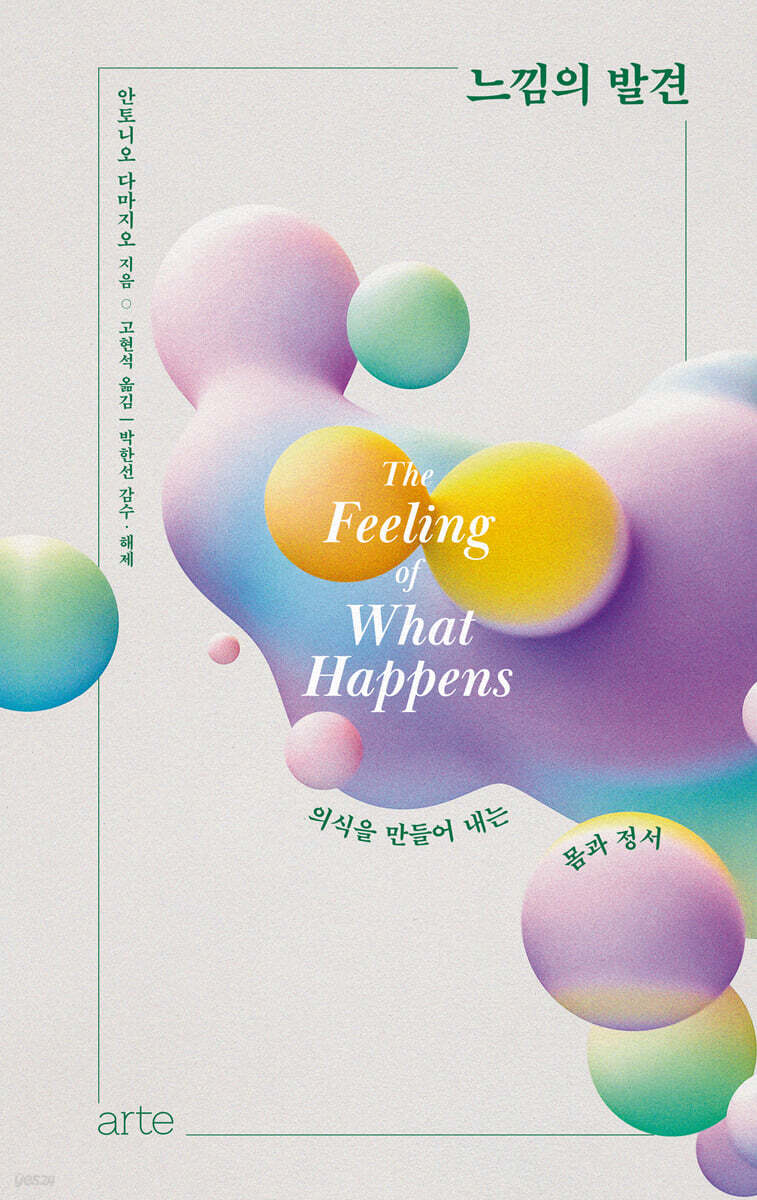
Discovery of feeling
 |
Description
Book Introduction
Antonio Damasio, the greatest neuroscientist of our time
The highlight of the trilogy on 'emotions and feelings'!
The Origin of Consciousness and Self in 'Feeling'
The second book in the 'Damasio Trilogy', it is a masterpiece that connects 'Descartes' Error' and 'Spinoza's Brain', and is a classic in neuroscience that brought about revolutionary progress in the study of feeling and consciousness.
Antonio Damasio, a neurologist and professor at the University of Southern California, presents fascinating arguments about emotions, feelings, and consciousness through scientific observation and analysis.
How do consciousness and a sense of self arise? How do I know that I am myself, and how do I know that I know something? What biological circumstances do we pass through to enter the light of consciousness? In this book, Antonio Damasio, one of today's most prominent neuroscientists, demonstrates, through various clinical cases, that the body and emotions are closely interconnected to shape our consciousness and self, thereby achieving a remarkable shift from Cartesian mind-body dualism to Spinozist mind-body monism.
The highlight of the trilogy on 'emotions and feelings'!
The Origin of Consciousness and Self in 'Feeling'
The second book in the 'Damasio Trilogy', it is a masterpiece that connects 'Descartes' Error' and 'Spinoza's Brain', and is a classic in neuroscience that brought about revolutionary progress in the study of feeling and consciousness.
Antonio Damasio, a neurologist and professor at the University of Southern California, presents fascinating arguments about emotions, feelings, and consciousness through scientific observation and analysis.
How do consciousness and a sense of self arise? How do I know that I am myself, and how do I know that I know something? What biological circumstances do we pass through to enter the light of consciousness? In this book, Antonio Damasio, one of today's most prominent neuroscientists, demonstrates, through various clinical cases, that the body and emotions are closely interconnected to shape our consciousness and self, thereby achieving a remarkable shift from Cartesian mind-body dualism to Spinozist mind-body monism.
- You can preview some of the book's contents.
Preview
index
Recommendation 004
Part 1 Introduction
Chapter 1 Into the Light
Part 2: Feeling and Knowing
Chapter 2 Emotions and Feelings
Chapter 3: Core Awareness
Chapter 4: Half-guessed hints
Part 3: The Biology of Knowledge
Chapter 5 Organisms and Objects
Chapter 6: The Creation of Core Consciousness
Chapter 7: Expanded Consciousness
Chapter 8: The Neurology of Consciousness
Part 4: Prepare the eggs
Chapter 9: Feeling the Feeling
Chapter 10: The Uses of Consciousness
Chapter 11 Under the Light
supplement.
Notes on Mind and Brain
Week 463
Acknowledgments 509
Release 513
Index 527
Part 1 Introduction
Chapter 1 Into the Light
Part 2: Feeling and Knowing
Chapter 2 Emotions and Feelings
Chapter 3: Core Awareness
Chapter 4: Half-guessed hints
Part 3: The Biology of Knowledge
Chapter 5 Organisms and Objects
Chapter 6: The Creation of Core Consciousness
Chapter 7: Expanded Consciousness
Chapter 8: The Neurology of Consciousness
Part 4: Prepare the eggs
Chapter 9: Feeling the Feeling
Chapter 10: The Uses of Consciousness
Chapter 11 Under the Light
supplement.
Notes on Mind and Brain
Week 463
Acknowledgments 509
Release 513
Index 527
Detailed image

Into the book
You could say that your existence is what happens when you feel what happens when your existence is modified by the act of understanding what it is.
This being never stops from the moment it wakes up until the moment it falls asleep.
This being is definitely there, otherwise you wouldn't be there.
--- pp.29~30
Consciousness begins with the feeling of what happens when we see, hear, or touch.
To put it more concretely, consciousness is a kind of feeling that accompanies the creation of all kinds of images, including visual, auditory, tactile, and visceral images, within a living organism.
In short, we can say that feelings are what label these images as our images, and they literally allow us to say that we hear or touch them.
Organisms that lack the ability to generate core consciousness can readily create visual, auditory, and tactile images, but are unaware that they have created such images.
From the very beginning of consciousness at its lowest level, consciousness was knowledge, and knowledge was consciousness.
These two are inseparable, like truth and beauty.
--- p.51
You may find it difficult to distinguish between 'feeling' and 'knowing you have a feeling.'
Of course, doesn't the state of feeling imply that the feeling organism is fully conscious of the emotion and the feelings it is expressing? I don't think so.
My theory is that organisms can express what we call feelings in the form of neural and mental patterns, even when we are completely unaware that the feelings are occurring.
--- pp.62~63
In other words, the biological 'purpose' of emotions is clear, and emotions are not a luxury that can be dispensed with.
Emotions are a curious adaptation and a central part of the organism's survival mechanisms.
Although it is an old element in the evolutionary process, it constitutes a fairly high level of the life control mechanism.
This element of emotion lies between the basic survival kit (e.g., metabolic regulation, simple reflexes, motivation, biological mechanisms of pain and pleasure) and the higher rational apparatus, but it occupies a significant portion of the many layers that make up the life control apparatus.
For less complex species and even for insane individuals, emotions actually produce very rational behaviors from a survival standpoint.
--- p.87
Although much is known about how organisms are represented in the brain, the idea that these representations might be linked to ideas about the mind and self has received little attention.
We still have no answer to the question of what could give the brain the natural means to create a single, stable object, which we call a self.
For a very long time I believed that the answer lay in a particular set of representations of organisms and their potential behavior.
In Descartes' Error, I argued that the part of the mind we call the self is based on a set of unconscious neural patterns that biologically represent the part of the organism we call the body.
--- p.192
We become conscious when our organism internally constructs and reveals a certain kind of nonverbal knowledge that it has been changed by an object, and when this knowledge manifests itself by making the object internally salient.
The simplest form of this knowledge is the feeling of knowing, and the puzzle we must solve is summarized in the following question:
By what mechanisms is this knowledge collected, and why does it first appear in the form of feelings?
--- p.239
This book began with a description of some barriers.
Emotions are a barrier that cannot be known to the subject until consciousness exists.
So far I have presented my views on the properties of consciousness.
Now it's time to explain how we can know emotions.
Let's start from the very beginning.
We know that we have emotions when a sense of self is created in our mind.
Before any sense of self emerges, either in evolution or in individual development, there exist well-coordinated responses that constitute emotions and the brain's representations that subsequently constitute feelings.
But we know that we feel an emotion only when we sense that emotion occurring within the organism.
--- p.385
Feeling emotions is a simple matter.
It has images that are generated from neural patterns that represent the changes in the body and brain that constitute emotions.
But knowing that we have that feeling, that is, feeling about that feeling, only occurs after we have built the secondary representations necessary for core consciousness.
As discussed above, the secondary representation is a representation of the relationship between the organism and the object (in this case, the emotion) and the causal influence that object has on the organism.
--- p.386
The most surprising idea discussed in this book is that consciousness ultimately begins with feeling.
It's definitely a special kind of feeling, but it's a feeling nonetheless.
I remember why I started thinking of consciousness as a feeling, and the reason still seems reasonable to me.
Consciousness feels like a feeling, and that is why if consciousness feels like a feeling, then it must be a feeling.
--- p.429
The reason consciousness is the source of the drama that the human condition creates is because consciousness has to do with the knowledge we gain from deals that none of us have ever made.
The price of becoming a better being is to lose the ignorance of that being.
Our feelings about what's happening are the answers to questions we didn't ask, and they're also the coins used in a Faustian bargain we couldn't negotiate.
This deal is a negotiation that nature has made on our behalf.
This being never stops from the moment it wakes up until the moment it falls asleep.
This being is definitely there, otherwise you wouldn't be there.
--- pp.29~30
Consciousness begins with the feeling of what happens when we see, hear, or touch.
To put it more concretely, consciousness is a kind of feeling that accompanies the creation of all kinds of images, including visual, auditory, tactile, and visceral images, within a living organism.
In short, we can say that feelings are what label these images as our images, and they literally allow us to say that we hear or touch them.
Organisms that lack the ability to generate core consciousness can readily create visual, auditory, and tactile images, but are unaware that they have created such images.
From the very beginning of consciousness at its lowest level, consciousness was knowledge, and knowledge was consciousness.
These two are inseparable, like truth and beauty.
--- p.51
You may find it difficult to distinguish between 'feeling' and 'knowing you have a feeling.'
Of course, doesn't the state of feeling imply that the feeling organism is fully conscious of the emotion and the feelings it is expressing? I don't think so.
My theory is that organisms can express what we call feelings in the form of neural and mental patterns, even when we are completely unaware that the feelings are occurring.
--- pp.62~63
In other words, the biological 'purpose' of emotions is clear, and emotions are not a luxury that can be dispensed with.
Emotions are a curious adaptation and a central part of the organism's survival mechanisms.
Although it is an old element in the evolutionary process, it constitutes a fairly high level of the life control mechanism.
This element of emotion lies between the basic survival kit (e.g., metabolic regulation, simple reflexes, motivation, biological mechanisms of pain and pleasure) and the higher rational apparatus, but it occupies a significant portion of the many layers that make up the life control apparatus.
For less complex species and even for insane individuals, emotions actually produce very rational behaviors from a survival standpoint.
--- p.87
Although much is known about how organisms are represented in the brain, the idea that these representations might be linked to ideas about the mind and self has received little attention.
We still have no answer to the question of what could give the brain the natural means to create a single, stable object, which we call a self.
For a very long time I believed that the answer lay in a particular set of representations of organisms and their potential behavior.
In Descartes' Error, I argued that the part of the mind we call the self is based on a set of unconscious neural patterns that biologically represent the part of the organism we call the body.
--- p.192
We become conscious when our organism internally constructs and reveals a certain kind of nonverbal knowledge that it has been changed by an object, and when this knowledge manifests itself by making the object internally salient.
The simplest form of this knowledge is the feeling of knowing, and the puzzle we must solve is summarized in the following question:
By what mechanisms is this knowledge collected, and why does it first appear in the form of feelings?
--- p.239
This book began with a description of some barriers.
Emotions are a barrier that cannot be known to the subject until consciousness exists.
So far I have presented my views on the properties of consciousness.
Now it's time to explain how we can know emotions.
Let's start from the very beginning.
We know that we have emotions when a sense of self is created in our mind.
Before any sense of self emerges, either in evolution or in individual development, there exist well-coordinated responses that constitute emotions and the brain's representations that subsequently constitute feelings.
But we know that we feel an emotion only when we sense that emotion occurring within the organism.
--- p.385
Feeling emotions is a simple matter.
It has images that are generated from neural patterns that represent the changes in the body and brain that constitute emotions.
But knowing that we have that feeling, that is, feeling about that feeling, only occurs after we have built the secondary representations necessary for core consciousness.
As discussed above, the secondary representation is a representation of the relationship between the organism and the object (in this case, the emotion) and the causal influence that object has on the organism.
--- p.386
The most surprising idea discussed in this book is that consciousness ultimately begins with feeling.
It's definitely a special kind of feeling, but it's a feeling nonetheless.
I remember why I started thinking of consciousness as a feeling, and the reason still seems reasonable to me.
Consciousness feels like a feeling, and that is why if consciousness feels like a feeling, then it must be a feeling.
--- p.429
The reason consciousness is the source of the drama that the human condition creates is because consciousness has to do with the knowledge we gain from deals that none of us have ever made.
The price of becoming a better being is to lose the ignorance of that being.
Our feelings about what's happening are the answers to questions we didn't ask, and they're also the coins used in a Faustian bargain we couldn't negotiate.
This deal is a negotiation that nature has made on our behalf.
--- p.435
Publisher's Review
Antonio Damasio, the greatest neuroscientist of our time
The highlight of the trilogy on 'emotions and feelings'!
From Descartes to Spinoza, an original interpretation of 'consciousness' that crosses science and humanities.
Antonio Damasio, one of today's most prominent neuroscientists and a major influence on modern psychology and philosophy, has published his masterpiece, "The Discovery of Feelings," as the 18th book in the Arte Philos series.
"The Discovery of Feelings" is the second book in the so-called "Damasio Trilogy," which illuminates the influence of the body and emotions on human consciousness and the formation of the self. It is a classic in brain science that brought about revolutionary advances in the study of feeling and consciousness.
Damasio unravels the contradictions inherent in mind-body dualism, a core belief in Western intellectual history, and uses scientific analysis and bold imagination to illuminate the structure of human consciousness.
In the first book of the trilogy, Descartes' Error (1994), Damasio criticizes the philosopher Descartes as a symbolic figure who divided mind and body into two substances with the distinct properties of thought and extension, and reveals the influence of the body and feelings, which have been disparaged so far, on the activities of reason and decision-making.
In his second book, The Feeling of What Happens (1999), he develops the argument to explain the role that emotions and feelings play in the formation of human consciousness and sense of self, and in his final book, Looking for Spinoza (2003), he concludes his trilogy on 'emotions-feelings' based on the monism of the philosopher Spinoza, who understood mind and body as two aspects of the same substance.
In particular, this book, "The Discovery of Feeling," is a masterpiece that contains Damasio's unique interpretation that combines science and philosophy, and is the highlight of the trilogy that marks the great transition from Cartesian mind-body dualism to Spinoza's mind-body monism.
In this book, Damasio uses various clinical cases to reveal that our body and emotions are closely interconnected to form consciousness and self.
The book is filled with medically researched neurological and anatomical data, including brain scans and cross-sections, as well as counseling cases of patients with neurological disorders that he has observed over a long period of time. Based on this, the various layers of human consciousness and self are meticulously explained.
Through "The Discovery of Feeling," readers will be able to experience the essence of Damasio's world, famous for his brilliant writing style, diverse case studies, and ingenious and wide-ranging speculative developments that cross medicine, neurology, philosophy, and literature.
“The best book on the brain to come out in the last decade.
(…)
“A must-read for anyone waiting for a neuroscientist's perspective on the great mysteries yet to be solved.”
_The New York Times
How do I know something?
And how do I know that I know something?
The Origin of Consciousness and Self in 'Feeling'
As can be seen from the original title of 『The Discovery of Feeling』, ‘The Feeling of What Happens’, what Antonio Damasio focuses on as the beginning of consciousness is feeling, which has been considered an obstacle to reason in Western intellectual history.
Feeling is the subject's recognition of a change when a change occurs inside or outside the organism, that is, when an emotion occurs. Our consciousness and self begin with feelings about what happens when we see, hear, or touch.
To summarize, it is like this.
There is something constantly 'happening' inside and outside of an organism.
However, only some of them remain as 'feelings', only some of the 'feelings' become conscious, and only some of the 'conscious feelings' remain as 'memories'.
And only a portion of those memories remain as explicit verbal memories.
In other words, the original title, ‘the feeling of what is happening’, is consciousness, that is, ‘I’.
The primal sense of self is closely connected to the feeling-body, and these are the oldest foundations in evolutionary history and form the basis of consciousness.
In other words, feelings are essential for maintaining homeostasis, which is the core of life activities, and they are the starting point of consciousness and the source of the sense of self that makes the 'movie in the brain' known to its owner.
Strangely enough, consciousness begins with a feeling about what happens when we see, hear, or touch.
To put it more concretely, consciousness is a kind of feeling that accompanies the creation of all kinds of images, including visual, auditory, tactile, and visceral images, within a living organism.
_In the text
How do I know that I am me?
A half-guessed hint, and a half-understood gift
In 1735, Carl Linnaeus classified apes, sloths, and humans together as the "Primiformes," adding the description of humans as "Nosce te ipsum" (I know myself).
In other words, humans are animals that ‘know themselves,’ and that is the most important characteristic of humans.
Furthermore, humans have a unique ability to self-awareness that allows them to connect multiple 'selves' into a continuous and consistent 'self' through expanded consciousness, and human society and culture are all based on the illusion of the unity and continuity of this 'self'.
In other words, understanding consciousness and the self is crucial for uncovering the secrets of the human organism and understanding its existence from a psychophilosophical and sociocultural perspective.
As can be seen from the verse “The hint half guessed”, which Damasio quotes several times, the very existence of the “I” is, of course, a concept that is difficult to fully understand.
Yet, at the same time, it is “a truly wonderful evolutionary gift to humans.”
Through 『The Discovery of Feeling』, which presents a wide range of insights into the meaning of 'I', including the evolutionary ultimate causes and adaptive related functions of feelings, emotions, and consciousness, as well as psychopathological cases of various 'self-disorders', readers will be able to understand the true nature of that gift at least 'halfway'.
Release (some excerpts)
Park Han-seon (Professor of Anthropology, Seoul National University, Psychiatrist)
Damasio divides consciousness into three layers.
It's reminiscent of Freud's id, ego, and superego, although of course they're not exact equivalents.
At the very bottom is the protoself.
And on top of that there is core consciousness.
And there is an extended consciousness that extends upwards or outwards.
But how on earth does this consciousness arise?
Damasio said that even primitive creatures have emotions.
Emotion refers to a complex response to stimuli that induce changes in an organism, that is, physiological or behavioral changes.
However, the stimuli that cause these changes can be divided into two types.
There are internal and external stimuli.
The moment an organism recognizes a change in this stimulus, it is said to 'feel'.
That is, feeling.
(…) But the neurological patterns called emotions can also be activated on their own.
Then the brain will be able to feel it again.
Damasio calls this the core consciousness.
Core consciousness is a creative cognitive process that arises from feeling the emotions brought about by internal and external changes.
The consistent emotional patterns mentioned above are projected as images, like a kind of mental theater.
The organism feels 'me' while watching a movie on the screen.
The movie scenes are constantly changing, but we know it's the same movie.
During the running time, I feel like I am ‘the same person’.
In other words, the core consciousness is the 'feeling of knowing the feeling'.
One of the best books on the brain to come out in the last decade.
(…) A must-read for anyone looking for a neuroscientist's perspective on the great mysteries yet to be solved.
- [New York Times]
Antonio Damasio's remarkable book not only explains the embodiment of feeling states, but also offers suggestions for understanding two important problems in neuroscience.
(…) 『The Discovery of Feeling』 approaches these questions with surprising boldness, providing the first compelling account of the self.
- [Nature]
Antonio Damasio offers a very original explanation of how consciousness works, claiming that human consciousness can be understood.
What makes Damasio's views so compelling is that they are based not only on theory but also on decades of clinical research with patients with epilepsy, stroke, and brain damage from disease and trauma.
-"time]
This book uses clear, beautiful language and engaging case studies to explain difficult scientific problems to readers of all interests.
This book is a landmark in a multidisciplinary project of consciousness research.
-Scientific American
The Discovery of Feelings is a book that comes to life because it was written by Antonio Damasio.
The examples cited are beautifully crisp and clear.
(…) Few subjects are more fascinating than the origin and operation of consciousness, and few are better equipped to explain it than the author.
- [The Guardian (London)]
A wonderfully original perspective.
(…) Antonio Damasio combines developmental biology, clinical neurology, and physiological psychology to guide readers into previously hidden realms of consciousness.
Although many prominent scholars had tackled this topic before Damasio, none had presented an explanation as persuasive as Damasio.
- [The Sunday Times (London)]
Antonio Damasio shows you how charming you really are.
Damasio is not only a rare writer who writes captivatingly on complex topics, but he is also an active and groundbreaking researcher in his field.
(…) We must be careful to follow the path that Damasio is pioneering.
If you read the neuroanatomy section without skipping it, you will gain refreshing insights into a complex issue.
- [Bloomsbury Review]
Beyond its scientific value, what makes "The Discovery of Feeling" so impressive lies in its clarity of expression.
(…) The author has made this book a model of effective scientific writing by avoiding jargon and difficult vocabulary, summarizing and reiterating meticulously, reasoning clearly, and consistently respecting the needs of non-specialist readers.
- [Dallas Morning News]
It is an excellent book that is neither lacking nor excessive.
The thoughts are organized in a flowing manner and written in sentences that anyone can understand.
(…) It is a book that takes us one step ahead on a journey full of questions, and is a cornerstone that provides the most reliable view of the human mind.
- [Gazeta Mercantil (São Paulo)]
Antonio Damasio is one of the most influential scholars in his field and a professor with the deepest understanding of higher human cognition.
Both his works, Descartes' Error and The Discovery of Feeling, are must-reads.
These books are classics that will shake up the horizons of psychology and neuroscience.
If you read these two books and think deeply about them, you will be at least 10 years ahead of others.
- [Journal of the Royal Society of Medicine]
A monumental book.
(…) This is without a doubt the best book ever written on the subject of consciousness and the brain.
(…) This book will challenge and delight educated readers.
- [Journal of Consciousness Research]
The highlight of the trilogy on 'emotions and feelings'!
From Descartes to Spinoza, an original interpretation of 'consciousness' that crosses science and humanities.
Antonio Damasio, one of today's most prominent neuroscientists and a major influence on modern psychology and philosophy, has published his masterpiece, "The Discovery of Feelings," as the 18th book in the Arte Philos series.
"The Discovery of Feelings" is the second book in the so-called "Damasio Trilogy," which illuminates the influence of the body and emotions on human consciousness and the formation of the self. It is a classic in brain science that brought about revolutionary advances in the study of feeling and consciousness.
Damasio unravels the contradictions inherent in mind-body dualism, a core belief in Western intellectual history, and uses scientific analysis and bold imagination to illuminate the structure of human consciousness.
In the first book of the trilogy, Descartes' Error (1994), Damasio criticizes the philosopher Descartes as a symbolic figure who divided mind and body into two substances with the distinct properties of thought and extension, and reveals the influence of the body and feelings, which have been disparaged so far, on the activities of reason and decision-making.
In his second book, The Feeling of What Happens (1999), he develops the argument to explain the role that emotions and feelings play in the formation of human consciousness and sense of self, and in his final book, Looking for Spinoza (2003), he concludes his trilogy on 'emotions-feelings' based on the monism of the philosopher Spinoza, who understood mind and body as two aspects of the same substance.
In particular, this book, "The Discovery of Feeling," is a masterpiece that contains Damasio's unique interpretation that combines science and philosophy, and is the highlight of the trilogy that marks the great transition from Cartesian mind-body dualism to Spinoza's mind-body monism.
In this book, Damasio uses various clinical cases to reveal that our body and emotions are closely interconnected to form consciousness and self.
The book is filled with medically researched neurological and anatomical data, including brain scans and cross-sections, as well as counseling cases of patients with neurological disorders that he has observed over a long period of time. Based on this, the various layers of human consciousness and self are meticulously explained.
Through "The Discovery of Feeling," readers will be able to experience the essence of Damasio's world, famous for his brilliant writing style, diverse case studies, and ingenious and wide-ranging speculative developments that cross medicine, neurology, philosophy, and literature.
“The best book on the brain to come out in the last decade.
(…)
“A must-read for anyone waiting for a neuroscientist's perspective on the great mysteries yet to be solved.”
_The New York Times
How do I know something?
And how do I know that I know something?
The Origin of Consciousness and Self in 'Feeling'
As can be seen from the original title of 『The Discovery of Feeling』, ‘The Feeling of What Happens’, what Antonio Damasio focuses on as the beginning of consciousness is feeling, which has been considered an obstacle to reason in Western intellectual history.
Feeling is the subject's recognition of a change when a change occurs inside or outside the organism, that is, when an emotion occurs. Our consciousness and self begin with feelings about what happens when we see, hear, or touch.
To summarize, it is like this.
There is something constantly 'happening' inside and outside of an organism.
However, only some of them remain as 'feelings', only some of the 'feelings' become conscious, and only some of the 'conscious feelings' remain as 'memories'.
And only a portion of those memories remain as explicit verbal memories.
In other words, the original title, ‘the feeling of what is happening’, is consciousness, that is, ‘I’.
The primal sense of self is closely connected to the feeling-body, and these are the oldest foundations in evolutionary history and form the basis of consciousness.
In other words, feelings are essential for maintaining homeostasis, which is the core of life activities, and they are the starting point of consciousness and the source of the sense of self that makes the 'movie in the brain' known to its owner.
Strangely enough, consciousness begins with a feeling about what happens when we see, hear, or touch.
To put it more concretely, consciousness is a kind of feeling that accompanies the creation of all kinds of images, including visual, auditory, tactile, and visceral images, within a living organism.
_In the text
How do I know that I am me?
A half-guessed hint, and a half-understood gift
In 1735, Carl Linnaeus classified apes, sloths, and humans together as the "Primiformes," adding the description of humans as "Nosce te ipsum" (I know myself).
In other words, humans are animals that ‘know themselves,’ and that is the most important characteristic of humans.
Furthermore, humans have a unique ability to self-awareness that allows them to connect multiple 'selves' into a continuous and consistent 'self' through expanded consciousness, and human society and culture are all based on the illusion of the unity and continuity of this 'self'.
In other words, understanding consciousness and the self is crucial for uncovering the secrets of the human organism and understanding its existence from a psychophilosophical and sociocultural perspective.
As can be seen from the verse “The hint half guessed”, which Damasio quotes several times, the very existence of the “I” is, of course, a concept that is difficult to fully understand.
Yet, at the same time, it is “a truly wonderful evolutionary gift to humans.”
Through 『The Discovery of Feeling』, which presents a wide range of insights into the meaning of 'I', including the evolutionary ultimate causes and adaptive related functions of feelings, emotions, and consciousness, as well as psychopathological cases of various 'self-disorders', readers will be able to understand the true nature of that gift at least 'halfway'.
Release (some excerpts)
Park Han-seon (Professor of Anthropology, Seoul National University, Psychiatrist)
Damasio divides consciousness into three layers.
It's reminiscent of Freud's id, ego, and superego, although of course they're not exact equivalents.
At the very bottom is the protoself.
And on top of that there is core consciousness.
And there is an extended consciousness that extends upwards or outwards.
But how on earth does this consciousness arise?
Damasio said that even primitive creatures have emotions.
Emotion refers to a complex response to stimuli that induce changes in an organism, that is, physiological or behavioral changes.
However, the stimuli that cause these changes can be divided into two types.
There are internal and external stimuli.
The moment an organism recognizes a change in this stimulus, it is said to 'feel'.
That is, feeling.
(…) But the neurological patterns called emotions can also be activated on their own.
Then the brain will be able to feel it again.
Damasio calls this the core consciousness.
Core consciousness is a creative cognitive process that arises from feeling the emotions brought about by internal and external changes.
The consistent emotional patterns mentioned above are projected as images, like a kind of mental theater.
The organism feels 'me' while watching a movie on the screen.
The movie scenes are constantly changing, but we know it's the same movie.
During the running time, I feel like I am ‘the same person’.
In other words, the core consciousness is the 'feeling of knowing the feeling'.
One of the best books on the brain to come out in the last decade.
(…) A must-read for anyone looking for a neuroscientist's perspective on the great mysteries yet to be solved.
- [New York Times]
Antonio Damasio's remarkable book not only explains the embodiment of feeling states, but also offers suggestions for understanding two important problems in neuroscience.
(…) 『The Discovery of Feeling』 approaches these questions with surprising boldness, providing the first compelling account of the self.
- [Nature]
Antonio Damasio offers a very original explanation of how consciousness works, claiming that human consciousness can be understood.
What makes Damasio's views so compelling is that they are based not only on theory but also on decades of clinical research with patients with epilepsy, stroke, and brain damage from disease and trauma.
-"time]
This book uses clear, beautiful language and engaging case studies to explain difficult scientific problems to readers of all interests.
This book is a landmark in a multidisciplinary project of consciousness research.
-Scientific American
The Discovery of Feelings is a book that comes to life because it was written by Antonio Damasio.
The examples cited are beautifully crisp and clear.
(…) Few subjects are more fascinating than the origin and operation of consciousness, and few are better equipped to explain it than the author.
- [The Guardian (London)]
A wonderfully original perspective.
(…) Antonio Damasio combines developmental biology, clinical neurology, and physiological psychology to guide readers into previously hidden realms of consciousness.
Although many prominent scholars had tackled this topic before Damasio, none had presented an explanation as persuasive as Damasio.
- [The Sunday Times (London)]
Antonio Damasio shows you how charming you really are.
Damasio is not only a rare writer who writes captivatingly on complex topics, but he is also an active and groundbreaking researcher in his field.
(…) We must be careful to follow the path that Damasio is pioneering.
If you read the neuroanatomy section without skipping it, you will gain refreshing insights into a complex issue.
- [Bloomsbury Review]
Beyond its scientific value, what makes "The Discovery of Feeling" so impressive lies in its clarity of expression.
(…) The author has made this book a model of effective scientific writing by avoiding jargon and difficult vocabulary, summarizing and reiterating meticulously, reasoning clearly, and consistently respecting the needs of non-specialist readers.
- [Dallas Morning News]
It is an excellent book that is neither lacking nor excessive.
The thoughts are organized in a flowing manner and written in sentences that anyone can understand.
(…) It is a book that takes us one step ahead on a journey full of questions, and is a cornerstone that provides the most reliable view of the human mind.
- [Gazeta Mercantil (São Paulo)]
Antonio Damasio is one of the most influential scholars in his field and a professor with the deepest understanding of higher human cognition.
Both his works, Descartes' Error and The Discovery of Feeling, are must-reads.
These books are classics that will shake up the horizons of psychology and neuroscience.
If you read these two books and think deeply about them, you will be at least 10 years ahead of others.
- [Journal of the Royal Society of Medicine]
A monumental book.
(…) This is without a doubt the best book ever written on the subject of consciousness and the brain.
(…) This book will challenge and delight educated readers.
- [Journal of Consciousness Research]
GOODS SPECIFICS
- Date of issue: May 2, 2023
- Format: Hardcover book binding method guide
- Page count, weight, size: 544 pages | 784g | 135*218*35mm
- ISBN13: 9788950906214
- ISBN10: 895090621X
You may also like
카테고리
korean


korean

![GQ KOREA Mark (Monthly): December [2025]](http://librairie.coreenne.fr/cdn/shop/files/8ef265dbbfbf186523ed75ba7319009d.jpg?v=1765340328&width=3840)


