

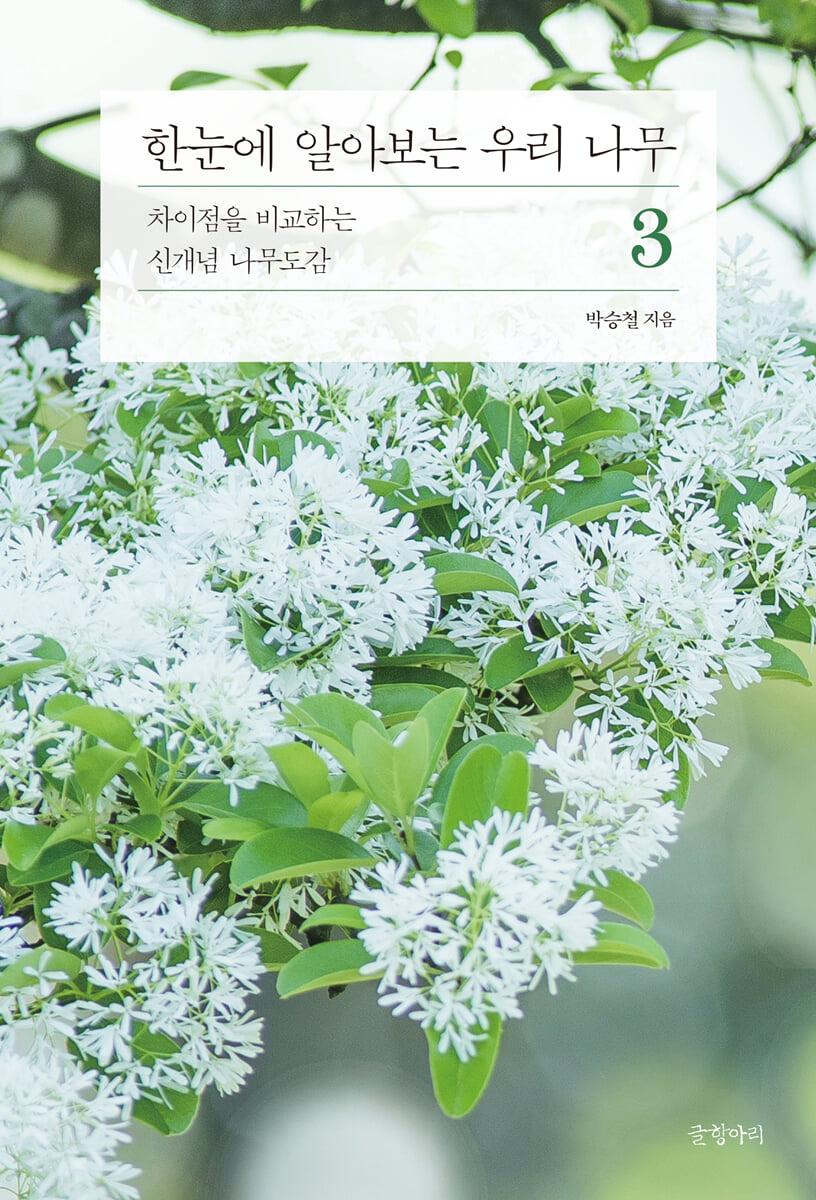
3 Trees We Know at a Glance
 |
Description
Book Introduction
A new challenge for the evolving tree encyclopedia!
Three-dimensional innovation in "Edit," "Photo," and "Description"
A massive collection of content spanning 4,000 pages in 8 volumes.
A must-read guide to practical study optimized for visual comparison!
The most notable feature of 『Our Trees at a Glance』 is that it presents 15 photos showing the characteristics of each tree species and places descriptions above the photos, allowing information to be input into the mind as soon as you see it.
Another advantage that sets it apart from other picture guides is that it allows you to see even the smallest differences in detail, such as the shape of leaves and seeds, the length and direction of hairs, and the degree of darkness or lightness of color, through clear, enlarged photos.
In addition, this book includes not only native species but also alien and horticultural species that have been neglected in existing guides, as they are commonly found in parks, arboretums, and apartment flower beds.
In other words, I have been faithful to the innate human desire to properly understand the trees around me, and have put my heart and soul into resolving the common questions of those who want to study trees!
Three-dimensional innovation in "Edit," "Photo," and "Description"
A massive collection of content spanning 4,000 pages in 8 volumes.
A must-read guide to practical study optimized for visual comparison!
The most notable feature of 『Our Trees at a Glance』 is that it presents 15 photos showing the characteristics of each tree species and places descriptions above the photos, allowing information to be input into the mind as soon as you see it.
Another advantage that sets it apart from other picture guides is that it allows you to see even the smallest differences in detail, such as the shape of leaves and seeds, the length and direction of hairs, and the degree of darkness or lightness of color, through clear, enlarged photos.
In addition, this book includes not only native species but also alien and horticultural species that have been neglected in existing guides, as they are commonly found in parks, arboretums, and apartment flower beds.
In other words, I have been faithful to the innate human desire to properly understand the trees around me, and have put my heart and soul into resolving the common questions of those who want to study trees!
- You can preview some of the book's contents.
Preview
index
Note
Wall-crested chrysanthemum
410 WallflowerFirmiana simplex
Asteraceae
411 Daphne kiusiana
412 Daphne odora
413 Wikstroemia genkwa
414 Edgeworthia chrysantha
415 Wikstroemia trichotoma
Barley family
416 Elaeagnus multiflora
417 Elaeagnus umbellata
418 Elaeagnus umbellata var.
longicarpa
419 Elaeagnus umbellata var.
Korean
Inamucaceae
420 Idesia polycarpa
Passiflora and
421 Passiflora caerulea
Satellite family
422 Satellite Tamarix chinensis
423 Tamarix juniperina
Buddha's flower and
424 Lagerstroemia indica f.
alba
Pomegranate family
425 Pomegranate tree Punica granatum
Bataceae
426 Bat tree Alangium platanifolium var.
trilobum
427 Alangium platanifolium
Cornus officinalis
428 Aucuba japonica
429 Aucuba japonica f.
variegata
430 Cornus officinalis
431 Cornelian cherry Cornus kousa
432 Cornus controversa
433 Cornus walteri
434 Bear's Hornbeam Cornus macrophylla
435 White Cornus alba
436 Yellow Cornelian Cherry Cornus sericea
Araliaceae
437 Eleutherococcus sessiliflorus
438 Eleutherococcus divaricatus
439 Jirisan OgalpiEleutherococcus divaricatus var.
chiisanensis
440 Eleutherococcus senticosus
441 Eleutherococcus gracilistylus
442 Eleutherococcus sieboldianus
443 Kalopanax septemlobus
444 Kalopanax septemlobus f.
maximowiczii
445 Kalopanax septemlobus var.
magnificus
446 Aralia elata
447 Aralia elata f.
canescens
448 Dendropanax trifidus
449 Fatsia japonica
450 Songak Hedera rhombea
Ericaceae
451 BaeksanchaLedum palustre var.
diversipilosum
452 Narrow White TeaLedum palustre var.
decumbens
453 Rhododendron micranthum
454 Rhododendron dauricum
455 Rhododendron mucronulatum
456 Rhododendron mucronulatum var.
ciliatum
457 Rhododendron mucronulatum f.
albiflorum
458 Rhododendron lapponicum subsp.
albiflorum
459 Rhododendron weyrichii
460 Rhododendron schlippenbachii
461 Rhododendron schlippenbachii f.
albiflorum
462 Rhododendron yedoense f.
poukhanense
463 Rhododendron yedoense f.
albflora
464 Rhododendron yedoense
465 Rhododendron japonicum
466 Rhododendron japonicum for.
flavum
467 Rhododendron aureum
468 Rhododendron brachycarpum
469 Maple Enkianthus perulatus
470 Enkianthus campanulatus
471 Vaccinium hirtum var.
koreanum
472 Vaccinium oldhamii
473 Vaccinium uliginosum
474 Vaccinium oxycoccus
Financial Services Department
475 Ardisia crispa
476 Coral tree Ardisia pusilla
477 Ardisia japonica
Persimmon family
478 Diospyros kaki
479 Diospyros lotus
Bamboo family
480 Silver Bell Tree Halesia carolina
481 Styrax japonicus
482 Styrax obassia
483 Pterostyrax hispidis
Stink bug family
484 Symplocos sawafutagi
485 Island squirrel tree (Symplocos coreana)
486 Blackthorn Tree (Symplocos tanakana)
Oleaceae family
487 Chionanthus retusus
488 Chionanthus retusus var.
Korean
489 Abeliophyllum distichum
490 Abeliophyllum distichum var.
rotundicarpum
491 Abeliophyllum distichum f.
lilacinum
492 Abeliophyllum distichum f.
eburneum
493 Abeliophyllum distichum f.
viridicalycinum
494 Forsythia koreana
495 Forsythia suspensa
496 Forsythia viridissima
497 Forsythia saxatilis var.
lanceolata
498 Forsythia saxatilis
499 Forsythia saxatilis var.
pilosa
500 ManlihwaForsythia ovata
501 Longevity Forsythia nakaii
502 Jasminum nudiflorum
503 Fraxinus mandshurica
504 Fraxinus chiisanensis
505 Fraxinus excelsior
506 Fraxinus rhynchophylla
507 Fraxinus rhynchophylla var.
densata
508 American ash Fraxinus americana
509 Fraxinus sieboldiana
510 Fraxinus sieboldiana var.
angusta
511 Fontanesia nudiflorum
512 Ligustrum japonicum
513 Ligustrum lucidum
514 Round-leafed Ligustrum japonicum f.
rotundifolium
515 Ligustrum salicinum
516 Ligustrum obtusifolium subsp.
microphyllum
517 Ligustrum ibota
518 Ligustrum obtusifolium
519 Ligustrum leucanthum
520 Ligustrum obtusifolium var.
regelianum
521 Ligustrum quihoui
522 Ligustrum ovalifolium
523 Round-leaved island privet Ligustrum foliosum f.
ovale
524 Ligustrum foliosum
525 Osmanthus fragrans
526 Osmanthus fragrans var.
aurantiacus
527 Osmanthus heterophyllus
528 Syringa reticulata
529 Syringa reticulata f.
bracteata
530 Wild clove Syringa amurensis var.
japonica
531 Syringa villosa subsp.
wolfii
532 Syringa pubescens subsp.
patula
533 Syringa patula var.
venosa
534 White Island Syringa Syringa patula var.
venosa f.
lactea
535 Clove treeSyringa patula var.
kamibayshii
536 Syringa oblata var.
dilatata
537 LilacSyringa vulgaris
538 Miss Kim LilacSyringa pubescens subsp.
patula 'Miss Kim'
539 Syringa meyeri 'Palibin'
Oleander family
540 Mancheophyeopjukdo Nerium indicum f.
plenum
541 White oleander Nerium indicum f.
leucanthum
542 Trachelospermum asiaticum
543 Trachelospermum jasminoides
544 Trachelospermum asiaticum var.
majus
Rubiaceae
545 Vinca minor
546 Vinca major
547 Adina rubella
548 Damnacanthus indicus
549 Gardenia jasminoides
550 Gardenia jasminoides var.
radicans
551 Paederia foetida
552 Paederia scandens var.
velutina
553 Paederia scandens var.
angustifolia
554 Serissa japonica
Verbena superfamily
555 Callicarpa japonica
556 Callicarpa japonica var.
leucocarpa
557 Callicarpa dichotoma
558 Callicarpa dichotoma f.
albifructa
559 Callicarpa mollis
560 Clerodendrum trichotomum
561 Clerodendrum trichotomum var.
ferrugineum
562 Clerodendrum trichotomum var.
esculentum
563 Vitex negundo var.
cannabifolia
564 Vitex negundo var.
incisa
565 Vitex rotundifolia
566 Caryopteris incana
Indong and
567 Zabelia tyaihyonii
568 Abelia mosanensis
569 Abelia x grandiflora
570 Rocky Mountain Zelkova Zabelia integrifolia
571 Zabelia biflora
572 Abelia coreana var.
insularis
573 Diabelia serrata
574 Diabelia spathulata
575 Lonicera japonica
576 Lonicera japonica var.
repens
577 Red-crowned Crane's-Eye Lonicera x heckrottii
578 Lonicera maackii
579 Lonicera insularis
580 Lonicera vesicaria
581 Lonicera praeflorens
582 Lonicera harae
583 Lonicera coreana
584 Lonicera subsessilis
585 Pink Fire Tree Lonicera tatarica
586 Lonicera tatarinowii
587 Sambucus racemosa subsp.
pendula
588 Sambucus racemosa subsp.
kamtschatica
589 Sambucus racemosa
590 Elderberry Sambucus williamsii
591 Broadleaf Elderberry Sambucus latipinna
592 Diervilla sessilifolia
593 Viburnum carlesii
594 Viburnum burejaeticum
595 Viburnum dilatatum
596 Viburnum wrightii
597 Viburnum wrightii var.
stipllatum
598 Viburnum erosum
599 Viburnum odoratissimum var.
awabuki
600 Viburnum koreanum
601 Viburnum opulus var.
calvescens
602 Viburnum opulus f.
puberulum
603 Viburnum opulus f.
hydrangeoides
604 Bottleflower Weigela subsessilis
605 Weigela subsessilis var.
mollis
606 Weigela florida
607 Weigela hortensis
608 Weigela praecox
609 Weigela florida f.
candida
Search all volumes 1-4 (including aliases and pseudonyms)
Search all volumes 1-4 (scientific names)
Wall-crested chrysanthemum
410 WallflowerFirmiana simplex
Asteraceae
411 Daphne kiusiana
412 Daphne odora
413 Wikstroemia genkwa
414 Edgeworthia chrysantha
415 Wikstroemia trichotoma
Barley family
416 Elaeagnus multiflora
417 Elaeagnus umbellata
418 Elaeagnus umbellata var.
longicarpa
419 Elaeagnus umbellata var.
Korean
Inamucaceae
420 Idesia polycarpa
Passiflora and
421 Passiflora caerulea
Satellite family
422 Satellite Tamarix chinensis
423 Tamarix juniperina
Buddha's flower and
424 Lagerstroemia indica f.
alba
Pomegranate family
425 Pomegranate tree Punica granatum
Bataceae
426 Bat tree Alangium platanifolium var.
trilobum
427 Alangium platanifolium
Cornus officinalis
428 Aucuba japonica
429 Aucuba japonica f.
variegata
430 Cornus officinalis
431 Cornelian cherry Cornus kousa
432 Cornus controversa
433 Cornus walteri
434 Bear's Hornbeam Cornus macrophylla
435 White Cornus alba
436 Yellow Cornelian Cherry Cornus sericea
Araliaceae
437 Eleutherococcus sessiliflorus
438 Eleutherococcus divaricatus
439 Jirisan OgalpiEleutherococcus divaricatus var.
chiisanensis
440 Eleutherococcus senticosus
441 Eleutherococcus gracilistylus
442 Eleutherococcus sieboldianus
443 Kalopanax septemlobus
444 Kalopanax septemlobus f.
maximowiczii
445 Kalopanax septemlobus var.
magnificus
446 Aralia elata
447 Aralia elata f.
canescens
448 Dendropanax trifidus
449 Fatsia japonica
450 Songak Hedera rhombea
Ericaceae
451 BaeksanchaLedum palustre var.
diversipilosum
452 Narrow White TeaLedum palustre var.
decumbens
453 Rhododendron micranthum
454 Rhododendron dauricum
455 Rhododendron mucronulatum
456 Rhododendron mucronulatum var.
ciliatum
457 Rhododendron mucronulatum f.
albiflorum
458 Rhododendron lapponicum subsp.
albiflorum
459 Rhododendron weyrichii
460 Rhododendron schlippenbachii
461 Rhododendron schlippenbachii f.
albiflorum
462 Rhododendron yedoense f.
poukhanense
463 Rhododendron yedoense f.
albflora
464 Rhododendron yedoense
465 Rhododendron japonicum
466 Rhododendron japonicum for.
flavum
467 Rhododendron aureum
468 Rhododendron brachycarpum
469 Maple Enkianthus perulatus
470 Enkianthus campanulatus
471 Vaccinium hirtum var.
koreanum
472 Vaccinium oldhamii
473 Vaccinium uliginosum
474 Vaccinium oxycoccus
Financial Services Department
475 Ardisia crispa
476 Coral tree Ardisia pusilla
477 Ardisia japonica
Persimmon family
478 Diospyros kaki
479 Diospyros lotus
Bamboo family
480 Silver Bell Tree Halesia carolina
481 Styrax japonicus
482 Styrax obassia
483 Pterostyrax hispidis
Stink bug family
484 Symplocos sawafutagi
485 Island squirrel tree (Symplocos coreana)
486 Blackthorn Tree (Symplocos tanakana)
Oleaceae family
487 Chionanthus retusus
488 Chionanthus retusus var.
Korean
489 Abeliophyllum distichum
490 Abeliophyllum distichum var.
rotundicarpum
491 Abeliophyllum distichum f.
lilacinum
492 Abeliophyllum distichum f.
eburneum
493 Abeliophyllum distichum f.
viridicalycinum
494 Forsythia koreana
495 Forsythia suspensa
496 Forsythia viridissima
497 Forsythia saxatilis var.
lanceolata
498 Forsythia saxatilis
499 Forsythia saxatilis var.
pilosa
500 ManlihwaForsythia ovata
501 Longevity Forsythia nakaii
502 Jasminum nudiflorum
503 Fraxinus mandshurica
504 Fraxinus chiisanensis
505 Fraxinus excelsior
506 Fraxinus rhynchophylla
507 Fraxinus rhynchophylla var.
densata
508 American ash Fraxinus americana
509 Fraxinus sieboldiana
510 Fraxinus sieboldiana var.
angusta
511 Fontanesia nudiflorum
512 Ligustrum japonicum
513 Ligustrum lucidum
514 Round-leafed Ligustrum japonicum f.
rotundifolium
515 Ligustrum salicinum
516 Ligustrum obtusifolium subsp.
microphyllum
517 Ligustrum ibota
518 Ligustrum obtusifolium
519 Ligustrum leucanthum
520 Ligustrum obtusifolium var.
regelianum
521 Ligustrum quihoui
522 Ligustrum ovalifolium
523 Round-leaved island privet Ligustrum foliosum f.
ovale
524 Ligustrum foliosum
525 Osmanthus fragrans
526 Osmanthus fragrans var.
aurantiacus
527 Osmanthus heterophyllus
528 Syringa reticulata
529 Syringa reticulata f.
bracteata
530 Wild clove Syringa amurensis var.
japonica
531 Syringa villosa subsp.
wolfii
532 Syringa pubescens subsp.
patula
533 Syringa patula var.
venosa
534 White Island Syringa Syringa patula var.
venosa f.
lactea
535 Clove treeSyringa patula var.
kamibayshii
536 Syringa oblata var.
dilatata
537 LilacSyringa vulgaris
538 Miss Kim LilacSyringa pubescens subsp.
patula 'Miss Kim'
539 Syringa meyeri 'Palibin'
Oleander family
540 Mancheophyeopjukdo Nerium indicum f.
plenum
541 White oleander Nerium indicum f.
leucanthum
542 Trachelospermum asiaticum
543 Trachelospermum jasminoides
544 Trachelospermum asiaticum var.
majus
Rubiaceae
545 Vinca minor
546 Vinca major
547 Adina rubella
548 Damnacanthus indicus
549 Gardenia jasminoides
550 Gardenia jasminoides var.
radicans
551 Paederia foetida
552 Paederia scandens var.
velutina
553 Paederia scandens var.
angustifolia
554 Serissa japonica
Verbena superfamily
555 Callicarpa japonica
556 Callicarpa japonica var.
leucocarpa
557 Callicarpa dichotoma
558 Callicarpa dichotoma f.
albifructa
559 Callicarpa mollis
560 Clerodendrum trichotomum
561 Clerodendrum trichotomum var.
ferrugineum
562 Clerodendrum trichotomum var.
esculentum
563 Vitex negundo var.
cannabifolia
564 Vitex negundo var.
incisa
565 Vitex rotundifolia
566 Caryopteris incana
Indong and
567 Zabelia tyaihyonii
568 Abelia mosanensis
569 Abelia x grandiflora
570 Rocky Mountain Zelkova Zabelia integrifolia
571 Zabelia biflora
572 Abelia coreana var.
insularis
573 Diabelia serrata
574 Diabelia spathulata
575 Lonicera japonica
576 Lonicera japonica var.
repens
577 Red-crowned Crane's-Eye Lonicera x heckrottii
578 Lonicera maackii
579 Lonicera insularis
580 Lonicera vesicaria
581 Lonicera praeflorens
582 Lonicera harae
583 Lonicera coreana
584 Lonicera subsessilis
585 Pink Fire Tree Lonicera tatarica
586 Lonicera tatarinowii
587 Sambucus racemosa subsp.
pendula
588 Sambucus racemosa subsp.
kamtschatica
589 Sambucus racemosa
590 Elderberry Sambucus williamsii
591 Broadleaf Elderberry Sambucus latipinna
592 Diervilla sessilifolia
593 Viburnum carlesii
594 Viburnum burejaeticum
595 Viburnum dilatatum
596 Viburnum wrightii
597 Viburnum wrightii var.
stipllatum
598 Viburnum erosum
599 Viburnum odoratissimum var.
awabuki
600 Viburnum koreanum
601 Viburnum opulus var.
calvescens
602 Viburnum opulus f.
puberulum
603 Viburnum opulus f.
hydrangeoides
604 Bottleflower Weigela subsessilis
605 Weigela subsessilis var.
mollis
606 Weigela florida
607 Weigela hortensis
608 Weigela praecox
609 Weigela florida f.
candida
Search all volumes 1-4 (including aliases and pseudonyms)
Search all volumes 1-4 (scientific names)
Publisher's Review
Volume 3 of 8 (21 subjects, 200 items) published
Complete publication of the entire series, including Succulents (Volumes 5-7) and Roses (Volume 8), by next year!
A comprehensive index of correct names, pseudonyms, generic names, and scientific names is included at the back of the book.
The beginning of a proper study of trees!
The term ESG has come to us since the COVID-19 pandemic.
It is an abbreviation for environment, social, and governance, and the story is that these three things will determine our future lives.
Among them, the environment is emerging as the area of greatest concern due to infectious diseases, global warming, and fine dust.
We have been singing about the environment for a long time, but now is the first time that we have all started to seriously think about environmental issues as we stand at a crossroads for the existence of humanity.
Here, environment is another word for natural ecosystem.
Restoring the Earth's original healthy natural ecosystem and its primordial rhythm has now become the goal of sustainable human life.
It is a well-known fact that the core of the natural ecosystem is the forest, and that the forest is made up of trees and all kinds of plants and animals in harmony.
Interest in trees has been steadily increasing, and now there are more and more people who want to study trees in earnest.
Because more and more people are drawn to the fundamental healing power of trees and forests.
What's different from the existing tree encyclopedia!
There are a variety of books about trees, but the reality of our publishing industry is that the publication of the most basic types of books, such as picture books, is not very active.
In addition, existing tree and plant guides often had small photos and limited quantity, which often failed to fully display the characteristics of the tree in question. In addition, the photos and text were separated, which was inefficient and inconvenient, requiring a long time to search for the relevant information after looking at the photo.
Additionally, the terminology was technical and difficult, and the explanations were not specific.
Therefore, there were many limitations in resolving the curiosity of those who encounter and study trees in actual natural settings.
The number of species covered is too small, and the reality is that newly introduced and established alien species and horticultural species are rarely covered, and the photos and descriptions are general, so it is often difficult to resolve questions about even the smallest details.
The book that solved this frustration with one's own hands is 『Our Trees at a Glance』 (8 volumes) that was recently published.
From 1998 to 2020, over 23 years, we traveled to nature sites and took over 1.5 million high-resolution photos showing the characteristics of each tree species to build a database, and it took over 5 years just to edit them.
Trees change their appearance with each season and bloom or die every day, so it's usually not easy to capture all the characteristics of a single tree and even capture them in a photograph.
Of the photos taken in this way, 40,000 were selected and 1,500 species of trees (mainly trees, but also grasses) were compiled into 8 volumes.
The first and second volumes published this time contain a total of 409 species of trees.
A three-dimensional innovation in photography, editing, and captioning!
In that respect, this book can be said to be a major innovation that breaks the existing framework of the tree encyclopedia.
The innovation can be broadly divided into three categories and examined in detail.
First is the photo.
This book devotes a large number of photographs, 15 for each tree species.
Readers can see everything about the tree in person, without missing a single detail, through photographs.
In addition, the size of photos of leaves, stems, fruits, flowers, etc. has been increased to about twice that of the existing picture book.
There is a big difference in the quality and accuracy of information obtained from viewing a tree from 1 meter away versus from 0.5 meters away.
Furthermore, since it provides high-quality photos that are more than ten times larger than the actual size of small parts such as honey glands and ovaries, this part can be said to be a new world that could not be found in existing guides.
This is because these are photos that cannot be obtained anywhere else unless the author gets down on his knees and takes the photos himself with an expensive lens.
Readers will find the photographs of trees in this book refreshing to the eyes.
The second is editing.
Existing picture books are organized in a way that the photos are grouped separately at the top and the descriptions are grouped separately at the bottom of the book.
The reason this is inconvenient is that the photos and text are not visible at a glance, and it is confusing and requires constant searching to match them.
However, 『Our Trees at a Glance』 integrates photos and text into one body.
For example, if it's a pine tree, fill two pages with 15 photos of the overall shape of the pine tree and each part without any gaps. (The arrangement principles can be found in the 'Notes' at the beginning of the book.) The description of each part is placed as a caption above the corresponding photo so that information can be intuitively obtained at a glance.
It is the most efficient use of the space of the fixed format of a book.
And when uploading the 15 photos, I specified the positions so that if it was a fruit, it would be a fruit, and if it was a leaf, it would be a leaf, so that it would be repeated in the same position every time.
That is, the reader can learn each part of the tree repeatedly by turning the page in the order determined by the author.
This edit reflects the idea that studying trees is also a form of study, and that nothing is as important as repetition.
The third is the explanation.
The author changed existing plant terms based on difficult Chinese characters into terms written in Korean as much as possible.
For example, the preface to the book, Yuihwaseo, was changed to Korean expressions such as '꼬리꽃절' (tail flower arrangement) and '실편' to '솔콩각각' (pine cone carving), so that readers would not get stuck while reading. In addition, existing Chinese character terms were written next to each other or included in the glossary at the back so that readers could understand the changes in terminology from the past to the present.
Arrows were also actively used.
In the case of seeds, we have taken great care to avoid confusion for the reader by clearly indicating with arrows where the wings are, where the seeds are, what the leaf pores are, the split parts of the leaves, and the location of the winter buds.
Arrangement principles for 15 photos of each type
Representative photos showing the characteristics of 00 species.
01 Overall view of the inflorescence.
02 Appearance of female flower when it is a monoecious flower.
03 Appearance of male flower when it is a single flower.
04 Enlarge specific parts of the flower that indicate the characteristics of the species, such as the pistil, stamens, or sepals.
05 Leaf surface (above) and back of leaf.
06 Appearance of petioles or stipules.
07 One small leaf forming a compound leaf or one simple leaf.
08 Leaf order, the appearance of the entire compound leaf made up of small leaves all gathered together.
09 Overall view of the fruiting order.
10 The appearance of each fruit.
11 seeds.
12 The tree's unique features, such as the serrations of the leaves, leaf veins, thorns on the stem, sepals, and winter buds.
13 Hair or winter buds on new branches or young branches.
14 Morphological characteristics of the tree, such as its height, along with its bark.
Included species and classification system
This book contains over 1,500 species, including trees native to Korea's mountains and fields, as well as horticultural species, cacti, and succulents that have taken root in Korea but were brought in from abroad, making it the domestic guidebook that covers the largest number of tree species.
In particular, we tried to include all horticultural species, including those that survive the winter without freezing in the wild, as well as those commonly found in parks, arboretums, greenhouses, or indoors.
Among them, there are some species that were not found in existing tree guides and are being introduced for the first time in this book.
The trees were first broadly divided into general tree species and succulents, and then arranged by family.
Even within the same department, species with similar shapes and colors are grouped together to make comparison and review as easy as possible.
For each tree, the scientific name is written first, then a number is assigned to make it easy to find, and the Korean name, other names (in parentheses), and scientific name are listed together.
The scientific and Korean names follow the National Arboretum's 'National Standard Plant List', and for names not listed here, we have referenced the North American flora, Chinese flora FOC, and Japanese flora.
Cacti and succulents were organized based on the National Standard Plant List and by referring to the 'RSChoi Cactus Garden'.
- National Standard Plant List http://www.nature.go.kr/kpni/index.do
- Flora of North America http://www.efloras.org
Use of terms
The text was written in simple Korean as much as possible so that anyone can understand it without difficulty.
When using technical terms, the corresponding parts are indicated in the photo to help understanding.
When different scholars use different terms, the most commonly used term is chosen.
Also, for frequently used words with other names, such as Chinese characters, a separate glossary is included in the appendix of Volume 1 so that you can look them up. (Due to the large size of the glossary, it could not be included in Volume 2 and later.) The glossary was referenced from the National Arboretum's 'Dictionary of Plant Terms', the Rural Development Administration's 'Dictionary of Agricultural Terms', and 『Resource Plants of Korea』(Byeong-hwa Kang, Korea Research Information, 2012).
You can save more time by learning the glossary first and then reading the guide.
- National Arboretum Plant Terminology Dictionary http://www.nature.go.kr/
- Rural Development Administration Agricultural Terminology Dictionary http://lib.rda.go.kr/newlib/dictN/dictSearch.asp
Complete publication of the entire series, including Succulents (Volumes 5-7) and Roses (Volume 8), by next year!
A comprehensive index of correct names, pseudonyms, generic names, and scientific names is included at the back of the book.
The beginning of a proper study of trees!
The term ESG has come to us since the COVID-19 pandemic.
It is an abbreviation for environment, social, and governance, and the story is that these three things will determine our future lives.
Among them, the environment is emerging as the area of greatest concern due to infectious diseases, global warming, and fine dust.
We have been singing about the environment for a long time, but now is the first time that we have all started to seriously think about environmental issues as we stand at a crossroads for the existence of humanity.
Here, environment is another word for natural ecosystem.
Restoring the Earth's original healthy natural ecosystem and its primordial rhythm has now become the goal of sustainable human life.
It is a well-known fact that the core of the natural ecosystem is the forest, and that the forest is made up of trees and all kinds of plants and animals in harmony.
Interest in trees has been steadily increasing, and now there are more and more people who want to study trees in earnest.
Because more and more people are drawn to the fundamental healing power of trees and forests.
What's different from the existing tree encyclopedia!
There are a variety of books about trees, but the reality of our publishing industry is that the publication of the most basic types of books, such as picture books, is not very active.
In addition, existing tree and plant guides often had small photos and limited quantity, which often failed to fully display the characteristics of the tree in question. In addition, the photos and text were separated, which was inefficient and inconvenient, requiring a long time to search for the relevant information after looking at the photo.
Additionally, the terminology was technical and difficult, and the explanations were not specific.
Therefore, there were many limitations in resolving the curiosity of those who encounter and study trees in actual natural settings.
The number of species covered is too small, and the reality is that newly introduced and established alien species and horticultural species are rarely covered, and the photos and descriptions are general, so it is often difficult to resolve questions about even the smallest details.
The book that solved this frustration with one's own hands is 『Our Trees at a Glance』 (8 volumes) that was recently published.
From 1998 to 2020, over 23 years, we traveled to nature sites and took over 1.5 million high-resolution photos showing the characteristics of each tree species to build a database, and it took over 5 years just to edit them.
Trees change their appearance with each season and bloom or die every day, so it's usually not easy to capture all the characteristics of a single tree and even capture them in a photograph.
Of the photos taken in this way, 40,000 were selected and 1,500 species of trees (mainly trees, but also grasses) were compiled into 8 volumes.
The first and second volumes published this time contain a total of 409 species of trees.
A three-dimensional innovation in photography, editing, and captioning!
In that respect, this book can be said to be a major innovation that breaks the existing framework of the tree encyclopedia.
The innovation can be broadly divided into three categories and examined in detail.
First is the photo.
This book devotes a large number of photographs, 15 for each tree species.
Readers can see everything about the tree in person, without missing a single detail, through photographs.
In addition, the size of photos of leaves, stems, fruits, flowers, etc. has been increased to about twice that of the existing picture book.
There is a big difference in the quality and accuracy of information obtained from viewing a tree from 1 meter away versus from 0.5 meters away.
Furthermore, since it provides high-quality photos that are more than ten times larger than the actual size of small parts such as honey glands and ovaries, this part can be said to be a new world that could not be found in existing guides.
This is because these are photos that cannot be obtained anywhere else unless the author gets down on his knees and takes the photos himself with an expensive lens.
Readers will find the photographs of trees in this book refreshing to the eyes.
The second is editing.
Existing picture books are organized in a way that the photos are grouped separately at the top and the descriptions are grouped separately at the bottom of the book.
The reason this is inconvenient is that the photos and text are not visible at a glance, and it is confusing and requires constant searching to match them.
However, 『Our Trees at a Glance』 integrates photos and text into one body.
For example, if it's a pine tree, fill two pages with 15 photos of the overall shape of the pine tree and each part without any gaps. (The arrangement principles can be found in the 'Notes' at the beginning of the book.) The description of each part is placed as a caption above the corresponding photo so that information can be intuitively obtained at a glance.
It is the most efficient use of the space of the fixed format of a book.
And when uploading the 15 photos, I specified the positions so that if it was a fruit, it would be a fruit, and if it was a leaf, it would be a leaf, so that it would be repeated in the same position every time.
That is, the reader can learn each part of the tree repeatedly by turning the page in the order determined by the author.
This edit reflects the idea that studying trees is also a form of study, and that nothing is as important as repetition.
The third is the explanation.
The author changed existing plant terms based on difficult Chinese characters into terms written in Korean as much as possible.
For example, the preface to the book, Yuihwaseo, was changed to Korean expressions such as '꼬리꽃절' (tail flower arrangement) and '실편' to '솔콩각각' (pine cone carving), so that readers would not get stuck while reading. In addition, existing Chinese character terms were written next to each other or included in the glossary at the back so that readers could understand the changes in terminology from the past to the present.
Arrows were also actively used.
In the case of seeds, we have taken great care to avoid confusion for the reader by clearly indicating with arrows where the wings are, where the seeds are, what the leaf pores are, the split parts of the leaves, and the location of the winter buds.
Arrangement principles for 15 photos of each type
Representative photos showing the characteristics of 00 species.
01 Overall view of the inflorescence.
02 Appearance of female flower when it is a monoecious flower.
03 Appearance of male flower when it is a single flower.
04 Enlarge specific parts of the flower that indicate the characteristics of the species, such as the pistil, stamens, or sepals.
05 Leaf surface (above) and back of leaf.
06 Appearance of petioles or stipules.
07 One small leaf forming a compound leaf or one simple leaf.
08 Leaf order, the appearance of the entire compound leaf made up of small leaves all gathered together.
09 Overall view of the fruiting order.
10 The appearance of each fruit.
11 seeds.
12 The tree's unique features, such as the serrations of the leaves, leaf veins, thorns on the stem, sepals, and winter buds.
13 Hair or winter buds on new branches or young branches.
14 Morphological characteristics of the tree, such as its height, along with its bark.
Included species and classification system
This book contains over 1,500 species, including trees native to Korea's mountains and fields, as well as horticultural species, cacti, and succulents that have taken root in Korea but were brought in from abroad, making it the domestic guidebook that covers the largest number of tree species.
In particular, we tried to include all horticultural species, including those that survive the winter without freezing in the wild, as well as those commonly found in parks, arboretums, greenhouses, or indoors.
Among them, there are some species that were not found in existing tree guides and are being introduced for the first time in this book.
The trees were first broadly divided into general tree species and succulents, and then arranged by family.
Even within the same department, species with similar shapes and colors are grouped together to make comparison and review as easy as possible.
For each tree, the scientific name is written first, then a number is assigned to make it easy to find, and the Korean name, other names (in parentheses), and scientific name are listed together.
The scientific and Korean names follow the National Arboretum's 'National Standard Plant List', and for names not listed here, we have referenced the North American flora, Chinese flora FOC, and Japanese flora.
Cacti and succulents were organized based on the National Standard Plant List and by referring to the 'RSChoi Cactus Garden'.
- National Standard Plant List http://www.nature.go.kr/kpni/index.do
- Flora of North America http://www.efloras.org
Use of terms
The text was written in simple Korean as much as possible so that anyone can understand it without difficulty.
When using technical terms, the corresponding parts are indicated in the photo to help understanding.
When different scholars use different terms, the most commonly used term is chosen.
Also, for frequently used words with other names, such as Chinese characters, a separate glossary is included in the appendix of Volume 1 so that you can look them up. (Due to the large size of the glossary, it could not be included in Volume 2 and later.) The glossary was referenced from the National Arboretum's 'Dictionary of Plant Terms', the Rural Development Administration's 'Dictionary of Agricultural Terms', and 『Resource Plants of Korea』(Byeong-hwa Kang, Korea Research Information, 2012).
You can save more time by learning the glossary first and then reading the guide.
- National Arboretum Plant Terminology Dictionary http://www.nature.go.kr/
- Rural Development Administration Agricultural Terminology Dictionary http://lib.rda.go.kr/newlib/dictN/dictSearch.asp
GOODS SPECIFICS
- Date of issue: March 10, 2023
- Page count, weight, size: 440 pages | 818g | 153*225*23mm
- ISBN13: 9791169090896
- ISBN10: 1169090893
You may also like
카테고리
korean


korean

![GQ KOREA Mark (Monthly): December [2025]](http://librairie.coreenne.fr/cdn/shop/files/8ef265dbbfbf186523ed75ba7319009d.jpg?v=1765340328&width=3840)


