

Darwin's Apostles
 |
Description
Book Introduction
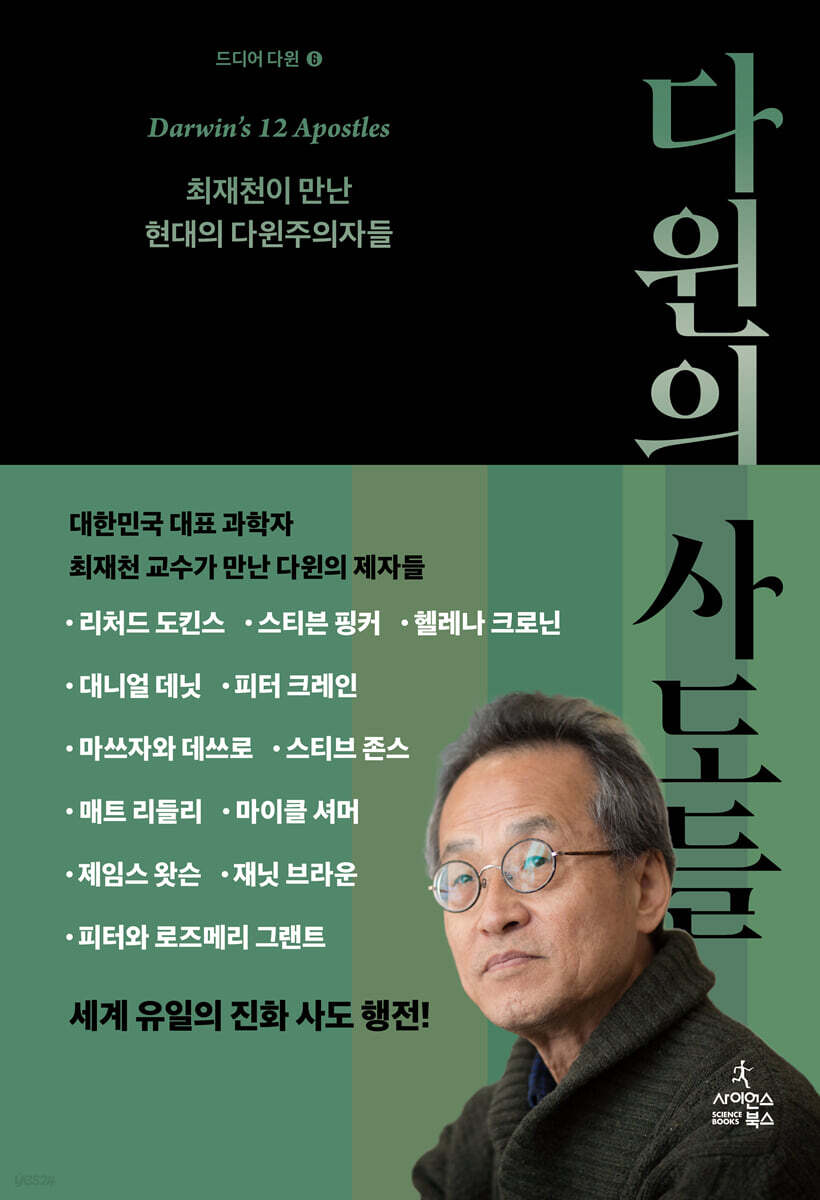
Why is Darwin important? Choi Jae-cheon asks and the world answers! We still return to Darwin's well and quench our thirst with his waters. -Irvin DeBoer (Professor of Anthropology, Harvard University) Professor Choi Jae-cheon, a leading scientist in South Korea, meets Darwin's disciples. February 12, 1809 is the birthday of Charles Robert Darwin, the founder of the theory of evolution through natural selection. 214 years after Darwin's birth and 164 years after the publication of On the Origin of Species, Darwin's theory has been firmly established as the foundation of modern biology and the pillar of modern science. The status of Darwin's theory of evolution, also known as Darwinism, in Korean society is slowly but surely rising thanks to the efforts of many people. For example, the Korean Society for Evolutionary Studies was launched in September of last year. The person who has played the greatest role in raising the status of Darwinism in Korean society is Professor Choi Jae-cheon of the Department of Ecological Sciences at Ewha Womans University. Since his debut in the publishing world in 1999 with "Discovery of the Ant Empire," which introduced the sociality of ants in a fun way based on the latest research in sociobiology and animal behavior, he has published nearly 50 books and translated works, and has been an evangelist for evolutionary biology, actively introducing Darwin's ideas and the insights of modern life science to the public. In addition, he played a role in the abolition of the household head system by arguing that if there was a head of household system in nature that required a male head of the household, it would have been a woman, not a man. He also started a wave of consilience and fusion that broke down the system of separation between liberal arts and science that had dominated Korean education and academia for over 100 years by translating and publishing Consilience, a book by Edward Wilson, his advisor at Harvard. He was deeply involved in the planning and design of the National Institute of Ecology and served as its first director, thereby laying the foundation for the National Institute of Ecology to develop into an academic research institute rather than a simple exhibition institution. He also served as the civilian chairman of the COVID-19 Daily Life Recovery Support Committee and prepared a master plan for pandemic prevention and daily life recovery from the perspective of evolutionary medicine. Professor Choi has had a career that can be called a true apostle, literally combining the theory and practice of Darwinism. Professor Jae-Cheon Choi's new book, "Darwin's 12 Apostles," published to commemorate Darwin's birthday in 2023, is a collection of interviews with Darwinists from around the world that shows that Professor Choi's path is not lonely, that there are companions walking the path of Darwinism together all over the world, and that Darwin's evolutionary insights have deeply permeated the academic world from science to economics and philosophy since the Enlightenment. |
- You can preview some of the book's contents.
Preview
index
Publisher's Note │ On the Publication of the "Darwin at Last" Series … … … 5
Preface │ Darwin's 'Army' … … … 13
01 First Apostles Peter and Rosemary Grant: Sworn Witnesses in Darwin's Court... 27
02 Second Apostle Helena Cronin: Ants and Peacocks, What More Could You Need? … … … 63
03 Third Apostle Steven Pinker: The Evolutionary Psychologist Who Makes the Familiar Strange… … … 113
04 The Fourth Apostle Richard Dawkins: Mr. Darwin with the Eyes of Genes… … … 147
05 The Fifth Apostle, Daniel Dennett: Philosophizing on Darwin… … … 183
06 The Sixth Apostle Peter Crane: Botanist Darwin, and his botanical colleagues… … … 213
07 The Seventh Apostle, Tetsuro Matsuzawa: Looking into the Heart… … … 245
08 Eighth Apostle Steve Jones: Blue-Collar Darwinian… … … 271
09 The Ninth and Tenth Apostles Matt Ridley and Michael Shermer: Modern-Day Darwinian Bulldogs … … … 313
10 The Eleventh Apostle James Watson: “The most important thing in the world, more important than a mother” … … … 385
11 Twelfth Apostle Janet Brown: So who is Darwin? … … … 423
Conclusion │ WikiDawinia … … … 451
Further Reading… … … 457
Copyright of the painting… … … 464
Search … … … 465
Preface │ Darwin's 'Army' … … … 13
01 First Apostles Peter and Rosemary Grant: Sworn Witnesses in Darwin's Court... 27
02 Second Apostle Helena Cronin: Ants and Peacocks, What More Could You Need? … … … 63
03 Third Apostle Steven Pinker: The Evolutionary Psychologist Who Makes the Familiar Strange… … … 113
04 The Fourth Apostle Richard Dawkins: Mr. Darwin with the Eyes of Genes… … … 147
05 The Fifth Apostle, Daniel Dennett: Philosophizing on Darwin… … … 183
06 The Sixth Apostle Peter Crane: Botanist Darwin, and his botanical colleagues… … … 213
07 The Seventh Apostle, Tetsuro Matsuzawa: Looking into the Heart… … … 245
08 Eighth Apostle Steve Jones: Blue-Collar Darwinian… … … 271
09 The Ninth and Tenth Apostles Matt Ridley and Michael Shermer: Modern-Day Darwinian Bulldogs … … … 313
10 The Eleventh Apostle James Watson: “The most important thing in the world, more important than a mother” … … … 385
11 Twelfth Apostle Janet Brown: So who is Darwin? … … … 423
Conclusion │ WikiDawinia … … … 451
Further Reading… … … 457
Copyright of the painting… … … 464
Search … … … 465
Detailed image

Publisher's Review
Why is Darwin important?
Choi Jae-cheon asks and the world answers!
We still return to Darwin's well and quench our thirst with his waters.
-Irvin DeBoer (Professor of Anthropology, Harvard University)
Professor Choi Jae-cheon, a leading scientist in South Korea, meets Darwin's disciples.
February 12, 1809 is the birthday of Charles Robert Darwin, the founder of the theory of evolution through natural selection.
214 years after Darwin's birth and 164 years after the publication of On the Origin of Species, Darwin's theory has been firmly established as the foundation of modern biology and the pillar of modern science.
The status of Darwin's theory of evolution, also known as Darwinism, in Korean society is slowly but surely rising thanks to the efforts of many people.
For example, the Korean Society for Evolutionary Studies was launched in September of last year.
The person who has played the greatest role in raising the status of Darwinism in Korean society is Professor Choi Jae-cheon of the Department of Ecological Sciences at Ewha Womans University.
Since his debut in the publishing world in 1999 with "Discovery of the Ant Empire," which introduced the sociality of ants in a fun way based on the latest research in sociobiology and animal behavior, he has published nearly 50 books and translated works, and has been an evangelist for evolutionary biology, actively introducing Darwin's ideas and the insights of modern life science to the public.
In addition, he played a role in the abolition of the household head system by arguing that if there was a head of household system in nature that required a male head of the household, it would have been a woman, not a man. He also started a wave of consilience and fusion that broke down the system of separation between liberal arts and science that had dominated Korean education and academia for over 100 years by translating and publishing Consilience, a book by Edward Wilson, his advisor at Harvard. He was deeply involved in the planning and design of the National Institute of Ecology and served as its first director, thereby laying the foundation for the National Institute of Ecology to develop into an academic research institute rather than a simple exhibition institution. He also served as the civilian chairman of the COVID-19 Daily Life Recovery Support Committee and prepared a master plan for pandemic prevention and daily life recovery from the perspective of evolutionary medicine.
Professor Choi has had a career that can be called a true apostle, literally combining the theory and practice of Darwinism.
Professor Jae-Cheon Choi's new book, "Darwin's 12 Apostles," published to commemorate Darwin's birthday in 2023, is a collection of interviews with Darwinists from around the world that shows that Professor Choi's path is not lonely, that there are companions walking the path of Darwinism together all over the world, and that Darwin's evolutionary insights have deeply permeated the academic world from science to economics and philosophy since the Enlightenment.
The list of interviewees (inteveiwee) who participated in this interview collection is as follows.
Peter and Rosemary Grant, a couple who studied Darwin's finches (finches) for nearly 50 years in the Galapagos Islands, known as the birthplace of Darwinism, experimentally proved the phenomena of evolution through natural selection, species differentiation through survival of the fittest, and expansion of biodiversity.
(Chapter 1: The First Apostle) Helena Cronin, a historian of science and philosopher, clearly explained the history of the formation and development of the concept of sexual selection, one of the two pillars of Darwinian evolution along with natural selection.
(Chapter 2 The Second Apostle)
Steven Pinker, who studies human cognition and language at the forefront of evolutionary psychology, a product of the fusion of psychology and biology predicted by Darwin in 'Origin of Species'.
(Chapter 3, Third Apostle) Richard Dawkins reinterpreted and developed Darwinian insights from the perspective of genetics, which made remarkable progress in the early to mid-20th century with Mendel's genetics and the discovery of the double helix structure of DNA.
(Chapter 4, Fourth Apostle) Daniel Dennett, a biological philosopher who thoroughly reconstructs humanities issues that were previously considered only philosophical tasks, such as consciousness, religion, free will, and cultural evolution, based on Darwinism.
(Chapter 5, The Fifth Apostle)
Peter Crane, a botanist who traces the evolutionary tree of plants using fossils and former director of the Field Museum of Natural History in Chicago and the Royal Botanic Gardens, Kew, in London.
(Chapter 6, Sixth Apostle) Tetsuro Matsuzawa, the orthodox successor of Japanese primatology who has achieved a unique history and a pioneer in the study of ape language.
(Chapter 7, Seventh Apostle) Steve Jones has been working hard to spread Darwin's ideas and the development of biology to the public through broadcasts, books, and lectures.
(Chapter 8, The Eighth Apostle) Science writer Matt Ridley (Chapter 9, The Ninth Apostle), one of Darwin's most eloquent spokespeople, and Michael Shermer (Chapter 9, The Tenth Apostle), who has been a strong defender of Darwin's theory of evolution and a leader in the skepticism movement against pseudoscience.
James Watson, who discovered the double helix structure of DNA and was considered a 20th century biologist himself.
(Chapter 10, The Eleventh Apostle) Janet Brown, author of 『A Biography of Charles Darwin』, who recreated Darwin's life and achievements, his personality and actions more accurately than anyone else.
(Chapter 11 The Twelfth Apostle)
Professor Choi Jae-cheon converses with these twelve apostles (he counts Peter and Rosemary Grant as one apostle), asking what kind of 'human' and 'scientist' Charles Darwin was, what the meaning of 'evolution' as used by Darwin and in biology is, how Darwin's achievements differ from those of other great scientists such as Newton or Einstein, what influence Darwinism has not only on science but also on philosophy, religion, and even on human daily life, how each Darwinist, Darwin's apostles featured in this book, accept and understand the theory of evolution, and why Darwin is important in the first place.
Professor Choi said this in his “Conclusion” after organizing all the interviews.
Looking back on the many things I have done in my life, I see that they were all done with Darwin's teachings in mind.
In 2009, I met with twelve fellow apostles from around the world and revisited their acts together, and I learned and realized so much.
This book is not a collection of one-sided interviews in which non-experts ask questions and experts answer.
It is a collection of honest conversations between the apostles.
We generally joined together in praising our teacher and honoring his achievements.
But sometimes I bumped into things and sometimes I took back the words I had said.
If you want to learn from Darwin's apostles, read their books.
You just have to listen to their lectures.
But honest conversation can bring out stories that lie deep within us, or even at the back of our minds, that we cannot find in books or lectures.
To do that, I often asked odd and uncomfortable questions, not the ones in the script.
I hope readers of this book enjoy this tense tension.
-In the closing remarks
Richard Dawkins, Steven Pinker, Helena Cronin, Daniel Dennett, Peter Crane, Tetsuro Matsuzawa, Steve Jones, Matt Ridley, Michael Shermer, James Watson,
Janet Brown, Peter Grant, and Rosemary Grant
The world's only evolutionary story told by the great Darwin's disciples!
This book was originally planned as a companion to 『Darwinian Intelligence: Jae-Cheon Choi's Essays on Evolution』, which was first published in 2012 and then revised and expanded in 2022, 10 years later.
In 2005, Professor Choi Jae-cheon created the Darwin Forum, a Darwin anthology publication project called "Finally Darwin," which brought together Darwinists from our society. This project was planned as a commentary to introduce the ideas and achievements of contemporary Darwinists and the development of modern evolutionary theory, along with "Darwin Intelligence," which deals with the basic concepts and theories of Darwinian evolutionary theory.
However, the publication of this book was also delayed due to delays in reviewing and revising the interviewees' interviews.
With the publication of 『The Origin of Species』 translated by Professor Jang Dae-ik in 2019 and 『The Expression of Emotions in Humans and Animals』 translated by Professor Kim Seong-han in 2020, the publication of the "Finally Darwin" series, which can be said to be the only Darwin anthology in Korea, has been in full swing, and the finishing work on this book and the revision and expansion of 『Darwin's Intelligence』 have also been accelerated, and on November 24, 2022, the second edition of 『Darwin's Intelligence』 was published with updated content and additional articles on pandemics and coevolution, the evolution of the mind, the evolution of music, and Homo symbious. On February 14, 2023, the book 『Darwin's Apostles』 was published, marking the 214th anniversary of Darwin's birth.
With this, Professor Choi Jae-cheon's plan to encompass the theory and practice of modern Darwinism has come to fruition, 18 years after the formation of the Darwin Forum.
(Darwin's second and third volumes, 『The Descent of Man and Sexual Selection』, translated by Professors Choi Jae-cheon and Kim Seong-han, are finally scheduled for publication in 2024.)
Professor Choi Jae-cheon prefaces this book with a passage titled "Darwin's 'Army.'" He points out that just as BTS's fandom, the "Army," "embodied BTS's music and messages, then actively reproduced and disseminated them," helped catapult BTS to the ranks of the world's top groups, Darwin and his theory of evolution would not have spread or developed without the fandom of his time, who could be called his "Army," and the current fandom who call themselves his disciples and apostles and are active in various scientific fields today.
Darwinism is literally the product of a supremely “spontaneous and effective collective intelligence.”
The book 『Darwinian Intelligence』 introduces the core concepts and theories of 'Darwinian intelligence', a type of collective intelligence, through 29 keywords, and the book 『Darwin's Apostles』, which was recently published, vividly tells the story of the human beings who make up this collective intelligence.
Using these books as a stepping stone, I dream of 'WikiDarwinia', which explores the ultimate cause of nature and all things in the universe.
During my PhD at Harvard University, I worked as a teaching assistant in the "Human Evolutionary Biology" class taught by legendary anthropology professor Irvin DeBoer.
Born in Joy, Texas, a small town with a population of less than 100, he was known for his moving lectures, almost like sermons, perhaps due to the influence of his father, who was the pastor of the town church.
When he finished his lectures, Harvard students would often jump to their feet, clap, and shout “Amen.”
His closing remark at the end of the lecture, “We still return to Darwin’s fountain and quench our thirst with his waters,” touched my heart countless times as I compiled this book.
I apologize for lumping together Darwin's twelve apostles, who are like stars, but no matter how much we may think we have discovered something new, we are all offering our thoughts to Darwin, who is now lying in his grave.
Have you ever seen a more spontaneous and effective example of collective intelligence? In Kim Hoon's novel "Boiling Ramen," there's a famous quote: "Darwin is still observing, and the theory of evolution is evolving."
Yes, that's right.
Modern Darwin disciples are still observing, and thanks to them, Darwin's theory of evolution is still evolving.
I call this 'WikiDarwinia'. - From the closing remarks
A condensed history of 150 years of Darwinism
"Finally Darwin" series interview collection!
The best way to understand Darwin's life and achievements is to read his original texts.
However, the vivid stories of those who have devoted their lives to Darwin and studied him intensely in various fields, from biology to philosophy, provide insight into the profound meaning of his life and achievements that even Darwin himself was unaware of.
The overall picture of Darwin and his ideas, created by the convergence of these voices, is astonishing even to readers who have been interested in Darwin and his theory of evolution.
At the same time, we can see that Darwin's theory of evolution is still accepted as the most fundamental principle of life sciences, nearly 200 years later, and that it helps us search for extraterrestrial life and find solutions to economic crises and political conflicts.
I invite you to witness for yourself the voices of those who are arguably the greatest Darwinists of our time.
Below are Darwin's disciples' answers to the common question of this interview project: "Why is Darwin important?"
Darwinian evolution tells us where we came from.
Having a theory that explains what happens to all living things allows us to understand ourselves better than we would without such a theory.
─Peter and Rosemary Grant
And last but not least, Darwin's contributions symbolize human progress.
Darwinism is not only the pinnacle of science, but also a central legacy of the Enlightenment.
─Helena Cronin
No one can definitively prove that Darwin's theory is the best idea ever, but no one can deny that it is certainly one of the best.
Because it bridges the gap between the living and non-living worlds.
Darwin's theory explains that design, purpose, and teleology arise from processes that themselves have no designer or purpose.
In this respect, Darwin's theory unifies our understanding of the universe.
─Steven Pinker
Darwin is perhaps the person who provided the answer to the most important question for us humans: “Why do we exist?”
─Richard Dawkins
Darwin's theory of evolution was the most brilliant idea ever devised.
The single scientific idea that ties everything we know together is evolution.
… …Darwin was the one who showed how carbon atoms and glucose molecules could become poetry.
─Daniel Dennett
The importance of the ideas he came up with can be found everywhere in biology, and some even say in fields other than biology.
Evolutionary thinking can be applied to any level of biology.
So Dobzhansky's famous statement that "nothing in biology makes sense outside of evolution" is absolutely true.
─Peter Crane
Yes, Darwin is important.
I learned a lot about evolution from him.
I have complete respect for Darwin, but he is only a part of me, not all of me.
─Tetsuro Matsuzawa
Newtonian physics was wrong in a profound sense.
Mendel and Darwin's theories are correct in a profound sense.
─Steve Jones
I think Darwin was important because he brilliantly demonstrated that complex systems can arise from simpler ones through a spontaneous, undirected process, from the bottom up.
We don't even have words yet to describe this fascinating and universal phenomenon.
─Matt Ridley
The reason Darwin is important is, first, that he answered the creationist argument that life requires a top-down designer and offered us a bottom-up designer.
But on a deeper level, he answered questions like, "Who are we? Where do we come from? Where are we going? What is our place in nature?"
In that sense, the reason Darwin is important is that he gave us a myth that has value as fact.
─Michael Shermer
We cannot understand life without Darwin.
And life is the most important thing on Earth.
─James Watson
He is important because he succeeded in integrating many different fields of biology into one grand system of thought.
Although the theory of evolution by natural selection has undergone many changes since 1859, and molecular biology has completely changed the way we think about biodiversity, his theory remains valid.
That's why he's important.
─Janet Brown
Choi Jae-cheon asks and the world answers!
We still return to Darwin's well and quench our thirst with his waters.
-Irvin DeBoer (Professor of Anthropology, Harvard University)
Professor Choi Jae-cheon, a leading scientist in South Korea, meets Darwin's disciples.
February 12, 1809 is the birthday of Charles Robert Darwin, the founder of the theory of evolution through natural selection.
214 years after Darwin's birth and 164 years after the publication of On the Origin of Species, Darwin's theory has been firmly established as the foundation of modern biology and the pillar of modern science.
The status of Darwin's theory of evolution, also known as Darwinism, in Korean society is slowly but surely rising thanks to the efforts of many people.
For example, the Korean Society for Evolutionary Studies was launched in September of last year.
The person who has played the greatest role in raising the status of Darwinism in Korean society is Professor Choi Jae-cheon of the Department of Ecological Sciences at Ewha Womans University.
Since his debut in the publishing world in 1999 with "Discovery of the Ant Empire," which introduced the sociality of ants in a fun way based on the latest research in sociobiology and animal behavior, he has published nearly 50 books and translated works, and has been an evangelist for evolutionary biology, actively introducing Darwin's ideas and the insights of modern life science to the public.
In addition, he played a role in the abolition of the household head system by arguing that if there was a head of household system in nature that required a male head of the household, it would have been a woman, not a man. He also started a wave of consilience and fusion that broke down the system of separation between liberal arts and science that had dominated Korean education and academia for over 100 years by translating and publishing Consilience, a book by Edward Wilson, his advisor at Harvard. He was deeply involved in the planning and design of the National Institute of Ecology and served as its first director, thereby laying the foundation for the National Institute of Ecology to develop into an academic research institute rather than a simple exhibition institution. He also served as the civilian chairman of the COVID-19 Daily Life Recovery Support Committee and prepared a master plan for pandemic prevention and daily life recovery from the perspective of evolutionary medicine.
Professor Choi has had a career that can be called a true apostle, literally combining the theory and practice of Darwinism.
Professor Jae-Cheon Choi's new book, "Darwin's 12 Apostles," published to commemorate Darwin's birthday in 2023, is a collection of interviews with Darwinists from around the world that shows that Professor Choi's path is not lonely, that there are companions walking the path of Darwinism together all over the world, and that Darwin's evolutionary insights have deeply permeated the academic world from science to economics and philosophy since the Enlightenment.
The list of interviewees (inteveiwee) who participated in this interview collection is as follows.
Peter and Rosemary Grant, a couple who studied Darwin's finches (finches) for nearly 50 years in the Galapagos Islands, known as the birthplace of Darwinism, experimentally proved the phenomena of evolution through natural selection, species differentiation through survival of the fittest, and expansion of biodiversity.
(Chapter 1: The First Apostle) Helena Cronin, a historian of science and philosopher, clearly explained the history of the formation and development of the concept of sexual selection, one of the two pillars of Darwinian evolution along with natural selection.
(Chapter 2 The Second Apostle)
Steven Pinker, who studies human cognition and language at the forefront of evolutionary psychology, a product of the fusion of psychology and biology predicted by Darwin in 'Origin of Species'.
(Chapter 3, Third Apostle) Richard Dawkins reinterpreted and developed Darwinian insights from the perspective of genetics, which made remarkable progress in the early to mid-20th century with Mendel's genetics and the discovery of the double helix structure of DNA.
(Chapter 4, Fourth Apostle) Daniel Dennett, a biological philosopher who thoroughly reconstructs humanities issues that were previously considered only philosophical tasks, such as consciousness, religion, free will, and cultural evolution, based on Darwinism.
(Chapter 5, The Fifth Apostle)
Peter Crane, a botanist who traces the evolutionary tree of plants using fossils and former director of the Field Museum of Natural History in Chicago and the Royal Botanic Gardens, Kew, in London.
(Chapter 6, Sixth Apostle) Tetsuro Matsuzawa, the orthodox successor of Japanese primatology who has achieved a unique history and a pioneer in the study of ape language.
(Chapter 7, Seventh Apostle) Steve Jones has been working hard to spread Darwin's ideas and the development of biology to the public through broadcasts, books, and lectures.
(Chapter 8, The Eighth Apostle) Science writer Matt Ridley (Chapter 9, The Ninth Apostle), one of Darwin's most eloquent spokespeople, and Michael Shermer (Chapter 9, The Tenth Apostle), who has been a strong defender of Darwin's theory of evolution and a leader in the skepticism movement against pseudoscience.
James Watson, who discovered the double helix structure of DNA and was considered a 20th century biologist himself.
(Chapter 10, The Eleventh Apostle) Janet Brown, author of 『A Biography of Charles Darwin』, who recreated Darwin's life and achievements, his personality and actions more accurately than anyone else.
(Chapter 11 The Twelfth Apostle)
Professor Choi Jae-cheon converses with these twelve apostles (he counts Peter and Rosemary Grant as one apostle), asking what kind of 'human' and 'scientist' Charles Darwin was, what the meaning of 'evolution' as used by Darwin and in biology is, how Darwin's achievements differ from those of other great scientists such as Newton or Einstein, what influence Darwinism has not only on science but also on philosophy, religion, and even on human daily life, how each Darwinist, Darwin's apostles featured in this book, accept and understand the theory of evolution, and why Darwin is important in the first place.
Professor Choi said this in his “Conclusion” after organizing all the interviews.
Looking back on the many things I have done in my life, I see that they were all done with Darwin's teachings in mind.
In 2009, I met with twelve fellow apostles from around the world and revisited their acts together, and I learned and realized so much.
This book is not a collection of one-sided interviews in which non-experts ask questions and experts answer.
It is a collection of honest conversations between the apostles.
We generally joined together in praising our teacher and honoring his achievements.
But sometimes I bumped into things and sometimes I took back the words I had said.
If you want to learn from Darwin's apostles, read their books.
You just have to listen to their lectures.
But honest conversation can bring out stories that lie deep within us, or even at the back of our minds, that we cannot find in books or lectures.
To do that, I often asked odd and uncomfortable questions, not the ones in the script.
I hope readers of this book enjoy this tense tension.
-In the closing remarks
Richard Dawkins, Steven Pinker, Helena Cronin, Daniel Dennett, Peter Crane, Tetsuro Matsuzawa, Steve Jones, Matt Ridley, Michael Shermer, James Watson,
Janet Brown, Peter Grant, and Rosemary Grant
The world's only evolutionary story told by the great Darwin's disciples!
This book was originally planned as a companion to 『Darwinian Intelligence: Jae-Cheon Choi's Essays on Evolution』, which was first published in 2012 and then revised and expanded in 2022, 10 years later.
In 2005, Professor Choi Jae-cheon created the Darwin Forum, a Darwin anthology publication project called "Finally Darwin," which brought together Darwinists from our society. This project was planned as a commentary to introduce the ideas and achievements of contemporary Darwinists and the development of modern evolutionary theory, along with "Darwin Intelligence," which deals with the basic concepts and theories of Darwinian evolutionary theory.
However, the publication of this book was also delayed due to delays in reviewing and revising the interviewees' interviews.
With the publication of 『The Origin of Species』 translated by Professor Jang Dae-ik in 2019 and 『The Expression of Emotions in Humans and Animals』 translated by Professor Kim Seong-han in 2020, the publication of the "Finally Darwin" series, which can be said to be the only Darwin anthology in Korea, has been in full swing, and the finishing work on this book and the revision and expansion of 『Darwin's Intelligence』 have also been accelerated, and on November 24, 2022, the second edition of 『Darwin's Intelligence』 was published with updated content and additional articles on pandemics and coevolution, the evolution of the mind, the evolution of music, and Homo symbious. On February 14, 2023, the book 『Darwin's Apostles』 was published, marking the 214th anniversary of Darwin's birth.
With this, Professor Choi Jae-cheon's plan to encompass the theory and practice of modern Darwinism has come to fruition, 18 years after the formation of the Darwin Forum.
(Darwin's second and third volumes, 『The Descent of Man and Sexual Selection』, translated by Professors Choi Jae-cheon and Kim Seong-han, are finally scheduled for publication in 2024.)
Professor Choi Jae-cheon prefaces this book with a passage titled "Darwin's 'Army.'" He points out that just as BTS's fandom, the "Army," "embodied BTS's music and messages, then actively reproduced and disseminated them," helped catapult BTS to the ranks of the world's top groups, Darwin and his theory of evolution would not have spread or developed without the fandom of his time, who could be called his "Army," and the current fandom who call themselves his disciples and apostles and are active in various scientific fields today.
Darwinism is literally the product of a supremely “spontaneous and effective collective intelligence.”
The book 『Darwinian Intelligence』 introduces the core concepts and theories of 'Darwinian intelligence', a type of collective intelligence, through 29 keywords, and the book 『Darwin's Apostles』, which was recently published, vividly tells the story of the human beings who make up this collective intelligence.
Using these books as a stepping stone, I dream of 'WikiDarwinia', which explores the ultimate cause of nature and all things in the universe.
During my PhD at Harvard University, I worked as a teaching assistant in the "Human Evolutionary Biology" class taught by legendary anthropology professor Irvin DeBoer.
Born in Joy, Texas, a small town with a population of less than 100, he was known for his moving lectures, almost like sermons, perhaps due to the influence of his father, who was the pastor of the town church.
When he finished his lectures, Harvard students would often jump to their feet, clap, and shout “Amen.”
His closing remark at the end of the lecture, “We still return to Darwin’s fountain and quench our thirst with his waters,” touched my heart countless times as I compiled this book.
I apologize for lumping together Darwin's twelve apostles, who are like stars, but no matter how much we may think we have discovered something new, we are all offering our thoughts to Darwin, who is now lying in his grave.
Have you ever seen a more spontaneous and effective example of collective intelligence? In Kim Hoon's novel "Boiling Ramen," there's a famous quote: "Darwin is still observing, and the theory of evolution is evolving."
Yes, that's right.
Modern Darwin disciples are still observing, and thanks to them, Darwin's theory of evolution is still evolving.
I call this 'WikiDarwinia'. - From the closing remarks
A condensed history of 150 years of Darwinism
"Finally Darwin" series interview collection!
The best way to understand Darwin's life and achievements is to read his original texts.
However, the vivid stories of those who have devoted their lives to Darwin and studied him intensely in various fields, from biology to philosophy, provide insight into the profound meaning of his life and achievements that even Darwin himself was unaware of.
The overall picture of Darwin and his ideas, created by the convergence of these voices, is astonishing even to readers who have been interested in Darwin and his theory of evolution.
At the same time, we can see that Darwin's theory of evolution is still accepted as the most fundamental principle of life sciences, nearly 200 years later, and that it helps us search for extraterrestrial life and find solutions to economic crises and political conflicts.
I invite you to witness for yourself the voices of those who are arguably the greatest Darwinists of our time.
Below are Darwin's disciples' answers to the common question of this interview project: "Why is Darwin important?"
Darwinian evolution tells us where we came from.
Having a theory that explains what happens to all living things allows us to understand ourselves better than we would without such a theory.
─Peter and Rosemary Grant
And last but not least, Darwin's contributions symbolize human progress.
Darwinism is not only the pinnacle of science, but also a central legacy of the Enlightenment.
─Helena Cronin
No one can definitively prove that Darwin's theory is the best idea ever, but no one can deny that it is certainly one of the best.
Because it bridges the gap between the living and non-living worlds.
Darwin's theory explains that design, purpose, and teleology arise from processes that themselves have no designer or purpose.
In this respect, Darwin's theory unifies our understanding of the universe.
─Steven Pinker
Darwin is perhaps the person who provided the answer to the most important question for us humans: “Why do we exist?”
─Richard Dawkins
Darwin's theory of evolution was the most brilliant idea ever devised.
The single scientific idea that ties everything we know together is evolution.
… …Darwin was the one who showed how carbon atoms and glucose molecules could become poetry.
─Daniel Dennett
The importance of the ideas he came up with can be found everywhere in biology, and some even say in fields other than biology.
Evolutionary thinking can be applied to any level of biology.
So Dobzhansky's famous statement that "nothing in biology makes sense outside of evolution" is absolutely true.
─Peter Crane
Yes, Darwin is important.
I learned a lot about evolution from him.
I have complete respect for Darwin, but he is only a part of me, not all of me.
─Tetsuro Matsuzawa
Newtonian physics was wrong in a profound sense.
Mendel and Darwin's theories are correct in a profound sense.
─Steve Jones
I think Darwin was important because he brilliantly demonstrated that complex systems can arise from simpler ones through a spontaneous, undirected process, from the bottom up.
We don't even have words yet to describe this fascinating and universal phenomenon.
─Matt Ridley
The reason Darwin is important is, first, that he answered the creationist argument that life requires a top-down designer and offered us a bottom-up designer.
But on a deeper level, he answered questions like, "Who are we? Where do we come from? Where are we going? What is our place in nature?"
In that sense, the reason Darwin is important is that he gave us a myth that has value as fact.
─Michael Shermer
We cannot understand life without Darwin.
And life is the most important thing on Earth.
─James Watson
He is important because he succeeded in integrating many different fields of biology into one grand system of thought.
Although the theory of evolution by natural selection has undergone many changes since 1859, and molecular biology has completely changed the way we think about biodiversity, his theory remains valid.
That's why he's important.
─Janet Brown
GOODS SPECIFICS
- Date of issue: February 12, 2023
- Format: Hardcover book binding method guide
- Page count, weight, size: 476 pages | 716g | 128*188*40mm
- ISBN13: 9791192107325
- ISBN10: 1192107322
You may also like
카테고리
korean


korean

![GQ KOREA Mark (Monthly): December [2025]](http://librairie.coreenne.fr/cdn/shop/files/8ef265dbbfbf186523ed75ba7319009d.jpg?v=1765340328&width=3840)


