

deep waters
 |
Description
Book Introduction
- A visual book on deep-sea life by Claire Noubian, winner of the 2018 Goldman Environmental Prize
- A book that served as a source of inspiration for director Bong Joon-ho's deep-sea creature animation!
“Mysterious! Beautiful!”
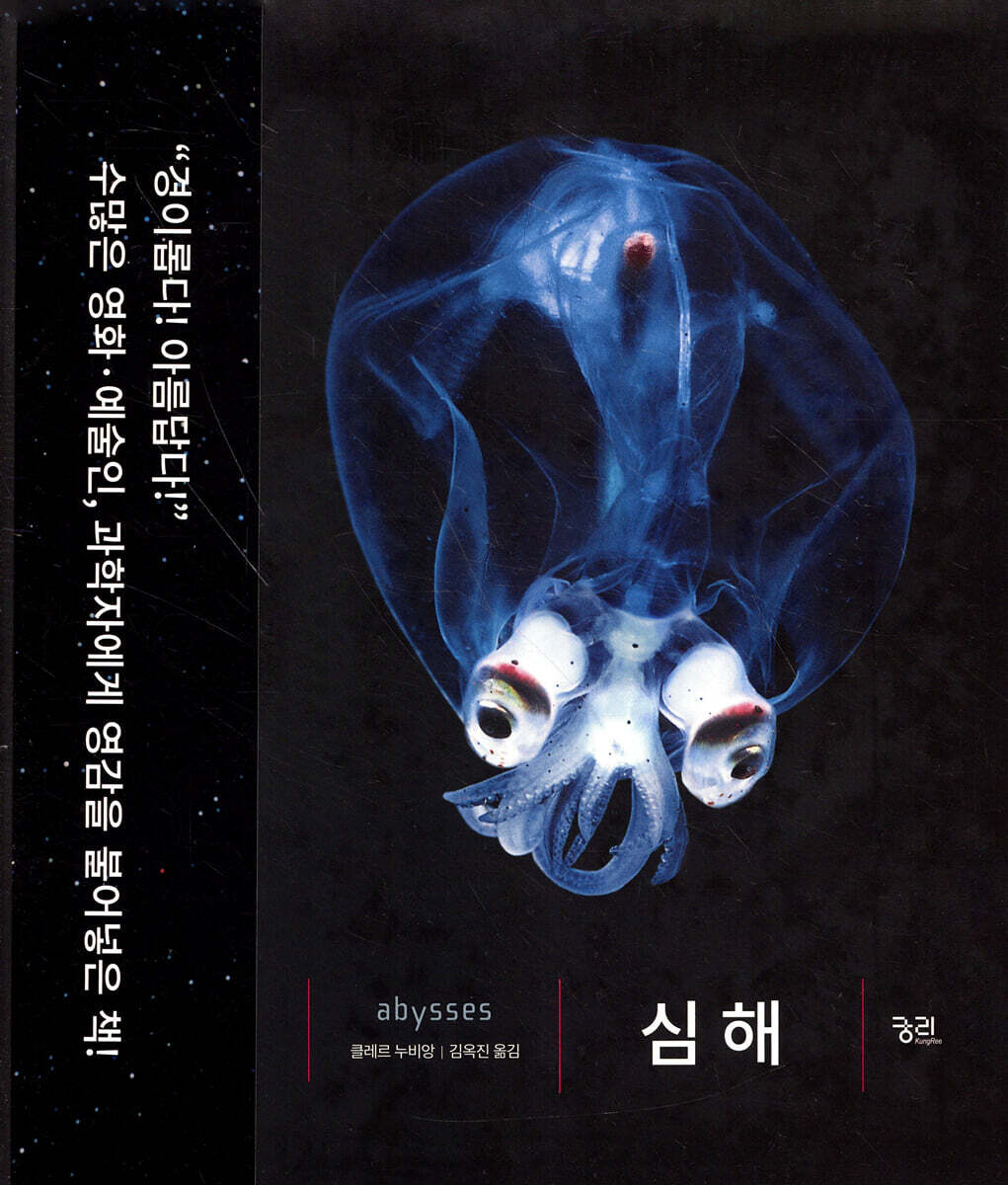
The book 『Abysses』, which has inspired countless filmmakers, artists, and scientists since its first publication in 2006, has garnered attention as it has been revealed that director Bong Joon-ho is preparing an animation about deep-sea creatures using the book as a bible.
As if observing deep-sea creatures directly where they live and marveling at their biodiversity, French nature documentary director and writer Claire Noubian takes readers on an unforgettable journey through the deep sea.
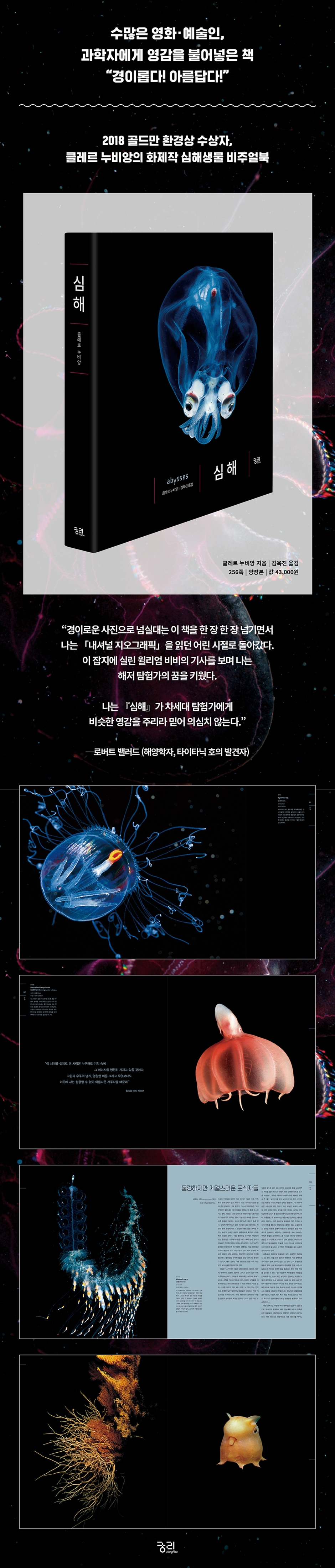
Combining over 200 photographs and scientific information, "The Deep Sea" is a book that strives to bring you closer to the deep sea than any other book.
- A book that served as a source of inspiration for director Bong Joon-ho's deep-sea creature animation!
“Mysterious! Beautiful!”
The book 『Abysses』, which has inspired countless filmmakers, artists, and scientists since its first publication in 2006, has garnered attention as it has been revealed that director Bong Joon-ho is preparing an animation about deep-sea creatures using the book as a bible.
As if observing deep-sea creatures directly where they live and marveling at their biodiversity, French nature documentary director and writer Claire Noubian takes readers on an unforgettable journey through the deep sea.
Combining over 200 photographs and scientific information, "The Deep Sea" is a book that strives to bring you closer to the deep sea than any other book.
- You can preview some of the book's contents.
Preview
index
Introduction
introduction
Life in the middle waters
Deep Sea Exploration - Cindy Lee Van Dover (College of William & Mary, USA)
Surviving in the Deep Waters - George I.
Matsumoto (Monterey Bay Oceanographic Research Institute, USA)
Chinese shadow play
The Night Ballet of Deep-Sea Life - Marcy Youngblus (Harbor Branch Oceanographic Institute, USA)
Living Lights of the Sea - Edith Wither (American Marine Research and Conservation Association)
The scene of evolution caught on film
Soft but Ravenous Predators - Lawrence Maddin (Woods Hole Oceanographic Institution, USA)
From Myth to Reality: Monsters of the Deep - Clyde Roper (Smithsonian Institution)
Are deep-sea animals living fossils? -Robert C.
Bryenhoek (Monterey Bay Oceanographic Institute, USA)
Vampire Squid from Hell
Deep sea creatures
Deep Sea: A Lifeless Desert? - Craig M.
Young (Oregon Marine Biological Laboratory, USA)
Polar Deep Sea - Michael Klages (Alfred Wegener Institute, Germany)
Monterey Trough - Gary Green (Monterey Bay Oceanographic Institute, USA)
Sharks in the Dark
Seamount: The Galapagos of the Deep -J.
Anthony Koslow (Commonwealth Scientific and Industrial Research Organisation, Ocean and Atmospheric Research Division, Australia)
Deep Sea Coral Reefs: Out of sight, out of mind
Deep-sea hydrothermal vents - Daniel Debruyère (French Institute for Marine Exploration)
Gas Fuels Life: Methane Seeps - Lisa Levin (Scripps Institution of Oceanography, USA)
The death of a whale is the beginning of life in the deep sea - Craig R.
Smith (University of Hawaii, USA)
Deep Sea Trench: The Ultimate Abyss - Kantaro Fujioka and Dugal Lindsey (Japan Agency for Marine-Earth Exploration)
The Deep Sea in Numbers
Glossary
Search
References
Acknowledgements
Photo source
introduction
Life in the middle waters
Deep Sea Exploration - Cindy Lee Van Dover (College of William & Mary, USA)
Surviving in the Deep Waters - George I.
Matsumoto (Monterey Bay Oceanographic Research Institute, USA)
Chinese shadow play
The Night Ballet of Deep-Sea Life - Marcy Youngblus (Harbor Branch Oceanographic Institute, USA)
Living Lights of the Sea - Edith Wither (American Marine Research and Conservation Association)
The scene of evolution caught on film
Soft but Ravenous Predators - Lawrence Maddin (Woods Hole Oceanographic Institution, USA)
From Myth to Reality: Monsters of the Deep - Clyde Roper (Smithsonian Institution)
Are deep-sea animals living fossils? -Robert C.
Bryenhoek (Monterey Bay Oceanographic Institute, USA)
Vampire Squid from Hell
Deep sea creatures
Deep Sea: A Lifeless Desert? - Craig M.
Young (Oregon Marine Biological Laboratory, USA)
Polar Deep Sea - Michael Klages (Alfred Wegener Institute, Germany)
Monterey Trough - Gary Green (Monterey Bay Oceanographic Institute, USA)
Sharks in the Dark
Seamount: The Galapagos of the Deep -J.
Anthony Koslow (Commonwealth Scientific and Industrial Research Organisation, Ocean and Atmospheric Research Division, Australia)
Deep Sea Coral Reefs: Out of sight, out of mind
Deep-sea hydrothermal vents - Daniel Debruyère (French Institute for Marine Exploration)
Gas Fuels Life: Methane Seeps - Lisa Levin (Scripps Institution of Oceanography, USA)
The death of a whale is the beginning of life in the deep sea - Craig R.
Smith (University of Hawaii, USA)
Deep Sea Trench: The Ultimate Abyss - Kantaro Fujioka and Dugal Lindsey (Japan Agency for Marine-Earth Exploration)
The Deep Sea in Numbers
Glossary
Search
References
Acknowledgements
Photo source
Detailed image
Publisher's Review
Meet another master of the Earth who lives in the deep sea!
Cold, dark, and oppressed by immense pressure… Many people think of the deep sea as a place devoid of life, but in reality, it is a rich world that provides a vast home for life.
This book features over 200 photographs of bizarre deep-sea creatures that defy everyone's imagination.
Deep-sea vampires, big-eared octopuses, terrifying sea monsters, living fossils, and mysterious, self-luminous creatures… French writer and documentary filmmaker Claire Noubian was drawn into the depths after seeing footage of these astonishing and beautiful deep-sea creatures.
And to share the deepest secrets of this planet with many people, we visited renowned oceanographers around the world and collected photos taken by exploration robots and manned submersibles that dive to depths of 6,000 meters for three years.
This book also includes articles by oceanographers covering a wide range of topics, from the biology of deep-sea organisms to the ecology of deep-sea habitats and the history of deep-sea exploration.
The deep sea, the largest treasure trove of life on Earth
What do we know about the deep sea?
To the beauty of the dark planet deep in the sea,
A natural heritage we must protect and admire!
On solid land, most life relies on the surface.
Even the tallest trees do not exceed 100 meters in height.
However, in the ocean, the living space spans both vertical and horizontal dimensions.
The ocean, with an average depth of 3,800 meters, covers 99% of the habitable space on Earth.
The deep sea, shrouded in eternal darkness since the beginning of time, occupies 85% of this space.
What do we know about the deep sea, the greatest reservoir of life on Earth?
Did you know that there is no plant life below 200 meters? That 90% of deep-sea creatures produce their own light? Could you imagine that deep-sea creatures can sense the changing seasons—spring, summer, fall, and winter? That a single whale carcass can feed deep-sea creatures for 10 years? That bottom trawls, which sweep the ocean floor with nets, destroy underwater habitats and put coral reefs and countless other marine species at risk of extinction? Did you know that large-scale whaling in many oceans has drastically reduced whale populations, and that deep-sea ecosystems sustained by whale carcasses are being devastated as a result?
The primary purpose of this book is to fully enjoy the bizarre appearances of deep-sea creatures that cannot be imagined until you see them firsthand.
But as you turn the pages, you discover that marine ecosystems are interconnected in ways we never dreamed possible.
The ocean, which absorbs carbon dioxide from the atmosphere, regulates the climate, and provides a habitat for marine life, is a precious space that maintains the balance of the Earth.
However, human destructive activities are leaving their traces deep in the ocean.
This book opens your eyes to the amazing biodiversity of our planet.
It reminds us that not only the beauty of our blue planet, illuminated by the sun for all to see, but also the beauty of the dark planet deep in the ocean, where light cannot penetrate, are natural heritages we must protect and admire.
Since its co-publication in Germany, France, and Italy in 2006, 『The Deep Sea』 has been translated and published in ten languages, including English, Portuguese, Spanish, Japanese, Chinese, and Korean.
After the publication of this book, Claire Noubian planned the “Deep Sea Exhibition”, which was presented at the National Museum of Natural History in Paris, and toured to Hong Kong, Singapore, Taiwan, and other countries.
Claire Noubian founded Bloom in 2005 to protect the oceans and marine life and has been campaigning against deep-sea trawling.
In recognition of his contributions, he won the Goldman Environmental Prize, often called the "Green Nobel Prize," in 2018.
A 'monster' fish with scary teeth, a squid with a transparent body,
An octopus that has converted its suction cups into glowing lights, a worm that lives in a vent that's over 80 degrees Celsius...
Let's learn about the strange creatures that live in the deep, deep sea and their ingenious survival methods!
Despite constant darkness, high pressure, freezing temperatures, and scarce food, life thrives in every ocean depth, from the Arctic to the Antarctic, from the continental margins to the deepest trenches.
The main characters are creatures with unfamiliar names, such as vampire squid, fireworks jellyfish, ghost fish, balloon eels, Pompeii worms, and samcheonbali.
The book is largely divided into two parts.
Part 1, 'Life in the Middle Sea', deals with pelagic organisms that swim or float on the seabed, while Part 2, 'Life in the Deep Sea', deals with benthic organisms that settle on the bottom.
In particular, Part 2 takes an in-depth look at benthic ecosystems such as seamounts, troughs, hydrothermal vents, and cold-water vents.
Deep-sea creatures adopt different forms, feeding methods, defensive strategies, and behaviors depending on the environment in which they live, just as they wear different clothes.
There are many fish that produce their own light in the sea between 200 and 1,000 meters deep, where sunlight shines dimly.
Among them are lights for finding food, lights for attracting mates, and lights for defense.
Cyclothone, a type of worm, uses a luminescent organ on its abdomen to camouflage itself from predators.
There are also 'traveler' creatures that come up to the surface every night where there is plenty of food and then return to the deep sea at dawn.
Deeper than 1,000 meters, where no light reaches, there are many strangely shaped creatures.
The 20-centimeter-long female black devil's anglerfish rarely moves to conserve energy and sense the subtle vibrations in the water.
The bottom of the sea, the deep sea floor, is covered with soft sediment called mud, and is home to schools of deep-sea sea urchins and sea cucumbers that feed on mud.
Also, the deep-sea living tripod fish have evolved their fins to act as supports to lift them into the ocean currents.
To be exposed to the ocean currents as much as possible.
The long-stalked sea slug bends like a windblown umbrella, collecting fine particles from the water passing by.
The area surrounding hydrothermal vents, which spew out hot water 2,500 meters below sea level, is full of heavy metals and toxic sulfides that are deadly to humans.
The giant crown beetles thrive here in high densities thanks to bacteria that convert chemicals into nutrients.
Cold, dark, and oppressed by immense pressure… Many people think of the deep sea as a place devoid of life, but in reality, it is a rich world that provides a vast home for life.
This book features over 200 photographs of bizarre deep-sea creatures that defy everyone's imagination.
Deep-sea vampires, big-eared octopuses, terrifying sea monsters, living fossils, and mysterious, self-luminous creatures… French writer and documentary filmmaker Claire Noubian was drawn into the depths after seeing footage of these astonishing and beautiful deep-sea creatures.
And to share the deepest secrets of this planet with many people, we visited renowned oceanographers around the world and collected photos taken by exploration robots and manned submersibles that dive to depths of 6,000 meters for three years.
This book also includes articles by oceanographers covering a wide range of topics, from the biology of deep-sea organisms to the ecology of deep-sea habitats and the history of deep-sea exploration.
The deep sea, the largest treasure trove of life on Earth
What do we know about the deep sea?
To the beauty of the dark planet deep in the sea,
A natural heritage we must protect and admire!
On solid land, most life relies on the surface.
Even the tallest trees do not exceed 100 meters in height.
However, in the ocean, the living space spans both vertical and horizontal dimensions.
The ocean, with an average depth of 3,800 meters, covers 99% of the habitable space on Earth.
The deep sea, shrouded in eternal darkness since the beginning of time, occupies 85% of this space.
What do we know about the deep sea, the greatest reservoir of life on Earth?
Did you know that there is no plant life below 200 meters? That 90% of deep-sea creatures produce their own light? Could you imagine that deep-sea creatures can sense the changing seasons—spring, summer, fall, and winter? That a single whale carcass can feed deep-sea creatures for 10 years? That bottom trawls, which sweep the ocean floor with nets, destroy underwater habitats and put coral reefs and countless other marine species at risk of extinction? Did you know that large-scale whaling in many oceans has drastically reduced whale populations, and that deep-sea ecosystems sustained by whale carcasses are being devastated as a result?
The primary purpose of this book is to fully enjoy the bizarre appearances of deep-sea creatures that cannot be imagined until you see them firsthand.
But as you turn the pages, you discover that marine ecosystems are interconnected in ways we never dreamed possible.
The ocean, which absorbs carbon dioxide from the atmosphere, regulates the climate, and provides a habitat for marine life, is a precious space that maintains the balance of the Earth.
However, human destructive activities are leaving their traces deep in the ocean.
This book opens your eyes to the amazing biodiversity of our planet.
It reminds us that not only the beauty of our blue planet, illuminated by the sun for all to see, but also the beauty of the dark planet deep in the ocean, where light cannot penetrate, are natural heritages we must protect and admire.
Since its co-publication in Germany, France, and Italy in 2006, 『The Deep Sea』 has been translated and published in ten languages, including English, Portuguese, Spanish, Japanese, Chinese, and Korean.
After the publication of this book, Claire Noubian planned the “Deep Sea Exhibition”, which was presented at the National Museum of Natural History in Paris, and toured to Hong Kong, Singapore, Taiwan, and other countries.
Claire Noubian founded Bloom in 2005 to protect the oceans and marine life and has been campaigning against deep-sea trawling.
In recognition of his contributions, he won the Goldman Environmental Prize, often called the "Green Nobel Prize," in 2018.
A 'monster' fish with scary teeth, a squid with a transparent body,
An octopus that has converted its suction cups into glowing lights, a worm that lives in a vent that's over 80 degrees Celsius...
Let's learn about the strange creatures that live in the deep, deep sea and their ingenious survival methods!
Despite constant darkness, high pressure, freezing temperatures, and scarce food, life thrives in every ocean depth, from the Arctic to the Antarctic, from the continental margins to the deepest trenches.
The main characters are creatures with unfamiliar names, such as vampire squid, fireworks jellyfish, ghost fish, balloon eels, Pompeii worms, and samcheonbali.
The book is largely divided into two parts.
Part 1, 'Life in the Middle Sea', deals with pelagic organisms that swim or float on the seabed, while Part 2, 'Life in the Deep Sea', deals with benthic organisms that settle on the bottom.
In particular, Part 2 takes an in-depth look at benthic ecosystems such as seamounts, troughs, hydrothermal vents, and cold-water vents.
Deep-sea creatures adopt different forms, feeding methods, defensive strategies, and behaviors depending on the environment in which they live, just as they wear different clothes.
There are many fish that produce their own light in the sea between 200 and 1,000 meters deep, where sunlight shines dimly.
Among them are lights for finding food, lights for attracting mates, and lights for defense.
Cyclothone, a type of worm, uses a luminescent organ on its abdomen to camouflage itself from predators.
There are also 'traveler' creatures that come up to the surface every night where there is plenty of food and then return to the deep sea at dawn.
Deeper than 1,000 meters, where no light reaches, there are many strangely shaped creatures.
The 20-centimeter-long female black devil's anglerfish rarely moves to conserve energy and sense the subtle vibrations in the water.
The bottom of the sea, the deep sea floor, is covered with soft sediment called mud, and is home to schools of deep-sea sea urchins and sea cucumbers that feed on mud.
Also, the deep-sea living tripod fish have evolved their fins to act as supports to lift them into the ocean currents.
To be exposed to the ocean currents as much as possible.
The long-stalked sea slug bends like a windblown umbrella, collecting fine particles from the water passing by.
The area surrounding hydrothermal vents, which spew out hot water 2,500 meters below sea level, is full of heavy metals and toxic sulfides that are deadly to humans.
The giant crown beetles thrive here in high densities thanks to bacteria that convert chemicals into nutrients.
GOODS SPECIFICS
- Publication date: October 5, 2022
- Format: Hardcover book binding method guide
- Page count, weight, size: 256 pages | 1,926g | 225*300*25mm
- ISBN13: 9788958207795
- ISBN10: 8958207795
You may also like
카테고리
korean


korean

![GQ KOREA Mark (Monthly): December [2025]](http://librairie.coreenne.fr/cdn/shop/files/8ef265dbbfbf186523ed75ba7319009d.jpg?v=1765340328&width=3840)


