

empathetic genes
 |
Description
Book Introduction
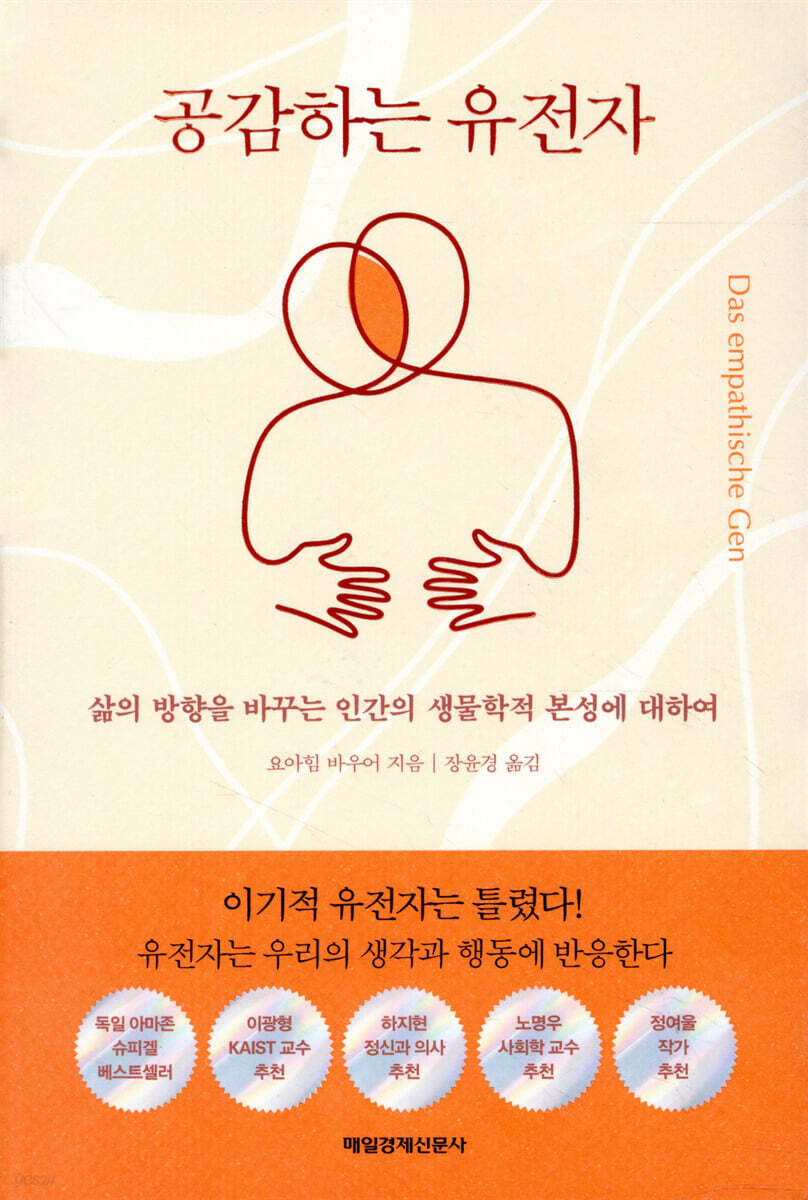
“We can change our genetic activity!” How does human lifestyle affect genes? Genetic activity and human life transformed by humanity and empathy German Amazon and Spiegel bestseller Recommended by KAIST Professor Lee Kwang-hyung, psychiatrist Ha Ji-hyun, sociology professor Noh Myung-woo, and author Jeong Yeo-ul We are now paying a heavy price for what humanity has done. From war, poverty, hatred, destruction, the climate crisis, to the coronavirus pandemic. People who only care about themselves have ruined our community and the world, trying to survive on their own. The proposition that humans are ‘selfish beings’ made all these actions possible. What does the future hold for humanity? Are humans truly inherently selfish and destructive? Is the future of humanity and the planet truly hopeless? Joachim Bauer, a renowned German neurobiologist and psychiatrist, confronts this world by advocating for "humanity." ‘Humanity’ is the biological nature of humans and is based on ‘empathy and coexistence.’ According to Joachim Bauer, our human genes are meaningful, human-friendly, and responsive to social attitudes. It also responds to environmental factors and lifestyle. Therefore, an inner attitude that is value-oriented and oriented toward a communal life leads to beneficial genetic activity, which helps us live a healthy and 'good life'. This book, from that very perspective, presents a direction for overcoming the crisis we currently face and creating a possible future. When the mind desires, the genes respond and act accordingly. By inducing beneficial genetic activity, we can create a better tomorrow and overcome the problems that plague humanity. |
- You can preview some of the book's contents.
Preview
index
Recommendation
preface
Chapter 1: What is a 'Good Life'?
Chapter 2: Genes and the 'Good Life'
Our genome is like a piano keyboard | How social experiences reach our genes | Our attitude toward life influences gene activity | People who help others of their own free will activate 'good genes' | There is no 'good life' without freedom and spontaneity | Causes of anxiety, stress, and disease | Genes don't create morality, but they do enable good.
Chapter 3: Humans, Beings Born for Affection and Love
The Foundation for Social Solidarity | The Suffering of Discrimination | Suffering Breeds Aggression | The Prerequisites for a 'Good Life'
Chapter 4: The Subject of Empathy: The Self
The Discovery of the Self-Network | Empathy: An Essential Element of Personality | Our Ego Is Inseparable from Others | The Product of Empathy
Chapter 5: Resonance of Neurons and the Emotional Component of Empathy
Chapter 6: What Makes Up the Habitat of Empathy
There is no empathy without loving parenting | Why children should be allowed to play | The impact of education on the 'good life' | There is no 'good life' without cultural life | Education and culture: allies for peace
Chapter 7: Empathy for Nature and the 'Good Life'
Chapter 8: Is it possible to live a "good life" even when you're sick?
Life goes on even when you're sick | What it means to "turn your life around" | Are you passionate about living a healthy life? | A "good life" through healthy eating and exercise
Chapter 9: Dementia and the Loss of Meaning in Life
Vascular Dementia and Alzheimer's Disease | The Collapse of Life's Context
Chapter 10: Empathy, Humanity, and the 'Good Life'
Designed to be good, but not inherently good | The political conditions for a 'good life' | Solidarity between the Internet and humans | The dangerous emotional contagion of the Internet | How moral contagion occurs | The 'new enlightenment' and the 'good life': both teeth and conflicts
Appendix 2021 Carus Lecture Contents
The "Self" in a Time of Crisis | The Reality of Personality: Exploring and Exploring the Neural Self Network | The Impact of the "Self" on Genetic Patterns | The Vitality of Oneness with Nature
Conclusion
Joachim Bauer's professional growth
Acknowledgements
annotation
chart
Biographical Index
Item Index
preface
Chapter 1: What is a 'Good Life'?
Chapter 2: Genes and the 'Good Life'
Our genome is like a piano keyboard | How social experiences reach our genes | Our attitude toward life influences gene activity | People who help others of their own free will activate 'good genes' | There is no 'good life' without freedom and spontaneity | Causes of anxiety, stress, and disease | Genes don't create morality, but they do enable good.
Chapter 3: Humans, Beings Born for Affection and Love
The Foundation for Social Solidarity | The Suffering of Discrimination | Suffering Breeds Aggression | The Prerequisites for a 'Good Life'
Chapter 4: The Subject of Empathy: The Self
The Discovery of the Self-Network | Empathy: An Essential Element of Personality | Our Ego Is Inseparable from Others | The Product of Empathy
Chapter 5: Resonance of Neurons and the Emotional Component of Empathy
Chapter 6: What Makes Up the Habitat of Empathy
There is no empathy without loving parenting | Why children should be allowed to play | The impact of education on the 'good life' | There is no 'good life' without cultural life | Education and culture: allies for peace
Chapter 7: Empathy for Nature and the 'Good Life'
Chapter 8: Is it possible to live a "good life" even when you're sick?
Life goes on even when you're sick | What it means to "turn your life around" | Are you passionate about living a healthy life? | A "good life" through healthy eating and exercise
Chapter 9: Dementia and the Loss of Meaning in Life
Vascular Dementia and Alzheimer's Disease | The Collapse of Life's Context
Chapter 10: Empathy, Humanity, and the 'Good Life'
Designed to be good, but not inherently good | The political conditions for a 'good life' | Solidarity between the Internet and humans | The dangerous emotional contagion of the Internet | How moral contagion occurs | The 'new enlightenment' and the 'good life': both teeth and conflicts
Appendix 2021 Carus Lecture Contents
The "Self" in a Time of Crisis | The Reality of Personality: Exploring and Exploring the Neural Self Network | The Impact of the "Self" on Genetic Patterns | The Vitality of Oneness with Nature
Conclusion
Joachim Bauer's professional growth
Acknowledgements
annotation
chart
Biographical Index
Item Index
Detailed image
.jpg)
Into the book
The inner attitude of setting oneself up to live a meaning-oriented life has effects not only internally but also externally.
In other words, this attitude toward life is not only beneficial to our physical and mental health, but also positions us to overcome future challenges and difficulties.
The 'good life' in the meaning-oriented and philosophical sense is not that complicated or special.
It means that as humans living on this big and small Earth, we 'live together' well with each other.
If we can do this, we will all have a foundation to look to the future with hope.
---From the "Preface"
If a specific mindset toward life influences health and the brain, wouldn't it also influence genes? The answer to this question is in the next chapter.
'Social Genomics', which deals with this, is a new field of study that analyzes the influence of genetics on our thoughts and behaviors in the social sphere in particular.
A widely held view about human genetics is that our genes are 'selfish'.
If this theory is correct, we might speculate that our genes might be biased toward hedonism.
But this is quite the opposite.
In the future, we will confirm that fact.
---From "What is a Good Life"
I spend a lot of time on genetic research in my career.
To me, Dawkins's claim that genes are 'selfish' sounds somewhat absurd.
It's as if a watch shop owner visited a Swiss watch factory and then published a book titled "The Selfish Gears of Clockwork."
For that reason, I would like to begin by elucidating the meaning of genes as a collaborator and communicator.
Drawing on numerous studies conducted over the past several years, I will now elaborate on the fact that we humans are not hardwired to live selfish lives, but rather to live meaningful and socially oriented lives, "from a genetic perspective."
---From "Genes and the Good Life"
In groups that were specifically asked to do something good for others, the activity patterns of the (potentially harmful) 'risk gene club' were significantly reduced.
The remaining three groups did not fall into this category.
In short, our unique human instinct to do good for others activates genetic patterns that protect our bodies from chronic inflammation and help us stay healthy.
---From "Genes and the Good Life"
All human behavior is an unconscious search for resonance.
Children each exhibit very different behaviors.
Defensive or aggressive behavior is also often an unconscious appeal.
A world that doesn't respond makes us numb or depressed, and fosters aggressive tendencies.
Then you may end up finding something you can become addicted to and relying on it.
Children and adolescents turn away when they don't receive any resonance for their actions.
Into this gap of lack of resonance comes social media and other things that the internet world has to offer.
---From "Things That Make Up the Habitat of Empathy"
An attitude that promotes good humanity, a eudaimonic good life, socially friendly coexistence, public spirit, fairness, and empathy activates genetic programs and bodily systems beneficial to human health, reducing the risk of disease.
Persistent anxiety and aggression, and the associated activation of the nervous system, trigger a subacute, so-called "flying under the radar" chronic inflammatory process in the human body.
This can promote cardiovascular and cancer diseases, and dementia.
The information we can obtain today on the question of what kind of being a human being is this clear and unambiguous.
But it doesn't end here.
It was crucially added that humans, with these physical systems and neurobiological structures, could make themselves empathetic creatures.
In other words, we humans can equip ourselves with the neurobiological tools that enable us to feel what others feel and to think from their perspective.
Humans feel joy when they can make other humans happy.
In other words, this attitude toward life is not only beneficial to our physical and mental health, but also positions us to overcome future challenges and difficulties.
The 'good life' in the meaning-oriented and philosophical sense is not that complicated or special.
It means that as humans living on this big and small Earth, we 'live together' well with each other.
If we can do this, we will all have a foundation to look to the future with hope.
---From the "Preface"
If a specific mindset toward life influences health and the brain, wouldn't it also influence genes? The answer to this question is in the next chapter.
'Social Genomics', which deals with this, is a new field of study that analyzes the influence of genetics on our thoughts and behaviors in the social sphere in particular.
A widely held view about human genetics is that our genes are 'selfish'.
If this theory is correct, we might speculate that our genes might be biased toward hedonism.
But this is quite the opposite.
In the future, we will confirm that fact.
---From "What is a Good Life"
I spend a lot of time on genetic research in my career.
To me, Dawkins's claim that genes are 'selfish' sounds somewhat absurd.
It's as if a watch shop owner visited a Swiss watch factory and then published a book titled "The Selfish Gears of Clockwork."
For that reason, I would like to begin by elucidating the meaning of genes as a collaborator and communicator.
Drawing on numerous studies conducted over the past several years, I will now elaborate on the fact that we humans are not hardwired to live selfish lives, but rather to live meaningful and socially oriented lives, "from a genetic perspective."
---From "Genes and the Good Life"
In groups that were specifically asked to do something good for others, the activity patterns of the (potentially harmful) 'risk gene club' were significantly reduced.
The remaining three groups did not fall into this category.
In short, our unique human instinct to do good for others activates genetic patterns that protect our bodies from chronic inflammation and help us stay healthy.
---From "Genes and the Good Life"
All human behavior is an unconscious search for resonance.
Children each exhibit very different behaviors.
Defensive or aggressive behavior is also often an unconscious appeal.
A world that doesn't respond makes us numb or depressed, and fosters aggressive tendencies.
Then you may end up finding something you can become addicted to and relying on it.
Children and adolescents turn away when they don't receive any resonance for their actions.
Into this gap of lack of resonance comes social media and other things that the internet world has to offer.
---From "Things That Make Up the Habitat of Empathy"
An attitude that promotes good humanity, a eudaimonic good life, socially friendly coexistence, public spirit, fairness, and empathy activates genetic programs and bodily systems beneficial to human health, reducing the risk of disease.
Persistent anxiety and aggression, and the associated activation of the nervous system, trigger a subacute, so-called "flying under the radar" chronic inflammatory process in the human body.
This can promote cardiovascular and cancer diseases, and dementia.
The information we can obtain today on the question of what kind of being a human being is this clear and unambiguous.
But it doesn't end here.
It was crucially added that humans, with these physical systems and neurobiological structures, could make themselves empathetic creatures.
In other words, we humans can equip ourselves with the neurobiological tools that enable us to feel what others feel and to think from their perspective.
Humans feel joy when they can make other humans happy.
---From "Empathy, Humanity, and the Good Life"
Publisher's Review
Are humans really 'selfish beings'?
We are now paying a heavy price for what humanity has done.
From war, poverty, hatred, destruction, the climate crisis, to the coronavirus pandemic.
People who only care about themselves have ruined our community and the world, trying to survive on their own.
The proposition that humans are ‘selfish beings’ made all these actions possible.
What can we do in such a situation? What, exactly, is our purpose? Is it to fight, to steal, and to compete? Joachim Bauer, a renowned German neurobiologist and psychiatrist, counters the notion that humans are "selfish beings," asserting that they are beings driven by cooperation, love, and peace.
According to Joachim Bauer, genes respond to our thoughts and actions, that is, our lifestyle.
Therefore, depending on the lifestyle we pursue, our gene activity can be either good or bad.
Accordingly, our health and life also change.
Professor Barbara McClintock, who won the Nobel Prize in Physiology or Medicine in 1983 for her research on genes, also stated that genes are sensory organs, and that genes communicate with each other and we cooperate with our surrounding environment.
In his new book, The Empathetic Gene, Joachim Bauer presents a new perspective based on these research findings and the emerging field of psychosomatic medicine and ‘social genomics.’
It is said that a meaning-oriented attitude and a pro-social attitude can lead to positive and health-promoting gene activity patterns in humans.
When the mind desires it, the genes respond and act accordingly.
Social genomics is a new branch of scientific research pioneered by Stephen Cole that examines how human thought and behavior influence society from a genetic perspective.
According to social genomics research, our meaning-oriented and communal attitudes toward life are also reflected in our physical structure.
In other words, our way of thinking and lifestyle permeate our bodies, our somatic cells, and even our genes.
Therefore, abandoning selfish strategies and pursuing a life of virtue, a life of goodness, and a life of coexistence makes sense not only socially and psychologically, but also biologically.
According to Joachim Bauer, genes do not create 'good', but they respond to meaningful, human-friendly, and social attitudes in humans.
It induces gene activity that is beneficial to our health and prevents diseases such as cardiovascular disease, cancer, and dementia.
In other words, this means that selfish living or social isolation and alienation promote these diseases.
This has actually been proven through numerous research cases.
There is a risk gene club called CTRA (Conserved Transcriptional Response to Adversity) in our body, and it has been confirmed that not only factors such as drinking or smoking, but also an individual's attitude towards life and public spirit affect the activity of these genes.
It has also been confirmed that our 'self', which recognizes 'me' and 'you', 'ourselves' and 'precious others', is connected to these meaningful objects through 'resonance of the nervous system'.
Our genes as communicators and collaborators
The diseases that come to us are the result of chronic and subacute inflammatory responses that we are unaware of.
In other words, it is because of the activities of the risk gene club that has been moving secretly for a long time.
These genetic activities are influenced by things that are harmful to our bodies, such as bad eating habits or behaviors, as well as mental stress that gradually takes a toll on our bodies.
This mental stress includes competition, selfishness, isolation, alienation, anxiety, aggression, and lack of social contact.
Let's think about the word 'corona blues'.
How has 'social isolation' due to the coronavirus affected us?
Therefore, what is crucial to human health is not whether we inherit 'good' or 'bad' genes, with a few exceptions.
It can be said that it is a question of how genetic activity is regulated in the life of an individual human being.
Here humans can influence themselves.
This is because our genome is constantly moving, detecting signals coming from 'outside' and responding with unique responses.
So genes are 'communicators'.
In addition, it is a 'collaborator' that helps our body function smoothly based on this communication.
Although we are not conscious, genes are also part of what makes us human.
And the mind and genes are connected through the nervous system.
So how can we induce beneficial genetic activity? Author Joachim Bauer urges us to pursue a "good life."
The good life we are talking about here is 'eudaimonia', which comes from Greek philosophy and is based on humanity and empathy.
Humanity and empathy, the biological nature of humans
An attitude that promotes good humanity, social coexistence, public spirit, fairness, and empathy activates genetic programs and bodily systems beneficial to human health, reducing the risk of disease.
The important thing is that humans, with these body systems and biological structures, can make themselves into empathetic creatures.
In other words, we humans can equip ourselves with the neurobiological tools that enable us to feel what others feel and to think from their perspective.
Therefore, humanity and empathy are innate human nature.
Joachim Bauer goes so far as to say, “The humanity and empathy that make us human are innate and flow in our blood.”
Kant's famous categorical imperative, "Act so that the maxim of your action becomes at the same time a universal principle," also explicitly presupposes human ability and will.
That is, we have humanity.
Ultimately, through the resources of humanity and empathy, we can transform not only individual health, but also the lives of humanity and even the life of the planet.
So what we need now is a change in our internal attitude.
This book, from that very perspective, presents a direction for overcoming the crisis we currently face and creating a possible future.
By inducing beneficial genetic activity, we can create a better tomorrow and overcome the problems that plague humanity.
We are now paying a heavy price for what humanity has done.
From war, poverty, hatred, destruction, the climate crisis, to the coronavirus pandemic.
People who only care about themselves have ruined our community and the world, trying to survive on their own.
The proposition that humans are ‘selfish beings’ made all these actions possible.
What can we do in such a situation? What, exactly, is our purpose? Is it to fight, to steal, and to compete? Joachim Bauer, a renowned German neurobiologist and psychiatrist, counters the notion that humans are "selfish beings," asserting that they are beings driven by cooperation, love, and peace.
According to Joachim Bauer, genes respond to our thoughts and actions, that is, our lifestyle.
Therefore, depending on the lifestyle we pursue, our gene activity can be either good or bad.
Accordingly, our health and life also change.
Professor Barbara McClintock, who won the Nobel Prize in Physiology or Medicine in 1983 for her research on genes, also stated that genes are sensory organs, and that genes communicate with each other and we cooperate with our surrounding environment.
In his new book, The Empathetic Gene, Joachim Bauer presents a new perspective based on these research findings and the emerging field of psychosomatic medicine and ‘social genomics.’
It is said that a meaning-oriented attitude and a pro-social attitude can lead to positive and health-promoting gene activity patterns in humans.
When the mind desires it, the genes respond and act accordingly.
Social genomics is a new branch of scientific research pioneered by Stephen Cole that examines how human thought and behavior influence society from a genetic perspective.
According to social genomics research, our meaning-oriented and communal attitudes toward life are also reflected in our physical structure.
In other words, our way of thinking and lifestyle permeate our bodies, our somatic cells, and even our genes.
Therefore, abandoning selfish strategies and pursuing a life of virtue, a life of goodness, and a life of coexistence makes sense not only socially and psychologically, but also biologically.
According to Joachim Bauer, genes do not create 'good', but they respond to meaningful, human-friendly, and social attitudes in humans.
It induces gene activity that is beneficial to our health and prevents diseases such as cardiovascular disease, cancer, and dementia.
In other words, this means that selfish living or social isolation and alienation promote these diseases.
This has actually been proven through numerous research cases.
There is a risk gene club called CTRA (Conserved Transcriptional Response to Adversity) in our body, and it has been confirmed that not only factors such as drinking or smoking, but also an individual's attitude towards life and public spirit affect the activity of these genes.
It has also been confirmed that our 'self', which recognizes 'me' and 'you', 'ourselves' and 'precious others', is connected to these meaningful objects through 'resonance of the nervous system'.
Our genes as communicators and collaborators
The diseases that come to us are the result of chronic and subacute inflammatory responses that we are unaware of.
In other words, it is because of the activities of the risk gene club that has been moving secretly for a long time.
These genetic activities are influenced by things that are harmful to our bodies, such as bad eating habits or behaviors, as well as mental stress that gradually takes a toll on our bodies.
This mental stress includes competition, selfishness, isolation, alienation, anxiety, aggression, and lack of social contact.
Let's think about the word 'corona blues'.
How has 'social isolation' due to the coronavirus affected us?
Therefore, what is crucial to human health is not whether we inherit 'good' or 'bad' genes, with a few exceptions.
It can be said that it is a question of how genetic activity is regulated in the life of an individual human being.
Here humans can influence themselves.
This is because our genome is constantly moving, detecting signals coming from 'outside' and responding with unique responses.
So genes are 'communicators'.
In addition, it is a 'collaborator' that helps our body function smoothly based on this communication.
Although we are not conscious, genes are also part of what makes us human.
And the mind and genes are connected through the nervous system.
So how can we induce beneficial genetic activity? Author Joachim Bauer urges us to pursue a "good life."
The good life we are talking about here is 'eudaimonia', which comes from Greek philosophy and is based on humanity and empathy.
Humanity and empathy, the biological nature of humans
An attitude that promotes good humanity, social coexistence, public spirit, fairness, and empathy activates genetic programs and bodily systems beneficial to human health, reducing the risk of disease.
The important thing is that humans, with these body systems and biological structures, can make themselves into empathetic creatures.
In other words, we humans can equip ourselves with the neurobiological tools that enable us to feel what others feel and to think from their perspective.
Therefore, humanity and empathy are innate human nature.
Joachim Bauer goes so far as to say, “The humanity and empathy that make us human are innate and flow in our blood.”
Kant's famous categorical imperative, "Act so that the maxim of your action becomes at the same time a universal principle," also explicitly presupposes human ability and will.
That is, we have humanity.
Ultimately, through the resources of humanity and empathy, we can transform not only individual health, but also the lives of humanity and even the life of the planet.
So what we need now is a change in our internal attitude.
This book, from that very perspective, presents a direction for overcoming the crisis we currently face and creating a possible future.
By inducing beneficial genetic activity, we can create a better tomorrow and overcome the problems that plague humanity.
GOODS SPECIFICS
- Date of issue: June 1, 2022
- Page count, weight, size: 276 pages | 394g | 135*195*20mm
- ISBN13: 9791164844210
- ISBN10: 1164844210
You may also like
카테고리
korean


korean

![GQ KOREA Mark (Monthly): December [2025]](http://librairie.coreenne.fr/cdn/shop/files/8ef265dbbfbf186523ed75ba7319009d.jpg?v=1765340328&width=3840)


