

A Friendly Brain Science Story in Pictures
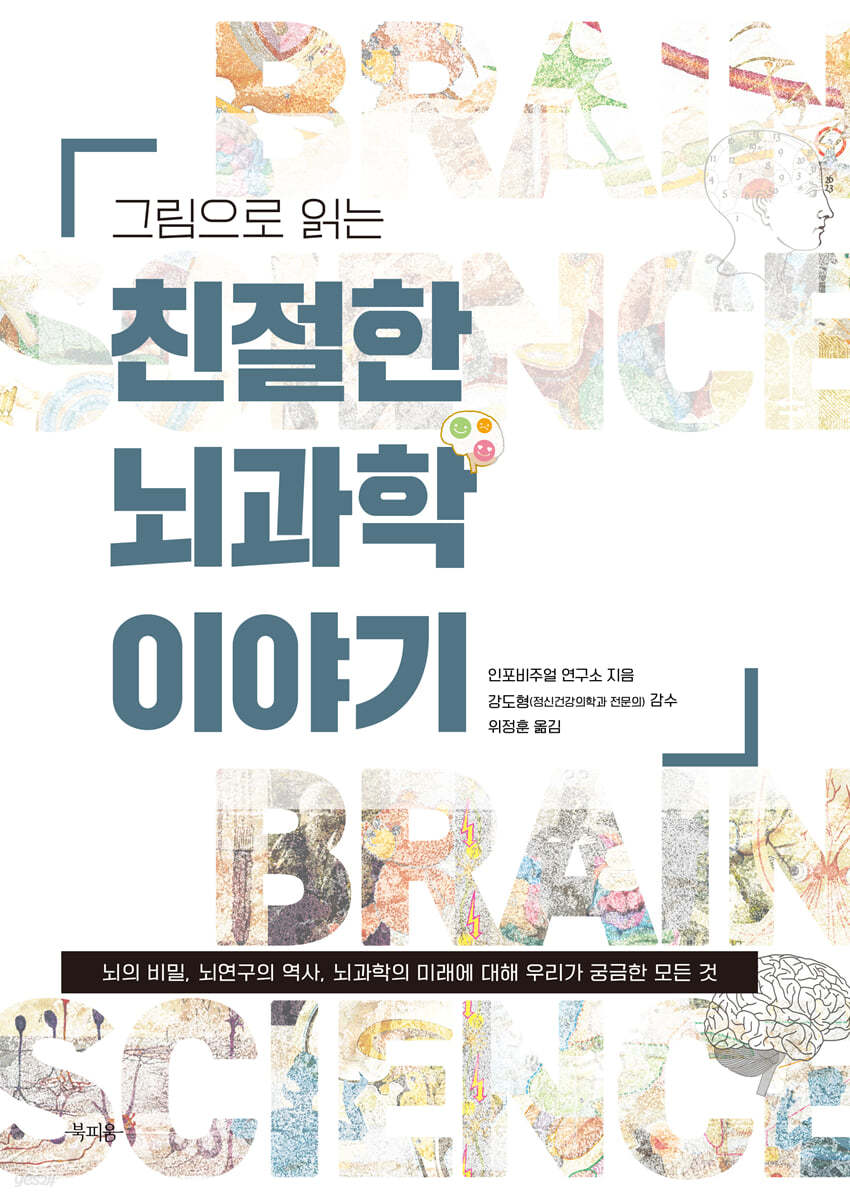 |
Description
Book Introduction
A 1.5kg 'little giant' desperately searches for the secrets of the brain.
The brain is the primary contributor to making humans the most powerful species on Earth, and it is a small but enormous entity weighing 1.5 kg that controls and regulates thoughts and emotions.
Having deciphered the DNA code through the Genome Project, humanity has now turned its curious gaze to the brain, the 'computer' inside our heads.
"A Friendly Brain Science Story in Pictures" is a concise and three-dimensional book that extracts only the necessary information and presents the past, present, and future of brain science at a glance through pictures and illustrations.
It comprehensively presents the bizarre and dramatic episodes of countless scholars who have dedicated their lives to brain research, the structure of the brain and the various roles it plays as revealed through intense research, and even the utopian or dystopian future surrounding the infinite possibilities of brain science.
"A Friendly Brain Science Story in Pictures" is a book that neatly organizes the information we need to know about the brain into infographics.
This is the third volume in the "Reading with Pictures" series, which presents important issues that modern people must know in an easy-to-understand way using creative visual content. It is organized into compact pages of around 100 pages, condensing only the key points into intuitive and refreshing infographics that can be seen at a glance.
The brain is the primary contributor to making humans the most powerful species on Earth, and it is a small but enormous entity weighing 1.5 kg that controls and regulates thoughts and emotions.
Having deciphered the DNA code through the Genome Project, humanity has now turned its curious gaze to the brain, the 'computer' inside our heads.
"A Friendly Brain Science Story in Pictures" is a concise and three-dimensional book that extracts only the necessary information and presents the past, present, and future of brain science at a glance through pictures and illustrations.
It comprehensively presents the bizarre and dramatic episodes of countless scholars who have dedicated their lives to brain research, the structure of the brain and the various roles it plays as revealed through intense research, and even the utopian or dystopian future surrounding the infinite possibilities of brain science.
"A Friendly Brain Science Story in Pictures" is a book that neatly organizes the information we need to know about the brain into infographics.
This is the third volume in the "Reading with Pictures" series, which presents important issues that modern people must know in an easy-to-understand way using creative visual content. It is organized into compact pages of around 100 pages, condensing only the key points into intuitive and refreshing infographics that can be seen at a glance.
- You can preview some of the book's contents.
Preview
index
A Word from the Reviewer - A book that gives you a thrilling moment of encountering your own brain.
Preface - Aristotle believed that the human 'brain' was the cooling device of the mind.
How far has brain research progressed today?
Part 1.
Let's learn the secrets of the brain, starting with the ABCs.
1 Is the being called 'I' a 1.5kg gray-white object floating in the sea inside the skull!?
2 The brain has 100 billion nerve cells that transmit electrical signals.
3 Information transmission between neurons is the result of complex electrochemical reactions.
4 Neurotransmitters that connect information between nerve cells
5 The four parts of the brain that work to make me exist as 'me'
6 The innermost part of the cerebrum, the cerebellum, and the brainstem are responsible for functions necessary for survival.
Part 2.
How did we uncover the secrets of the brain?
1 You can tell a villain by their skull!?
2 Structure and function of various brain regions found in accidents and diseases
3 The brain runs on electricity
4 The emergence of brain cell-viewing technology and the debate surrounding neurons
5. Brodman's Brain Map: A Guide to the Theory of the Localization of Brain Function
6 How do neurons transmit information?
7 In the 20th century, technology to view the brain from the outside made a leap forward in brain science.
8 We saw human brain activity through 'fMRI', which visualizes blood flow!
Part 3.
Perception, Action, and Brain Mechanisms
1 The complex visual mechanism in which the eyes capture objects and the brain 'sees' them
2 The brain doesn't show the world as it is?
3. The auditory information transmitted from the ears until the brain recognizes it as sound.
4 The reason why smells affect emotions is because the olfactory transmission pathway is special.
5 The brain that feels 'delicious'
6 Homeostasis, which gathers sensory information from the entire body and acts to protect the body
7 Motor areas responsible for complex movements and how the brain controls muscles
8 The brain skillfully uses language, a language unique to humans, through linked play.
9 The brain doesn't have a dedicated memory hard disk to store massive amounts of information?
10 Memories are fixed through repeated stimulation.
11 What learning requires is repetition, repetition, repetition?
12 What's happening in the brains of dementia patients?
Part 4.
I want to know the relationship between the mind and the brain.
1 How does the brain create the ‘mind’?
2 The brain network that creates emotions, and the hormones and neurotransmitters that promote them
3 Why are the switches for anger and violence so easily turned on in the male brain circuit?
The horrors people experience continue to plague them with PTSD even after time has passed.
5 Mirror neurons that respond like a mirror
6. Schizophrenia, which is plagued by delusions and isolation, has abnormalities in neurotransmission?
7 Dysregulation of monoamine neurotransmitters that causes depression and bipolar disorder
8 Brain dysfunction hinders communication
9 Attention deficit hyperactivity disorder and learning disabilities are also caused by problems with brain function.
10 The brain that regulates sleep and wakefulness by leading us to rest and dream.
11 Why does the brain continue to pursue pleasure?
Part 5.
Is the future of neuroscience a utopia or a dystopia?
1 Four Areas of Brain Research Advancing Through Diverse Approaches
2 Brain-machine interfaces that connect the human brain and machines
3. Research on brain regenerative medicine, driven by the discovery of 'regenerating brain cells'
4. Machine Brain Neurocomputers and Reverse Engineering of the Brain
5. The mechanisms of human 'consciousness' and 'social behavior' revealed by cognitive science
Conclusion: The day will come when the brain abandons the body?!
References
Reference site
Preface - Aristotle believed that the human 'brain' was the cooling device of the mind.
How far has brain research progressed today?
Part 1.
Let's learn the secrets of the brain, starting with the ABCs.
1 Is the being called 'I' a 1.5kg gray-white object floating in the sea inside the skull!?
2 The brain has 100 billion nerve cells that transmit electrical signals.
3 Information transmission between neurons is the result of complex electrochemical reactions.
4 Neurotransmitters that connect information between nerve cells
5 The four parts of the brain that work to make me exist as 'me'
6 The innermost part of the cerebrum, the cerebellum, and the brainstem are responsible for functions necessary for survival.
Part 2.
How did we uncover the secrets of the brain?
1 You can tell a villain by their skull!?
2 Structure and function of various brain regions found in accidents and diseases
3 The brain runs on electricity
4 The emergence of brain cell-viewing technology and the debate surrounding neurons
5. Brodman's Brain Map: A Guide to the Theory of the Localization of Brain Function
6 How do neurons transmit information?
7 In the 20th century, technology to view the brain from the outside made a leap forward in brain science.
8 We saw human brain activity through 'fMRI', which visualizes blood flow!
Part 3.
Perception, Action, and Brain Mechanisms
1 The complex visual mechanism in which the eyes capture objects and the brain 'sees' them
2 The brain doesn't show the world as it is?
3. The auditory information transmitted from the ears until the brain recognizes it as sound.
4 The reason why smells affect emotions is because the olfactory transmission pathway is special.
5 The brain that feels 'delicious'
6 Homeostasis, which gathers sensory information from the entire body and acts to protect the body
7 Motor areas responsible for complex movements and how the brain controls muscles
8 The brain skillfully uses language, a language unique to humans, through linked play.
9 The brain doesn't have a dedicated memory hard disk to store massive amounts of information?
10 Memories are fixed through repeated stimulation.
11 What learning requires is repetition, repetition, repetition?
12 What's happening in the brains of dementia patients?
Part 4.
I want to know the relationship between the mind and the brain.
1 How does the brain create the ‘mind’?
2 The brain network that creates emotions, and the hormones and neurotransmitters that promote them
3 Why are the switches for anger and violence so easily turned on in the male brain circuit?
The horrors people experience continue to plague them with PTSD even after time has passed.
5 Mirror neurons that respond like a mirror
6. Schizophrenia, which is plagued by delusions and isolation, has abnormalities in neurotransmission?
7 Dysregulation of monoamine neurotransmitters that causes depression and bipolar disorder
8 Brain dysfunction hinders communication
9 Attention deficit hyperactivity disorder and learning disabilities are also caused by problems with brain function.
10 The brain that regulates sleep and wakefulness by leading us to rest and dream.
11 Why does the brain continue to pursue pleasure?
Part 5.
Is the future of neuroscience a utopia or a dystopia?
1 Four Areas of Brain Research Advancing Through Diverse Approaches
2 Brain-machine interfaces that connect the human brain and machines
3. Research on brain regenerative medicine, driven by the discovery of 'regenerating brain cells'
4. Machine Brain Neurocomputers and Reverse Engineering of the Brain
5. The mechanisms of human 'consciousness' and 'social behavior' revealed by cognitive science
Conclusion: The day will come when the brain abandons the body?!
References
Reference site
Detailed image
Into the book
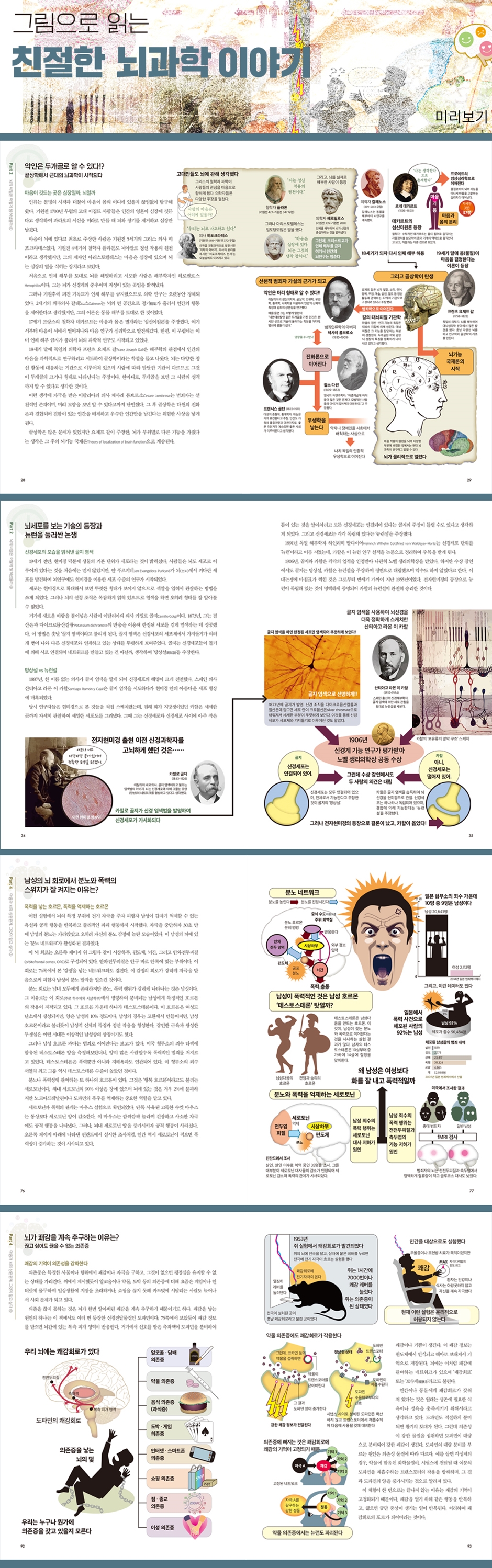
The greatest strength of this book is that it presents information about the complex brain in intuitive and easy-to-understand illustrations.
Reading through pictures! And even those scientific theories about the brain, which are so difficult, are just plain wrong.
Although it may be quite a difficult task, looking at the illustrations that show the authors' meticulous efforts, even readers who are unfamiliar with brain science will find it a great help in forming a three-dimensional picture of the subject in their minds after reading it once.
(syncopation)
Neuroscience will continue to advance to unimaginable levels.
Just as the 'Genome Project' deciphered the DNA sequence, future generations of humanity will also perfectly unlock the secrets of the brain.
But the most important question here is how to utilize the achievements of brain science to contribute to the happiness of humanity.
Readers, how are you utilizing your brain? To utilize it effectively, you must first understand it.
I sincerely hope to share with readers through this book the exciting moment of encountering the true nature of my brain, which has been with me every moment of my life but to which I have been indifferent.
--- From "Remarks by Kang Do-hyung (psychiatrist), reviewer"
It is speculated that the reason we were able to rise to the top of the creatures on Earth is because of a revolution in our 'brain'.
That revolution is called the 'cognitive revolution'.
'Cognition' is observing the world outside our bodies and bringing that world into the virtual order created by our minds, and the 'cognitive revolution' is collectively sharing that order through 'language'.
The social order we take for granted today, such as the state, currency, law, democracy, capitalism, banking, science and technology, and computers, are all virtual orders created as a result of the 'cognitive revolution' of our 'brains'.
We humans live in this virtual world.
However, even though we have a 'brain' that has taken over the world with a virtual order of its own creation, there is one thing that cannot be virtualized.
It is a real 'brain' as a material.
There is a great mystery here.
How did the material 'brain' create the 'mind' called 'me' and create a virtual world?
This has also been an ancient philosophical question: 'What is a human being?'
American researchers have a much bolder plan.
It is a plan to connect the human brain and AI computers.
By connecting the human brain with neural network artificial intelligence, we humans can have a brain that surpasses that of humans.
This kind of extreme and optimistic thinking is emerging among executives at large American IT companies.
It seems like we are seeing the ultimate form of scientific brain exploration that began in the Middle Ages.
On the other hand, voices of concern and anxiety are also growing louder that this kind of thinking is going down a path that is significantly deviating from our human 'heart'.
Reading through pictures! And even those scientific theories about the brain, which are so difficult, are just plain wrong.
Although it may be quite a difficult task, looking at the illustrations that show the authors' meticulous efforts, even readers who are unfamiliar with brain science will find it a great help in forming a three-dimensional picture of the subject in their minds after reading it once.
(syncopation)
Neuroscience will continue to advance to unimaginable levels.
Just as the 'Genome Project' deciphered the DNA sequence, future generations of humanity will also perfectly unlock the secrets of the brain.
But the most important question here is how to utilize the achievements of brain science to contribute to the happiness of humanity.
Readers, how are you utilizing your brain? To utilize it effectively, you must first understand it.
I sincerely hope to share with readers through this book the exciting moment of encountering the true nature of my brain, which has been with me every moment of my life but to which I have been indifferent.
--- From "Remarks by Kang Do-hyung (psychiatrist), reviewer"
It is speculated that the reason we were able to rise to the top of the creatures on Earth is because of a revolution in our 'brain'.
That revolution is called the 'cognitive revolution'.
'Cognition' is observing the world outside our bodies and bringing that world into the virtual order created by our minds, and the 'cognitive revolution' is collectively sharing that order through 'language'.
The social order we take for granted today, such as the state, currency, law, democracy, capitalism, banking, science and technology, and computers, are all virtual orders created as a result of the 'cognitive revolution' of our 'brains'.
We humans live in this virtual world.
However, even though we have a 'brain' that has taken over the world with a virtual order of its own creation, there is one thing that cannot be virtualized.
It is a real 'brain' as a material.
There is a great mystery here.
How did the material 'brain' create the 'mind' called 'me' and create a virtual world?
This has also been an ancient philosophical question: 'What is a human being?'
American researchers have a much bolder plan.
It is a plan to connect the human brain and AI computers.
By connecting the human brain with neural network artificial intelligence, we humans can have a brain that surpasses that of humans.
This kind of extreme and optimistic thinking is emerging among executives at large American IT companies.
It seems like we are seeing the ultimate form of scientific brain exploration that began in the Middle Ages.
On the other hand, voices of concern and anxiety are also growing louder that this kind of thinking is going down a path that is significantly deviating from our human 'heart'.
--- From the "Preface"
Publisher's Review
“You are with me every moment of my life, but I have been indifferent to you during that time.
“The thrilling moment of discovering the true nature of my brain”
- From the editor's note
The day will come when the brain abandons the body!?
And will the day come when machines think like humans?
How did a brain weighing less than 2kg make humans the most powerful species on Earth?
How many of the brain's secrets have been revealed?
Is the future of neuroscience rosy or gray?
The brain is the primary contributor to making humans the most powerful species on Earth, and it is a small but enormous entity weighing 1.5 kg that controls and regulates thoughts and emotions.
Having deciphered the DNA code through the Genome Project, humanity has now turned its curious gaze to the brain, the 'computer' inside our heads.
"A Friendly Brain Science Story in Pictures" is a concise and three-dimensional book that extracts only the necessary information and presents the past, present, and future of brain science at a glance through pictures and illustrations.
It comprehensively presents the bizarre and dramatic episodes of countless scholars who have dedicated their lives to brain research, the structure of the brain and the various roles it plays as revealed through intense research, and even the utopian or dystopian future surrounding the infinite possibilities of brain science.
A 1.5kg 'little giant' desperately searches for the secrets of the brain.
We humans all have a brain.
However, we usually live without being aware of the existence of the brain.
I wake up in the morning, wash my face, eat breakfast, and walk or take the bus or subway to school or work.
The command center that makes all of this happen, consciously or unconsciously, is the brain.
However, we do not consciously think, ‘I should wash my face because my brain tells me to’ or ‘I should eat because my brain tells me to’.
I wash my face because I want to go out with a clean face, and I eat because I'm hungry.
However, the identity of all such thoughts and sensations is ultimately 'commands given by the brain'.
But what is the brain's structure, and what exactly does it do? As the brain's secrets are gradually being revealed, we encounter countless articles and information through the media and social media. However, this information is often fragmentary, making it difficult to form a three-dimensional picture of the brain and neuroscience.
"A Friendly Brain Science Story in Pictures" is a book that concisely summarizes only the information we need to know about the 'brain' and neatly organizes it into infographics.
This is the third volume in the "Reading with Pictures" series, which presents important issues that modern people must know in an easy-to-understand way using creative visual content. It is organized into compact pages of around 100 pages, condensing only the key points into intuitive and refreshing infographics that can be seen at a glance.
The most notable feature of "A Friendly Brain Science Story in Pictures" is that it reconstructs and presents information that is difficult to explain in words alone in the form of infographics.
The Past, Present, and Future of Brain Science
It has been less than 50 years since the brain, the ultimate unknown area of the human body, began to be studied in earnest. However, in the 21st century, thanks to the remarkable development of scientific equipment such as computers and cutting-edge medical devices such as fMRI, the secrets of the brain are being gradually revealed.
We know that the brain is largely composed of the cerebrum, cerebellum, diencephalon, and brainstem, and that each of these performs different roles.
However, the specific details of how each region of the brain functions remain a matter of curiosity and exploration.
Which areas of the brain are responsible for language, movement, and emotion, and who, when, and how did they discover this?
The text is largely divided into five chapters.
Chapter 1, 'Let's learn about the secrets of the brain, starting with the ABCs', organizes basic knowledge about the brain.
The brain is a solidified gray-white jelly weighing about 1.5 kg and is divided into four major parts.
The brain has 100 billion nerve cells that transmit electrical signals (14 billion in the cerebrum alone, and 70 billion in the cerebellum alone). These convert information into electrical signals and transmit them one after another like a game of dominoes, thereby gathering information.
The cerebrum, which accounts for 80% of the entire brain, is divided into four parts: the frontal lobe, occipital lobe, temporal lobe, and parietal lobe, and each part has a different role.
For example, the frontal lobe is responsible for behavior, the temporal lobe for hearing, the parietal lobe for spatial cognition, and the occipital lobe for vision.
Chapter 2, "How Did We Uncover the Brain's Secrets?" concisely summarizes the background knowledge of brain science through the history of humanity's persistent exploration and challenges toward the brain.
Since ancient times, humans have been interested in 'where the mind resides.'
Where does the mind reside? The heart or the brain? The ancient Egyptians believed the human soul resided in the heart, so they removed the brain and internal organs from mummies, leaving only the heart.
The first person to claim that the mind is in the brain was Hippocrates, the 'god of medicine'.
In the past, studying the brain, especially the human brain, was very difficult.
This was because it was impossible to conduct experiments on living humans.
Nonetheless, countless scientists and doctors have studied people with brain damage from accidents or disabilities.
Episodes of those who left their mark on history, such as Brodmann, the first doctor to draw a brain map; Broca, who discovered the language area in the left frontal lobe of the brain; and Wernicke, who discovered the language area in the left temporal lobe, are presented in a clear and diagrammatic manner.
Chapter 3, 'Perception, Behavior, and the Mechanism of the Brain' and Chapter 4, 'The Relationship Between the Mind and the Brain, I Want to Know That' summarize the core contents about the brain mechanisms that generate the functions necessary for our daily lives, and the diseases that occur when there are abnormalities in functions such as consciousness, perception, cognition, emotion, and behavior.
It shows in detail the mechanisms by which various sensory organs, such as vision, hearing, taste, and smell, are transmitted to the brain, and the roles of each area of the brain, such as movement, language, and memory.
It also comprehensively covers brain-related diseases that are becoming a problem these days, such as the correlation between depression or anger and the brain, post-traumatic stress disorder (PTSD), attention deficit hyperactivity disorder (ADHD), and learning disabilities (LD).
Chapter 5, "Is the Future of Brain Science a Utopia or a Dystopia?" vividly conveys the current state of brain science, where competition between nations is fierce, including the "Brain Initiative Project" being promoted by the United States, and forecasts how the products of the dazzlingly developing brain science will change human life, thereby making us reflect on what we must do to achieve the utopian development of brain science.
Utopia vs. Dystopia, Homo Deus vs. Homo Sapiens
The secrets of the brain that the ancients were so curious about but could never figure out, modern people, standing on the shoulders of giants called science and technology, are not only unraveling them without hesitation, but are also trying to utilize them on an entirely new level.
What kind of future will our brains face? Will we truly be ruled by Homo Deus, a species more evolved than Homo sapiens? Will the images of people submerged in saltwater, wrapped in countless wires, with only their brains remaining, like those depicted in science fiction movies, become reality? Will we, connected to AI and robots, gain immense strength and intelligence that surpass our physical capabilities? "A Friendly Story of Brain Science in Pictures" provides a basic understanding of the brain and neuroscience, while also providing an opportunity to consider what scientific answers can be found to philosophical questions such as what constitutes "self" and "humanity," or what life and death are and where their boundaries lie.
“The thrilling moment of discovering the true nature of my brain”
- From the editor's note
The day will come when the brain abandons the body!?
And will the day come when machines think like humans?
How did a brain weighing less than 2kg make humans the most powerful species on Earth?
How many of the brain's secrets have been revealed?
Is the future of neuroscience rosy or gray?
The brain is the primary contributor to making humans the most powerful species on Earth, and it is a small but enormous entity weighing 1.5 kg that controls and regulates thoughts and emotions.
Having deciphered the DNA code through the Genome Project, humanity has now turned its curious gaze to the brain, the 'computer' inside our heads.
"A Friendly Brain Science Story in Pictures" is a concise and three-dimensional book that extracts only the necessary information and presents the past, present, and future of brain science at a glance through pictures and illustrations.
It comprehensively presents the bizarre and dramatic episodes of countless scholars who have dedicated their lives to brain research, the structure of the brain and the various roles it plays as revealed through intense research, and even the utopian or dystopian future surrounding the infinite possibilities of brain science.
A 1.5kg 'little giant' desperately searches for the secrets of the brain.
We humans all have a brain.
However, we usually live without being aware of the existence of the brain.
I wake up in the morning, wash my face, eat breakfast, and walk or take the bus or subway to school or work.
The command center that makes all of this happen, consciously or unconsciously, is the brain.
However, we do not consciously think, ‘I should wash my face because my brain tells me to’ or ‘I should eat because my brain tells me to’.
I wash my face because I want to go out with a clean face, and I eat because I'm hungry.
However, the identity of all such thoughts and sensations is ultimately 'commands given by the brain'.
But what is the brain's structure, and what exactly does it do? As the brain's secrets are gradually being revealed, we encounter countless articles and information through the media and social media. However, this information is often fragmentary, making it difficult to form a three-dimensional picture of the brain and neuroscience.
"A Friendly Brain Science Story in Pictures" is a book that concisely summarizes only the information we need to know about the 'brain' and neatly organizes it into infographics.
This is the third volume in the "Reading with Pictures" series, which presents important issues that modern people must know in an easy-to-understand way using creative visual content. It is organized into compact pages of around 100 pages, condensing only the key points into intuitive and refreshing infographics that can be seen at a glance.
The most notable feature of "A Friendly Brain Science Story in Pictures" is that it reconstructs and presents information that is difficult to explain in words alone in the form of infographics.
The Past, Present, and Future of Brain Science
It has been less than 50 years since the brain, the ultimate unknown area of the human body, began to be studied in earnest. However, in the 21st century, thanks to the remarkable development of scientific equipment such as computers and cutting-edge medical devices such as fMRI, the secrets of the brain are being gradually revealed.
We know that the brain is largely composed of the cerebrum, cerebellum, diencephalon, and brainstem, and that each of these performs different roles.
However, the specific details of how each region of the brain functions remain a matter of curiosity and exploration.
Which areas of the brain are responsible for language, movement, and emotion, and who, when, and how did they discover this?
The text is largely divided into five chapters.
Chapter 1, 'Let's learn about the secrets of the brain, starting with the ABCs', organizes basic knowledge about the brain.
The brain is a solidified gray-white jelly weighing about 1.5 kg and is divided into four major parts.
The brain has 100 billion nerve cells that transmit electrical signals (14 billion in the cerebrum alone, and 70 billion in the cerebellum alone). These convert information into electrical signals and transmit them one after another like a game of dominoes, thereby gathering information.
The cerebrum, which accounts for 80% of the entire brain, is divided into four parts: the frontal lobe, occipital lobe, temporal lobe, and parietal lobe, and each part has a different role.
For example, the frontal lobe is responsible for behavior, the temporal lobe for hearing, the parietal lobe for spatial cognition, and the occipital lobe for vision.
Chapter 2, "How Did We Uncover the Brain's Secrets?" concisely summarizes the background knowledge of brain science through the history of humanity's persistent exploration and challenges toward the brain.
Since ancient times, humans have been interested in 'where the mind resides.'
Where does the mind reside? The heart or the brain? The ancient Egyptians believed the human soul resided in the heart, so they removed the brain and internal organs from mummies, leaving only the heart.
The first person to claim that the mind is in the brain was Hippocrates, the 'god of medicine'.
In the past, studying the brain, especially the human brain, was very difficult.
This was because it was impossible to conduct experiments on living humans.
Nonetheless, countless scientists and doctors have studied people with brain damage from accidents or disabilities.
Episodes of those who left their mark on history, such as Brodmann, the first doctor to draw a brain map; Broca, who discovered the language area in the left frontal lobe of the brain; and Wernicke, who discovered the language area in the left temporal lobe, are presented in a clear and diagrammatic manner.
Chapter 3, 'Perception, Behavior, and the Mechanism of the Brain' and Chapter 4, 'The Relationship Between the Mind and the Brain, I Want to Know That' summarize the core contents about the brain mechanisms that generate the functions necessary for our daily lives, and the diseases that occur when there are abnormalities in functions such as consciousness, perception, cognition, emotion, and behavior.
It shows in detail the mechanisms by which various sensory organs, such as vision, hearing, taste, and smell, are transmitted to the brain, and the roles of each area of the brain, such as movement, language, and memory.
It also comprehensively covers brain-related diseases that are becoming a problem these days, such as the correlation between depression or anger and the brain, post-traumatic stress disorder (PTSD), attention deficit hyperactivity disorder (ADHD), and learning disabilities (LD).
Chapter 5, "Is the Future of Brain Science a Utopia or a Dystopia?" vividly conveys the current state of brain science, where competition between nations is fierce, including the "Brain Initiative Project" being promoted by the United States, and forecasts how the products of the dazzlingly developing brain science will change human life, thereby making us reflect on what we must do to achieve the utopian development of brain science.
Utopia vs. Dystopia, Homo Deus vs. Homo Sapiens
The secrets of the brain that the ancients were so curious about but could never figure out, modern people, standing on the shoulders of giants called science and technology, are not only unraveling them without hesitation, but are also trying to utilize them on an entirely new level.
What kind of future will our brains face? Will we truly be ruled by Homo Deus, a species more evolved than Homo sapiens? Will the images of people submerged in saltwater, wrapped in countless wires, with only their brains remaining, like those depicted in science fiction movies, become reality? Will we, connected to AI and robots, gain immense strength and intelligence that surpass our physical capabilities? "A Friendly Story of Brain Science in Pictures" provides a basic understanding of the brain and neuroscience, while also providing an opportunity to consider what scientific answers can be found to philosophical questions such as what constitutes "self" and "humanity," or what life and death are and where their boundaries lie.
GOODS SPECIFICS
- Publication date: April 22, 2022
- Page count, weight, size: 112 pages | 360g | 182*257*9mm
- ISBN13: 9791197404320
- ISBN10: 1197404325
You may also like
카테고리
korean


korean

![GQ KOREA Mark (Monthly): December [2025]](http://librairie.coreenne.fr/cdn/shop/files/8ef265dbbfbf186523ed75ba7319009d.jpg?v=1765340328&width=3840)


